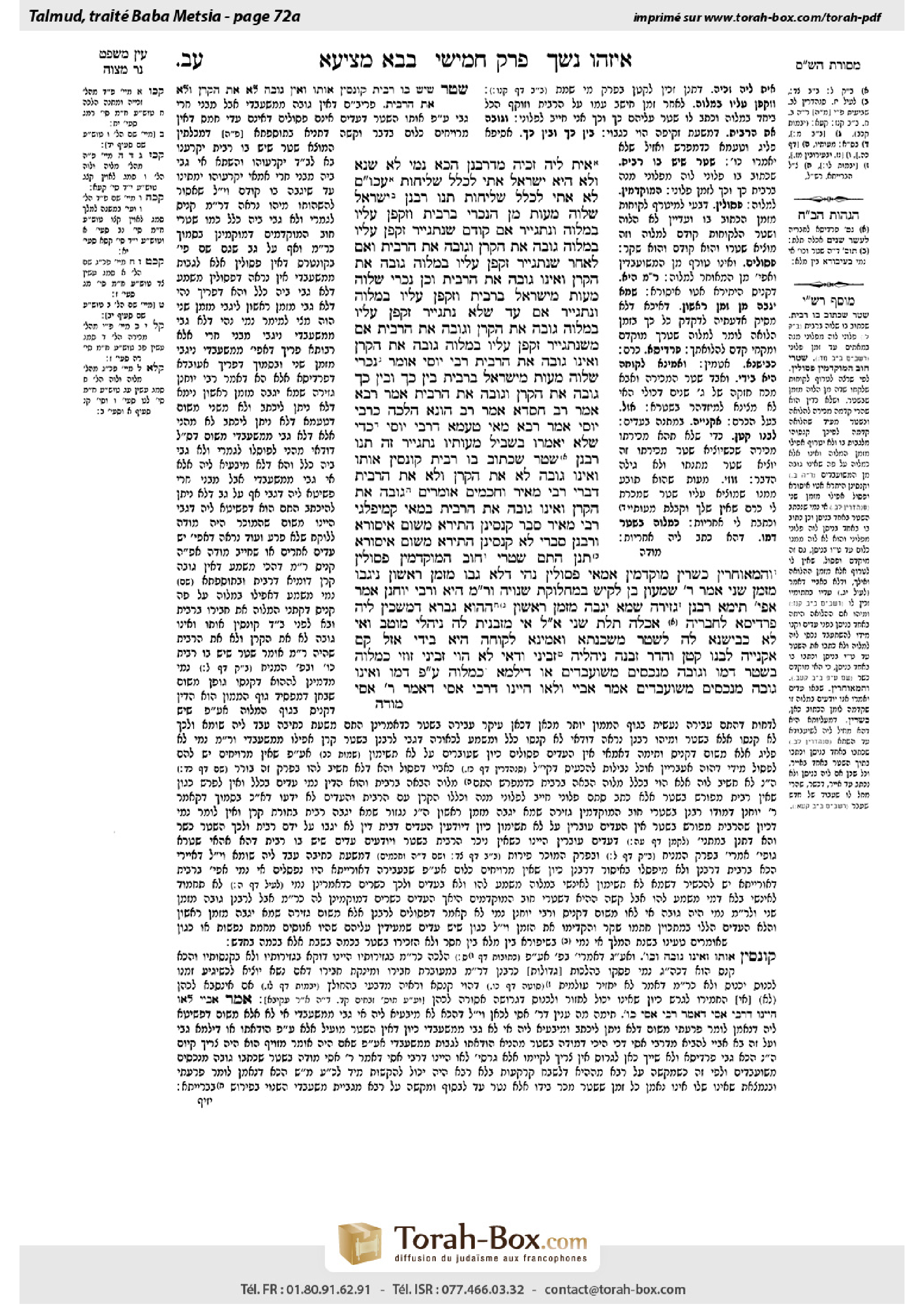
Bava Metzia 72a: Talmud study for Daf Yomi
Study the Talmud for Daf Yomi with scanned pages, Hebrew text, English translations from Sefaria and AI-generated French translations.
Passage selection and English or AI-generated French translation are available where the scan has annotations. Daf Study is independent of Torah-Box and Sefaria.
Browse Bava Metzia · בבא מציעא · All tractatesBava Metzia 72a text and translations
This page of Bava Metzia includes the Aramaic text, an English translation and an AI-generated French translation, alongside the scan above.
בבא מציעא ע״ב א · Aramaic and Hebrew text
אִית לֵיהּ זְכִיָּה מִדְּרַבָּנַן. הָכָא נָמֵי לָא שְׁנָא.
וְלָא הִיא: יִשְׂרָאֵל אָתֵי לִכְלַל שְׁלִיחוּת, נׇכְרִי לָא אָתֵי לִכְלַל שְׁלִיחוּת.
תָּנוּ רַבָּנַן: יִשְׂרָאֵל שֶׁלָּוָה מָעוֹת מִן הַנׇּכְרִי בְּרִבִּית, וּזְקָפָן עָלָיו בְּמִלְוֶה, וְנִתְגַּיֵּיר. אִם קוֹדֶם שֶׁנִּתְגַּיֵּיר זְקָפָן עָלָיו בְּמִלְוֶה – גּוֹבֶה אֶת הַקֶּרֶן וְגוֹבֶה אֶת הָרִבִּית. וְאִם לְאַחַר שֶׁנִּתְגַּיֵּיר זְקָפָן עָלָיו בְּמִלְוֶה – גּוֹבֶה אֶת הַקֶּרֶן וְאֵינוֹ גּוֹבֶה אֶת הָרִבִּית.
וְכֵן נׇכְרִי שֶׁלָּוָה מָעוֹת מִיִּשְׂרָאֵל בְּרִבִּית וּזְקָפָן עָלָיו בְּמִלְוֶה וְנִתְגַּיֵּיר, אִם עַד שֶׁלֹּא נִתְגַּיֵּיר זְקָפָן עָלָיו בְּמִלְוֶה – גּוֹבֶה אֶת הַקֶּרֶן וְגוֹבֶה אֶת הָרִבִּית. אִם מִשֶּׁנִּתְגַּיֵּיר זְקָפָן עָלָיו בְּמִלְוֶה – גּוֹבֶה אֶת הַקֶּרֶן וְאֵינוֹ גּוֹבֶה אֶת הָרִבִּית.
רַבִּי יוֹסֵי אוֹמֵר: נׇכְרִי שֶׁלָּוָה מָעוֹת מִיִּשְׂרָאֵל בְּרִבִּית, בֵּין כָּךְ וּבֵין כָּךְ – גּוֹבֶה אֶת הַקֶּרֶן וְגוֹבֶה אֶת הָרִבִּית. אָמַר רָבָא אָמַר רַב חִסְדָּא אָמַר רַב הוּנָא: הֲלָכָה כְּרַבִּי יוֹסֵי. אָמַר רָבָא: מַאי טַעְמָא דְּרַבִּי יוֹסֵי – כְּדֵי שֶׁלֹּא יֹאמְרוּ בִּשְׁבִיל מְעוֹתָיו נִתְגַּיֵּיר זֶה.
תָּנוּ רַבָּנַן: שְׁטָר שֶׁכָּתוּב בּוֹ רִבִּית – קוֹנְסִין אוֹתוֹ, וְאֵינוֹ גּוֹבֶה לֹא אֶת הַקֶּרֶן וְלֹא אֶת הָרִבִּית, דִּבְרֵי רַבִּי מֵאִיר. וַחֲכָמִים אוֹמְרִים: גּוֹבֶה אֶת הַקֶּרֶן וְאֵינוֹ גּוֹבֶה אֶת הָרִבִּית. בְּמַאי קָמִיפַּלְגִי? רַבִּי מֵאִיר סָבַר: קָנְסִינַן הֶתֵּירָא מִשּׁוּם אִיסּוּרָא, וְרַבָּנַן סָבְרִי: לָא קָנְסִינַן הֶתֵּירָא מִשּׁוּם אִיסּוּרָא.
תְּנַן הָתָם: שְׁטָרֵי חוֹב הַמּוּקְדָּמִין – פְּסוּלִין, וְהַמְאוּחָרִין – כְּשֵׁרִין. מוּקְדָּמִין אַמַּאי פְּסוּלִין? נְהִי דְּלָא גְּבוֹ מִזְּמַן רִאשׁוֹן, נִיגְבּוֹ מִזְּמַן שֵׁנִי!
אָמַר רַבִּי שִׁמְעוֹן בֶּן לָקִישׁ: בְּמַחְלוֹקֶת שְׁנוּיָה, וְרַבִּי מֵאִיר הִיא. וְרַבִּי יוֹחָנָן אָמַר: אֲפִילּוּ תֵּימָא רַבָּנַן – גְּזֵירָה שֶׁמָּא יִגְבֶּה מִזְּמַן רִאשׁוֹן.
הָהוּא גַּבְרָא דְּמַשְׁכֵּין לֵיהּ פַּרְדֵּיסָא לְחַבְרֵיהּ, אַכְלַהּ תְּלָת שְׁנֵי. אֲמַר לֵיהּ: אִי מְזַבְּינַתְּ לַהּ נִיהֲלִי – מוּטָב, וְאִי לָא – כָּבֵישְׁנָא לַהּ לִשְׁטַר מַשְׁכַּנְתָּא וְאָמֵינָא: ״לְקוּחָה הִיא בְּיָדִי״.
אֲזַל קָם אַקְנְיַיהּ לִבְנוֹ קָטָן, וַהֲדַר זַבְּנַהּ נִיהֲלֵיהּ.
זְבִינֵי וַדַּאי לָא הָווּ זְבִינֵי. זוּזֵי כְּמִלְוֶה בִּשְׁטָר דָּמוּ וְגוֹבֶה מִנְּכָסִים מְשׁוּעְבָּדִים, אוֹ דִילְמָא כְּמִלְוֶה עַל פֶּה דָּמוּ וְאֵינוֹ גּוֹבֶה מִנְּכָסִים מְשׁוּעְבָּדִים? אָמַר אַבָּיֵי: וְלָאו הַיְינוּ דְּרַבִּי אַסִּי, דְּאָמַר רַבִּי אַסִּי:
Bava Metzia 72a · English translation
nevertheless, he has the power, by rabbinic law, to acquire an item by means of an act of acquisition performed by another? Here, also, it is not different; the Jew can perform an act of acquisition on behalf of the gentile even though there is no agency for gentiles.
The Gemara rejects this comparison: But that is not so. A minor Jew will eventually reach the stage of eligibility for agency, but a gentile will not reach eligibility for agency. Consequently, the Sages did not establish the power for gentiles to acquire an item by means of an act of acquisition performed by a Jew.
§ The Sages taught: In the case of a Jew who borrowed money with interest from a gentile, and the gentile lender established the interest as a loan for the Jewish borrower, i.e., he added the amount of interest to the principal and consolidated it into a single debt, and then the gentile converted, the halakha depends on the circumstances. If the gentile established it as a loan for him before he converted, he may collect the principal from the borrower and he may also collect the interest. Since it had already been consolidated into a single debt, it is as though he already collected the interest while he was still a gentile. But if he established it as a loan for him after he converted, he may collect the principal but may not collect the interest, as it still had the status of interest when he became a Jew.
And similarly, in the case of a gentile who borrowed money with interest from a Jew and the Jewish lender established the interest as a loan for the gentile borrower, and then the gentile borrower converted, if he established it as a loan before he converted, the Jew may collect the principal and may also collect the interest. If he established it as a loan for the gentile after he converted, he may collect the principal but may not collect the interest, as it still had the status of interest when he became a Jew.
The baraita continues: Rabbi Yosei says: If a gentile borrowed money with interest from a Jew and converted, whether in this circumstance or whether in that circumstance, i.e., regardless of when the lender consolidated the interest and principal into a single debt, the Jewish lender may collect the principal and he may also collect the interest. Rava says that Rav Ḥisda says that Rav Huna says: The halakha is in accordance with the opinion of Rabbi Yosei. Rava says: What is the reasoning behind the opinion of Rabbi Yosei? What is the justification for collecting interest from a Jew? It is in order that people will not say: This individual converted due to concern for his money. People will suspect that he converted in order to avoid paying the interest.
§ The Sages taught: In the case of a promissory note in which the details of a loan with interest were written, we penalize the lender, and therefore he may not collect the principal and may not collect the interest; this is the statement of Rabbi Meir. And the Rabbis say: He may collect the principal but he may not collect the interest. The Gemara asks: With regard to what principle do they disagree? The Gemara explains: Rabbi Meir holds: We penalize him with regard to that which is permitted due to that which is prohibited, and the Rabbis hold: We do not penalize him with regard to that which is permitted due to that which is prohibited.
We learned in a mishna elsewhere (Shevi’it 10:5): Antedated promissory notes, in which the date written in the document is earlier than the date the loan was actually transacted, are not valid, but postdated promissory notes are valid. The Gemara asks: Why are antedated documents not valid? Granted, they cannot be used to collect from the first date, the date written in them, because this could cause loss to people who purchased land from the borrower in the time between the date written on the promissory note and the time the loan was actually granted. The land they purchased would be subject to a lien when it fact it should not be. But at least they should be able to be used to collect from the second date, when the loan was actually granted.
Rabbi Shimon ben Lakish says: This mishna is subject to dispute, and it is taught in accordance with the opinion of Rabbi Meir, who said that the lender is penalized with regard to that which is permitted due to that which is prohibited. Here too, since he wrote an incorrect date, the entire document is invalidated as a penalty. And Rabbi Yoḥanan says: You may even say that this halakha is in accordance with the opinion of the Rabbis, as here there is a rabbinic decree invalidating the document lest he collect from the first date. If the document is not invalidated, the lender will depend on it and will come to collect repayment according to the date written on it.
The Gemara relates: There was a certain man who mortgaged his orchard to another as security for a loan, and the lender consumed the produce of the orchard for three years. At the end of this time the lender said to the borrower: If you sell me the orchard, that is good. But if not, I will hide the document of the mortgage and I will say: It is purchased, and that is why it is in my possession, meaning I will claim I purchased the field and lost the deed. Since the land has been in my possession for three years I do not have to bring any other proof, as the halakha is that after three years of use of a field there is a presumption of ownership for the one who uses it (see Bava Batra 29b).
When the borrower saw that he could not protect himself against the ruse, he devised a scheme: He went and transferred ownership of the field to his minor son by means of a deed of gift, and afterward sold the field to the lender. Subsequently, he demanded that the sale be annulled, since when he sold the field, it was not his.
The Gemara clarifies the halakha: The sale was certainly not a sale, since the field was not his to sell, but the question is: Are the dinars that the buyer paid similar to a loan with a promissory note, and therefore the buyer can collect the money he paid even from liened property that has been sold? Or perhaps it is similar to a loan by oral agreement, and therefore he cannot collect it from liened property that has been sold. Abaye said: Is this question not the same as that of Rabbi Asi? As Rabbi Asi says:
Bava Metzia 72a · Traduction française (IA)
Cependant, il a le pouvoir, selon la loi rabbinique, d'acquérir un objet par l'intermédiaire d'une action d'acquisition effectuée par un autre ? Ici aussi, il n'y a pas de différence ; un Juif peut effectuer une action d'acquisition au nom du non-Juif, même s'il n'y a pas d'agent pour les non-Juifs.
La Guemara rejette cette comparaison : Mais cela n'est pas ainsi. Un Juif mineur arrivera un jour à l'état de capacité à agir, mais un non-Juif ne parviendra jamais à l'état de capacité à agir. Par conséquent, les Sages n'ont pas institué le pouvoir pour les non-Juifs d'acquérir un objet par l'intermédiaire d'une action d'acquisition effectuée par un Juif.
§ Les Sages enseignent : Dans le cas d'un Juif qui emprunte de l'argent avec intérêt à un non-Juif, et le prêteur non-Juif établit l'intérêt comme un prêt pour le prêteur juif, c'est-à-dire qu'il ajoute la somme de l'intérêt au principal et le consolide en un seul prêt, et ensuite le non-Juif devient juif, la halakha dépend des circonstances. Si le non-Juif l'a établi comme un prêt avant de devenir juif, il peut récupérer le principal du prêteur et il peut également récupérer l'intérêt. Puisque cela avait déjà été consolidé en un seul prêt, cela est comme s'il avait déjà récupéré l'intérêt alors qu'il était encore non-Juif. Mais si l'établissement a eu lieu après sa conversion, il peut récupérer le principal mais ne peut pas récupérer l'intérêt, car il conservait encore le statut d'intérêt lorsqu'il est devenu juif.
Et de même, dans le cas d'un non-Juif qui emprunte de l'argent avec intérêt à un Juif et le prêteur juif établit l'intérêt comme un prêt pour le prêteur non-Juif, et ensuite le prêteur non-Juif devient juif, si l'établissement a eu lieu avant sa conversion, le Juif peut récupérer le principal et peut également récupérer l'intérêt. Si l'établissement a eu lieu après sa conversion, il peut récupérer le principal mais ne peut pas récupérer l'intérêt, car l'intérêt conservait encore le statut d'intérêt lorsqu'il est devenu juif.
La baraïta continue : Rabbi Yosei dit : Si un non-Juif emprunte de l'argent avec intérêt à un Juif et devient juif, qu'importe la circonstance ou l'autre circonstance, c'est-à-dire indépendamment de l'époque où le prêteur a consolidé l'intérêt et le principal en un seul prêt, le prêteur juif peut récupérer le principal et peut également récupérer l'intérêt. Rava dit que Rav Ḥisda dit que Rav Huna dit : La halakha suit l'opinion de Rabbi Yosei. Rava dit : Quel est le raisonnement de l'opinion de Rabbi Yosei ? Quel est le fondement de la collecte d'intérêt d'un Juif ? C'est afin que les gens ne disent pas : Cette personne a converti à cause de ses affaires. On soupçonnera qu'il a converti pour éviter de payer l'intérêt.
§ Les Sages enseignent : Dans le cas d'un billet de change dans lequel les détails d'un prêt avec intérêt sont inscrits, on punit le prêteur, et par conséquent il ne peut pas récupérer le principal ni l'intérêt ; c'est l'opinion de Rabbi Meir. Et les Rabbins disent : Il peut récupérer le principal mais ne peut pas récupérer l'intérêt. La Guemara pose la question : Sur quel principe se déroule leur désaccord ? La Guemara explique : Rabbi Meir considère que l'on punit en ce qui est permis à cause de ce qui est interdit, et les Rabbins considèrent que l'on ne punit pas en ce qui est permis à cause de ce qui est interdit.
Nous avons appris dans une mitsna ailleurs (Shevi’it 10:5) : Les billets de change antédatés, dans lesquels la date inscrite dans le document est antérieure à la date réelle du prêt, ne sont pas valides, mais les billets de change postdatés sont valides. La Guemara pose la question : Pourquoi les documents antédatés ne sont-ils pas valides ? Bien sûr, ils ne peuvent pas être utilisés pour récupérer de la première date, la date inscrite dans le document, car cela pourrait causer un préjudice aux personnes qui ont acheté un terrain du prêteur entre la date inscrite sur le billet de change et la date réelle du prêt. Le terrain qu'ils ont acheté serait soumis à un droit de gage alors qu'il ne le devrait pas être. Mais au moins ils devraient pouvoir être utilisés pour récupérer de la deuxième date, la date réelle du prêt.
Rabbi Shimon ben Lakish dit : Cette mitsna est sujette à débat, et elle est enseignée selon l'opinion de Rabbi Meir, qui disait que le prêteur est puni en ce qui est permis à cause de ce qui est interdit. Ici aussi, puisqu'il a inscrit une date incorrecte, le document entier est invalidé comme une punition. Et Rabbi Yoḥanan dit : On peut même dire que cette halakha suit l'opinion des Rabbins, car ici il y a un décret rabbinique invalidant le document afin qu'il ne puisse pas récupérer de la première date. Si le document n'est pas invalidé, le prêteur en dépendra et viendra récupérer le prêt selon la date inscrite sur le document.
La Guemara rapporte : Il y avait un certain homme qui avait hypothéqué son verger à un autre comme garantie d'un prêt, et le prêteur avait consommé les produits du verger pendant trois ans. À la fin de cette période, le prêteur a dit au débiteur : Si tu me vends le verger, c'est bien. Mais si non, je vais cacher le document de l'hypothèque et je dirai : Il est acheté, et c'est pourquoi il est en mon possession, c'est-à-dire que je prétendrai avoir acheté le champ et avoir perdu le titre. Puisque le terrain est en mon possession depuis trois ans, je n'ai pas besoin d'apporter d'autres preuves, car la halakha est que, après trois ans d'utilisation d'un terrain, il y a une présomption de propriété pour celui qui l'utilise (voir Bava Batra 29b).
Quand le débiteur a vu qu'il ne pouvait pas se défendre contre ce tour, il a imaginé un plan : Il est allé et a transféré la propriété du champ à son fils mineur par un acte de don, puis il a vendu le champ au prêteur. Par la suite, il a demandé l'annulation de la vente, car, lorsqu'il a vendu le champ, ce n'était pas encore à lui.
La Guemara clarifie la halakha : La vente n'était certainement pas une vente, puisque le champ n'était pas à vendre, mais la question est : les dinars que l'acheteur a payés sont-ils semblables à un prêt avec un billet de remise, et donc l'acheteur peut récupérer l'argent qu'il a payé même à partir d'un bien hypothéqué vendu ? Ou peut-être sont-ils semblables à un prêt par accord oral, et donc il ne peut pas récupérer cet argent à partir d'un bien hypothéqué vendu. Abaye dit : Cette question n'est-elle pas identique à celle de Rabbi Asi ? Comme dit Rabbi Asi :
Traduction française générée par IA à partir de l’édition anglaise de Sefaria. Vérifie toujours un passage avec le texte source.
Text from Sefaria: William Davidson Edition - Vocalized Aramaic (CC BY NC); William Davidson Edition - English (CC BY NC).