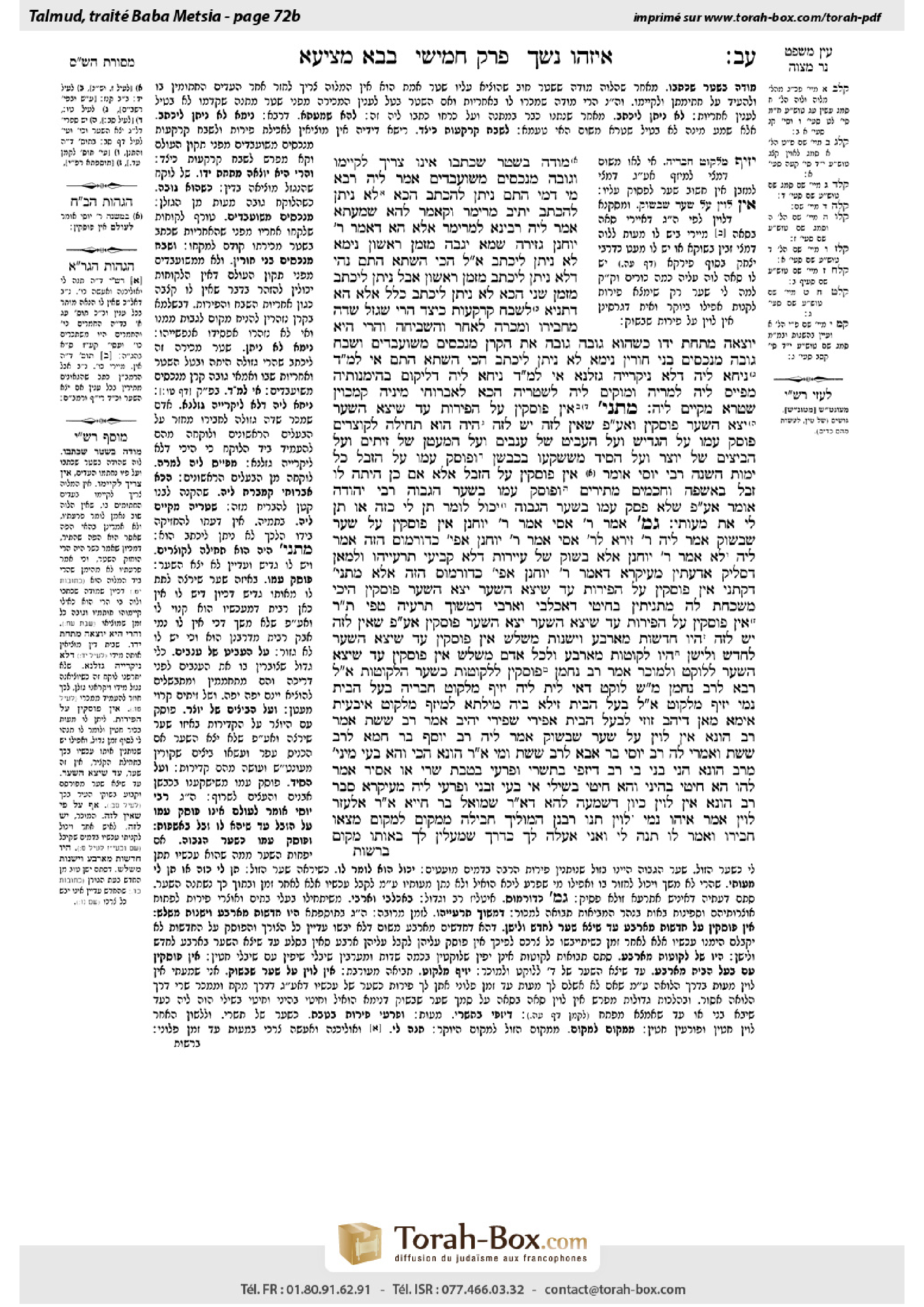
Bava Metzia 72b: Talmud study for Daf Yomi
Study the Talmud for Daf Yomi with scanned pages, Hebrew text, English translations from Sefaria and AI-generated French translations.
Passage selection and English or AI-generated French translation are available where the scan has annotations. Daf Study is independent of Torah-Box and Sefaria.
Browse Bava Metzia · בבא מציעא · All tractatesBava Metzia 72b text and translations
This page of Bava Metzia includes the Aramaic text, an English translation and an AI-generated French translation, alongside the scan above.
בבא מציעא ע״ב ב · Aramaic and Hebrew text
מוֹדֶה בִּשְׁטָר שֶׁכְּתָבוֹ – אֵינוֹ צָרִיךְ לְקַיְּימוֹ, וְגוֹבֶה מִנְּכָסִים מְשׁוּעְבָּדִים.
אֲמַר לֵיהּ רָבָא: מִי דָּמֵי? הָתָם נִיתַּן לְהִכָּתֵב. הָכָא לֹא נִיתַּן לְהִכָּתֵב.
יָתֵיב מָרִימָר וְקָאָמַר לְהָא שְׁמַעְתָּא. אֲמַר לֵיהּ רָבִינָא לְמָרִימָר: אֶלָּא הָא דְּאָמַר רַבִּי יוֹחָנָן גְּזֵירָה שֶׁמָּא יִגְבֶּה מִזְּמַן רִאשׁוֹן, נֵימָא: לֹא נִיתַּן לִיכָּתֵב! אֲמַר לֵיהּ הָכִי הַשְׁתָּא. הָתָם נְהִי דְּלֹא נִיתַּן לִיכָּתֵב מִזְּמַן רִאשׁוֹן, אֲבָל נִיתַּן לִיכָּתֵב מִזְּמַן שֵׁנִי. הָכָא לֹא נִיתַּן לִיכָּתֵב כְּלָל.
אֶלָּא הָא דְּתַנְיָא: לְשֶׁבַח קַרְקָעוֹת כֵּיצַד? הֲרֵי שֶׁגָּזַל שָׂדֶה מֵחֲבֵירוֹ וּמְכָרָהּ לְאַחֵר וְהִשְׁבִּיחָהּ, וַהֲרֵי הִיא יוֹצְאָה מִתַּחַת יָדוֹ. כְּשֶׁהוּא גּוֹבֶה – גּוֹבֶה אֶת הַקֶּרֶן מִנְּכָסִים מְשׁוּעְבָּדִים, וְשֶׁבַח גּוֹבֶה מִנְּכָסִים בְּנֵי חוֹרִין. נֵימָא: לֹא נִיתַּן לִיכָּתֵב!
הָכִי הַשְׁתָּא? הָתָם, אִי לְמַאן דְּאָמַר נִיחָא לֵיהּ דְּלָא נִיקְרְיֵיהּ גַּזְלָנָא, אִי לְמַאן דְּאָמַר נִיחָא לֵיהּ דְּלֵיקוּם בְּהֵימָנוּתֵיהּ, מְפַיֵּיס לֵיהּ לְמָרֵיהּ וּמוֹקֵים לֵיהּ לִשְׁטָרֵיהּ. הָכָא, לְאַבְרוֹחֵי מִינֵּיהּ קָמְכַוֵּין, שְׁטָרָא מְקַיֵּים לֵיהּ.
מַתְנִי׳ אֵין פּוֹסְקִין עַל הַפֵּירוֹת עַד שֶׁיֵּצֵא הַשַּׁעַר. יָצָא הַשַּׁעַר – פּוֹסְקִין, וְאַף עַל פִּי שֶׁאֵין לָזֶה יֵשׁ לָזֶה.
הָיָה הוּא תְּחִילָּה לַקּוֹצְרִים, פּוֹסֵק עִמּוֹ עַל הַגָּדִישׁ, וְעַל הֶעָבִיט שֶׁל עֲנָבִים, וְעַל הַמַּעֲטָן שֶׁל זֵיתִים, וְעַל הַבֵּיצִים שֶׁל יוֹצֵר, וְעַל הַסִּיד מִשֶּׁשִּׁקְּעוֹ בַּכִּבְשָׁן.
וּפוֹסֵק עִמּוֹ עַל הַזֶּבֶל כׇּל יְמוֹת הַשָּׁנָה. רַבִּי יוֹסֵי אוֹמֵר: אֵין פּוֹסְקִין עַל הַזֶּבֶל אֶלָּא אִם כֵּן הָיְתָה לוֹ זֶבֶל בָּאַשְׁפָּה, וַחֲכָמִים מַתִּירִים.
וּפוֹסֵק עִמּוֹ בְּשַׁעַר הַגָּבוֹהַּ. רַבִּי יְהוּדָה אוֹמֵר: אַף עַל פִּי שֶׁלֹּא פָּסַק עִמּוֹ בְּשַׁעַר הַגָּבוֹהַּ, יָכוֹל לוֹמַר: תֵּן לִי כָּזֶה, אוֹ תֵּן לִי אֶת מְעוֹתַי.
גְּמָ׳ אָמַר רַבִּי אַסִּי אָמַר רַבִּי יוֹחָנָן: אֵין פּוֹסְקִין עַל הַשַּׁעַר שֶׁבַּשּׁוּק. אֲמַר לֵיהּ רַבִּי זֵירָא לְרַבִּי אַסִּי: אָמַר רַבִּי יוֹחָנָן אֲפִילּוּ כַּדּוֹרְמוּס הַזֶּה? אֲמַר לֵיהּ: לָא אָמַר רַבִּי יוֹחָנָן אֶלָּא בַּשּׁוּק שֶׁל עֲיָירוֹת, דְּלָא קְבִיעִי תַּרְעַיְיהוּ.
וּלְמַאן דִּסְלֵיק אַדַּעְתִּין מֵעִיקָּרָא דְּאָמַר רַבִּי יוֹחָנָן אֲפִילּוּ כַּדּוֹרְמוּס הַזֶּה, אֶלָּא מַתְנִיתִין דְּקָתָנֵי: אֵין פּוֹסְקִין עַל הַפֵּירוֹת עַד שֶׁיֵּצֵא הַשַּׁעַר, יָצָא הַשַּׁעַר פּוֹסְקִין, הֵיכִי מַשְׁכַּחַתְּ לַהּ? מַתְנִיתִין בְּחִיטֵּי דְּאַכְלַבֵּי וְאַרְבֵי, דִּמְשִׁוךְ תַּרְעַיְהוּ טְפֵי.
תָּנוּ רַבָּנַן: אֵין פּוֹסְקִין עַל הַפֵּירוֹת עַד שֶׁיֵּצֵא הַשַּׁעַר, יָצָא הַשַּׁעַר פּוֹסְקִין, אַף עַל פִּי שֶׁאֵין לָזֶה יֵשׁ לָזֶה. הָיוּ חֲדָשׁוֹת מֵאַרְבַּע וִישָׁנוֹת מִשָּׁלֹשׁ – אֵין פּוֹסְקִין עַד שֶׁיֵּצֵא הַשַּׁעַר לֶחָדָשׁ וְלַיָּשָׁן.
הָיוּ לָקוֹטוֹת מֵאַרְבַּע, וּלְכׇל אָדָם מִשָּׁלֹשׁ – אֵין פּוֹסְקִין עַד שֶׁיֵּצֵא הַשַּׁעַר לַלּוֹקֵט וְלַמּוֹכֵר.
אָמַר רַב נַחְמָן: פּוֹסְקִין לַלָּקוֹטוֹת כְּשַׁעַר הַלָּקוֹטוֹת. אֲמַר לֵיהּ רָבָא לְרַב נַחְמָן: מַאי שְׁנָא לָקוֹט דְּאִי לֵית לֵיהּ יָזֵיף מִלָּקוֹט חַבְרֵיהּ, בַּעַל הַבַּיִת נָמֵי יְזֵיף מִלָּקוֹט! אֲמַר לֵיהּ: בַּעַל הַבַּיִת זִילָא בֵּיהּ מִילְּתָא לְמֵיזַף מִלָּקוֹט. אִיבָּעֵית אֵימָא: מַאן דְּיָהֵיב זוּזֵי לְבַעַל הַבַּיִת – אַפֵּירֵי שַׁפִּירֵי יָהֵיב.
אָמַר רַב שֵׁשֶׁת אָמַר רַב הוּנָא: אֵין לֹוִין עַל שַׁעַר שֶׁבַּשּׁוּק. אֲמַר לֵיהּ רַב יוֹסֵף בַּר חָמָא לְרַב שֵׁשֶׁת, וְאָמְרִי לַהּ רַב יוֹסֵי בַּר אַבָּא לְרַב שֵׁשֶׁת: וּמִי אָמַר רַב הוּנָא הָכִי? וְהָא בָּעֵי מִינֵּיהּ מֵרַב הוּנָא: הָנֵי בְּנֵי בֵּי רַב, דְּיָזְפִי בְּתִשְׁרִי וּפָרְעִי בְּטֵבֵת, שְׁרֵי אוֹ אֲסִיר? אֲמַר לְהוּ: הָא חִיטֵּי בְּהִינֵי וְהָא חִיטֵּי בְּשִׁילֵי, אִי בָּעֵי זָבְנִי וּפָרְעִי לֵיהּ.
מֵעִיקָּרָא סָבַר רַב הוּנָא אֵין לֹוִין, כֵּיוָן דְּשַׁמְעַהּ לְהָא דְּאָמַר רַבִּי שְׁמוּאֵל בַּר חִיָּיא אָמַר רַבִּי אֶלְעָזָר: לֹוִין, אָמַר אִיהוּ נָמֵי: לֹוִין.
תָּנוּ רַבָּנַן: הַמּוֹלִיךְ חֲבִילָה מִמָּקוֹם לְמָקוֹם, מְצָאוֹ חֲבֵירוֹ וְאָמַר לוֹ: תְּנָהּ לִי וַאֲנִי אַעֲלֶה לְךָ כְּדֶרֶךְ שֶׁמַּעֲלִין לְךָ בְּאוֹתוֹ מָקוֹם.
Bava Metzia 72b · English translation
In the case of a debtor who admits that he wrote a promissory note, the creditor is not required to ratify it in court in order to collect the debt, and he can therefore use the document to collect the debt even from liened property that has been sold. In the present case as well, the seller admits that he received the money; therefore the document of sale should enable the buyer to collect his money from liened property.
Rava said to him: Are these cases comparable? There, the matter detailed in the document may be written, as it is a substantive matter; the document attests to true events and it is therefore possible to use the promissory note to collect the debt. But here, the matter detailed in the document may not be written, as the entire sale was not genuine since it was done against the will of the seller. Consequently, this document is completely invalid and cannot be used to collect from liened property.
Mareimar sat and stated this halakha. Ravina said to Mareimar: But if Rava’s answer is accepted, then with regard to that which Rabbi Yoḥanan said concerning an antedated loan document, that there is a rabbinic decree invalidating the document lest he collect from the first date, let us say that there is a better rationale, as Rava stated: The antedated document is invalid, as it may not be written. Mareimar said to him: How can these cases be compared? There, in the case of the antedated document, granted, it may not be written from the first date, but it may be written from the second date. Here, it may not be written at all.
The Gemara further asks: But how does one understand that which is taught in a baraita: What is the case in which one appropriates property for the enhancement of land? It is a case where one robbed another of a field and sold it to another and that buyer enhanced it, and it is appropriated by the court from his possession. When the buyer collects payment from the robber, he collects the principal, i.e., the money he paid for the field itself, even from liened property that the robber had sold in the interim, and he collects the value of the enhancement from the robber’s unsold property. Let us say there also that this illegal sale of the field was a transaction that may not be written, and therefore he should not be allowed to collect even the principal from liened property.
The Gemara refutes this suggestion: How can these cases be compared? There, in the case of the field purchased from a robber, the deed of sale is meaningful either according to the one who says that it is preferable for the robber not to be called a robber by the buyer, or according to the one who says that it is preferable for the robber to maintain his reliability, i.e., to be considered an honest person; and therefore, the robber will appease the owner of the field by paying him for it and will attempt to ratify his document so that it is valid. But here, where the one who sold the field under duress intends to remove the buyer from it, will he then ratify his document?
MISHNA: One may not set a price with a buyer for the future delivery of produce until the market rate is publicized, as, if he is paid for supplying produce at a later date in advance of the publication of the market rate for that type of produce, he may set a price that is too low. The money paid in advance is deemed a loan, and if the initial payment was lower than the later market value, delivery of the produce will constitute interest on the loan. Once the market rate is publicized, the seller may set a price, even if the produce is not yet in his possession. The reason for this is that even though this one, i.e., the seller, does not have any of the produce, that one, someone else, has it, and the seller could theoretically acquire the produce now at the price he set.
If the seller was first among the reapers, having harvested his crop before the market rate was set, he may set a price with a buyer as he wishes for a stack of grain that is already in his possession, or for a large basket of grapes prepared for pressing into wine, or for a vat [hama’atan] of olives prepared for pressing into oil, or for the clumps [habeitzim] of clay prepared for use by a potter, or for plaster nearing the end of the manufacturing process at the point after he has sunk it, i.e., baked it, in the kiln. Although the market rate has yet to be set, the seller may nevertheless set a price now for their eventual delivery.
The mishna continues: And he may set a price with a buyer for manure on any of the days of the year, as the manure will certainly be available and it is therefore viewed as if it is ready. Rabbi Yosei says: One may set the price of manure only if he already had a pile of manure in his dunghill to which the sale can immediately be applied, but the Rabbis permit it in all cases.
And one may also set a price with a buyer at the highest rate, i.e., a large amount of produce sold for the lowest price, stipulating with the seller that the sale price match the lowest market rate for this product during the course of the year. Rabbi Yehuda says: Even if he did not set a price with him beforehand at the highest rate, the buyer may say to the seller: Give me the produce at this rate or give me back my money. Since he did not formally acquire the produce, if the price changed he may withdraw from the transaction.
GEMARA: Rabbi Asi says that Rabbi Yoḥanan says: One may not set a price for the future delivery of produce at the current market rate because the market is not sufficiently stable. Rabbi Zeira said to Rabbi Asi: Does Rabbi Yoḥanan state this ruling even with regard to the rate of this large central market [dormus]? Rabbi Asi said to him: Rabbi Yoḥanan stated this ruling only with regard to the small-town markets, since their rates are not fixed, as smaller markets have greater sensitivity to fluctuations in price.
The Gemara asks: And according to what we thought initially, that Rabbi Yoḥanan stated this ruling even with regard to this large central market, but then there is a difficulty with the mishna, which teaches: One may not set a price with a buyer for the future delivery of produce until the market rate is publicized. By inference, once the market rate is publicized, one may set a price. If Rabbi Yoḥanan’s ruling applies even to large central markets, how can you find these circumstances? The Gemara answers: The mishna may be speaking about wheat that comes from large warehouses and from ships, as their rate lasts longer, since this merchandise comes to market in very large quantities.
§ The Sages taught: One may not set a price with a buyer for the future delivery of produce until the market rate is publicized. Once the market rate is publicized, the seller may set a price, even if the produce is not yet in his possession. The reason for this is that even though this one, the seller, does not have any of the produce, that one, someone else, has it, and the seller could theoretically acquire the produce now at the price he set. If the new grain was selling at the rate of four se’a for a sela and the old grain was selling at three, one may not set the price according to the price of the new grain until the market rate is publicized both for the new and for the old grain. By the time payment is made, the new grain will not be entirely new and its price will be the same as that of the old grain.
Similarly, if the produce sold by gleaners who gather wheat from various fields, the quality of which is low, is selling at the rate of four se’a of wheat for a sela and that of every other person is selling at the rate of three se’a of wheat for a sela, one may not set a price at the gleaners’ rate until the market rate is publicized both for wheat sold by a gleaner and for wheat sold by an ordinary seller.
Rav Naḥman said: One may set a price for gleaners to deliver produce in the future at the gleaners’ rate. Rava said to Rav Naḥman: What is different about a gleaner, who you hold can immediately set his price at the gleaners’ rate? As, if he has no produce he can borrow it from another gleaner, and therefore it is viewed as though it were in his possession. A homeowner as well should be able to set a price at the gleaners’ rate, as, if he has no grain he can borrow from a gleaner. Rav Naḥman said to him: It is degrading for a homeowner to borrow from a gleaner. Consequently, there is a need to establish a market rate for ordinary sellers. And if you wish, say instead: One who gives money to a homeowner to buy his grain gives the money in return for quality produce, and he does not want the inferior produce the homeowner could borrow from gleaners.
Rav Sheshet says that Rav Huna says: One may not borrow produce based on the market rate, meaning that one may not purchase produce on credit with an agreement to pay for it later at the future market price, even though there is grain sold at this price in another location. Rav Yosef bar Ḥama said to Rav Sheshet, and some say that it was Rav Yosei bar Abba who said to Rav Sheshet: And did Rav Huna say this? But didn’t it occur that the Sages asked Rav Huna: With regard to those students of Torah who borrow food in the month of Tishrei and pay for it in Tevet at the rate in effect then, is this permitted or prohibited? Rav Huna said to them: There is wheat in the town called Hini and there is wheat in the town called Shili, and if the students want to they can buy wheat there and pay the lender immediately, and since they can pay at any time, it is permitted.
The Gemara answers: Initially, Rav Huna thought that one may not borrow produce in this manner, but when he heard that Rabbi Shmuel bar Ḥiyya says that Rabbi Elazar says: One may borrow produce in this manner, he retracted his previously stated opinion and he also said that one may borrow produce in this manner.
The Sages taught: With regard to one who transports a package of goods from one place, where he bought it inexpensively, to another place, where the price is higher, in order to sell it at a profit, and another found him on the way and said to him: Give me the package, and I will pay you in the manner that they pay you in that place to which you are going,
Bava Metzia 72b · Traduction française (IA)
Dans le cas d'un débiteur qui admet qu'il a rédigé une promesse de paiement, le créancier n'est pas tenu de valider ce document devant un tribunal afin de récupérer la dette, et il peut donc utiliser ce document pour récupérer la dette même sur un bien hypothéqué vendu. Dans le cas présent également, le vendeur admet qu'il a reçu l'argent ; par conséquent, le document de vente devrait permettre au acheteur de récupérer son argent sur un bien hypothéqué.
Rava dit à lui : Ces cas sont-ils comparables ? Là, le contenu du document peut être écrit, car il s'agit d'une matière substantielle ; le document atteste d'événements réels et il est donc possible d'utiliser la promesse de paiement pour récupérer la dette. Mais ici, le contenu du document ne peut pas être écrit, car la vente entière n'était pas authentique, car elle a été faite contre la volonté du vendeur. Par conséquent, ce document est totalement invalide et ne peut pas être utilisé pour récupérer sur un bien hypothéqué.
Mareimar s'est assis et a déclaré cette halakha. Ravina dit à Mareimar : Mais si l'argument de Rava est accepté, alors concernant ce que Rabbi Yoḥanan a dit concernant un document de prêt antédaté, à savoir qu'il y a un décret rabbinique invalidant le document afin qu'il ne puisse pas récupérer sur la première date, disons qu'il y a une meilleure justification, car Rava a dit : Le document antédaté est invalide, car il ne peut pas être écrit. Mareimar dit à lui : Comment ces cas peuvent-ils être comparés ? Là, dans le cas du document antédaté, certes, il ne peut pas être écrit à la première date, mais il peut être écrit à la deuxième date. Ici, il ne peut pas être écrit du tout.
La Guemara pose ensuite une question supplémentaire : Mais comment comprend-on ce qui est enseigné dans une baraïta : Quel est le cas où l'on approprie un bien pour l'amélioration d'un terrain ? C'est le cas où l'on a volé un champ à un autre et l'a vendu à un tiers, et ce dernier a amélioré le terrain, et le tribunal l'a approprié à son possession. Lorsque l'acheteur récupère le paiement auprès du voleur, il récupère le principal, c'est-à-dire l'argent qu'il a payé pour le champ lui-même, même sur un bien hypothéqué que le voleur avait vendu entretemps, et il récupère la valeur de l'amélioration auprès des biens non vendus du voleur. Disons aussi dans ce cas que cette vente illégale du champ était une transaction qui ne peut pas être écrite, et par conséquent, il ne devrait pas être autorisé à récupérer même le principal sur un bien hypothéqué.
La Guemara réfute cette suggestion : Comment peuvent-ils être comparés ? Là, dans le cas du champ acheté auprès d'un voleur, le document de vente est significatif soit selon celui qui dit qu'il est préférable que le voleur ne soit pas appelé un voleur par l'acheteur, soit selon celui qui dit qu'il est préférable que le voleur maintienne sa crédibilité, c'est-à-dire qu'il soit considéré comme une personne honnête ; et par conséquent, le voleur apaisera l'propriétaire du champ en lui payant pour celui-ci et tentera de valider son document afin qu'il soit valide. Mais ici, dans le cas où la personne qui a vendu le champ sous la contrainte veut expulser l'acheteur, acceptera-t-il alors de valider son document ?
MICHNA : On ne peut pas fixer un prix avec un acheteur pour la livraison future de produits agricoles avant que le prix du marché ne soit publié, car, si l'on est payé pour fournir des produits agricoles à une date ultérieure avant la publication du prix du marché pour ce type de produit, on pourrait fixer un prix trop bas. L'argent payé à l'avance est considéré comme un prêt, et si le paiement initial était inférieur à la valeur du marché ultérieure, la livraison des produits agricoles constituerait un intérêt sur le prêt. Une fois que le prix du marché est publié, le vendeur peut fixer un prix, même si les produits agricoles ne sont pas encore en son possession. La raison de cela est que même si ce vendeur n'a pas de produits agricoles, quelqu'un d'autre les a, et le vendeur pourrait théoriquement acquérir les produits agricoles maintenant au prix qu'il a fixé.
Si le vendeur était le premier à récolter, ayant récolté sa récolte avant que le prix du marché ne soit fixé, il peut fixer un prix avec un acheteur comme il l'entend pour un tas de blé déjà en son possession, ou pour une grande corbeille de raisins préparée pour la fabrication du vin, ou pour un tonneau [hama’atan] d'olives préparé pour la fabrication de l'huile, ou pour des boulettes [habeitzim] de terre préparées pour l'usage d'un potier, ou pour un plâtre en fin de processus de fabrication au moment où il a été mis dans le four, c'est-à-dire cuit. Bien que le prix du marché n'ait pas encore été fixé, le vendeur peut néanmoins fixer un prix maintenant pour la livraison ultérieure de ces produits.
La mishna continue : Et il peut fixer un prix avec un acheteur pour du fumier à tout moment de l'année, car le fumier sera certainement disponible et est donc considéré comme prêt. Rabbi Yosei dit : On peut fixer le prix du fumier uniquement si l'on avait déjà une pile de fumier dans son tas de fumier à laquelle la vente peut être immédiatement appliquée, mais les Rabbins permettent cela dans tous les cas.
Et on peut également fixer un prix avec un acheteur au taux le plus élevé, c'est-à-dire une grande quantité de produits vendus au prix le plus bas, en stipulant avec le vendeur que le prix de vente corresponde au taux du marché le plus bas pour ce produit durant l'année. Rabbi Yehuda dit : Même s'il n'a pas fixé un prix avec lui auparavant au taux le plus élevé, l'acheteur peut dire au vendeur : Donnez-moi les produits à ce taux ou remettez-moi mon argent. Comme il n'a pas formellement acquis les produits, si le prix a changé, il peut se retirer de la transaction.
GUEMARA : Rabbi Asi dit que Rabbi Yoḥanan dit : On ne peut pas fixer un prix pour la livraison future de produits agricoles au taux actuel du marché, car le marché n'est pas suffisamment stable. Rabbi Zeira dit à Rabbi Asi : Rabbi Yoḥanan affirme-t-il cette décision même concernant le taux de ce grand marché central [dormus] ? Rabbi Asi dit à lui : Rabbi Yoḥanan a formulé cette décision uniquement concernant les marchés des petites villes, car leurs taux ne sont pas fixes, car les petits marchés sont plus sensibles aux fluctuations de prix.
Le Guemara pose la question : Et selon ce que nous pensions initialement, que Rabbi Yoḥanan a formulé cette décision même concernant ce grand marché central, mais alors il y a un problème avec la Michna, qui enseigne : On ne peut pas fixer un prix avec un acheteur pour la livraison future des produits agricoles avant que le taux du marché ne soit publié. Par conséquent, une fois que le taux du marché est publié, on peut fixer un prix. Si la décision de Rabbi Yoḥanan s'applique même aux grands marchés centraux, comment peut-on trouver ces circonstances ? Le Guemara répond : La Michna peut parler de blé provenant de grandes entrepôts et de navires, car leur taux dure plus longtemps, puisque ce produit arrive en très grande quantité sur le marché.
§ Les Sages enseignent : On ne peut pas fixer un prix avec un acheteur pour la livraison future des produits agricoles avant que le taux du marché ne soit publié. Une fois que le taux du marché est publié, le vendeur peut fixer un prix, même si les produits ne sont pas encore en son possession. La raison en est que même si ce dernier, le vendeur, n'a pas de produits, celui-ci, quelqu'un d'autre, les possède, et le vendeur pourrait théoriquement acquérir les produits maintenant au prix qu'il a fixé. Si le nouveau blé se vendait au taux de quatre se'a pour un sela et le vieux blé au taux de trois, on ne peut pas fixer le prix selon le taux du nouveau blé avant que le taux du marché ne soit publié à la fois pour le nouveau et pour le vieux blé. Au moment du paiement, le nouveau blé ne sera plus tout à fait nouveau et son prix sera le même que celui du vieux blé.
De même, si les produits vendus par les récolteurs de blé, qui récoltent du blé de différents champs, dont la qualité est faible, se vendent au taux de quatre se'a de blé pour un sela et que celui de chaque autre personne se vend au taux de trois se'a de blé pour un sela, on ne peut pas fixer un prix au taux des récolteurs avant que le taux du marché ne soit publié à la fois pour le blé vendu par un récolteur et pour le blé vendu par un vendeur ordinaire.
Rav Naḥman a dit : On peut fixer un prix pour les récolteurs afin qu'ils livrent des produits à l'avenir au taux des récolteurs. Rava a dit à Rav Naḥman : Qu'est-ce qui diffère dans le cas d'un récolteur, que tu considères comme pouvant immédiatement fixer son prix au taux des récolteurs ? Car, s'il n'a pas de produits, il peut emprunter à un autre récolteur, et donc il est vu comme s'il les possédait. Un propriétaire de maison devrait pouvoir aussi fixer un prix au taux des récolteurs, car, s'il n'a pas de céréales, il peut emprunter à un récolteur. Rav Naḥman a répondu à lui : C'est dégradant pour un propriétaire de maison d'emprunter à un récolteur. Par conséquent, il y a besoin d'établir un taux du marché pour les vendeurs ordinaires. Et si tu veux, dis plutôt : Celui qui donne de l'argent à un propriétaire de maison pour acheter ses céréales donne l'argent en échange de produits de qualité, et il ne veut pas les produits inférieurs que le propriétaire pourrait emprunter aux récolteurs.
Rav Sheshet dit que Rav Huna dit : On ne peut pas emprunter des produits en se basant sur le taux du marché, c'est-à-dire qu'on ne peut pas acheter des produits à crédit avec un accord de paiement ultérieur au taux du marché futur, même s'il y a des céréales vendues à ce taux dans un autre lieu. Rav Yosef bar Ḥama a dit à Rav Sheshet, et certains disent que c'était Rav Yosei bar Abba qui a dit à Rav Sheshet : Et Rav Huna a-t-il dit cela ? Mais n'est-ce pas arrivé que les Sages aient interrogé Rav Huna : Concernant ceux qui étudient la Torah et empruntent de la nourriture en Tishrei et paient en Tevet au taux en vigueur à ce moment, est-ce permis ou interdit ? Rav Huna a répondu à eux : Il y a du blé dans la ville d'Hini et du blé dans la ville de Shili, et si les étudiants le veulent, ils peuvent acheter du blé là-bas et payer immédiatement au créancier, et puisque ils peuvent payer à tout moment, cela est permis.
Le Guemara répond : Initialement, Rav Huna pensait qu'on ne pouvait pas emprunter des produits de cette manière, mais lorsqu'il a entendu que Rabbi Shmuel bar Ḥiyya dit que Rabbi Elazar dit : On peut emprunter des produits de cette manière, il a rétracté son opinion précédente et il a également dit qu'on peut emprunter des produits de cette manière.
Les Sages enseignent : Concernant celui qui transporte un colis d'articles d'un lieu où il les a achetés à bas prix vers un autre lieu où le prix est plus élevé, afin de les vendre à profit, et quelqu'un le trouve en chemin et lui dit : Donne-moi le colis, et je te paierai selon la manière dont on te paie là-bas, vers lequel tu vas,
Traduction française générée par IA à partir de l’édition anglaise de Sefaria. Vérifie toujours un passage avec le texte source.
Text from Sefaria: William Davidson Edition - Vocalized Aramaic (CC BY NC); William Davidson Edition - English (CC BY NC).