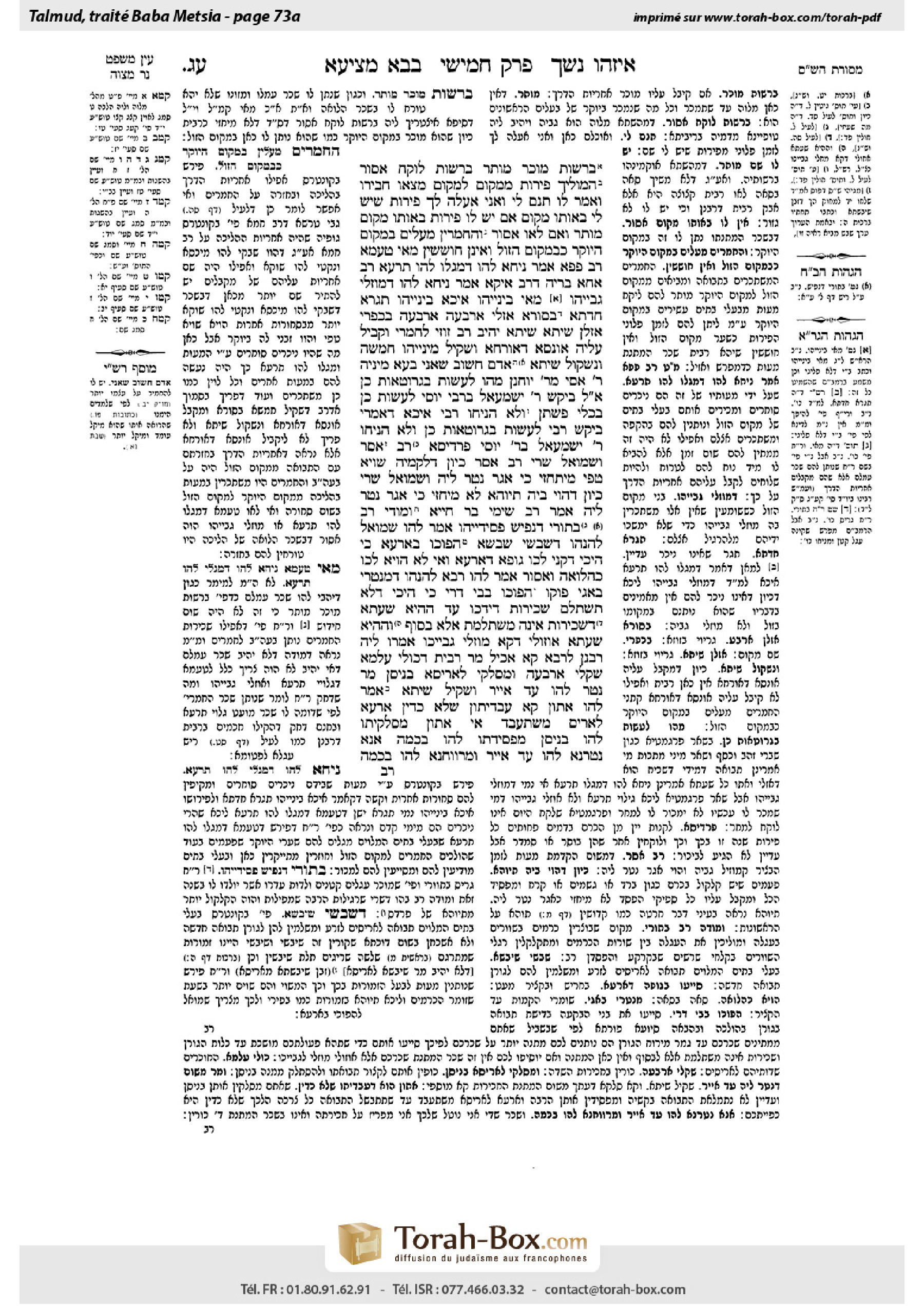
Bava Metzia 73a: Talmud study for Daf Yomi
Study the Talmud for Daf Yomi with scanned pages, Hebrew text, English translations from Sefaria and AI-generated French translations.
Passage selection and English or AI-generated French translation are available where the scan has annotations. Daf Study is independent of Torah-Box and Sefaria.
Browse Bava Metzia · בבא מציעא · All tractatesBava Metzia 73a text and translations
This page of Bava Metzia includes the Aramaic text, an English translation and an AI-generated French translation, alongside the scan above.
בבא מציעא ע״ג א · Aramaic and Hebrew text
בִּרְשׁוּת מוֹכֵר – מוּתָּר, בִּרְשׁוּת לוֹקֵחַ – אָסוּר.
הַמּוֹלִיךְ פֵּירוֹת מִמָּקוֹם לְמָקוֹם, מְצָאוֹ חֲבֵירוֹ וְאָמַר לוֹ: תְּנֵם לִי וַאֲנִי אַעֲלֶה לְךָ פֵּירוֹת שֶׁיֵּשׁ לִי בְּאוֹתוֹ מָקוֹם, אִם יֵשׁ לוֹ פֵּירוֹת בְּאוֹתוֹ מָקוֹם – מוּתָּר, וְאִם לָאו – אָסוּר. וְהַחַמָּרִין מַעֲלִים בִּמְקוֹם הַיּוֹקֶר כְּבִמְקוֹם הַזּוֹל, וְאֵינָן חוֹשְׁשִׁין.
מַאי טַעְמָא? רַב פָּפָּא אָמַר: נִיחָא לְהוּ דִּמְגַלּוּ לְהוּ תַּרְעָא. רַב אַחָא בְּרֵיהּ דְּרַב אִיקָא אָמַר: נִיחָא לְהוּ דְּמוֹזְלִי גַּבַּיְיהוּ.
מַאי בֵּינַיְיהוּ? אִיכָּא בֵּינַיְיהוּ תַּגָּרָא חַדְתָּא.
בְּסוּרָא אָזְלִי אַרְבָּעָה אַרְבְּעָה, בְּכַפְרִי אָזְלָן שִׁיתָּא שִׁיתָּא. יָהֵיב רַב זוּזֵי לְחַמָּרֵי וּ[מְ]קַבֵּיל עֲלֵיהּ אוּנְסָא דְאוֹרְחָא, וְשָׁקֵיל מִינַּיְיהוּ חַמְשָׁה. וְנִשְׁקוֹל שִׁיתָּא! אָדָם חָשׁוּב שָׁאנֵי.
בְּעָא מִינֵּיהּ רַבִּי אַסִּי מֵרַבִּי יוֹחָנָן: מַהוּ לַעֲשׂוֹת בִּגְרוּטָאוֹת כֵּן? אֲמַר לֵיהּ: בִּיקֵּשׁ רַבִּי יִשְׁמָעֵאל בְּרַבִּי יוֹסֵי לַעֲשׂוֹת כֵּן בִּכְלֵי פִשְׁתָּן, וְלֹא הִנִּיחוֹ רַבִּי. אִיכָּא דְּאָמְרִי: בִּיקֵּשׁ רַבִּי לַעֲשׂוֹת בִּגְרוּטָאוֹת כֵּן, וְלֹא הִנִּיחוֹ רַבִּי יִשְׁמָעֵאל בְּרַבִּי יוֹסֵי.
פַּרְדֵּיסָא, רַב אָסַר וּשְׁמוּאֵל שָׁרֵי. רַב אָסַר, כֵּיוָן דִּלְקַמֵּיהּ שָׁוְיָא טְפֵי – מִתְחֲזֵי כִּי אֲגַר נְטַר לֵיהּ. וּשְׁמוּאֵל שָׁרֵי, כֵּיוָן דְּהָוֵי בֵּיהּ תִּיוְהָא – לָא מִיחֲזֵי כִּי אֲגַר נְטַר לֵיהּ.
אָמַר רַב שִׁימִי בַּר חִיָּיא: וּמוֹדֵי רַב בְּתוֹרֵי דִּנְפִישׁ פְּסֵידַיְיהוּ.
אֲמַר לְהוּ שְׁמוּאֵל לְהָנְהוּ דְּשָׁבְשִׁי שִׁבְשָׁא, הֲפוֹכוּ בְּאַרְעָא, כִּי הֵיכִי דִּקְנֵי לְכוּ גּוּפָא דְאַרְעָא, וְאִי לָא – הָוְיָא לְכוּ כְּהַלְוָאָה וְאָסוּר.
אֲמַר לְהוּ רָבָא לְהָנְהוּ דִּמְנַטְּרִי בָּאגֵי: פּוּקוּ הֲפוֹכוּ בְּבֵי דָרֵי, כִּי הֵיכִי דְּלָא תִּשְׁתַּלַּם שְׂכִירוּת דִּידְכוּ עַד הַהִיא שַׁעְתָּא, דִּשְׂכִירוּת אֵינָהּ מִשְׁתַּלֶּמֶת אֶלָּא בַּסּוֹף, וְהַהִיא שַׁעְתָּא אוֹזוֹלֵי דְּקָא מוֹזְלִי גַּבַּיְיכוּ.
אֲמַרוּ לֵיהּ רַבָּנַן לְרָבָא: קָא אָכֵיל מָר רִבִּית, דְּכוּלֵּי עָלְמָא שָׁקְלִי אַרְבְּעָה וּמְסַלְּקִי לְאָרִיסָא בְּנִיסָן, מָר נָטַר לְהוּ עַד אִיָּיר וְשָׁקֵיל שִׁיתָּא!
אֲמַר לְהוּ: אַתּוּן קָא עָבְדִיתוּן שֶׁלֹּא כַּדִּין, אַרְעָא לְאָרִיס מִשְׁתַּעְבַּד – אִי אַתּוּן מְסַלְּקִיתוּ לְהוּ בְּנִיסָן, מַפְסֵידְתּוּ לְהוּ בְּכַמָּה. אֲנָא נָטַרְנָא לְהוּ עַד אִיָּיר, וּמַרְוַוחְנָא לְהוּ בְּכַמָּה.
Bava Metzia 73a · English translation
then, if the package remains in the possession of the seller, i.e., the seller accepts upon himself responsibility for any accidental damage that occurs along the way, it is permitted, as the transaction is not a loan. But if it is in the possession of the buyer, meaning that the buyer accepts responsibility for accidental damage, then the transaction is prohibited, as it is considered a loan with interest.
With regard to one who transports produce from one place to another place, if another finds him and says to him: Give the produce to me now and I will repay you with produce that I have in that place to which you are going, then, if he actually has produce in that place, it is permitted, but if not, it is prohibited. But donkey drivers who transport merchandise from one place to another may accept money and set prices in a place where goods are sold at expensive prices according to the rate in effect in another place, where goods are sold at inexpensive prices, and need not be concerned, as this practice is permitted.
The Gemara asks: What is the reason this is permitted? Rav Pappa says: It is satisfactory to them to sell merchandise at a discounted rate, because by doing so the gates to the new market are opened for them, as in this way they begin to do business in this area and gain new customers. Rav Aḥa, son of Rav Ika, said: It is satisfactory to them because the prices are reduced for them in the places where they make their purchases. Since the sellers there hear that the donkey drivers will need to resell the merchandise at a lower price, the sellers give a discount to the donkey drivers. According to either opinion, the donkey drivers provide the additional produce to the customer not as interest on the loan but as a discount to promote their business.
The Gemara asks: What is the difference between these two reasons to allow this practice? The Gemara answers: The difference between them concerns a merchant who is new in the area. According to the one who holds that the reason he may sell the produce is in order to open the market for him, it applies especially to a merchant in this situation. But according to the one who holds that the reason is that he can procure his merchandise inexpensively, the sellers will not believe him if he is new to his trade, and they will not sell it to him at a discount.
The Gemara relates: In Sura, four se’a of wheat were going for a sela, and in the nearby town of Kafri they were going for six se’a for a sela. Rav gave money to donkey drivers to purchase wheat in Kafri and accepted upon himself responsibility for any accident that might happen on the way, rendering it permitted for him to set a price according to the rate in effect in Kafri, and he accepted five se’a of wheat for one sela from them. The Gemara challenges: Since he accepted responsibility for damage that might occur as a result of an accident, the produce was his at the time it was purchased, and therefore there was no loan. Consequently, he should have accepted six se’a for a sela. The Gemara explains: An important person is different, as he has to be more stringent with himself and more careful to avoid the appearance of interest.
Rabbi Asi asked Rabbi Yoḥanan: What is the halakha about doing so with metal scraps [bigerutaot]? Is it permitted to make an agreement to purchase metal scraps at the low rate in effect elsewhere, just as it is permitted with wheat and other produce? Rabbi Yoḥanan said to him: Rabbi Yishmael, son of Rabbi Yosei, wanted to do so with linen garments and Rabbi Yehuda HaNasi did not allow him to do so. There are those who say a different version of this exchange: Rabbi Yehuda HaNasi wanted to do so with metal scraps, and Rabbi Yishmael, son of Rabbi Yosei, did not permit him to do so.
With regard to one who wants to purchase the produce of an entire orchard, in advance of the harvest, at a cheaper price, Rav prohibits this practice and Shmuel permits it. The Gemara explains: Rav prohibits it because in the future the produce will be worth more, so it appears that the seller is paying interest to the buyer for waiting before receiving the produce, and that has the appearance of interest. And Shmuel permits it, as, since there can be spoilage in the produce of the orchard and the buyer took upon himself responsibility for any losses, it does not appear that the seller is paying interest to the buyer for waiting before receiving the produce, as the buyer may either gain or lose.
Rav Shimi bar Ḥiyya said: Rav concedes to Shmuel that an arrangement like this would be permitted in a case where one arranges to purchase young oxen at a later date, as their loss is likely to be great. Since it is common for one to incur a discernible loss when raising oxen, as some may die, this arrangement is regarded as an investment.
Shmuel said to those who purchase branches of grapevines and pay in advance for the vine shoots that will be harvested later: Since the risk in this transaction is small, it has the appearance of interest and therefore you should turn over a bit of the land yourselves, i.e., perform some labor in farming the orchard, so that you acquire some of the land itself for yourselves, and by doing this you become partners with the owner. And this action is necessary because if you do not do this it will be like a loan for you and it will be prohibited for you to accept the branches.
Similarly, Rava said to those who guard fields [bagei] until the harvest is complete and receive their wages from the crops when the harvest is over: Go out and turn over some of the crops in the threshing floor, and thereby assist the owners in their work in order that the wages for your hire are not payable until that time. If you assist in the actual farming work, the halakhic period of your employment will continue until the processing of the grain is complete, and according to the halakha that the obligation to pay a person’s wage is incurred only at the end of the period for which he was hired, it is then that the owners make a reduction for the guards by giving them the crops at a reduced rate, and it is not payment of interest for delaying the wages that they should have been paid earlier. Consequently, such an arrangement is permitted.
The Rabbis said to Rava: The Master, meaning Rava, consumes interest. They explained: Everyone else who leases his field to a sharecropper receives four kor of grain as payment, and the owners accept this payment and remove the sharecropper from the field in the month of Nisan. But the Master waits until the month of Iyar and then takes six kor from them. Consequently, they accused Rava of accepting an additional payment for waiting an extra month to take back his field.
Rava said to them: On the contrary, you are the ones who are acting unlawfully, as in truth all of the land is liened to the sharecropper until he finishes working it and harvests all that he can from it. If you remove sharecroppers from the field in Nisan you cause them to lose a great deal, as they do not have enough time to harvest all the produce from the field. I wait for them until Iyyar, and in this way I enable them to profit a great deal. Consequently, I act in accordance with halakha and receive a suitable payment for leasing the field for the proper length of time, whereas you deprive the sharecroppers of what is due to them, even though you receive less direct remuneration.
Bava Metzia 73a · Traduction française (IA)
Si le colis reste en possession du vendeur, c'est-à-dire que le vendeur accepte de prendre à sa charge tout dommage accidentel survenant en route, la transaction est permise, car celle-ci n'est pas un prêt. Mais si le colis est en possession du acheteur, c'est-à-dire que l'acheteur accepte de prendre à sa charge tout dommage accidentel, la transaction est interdite, car elle est considérée comme un prêt avec intérêt.
En ce qui concerne celui qui transporte des produits d'un lieu à un autre, si un autre le trouve et lui dit : Donne-moi les produits maintenant et je te rembourserai avec les produits que j'ai dans ce lieu où tu vas, alors, si celui-ci a effectivement des produits dans ce lieu, la transaction est permise, mais si non, elle est interdite. Les conducteurs de chameaux qui transportent des marchandises d'un lieu à un autre peuvent accepter de l'argent et fixer des prix dans un lieu où les marchandises sont vendues à des prix élevés selon le taux en vigueur dans un autre lieu où les marchandises sont vendues à des prix bas, et n'ont pas à s'inquiéter, car cette pratique est permise.
La Guemara pose la question : Quel est le motif qui permet cette pratique ? Rav Pappa dit : C'est satisfaisant pour eux de vendre des marchandises à un prix réduit, car ainsi les portes du nouveau marché s'ouvrent pour eux, car ainsi ils commencent à faire affaire dans cette zone et à gagner de nouveaux clients. Rav Acha, fils de Rav Ika, dit : C'est satisfaisant pour eux car les prix sont réduits pour eux dans les lieux où ils achètent leurs marchandises. Les vendeurs là-bas entendent que les conducteurs de chameaux auront besoin de revendre les marchandises à un prix réduit, et les vendeurs donnent donc un rabais aux conducteurs de chameaux. Selon l'opinion de l'un ou de l'autre, les conducteurs de chameaux offrent les marchandises supplémentaires au client non pas comme intérêt sur le prêt mais comme un rabais pour promouvoir leur affaire.
La Guemara pose la question : Quelle est la différence entre ces deux motifs qui permettent cette pratique ? La Guemara répond : La différence entre eux concerne un marchand nouveau dans la région. Selon celui qui considère que la raison pour laquelle il peut vendre les produits est d'ouvrir le marché pour lui, cela s'applique particulièrement à un marchand dans cette situation. Mais selon celui qui considère que la raison est qu'il peut acheter ses marchandises à un prix bas, les vendeurs ne croiront pas à lui s'il est nouveau dans son métier, et ne lui vendront pas à un rabais.
La Guemara rapporte : À Sura, quatre se'ot de blé étaient vendues pour un sela, et dans la ville voisine de Kafri, elles étaient vendues pour six se'ot pour un sela. Rav a donné de l'argent aux conducteurs de chameaux pour acheter du blé à Kafri et a accepté de prendre à sa charge tout dommage pouvant survenir en route, ce qui rendait permis pour lui de fixer un prix selon le taux en vigueur à Kafri, et il a accepté cinq se'ot de blé pour un sela d'eux. La Guemara conteste : Puisque il a accepté de prendre à sa charge tout dommage pouvant résulter d'un accident, les produits étaient à lui au moment de l'achat, et par conséquent il n'y avait pas de prêt. Ainsi, il aurait dû accepter six se'ot pour un sela. La Guemara explique : Une personne importante est différente, car il faut qu'il soit plus strict avec lui-même et plus prudent pour éviter l'apparence d'intérêt.
Rabbi Asi demanda à Rabbi Yoḥanan : Quelle est la halakha concernant l'achat de débris de métal [bigerutaot] ? Est-il permis de conclure un accord pour acheter des débris de métal au prix bas en vigueur ailleurs, tout comme c'est permis avec le blé et d'autres produits ? Rabbi Yoḥanan répondit à lui : Rabbi Yishmael, fils de Rabbi Yosei, voulait le faire avec des vêtements de lin et Rabbi Yehuda HaNasi n'a pas permis de le faire. Il y a ceux qui disent une version différente de cet échange : Rabbi Yehuda HaNasi voulait le faire avec des débris de métal, et Rabbi Yishmael, fils de Rabbi Yosei, n'a pas permis de le faire.
En ce qui concerne celui qui veut acheter les produits d'un verger entier, avant la récolte, à un prix plus bas, Rav interdit cette pratique et Shmuel la permet. La Guemara explique : Rav l'interdit car, à l'avenir, les produits seront plus précieux, ce qui fait apparaître que le vendeur paie un intérêt au acheteur pour attendre avant de recevoir les produits, et cela a l'apparence d'un intérêt. Et Shmuel la permet, car, puisque des pertes peuvent survenir dans les produits du verger et que l'acheteur a pris à sa charge toute perte, cela n'apparaît pas que le vendeur paie un intérêt au acheteur pour attendre avant de recevoir les produits, car l'acheteur peut soit gagner soit perdre.
Rav Shimi bar Ḥiyya dit : Rav reconnaît à Shmuel que cette disposition serait permise dans le cas où l'on arrange l'achat de jeunes taureaux à une date ultérieure, car leur perte est probablement grande. Puisque c'est commun de subir une perte discernable lors de l'élevage des taureaux, car certains peuvent mourir, cette disposition est considérée comme un investissement.
Shmuel a dit à ceux qui achètent des branches de vigne et paient à l'avance pour les rameaux qui seront récoltés plus tard : Puisque le risque dans cette transaction est faible, cela a l'apparence d'un intérêt et par conséquent vous devriez mettre un peu de terre vous-mêmes, c'est-à-dire effectuer un peu de travail dans l'exploitation du verger, afin d'acquérir une partie de la terre vous-même, et ainsi devenir associé à l'exploitant. Et cette action est nécessaire car, si vous ne le faites pas, cela ressemblera à un prêt pour vous et il sera interdit pour vous d'accepter les branches.
De même, Rava dit à ceux qui gardent les champs [bagei] jusqu'à ce que la récolte soit achevée et reçoivent leur salaire à partir des récoltes une fois la moisson terminée : Sortez et retournez certains des produits dans le moulin, afin d'aider les propriétaires dans leur travail, de sorte que le salaire pour votre travail ne soit pas dû avant ce moment. Si vous assistez effectivement au travail agricole, la période halachique de votre emploi continuera jusqu'à la fin du traitement du grain, et selon la halakha selon laquelle l'obligation de payer le salaire d'une personne est engagée uniquement à la fin de la période pour laquelle il a été embauché, c'est alors que les propriétaires font une réduction pour les gardiens en leur donnant les produits à un taux réduit, et ce n'est pas le paiement d'intérêts pour le retard du salaire qui devait être payé plus tôt. Ainsi, telle disposition est permise.
Les Rabbins dirent à Rava : Le Maître, c'est-à-dire Rava, consomme des intérêts. Ils expliquèrent : Tout le monde qui loue son champ à un cultivateur partage les récoltes reçoit quatre kor de blé comme paiement, et les propriétaires acceptent ce paiement et retirent le cultivateur du champ en Nisan. Mais le Maître attend jusqu'au mois d'Iyar et prend alors six kor d'eux. Ainsi, ils accusèrent Rava d'accepter un paiement supplémentaire pour attendre un mois supplémentaire avant de reprendre son champ.
Rava dit à eux : Au contraire, vous êtes ceux qui agissent illégalement, car en vérité tout le terrain est lié au cultivateur jusqu'à ce qu'il ait terminé son travail et récolté tout ce qu'il peut en. Si vous retirez les cultivateurs du champ en Nisan, vous leur faites perdre beaucoup, car ils n'ont pas assez de temps pour récolter toute la production du champ. J'attends jusqu'à Iyar, et ainsi je leur permet de réaliser un bénéfice considérable. Ainsi, j'agis conformément à la halakha et reçois un paiement approprié pour la location du champ pendant la durée correcte, tandis que vous privez les cultivateurs de ce qui leur est dû, même si vous recevez moins directement.
Traduction française générée par IA à partir de l’édition anglaise de Sefaria. Vérifie toujours un passage avec le texte source.
Text from Sefaria: William Davidson Edition - Vocalized Aramaic (CC BY NC); William Davidson Edition - English (CC BY NC).