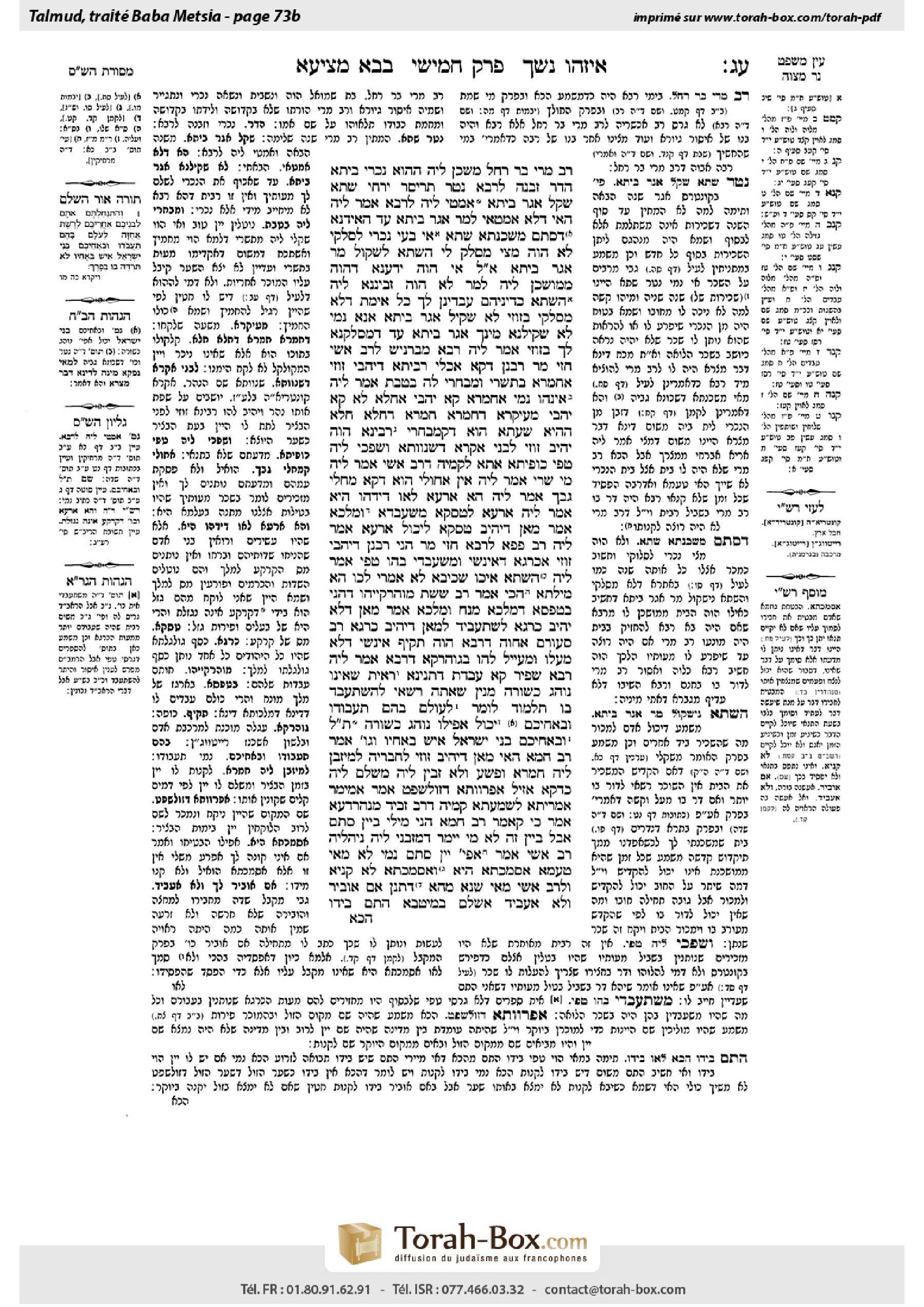
Bava Metzia 73b: Talmud study for Daf Yomi
Study the Talmud for Daf Yomi with scanned pages, Hebrew text, English translations from Sefaria and AI-generated French translations.
Passage selection and English or AI-generated French translation are available where the scan has annotations. Daf Study is independent of Torah-Box and Sefaria.
Browse Bava Metzia · בבא מציעא · All tractatesBava Metzia 73b text and translations
This page of Bava Metzia includes the Aramaic text, an English translation and an AI-generated French translation, alongside the scan above.
בבא מציעא ע״ג ב · Aramaic and Hebrew text
רַב מָרִי בַּר רָחֵל מַשְׁכֵּן לֵיהּ הָהוּא גּוֹי בֵּיתָא. הֲדַר זַבְּנֵהּ לְרָבָא. נְטַר תְּרֵיסַר יַרְחֵי שַׁתָּא, שְׁקַל אֲגַר בֵּיתָא אַמְטִי לֵיהּ לְרָבָא. אֲמַר לֵיהּ: הַאי דְּלָא אַמְטַאי לְמָר אֲגַר בֵּיתָא עַד הָאִידָּנָא, דִּסְתַם מַשְׁכַּנְתָּא שַׁתָּא, אִי בָּעֵי גּוֹי לְסַלֹּקֵי לָא הֲוָה מָצֵי מְסַלֵּק לִי, הַשְׁתָּא לִשְׁקוֹל מָר אֲגַר בֵּיתָא.
אֲמַר לֵיהּ: אִי הֲוָה יָדַעְנָא דַּהֲוָה מְמוּשְׁכַּן לֵיהּ לְמָר, לָא הֲוָה זָבֵינְנָא לֵיהּ. הַשְׁתָּא כְּדִינֵיהֶם עָבֵידְנָא לָךְ, כׇּל אֵימַת דְּלָא מְסַלְּקִי בְּזוּזֵי לָא שָׁקֵיל אֲגַר בֵּיתָא. אֲנָא נָמֵי לָא שָׁקֵילְנָא מִינָּךְ אֲגַר בֵּיתָא עַד דִּמְסַלֵּקְנָא לָךְ בְּזוּזֵי.
אֲמַר לֵיהּ רָבָא מִבַּרְנִישׁ לְרַב אָשֵׁי: חֲזִי מָר רַבָּנַן דְּקָא אָכְלִי רִבִּיתָא, דְּיָהֲבִי זוּזֵי אַחַמְרָא בְּתִשְׁרִי וּמְבַחֲרִי לֵהּ בְּטֵבֵת!
אֲמַר לֵיהּ: אִינְהוּ נָמֵי אַחַמְרָא קָא יָהֲבִי, אַחַלָּא לָא קָא יָהֲבִי – מֵעִיקָּרָא דְּחַמְרָא חַמְרָא, דְּחַלָּא חַלָּא, הָהִיא שַׁעְתָּא הוּא דְּקָמְבַחֲרִי.
רָבִינָא הֲוָה יָהֵיב זוּזֵי לִבְנֵי אַקְרָא דְּשַׁנְווֹתָא וְשָׁפְכִי לֵיהּ טְפֵי כּוּפִיתָא. אֲתָא לְקַמֵּיהּ דְּרַב אָשֵׁי, אֲמַר לֵיהּ: מִי שְׁרֵי? אֲמַר לֵיהּ: אִין, אַחוֹלֵי הוּא דְּקָא מָחֲלִי גַּבָּךְ.
אֲמַר לֵיהּ: הָא אַרְעָא לָאו דִּידְהוּ הִיא! אֲמַר לֵיהּ: אַרְעָא לְטַסְקָא מְשַׁעְבְּדָא. וּמַלְכָּא אָמַר: מַאן דְּיָהֵיב טַסְקָא – לֵיכוֹל אַרְעָא.
אֲמַר לֵיהּ רַב פָּפָּא לְרָבָא: חֲזִי מָר הָנֵי רַבָּנַן דְּיָהֲבִי זוּזֵי אַכְּרָגָא דְּאִינָשֵׁי וּמְשַׁעְבְּדִי בְּהוּ טְפֵי! אֲמַר לֵיהּ: הַשְׁתָּא אִיכּוֹ שְׁכֵיבִי לָא אֲמַרִי לְכוּ הָא מִילְּתָא. הָכִי אָמַר רַב שֵׁשֶׁת: מוּהְרְקַיְיהוּ דְּהָנֵי בְּטֻפְסָא דְמַלְכָּא מַנַּח, וּמַלְכָּא אָמַר: מַאן דְּלָא יָהֵיב כְּרָגָא לִשְׁתַּעְבַּיד לְמַאן דְּיָהֵיב כְּרָגָא!
רַב סְעוּרָם אֲחוּהּ דְּרָבָא הֲוָה תָּקֵיף אִינָשֵׁי דְּלָא מְעַלּוּ וּמְעַיֵּיל לְהוּ בְּגוּהַרְקָא דְּרָבָא. אֲמַר לֵיהּ רָבָא: שַׁפִּיר קָא עָבְדַתְּ, דִּתְנֵינָא: רְאִית[וֹ] שֶׁאֵינוֹ נוֹהֵג כַּשּׁוּרָה, מִנַּיִן שֶׁאַתָּה רַשַּׁאי לְהִשְׁתַּעְבֵּד בּוֹ – תַּלְמוּד לוֹמַר: ״לְעוֹלָם בָּהֶם תַּעֲבֹדוּ וּבְאַחֵיכֶם״. יָכוֹל אֲפִילּוּ נוֹהֵג כַּשּׁוּרָה – תַּלְמוּד לוֹמַר: ״וּבְאַחֵיכֶם בְּנֵי יִשְׂרָאֵל אִישׁ בְּאָחִיו וְגוֹ׳״.
אָמַר רַב חָמָא: הַאי מַאן דְּיָהֵיב זוּזֵי לְחַבְרֵיהּ לְמִיזְבַּן לֵיהּ חַמְרָא וּפְשַׁע וְלָא זְבַין לֵיהּ – מְשַׁלֵּם לֵיהּ כִּדְקָא אָזֵיל אַפַּרְווֹתָא דְזוּלְשְׁפָט.
אָמַר אַמֵּימָר אַמְרִיתָא לִשְׁמַעְתָּא קַמֵּיהּ דְּרַב זְבִיד מִנְּהַרְדְּעָא, אָמַר: כִּי קָאָמַר רַב חָמָא, הָנֵי מִילֵּי בְּ״יַיִן״ סְתָם, אֲבָל בְּ״יַיִן זֶה״ – לָא, מִי יֵימַר דִּמְזַבְּנִי לֵיהּ נִיהֲלֵיהּ?
רַב אָשֵׁי אָמַר: אֲפִילּוּ ״יַיִן״ סְתָם נָמֵי לָא, מַאי טַעְמָא – אַסְמַכְתָּא הִיא, וְאַסְמַכְתָּא לָא קָנְיָא.
וּלְרַב אָשֵׁי מַאי שְׁנָא מֵהָא דִּתְנַן: ״אִם אוֹבֵיר וְלָא אֶעֱבֵיד אֲשַׁלֵּם בְּמֵיטְבָא״, הָתָם בְּיָדוֹ,
Bava Metzia 73b · English translation
The Gemara relates: A certain gentile mortgaged a house to Rav Mari bar Raḥel for a loan that Rav Mari had provided him. Afterward, the gentile sold the house to Rava. Rav Mari waited for twelve months of the year to pass, took the amount of money necessary to pay rent for the house and brought it to Rava, who was now the owner of the house. Rav Mari said to Rava: This fact that I did not bring the rental fee for the house to the Master until now is because an unspecified mortgage is in effect for a period of one year. If that gentile wanted to remove me from the house by paying back the loan, he could not remove me from it until now. Consequently, the house actually belonged to me for that year, and I was not required to pay rent. Now, since the gentile can remove me from the house by repaying the loan, the house belongs to you. Therefore, let the Master now take the rental fee for the house for the coming year.
Rava said to him: Had I known that this house was mortgaged to the Master, I would not have purchased it at all, as I would have given you the chance to purchase it first. Now, therefore, I will act toward you according to the law of the gentiles, as I assumed the rights previously held by the gentile. According to gentile law, as long as the borrower does not remove the lender by paying back the money, he also does not take a rental fee for the house, as there is no prohibition against a gentile paying or receiving interest. Therefore, I too will not take a rental fee for the house from you until I remove you by forcing the gentile to pay the money that is owed to you.
The Gemara relates: Rava of Barnish said to Rav Ashi: The Master sees the Sages who consume interest, as they give people money for wine in the month of Tishrei, and they select the wine later, in the month of Tevet. Had they taken the wine immediately upon payment, there is a chance that it would have spoiled. Now, in return for paying for the wine in advance, they receive the benefit of guaranteeing that the wine they receive will not be spoiled. Rava of Barnish understood that this benefit, received in exchange for advance payment, is a form of interest.
Rav Ashi said to him: They too gave the money at the outset for wine, but they did not give it for vinegar. That which was wine at the outset is still wine, and that which became vinegar was vinegar when they paid for it but they did not know it. It was at that time of selection that they merely selected the wine that they had paid for previously. Since they agreed to buy wine, not vinegar, the benefit of actually receiving wine does not constitute interest.
The Gemara relates: Ravina would give money in advance to the people of the fortress [akra] at the river Shanvata in order to buy wine to be supplied after the grape harvest, and when they supplied the wine they would pour an extra jug [kufita] of wine for him as a gift, although there was no stipulation between them requiring this. Ravina came before Rav Ashi to ask whether this involved interest. Ravina said to him: Is it permitted to do this? Rav Ashi said to him: Yes, it is permitted, as they forgo payment for the extra wine to your benefit in order to maintain good relations with you. Since the additional wine is not provided as consideration for the advance payment, there is no problem of interest.
Ravina said to him: But the land is not theirs. The people of the fortress at Shanvata worked land belonging to others who abandoned their fields because they could not pay the real estate taxes. The people of the fortress paid the taxes and were therefore able to use the fields. Ravina was concerned that perhaps they did not own the grapes and were therefore unable to forgo payment for the additional amount as it did not belong to them. Rav Ashi said to him: The land is liened to the king as payment for the taxes [letaska], and the king says: Whoever pays the tax may consume the produce of the land. Consequently, the ones who pay the taxes have ownership of the wine by dint of the law of the kingdom.
The Gemara relates that Rav Pappa said to Rava: Let the Master see these Sages who pay money for the tax [akarga] on behalf of other people and afterward make them work more than is reasonable for the amount of money they paid. Rava said to him: Now, if I were dead I could not say the explanation of this matter to you, so it is good that you asked me while I am still alive, as I know that this is what Rav Sheshet said: The document [moharkayyhu] of servitude of these people lies in the treasury of the king, i.e., all of his subjects are considered his servants, and the king said: The one who does not pay the head tax shall serve the one who does pay the head tax, and consequently, by dint of the law of the kingdom they can have them work as much as they want.
The Gemara relates: Rav Se’oram, the brother of Rava, would forcefully seize people who were not acting properly and have them carry Rava’s sedan chair. Rava said to him: You acted correctly, as we learn: If you see a Jew who does not behave properly, from where is it derived that you are permitted to have him work as a slave? The verse states: “Of them you may take your slaves forever; and over your brothers” (Leviticus 25:46). It is derived from the conjunctive “and” linking the two clauses of the verse that there are circumstances where it is permitted to treat a fellow Jew as if he were a slave. One might have thought that this is the halakha even if a Jew acts properly. To counter this, the verse states in the continuation: “And over your brothers the children of Israel you shall not rule, one over another, with rigor.”
Rav Ḥama said: With regard to one who gave money to another to purchase wine for him, and the other, i.e., the agent, was negligent and did not purchase it for him, the agent must pay the one who gave him the money according to the going rate of wine in the port city of Zolshefat, where the main wine market was located, and he must purchase the wine according to the price in that market even if it is more expensive than the amount he was given initially.
Ameimar said: I said this halakha before Rav Zevid of Neharde’a, and when he heard it he said: When Rav Ḥama said this, he said that statement in a case where the buyer asked the agent to purchase wine without specification concerning exactly which wine he wanted. But if he said to the agent: Buy this specific wine for me, the agent who neglected to buy the wine is not obligated to buy it at a higher price later, as when he was sent to buy it initially, who says that the owner would have sold it to him? The one who gave the money to the agent was aware of the fact that the agent may not be able to successfully purchase that specific wine. Consequently, the obligation of the agent is simply to return the money, and nothing may be added to that sum, due to the prohibition of interest.
Rav Ashi said: Even if he asked the agent to buy wine without specification, the agent is also not obligated to buy wine later for more than the amount he was given. What is the reason for this? The implicit obligation that the agent accepted upon himself, to pay the one who hired him with wine of a higher value than the amount of money he received, is a transaction with inconclusive consent [asmakhta], as any situation where one will have to pay more money than he received is similar to the payment of a fine, and the acceptance of an asmakhta does not effect acquisition, as his acceptance is assumed to be insincere.
The Gemara asks: And according to Rav Ashi, in what way is this case different from that which we learned in a mishna (104a) concerning a rental agreement for land, in which a sharecropper agreed to cultivate a field in return for a share of the produce and wrote: If I let the field lie fallow and do not cultivate it, I will pay with the best-quality produce? In that case, the sharecropper agreed to pay the amount he caused the owner to lose due to his lack of activity, and it was not ruled an asmakhta. The Gemara answers: There, the matter is in his power, as he can decide whether to work the field or not to work it.
Bava Metzia 73b · Traduction française (IA)
Le Guemara rapporte : Un certain non-Juif a hypothéqué une maison à Rav Mari bar Raḥel pour un prêt que ce dernier lui avait octroyé. Par la suite, ce non-Juif a vendu la maison à Rava. Rav Mari a attendu que douze mois de l'année passent, a pris la somme nécessaire pour payer le loyer de la maison et l'a apportée à Rava, qui était désormais propriétaire de la maison. Rav Mari a dit à Rava : Ce fait que je n'ai pas apporté le loyer de la maison au Maître jusqu'à présent est dû au fait qu'une hypothèque indéterminée est en vigueur pendant un an. Si ce non-Juif souhaitait me faire partir de la maison en remboursant le prêt, il ne pouvait pas me faire partir avant maintenant. Ainsi, la maison appartenait en réalité à moi pendant cette année, et je n'étais pas tenu de payer le loyer. Maintenant que ce non-Juif peut me faire partir de la maison en remboursant le prêt, la maison t'appartient. Donc, que le Maître prenne maintenant le loyer de la maison pour l'année à venir.
Rava a dit à lui : Si j'avais su que cette maison était hypothéquée au Maître, je n'aurais pas acheté cette maison du tout, car j'aurais eu la possibilité de t'acheter la maison en premier. Maintenant, donc, je vais agir envers toi selon la loi des non-Juifs, car j'ai assumé les droits précédemment détenus par le non-Juif. Selon la loi des non-Juifs, tant que le prêteur ne fait pas partir le prêteur en remboursant l'argent, il ne prend pas non plus un loyer pour la maison, car il n'y a pas d'interdiction pour un non-Juif de payer ou de recevoir un intérêt. Ainsi, je ne prendrai pas non plus un loyer pour la maison de ta part jusqu'à ce que je te fasse partir en forçant le non-Juif à payer l'argent dû à toi.
Le Guemara rapporte : Rava de Barnish a dit à Rav Ashi : Le Maître voit les Sages qui consomment un intérêt, car ils donnent de l'argent pour du vin en mois de Tishrei, et ils choisissent le vin plus tard, en mois de Tevet. S'ils avaient pris le vin immédiatement après le paiement, il y avait une chance qu'il se gâte. Maintenant, en échange du paiement anticipé, ils reçoivent le bénéfice de garantir que le vin qu'ils reçoivent ne se gâte pas. Rava de Barnish a compris que ce bénéfice, reçu en échange du paiement anticipé, est une forme d'intérêt.
Rav Ashi a dit à lui : Ils ont aussi donné l'argent au début pour du vin, mais pas pour du vinaigre. Ce qui était du vin au début reste du vin, et ce qui est devenu du vinaigre était du vinaigre lorsqu'ils ont payé, mais ils ne le savaient pas. C'était à ce moment de sélection qu'ils ont simplement sélectionné le vin qu'ils avaient payé précédemment. Comme ils avaient convenu d'acheter du vin, pas du vinaigre, le bénéfice de recevoir effectivement du vin ne constitue pas d'intérêt.
Le Guemara rapporte : Ravina donnait de l'argent à l'avance aux habitants du fort [akra] à la rivière Shanvata afin d'acheter du vin à fournir après la récolte des raisins, et lorsqu'ils fournissaient le vin, ils versaient une juge de vin supplémentaire pour lui en cadeau, même s'il n'y avait pas de stipulation entre eux exigeant cela. Ravina est venu devant Rav Ashi pour demander si cela impliquait un intérêt. Ravina a dit à lui : Est-ce permis de faire cela ? Rav Ashi a dit à lui : Oui, c'est permis, car ils renoncent au paiement du vin supplémentaire à votre bénéfice afin de maintenir de bonnes relations avec vous. Comme le vin supplémentaire n'est pas fourni en échange du paiement anticipé, il n'y a pas de problème d'intérêt.
Ravina dit à lui : Mais la terre n'est pas la leur. Les habitants du fort à Shanvata travaillaient des terres appartenant à d'autres qui avaient abandonné leurs champs car ils ne pouvaient pas payer les impôts fonciers. Les habitants du fort ont payé les impôts et ont donc pu utiliser les champs. Ravina s'inquiétait qu'ils ne possèdent pas les raisins et qu'ils ne puissent donc renoncer au paiement de la quantité supplémentaire, car cela ne leur appartenait pas. Rav Ashi dit à lui : La terre est hypothéquée au roi en paiement des impôts [letaska], et le roi dit : Celui qui paie l'impôt peut consommer les produits de la terre. Ainsi, ceux qui paient les impôts ont la propriété du vin en vertu de la loi du royaume.
Le Guemara rapporte que Rav Pappa a dit à Rava : Que le Maître voie ces Sages qui paient de l'argent pour l'impôt [akarga] au nom d'autres personnes et ensuite les font travailler plus que ce qui est raisonnable par rapport à l'argent qu'ils ont payé. Rava a dit à lui : Maintenant, si j'étais mort, je ne pourrais pas expliquer cette affaire à toi, donc c'est bon que tu m'aies demandé tout en étant encore vivant, car je sais que c'est ce que Rav Sheshet a dit : Le document [moharkayyhu] de servitude de ces gens est dans le trésor du roi, c'est-à-dire que tous ses sujets sont considérés comme ses serviteurs, et le roi dit : Celui qui ne paie pas l'impôt des têtes doit servir celui qui paie l'impôt des têtes, et ainsi, en vertu de la loi du royaume, ils peuvent les faire travailler autant qu'ils veulent.
Le Guemara rapporte : Rav Se’oram, le frère de Rava, forçait les gens qui ne se comportaient pas correctement à porter la chaise de Rava. Rava lui a dit : Tu as agi correctement, car nous apprenons : Si tu vois un Juif qui ne se comporte pas correctement, d'où est-il dérivé que tu es autorisé à le faire travailler comme esclave ? La Sainte Écriture dit : « De ceux-ci tu peux prendre tes esclaves pour toujours ; et sur tes frères » (Lévitique 25:46). C'est dérivé du conjonctif « et » reliant les deux phrases de la Sainte Écriture que des circonstances existent où il est permis de traiter un Juif comme un esclave. On pourrait penser que c'est la halakha même si un Juif se comporte correctement. Pour contrecarrer cela, la Sainte Écriture dit dans la continuation : « Et sur tes frères, les enfants d'Israël, tu ne règnes pas, l'un sur l'autre, avec rigueur. »
Rav Ḥama a dit : En ce qui concerne celui qui a donné de l'argent à un autre pour acheter du vin à son intention, et l'autre, c'est-à-dire l'agent, a été négligent et n'a pas acheté le vin à son intention, l'agent doit payer à celui qui lui a donné l'argent selon le prix du vin dans la ville portuaire de Zolshefat, où se trouvait le principal marché du vin, et il doit acheter le vin selon le prix de ce marché même s'il est plus cher que la somme qu'il avait reçue initialement.
Ameimar a dit : J’ai dit cette halakha à Rav Zevid de Neharde’a, et lorsqu’il l’a entendue, il a dit : Lorsque Rav Ḥama a dit cela, il a dit cette déclaration dans un cas où l’acheteur a demandé à l’agent d’acheter du vin sans préciser exactement quel vin il voulait. Mais si l’acheteur a dit à l’agent : Achète-moi ce vin spécifique, l’agent qui a négligé d’acheter le vin n’est pas tenu de l’acheter à un prix plus élevé plus tard, car lorsqu’il était envoyé acheter le vin, qui dit que l’propriétaire l’aurait vendu à lui ? Celui qui a donné l’argent à l’agent savait que l’agent pourrait ne pas pouvoir acheter ce vin spécifique. Par conséquent, l’obligation de l’agent est simplement de rendre l’argent, et rien ne peut être ajouté à cette somme, en raison de l’interdiction d’intérêt.
Rav Ashi a dit : Même si l’acheteur a demandé à l’agent d’acheter du vin sans précision, l’agent n’est pas tenu d’acheter du vin plus cher que l’argent qu’il a reçu. Pourquoi ? L’obligation implicite que l’agent s’est engagé à remplir, à payer à celui qui l’a engagé du vin de meilleure qualité que la somme qu’il avait reçue, est une transaction avec un consentement indéterminé [asmakhta], car toute situation où l’on doit payer plus d’argent que l’on a reçu est semblable au paiement d’une amende, et l’acceptation d’un asmakhta ne constitue pas un achat, car son acceptation est supposée insincère.
Le Guemara pose la question : Et selon Rav Ashi, dans quel cas cette situation diffère-t-elle de celle que nous avons apprise dans une mitsva (104a) concernant un contrat de location de terre, où un cultivateur a convenu de cultiver un champ en échange d’une part des récoltes et a écrit : Si je laisse le champ en friche et ne le cultive pas, je paierai avec les produits de meilleure qualité ? Dans ce cas, le cultivateur a convenu de payer la somme qu’il avait causé à l’exploitant de perdre en raison de son inactivité, et cela n’a pas été jugé comme un asmakhta. Le Guemara répond : Là, la question est en son pouvoir, car il peut décider s’il travaille le champ ou non.
Traduction française générée par IA à partir de l’édition anglaise de Sefaria. Vérifie toujours un passage avec le texte source.
Text from Sefaria: William Davidson Edition - Vocalized Aramaic (CC BY NC); William Davidson Edition - English (CC BY NC).