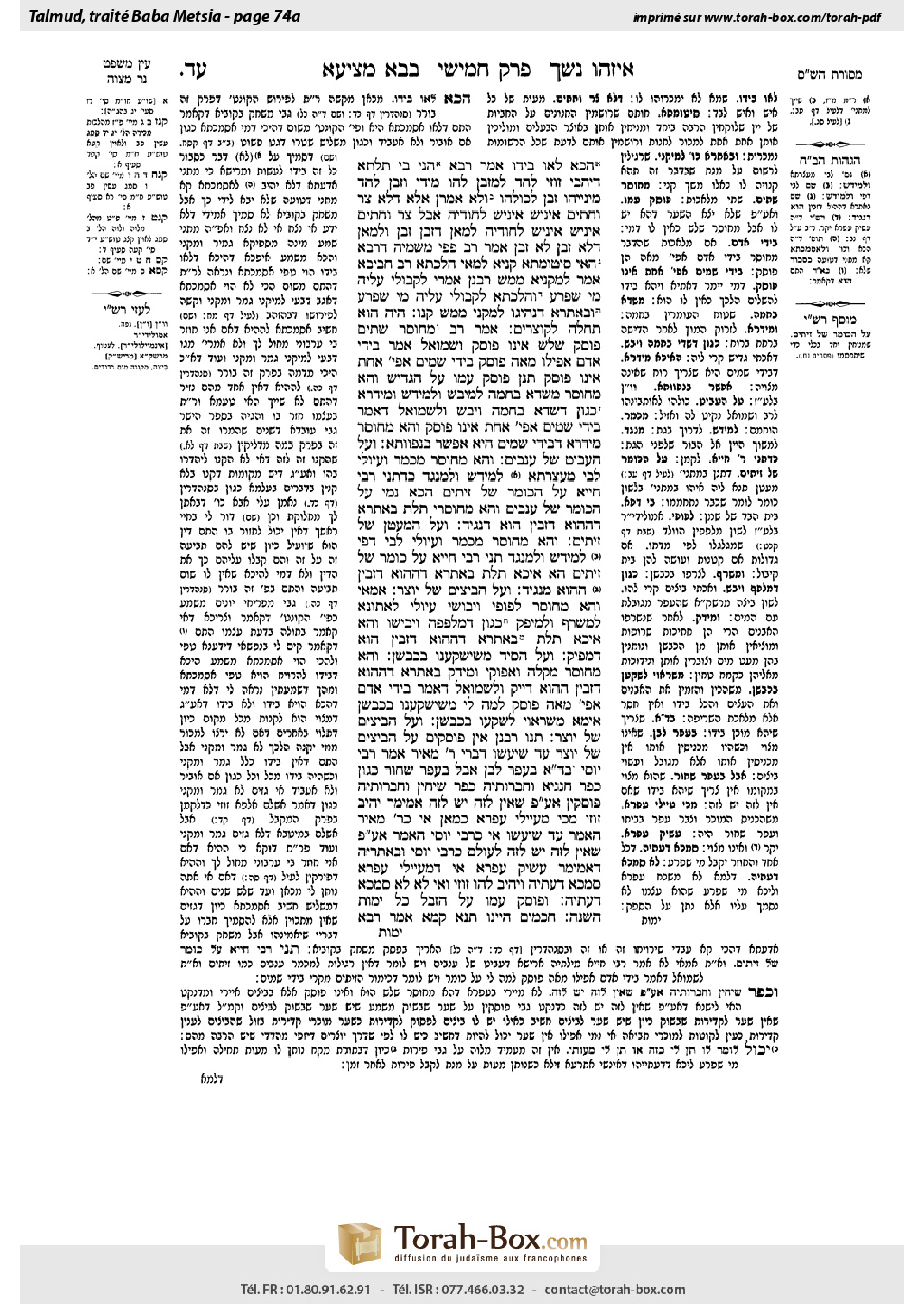
Bava Metzia 74a: Talmud study for Daf Yomi
Study the Talmud for Daf Yomi with scanned pages, Hebrew text, English translations from Sefaria and AI-generated French translations.
Passage selection and English or AI-generated French translation are available where the scan has annotations. Daf Study is independent of Torah-Box and Sefaria.
Browse Bava Metzia · בבא מציעא · All tractatesBava Metzia 74a text and translations
This page of Bava Metzia includes the Aramaic text, an English translation and an AI-generated French translation, alongside the scan above.
בבא מציעא ע״ד א · Aramaic and Hebrew text
הָכָא לָאו בְּיָדוֹ.
אָמַר רָבָא: הָנֵי בֵּי תְלָתָא דְּיָהֲבִי זוּזֵי לְחַד לְמִזְבַּן לְהוּ מִידֵּי וּזְבַן לְחַד מִינַּיְיהוּ – זְבַן לְכוּלְּהוּ. וְלָא אֲמַרַן אֶלָּא דְּלָא צָר וַחֲתֵים אִינִישׁ אִינִישׁ לְחוֹדֵיהּ. אֲבָל צָר וַחֲתֵים אִינִישׁ אִינִישׁ לְחוֹדֵיהּ, לְמַאן דִּזְבַן – זְבַן, וּלְמַאן דְּלָא זְבַן – לָא זְבַן.
אָמַר רַב פַּפִּי מִשְּׁמֵיהּ דְּרָבָא: הַאי סִיטוּמְתָּא – קָנְיָא. לְמַאי הִלְכְתָא? רַב חֲבִיבָא אֲמַר: לְמִקְנֵיא מַמָּשׁ.
רַבָּנַן אָמְרִי: לְקַבּוֹלֵי עֲלֵיהּ מִי שֶׁפָּרַע.
וְהִלְכְתָא לְקַבּוֹלֵי עֲלֵיהּ ״מִי שֶׁפָּרַע״. וּבְאַתְרָא דִּנְהִיגוּ לְמִקְנֵי מַמָּשׁ – קָנוּ.
הָיָה הוּא תְּחִלָּה לַקּוֹצְרִים. אָמַר רַב: מְחוּסָּר שְׁתַּיִם – פּוֹסֵק. שָׁלֹשׁ – אֵינוֹ פּוֹסֵק. וּשְׁמוּאֵל אָמַר: בִּידֵי אָדָם – אֲפִילּוּ מֵאָה פּוֹסֵק. בִּידֵי שָׁמַיִם – אֲפִילּוּ אַחַת אֵינוֹ פּוֹסֵק.
תְּנַן: פּוֹסֵק עִמּוֹ עַל הַגָּדִישׁ, וְהָא מְחוּסָּר מִשְׁדֵּא בְּחַמָּה לְמֵיבַשׁ וּלְמֵידַשׁ וּמִידְרֵא! כְּגוֹן דִּשְׁדָא בְּחַמָּה וִיבַשׁ.
וְלִשְׁמוּאֵל, דְּאָמַר: בִּידֵי שָׁמַיִם אֲפִילּוּ אַחַת אֵינוֹ פּוֹסֵק, וְהָא מְחוּסָּר מִידְרֵא, דְּבִידֵי שָׁמַיִם הִיא – אֶפְשָׁר בְּנָפְווֹתָא.
וְעַל הֶעָבִיט שֶׁל עֲנָבִים. וְהָא מְחוּסָּר מִכְמַר, וְעַיּוֹלֵי לְבֵי מַעְצַרְתָּא, לְמֵידַשׁ וּלְמִנְגַּד! כִּדְתָנֵי רַבִּי חִיָּיא: עַל הַכּוֹמֶר שֶׁל זֵיתִים, הָכָא נָמֵי עַל הַכּוֹמֶר שֶׁל עֲנָבִים.
וְהָא מְחוּסְּרֵי תְּלָת! בְּאַתְרָא דְּהָהוּא דְּזָבֵין הוּא דְּנָגֵיד.
וְעַל הַמַּעֲטָן שֶׁל זֵיתִים. וְהָא מְחוּסָּר מִכְמַר וְעַיּוֹלֵי לְבֵי דַפֵּי לְמֵידַשׁ וּלְמִנְגַּד! תָּנֵי רַבִּי חִיָּיא: עַל כּוֹמֶר שֶׁל זֵיתִים. הָא אִיכָּא תְּלָת! בְּאַתְרָא דְּהָהוּא דְּזָבֵין הָהוּא (מְנַגֵּיד).
וְעַל הַבֵּיצִים שֶׁל יוֹצֵר. אַמַּאי? וְהָא מְחוּסָּר לָפוֹפֵי וְיַבּוֹשֵׁי, עַיּוֹלֵי לְאַתּוּנָא לְמִשְׂרַף וּלְמִיפַּק! כְּגוֹן דִּמְלָפְפָה וִיבִישׁוּ. וְהָא אִיכָּא תְּלָת! בְּאַתְרָא דְּהָהוּא דְּזָבֵין הוּא דְּמַפֵּיק.
וְעַל הַסִּיד מִשֶּׁיְּשַׁקְּעֶנּוּ בַּכִּבְשָׁן. וְהָא מְחוּסָּר מִקְלֵה וְאַפּוֹקֵי וּמֵידַק! בְּאַתְרָא דְּהָהוּא דְּזָבֵין הָהוּא דָּיֵיק. וְלִשְׁמוּאֵל דְּאָמַר: בִּידֵי אָדָם אֲפִילּוּ מֵאָה פּוֹסֵק, לְמָה לִי מִשֶּׁיְּשַׁקְּעֶנּוּ בַּכִּבְשָׁן? אֵימָא ״מִשֶּׁרָאוּי לְשַׁקְּעוֹ בַּכִּבְשָׁן״.
וְעַל הַבֵּיצִים שֶׁל יוֹצֵר. תָּנוּ רַבָּנַן: אֵין פּוֹסְקִים עַל הַבֵּיצִים שֶׁל יוֹצֵר עַד שֶׁיֵּעָשׂוּ, דִּבְרֵי רַבִּי מֵאִיר. אָמַר רַבִּי יוֹסֵי: בַּמֶּה דְּבָרִים אֲמוּרִים – בְּעָפָר לָבָן, אֲבָל בְּעָפָר שָׁחוֹר, כְּגוֹן כְּפַר חֲנַנְיָא וְחַבְרוֹתֶיהָ, כְּפַר שִׁיחִין וְחַבְרוֹתֶיהָ – פּוֹסְקִין, אַף עַל פִּי שֶׁאֵין לְזֶה יֵשׁ לְזֶה.
אַמֵּימָר יָהֵיב זוּזֵי מִכִּי מְעַיְּילִי עַפְרָא. כְּמַאן? אִי כְּרַבִּי מֵאִיר, הָאָמַר: עַד שֶׁיֵּעָשׂוּ. אִי כְּרַבִּי יוֹסֵי, הָאָמַר: אַף עַל פִּי שֶׁאֵין לְזֶה יֵשׁ לְזֶה! לְעוֹלָם כְּרַבִּי יוֹסֵי, וּבְאַתְרֵיהּ דְּאַמֵּימָר עֲשִׁיק עַפְרָא: אִי דִּמְעַיְּילִי עַפְרָא סָמְכָא דַּעְתֵּיהּ וְיָהֵיב לְהוּ זוּזֵי, וְאִי לָא – לָא סָמְכָא דַּעְתֵּיהּ.
וּפוֹסֵק עִמּוֹ עַל הַזֶּבֶל כׇּל יְמוֹת הַשָּׁנָה. חֲכָמִים הַיְינוּ תַּנָּא קַמָּא? אָמַר רָבָא:
Bava Metzia 74a · English translation
By contrast, here, the matter is not in his power to determine whether or not to buy the wine, as perhaps the owner will not sell it to him.
§ Rava said: In the case of these three people who gave money to one individual in order for him to purchase an item for them and he purchased the item for only one of them, he has actually purchased it for all of them. All three share ownership of that which was purchased, and the one for whom the item was purchased does not have any additional claim on the merchandise. And we said this ruling only when the agent did not wrap up and seal each person’s money separately but rather put all of the money in one bundle. But if he wrapped up and sealed each person’s money separately and spent the money of only one of them, he purchased the item only for the one for whom he purchased it, and he did not purchase the item for those for whom he did not purchase it.
Rav Pappi said in the name of Rava: In this case of labeling an item with a marker [situmta], which was commonly used to indicate that specific merchandise had been sold, even though the buyer had not yet paid and the item was still located in the seller’s warehouse, the labeling effects acquisition of the merchandise for the buyer. The Gemara asks: With regard to what halakha was this said? What is the significance of this acquisition? Rav Ḥaviva said: It means to actually effect acquisition, in other words, that the merchandise belongs to the buyer for all intents and purposes.
But the Rabbis said: It effects acquisition only concerning a case where one of the parties withdraws from the transaction and is required to accept upon himself the curse of: He Who exacted payment from the people of the generation of the flood, and from the people of the generation of the dispersion, i.e., that of the Tower of Babel, will in the future exact payment from whoever does not stand by his statement (see 44a). The court does not force the parties to complete the transaction but applies the curse to the one who withdraws for his lack of integrity.
The Gemara concludes: And the halakha is that a marker effects the acquisition of the item only in that one who withdraws from the transaction is required to accept upon himself the curse: He Who exacted payment. But in a place where the custom is that it actually effects the acquisition of the item, it actually effects acquisition of it, as the halakha recognizes the legitimacy of the local custom.
§ The mishna teaches that if the seller was first among the reapers, he may set a price with the buyer only when the produce he has is ready for delivery. Rav says: If only two actions needed to complete the labor to prepare the produce were lacking, he may set a price, as the produce is viewed as if it had already been prepared. But if three actions were lacking, he may not set a price, as the item is still not considered prepared, and the setting of a price in advance creates a concern of interest. And Shmuel says: If the actions needed to complete the labor are to be performed by human hands, then even if one hundred actions were lacking, he may set a price, but if the necessary actions must be accomplished by the hand of Heaven, then even if one action is lacking, he may not set a price.
The Gemara challenges Rav’s opinion. We learned in the mishna that he may set a price on a stack of grain. But there are still several actions that are lacking: Placing it in the sun to dry, and threshing, and winnowing. There are three actions that are lacking, and yet the mishna rules that he may set a price. The Gemara responds: The mishna is discussing a case where he already placed it in the sun and it dried. Consequently, there are only two actions that are lacking.
The Gemara asks: And according to Shmuel, who says: If the actions remaining are to be accomplished by the hand of Heaven even if only one action is lacking he may not set a price, how does he explain the mishna? In the case of the mishna the produce is lacking winnowing, which is done by the hand of Heaven, since winnowing can be done only when there is wind. The Gemara answers: It is possible to winnow with sieves when the wind is not blowing. Although this is done only in exigent circumstances, since it is possible to perform the action entirely by human hands, it is permitted to set a price.
The mishna teaches that one may set a price for a large basket of grapes. Based on this, the Gemara challenges the opinion of Rav: But there are still several actions that are lacking: Warming in a stack, bringing the grapes to the winepress, treading upon them, and drawing the wine out into the pit where it is stored. The Gemara answers: This can be explained as Rabbi Ḥiyya teaches, concerning a difficulty raised from the next clause of the mishna, that the mishna is not discussing setting a price on olives immediately after they were picked but rather for a stack [hakomer] of warmed olives, and here also, it is speaking about a price for a stack of warmed grapes.
The Gemara challenges: But there are three actions that are lacking. The Gemara explains: The mishna is discussing a place where the local custom is that the one who purchases the grapes is the one who draws the wine out of the winepress. Consequently, there are only two actions remaining to complete the labor before the merchandise will be ready for purchase.
The mishna teaches that one may set a price for a vat of olives. Based on this, the Gemara challenges the opinion of Rav: But there are still several actions that are lacking: Warming the olives in a stack, bringing the olives to the olive press, pressing them, and drawing the oil out into the pit where it is stored. The Gemara answers: Rabbi Ḥiyya teaches a baraita with a different version of the statement, which reads: For a stack of olives that has already been warmed. The Gemara challenges: But there are three actions that are lacking: Bringing the olives to the olive press, pressing them, and drawing the oil. The Gemara explains: The mishna is discussing a place where the local custom is that the one who purchases the olives is the one who draws the oil.
The mishna teaches that one may set a price for the clumps of clay prepared for use by a potter. Based on this, the Gemara challenges the opinion of Rav: Why is this permitted? But there are still several actions that are lacking: Rolling them out to the proper size, drying them, putting them into the kiln, burning them, and removing them from the kiln. The Gemara answers: The mishna is discussing a case where they were already rolled and dried. The Gemara challenges: But there are three actions that are lacking. The Gemara explains: The mishna is discussing a place where the local custom is that the one who purchases the clumps of clay is the one who removes them from the kiln.
The mishna teaches that one may set a price for plaster after he has sunk it in the kiln. Based on this, the Gemara challenges the opinion of Rav: Why is this permitted? But there are still several actions that are lacking: Burning it, and removing it from the kiln, and grinding it. The Gemara answers: The mishna is discussing a place where the local custom is that the one who purchases the plaster is the one who grinds it. The Gemara asks: And according to the opinion of Shmuel, who says that if all actions that remain are to be done by human hands even if one hundred actions are lacking one may set a price, why do I need the statement that this applies only after he has sunk it in the kiln? The Gemara answers: Say: When it is fit to be sunk in the kiln.
§ The mishna teaches that one may set a price for the clumps of clay prepared for use by a potter. The Sages taught: One may not set a price for the clumps of clay prepared for use by a potter until they are fully formed; this is the statement of Rabbi Meir. Rabbi Yosei says: In what case is this statement said? It is said with regard to white earth from which superior clay pottery is made, but with regard to the simple and inexpensive black earth, from which ordinary clay pottery is made, such as that of Kefar Ḥananya and its environs, or that of Kefar Shiḥin and its environs, one may set a price immediately, since even if this one does not have any in his possession, that one does have it, as black earth is a common commodity.
The Gemara relates: Ameimar gave money to a seller of clumps of clay only from the time that the clay was brought into his house. In accordance with whose opinion did he act? If he acted in accordance with the opinion of Rabbi Meir, doesn’t Rabbi Meir say that one may not set a price until they are fully formed, but there is no need to wait until the merchandise is delivered to his house? And if he acted in accordance with the opinion of Rabbi Yosei, doesn’t Rabbi Yosei say that one may set a price at any time, as even though this one does not have any, that one does have it? The Gemara answers: Actually, he ruled in accordance with the opinion of Rabbi Yosei, but in Ameimar’s locale earth suitable for making clay was scarce, so much so that even black clay was not common. Consequently, if the clay was brought into his house, he relied on this and gave the seller the money, but if not, he did not rely on it.
§ The mishna teaches that one may set a price with him for manure on any of the days of the year, and that Rabbi Yosei permitted this only if he already had a pile of manure in his dunghill, whereas the Rabbis permitted it in all cases. The Gemara asks: The statement of the Rabbis is identical to the statement of the first tanna, so what is the reason to repeat it? Rava said:
Bava Metzia 74a · Traduction française (IA)
Par contraste, ici, la question n’est pas dans son pouvoir de décider s’il doit ou non acheter le vin, car peut-être le propriétaire ne le vendra pas à lui.
§ Rava a dit : Dans le cas de ces trois personnes qui ont donné de l’argent à une seule personne afin qu’il achète un objet à leur place et qu’il a acheté l’objet uniquement pour l’une d’entre elles, il a en réalité acheté l’objet pour toutes les trois. Les trois partagent la propriété de ce qui a été acheté, et celui pour qui l’objet a été acheté n’a aucun droit supplémentaire sur le produit. Et nous avons dit cette décision uniquement dans le cas où l’agent n’a pas enveloppé et scellé l’argent de chaque personne séparément, mais plutôt a mis tout l’argent dans un seul paquet. Mais si l’agent a enveloppé et scellé l’argent de chaque personne séparément et a dépensé l’argent d’une seule d’entre elles, il a acheté l’objet uniquement pour celui pour qui il l’a acheté, et il n’a pas acheté l’objet pour ceux pour qui il ne l’a pas acheté.
Rav Pappi a dit en nom de Rava : Dans le cas d’un marquage d’un objet [situmta], qui était couramment utilisé pour indiquer que l’objet spécifique avait été vendu, même si l’acheteur n’avait pas encore payé et que l’objet était encore dans l’entrepôt du vendeur, le marquage constitue l’acquisition de l’objet pour l’acheteur. La Guemara pose la question : À quel halakha cette déclaration s’applique-t-elle ? Quel est le sens de cette acquisition ? Rav Ḥaviva a dit : Cela signifie une acquisition effective, c’est-à-dire que l’objet appartient à l’acheteur pour tous les effets.
Mais les Rabbins ont dit : Cela constitue l’acquisition uniquement dans le cas où l’une des parties se retire de la transaction et est tenue de s’engager à la malédiction suivante : Celui qui a exigé le paiement des gens de la génération de la diluvion, et des gens de la génération de la dispersion, c’est-à-dire de la tour de Babel, exigera à l’avenir le paiement de celui qui ne se tient pas par sa déclaration (voir 44a). La cour ne force pas les parties à terminer la transaction, mais applique la malédiction à celui qui se retire pour son manque d’honnêteté.
La Guemara conclut : Et la halakha est que le marquage constitue l’acquisition de l’objet uniquement dans le cas où celui qui se retire de la transaction est tenu de s’engager à la malédiction : Celui qui a exigé le paiement. Mais dans un lieu où la coutume est que cela constitue effectivement l’acquisition de l’objet, cela constitue effectivement l’acquisition, car la halakha reconnaît la légitimité de la coutume locale.
§ La mitsna enseigne que si le vendeur était le premier des moissonneurs, il peut fixer un prix avec l’acheteur uniquement lorsque les produits qu’il a sont prêts à être livrés. Rav dit : Si seulement deux actions étaient nécessaires pour achever le travail de préparation des produits, il peut fixer un prix, car les produits sont considérés comme s’ils avaient déjà été préparés. Mais si trois actions étaient manquantes, il ne peut pas fixer un prix, car l’objet n’est pas encore considéré comme prêt, et fixer un prix à l’avance crée une préoccupation d’intérêt. Et Shmuel dit : Si les actions nécessaires pour achever le travail doivent être accomplies par la main de l’homme, alors même si cent actions étaient manquantes, il peut fixer un prix, mais si les actions nécessaires doivent être accomplies par la main de Dieu, alors même si une action est manquante, il ne peut pas fixer un prix.
La Guemara conteste l’opinion de Rav. Nous avons appris dans la mitsna que l’on peut fixer un prix sur un tas de blé. Mais il reste encore plusieurs actions manquantes : Le placement sous le soleil pour sécher, le battage et le tamisage. Il y a trois actions manquantes, et pourtant la mitsna règle que l’on peut fixer un prix. La Guemara répond : La mitsna parle d’un cas où il a déjà placé le blé sous le soleil et qu’il s’est séché. Ainsi, il ne reste que deux actions manquantes.
La Guemara pose la question : Et selon Shmuel, qui dit : Si les actions restantes doivent être accomplies par la main de Dieu même si une seule action est manquante, il ne peut pas fixer un prix, comment explique-t-il la mitsna ? Dans le cas de la mitsna, le produit manque le tamisage, qui est accompli par la main de Dieu, car le tamisage peut être fait uniquement en présence du vent. La Guemara répond : On peut tamiser avec des tamis lorsque le vent ne souffle pas. Bien que cela soit fait uniquement en cas d’urgence, puisque l’action peut être accomplie entièrement par la main de l’homme, il est permis de fixer un prix.
La mitsna enseigne que l’on peut fixer un prix pour une grande corbeille de raisins. Sur la base de cela, la Guemara conteste l’opinion de Rav : Mais il reste encore plusieurs actions manquantes : Le réchauffement en tas, l’apport des raisins à la presse, la foulée, et l’écoulement du vin dans le puits où il est stocké. La Guemara répond : Cela peut être expliqué comme Rabbi Ḥiyya enseigne, concernant une difficulté soulevée à partir de la prochaine clause de la mitsna, que la mitsna ne parle pas d’un prix fixé immédiatement après la récolte des olives, mais plutôt d’un tas [hakomer] d’olives réchauffées, et ici aussi, il parle d’un prix pour un tas de raisins réchauffés.
La Guemara conteste : Mais il manque trois actions. La Guemara explique : La mitsna parle d’un lieu où la coutume locale est que celui qui achète les raisins est celui qui extrait le vin de la presse. Ainsi, il ne reste que deux actions à accomplir avant que le produit ne soit prêt à l’achat.
La Michna enseigne que l'on peut fixer un prix pour un tonneau d'olives. D'après cela, la Guemara remet en question l'opinion de Rav : Mais il reste encore plusieurs actions manquantes : réchauffer les olives en tas, les amener à la presse à olives, les presser et extraire l'huile dans le bassin où elle est stockée. La Guemara répond : Rabbi Ḥiyya enseigne une baraïta avec une version différente de l'affirmation, qui dit : Pour un tas d'olives déjà réchauffé. La Guemara remet en question : Mais il reste encore trois actions manquantes : amener les olives à la presse à olives, les presser et extraire l'huile. La Guemara explique : La Michna parle d'un lieu où la coutume locale est que celui qui achète les olives est celui qui extrait l'huile.
La Michna enseigne que l'on peut fixer un prix pour les boulettes de terre préparées par un potier. D'après cela, la Guemara remet en question l'opinion de Rav : Pourquoi cela est-il permis ? Mais il reste encore plusieurs actions manquantes : étaler les boulettes à la bonne taille, les sécher, les mettre dans le four, les brûler et les enlever du four. La Guemara répond : La Michna parle d'un cas où elles étaient déjà étalées et sèches. La Guemara remet en question : Mais il reste encore trois actions manquantes. La Guemara explique : La Michna parle d'un lieu où la coutume locale est que celui qui achète les boulettes de terre est celui qui les enlève du four.
La Michna enseigne que l'on peut fixer un prix pour le plâtre après qu'il ait été mis dans le four. D'après cela, la Guemara remet en question l'opinion de Rav : Pourquoi cela est-il permis ? Mais il reste encore plusieurs actions manquantes : le brûler, l'enlever du four et le moudre. La Guemara répond : La Michna parle d'un lieu où la coutume locale est que celui qui achète le plâtre est celui qui le moud. La Guemara demande : Et selon l'opinion de Shmuel, qui dit que si toutes les actions restantes doivent être accomplies par la main de l'homme, même si cent actions manquent, l'on peut fixer un prix, pourquoi a-t-on besoin de la déclaration que cela s'applique seulement après qu'il ait été mis dans le four ? La Guemara répond : Dis : Quand il est prêt à être mis dans le four.
§ La Michna enseigne que l'on peut fixer un prix pour les boulettes de terre préparées par un potier. Les Sages enseignent : On ne peut pas fixer un prix pour les boulettes de terre préparées par un potier avant qu'elles ne soient entièrement formées ; c'est l'opinion de Rabbi Meir. Rabbi Yosei dit : Dans quel cas cette affirmation est-elle dite ? Elle est dite concernant la terre blanche à partir de laquelle on fait des céramiques de qualité, mais concernant la terre noire, simple et peu coûteuse, à partir de laquelle on fait des céramiques ordinaires, comme celles de Kefar Ḥananya et ses environs, ou celles de Kefar Shiḥin et ses environs, on peut fixer un prix immédiatement, car même si l'un n'en a pas, l'autre l'a, la terre noire étant un produit commun.
La Guemara rapporte : Ameimar a donné de l'argent à un vendeur de boulettes de terre uniquement à partir du moment où la terre était entrée dans sa maison. D'après l'opinion de qui a-t-il agi ? Si c'était selon l'opinion de Rabbi Meir, ne dit-il pas Rabbi Meir que l'on ne peut pas fixer un prix avant qu'elles ne soient entièrement formées, mais il n'y a pas besoin d'attendre que le produit soit livré à sa maison ? Et si c'était selon l'opinion de Rabbi Yosei, ne dit-il pas Rabbi Yosei que l'on peut fixer un prix à tout moment, car même si l'un n'en a pas, l'autre l'a ? La Guemara répond : En réalité, il a suivi l'opinion de Rabbi Yosei, mais dans la région d'Ameimar, la terre adaptée à la fabrication de céramiques était rare, à tel point que même la terre noire n'était pas commune. Par conséquent, si la terre était entrée dans sa maison, il s'est appuyé sur cela pour donner de l'argent au vendeur, mais s'il n'était pas entrée, il n'a pas suivi cette coutume.
§ La Michna enseigne que l'on peut fixer un prix avec lui pour les déjections sur n'importe quel jour de l'année, et que Rabbi Yosei a permis cela uniquement si l'on avait déjà une pile de déjections dans son tas de déjections, tandis que les Rabbins ont permis cela dans tous les cas. La Guemara demande : L'affirmation des Rabbins est identique à celle du premier tanna, donc quelle est la raison de la répéter ? Rava a dit :
Traduction française générée par IA à partir de l’édition anglaise de Sefaria. Vérifie toujours un passage avec le texte source.
Text from Sefaria: William Davidson Edition - Vocalized Aramaic (CC BY NC); William Davidson Edition - English (CC BY NC).