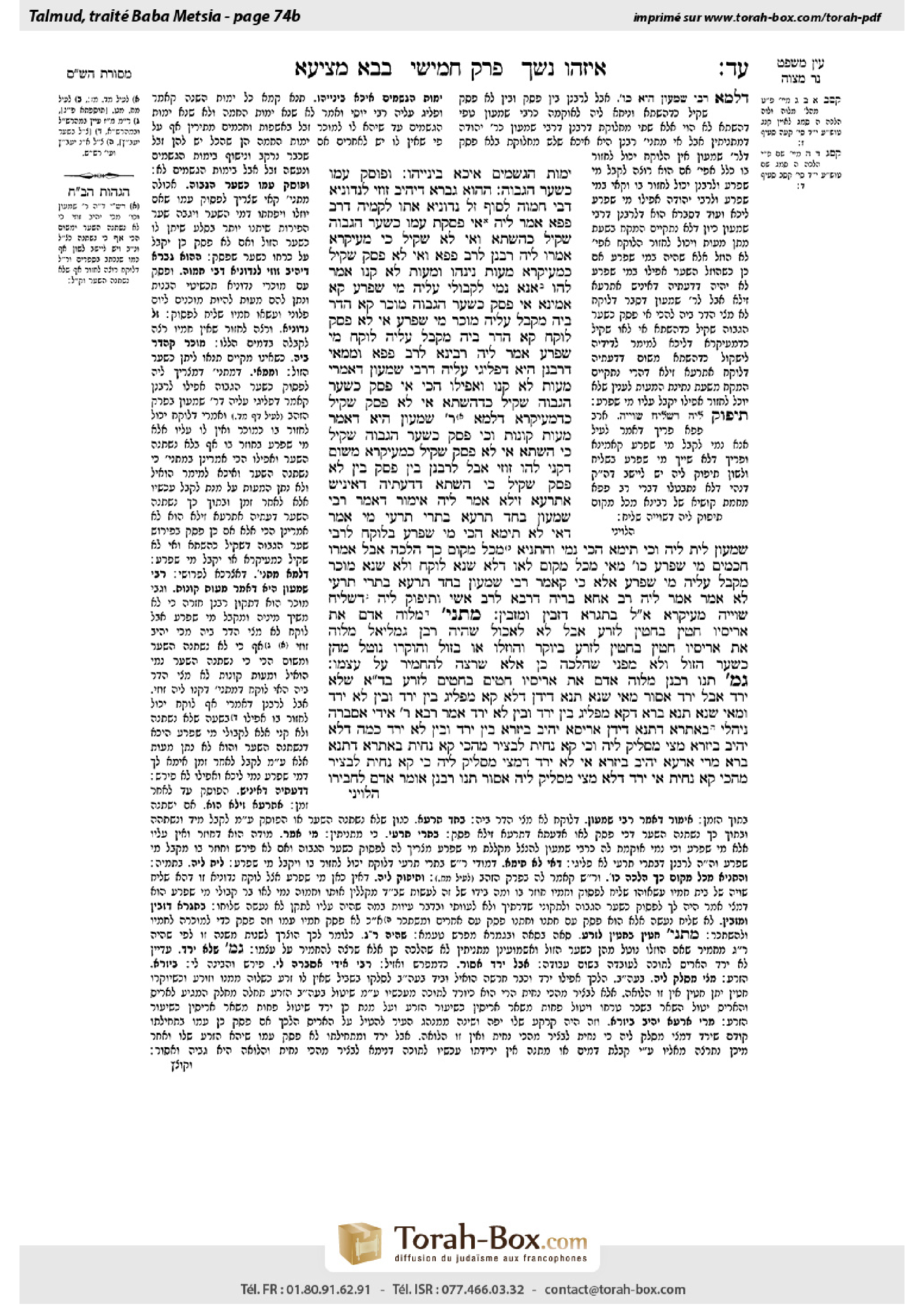
Bava Metzia 74b: Talmud study for Daf Yomi
Study the Talmud for Daf Yomi with scanned pages, Hebrew text, English translations from Sefaria and AI-generated French translations.
Passage selection and English or AI-generated French translation are available where the scan has annotations. Daf Study is independent of Torah-Box and Sefaria.
Browse Bava Metzia · בבא מציעא · All tractatesBava Metzia 74b text and translations
This page of Bava Metzia includes the Aramaic text, an English translation and an AI-generated French translation, alongside the scan above.
בבא מציעא ע״ד ב · Aramaic and Hebrew text
יְמוֹת הַגְּשָׁמִים – אִיכָּא בֵּינַיְיהוּ.
וּפוֹסֵק עִמּוֹ כְּשַׁעַר הַגָּבוֹהַּ.
הָהוּא גַּבְרָא דִּיהַיב זוּזֵי לִנְדוּנְיָא דְּבֵי חֲמוּהּ, לְסוֹף זַל נְדוּנְיָא. אֲתוֹ לְקַמֵּיהּ דְּרַב פָּפָּא. אֲמַר לֵיהּ: אִי פְּסַקְתְּ (עִמּוֹ) כְּשַׁעַר הַגָּבוֹהַּ – שְׁקֹל כִּהַשְׁתָּא. וְאִי לָא – שְׁקֹל כִּי מֵעִיקָּרָא.
אֲמַרוּ לֵיהּ רַבָּנַן לְרַב פָּפָּא: וְאִי לָא פְּסַק – שָׁקֵיל כְּמֵעִיקָּרָא? מָעוֹת נִינְהוּ, וּמָעוֹת לָא קָנוּ! אֲמַר לְהוּ: אֲנָא נָמֵי לְקַבּוֹלֵי עֲלֵיהּ ״מִי שֶׁפָּרַע״ קָא אָמֵינָא. אִי פְּסַק כְּשַׁעַר הַגָּבוֹהַּ, מוֹכֵר קָא הָדַר בֵּיהּ, מְקַבֵּל עֲלֵיהּ מוֹכֵר ״מִי שֶׁפָּרַע״. אִי לָא פְּסַק – לוֹקֵחַ קָא הָדַר בֵּיהּ, מְקַבֵּל עֲלֵיהּ לוֹקֵחַ ״מִי שֶׁפָּרַע״.
אֲמַר לֵיהּ רָבִינָא לְרַב פָּפָּא: וּמִמַּאי דְּרַבָּנַן הִיא דִּפְלִיגִי עֲלֵיהּ דְּרַבִּי שִׁמְעוֹן דְּאָמְרִי מָעוֹת לָא קָנוּ, וַאֲפִילּוּ הָכִי: אִי פְּסַק כְּשַׁעַר הַגָּבוֹהַּ – שָׁקֵיל כִּדְהַשְׁתָּא, אִי לָא פְּסַק – שָׁקֵיל כִּדְמֵעִיקָּרָא,
דִּלְמָא רַבִּי שִׁמְעוֹן הִיא, דְּאָמַר מָעוֹת קוֹנוֹת: וְכִי פְּסַק כְּשַׁעַר הַגָּבוֹהַּ – שָׁקֵיל כִּי הַשְׁתָּא, אִי לָא פְּסַק – שָׁקֵיל כְּמֵעִיקָּרָא, מִשּׁוּם דְּקָנֵי לְהוּ זוּזֵי. אֲבָל לְרַבָּנַן, בֵּין פְּסַק בֵּין לָא פְּסַק – שָׁקֵיל כִּי הַשְׁתָּא, דְּדַעְתֵּיהּ דְּאִינִישׁ אַתַּרְעָא זִילָא!
אֲמַר לֵיהּ: אֵימוֹר דְּאָמַר רַבִּי שִׁמְעוֹן בְּחַד תַּרְעָא, בִּתְרֵי תַּרְעֵי מִי אָמַר? דְּאִי לָא תֵּימָא הָכִי, ״מִי שֶׁפָּרַע״ בְּלוֹקֵחַ – לְרַבִּי שִׁמְעוֹן לֵית לֵיהּ!
וְכִי תֵּימָא: הָכִי נָמֵי, וְהָתַנְיָא: מִכׇּל מָקוֹם כָּךְ הֲלָכָה, אֲבָל אָמְרוּ חֲכָמִים ״מִי שֶׁפָּרַע״ כּוּ׳.
מַאי מִכׇּל מָקוֹם? לָאו דְּלָא שְׁנָא לוֹקֵחַ וְלָא שְׁנָא מוֹכֵר מְקַבֵּל עֲלֵיהּ ״מִי שֶׁפָּרַע״? אֶלָּא כִּי קָאָמַר רַבִּי שִׁמְעוֹן: בְּחַד תַּרְעָא, בִּתְרֵי תַּרְעֵי לָא אָמַר.
אֲמַר לֵיהּ רַב אַחָא בְּרֵיהּ דְּרָבָא לְרַב אָשֵׁי: וְתִיפּוֹק לֵיהּ דְּשָׁלִיחַ שַׁוְּיֵיהּ מֵעִיקָּרָא! אֲמַר לֵיהּ: בְּתַגָּרָא דְּזָבֵין וּמְזַבֵּין.
מַתְנִי׳ מַלְוֶה אָדָם אֶת אֲרִיסָיו חִטִּין בְּחִטִּין לְזֶרַע, אֲבָל לֹא לֶאֱכוֹל. שֶׁהָיָה רַבָּן גַּמְלִיאֵל מַלְוֶה אֶת אֲרִיסָיו חִטִּין בְּחִטִּין לְזֶרַע, בְּיוֹקֶר וְהוּזְלוּ, אוֹ בְּזוֹל וְהוּקְרוּ – נוֹטֵל מֵהֶן כְּשַׁעַר הַזּוֹל. וְלֹא מִפְּנֵי שֶׁהֲלָכָה כֵּן, אֶלָּא שֶׁרָצָה לְהַחְמִיר עַל עַצְמוֹ.
גְּמָ׳ תָּנוּ רַבָּנַן: מַלְוֶה אָדָם אֶת אֲרִיסָיו חִטִּים בְּחִטִּים לְזֶרַע. בַּמֶּה דְּבָרִים אֲמוּרִים – שֶׁלֹּא יָרַד, אֲבָל יָרַד אָסוּר. מַאי שְׁנָא תַּנָּא דִּידַן דְּלָא קָא מְפַלֵּיג בֵּין יָרַד וּבֵין לֹא יָרַד, וּמַאי שְׁנָא תַּנָּא בָּרָא דְּקָא מְפַלֵּיג בֵּין יָרַד וּבֵין לֹא יָרַד?
אָמַר רָבָא, רַבִּי אִידִי אַסְבְּרַהּ נִיהֲלִי: בְּאַתְרָא דְּתַנָּא דִּידַן, אֲרִיסָא יָהֵיב בִּיזְרָא, בֵּין יָרַד וּבֵין לֹא יָרַד – כַּמָּה דְּלָא יָהֵיב בִּיזְרָא מָצֵי מְסַלֵּיק לֵיהּ, וְכִי קָא נָחֵית – לִבְצִיר מֵהָכִי קָא נָחֵית.
בְּאַתְרָא דְּתַנָּא בָּרָא, מָרֵי אַרְעָא יָהֵיב בִּיזְרָא, אִי לֹא יָרַד דְּמָצֵי מְסַלֵּיק לֵיהּ, כִּי קָא נָחֵית – לִבְצִיר מֵהָכִי קָא נָחֵית, אִי יָרַד דְּלָא מָצֵי מְסַלֵּיק לֵיהּ – אָסוּר.
תָּנוּ רַבָּנַן, אוֹמֵר אָדָם לַחֲבֵירוֹ:
Bava Metzia 74b · English translation
The practical difference between them is with regard to the rainy season. According to the first tanna one may set a price for the future delivery of manure at any point in the year, including the rainy season, but according to the Rabbis one may not arrange for the delivery during the rainy season, because manure is not commonly available then.
§ The mishna teaches: One may set a price at the highest rate, meaning he may set a price for the future delivery of produce and stipulate that if the market rate falls below the agreed-upon price, he will purchase the product according to the lowest price in effect in the market at any point during the year, which is the price that will provide the highest amount of merchandise for the amount he agreed to pay.
The Gemara relates: There was a certain man who gave money to sellers to buy jewelry for his betrothed’s dowry [linduneya] on behalf of his father-in-law, as his intended father-in-law made him an agent to buy the jewelry for part of the dowry. The betrothed man stipulated with the sellers that they would provide the jewelry in time for the wedding. Ultimately, the jewelry for the dowry became less expensive, as the price fell. The betrothed man wanted to retract his commitment to buy the jewelry at the higher price. The parties came before Rav Pappa for a ruling. Rav Pappa said to the betrothed man: If you set a price with the seller to buy the jewelry at the highest rate, i.e., the largest amount of jewelry for the price you are willing to pay, then take the jewelry at the present price. But if not, take it at the price that you set initially.
The Sages said to Rav Pappa: And if he did not set a price at the highest rate, must he take the merchandise at the price he set initially? This is a case where he paid money, and giving money alone does not effect acquisition. Rav Pappa said to them: I did not mean that it was an actual acquisition; rather, I also agree that giving money does not effect acquisition. What I said was with regard to accepting upon himself the curse: He Who exacted payment. If the betrothed man set a price at the highest rate the buyer is in the right, and if so, the seller is the one who retracted, and therefore the seller accepts upon himself the curse: He Who exacted payment. But if the betrothed man did not set a price at the highest rate, then the betrothed man, i.e., the buyer, is the one who retracted, and therefore the buyer accepts upon himself the curse: He Who exacted payment.
Ravina said to Rav Pappa: From where do you know that the ruling of the mishna, i.e., that if he did not set a price according to the highest rate he must acquire the merchandise at the price he set initially, is in accordance with the opinion of the Rabbis who disagree with Rabbi Shimon and who say that giving money does not effect acquisition? And even so, they hold that if he set a price at the highest rate, he takes it at the current price, and if he did not set a price at the highest rate, he takes it at the price he set initially.
Perhaps the ruling of the mishna is in accordance with the opinion of Rabbi Shimon, who says that giving money effects acquisition, and therefore if he set a price at the highest rate, he takes it at the current price, and if he did not set a price at the highest rate, he takes it at the price he set initially, since giving money effects acquisition. But according to the opinion of the Rabbis, whether he set a price at the highest rate or did not set a price at the highest rate, he takes it at the current price, because a person’s intention is always to acquire merchandise at the least expensive price.
Rav Pappa said to him: Say that Rabbi Shimon said his ruling that giving money effects acquisition in a case where there was one price, i.e., the price did not change in the meantime. Did he say his ruling where there were two prices? Certainly Rabbi Shimon will concede that the buyer can withdraw from the sale if the market price changes. As, if you do not say so, then the curse: He Who exacted payment, will not apply to the buyer under any circumstances according to the opinion of Rabbi Shimon.
And if you would say: Indeed, the curse: He Who exacted payment, never applies to a buyer according to the opinion of Rabbi Shimon, isn’t it taught in a baraita: Rabbi Shimon says: Even though the Sages said that when one party takes possession of a garment, the other party acquires a gold dinar, but when one party takes possession of a gold dinar, the other party does not acquire a garment, in any case, that is what the halakha would be. But the Sages said with regard to one who withdraws from a transaction where one party performed an act of acquisition by pulling the gold dinar into his possession: He Who exacted payment from the people of the generation of the flood, and from the people of the generation of the dispersion, and from the inhabitants of Sodom and Gomorrah, and from the Egyptians in the Red Sea, will in the future exact payment from whoever does not stand by his statement.
Rav Pappa clarifies: What is the meaning of: In any case? Does it not mean that there is no difference whether it is the buyer and there is no difference whether it is the seller who withdraws from the sale, that either way he accepts upon himself the curse: He Who exacted payment? Rather, it must be that when Rabbi Shimon is saying that giving money effects acquisition, he is referring to a case where there was one price, but in a case where there were two prices he did not say it.
Rav Aḥa, son of Rava, said to Rav Ashi: But let Rav Pappa derive this halakha in the case of the dowry employing a more straightforward reasoning: The father-in-law initially made the betrothed man an agent, and since he was an agent, the father-in-law could say to him: I sent you to act for my benefit, not to my detriment. Purchasing the jewels at a more expensive price is to the detriment of the father-in-law, and therefore the agency and the sale itself are nullified. Rav Ashi said to him: It is speaking here about a case where the father-in-law did not actually make him an agent. Rather, the betrothed man was a merchant who buys and sells merchandise. The father-in-law understands that he engages in commerce and that he will not always profit from his trading.
MISHNA: A person may lend wheat to his sharecroppers in exchange for wheat, for the purpose of seeding, meaning that he may lend them a quantity of wheat with which to seed the field, and at harvest time the sharecropper will add the amount of grain that he borrowed to the landowner’s portion of the yield. But he may not lend wheat for the sharecroppers to eat and be paid back with an equivalent quantity because this creates a concern about interest, as the price of wheat may rise. As Rabban Gamliel would lend wheat to his sharecroppers in exchange for wheat, for purposes of seeding, and if he lent it at a high price and the price then fell, or if he lent it at an inexpensive price and the price subsequently rose, in all cases he would take it back from them at the inexpensive price. But this was not because this is the halakha; rather, he wanted to be stringent with himself.
GEMARA: The Sages taught in a baraita: A person may lend wheat to his sharecroppers in exchange for wheat, for the purpose of seeding. In what case is this statement said? It is said when the sharecropper has not yet gone down into the field to begin to work, but if he had already gone down into the field to begin to work, lending him wheat under these terms is prohibited. The Gemara asks: What is different about the tanna of our mishna, who does not differentiate between whether the sharecropper went down or did not go down, and what is different about the tanna of the baraita, who does differentiate between whether he went down or he did not go down?
Rava said: Rabbi Idi explained the matter to me: In the locale of the tanna of our mishna, the local custom was that the sharecropper would provide the seeds, and therefore, whether he went down or did not go down, as long as the sharecropper has not put the seeds into the field the landowner can remove him from the field. Consequently, in a case where the landowner gives the sharecropper the seeds, he sets the terms of the sharecropping tenancy, and when the sharecropper goes down into the field, he goes down into the field for less than this, under the agreement that he will reduce his share of the crop in order to return the seed to the landowner.
By contrast, in the locale of the tanna of the baraita, the landowner is the one who would provide the seeds, so if he has not yet gone down into the field the landowner can remove him, and therefore, when he goes down into the field, he goes down for less than this. But if he went down, and therefore the landowner can no longer remove him, lending him wheat under these terms is prohibited, because he took upon himself in advance to work the field without receiving seeds from the owner of the field. Consequently, these seeds that he then receives are like a loan and the prohibition of interest applies.
§ The Sages taught: A person may say to another:
Bava Metzia 74b · Traduction française (IA)
La différence pratique entre eux concerne la saison des pluies. Selon le premier tanna, on peut fixer un prix pour la livraison future de fumier à tout moment de l'année, y compris pendant la saison des pluies, mais selon les Rabbins, on ne peut pas organiser la livraison pendant la saison des pluies, car le fumier n'est pas disponible en quantité suffisante à ce moment-là.
§ La mitsna enseigne : On peut fixer un prix au taux le plus élevé, c'est-à-dire qu'on peut fixer un prix pour la livraison future de produits et stipuler que si le taux du marché tombe en dessous du prix convenu, on achètera le produit au prix le plus bas en vigueur sur le marché à tout moment de l'année, ce qui permet d'obtenir la quantité maximale de marchandises pour le montant convenu.
Le Guemara rapporte : Il y avait un homme qui avait donné de l'argent aux vendeurs pour acheter des bijoux pour le dot de sa fiancée, au nom de son père-beau-père, car son futur père-beau-père l'avait désigné comme agent pour acheter les bijoux pour une partie du dot. L'homme fiancé avait stipulé avec les vendeurs qu'ils lui fourniraient les bijoux à temps pour le mariage. Finalement, les bijoux pour le dot sont devenus moins chers, car le prix avait baissé. L'homme fiancé voulait révoquer sa promesse d'acheter les bijoux au prix plus élevé. Les parties se sont présentés devant Rav Pappa pour obtenir un avis. Rav Pappa a dit à l'homme fiancé : Si tu as fixé un prix avec le vendeur pour acheter les bijoux au taux le plus élevé, c'est-à-dire la quantité maximale de bijoux pour le prix que tu es prêt à payer, alors prends les bijoux au prix actuel. Mais si ce n'est pas le cas, prends-les au prix que tu as fixé initialement.
Les Sages ont dit à Rav Pappa : Et si ce n'est pas le cas qu'il ait fixé un prix au taux le plus élevé, doit-il prendre les marchandises au prix qu'il a fixé initialement ? C'est un cas où il a payé de l'argent, et donner de l'argent seul ne constitue pas une acquisition. Rav Pappa a dit à eux : Je n'ai pas voulu dire qu'il s'agissait d'une acquisition réelle ; plutôt, je suis d'accord avec le fait que donner de l'argent ne constitue pas une acquisition. Ce que j'ai dit concerne l'acceptation de la malédiction : Celui qui a exigé le paiement. Si l'homme fiancé a fixé un prix au taux le plus élevé, l'acheteur a raison, et si c'est le cas, le vendeur a révoqué, et donc le vendeur accepte la malédiction : Celui qui a exigé le paiement. Mais si l'homme fiancé n'a pas fixé un prix au taux le plus élevé, alors l'homme fiancé, c'est-à-dire l'acheteur, est celui qui a révoqué, et donc l'acheteur accepte la malédiction : Celui qui a exigé le paiement.
Ravina a dit à Rav Pappa : D'où sais-tu que la décision de la Michna, c'est-à-dire que si l'on n'a pas fixé un prix au taux le plus élevé, il doit acquérir les marchandises au prix qu'il a fixé initialement, correspond à l'opinion des Rabbins qui s'opposent à Rabbi Shimon et qui disent que donner de l'argent ne constitue pas une acquisition ? Et même ainsi, ils pensent que si l'on a fixé un prix au taux le plus élevé, on le prend au prix actuel, et si l'on n'a pas fixé un prix au taux le plus élevé, on le prend au prix qu'on a fixé initialement.
Peut-être que la décision de la Michna correspond à l'opinion de Rabbi Shimon, qui dit que donner de l'argent constitue une acquisition, et donc si l'on a fixé un prix au taux le plus élevé, on le prend au prix actuel, et si l'on n'a pas fixé un prix au taux le plus élevé, on le prend au prix qu'on a fixé initialement, car donner de l'argent constitue une acquisition. Mais selon l'opinion des Rabbins, que l'on ait fixé un prix au taux le plus élevé ou non, on le prend au prix actuel, car l'intention d'une personne est toujours d'acheter des marchandises au prix le plus bas.
Rav Pappa a dit à lui : Dis que Rabbi Shimon a dit sa décision que donner de l'argent constitue une acquisition dans un cas où il y avait un seul prix, c'est-à-dire que le prix n'a pas changé pendant ce temps. A-t-il dit sa décision dans un cas où il y avait deux prix ? Certainement Rabbi Shimon admettra que l'acheteur peut révoquer la vente si le prix du marché change. En effet, si tu ne dis pas cela, alors la malédiction : Celui qui a exigé le paiement ne s'appliquera pas à l'acheteur selon l'opinion de Rabbi Shimon.
Et si l'on disait : En effet, la malédiction : Celui qui a exigé le paiement ne s'applique jamais à un acheteur selon l'opinion de Rabbi Shimon, n'est-ce pas enseigné dans une baraïta : Rabbi Shimon dit : Même si les Sages disent que lorsque l'une des parties prend possession d'un vêtement, l'autre acquiert un dinar d'or, mais lorsque l'une des parties prend possession d'un dinar d'or, l'autre ne acquiert pas un vêtement, en tout cas, c'est ce qui serait la halakha. Mais les Sages disent concernant celui qui révoque une transaction où l'une des parties a accompli une acquisition en prenant possession du dinar d'or : Celui qui exigera le paiement des gens de la génération de la diluvion, et des gens de la dispersion, et des habitants de Sodome et de Gomorrah, et des Égyptiens dans la mer Rouge, exigera à l'avenir le paiement de celui qui ne tient pas à sa déclaration.
Rav Pappa clarifie : Quelle est la signification de : En tout cas ? Ne signifie-t-il pas que cela ne fait pas de différence si c'est l'acheteur ou si c'est le vendeur qui révoque la vente, que soit l'un ou l'autre accepte la malédiction : Celui qui a exigé le paiement ? Plutôt, il doit être que lorsque Rabbi Shimon dit que donner de l'argent constitue une acquisition, il parle d'un cas où il y avait un seul prix, mais dans un cas où il y avait deux prix, il n'a pas dit cela.
Rav Acha, fils de Rava, dit à Rav Ashi : Mais laissez plutôt Rav Pappa déduire cette halakha dans le cas du dot en utilisant un raisonnement plus direct : Le père du mari avait d'abord désigné le fiancé comme agent, et puisque c'était un agent, le père pouvait lui dire : Je t'ai envoyé agir en mon nom, pas contre mon intérêt. Acheter les bijoux à un prix plus élevé est contraire à l'intérêt du père, et donc l'agence et l'achat lui-même sont annulés. Rav Ashi répondit à lui : On parle ici d'un cas où le père n'avait pas effectivement désigné le fiancé comme agent. En réalité, le fiancé était un marchand qui achète et vend des marchandises. Le père sait qu'il engage dans le commerce et qu'il ne profitera pas toujours de ses transactions.
MICHNA : Une personne peut prêter du blé à ses fermiers en échange de blé, à des fins de semis, ce qui signifie qu'il peut prêter une quantité de blé avec laquelle ils semeront le champ, et à la récolte, le fermier ajoutera la quantité de blé qu'il a emprunté à la part du propriétaire. Mais il ne peut pas prêter du blé pour qu'ils le mangent et soient payés en équivalent, car cela crée une préoccupation concernant l'intérêt, en raison de la possible hausse du prix du blé. Comme Rabban Gamliel prêta du blé à ses fermiers en échange de blé, à des fins de semis, et s'il le prêta à un prix élevé et que le prix baissa ensuite, ou s'il le prêta à un prix bas et que le prix augmenta ensuite, dans tous les cas il le récupérait à un prix bas. Mais cela ne s'est pas fait parce que c'est la halakha ; plutôt, il voulait être strict avec lui-même.
GUEMARA : Les Sages ont enseigné dans une baraïta : Une personne peut prêter du blé à ses fermiers en échange de blé, à des fins de semis. Dans quel cas cette déclaration est-elle faite ? C'est lorsque le fermier n'a pas encore descendu dans le champ pour commencer à travailler, mais si c'était déjà le cas, prêter du blé sous ces termes est interdit. La Guemara pose la question : Qu'est-ce qui diffère dans la position du tanna de notre mishna, qui ne distingue pas entre le fait que le fermier ait descendu ou non, et ce qui diffère dans la position du tanna de la baraïta, qui distingue entre le fait qu'il ait descendu ou non ?
Rava dit : Rabbi Idi m'a expliqué la chose : Dans la région du tanna de notre mishna, la coutume locale était que le fermier fournissait les graines, et donc, que qu'il ait descendu ou non, tant que le fermier n'a pas mis les graines dans le champ, le propriétaire peut le retirer du champ. Ainsi, dans un cas où le propriétaire donne les graines au fermier, il fixe les termes de la location de la terre, et lorsque le fermier descend dans le champ, il descend pour moins que cela, sous l'accord qu'il réduira sa part de récolte afin de rendre les graines au propriétaire.
Par contraste, dans la région du tanna de la baraïta, c'est le propriétaire qui fournit les graines, donc si le fermier n'a pas encore descendu dans le champ, le propriétaire peut le retirer, et donc, lorsque le fermier descend dans le champ, il descend pour moins que cela. Mais si le fermier a déjà descendu, et donc le propriétaire ne peut plus le retirer, prêter du blé sous ces termes est interdit, car il s'est engagé à travailler le champ sans recevoir de graines du propriétaire. Ainsi, ces graines qu'il reçoit ensuite sont comme un prêt et la prohibition de l'intérêt s'applique.
§ Les Sages ont enseigné : Une personne peut dire à un autre :
Traduction française générée par IA à partir de l’édition anglaise de Sefaria. Vérifie toujours un passage avec le texte source.
Text from Sefaria: William Davidson Edition - Vocalized Aramaic (CC BY NC); William Davidson Edition - English (CC BY NC).