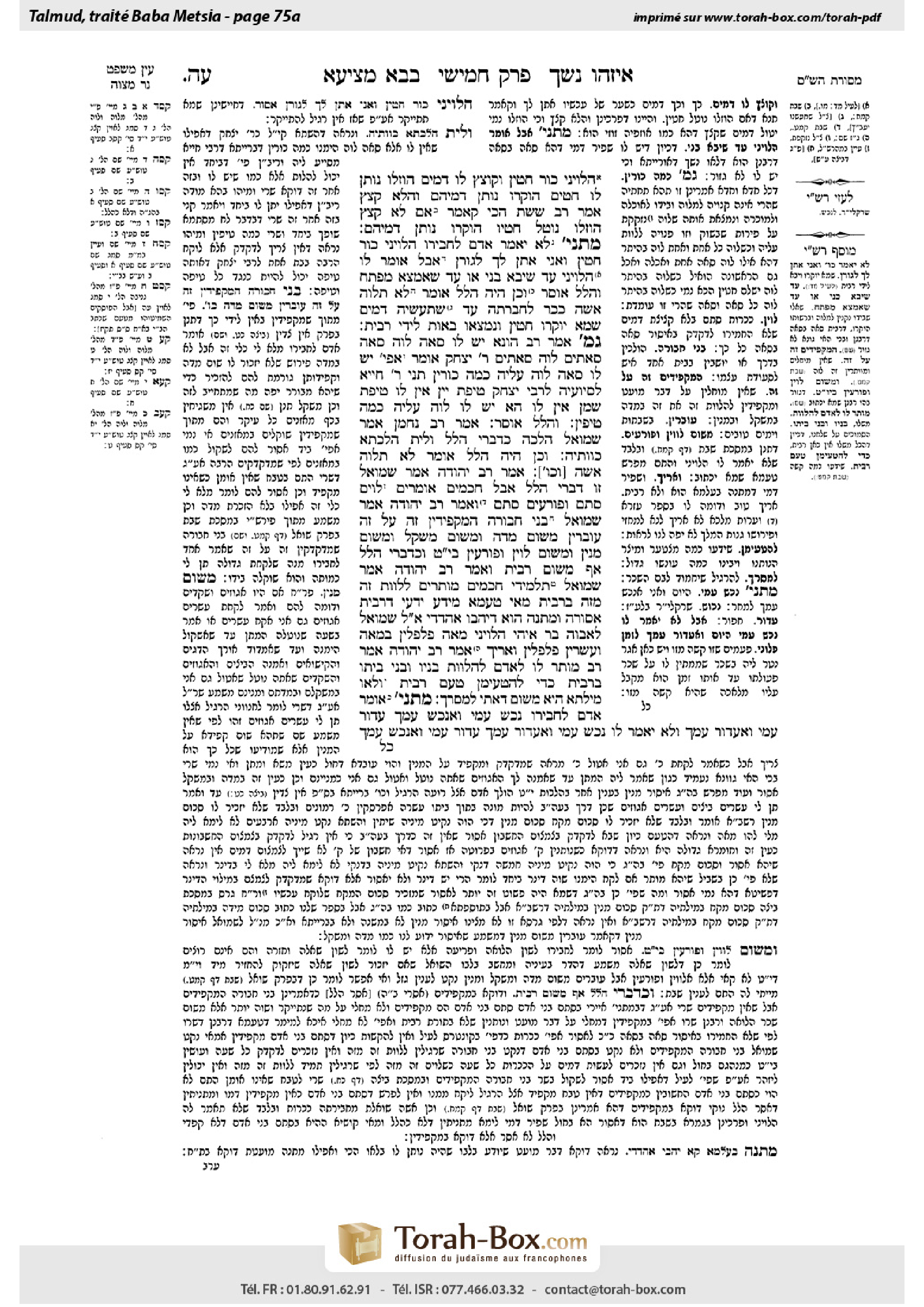
Bava Metzia 75a: Talmud study for Daf Yomi
Study the Talmud for Daf Yomi with scanned pages, Hebrew text, English translations from Sefaria and AI-generated French translations.
Passage selection and English or AI-generated French translation are available where the scan has annotations. Daf Study is independent of Torah-Box and Sefaria.
Browse Bava Metzia · בבא מציעא · All tractatesBava Metzia 75a text and translations
This page of Bava Metzia includes the Aramaic text, an English translation and an AI-generated French translation, alongside the scan above.
בבא מציעא ע״ה א · Aramaic and Hebrew text
הַלְוֵינִי כּוֹר חִטִּין וְקוֹצֵץ לוֹ דָּמִים, הוּזְלוּ – נוֹתֵן לוֹ חִטִּים, הוּקְרוּ – נוֹתֵן דְּמֵיהֶם.
וַהֲלֹא קָצַץ! אָמַר רַב שֵׁשֶׁת: הָכִי קָאָמַר. אִם לֹא קָצַץ – הוּזְלוּ – נוֹטֵל חִטָּיו. הוּקְרוּ – נוֹתֵן דְּמֵיהֶם.
מַתְנִי׳ לֹא יֹאמַר אָדָם לַחֲבֵירוֹ: הַלְוֵינִי כּוֹר חִטִּין וַאֲנִי אֶתֵּן לָךְ לַגּוֹרֶן. אֲבָל אוֹמֵר לוֹ: הַלְוֵינִי עַד שֶׁיָּבֹא בְּנִי אוֹ עַד שֶׁאֶמְצָא מַפְתֵּחַ. וְהִלֵּל אוֹסֵר. וְכֵן הָיָה הִלֵּל אוֹמֵר: לֹא תַּלְוֶה אִשָּׁה כִּכָּר לַחֲבֶרְתָּהּ עַד שֶׁתַּעֲשֶׂיהָ דָּמִים, שֶׁמָּא יוּקְרוּ חִטִּין, וְנִמְצְאוּ בָּאוֹת לִידֵי רִבִּית.
גְּמָ׳ אָמַר רַב הוּנָא: יֵשׁ לוֹ סְאָה – לֹוֶה סְאָה. סָאתַיִם – לֹוֶה סָאתַיִם. רַבִּי יִצְחָק אוֹמֵר: אֲפִילּוּ יֵשׁ לוֹ סְאָה – לֹוֶה עָלֶיהָ כַּמָּה כּוֹרִין.
תָּנֵי רַבִּי חִיָּיא לְסַיּוֹעֵיהּ לְרַבִּי יִצְחָק: טִיפַּת יַיִן אֵין לוֹ, טִיפַּת שֶׁמֶן אֵין לוֹ. הָא יֵשׁ לוֹ – לֹוֶה עָלֶיהָ כַּמָּה טִיפִּין.
וְהִלֵּל אוֹסֵר. אָמַר רַב נַחְמָן אָמַר שְׁמוּאֵל: הֲלָכָה כְּדִבְרֵי הִלֵּל. וְלֵית הִלְכְתָא כְּווֹתֵיהּ.
וְכֵן הָיָה הִלֵּל אוֹמֵר: לֹא תַּלְוֶה אִשָּׁה [וְכוּ׳]. אָמַר רַב יְהוּדָה אָמַר שְׁמוּאֵל: זוֹ דִּבְרֵי הִלֵּל, אֲבָל חֲכָמִים אוֹמְרִים: לֹוִים סְתָם וּפוֹרְעִים סְתָם.
וְאָמַר רַב יְהוּדָה אָמַר שְׁמוּאֵל: בְּנֵי חֲבוּרָה הַמַּקְפִּידִין זֶה עַל זֶה, עוֹבְרִין מִשּׁוּם מִדָּה וּמִשּׁוּם מִשְׁקָל וּמִשּׁוּם מִנְיָן, וּמִשּׁוּם לֹוִין וּפוֹרְעִין בְּיוֹם טוֹב, וּכְדִבְרֵי הִלֵּל אַף מִשּׁוּם רִבִּית.
וְאָמַר רַב יְהוּדָה אָמַר שְׁמוּאֵל: תַּלְמִידֵי חֲכָמִים מוּתָּרִים לִלְווֹת זֶה מִזֶּה בְּרִבִּית. מַאי טַעְמָא – מִידָּע יָדְעִי דְּרִבִּית אֲסוּרָה, וּמַתָּנָה הוּא דְּיָהֲבִי אַהֲדָדֵי. אֲמַר לֵיהּ שְׁמוּאֵל לַאֲבוּהּ בַּר אִיהִי: הַלְוֵינִי מֵאָה פִּלְפְּלִין בְּמֵאָה וְעֶשְׂרִין פִּלְפְּלִין, וַאֲרִיךְ.
אָמַר רַב יְהוּדָה אָמַר רַב: מוּתָּר לוֹ לָאָדָם לְהַלְווֹת בָּנָיו וּבְנֵי בֵיתוֹ בְּרִבִּית, כְּדֵי לְהַטְעִימָן טַעַם רִבִּית. וְלָאו מִילְּתָא הִיא, מִשּׁוּם דְּאָתֵי לְמִיסְרַךְ.
מַתְנִי׳ אוֹמֵר אָדָם לַחֲבֵירוֹ: נַכֵּשׁ עִמִּי וַאֲנַכֵּשׁ עִמָּךְ, עֲדוֹר עִמִּי וְאֶעֱדוֹר עִמָּךְ. וְלֹא יֹאמַר לוֹ: נַכֵּשׁ עִמִּי וְאֶעֱדוֹר עִמָּךְ, עֲדוֹר עִמִּי וַאֲנַכֵּשׁ עִמָּךְ.
Bava Metzia 75a · English translation
Lend me a kor of wheat, and the lender may set a price for him, stating that the borrower must repay the wheat in the future according to the value of wheat at the time of the loan. If, by the time the borrower must repay the loan, the wheat depreciates in value, he gives the lender a quantity of wheat equivalent to what he borrowed, and if it appreciates, he gives the value of the wheat he borrowed as per the market rate when he borrowed it, as agreed, but no more.
The Gemara questions this ruling: If the price of wheat depreciates, why should it be permitted for the borrower to pay him with wheat worth less than the value of the amount he borrowed? But he fixed a price at the time of the loan, and therefore the borrower owes him this amount of money. Rav Sheshet said: This is what the tanna is saying: If the lender did not set a price but merely lent him wheat, and it depreciates in value, the lender takes his wheat, as they did not agree that the borrower must repay the wheat according to its value at the time that the loan was taken out. But if it appreciates in value, the borrower gives the value of the wheat he borrowed as per the market rate when he borrowed it, in order to avoid the payment of interest.
MISHNA: A person may not say to another: Lend me a kor of wheat and I will give it back to you at the time the wheat is brought to the granary, as the wheat may increase in value, which would mean that when he gives him back a kor of wheat at the time the wheat is brought to the granary it is worth more than the value of the loan, and he therefore will have paid interest. But he may say to him: Lend me a kor of wheat for a short period of time, e.g., until my son comes or until I find the key, as there is no concern about a change in price during such a short interval of time. And Hillel prohibits the practice even in this case. And Hillel would similarly say: A woman may not lend a loaf of bread to another unless she establishes its monetary value, lest the wheat appreciate in value before she returns it, and they will therefore have come to transgress the prohibition of interest.
GEMARA: Rav Huna said: One who has a se’a of an item in his house may borrow a se’a of that item. Since he has available a se’a that he could give back right away, he may borrow one se’a, and similarly, if he has two se’a available he may borrow two se’a. Rabbi Yitzḥak says: Even if he has only one se’a, he may borrow several kor in reliance upon it. Since he can repay part of the loan immediately, and as the market value has yet to change there is only a concern about future interest, this concern is mitigated when it does not apply to the entire loan.
The Gemara comments: Rabbi Ḥiyya teaches a baraita in support of Rabbi Yitzḥak’s ruling: If one does not have a drop of wine or if he does not have a drop of oil, he may not borrow wine or oil. Consequently, by inference it can be derived: If he does have a drop of wine or oil, he may borrow many drops in reliance upon it, as the tanna is certainly not referring to a case where he borrows just a few meager drops.
§ The mishna teaches: And Hillel prohibits this practice. Rav Naḥman says that Shmuel says: The halakha is in accordance with the statement of Hillel. The Gemara comments: But the halakha is not, in fact, in accordance with the ruling of Shmuel.
§ The mishna further teaches: And Hillel would similarly say: A woman may not lend even a loaf of bread due to concern that she will violate the prohibition of interest. Rav Yehuda says that Shmuel says: This is the statement of Hillel, but the Rabbis say that one may borrow various types of foods without specification and repay them without specification. If neighbors are not particular with one another about these items, there is no concern about interest, in contrast to Hillel’s opinon.
And Rav Yehuda says that Shmuel says: With regard to the members of a group of people that eat together who are particular with each other and insist that each pay for precisely what he ate, if they dine together on Shabbat, they transgress a prohibition with regard to the strictures of measure, and with regard to the strictures of weight, and with regard to the strictures of counting, all of which are calculations that are forbidden on Shabbat. And they transgress a prohibition with regard to lending and repaying on a Festival, and according to the statement of Hillel, they also transgress the prohibition with regard to interest.
And Rav Yehuda says that Shmuel says: It is permitted for Torah scholars to borrow from one another with interest. The Gemara explains: What is the reason for this? It is because they are fully aware that interest is prohibited, and therefore they do not intend the loan to be a formal business transaction. They willingly forgo the additional payments to each other at the outset, and the extra payment is a gift that they give one another. The Gemara relates: Shmuel said to Avuh bar Ihi: Lend me one hundred peppers in exchange for 120 peppers that I will give you at a later date. And you should know that this matter is fitting and appropriate, as I intend that the additional twenty peppers be a gift.
Similarly, Rav Yehuda says that Rav says: It is permitted for a person to lend to his sons and the members of his household with interest, in order to have them taste the taste of interest so that they will understand how interest increases and how hard it is to repay it, which will discourage them from ever borrowing with interest again. The Gemara comments: But this is not correct, because the members of his household may become corrupted by doing so and act similarly with others in cases when there is no justification for such behavior.
MISHNA: A person may say to another: Weed the wild growths from my field with me now, and I will weed your field with you at a later stage, or: Till my field with me today and I will till with you on a different day. But he may not say to him: Weed with me today and I will till with you a different day, or: Till with me today and I will weed with you, as due to the different nature of the tasks it is possible that one of them will have to work harder than the other did, which is a type of interest, since he repaid him with additional labor.
Bava Metzia 75a · Traduction française (IA)
Prête-moi un kor de blé, et le prêteur peut fixer un prix, en indiquant que le prêteur doit rembourser le blé à l'avenir selon la valeur du blé à l'époque du prêt. Si, lorsqu'il doit rembourser le prêt, la valeur du blé diminue, il donne au prêteur une quantité de blé équivalente à ce qu'il a emprunté, et si la valeur augmente, il donne la valeur du blé emprunté selon le taux du marché à l'époque du prêt, comme convenu, mais pas plus.
La Guemara questionne cette décision : Si la valeur du blé diminue, pourquoi est-il permis au prêteur de payer avec un blé de valeur inférieure à celle de la somme empruntée ? Mais il a fixé un prix à l'époque du prêt, et donc le prêteur doit lui payer cette somme d'argent. Rav Sheshet a dit : C'est ce que le tanna dit : Si le prêteur n'a pas fixé un prix mais a simplement prêté du blé, et que la valeur du blé diminue, le prêteur récupère son blé, car ils n'ont pas convenu que le prêteur doive rembourser le blé selon sa valeur à l'époque du prêt. Mais si la valeur augmente, le prêteur donne la valeur du blé emprunté selon le taux du marché à l'époque du prêt, afin d'éviter le paiement d'intérêts.
MICHNA : Une personne ne peut pas dire à une autre : Prête-moi un kor de blé et je te le rendrai à l'époque où le blé est amené au grenier, car le blé peut augmenter en valeur, ce qui signifierait que lorsqu'il te rendra un kor de blé à l'époque où le blé est amené au grenier, il sera plus précieux que la valeur du prêt, et il aura donc payé des intérêts. Mais il peut dire à l'autre : Prête-moi un kor de blé pendant une courte période, par exemple jusqu'à ce que mon fils arrive ou jusqu'à ce que je trouve la clé, car il n'y a pas de préoccupation concernant une variation de prix pendant une telle courte période. Et Hillel interdit cette pratique même dans ce cas. Et Hillel dirait de la même manière : Une femme ne peut pas prêter un pain à une autre sans fixer sa valeur monétaire, de peur que le blé augmente en valeur avant qu'elle ne le rende, et qu'ils aboutissent ainsi à transgresser l'interdiction d'intérêts.
GUEMARA : Rav Huna a dit : Celui qui a un se’a d'un objet dans sa maison peut emprunter un se’a de cet objet. Puisqu'il a à disposition un se’a qu'il peut rendre immédiatement, il peut emprunter un se’a, et de même, s'il a deux se’a disponibles, il peut emprunter deux se’a. Rabbi Yitzḥak dit : Même s'il n'a qu'un se’a, il peut emprunter plusieurs kor en se fondant sur celui-ci. Puisqu'il peut rembourser une partie du prêt immédiatement, et que la valeur du marché n'a pas encore changé, il n'y a qu'une préoccupation concernant les intérêts futurs, cette préoccupation est atténuée lorsqu'elle ne s'applique pas à l'ensemble du prêt.
La Guemara commente : Rabbi Ḥiyya enseigne une baraïta en soutien de la décision de Rabbi Yitzḥak : Si l'on n'a pas une goutte de vin ou si l'on n'a pas une goutte d'huile, on ne peut pas emprunter du vin ou de l'huile. Par conséquent, par déduction, on peut dire : Si l'on a une goutte de vin ou d'huile, on peut emprunter plusieurs gouttes en se fondant sur celle-ci, car le tanna ne fait certainement pas référence à un cas où l'on emprunte juste quelques gouttes négligeables.
§ La Michna enseigne : Et Hillel interdit cette pratique. Rav Naḥman dit que Shmuel dit : La halakha suit la déclaration de Hillel. La Guemara commente : Mais la halakha n'est pas, en réalité, en conformité avec la décision de Shmuel.
§ La Michna enseigne de plus : Et Hillel dirait de la même manière : Une femme ne peut pas prêter même un pain à cause de la crainte de transgresser l'interdiction d'intérêts. Rav Yehuda dit que Shmuel dit : C'est la déclaration de Hillel, mais les Rabbins disent que l'on peut emprunter divers types de nourriture sans précision et les rendre sans précision. Si les voisins ne sont pas exigeants les uns envers les autres concernant ces objets, il n'y a pas de préoccupation d'intérêts, contrairement à l'opinion de Hillel.
Et Rav Yehuda dit que Shmuel dit : Concernant les membres d'un groupe de personnes qui mangent ensemble et qui sont exigeants les uns envers les autres et insistent pour que chacun paie exactement ce qu'il a mangé, s'ils dînent ensemble le sabbat, ils transgressent une interdiction concernant les mesures, les poids et le comptage, toutes des calculs interdits le sabbat. Et ils transgressent une interdiction concernant le prêt et le remboursement lors d'un festival, et selon la déclaration de Hillel, ils transgressent également l'interdiction concernant les intérêts.
Et Rav Yehuda dit que Shmuel dit : Il est permis aux savants de la Torah d'emprunter les uns aux autres avec intérêt. La Guemara explique : Quelle est la raison de cela ? C'est parce qu'ils sont pleinement conscients que l'intérêt est interdit, et donc ils n'ont pas l'intention que le prêt soit une transaction formelle. Ils renoncent volontairement aux paiements supplémentaires dès le départ, et ce supplément est un cadeau qu'ils donnent les uns aux autres. La Guemara rapporte : Shmuel a dit à Avuh bar Ihi : Prête-moi cent piments en échange de 120 piments que je te donnerai ultérieurement. Et tu dois savoir que cette affaire est appropriée et convenable, car j'entends que les vingt piments supplémentaires soient un cadeau.
De même, Rav Yehuda dit que Rav dit : Il est permis à une personne de prêter à ses fils et aux membres de sa famille avec intérêt, afin qu'ils goûtent l'expérience de l'intérêt et comprennent comment l'intérêt augmente et combien il est difficile de le rembourser, ce qui les découragera de jamais emprunter à nouveau avec intérêt. La Guemara commente : Mais cela n'est pas correct, car les membres de sa famille peuvent se corrompre en agissant ainsi et agir de même avec d'autres dans les cas où il n'y a pas de justification pour un tel comportement.
MICHNA : Une personne peut dire à une autre : Débarrasse les mauvaises herbes de mon champ avec moi maintenant, et je débarrasserai ton champ avec toi à une autre date, ou : Cultive mon champ avec moi aujourd'hui et je cultiverai avec toi un autre jour. Mais il ne peut pas dire à l'autre : Débarrasse les mauvaises herbes avec moi aujourd'hui et je cultiverai avec toi un autre jour, ou : Cultive avec moi aujourd'hui et je débarrasserai avec toi, car en raison de la nature différente des tâches, il est possible que l'un d'eux doive travailler plus dur que l'autre, ce qui constitue un genre d'intérêt, puisqu'il lui récompense avec un travail supplémentaire.
Traduction française générée par IA à partir de l’édition anglaise de Sefaria. Vérifie toujours un passage avec le texte source.
Text from Sefaria: William Davidson Edition - Vocalized Aramaic (CC BY NC); William Davidson Edition - English (CC BY NC).