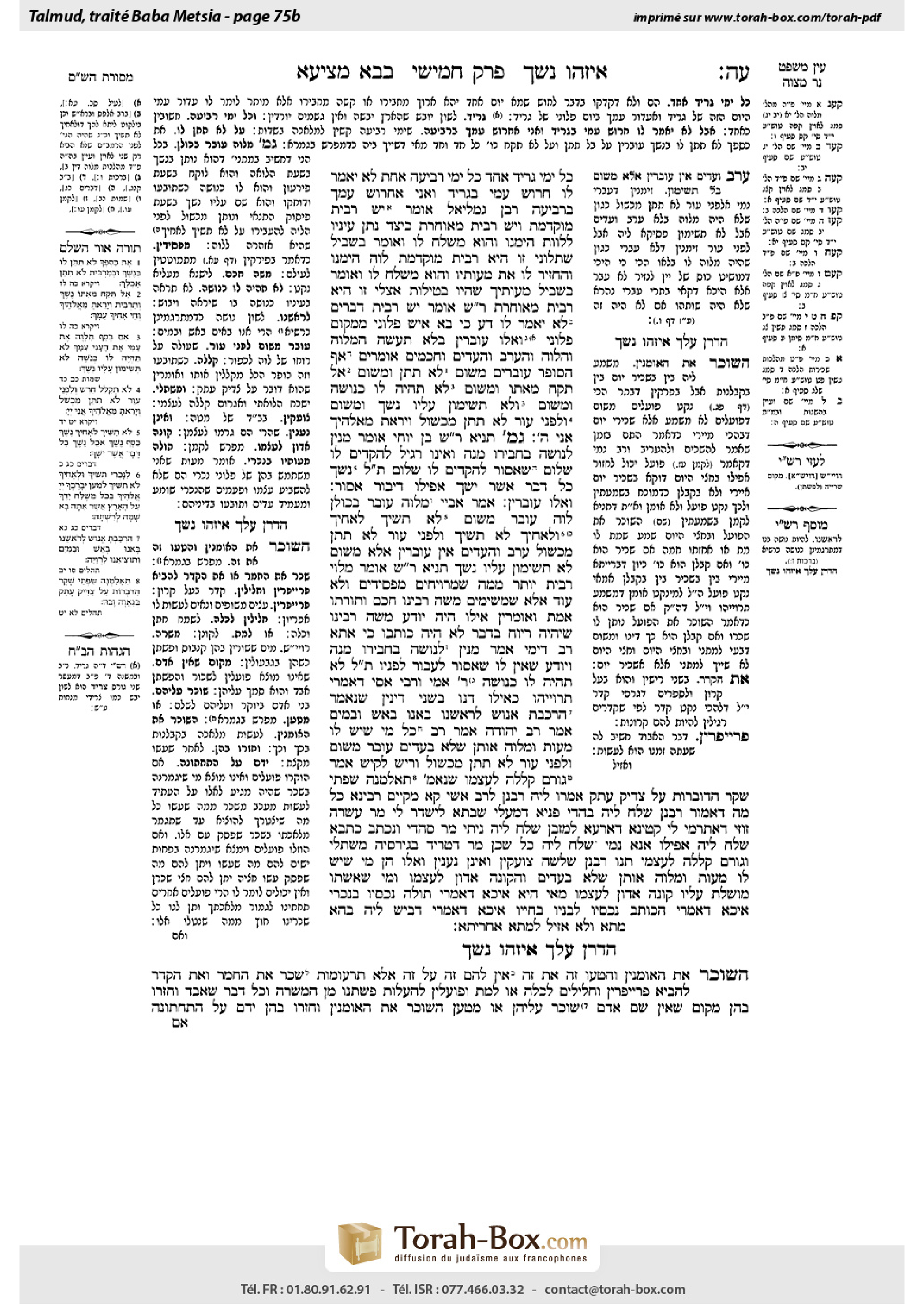
Bava Metzia 75b: Talmud study for Daf Yomi
Study the Talmud for Daf Yomi with scanned pages, Hebrew text, English translations from Sefaria and AI-generated French translations.
Passage selection and English or AI-generated French translation are available where the scan has annotations. Daf Study is independent of Torah-Box and Sefaria.
Browse Bava Metzia · בבא מציעא · All tractatesBava Metzia 75b text and translations
This page of Bava Metzia includes the Aramaic text, an English translation and an AI-generated French translation, alongside the scan above.
בבא מציעא ע״ה ב · Aramaic and Hebrew text
כׇּל יְמֵי גְּרִיד – אֶחָד. כׇּל יְמֵי רְבִיעָה – אַחַת. לֹא יֹאמַר לוֹ: חֲרוֹשׁ עִמִּי בִּגְרִיד וַאֲנִי אֶחְרוֹשׁ עִמְּךָ בָּרְבִיעָה.
רַבָּן גַּמְלִיאֵל אוֹמֵר: יֵשׁ רִבִּית מוּקְדֶּמֶת וְיֵשׁ רִבִּית מְאוּחֶרֶת. כֵּיצַד? נָתַן עֵינָיו לִלְווֹת הֵימֶנּוּ, וְהוּא מְשַׁלֵּחַ לוֹ וְאוֹמֵר: בִּשְׁבִיל שֶׁתַּלְוֵנִי – זוֹ הִיא רִבִּית מוּקְדֶּמֶת. לָוָה הֵימֶנּוּ וְהֶחְזִיר לוֹ אֶת מְעוֹתָיו, וְהוּא מְשַׁלֵּחַ לוֹ וְאוֹמֵר: בִּשְׁבִיל מְעוֹתֶיךָ שֶׁהָיוּ בְּטֵילוֹת אֶצְלִי – זוֹ הִיא רִבִּית מְאוּחֶרֶת.
רַבִּי שִׁמְעוֹן אוֹמֵר: יֵשׁ רִבִּית דְּבָרִים. לֹא יֹאמַר לוֹ ״דַּע כִּי בָּא אִישׁ פְּלוֹנִי מִמָּקוֹם פְּלוֹנִי״.
וְאֵלּוּ עוֹבְרִין בְּלֹא תַעֲשֶׂה: הַמַּלְוֶה וְהַלֹּוֶה וְהֶעָרֵב וְהָעֵדִים. וַחֲכָמִים אוֹמְרִים: אַף הַסּוֹפֵר. עוֹבְרִים מִשּׁוּם ״לֹא תִתֵּן״, וּמִשּׁוּם ״אַל תִּקַּח מֵאִתּוֹ״, וּמִשּׁוּם ״לֹא תִהְיֶה לוֹ כְּנוֹשֶׁה״, וּמִשּׁוּם ״לֹא תְשִׂימוּן עָלָיו נֶשֶׁךְ״, וּמִשּׁוּם ״וְלִפְנֵי עִוֵּר לֹא תִתֵּן מִכְשׁוֹל וְיָרֵאתָ מֵּאֱלֹהֶיךָ אֲנִי ה׳״.
גְּמָ׳ תַּנְיָא, רַבִּי שִׁמְעוֹן בֶּן יוֹחַי אוֹמֵר: מִנַּיִן לַנּוֹשֶׁה בַּחֲבֵירוֹ מָנֶה, וְאֵינוֹ רָגִיל לְהַקְדִּים לוֹ שָׁלוֹם, שֶׁאָסוּר לְהַקְדִּים לוֹ שָׁלוֹם – תַּלְמוּד לוֹמַר: ״נֶשֶׁךְ כׇּל דָּבָר אֲשֶׁר יִשָּׁךְ״ – אֲפִילּוּ דִּיבּוּר אָסוּר.
וְאֵלּוּ עוֹבְרִין, אָמַר אַבָּיֵי: מַלְוֶה עוֹבֵר בְּכוּלָּן. לֹוֶה עוֹבֵר מִשּׁוּם ״לֹא תַשִּׁיךְ לְאָחִיךָ״. ״וּלְאָחִיךָ לֹא תַשִּׁיךְ״, ״וְלִפְנֵי עִוֵּר לֹא תִתֵּן מִכְשׁוֹל״. עָרֵב וְהָעֵדִים אֵין עוֹבְרִין אֶלָּא מִשּׁוּם ״לֹא תְשִׂימוּן עָלָיו נֶשֶׁךְ״.
תַּנְיָא, רַבִּי שִׁמְעוֹן אוֹמֵר: מַלְוֵי רִבִּית יוֹתֵר מִמַּה שֶּׁמַּרְוִיחִים – מַפְסִידִים. וְלֹא עוֹד אֶלָּא שֶׁמְּשִׂימִים מֹשֶׁה רַבֵּינוּ חָכָם וְתוֹרָתוֹ אֱמֶת. וְאוֹמְרִין: אִילּוּ הָיָה יוֹדֵעַ מֹשֶׁה רַבֵּינוּ שֶׁיִּהְיֶה רֶיוַח בַּדָּבָר לֹא הָיָה כּוֹתְבוֹ.
כִּי אֲתָא רַב דִּימִי אָמַר: מִנַּיִן לַנּוֹשֶׁה בַּחֲבֵירוֹ מָנֶה, וְיוֹדֵעַ שֶׁאֵין לוֹ, שֶׁאָסוּר לַעֲבוֹר לְפָנָיו – תַּלְמוּד לוֹמַר: ״לֹא תִהְיֶה לוֹ כְּנֹשֶׁה״.
רַבִּי אַמֵּי וְרַבִּי אַסִּי דְאָמְרִי תַּרְוַיְיהוּ כְּאִילּוּ דָּנוֹ בִּשְׁנֵי דִּינִין, שֶׁנֶּאֱמַר: ״הִרְכַּבְתָּ אֱנוֹשׁ לְרֹאשֵׁנוּ בָּאנוּ בָאֵשׁ וּבַמַּיִם״.
אָמַר רַב יְהוּדָה אָמַר רַב: כָּל מִי שֶׁיֵּשׁ לוֹ מָעוֹת וּמַלְוֶה אוֹתָן שֶׁלֹּא בְּעֵדִים – עוֹבֵר מִשּׁוּם ״וְלִפְנֵי עִוֵּר לֹא תִתֵּן מִכְשֹׁל״. וְרֵישׁ לָקִישׁ אָמַר: גּוֹרֵם קְלָלָה לְעַצְמוֹ, שֶׁנֶּאֱמַר: ״תֵּאָלַמְנָה שִׂפְתֵי שָׁקֶר הַדּוֹבְרוֹת עַל צַדִּיק עָתָק״.
אֲמַרוּ לֵיהּ רַבָּנַן לְרַב אָשֵׁי: קָא מְקַיֵּים רָבִינָא כֹּל מָה דַּאֲמוּר רַבָּנַן. שְׁלַח לֵיהּ בַּהֲדֵי פַּנְיָא דְּמַעֲלֵי שַׁבְּתָא: לִישַׁדַּר לִי מָר עַשְׂרָה זוּזֵי דְּאִתְרְמִי לִי קַטִּינָא דְּאַרְעָא לְמִזְבַּן. שְׁלַח לֵיהּ: נַיְתֵי מָר סָהֲדֵי וְנִכְתֹּב כְּתָבָא. שְׁלַח לֵיהּ: אֲפִילּוּ אֲנָא נָמֵי? שְׁלַח לֵיהּ: כׇּל שֶׁכֵּן מָר דִּטְרִיד בְּגִירְסֵיהּ מִשְׁתְּלֵי וְגוֹרֵם קְלָלָה לְעַצְמוֹ.
תָּנוּ רַבָּנַן: שְׁלֹשָׁה צוֹעֲקִין וְאֵינָן נַעֲנִין, וְאֵלּוּ הֵן: מִי שֶׁיֵּשׁ לוֹ מָעוֹת וּמַלְוֶה אוֹתָן שֶׁלֹּא בְּעֵדִים, וְהַקּוֹנֶה אָדוֹן לְעַצְמוֹ, וּמִי שֶׁאִשְׁתּוֹ מוֹשֶׁלֶת עָלָיו.
קוֹנָה אָדוֹן לְעַצְמוֹ מַאי הִיא? אִיכָּא דְאָמְרִי: תּוֹלֶה נְכָסָיו בְּגוֹי. אִיכָּא דְּאָמְרִי: הַכּוֹתֵב נְכָסָיו לְבָנָיו בְּחַיָּיו. אִיכָּא דְּאָמְרִי: דְּבִישׁ לֵיהּ בְּהָא מָתָא וְלָא אָזֵיל לְמָתָא אַחֲרִיתִי.
הֲדַרַן עֲלָךְ אֵיזֶהוּ נֶשֶׁךְ
מַתְנִי׳ הַשּׂוֹכֵר אֶת הָאוּמָּנִין וְהִטְעוּ זֶה אֶת זֶה – אֵין לָהֶם זֶה עַל זֶה אֶלָּא תַּרְעוֹמֶת. שָׂכַר אֶת הַחַמָּר וְאֶת הַקַּדָּר לְהָבִיא פְּרִיָיפָרִין וַחֲלִילִים לַכַּלָּה אוֹ לַמֵּת, וּפוֹעֲלִין לְהַעֲלוֹת פִּשְׁתָּנוֹ מִן הַמִּשְׁרָה, וְכׇל דָּבָר שֶׁאָבֵד וְחָזְרוּ בָּהֶן, מָקוֹם שֶׁאֵין שָׁם אָדָם – שׂוֹכֵר עֲלֵיהֶן אוֹ מַטְעָן.
הַשּׂוֹכֵר אֶת הָאוּמָּנִין וְחָזְרוּ בָּהֶן – יָדָם עַל הַתַּחְתּוֹנָה.
Bava Metzia 75b · English translation
All the dry days during the summer, when it does not rain, are viewed as one period, meaning that if they each agreed to work one day, the dry days are viewed as though they were all exactly equal in length, despite the slight differences between them. Similarly, all the rainy days are treated as one period. But he may not say to him: Plow with me in the dry season and I will plow with you in the rainy season.
Rabban Gamliel says: There is a case of pre-paid interest, and there is also a case of interest paid later, both of which are prohibited. How so? If he had hopes of borrowing money from him in the future, and he sends him money or a gift and says: I am sending you this gift in order that you will lend to me, this is pre-paid interest. Similarly, if he borrowed money from him and subsequently returned his money, and he later sends a gift to him and says: I am sending you this gift in order to repay you for your money, which was idle with me, preventing you from earning a profit from it, this is interest paid later.
Rabbi Shimon says: Not only is there interest consisting of payment of money or items, but there is also verbal interest. For example, the borrower may not say to the lender: You should know that so-and-so has come from such and such a place, when he is aware that this information is of significance to his creditor. Since his intention is to provide a benefit to the lender, he has effectively paid him an extra sum for the money he lent him, which constitutes interest.
And these people violate a prohibition of interest: The lender, and the borrower, and the guarantor, and the witnesses. And the Rabbis say: Also the scribe who writes the promissory note violates this prohibition. These parties to the transaction violate different prohibtions. Some are in violation of: “You shall not give him your money with interest” (Leviticus 25:37), and of: “Do not take from him interest or increase” (Leviticus 25:36), and of: “Do not be to him as a creditor” (Exodus 22:24), and of “Do not place interest upon him” (Exodus 22:24), and of: “And you shall not place a stumbling block before the blind, and you shall fear your God; I am the Lord” (Leviticus 19:14).
GEMARA: It is taught in a baraita that Rabbi Shimon ben Yoḥai says: From where is it derived with regard to one who is owed one hundred dinars by another, and the borrower is not accustomed to greeting that lender, that it is prohibited to start greeting him after being granted the loan? The verse states: “Interest of any matter [davar] that is lent with interest” (Deuteronomy 23:20), which can also be read as indicating that even speech [dibbur] can be prohibited as interest.
§ The mishna teaches: And these people violate the prohibition of interest. Abaye says: The lender violates all of them, meaning all of the prohibitions listed in the mishna. The borrower violates the prohibition of: “You shall not lend to your brother with interest” (Deuteronomy 23:20), as he enables his brother to lend with interest. And they also violate the prohibition: “You may lend to a gentile with interest, but to your brother you shall not lend with interest” (Deuteronomy 23:21), as well as: “And you shall not place a stumbling block before the blind” (Leviticus 19:14). The guarantor and the witness violate only: “Do not place interest upon him” (Exodus 22:24).
It is taught in a baraita that Rabbi Shimon says: Those who lend with interest lose more than they gain, as they will eventually be punished by God. Moreover, a loan of this kind desecrates the name of Heaven, as they cause it to seem that Moses our teacher is a scholar and his Torah is true. This is a euphemism; Rabbi Shimon means that their actions make a mockery of Moses and his Torah. And this is because they say: Had Moses our teacher known that there was a profit involved in the matter, he would not have written it as a prohibition. Not only do they violate a mitzva but they also belittle the Torah.
§ The Gemara cites further statements with regard to loans in general. When Rav Dimi came from Eretz Yisrael, he said: From where is it derived that with regard to one who is owed one hundred dinars by another and knows that the borrower does not have the funds to repay him, that it is prohibited for him to pass before the borrower, so as not to embarrass the borrower and cause him discomfort? The verse states: “Do not be to him as a creditor” (Exodus 22:24). Even if he does not claim the debt from the borrower, his presence reminds the latter of the debt, which distresses him.
Rabbi Ami and Rabbi Asi both say that if one upsets another in this way, it is as though he sentences him to two types of punishments, as it is stated: “You have caused men to ride over our heads; we went through fire and through water” (Psalms 66:12). As the one in control, a creditor is regarded as though he had brought the debtor through fire and water.
§ Rav Yehuda says that Rav says: Whoever has money and lends it not in the presence of witnesses violates the prohibition of: “And you shall not place a stumbling block before the blind” (Leviticus 19:14), as this tempts the borrower not to repay his debt. And Reish Lakish says: He brings a curse upon himself, as it is stated: “Let the lying lips be dumb, which speak arrogantly against the righteous, with pride and contempt” (Psalms 31:19), as when the lender comes to claim his money without any proof, people will think he is falsely accusing the borrower, and they will end up cursing him.
The Gemara cites a related incident: The Sages said to Rav Ashi: Ravina fulfills all of the directives that the Sages say. Seeking to test him, Rav Ashi sent a messenger to him close to sunset on the eve of Shabbat, at the busiest time of the week, with the following request: Let the Master send me ten dinars as a loan, as I have happened upon a small piece of land for an acquisition and I need the money. Ravina sent a message to him: Let the Master bring witnesses and we will write a written document for this loan. Rav Ashi sent a message to him: Even I, as well? Do you suspect even me of shirking payment? Ravina sent a message to him: All the more so it is necessary to document a loan to the Master, who is occupied with his studies and therefore very likely to forget, and I will thereby bring a curse upon myself.
The Sages taught in a baraita: There are three who cry out and are not answered, as they are responsible for their own troubles. And they are: One who has money and lends it not in the presence of witnesses, and one who acquires a master for himself, and one whose wife rules over him.
The Gemara clarifies: One who acquires a master for himself, what is it? There are those who say that it is referring to one who attributes his property to a gentile. He falsely claims that his possessions belong to a gentile in order to evade his obligations, thereby inviting the gentile to take advantage of this declaration. And there are those who say that it is referring to one who writes a document bequeathing his property as a gift to his children in his lifetime, as he becomes financially dependent on them. And there are those who say that it is referring to one who has bad fortune in this town but does not go to a different town. He is consequently responsible for his own misfortunes.
MISHNA: With regard to one who hires artisans or laborers, and they deceived one another, they have nothing but a grievance against one another, and they have no financial claim against the deceptive party. If one hired a donkey driver or a potter to bring posts [piryafarin] for a canopy or flutes to play in honor of a bride or the dead, or if he hired laborers to bring up his flax from the retting tub, i.e., the container of water in which flax is placed in the first stage of the manufacture of linen, and likewise any matter that involves financial loss if not performed on time and the laborers reneged, if this occurred in a place where there is no other person to perform the task, he may hire replacements for a large fee at the expense of the first workers, or deceive them to get them to return to work.
The mishna states a related halakha: With regard to one who hires artisans or laborers to perform work and they reneged on the agreement midway through the work, they are at a disadvantage. They must ensure that the employer does not suffer a loss.
Bava Metzia 75b · Traduction française (IA)
Tous les jours secs de l'été, lorsqu'il ne pleut pas, sont considérés comme une seule période, ce qui signifie que si chacun d'eux s'accordait à travailler un jour, les jours secs sont considérés comme s'ils étaient tous exactement égaux en longueur, malgré les légères différences entre eux. De même, tous les jours pluvieux sont traités comme une seule période. Mais il ne peut pas dire à l'autre : Cultive avec moi en saison sèche et je cultiverai avec toi en saison pluvieuse.
Rabban Gamliel dit : Il y a un cas de taux d'intérêt prépayé et un cas de taux d'intérêt payé ultérieurement, tous deux étant interdits. Comment cela se produit-il ? Si l'un avait l'espoir de prêter de l'argent à l'autre à l'avenir, et qu'il lui envoie de l'argent ou un cadeau en disant : Je t'envoie ce cadeau afin que tu me prêtes de l'argent, c'est un taux d'intérêt prépayé. De même, si l'un avait emprunté de l'argent à l'autre et avait ensuite remboursé son argent, et qu'il lui envoyait ensuite un cadeau en disant : Je t'envoie ce cadeau afin de te rembourser pour ton argent, qui était inactif chez moi, empêchant ainsi de gagner un profit, c'est un taux d'intérêt payé ultérieurement.
Rabbi Shimon dit : Il n'y a pas seulement un taux d'intérêt consistant en un paiement d'argent ou d'objets, mais il y a aussi un taux d'intérêt verbal. Par exemple, le prêteur ne peut pas dire au créancier : Tu dois savoir que tel et tel est venu d'un tel lieu, sachant que cette information est importante pour son créancier. Puisque son intention est de lui fournir un bénéfice, il a effectivement payé une somme supplémentaire pour l'argent qu'il lui a prêté, ce qui constitue un taux d'intérêt.
Et ces personnes enfreignent une interdiction d'intérêt : le prêteur, le prêteur, le garant et les témoins. Et les Rabbins disent : le scribe qui écrit le contrat de prêt enfreint également cette interdiction. Ces parties à la transaction enfreignent différentes interdictions. Certains enfreignent : « Tu ne donneras pas à lui ton argent avec intérêt » (Lévitique 25:37), et : « Tu ne prendras pas d'intérêt ou d'augmentation de lui » (Lévitique 25:36), et : « Tu ne sois pas pour lui comme un créancier » (Ex 22:24), et : « Tu ne placeras pas d'intérêt sur lui » (Ex 22:24), et : « Et tu ne placeras pas un obstacle devant le bègue, et tu craigneras ton Dieu ; je suis le Seigneur » (Lévitique 19:14).
GUEMARA : Il est enseigné dans une baraïta que Rabbi Shimon ben Yoḥai dit : D'où est-il dérivé concernant celui qui est dû un cent drachmes par un autre, et le prêteur n'est pas habitué à saluer ce créancier, que c'est interdit de commencer à le saluer après avoir été accordé le prêt ? La versette dit : « Intérêt de toute chose [davar] qui est prêté avec intérêt » (Dn 23:20), ce qui peut aussi être lu comme indiquant que même la parole [dibbur] peut être interdite comme intérêt.
§ La mitsna enseigne : Et ces personnes enfreignent l'interdiction d'intérêt. Abaye dit : Le prêteur enfreint toutes ces choses, c'est-à-dire toutes les interdictions listées dans la mitsna. Le prêteur enfreint l'interdiction : « Tu ne prêteras pas à ton frère avec intérêt » (Dn 23:20), car il permet à son frère de prêter avec intérêt. Et ils enfreignent également l'interdiction : « Tu peux prêter à un non-Juif avec intérêt, mais à ton frère tu ne dois pas prêter avec intérêt » (Dn 23:21), ainsi que : « Et tu ne placeras pas un obstacle devant le bègue » (Lévitique 19:14). Le garant et le témoin enfreignent seulement : « Tu ne placeras pas d'intérêt sur lui » (Ex 22:24).
Il est enseigné dans une baraïta que Rabbi Shimon dit : Ceux qui prêtent avec intérêt perdent plus qu'ils ne gagnent, car ils seront finalement punis par Dieu. De plus, un tel prêt profane le nom du Ciel, car ils font semblant que Moïse notre maître est un savant et sa Torah est vraie. C'est une formule polie ; Rabbi Shimon veut dire que leurs actions font une moquerie de Moïse et de sa Torah. Et c'est parce qu'ils disent : Si Moïse notre maître avait su qu'il y avait un profit dans la chose, il n'aurait pas écrit cela comme une interdiction. Ils n'ont pas seulement enfreint une mitsva, mais ils ont aussi méprisé la Torah.
§ La Guemara cite davantage d'affirmations concernant les prêts en général. Lorsque Rav Dimi est venu d'Israël, il a dit : D'où est-il dérivé que, concernant celui qui est dû un cent drachmes par un autre et sait que le prêteur n'a pas les fonds pour le rembourser, il est interdit de le laisser passer devant le prêteur afin de ne pas l'embarrasser et de ne pas le rendre mal à l'aise ? La versette dit : « Tu ne sois pas pour lui comme un créancier » (Ex 22:24). Même s'il ne réclame pas le prêt, sa présence rappelle au prêteur la dette, ce qui le tourmente.
Rabbi Ami et Rabbi Asi disent tous les deux que si l'on met quelqu'un dans une situation embarrassante ainsi, c'est comme si l'on condamnait à deux types de punitions, car il est dit : « Vous avez fait monter des hommes sur nos têtes ; nous avons traversé le feu et l'eau » (Psa 66:12). Comme celui qui est en contrôle, le créancier est considéré comme s'il avait fait traverser le débiteur par le feu et l'eau.
§ Rav Yehuda dit que Rav dit : Celui qui a de l'argent et ne le prête pas en présence de témoins enfreint l'interdiction : « Et tu ne placeras pas un obstacle devant le bègue » (Lévitique 19:14), car cela incite le prêteur à ne pas rembourser sa dette. Et Reish Lakish dit : Il jette une malédiction sur lui-même, car il est dit : « Que les lèvres menteuses soient muettes, qui parlent hautement contre le juste, avec orgueil et dédain » (Psa 31:19), car lorsque le prêteur vient réclamer son argent sans preuve, les gens penseront qu'il accuse faussement le prêteur, et ils finiront par maudire lui-même.
La Guemara cite un incident similaire : Les Sages dirent à Rav Ashi : Ravina remplit toutes les directives que les Sages disent. Pour le tester, Rav Ashi envoya un messager à Ravina près du coucher du soleil, la veille du sabbat, à l'heure la plus chargée de la semaine, avec la demande suivante : Fais-moi parvenir dix drachmes comme prêt, car j'ai trouvé un petit morceau de terre à acquérir et j'ai besoin d'argent. Ravina envoya un message à Rav Ashi : Fais venir des témoins et nous établirons un document écrit pour ce prêt. Rav Ashi envoya un message à Ravina : Même moi, est-ce que tu soupçonnes même moi de ne pas payer ? Ravina envoya un message à Rav Ashi : Tout autant qu'il est nécessaire d'écriturer un prêt à la Maître, qui est occupé par ses études et donc très susceptible de l'oublier, et ainsi je m'expose à une malédiction.
Les Sages enseignèrent dans une baraïta : Il y a trois qui crient et ne sont pas entendus, car ils sont responsables de leurs propres malheurs. Et ils sont : celui qui a de l'argent et ne prête pas en présence de témoins, celui qui s'acquitte d'un maître pour lui-même, et celui dont la femme le domine.
La Guemara précise : Celui qui s'acquitte d'un maître pour lui-même, de quoi s'agit-il ? Certains disent qu'il s'agit de celui qui attribue ses biens à un non-Juif. Il affirme faussement que ses possessions appartiennent à un non-Juif afin d'éviter ses obligations, invitant ainsi le non-Juif à profiter de cette déclaration. D'autres disent qu'il s'agit de celui qui rédige un document léguant ses biens à ses enfants pendant sa vie, car il devient financièrement dépendant d'eux. D'autres encore disent qu'il s'agit de celui qui a une mauvaise fortune dans cette ville mais ne se rend pas dans une autre ville. Il est donc responsable de ses propres malheurs.
MICHNA : En ce qui concerne celui qui embauche des artisans ou des ouvriers, et qu'ils se sont trompés l'un l'autre, ils n'ont qu'une plainte mutuelle, et ils n'ont aucun droit financier contre la partie trompeuse. Si l'on embauche un conducteur de mule ou un potier pour apporter des poteaux [piryafarin] pour un dais ou des flûtes pour célébrer le mariage ou le décès, ou si l'on embauche des ouvriers pour monter son lin à partir du bac de macération, c'est-à-dire le récipient d'eau dans lequel le lin est placé à la première étape de la fabrication du lin, et de même pour toute affaire impliquant une perte financière si elle n'est pas accomplie à temps et que les ouvriers déclinent, si cela s'est produit dans un lieu où il n'y a personne d'autre pour accomplir la tâche, il peut embaucher des remplaçants à un prix élevé au détriment des premiers ou les tromper pour les inciter à revenir travailler.
La mishna énonce une halakha liée : En ce qui concerne celui qui embauche des artisans ou des ouvriers pour accomplir un travail et qu'ils ont décliné l'accord au milieu du travail, ils sont en désavantage. Ils doivent veiller à ce que l'employeur ne subisse pas de perte.
Traduction française générée par IA à partir de l’édition anglaise de Sefaria. Vérifie toujours un passage avec le texte source.
Text from Sefaria: William Davidson Edition - Vocalized Aramaic (CC BY NC); William Davidson Edition - English (CC BY NC).