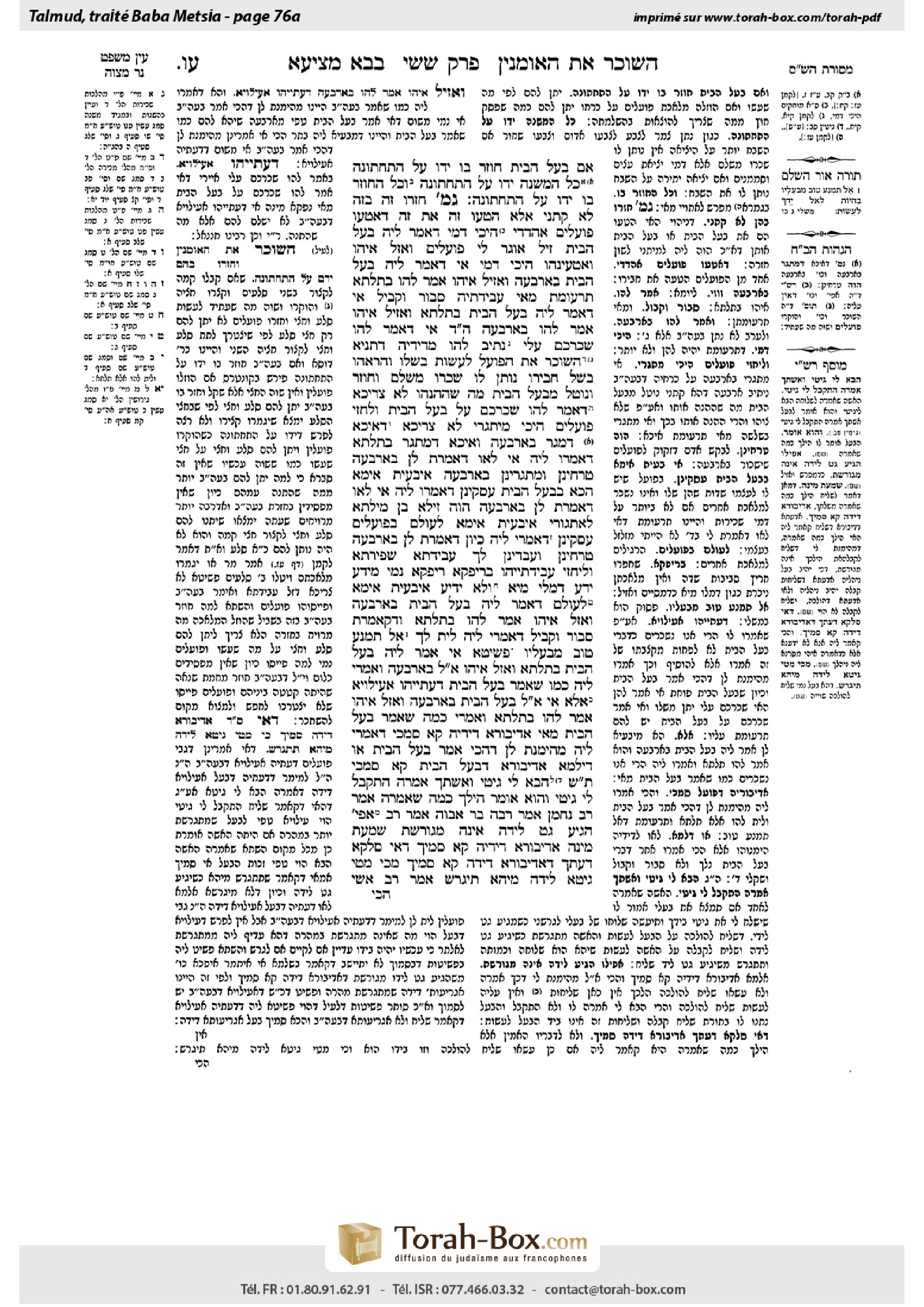
Bava Metzia 76a: Talmud study for Daf Yomi
Study the Talmud for Daf Yomi with scanned pages, Hebrew text, English translations from Sefaria and AI-generated French translations.
Passage selection and English or AI-generated French translation are available where the scan has annotations. Daf Study is independent of Torah-Box and Sefaria.
Browse Bava Metzia · בבא מציעא · All tractatesBava Metzia 76a text and translations
This page of Bava Metzia includes the Aramaic text, an English translation and an AI-generated French translation, alongside the scan above.
בבא מציעא ע״ו א · Aramaic and Hebrew text
אִם בַּעַל הַבַּיִת חוֹזֵר בּוֹ – יָדוֹ עַל הַתַּחְתּוֹנָה. כׇּל הַמְשַׁנֶּה – יָדוֹ עַל הַתַּחְתּוֹנָה, וְכׇל הַחוֹזֵר בּוֹ – יָדוֹ עַל הַתַּחְתּוֹנָה.
גְּמָ׳ ״חָזְרוּ זֶה בָּזֶה״ לָא קָתָנֵי, אֶלָּא ״הִטְעוּ זֶה אֶת זֶה״, דְּאַטְעוֹ פּוֹעֲלִים אַהֲדָדֵי. הֵיכִי דָּמֵי? דַּאֲמַר לֵיהּ בַּעַל הַבַּיִת: זִיל, אֲוגַר לִי פּוֹעֲלִים, וַאֲזַל אִיהוּ וְאַטְעִינְהוּ.
הֵיכִי דָּמֵי? אִי דַּאֲמַר לֵיהּ בַּעַל הַבַּיִת בְּאַרְבְּעָה, וַאֲזַיל אִיהוּ אֲמַר לְהוּ בִּתְלָתָא – תַּרְעוֹמֶת מַאי עֲבִידְתֵּיהּ? סְבוּר וְקַבֵּיל. אִי דַּאֲמַר לֵיהּ בַּעַל הַבַּיִת בִּתְלָתָא, וַאֲזַיל אִיהוּ אֲמַר לְהוּ בְּאַרְבְּעָה – הֵיכִי דָמֵי? אִי דַּאֲמַר לְהוּ: ״שְׂכַרְכֶם עָלַי״ – נִתֵּיב לְהוּ מִדִּידֵיהּ,
דְּתַנְיָא: הַשּׂוֹכֵר אֶת הַפּוֹעֵל לַעֲשׂוֹת בְּשֶׁלּוֹ וְהֶרְאָהוּ בְּשֶׁל חֲבֵירוֹ – נוֹתֵן לוֹ שְׂכָרוֹ מִשָּׁלֵם, וְחוֹזֵר וְנוֹטֵל מִבַּעַל הַבַּיִת מַה שֶּׁהֶהֱנָהוּ.
לָא צְרִיכָא, דַּאֲמַר לְהוּ שְׂכַרְכֶם עַל בַּעַל הַבַּיִת.
וְלִחְזֵי פּוֹעֲלִים הֵיכִי מִיתַּגְרִי? לָא צְרִיכָא, דְּאִיכָּא דְּמִתְּגַר בְּאַרְבְּעָה וְאִיכָּא דְּמִתְּגַר בִּתְלָתָא, דְּאָמְרוּ לֵיהּ: אִי לָאו דַּאֲמַרְתְּ לַן בְּאַרְבְּעָה – טָרְחִינַן וּמִתַּגְרִינַן בְּאַרְבְּעָה.
אִיבָּעֵית אֵימָא: הָכָא בְּבַעַל הַבַּיִת עָסְקִינַן, דְּאָמְרוּ לֵיהּ: אִי לָאו דַּאֲמַרְתְּ לַן בְּאַרְבְּעָה, הֲוָה זִילָא בַּן מִילְּתָא לְאִתְּגוֹרֵי.
אִיבָּעֵית אֵימָא: לְעוֹלָם בְּפוֹעֲלִים עָסְקִינַן, דְּאָמְרִי לֵיהּ: כֵּיוָן דַּאֲמַרְתְּ לַן בְּאַרְבְּעָה – טָרְחִינַן וְעָבְדִינַן לָךְ עֲבִידְתָּא שַׁפִּירְתָּא. וְלִחְזֵי עֲבִידְתַּיְיהוּ? בְּרִיפְקָא. רִיפְקָא נָמֵי מִידָּע יְדִיעַ? דִּמְלֵי מַיָּא וְלָא יְדִיעַ.
אִיבָּעֵית אֵימָא: לְעוֹלָם דַּאֲמַר לֵיהּ בַּעַל הַבַּיִת בְּאַרְבְּעָה, וַאֲזַל אִיהוּ אֲמַר לְהוּ בִּתְלָתָא, וּדְקָאָמְרַתְּ סְבוּר וְקַבֵּיל, דְּאָמְרִי לֵיהּ לֵית לָךָ ״אַל תִּמְנַע טוֹב מִבְּעָלָיו״?
פְּשִׁיטָא אִי אֲמַר לֵיהּ בַּעַל הַבַּיִת בִּתְלָתָא, וַאֲזַל אִיהוּ אֲמַר לְהוּ בְּאַרְבְּעָה, וְאָמְרִי לֵיהּ כְּמוֹ שֶׁאָמַר בַּעַל הַבַּיִת – דַּעְתַּיְיהוּ אַעִילּוּיָא.
אֶלָּא אִי אֲמַר לֵיהּ בַּעַל הַבַּיִת בְּאַרְבְּעָה, וַאֲזַל אִיהוּ אֲמַר לְהוּ בִּתְלָתָא, וְאָמְרִי: כְּמָה שֶׁאָמַר בַּעַל הַבַּיִת, מַאי? אַדִּיבּוּרָא דִּידֵיהּ קָא סָמְכִי, דְּאָמְרִי לֵיהּ מְהֵימְנַתְּ לַן דְּהָכִי אָמַר בַּעַל הַבַּיִת, אוֹ דִלְמָא אַדִּיבּוּרָא דְּבַעַל הַבַּיִת קָא סָמְכִי?
תָּא שְׁמַע: ״הָבֵא לִי גִּיטִּי״.
וְאִשְׁתְּךָ אָמְרָה ״הִתְקַבֵּל לִי גִּיטִּי״, וְהוּא אוֹמֵר: ״הֵילָךְ כְּמָה שֶׁאָמְרָה״. אָמַר רַב נַחְמָן אָמַר רַבָּה בַּר אֲבוּהּ אָמַר רַב: אֲפִילּוּ הִגִּיעַ גֵּט לְיָדָהּ – אֵינָהּ מְגוֹרֶשֶׁת.
שָׁמְעַתְּ מִינַּהּ אַדִּיבּוּרָא דִּידֵיהּ קָא סָמֵיךְ. דְּאִי סָלְקָא דַעְתָּךְ דְּאַדִּיבּוּרָא דִּידַהּ קָא סָמֵיךְ – מִכִּי מָטֵי גִּיטָּא לִידַהּ מִיהָא תִּיגָּרַשׁ. אָמַר רַב אָשֵׁי:
Bava Metzia 76a · English translation
Conversely, if the employer reneges, he is at a disadvantage. These two rulings are in accordance with the principle that whoever changes the terms accepted by both parties is at a disadvantage, and whoever reneges on an agreement is at a disadvantage.
GEMARA: The Gemara starts by analyzing the phrase: And they deceived one another. The Gemara comments: The tanna does not teach: They reneged on the agreement with one another, which would indicate that either the employer or the laborers changed their mind. Rather, it states that they deceived one another, which evidently means that the laborers deceived one another. The Gemara therefore inquires: What are the circumstances? The Gemara explains: This is referring to a case where, for example, the employer said to one of the laborers: Go and hire laborers for me, and that laborer went and deceived those other laborers.
The Gemara again asks: What are the circumstances of this deception? If the employer said to him: Hire for me laborers at four dinars, and he went and told them that they are hired for three dinars, what is the relevance of this grievance? After all, they knew and accepted the conditions of their hire. What grounds for complaint do they have? If the employer said to him to hire laborers for three dinars, and the middleman went and told them it was for four, what are the circumstances? If he told them at the time: The monetary value of your services, i.e., your wage, is incumbent upon me, let that middleman give them the difference from his own pocket.
This is as it is taught in a baraita: With regard to one who hires a laborer to perform work in his own field, and the employer inadvertently showed the laborer a field belonging to another in which he should work, the employer must give the laborer his full wages; and in addition, the employer goes back and takes from the owner of the field in which he worked the value of the benefit that owner received from the laborer. The employer is entitled to claim from the owner of the field the profit that owner gained from the work, but not the entire wages of the laborer. This indicates that one who says: Your wage is incumbent upon me, must pay the specified sum.
The Gemara explains: No, it is necessary to state this halakha where the middleman said to them: The obligation to pay your wages is incumbent upon the employer, and it subsequently became apparent that the employer was not willing to pay that much. In this case the laborers have a grievance only against the laborer who hired them.
The Gemara challenges: But let us see how much laborers are hired for in that place, and the employer should pay them in accordance with the accepted custom. The Gemara answers: No, it is necessary in a place where there are those who hire for four dinars and there are others who hire for three. The reason for their grievance is that the laborers can say to the middleman: Had you not told us that you were hiring us for four dinars, we would have made an effort and found another employer, and we would have hired ourselves out for four dinars. Consequently, you caused us a loss.
If you wish, say that the mishna is referring even to a place where there is a fixed wage for laborers. But here we are dealing with a homeowner, i.e., one usually not accustomed to labor, who was hired for his services. In order to supplement their earnings, such people will occasionally work for others as well. The reason for their grievance is that these laborers who own fields say to the middleman: Had you not told us that we are hired for four, it would have been too demeaning for us to be hired, as it is not worthwhile to work in the field of another for so little when we have our own plots of land. This is the cause of their grievance.
If you wish, say that actually, we are dealing with regular laborers, not a homeowner, and the reason for their grievance is that they say to the middleman: Since you spoke to us of four, we made an effort to do higher-quality work for you. The Gemara challenges: And let us see their work. If it is evident that they performed the task more effectively, they deserve to be paid more money. The Gemara responds: This is referring to tilling the land, where the quality of the work is not immediately apparent. The Gemara asks: With regard to tilling as well, doesn’t the employer know what they have done, as he can examine the earth they tilled? The Gemara answers: The laborers dug a ditch that is now filled with water, and therefore the employer does not know exactly what they have accomplished.
If you wish, say that actually, we are dealing with an employer who said to the middleman: Hire laborers for four, and he went and told them that they were hired for three. And as for that which you said: Why should they have a grievance against him, as they knew and accepted these terms? Although they agreed to those terms, they still have a grievance, as they can say to the one who came to terms with them: Don’t you have respect for the verse: “Do not withhold good from him to whom it is due, when it is in the power of your hand to do it” (Proverbs 3:27)?
§ After analyzing the circumstances of the case in the mishna, the Gemara observes: It is obvious that if the employer said to someone that he should hire laborers for three dinars, and that person went and said to them that they were hired for four, and they said to him: We agree to be paid as the employer says, in that case it is clear that their minds are on any additional sum the employer might have offered, and they certainly did not intend to accept less than the one with whom they spoke proposed.
But if the employer said he would hire them for four dinars, and the middleman went and told them that the offer was for three, and they said to him: We agree to be paid as the employer said, what is the halakha? Is it correct to say that the laborers rely on his statement, as they are effectively saying to him: We trust you that the employer said that which you reported in his name? Or perhaps they rely on the employer’s statement, and therefore they are entitled to the higher wages specified by the employer?
The Gemara suggests: Come and hear a resolution of this dilemma from a halakha concerning a bill of divorce: A woman said to her agent: Bring my bill of divorce for me. Knowing her husband was writing a bill of divorce, she asked the agent to collect the document and transmit it to her. According to the terms of his agency, the wife is divorced only when the document reaches her possession, as he was not appointed as an agent to receive the bill of divorce on her behalf.
But the agent went and told the husband: Your wife said to me: Receive my bill of divorce for me. This statement indicates that the wife had appointed him to receive the bill of divorce in her stead, as an agent of receipt, which would mean that she is divorced as soon as the agent is given the document. And the husband said: Take it in the manner in which my wife said. With regard to this case, Rav Naḥman says that Rabba bar Avuh says that Rav says: Even when the bill of divorce reaches her possession, she is not divorced.
One can learn from this that the husband relies on the agent’s statement. Since the husband was under the mistaken impression that he was interacting with an agent of receipt, he did not instruct him to deliver the document to his wife, and therefore the bill of divorce was not transmitted in the proper manner, which is why she is not divorced at all. As, if it enters your mind that the husband relies on her statement, she should at least be divorced when the bill of divorce reaches her possession, in accordance with the terms of an agent for delivery. This shows that the statement of an agent is accepted as a faithful representation of the wishes of the one who appointed him. Rav Ashi said:
Bava Metzia 76a · Traduction française (IA)
Inversement, si l'employeur rompt l'accord, il est désavantagé. Ces deux décisions s'inscrivent dans le principe selon lequel celui qui modifie les termes acceptés par les deux parties est désavantagé, et celui qui rompt un accord est désavantagé.
GUEMARA : La Guemara commence par analyser la phrase : Et ils se sont trompés l'un l'autre. La Guemara commente : Le tanna ne dit pas : Ils ont rompu leur accord mutuellement, ce qui indiquerait que soit l'employeur soit les ouvriers ont changé d'avis. Au contraire, il dit qu'ils se sont trompés l'un l'autre, ce qui semble signifier que les ouvriers se sont trompés mutuellement. La Guemara s'interroge donc : Quelles sont les circonstances ? La Guemara explique : Il s'agit d'un cas où, par exemple, l'employeur dit à l'un des ouvriers : Va et embauche d'autres ouvriers pour moi, et cet ouvrier est allé tromper ces autres ouvriers.
La Guemara pose à nouveau la question : Quelles sont les circonstances de cette tromperie ? Si l'employeur dit à lui : Embauche pour moi des ouvriers à quatre dinars, et il va et dit qu'ils sont embauchés à trois dinars, quelle est l'importance de cette plainte ? Après tout, ils savaient et avaient accepté les conditions de leur embauche. Quelle base de plainte ont-ils ? Si l'employeur dit à lui d'embaucher des ouvriers à trois dinars, et le médiateur va et dit qu'il est à quatre, quels sont les circonstances ? S'il leur dit à ce moment : La valeur monétaire de vos services, c'est-à-dire votre salaire, incombe à moi, que ce médiateur leur donne la différence de sa propre bourse.
C'est ce qui est enseigné dans une baraïta : En ce qui concerne celui qui embauche un ouvrier pour effectuer un travail dans son propre champ, et l'employeur a accidentellement montré à l'ouvrier un champ appartenant à un autre où il devait travailler, l'employeur doit payer à l'ouvrier son salaire complet ; et en outre, l'employeur revient et récupère de l'propriétaire du champ où il a travaillé la valeur du bénéfice que l'propriétaire a reçu de l'ouvrier. L'employeur a le droit de réclamer à l'propriétaire du champ le profit que l'propriétaire a gagné du travail, mais pas le salaire complet de l'ouvrier. Cela montre que celui qui dit : Votre salaire incombe à moi, doit payer la somme spécifiée.
La Guemara explique : Non, il est nécessaire d'énoncer cette halakha dans le cas où le médiateur a dit à eux : L'obligation de payer votre salaire incombe à l'employeur, et ensuite il s'est avéré que l'employeur n'était pas prêt à payer autant. Dans ce cas, les ouvriers ont une plainte uniquement contre l'ouvrier qui les a embauchés.
La Guemara conteste : Mais voyons combien les ouvriers sont embauchés dans cette région, et l'employeur devrait les payer conformément à la coutume établie. La Guemara répond : Non, il est nécessaire dans un lieu où il y a ceux qui embauchent à quatre dinars et ceux qui embauchent à trois. La raison de leur plainte est que les ouvriers peuvent dire au médiateur : Si vous n'aviez pas dit que nous étions embauchés à quatre dinars, nous aurions fait un effort et trouvé un autre employeur, et nous aurions nous-même été embauchés à quatre dinars. Ainsi, vous avez causé à nous une perte.
Si vous le souhaitez, dites que la Michna fait référence même à un lieu où il y a un salaire fixe pour les ouvriers. Mais ici nous sommes en présence d’un propriétaire, c’est-à-dire une personne habituellement non habituée au travail, qui a été embauchée pour ses services. Afin de compléter leurs revenus, de tels ouvriers travaillent occasionnellement pour d’autres. La raison de leur plainte est que ces ouvriers qui possèdent des champs disent au médiateur : Si vous n’aviez pas dit que nous étions embauchés à quatre, cela aurait été trop humiliant pour nous, car il n’est pas valorisant de travailler dans le champ d’autrui pour si peu, alors que nous avons nos propres parcelles de terre. C’est la cause de leur plainte.
Si vous le souhaitez, dites que, en réalité, nous sommes en présence d’ouvriers réguliers, pas d’un propriétaire, et la raison de leur plainte est qu’ils disent au médiateur : Puisque vous avez parlé de quatre, nous avons fait un effort pour faire un travail de meilleure qualité pour vous. La Guemara conteste : Et voyons leur travail. Si cela est évident qu’ils ont accompli la tâche plus efficacement, ils méritent d’être payés davantage. La Guemara répond : Cela fait référence à la culture des terres, où la qualité du travail n’est pas immédiatement apparente. La Guemara pose la question : En ce qui concerne la culture également, ne connaît pas l’employeur ce qu’ils ont accompli, car il peut examiner la terre qu’ils ont cultivée ? La Guemara répond : Les ouvriers ont creusé un canal qui est maintenant rempli d’eau, et donc l’employeur ne sait pas exactement ce qu’ils ont accompli.
Si vous le souhaitez, dites que, en réalité, nous sommes en présence d'un employeur qui a dit au médiateur : Embauche des ouvriers pour quatre, et il est allé et a dit qu'ils étaient embauchés pour trois. Et concernant ce que vous avez dit : Pourquoi devraient-ils avoir une plainte contre lui, puisqu'ils savaient et avaient accepté ces termes ? Bien qu'ils aient accepté ces termes, ils ont quand même une plainte, car ils peuvent dire à celui qui a conclu un accord avec eux : N'avez-vous pas de respect pour la parole : « Ne retenez pas le bien qui est dû à celui à qui il est dû, lorsque cela est en votre pouvoir de le faire » (Proverbes 3:27) ?
§ Après avoir analysé les circonstances du cas dans la mishna, la Guemara observe : Il est évident que si l'employeur a dit à quelqu'un qu'il devait embaucher des ouvriers pour trois dinars, et que cette personne est allé et a dit qu'ils étaient embauchés pour quatre, et qu'ils ont dit à lui : Nous acceptons de nous faire payer comme l'employeur le dit, dans ce cas il est clair que leurs esprits sont orientés vers toute somme supplémentaire que l'employeur aurait pu offrir, et ils n'ont certainement pas l'intention d'accepter moins que ce que celui avec qui ils ont parlé a proposé.
Mais si l'employeur avait dit qu'il les embauchait pour quatre dinars, et que le commissionnaire est allé leur dire que l'offre était de trois, et qu'ils lui ont répondu : Nous acceptons d'être payés comme l'employeur l'a dit, quelle est la halakha ? Est-il correct de dire que les ouvriers se fondent sur sa déclaration, comme s'ils lui disent effectivement : Nous vous faisons confiance pour ce que vous avez rapporté en son nom ? Ou bien est-ce que leur déclaration repose sur la déclaration de l'employeur, et qu'ils sont donc dûs aux salaires plus élevés spécifiés par l'employeur ?
La Guemara suggère : Venez écouter une résolution de ce dilemme à partir d'une halakha concernant un acte de divorce : Une femme a dit à son agent : Apporte-moi mon acte de divorce. Sachant que son mari écrivait un acte de divorce, elle a demandé à l'agent de récupérer le document et de le lui transmettre. Selon les termes de son mandat, la femme est divorcée uniquement lorsque le document arrive en son possession, car il n'était pas désigné comme agent pour recevoir l'acte de divorce à sa place.
Mais l'agent est allé dire au mari : Votre femme m'a dit : Reçois mon acte de divorce pour moi. Cette déclaration indique que la femme avait désigné cet agent pour recevoir l'acte de divorce à sa place, en tant qu'agent de réception, ce qui signifierait qu'elle est divorcée dès que l'agent reçoit le document. Et le mari a dit : Prends-le selon la manière dont ta femme l'a dit. En ce cas, Rav Naḥman dit que Rabba bar Avuh dit que Rav dit : Même lorsque l'acte de divorce arrive en possession de la femme, elle n'est pas divorcée.
On peut en tirer la conclusion que le mari se fonde sur la déclaration de l'agent. Puisque le mari avait une impression erronée qu'il interagissait avec un agent de réception, il n'a pas ordonné à l'agent de lui transmettre le document, et c'est pourquoi l'acte de divorce n'a pas été transmis correctement, ce qui explique pourquoi elle n'est pas divorcée du tout. En effet, si l'idée vous vient que le mari se fonde sur sa déclaration, elle devrait au moins être divorcée lorsque l'acte de divorce arrive en son possession, conformément aux termes d'un agent de livraison. Cela montre que la déclaration de l'agent est acceptée comme une représentation fidèle des souhaits de celui qui l'a désigné. Rav Ashi a dit :
Traduction française générée par IA à partir de l’édition anglaise de Sefaria. Vérifie toujours un passage avec le texte source.
Text from Sefaria: William Davidson Edition - Vocalized Aramaic (CC BY NC); William Davidson Edition - English (CC BY NC).