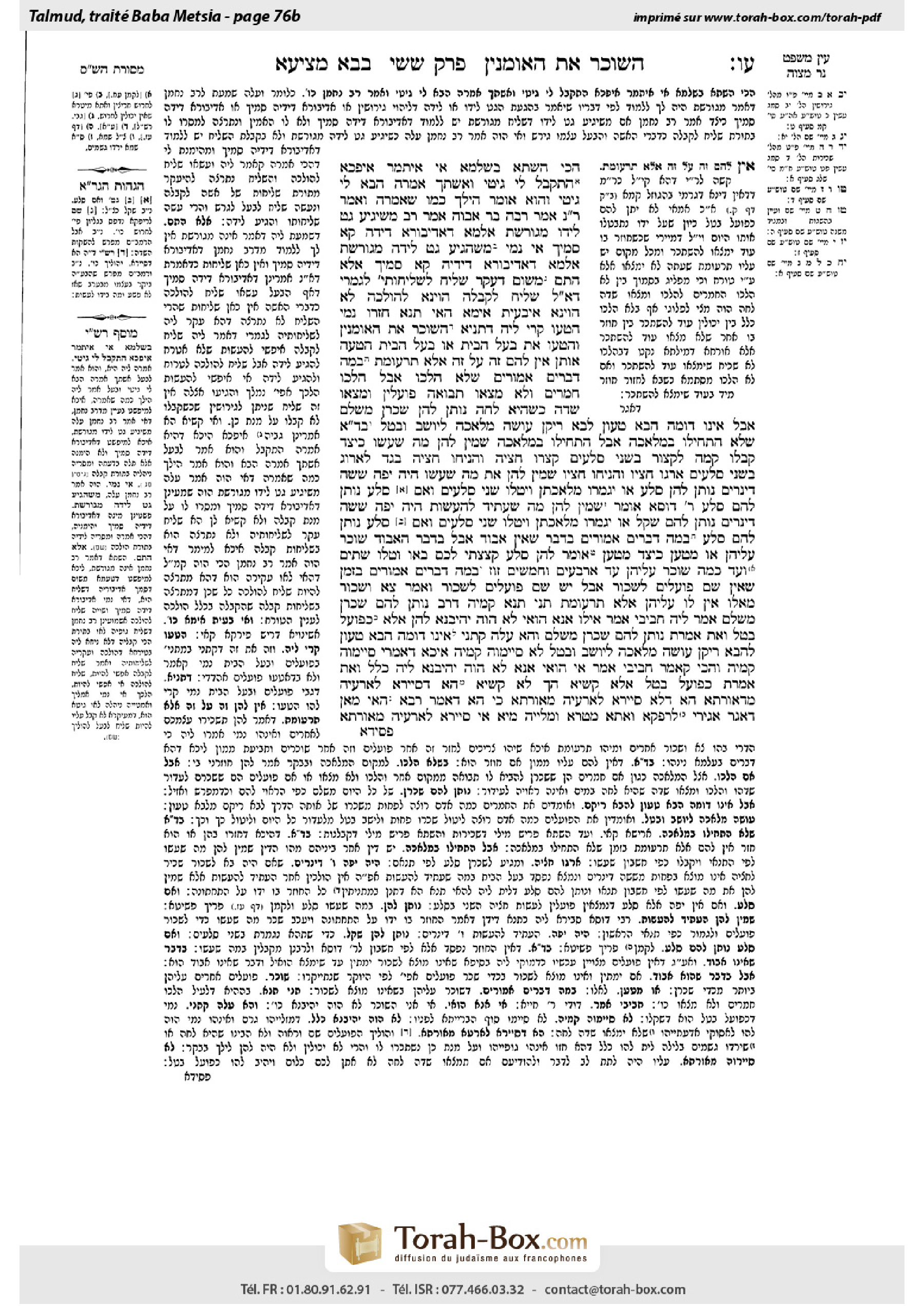
Bava Metzia 76b: Talmud study for Daf Yomi
Study the Talmud for Daf Yomi with scanned pages, Hebrew text, English translations from Sefaria and AI-generated French translations.
Passage selection and English or AI-generated French translation are available where the scan has annotations. Daf Study is independent of Torah-Box and Sefaria.
Browse Bava Metzia · בבא מציעא · All tractatesBava Metzia 76b text and translations
This page of Bava Metzia includes the Aramaic text, an English translation and an AI-generated French translation, alongside the scan above.
בבא מציעא ע״ו ב · Aramaic and Hebrew text
הָכִי הַשְׁתָּא?! בִּשְׁלָמָא אִי אִיתְּמַר אִיפְּכָא, ״הִתְקַבֵּל לִי גִּיטִּי״ וְאִשְׁתְּךָ אָמְרָה, ״הָבֵא לִי גִּיטִּי״, וְהוּא אוֹמֵר: ״הֵילָךְ כְּמוֹ שֶׁאָמְרָה״. וְאָמַר רַב נַחְמָן אָמַר רַבָּה בַּר אֲבוּהּ אָמַר רַב: מִשֶּׁיַּגִּיעַ גֵּט לְיָדוֹ – מְגוֹרֶשֶׁת, אַלְמָא דְּאַדִּיבּוּרָא דִּידַהּ קָא סְמִיךְ.
אִי נָמֵי: מִשֶּׁהִגִּיעַ גֵּט לְיָדָהּ מְגוֹרֶשֶׁת – אַלְמָא דְּאַדִּיבּוּרָא דִּידֵיהּ קָא סָמֵיךְ. אֶלָּא הָתָם – מִשּׁוּם דְּעָקַר שָׁלִיחַ לִשְׁלִיחוּתֵיהּ לִגְמָרֵי, דְּאָמַר לֵיהּ: ״שָׁלִיחַ לְִקַבָּלָה הָוֵינָא, לְהוֹלָכָה לָא הָוֵינָא״.
אִיבָּעֵית אֵימָא: הַאי תַּנָּא ״חָזְרוּ״ נָמֵי ״הִטְעוּ״ קָרֵי לֵיהּ, דְּתַנְיָא: הַשּׂוֹכֵר אֶת הָאוּמָּנִין וְהִטְעוּ אֶת בַּעַל הַבַּיִת, אוֹ בַּעַל הַבַּיִת הִטְעָה אוֹתָן – אֵין לָהֶם זֶה עַל זֶה אֶלָּא תַּרְעוֹמֶת.
בַּמֶּה דְּבָרִים אֲמוּרִים? שֶׁלֹּא הָלְכוּ. אֲבָל הָלְכוּ חַמָּרִים וְלֹא מָצְאוּ תְּבוּאָה, פּוֹעֲלִין וּמָצְאוּ שָׂדֶה כְּשֶׁהִיא לַחָה – נוֹתֵן לָהֶן שְׂכָרָן מִשָּׁלֵם, אֲבָל אֵינוֹ דּוֹמֶה הַבָּא טָעוּן לַבָּא רֵיקָן, עוֹשֶׂה מְלָאכָה לְיוֹשֵׁב וּבָטֵל.
בַּמֶּה דְּבָרִים אֲמוּרִים? שֶׁלֹּא הִתְחִילוּ בִּמְלָאכָה, אֲבָל הִתְחִילוּ בִּמְלָאכָה – שָׁמִין לָהֶן מַה שֶּׁעָשׂוּ. כֵּיצַד? קִבְּלוּ קָמָה לִקְצוֹר בִּשְׁנֵי סְלָעִים, קָצְרוּ חֶצְיָהּ וְהִנִּיחוּ חֶצְיָהּ. בֶּגֶד לֶאֱרוֹג בִּשְׁנֵי סְלָעִים, אָרְגוּ חֶצְיוֹ וְהִנִּיחוּ חֶצְיוֹ – שָׁמִין לָהֶן אֶת מַה שֶּׁעָשׂוּ.
הָיָה יָפֶה שִׁשָּׁה דִּינָרִים – נוֹתֵן לָהֶן סֶלַע, אוֹ יִגְמְרוּ מְלַאכְתָּן וְיִטְּלוּ שְׁנֵי סְלָעִים. וְאִם סֶלַע – נוֹתֵן לָהֶם סֶלַע.
רַבִּי דּוֹסָא אוֹמֵר: שָׁמִין לָהֶן מַה שֶּׁעָתִיד לְהֵעָשׂוֹת, הָיָה יָפֶה שִׁשָּׁה דִּינָרִים – נוֹתֵן לָהֶם שֶׁקֶל, אוֹ יִגְמְרוּ מְלַאכְתָּן וְיִטְּלוּ שְׁנֵי סְלָעִים. וְאִם סֶלַע – נוֹתֵן לָהֶם סֶלַע.
בַּמֶּה דְּבָרִים אֲמוּרִים? בְּדָבָר שֶׁאֵין אָבוּד, אֲבָל בְּדָבָר הָאָבוּד – שׂוֹכֵר עֲלֵיהֶן אוֹ מַטְעָן. כֵּיצַד מַטְעָן? אוֹמֵר לָהֶן: סֶלַע קָצַצְתִּי לָכֶם – בֹּאוּ וּטְלוּ שְׁתַּיִם. וְעַד כַּמָּה שׂוֹכֵר עֲלֵיהֶן? עַד אַרְבָּעִים וַחֲמִשִּׁים זוּז.
בַּמֶּה דְּבָרִים אֲמוּרִים? בִּזְמַן שֶׁאֵין שָׁם פּוֹעֲלִים לִשְׂכּוֹר. אֲבָל יֵשׁ שָׁם פּוֹעֲלִים לִשְׂכּוֹר, וְאָמַר: ״צֵא וּשְׂכוֹר מֵאֵלּוּ״ – אֵין לוֹ עֲלֵיהֶן אֶלָּא תַּרְעוֹמֶת.
תָּנֵי תַּנָּא קַמֵּיהּ דְּרַב: נוֹתֵן לָהֶם שְׂכָרָן מִשָּׁלֵם. אֲמַר לֵיהּ: חֲבִיבִי אָמַר, אִילּוּ אֲנָא הֲוַאי – לָא הֲוָה יָהֵיבְנָא לָהֶן אֶלָּא כְּפוֹעֵל בָּטֵל, וְאַתְּ אָמְרַתְּ נוֹתֵן לָהֶם שְׂכָרָן מִשָּׁלֵם! וְהָא עֲלַהּ קָתָנֵי: אֵינוֹ דּוֹמֶה הַבָּא טָעוּן לְהַבָּא רֵיקָן, עוֹשֶׂה מְלָאכָה לְיוֹשֵׁב וּבָטֵל! לָא סַיְּימוּהָ קַמֵּיהּ.
אִיכָּא דְּאָמְרִי: סַיְּימוּהָ קַמֵּיהּ, וְהָכִי קָאָמַר. חֲבִיבִי אֲמַר: אִי הֲוַאי אֲנָא – לָא הֲוָה יָהֵיבְנָא לֵיהּ כְּלָל, וְאַתְּ אָמְרַתְּ כְּפוֹעֵל בָּטֵל! אֶלָּא קַשְׁיָא הָךְ.
לָא קַשְׁיָא: הָא דְּסַיְּירַהּ לְאַרְעֵיהּ מִדְּאוּרְתָּא, הָא דְּלָא סַיְּירַהּ לְאַרְעֵיהּ מֵאוּרְתָּא.
כִּי הָא דְּאָמַר רָבָא: הַאי מַאן דַּאֲגַר אֲגִירֵי לְרִפְקָא וַאֲתָא מִטְרָא וּמַלְיַיהּ מַיָּא, אִי סַיְּירַהּ לְאַרְעֵיהּ מֵאוּרְתָּא –
Bava Metzia 76b · English translation
How can these cases be compared? Granted, if the opposite was stated, i.e., in a case where the woman said: Receive my bill of divorce for me, and the agent said to the husband: Your wife said: Bring me my bill of divorce, and the husband said: Here you are, as she said; and Rav Naḥman says that Rabba bar Avuh says that Rav says: From when the bill of divorce reaches the agent’s possession, she is divorced, it would be understandable. Apparently, the husband relies upon her statement that the agent is an agent of receipt.
Alternatively, had Rav Naḥman ruled: From when the bill of divorce reaches her possession, she is divorced, one could conclude that evidently, the husband relies on the agent’s statement, and based on that statement, the agent is designated as an agent for delivery. But there, in the case cited, where Rav Naḥman rules that she is not divorced, it is not because the husband relies on one statement or the other. Rather, it is due to the fact that by means of his statement the agent negates his agency entirely, as he said to the husband: I am an agent for receipt, meaning: I am not to be an agent for delivery. He is essentially saying that he is not prepared to go to the trouble of delivering the bill of divorce to her. Therefore, even if he does ultimately deliver the bill of divorce to her, he is an agent neither for the woman nor for her husband. No conclusion can be drawn with regard to the question of which statement the husband relies upon.
§ The Gemara had assumed that the term deceived used in the mishna must be referring to an inaccuracy stated by the middleman in his discussion with the laborers. The Gemara now offers an alternative explanation. If you wish, say that when the mishna teaches: They deceived one another, it means that one of the parties reneged on the agreement, as this tanna also calls a circumstance described by the term reneged, meaning that either the employer or the laborers reneged on their agreement, by the term deceived. As it is taught in a baraita in a similar manner: With regard to one who hires artisans or laborers, and they deceived the employer, or the employer deceived them, they have nothing but a grievance against one another, and no monetary claim.
The baraita continues: In what case is this statement said? When they did not go to the workplace, i.e., the employer reneged immediately. But if donkey drivers went and could not find any produce to carry, or laborers went off to work and found that the field was too moist for tilling, the employer must give them their full wages to which they are entitled. But he does not give them the entire stipulated amount, as a donkey driver who comes back loaded cannot be compared to one who comes back empty, nor can a laborer who performs work be compared to one who sits idle. The employer deducts a sum from the laborers’ wages, paying them the amount they are willing to receive given that they do not actually have to perform the work.
In what case is this statement, that if they reneged they have only a grievance, said? When they had not started the work at all. But if they had started the work, the court appraises for them that which they have done, for which they receive some form of compensation. How so? If they received standing grain to reap for a contractual agreement of two sela for the entire field, and they reaped half of it and left half of it, or if they took a garment to weave at two sela, and they weaved half of it and left half of it, in these cases the court appraises for them that which they have done.
The baraita details this appraisal: If the current wage for the part of the task they had done was now worth six dinars, a sela and a half, as the price for this assignment increased, either he gives them a sela, as originally agreed upon, since they do not forfeit their stipulated wages, or they finish their work and take two sela. And if the current wage for the part of the task they had done was worth a sela, he gives them a sela. This statement will be explained by the Gemara.
Rabbi Dosa says: The court appraises for them that which must still be done. If the current wage for the part of the task they had not done was worth six dinars, i.e., he can only find laborers who will complete it for six dinars, which is equivalent to one and a half sela, either he gives the first laborers a shekel, which is equivalent to half a sela, or they finish their work and take two sela. And if the current wage for the part of the task they had not done was worth a sela, he gives them a sela.
The baraita continues: In what case is this statement said, i.e., in what circumstance are the laborers paid for the amount they performed and the employer has only a grievance against them? It is said with regard to a matter that does not involve financial loss due to the work stoppage, but with regard to a matter that involves financial loss due to the work stoppage, the employer may hire replacement laborers for a high price at the expense of the first laborers or deceive the first laborers. How does he deceive them? For example, he can say to them: I fixed a sela as wages for you; come and take two. And up to what amount may he hire at their expense? Even up to forty or fifty dinars. He can pay other laborers far more than the first laborers’ wages to ensure that the work is completed.
In what case is this statement said, i.e., in what circumstance may the employer deceive them to such an extent in order to ensure that the work is completed? When there are no other laborers there, in that place, to hire. Since the employer will suffer a heavy loss, he may resort to one of these methods. But if there are laborers there to hire, and the laborers who reneged said to the employer: Go and hire from these, the employer has nothing but a grievance against them.
A tanna taught that baraita before Rav: The employer must give them their full wages. Rav said to him: My uncle [ḥavivi], Rabbi Ḥiyya, said: If I were ruling on this case, I would give them only the wages of an idle laborer, but no more, and yet you said that he gives them their full wages? The Gemara asks: But the baraita teaches concerning this very matter: A donkey driver who comes back loaded cannot be compared to one who comes back empty, nor can a laborer who performs work be compared to one who sits idle. Evidently, even the tanna of the baraita agrees that they do not receive their full wages. The Gemara answers: The tanna teaching the baraita before Rav did not conclude it, and he was unaware of this limitation, which is why he commented that they do not deserve their entire wages.
There are those who say that the tanna indeed concluded it before him, and this is what Rav is saying: My uncle said: If I were ruling on this case I would not give them anything, and yet you said that he gives them the wages of an idle laborer? The Gemara questions this version: But this is difficult. How can one account for the difference between the ruling of the baraita and that of Rav’s uncle, Rabbi Ḥiyya?
The Gemara responds: It is not difficult, as this case, where Rabbi Ḥiyya would rule that the laborers are not paid at all, is referring to one who surveyed his land the night before, observed that it was fit to be tilled, and hired laborers on the basis of this examination. It is their misfortune that something occurred in the meantime to prevent them from carrying out the task. Conversely, that case, where the baraita rules that they are given some payment, is referring to a landowner who did not survey his land the night before. Since he failed to check his own field, he must bear the responsibility.
This is like that which Rava said: With regard to one who hires laborers to till, and rain fell and filled his land with water, preventing the laborers from performing the work, if he surveyed his land the night before and did all he could,
Bava Metzia 76b · Traduction française (IA)
Comment ces cas peuvent-ils être comparés ? Supposons que l'inverse ait été dit, c'est-à-dire dans un cas où la femme disait : Reçois mon acte de divorce pour moi, et l'agent disait au mari : Votre femme dit : Apporte-moi mon acte de divorce, et le mari disait : Ici tu as, comme elle l'a dit ; et Rav Naḥman dit que Rabba bar Avuh dit que Rav dit : À partir du moment où l'acte de divorce arrive en possession de l'agent, elle est divorcée, cela serait compréhensible. Apparemment, le mari se base sur la déclaration de la femme selon laquelle l'agent est un agent de réception.
Sinon, si Rav Naḥman avait décidé : À partir du moment où l'acte de divorce arrive en possession d'elle, elle est divorcée, on pourrait conclure que manifestement, le mari se base sur la déclaration de l'agent, et sur cette déclaration, l'agent est désigné comme agent de livraison. Mais là, dans le cas cité, où Rav Naḥman décide qu'elle n'est pas divorcée, ce n'est pas parce que le mari se base sur l'une ou l'autre déclaration. C'est plutôt en raison du fait que par sa déclaration, l'agent nie entièrement son mandat, car il disait au mari : Je suis un agent de réception, c'est-à-dire : Je ne dois pas être un agent de livraison. Il dit essentiellement qu'il n'est pas prêt à fournir la peine de livrer l'acte de divorce à elle. Par conséquent, même si il finit par livrer l'acte de divorce à elle, il n'est pas un agent pour la femme ni pour son mari. Aucune conclusion ne peut être tirée concernant la question de la déclaration sur laquelle le mari se base.
§ La Guemara avait supposé que le terme trompé utilisé dans la Michna doit se référer à une inexactitude déclarée par le médiateur dans sa discussion avec les ouvriers. La Guemara propose maintenant une autre explication. Si tu veux, dis que lorsque la Michna enseigne : Ils se sont trompés les uns les autres, cela signifie qu'un des parties a rompu l'accord, car ce tanna appelle également une situation décrite par le terme rompu, c'est-à-dire que soit l'employeur soit les ouvriers ont rompu leur accord, par le terme trompé. Comme il est enseigné dans une baraïta de manière similaire : Concernant celui qui embauche des artisans ou des ouvriers, et s'ils trompent l'employeur, ou l'employeur trompe eux, ils n'ont que des griefs mutuels, et aucun droit financier.
La baraïta continue : Dans quel cas cette déclaration est-elle dite ? Lorsqu'ils n'ont pas été au lieu de travail, c'est-à-dire que l'employeur a immédiatement rompu l'accord. Mais si les conducteurs de bêtes de somme sont allés et n'ont pas trouvé de produits à transporter, ou les ouvriers sont partis travailler et ont trouvé que le champ était trop mouillé pour la culture, l'employeur doit leur verser leurs salaires complets auxquels ils ont droit. Mais il ne leur verse pas l'intégralité du montant convenu, car un conducteur de bêtes de somme qui revient chargé ne peut pas être comparé à celui qui revient vide, ni un ouvrier qui effectue le travail à celui qui reste inactif. L'employeur déduit une somme des salaires des ouvriers, leur versant la somme qu'ils sont prêts à accepter, sachant qu'ils n'ont pas réellement à effectuer le travail.
Dans quel cas cette déclaration, que s'ils ont rompu ils n'ont que des griefs, est-elle dite ? Lorsqu'ils n'ont pas encore commencé le travail. Mais si ils ont commencé le travail, la cour évalue pour eux ce qu'ils ont accompli, pour lequel ils reçoivent une forme de rémunération. Comment cela ? Si ils ont reçu des épis debout pour moissonner dans un contrat de deux sela pour l'ensemble du champ, et ils ont moissonné la moitié et laissé la moitié, ou si ils ont pris un vêtement à tisser à deux sela, et ils ont tissé la moitié et laissé la moitié, dans ces cas la cour évalue pour eux ce qu'ils ont accompli.
La baraïta détaille cette évaluation : Si le salaire actuel pour la partie de la tâche qu'ils avaient accomplie était maintenant de six dinars, un sela et demi, en raison de l'augmentation du prix de cette tâche, il leur donne un sela, comme convenu initialement, puisque ils ne perdent pas leur salaire convenu, ou ils terminent leur travail et prennent deux sela. Et si le salaire actuel pour la partie de la tâche qu'ils avaient accomplie était de un sela, il leur donne un sela. Cette déclaration sera expliquée par la Guemara.
Rabbi Dosa dit : La cour évalue pour eux ce qui doit encore être accompli. Si le salaire actuel pour la partie de la tâche qu'ils n'avaient pas accomplie était de six dinars, c'est-à-dire qu'il ne peut trouver que des ouvriers qui terminent la tâche pour six dinars, ce qui équivaut à un et demi sela, il leur donne un sela, ce qui équivaut à la moitié d'un sela, ou ils terminent leur travail et prennent deux sela. Et si le salaire actuel pour la partie de la tâche qu'ils n'avaient pas accomplie était de un sela, il leur donne un sela.
La baraïta continue : Dans quel cas cette déclaration est-elle dite, c'est-à-dire dans quelle circonstance les ouvriers reçoivent-ils le montant qu'ils ont accompli et l'employeur n'a que des griefs contre eux ? Elle est dite concernant une affaire où il n'y a pas de perte financière en raison de l'arrêt du travail, mais concernant une affaire où il y a une perte financière en raison de l'arrêt du travail, l'employeur peut embaucher des ouvriers de remplacement à un prix élevé au détriment des premiers ou tromper les premiers. Comment il les trompe ? Par exemple, il peut leur dire : J'ai fixé un sela comme salaire pour vous ; venez et prenez deux. Et jusqu'à quel montant peut-il embaucher à leur détriment ? Même jusqu'à quarante ou cinquante dinars. Il peut payer d'autres ouvriers bien plus que les salaires des premiers ouvriers pour s'assurer que le travail est accompli.
Dans quel cas cette déclaration est-elle dite, c'est-à-dire dans quelle circonstance l'employeur peut tromper à ce point afin d'assurer que le travail est accompli ? Lorsqu'il n'y a pas d'autres ouvriers là-bas, dans cet endroit, à embaucher. Puisque l'employeur subira une perte importante, il peut recourir à l'une de ces méthodes. Mais si des ouvriers sont là-bas à embaucher, et les ouvriers qui ont rompu ont dit à l'employeur : Va et embauche parmi ceux-ci, l'employeur n'a que des griefs contre eux.
Un tanna a appris une baraïta avant Rav : L'employeur doit leur donner leurs salaires complets. Rav dit à lui : Mon oncle [ḥavivi], Rabbi Ḥiyya, a dit : Si j'étais juge dans ce cas, je leur donnerais seulement le salaire d'un ouvrier inactif, mais pas plus, et pourtant tu dis qu'il leur donne leurs salaires complets ? La Guemara demande : Mais la baraïta enseigne justement sur cette même question : Un conducteur de bête de somme qui revient chargé ne peut être comparé à celui qui revient vide, ni un ouvrier qui effectue un travail peut être comparé à celui qui reste inactif. Évidemment, même le tanna de la baraïta est d'accord sur le fait qu'ils ne reçoivent pas leurs salaires complets. La Guemara répond : Le tanna qui enseignait la baraïta avant Rav n'a pas conclu, et il ne savait pas de cette limitation, c'est pourquoi il a commenté qu'ils ne méritent pas leurs salaires complets.
Certains disent que le tanna a effectivement conclu avant lui, et c'est ce que Rav dit : Mon oncle a dit : Si j'étais juge dans ce cas, je ne leur donnerais rien, et pourtant tu dis qu'il leur donne le salaire d'un ouvrier inactif ? La Guemara questionne cette version : Mais cela est difficile. Comment peut-on expliquer la différence entre le jugement de la baraïta et celui de l'oncle de Rav, Rabbi Ḥiyya ?
La Guemara répond : Ce n'est pas difficile, car ce cas, où Rabbi Ḥiyya jugerait que les ouvriers ne sont pas payés du tout, fait référence à celui qui a inspecté son terrain la veille, a constaté qu'il était propre à être cultivé, et a engagé des ouvriers sur la base de cette inspection. C'est leur malheur que quelque chose est arrivé en attendant pour empêcher l'accomplissement de la tâche. À l'inverse, ce cas, où la baraïta juge qu'ils reçoivent un certain paiement, fait référence à un propriétaire de terrain qui n'a pas inspecté son terrain la veille. Puisque l'a échoué à vérifier son propre champ, il doit porter la responsabilité.
C'est comme ce que Rava a dit : En ce qui concerne celui qui engage des ouvriers pour cultiver, et que la pluie est tombée et a rempli son terrain d'eau, empêchant les ouvriers d'accomplir le travail, s'il a inspecté son terrain la veille et a fait tout ce qu'il pouvait,
Traduction française générée par IA à partir de l’édition anglaise de Sefaria. Vérifie toujours un passage avec le texte source.
Text from Sefaria: William Davidson Edition - Vocalized Aramaic (CC BY NC); William Davidson Edition - English (CC BY NC).