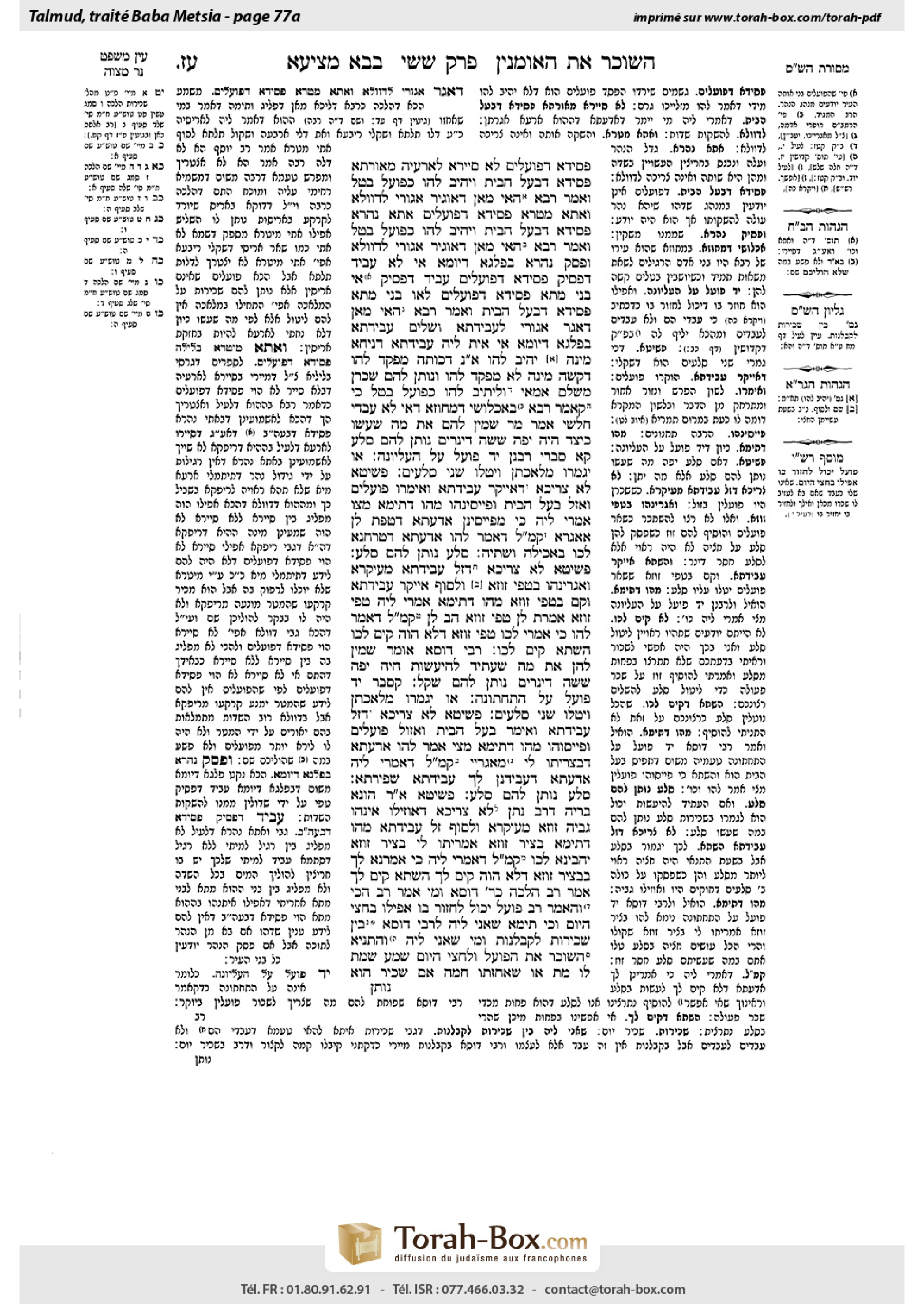
Bava Metzia 77a: Talmud study for Daf Yomi
Study the Talmud for Daf Yomi with scanned pages, Hebrew text, English translations from Sefaria and AI-generated French translations.
Passage selection and English or AI-generated French translation are available where the scan has annotations. Daf Study is independent of Torah-Box and Sefaria.
Browse Bava Metzia · בבא מציעא · All tractatesBava Metzia 77a text and translations
This page of Bava Metzia includes the Aramaic text, an English translation and an AI-generated French translation, alongside the scan above.
בבא מציעא ע״ז א · Aramaic and Hebrew text
פְּסֵידָא דְפוֹעֲלִים, לָא סַיְּירַהּ לְאַרְעֵיהּ מֵאוּרְתָּא – פְּסֵידָא דְּבַעַל הַבַּיִת וְיָהֵיב לְהוּ כְּפוֹעֵל בָּטֵל.
וְאָמַר רָבָא: הַאי מַאן דְּאוֹגַיר אֲגִירֵי לְדַוְולָא, וַאֲתָא מִטְרָא – פְּסֵידָא דְפוֹעֲלִים. אֲתָא נַהֲרָא – פְּסֵידָא דְּבַעַל הַבַּיִת, וְיָהֵיב לְהוּ כְּפוֹעֵל בָּטֵל.
וְאָמַר רָבָא: הַאי מַאן דְּאוֹגַיר אֲגִירֵי לְדַוְולָא, וּפְסַק נַהֲרָא בְּפַלְגָא דְיוֹמָא, אִי לָא עֲבִיד דְּפָסֵיק – פְּסֵידָא דְפוֹעֲלִים. עֲבִיד דְּפָסֵיק – אִי בְּנֵי מָתָא, פְּסֵידָא דְפוֹעֲלִים. לָאו בְּנֵי מָתָא – פְּסֵידָא דְּבַעַל הַבַּיִת.
וְאָמַר רָבָא: הַאי מַאן דַּאֲגַר אֲגִירֵי לַעֲבִידְתָּא, וּשְׁלִים עֲבִידְתָּא בְּפַלְגָא דְיוֹמָא, אִי אִית לֵיהּ עֲבִידְתָּא דְּנִיחָא מִינַּהּ – יָהֵיב לְהוּ, אִי נָמֵי דִּכְוָתַהּ – מְפַקֵּד לְהוּ, (דקשה) [דְּקַשְׁיָא] מִינַּהּ – לָא מְפַקֵּד לְהוּ, וְנוֹתֵן לָהֶם שְׂכָרָן מִשָּׁלֵם.
אַמַּאי? וְלִיתֵּיב לְהוּ כְּפוֹעֵל בָּטֵל! כִּי קָאָמַר רָבָא, בְּאַכְלוֹשֵׁי דְמָחוֹזָא, דְּאִי לָא עָבְדִי – חָלְשִׁי.
אָמַר מָר: שָׁמִין לָהֶם אֶת מַה שֶּׁעָשׂוּ, כֵּיצַד? הָיָה יָפֶה שִׁשָּׁה דִּינָרִים – נוֹתֵן לָהֶם סֶלַע. קָא סָבְרִי רַבָּנַן: יַד פּוֹעֵל עַל הָעֶלְיוֹנָה.
אוֹ יִגְמְרוּ מְלַאכְתָּן וְיִטְּלוּ שְׁנֵי סְלָעִים. פְּשִׁיטָא! לָא צְרִיכָא: דְּאִיַּיקַּר עֲבִידְתָּא וְאִימְּרוּ פּוֹעֲלִים וַאֲזַל בַּעַל הַבַּיִת וּפַיְּיסִינְהוּ. מַהוּ דְּתֵימָא, מָצוּ אָמְרִי לֵיהּ: כִּי מְפַיְּיסִינַן – אַדַּעְתָּא דְּטָפֵית לַן אַאַגְרָא, קָא מַשְׁמַע לַן דְּאָמַר לְהוּ: אַדַּעְתָּא דְּטָרַחְנָא לְכוּ בַּאֲכִילָה וּשְׁתִיָּה.
סֶלַע נוֹתֵן לָהֶם סֶלַע. פְּשִׁיטָא! לָא צְרִיכָא – דְּזַל עֲבִידְתָּא מֵעִיקָּרָא, וְאַגְרִינְהוּ בִּטְפֵי זוּזָא, וּלְסוֹף אִיַּיקַּר עֲבִידְתָּא וְקָם בִּטְפֵי זוּזָא.
מַהוּ דְּתֵימָא אָמְרִי לֵיהּ: טְפֵי זוּזָא אֲמַרְתְּ לַן – טְפֵי זוּזָא הַב לַן, קָא מַשְׁמַע לַן דַּאֲמַר לְהוּ, כִּי אֲמַרִי לְכוּ טְפֵי זוּזָא: דְּלָא הֲוָה קִים לְכוּ, הַשְׁתָּא קִים לְכוּ.
רַבִּי דּוֹסָא אוֹמֵר: שָׁמִין לָהֶן אֶת מַה שֶּׁעָתִיד לְהֵיעָשׂוֹת, הָיָה יָפֶה שִׁשָּׁה דִּינָרִים נוֹתֵן לָהֶם שֶׁקֶל. קָסָבַר יַד פּוֹעֵל עַל הַתַּחְתּוֹנָה.
אוֹ יִגְמְרוּ מְלַאכְתָּן וְיִטְּלוּ שְׁנֵי סְלָעִים. פְּשִׁיטָא! לָא צְרִיכָא דְּזַל עֲבִידְתָּא וְאִימַּר בַּעַל הַבַּיִת, וַאֲזוּל פּוֹעֲלִים וּפַיְּיסוּהּ. מַהוּ דְּתֵימָא, מָצֵי אֲמַר לְהוּ: אַדַּעְתָּא דְּבָצְרִיתוּ לִי מֵאַגְרַיי. קָא מַשְׁמַע לַן דְּאָמְרִי לֵיהּ: אַדַּעְתָּא דְּעָבְדִינַן לָךְ עֲבִידְתָּא שַׁפִּירְתָּא.
סֶלַע נוֹתֵן לָהֶם סֶלַע. פְּשִׁיטָא! אָמַר רַב הוּנָא בְּרֵיהּ דְּרַב נָתָן: לָא צְרִיכָא דְּאוֹזִילוּ אִינְהוּ גַּבֵּיהּ זוּזָא מֵעִיקָּרָא, וּלְסוֹף זַל עֲבִידְתָּא.
מַהוּ דְּתֵימָא: בְּצִיר זוּזָא אַמְרִיתוּ לִי – בְּצִיר זוּזָא יָהֵיבְנָא לְכוּ, קָא מַשְׁמַע לַן דְּאָמְרִי לֵיהּ: כִּי אֲמַרְנָא לָךְ בִּבְצִיר זוּזָא – דְּלָא הֲוָה קִים לָךְ, הַשְׁתָּא קִים לָךְ.
אָמַר רַב: הֲלָכָה כְּרַבִּי דּוֹסָא. וּמִי אָמַר רַב הָכִי? וְהָאָמַר רַב: פּוֹעֵל יָכוֹל לַחֲזוֹר בּוֹ אֲפִילּוּ בַּחֲצִי הַיּוֹם! וְכִי תֵּימָא שָׁאנֵי לֵיהּ לְרַבִּי דּוֹסָא בֵּין שְׂכִירוּת לְקַבְּלָנוּת, וּמִי שָׁאנֵי לֵיהּ? וְהָתַנְיָא: הַשּׂוֹכֵר אֶת הַפּוֹעֵל, וְלַחֲצִי הַיּוֹם שָׁמַע שֶׁמֵּת לוֹ מֵת, אוֹ שֶׁאֲחָזַתּוּ חַמָּה, אִם שָׂכִיר הוּא –
Bava Metzia 77a · English translation
this is the laborers’ loss, as it is a consequence of their misfortune. But if he did not survey his land the night before, it is the employer’s loss, and he gives them the wages of an idle laborer.
And Rava further said: With regard to this one who hires laborers to draw water from a river or a trench to irrigate his field, and rain fell, so that he no longer needs laborers, this is the laborers’ loss. The employer does not need to pay them, as he could not have known ahead of time that this would happen. But if the river comes up and irrigates the field, this is the employer’s loss, as he should have taken this possibility into consideration. And therefore he gives them the wages of an idle laborer.
And Rava says: With regard to this one who hires laborers to draw water from a river or a trench to irrigate his field, and the flow of the part of the river used to irrigate the field stopped midday, the halakha depends on the circumstance. If it is not prone to stopping, this is the laborers’ loss, a consequence of their misfortune. If it is prone to stopping, then one acts in accordance with this consideration: If the workers are residents of that city and know that this might happen, it is the laborers’ loss; if the laborers are not residents of that city and are not aware that this is a likely occurrence, it is the employer’s loss.
And Rava says: With regard to this one who hires laborers to perform a specific task and the task is completed by midday, if he has another task that is easier than the first one, he may give it to them. Alternatively, if he has other work that is similar to the first one in difficulty, he may assign it to them. But if he has other work that is more difficult than it, he may not assign it to them, and he gives them their full wages.
The Gemara asks: Why must he pay them their full wages? Let him pay them for the additional time at most as an idle laborer. The Gemara answers: When Rava said his ruling in this case, he was referring to workers [be’akhlushei] of Meḥoza, who become weak if they do not work. These laborers were accustomed to steady, strenuous work, and therefore sitting idle was difficult, not enjoyable, for them.
§ The Master said in the baraita: The court appraises for them that which they have done. How so? If the current wage for the part of the task they have done was now worth six dinars, a sela and a half, as the price for this assignment increased, there are two possibilities: One is that he gives them a sela, as originally agreed upon, since they do not forfeit their stipulated wages. The Gemara explains: The Rabbis hold that the laborer is at an advantage, and therefore even if the laborer reneges on the assignment, he does not lose everything.
The baraita states the second possibility: Or they finish their work and take two sela. The Gemara asks: Isn’t it obvious that this is the case? That is the sum they agreed on at the outset. The Gemara responds: No, it is necessary to state this halakha in a case where the price of labor increased during the day and the laborers rebelled and did not want to work anymore, and the employer went and appeased them and they agreed to finish their task. Lest you say that they can say to him: When we were appeased, it was with the intent that you would increase our wage, the baraita teaches us that the employer can say to them: I appeased you with the intent that I would trouble myself for you by providing you with superior food and drink, not that I would increase your wages.
The baraita further teaches that if they performed work worth a sela, he gives them a sela. The Gemara asks: Isn’t that obvious? The Gemara explains: No, it is necessary in a case where the price of labor was inexpensive at the outset and he hired them for one dinar more than accepted, and ultimately the price of labor increased and the going wage now stands at that rate of one more dinar.
The Gemara elaborates: Lest you say that they can say to him: You offered us a dinar above the going rate, so now too, give us one more dinar than the current rate, to counter this, the baraita teaches us that he can say to them: When I said to you that I would add one more dinar, the reason was that it was not clear with regard to you that you would be willing to work for the lower wage, so I increased it. Now it is clear with regard to you, i.e., you agreed to a wage that was acceptable to you, and I do not intend to increase it further.
The baraita further teaches that Rabbi Dosa says: The court appraises for them that which must still be done. If the current wage for the part of the task they had not done was worth six dinars, i.e., he can find laborers who will complete it only for six dinars, which is equivalent to one and a half sela, there are two possibilities: One is that he gives the first laborers a shekel, which is equivalent to half a sela. The Gemara explains that Rabbi Dosa holds that the laborer is at a disadvantage, in accordance with the principle that whoever reneges is at a disadvantage.
§ The baraita states the second possibility: Or they finish their work and take two sela. The Gemara asks: Isn’t this obvious? The Gemara explains: No, it is necessary in a case where the price of labor decreased midday and the employer rebelled, seeking to cancel the agreement, and the laborers went and appeased him so that he would let them continue their work. Lest you say that the employer can say to them: When I was appeased, that was with the intent that you would decrease your wages for me, therefore, the baraita teaches us that the laborers can say to him: When we spoke it was with the intent that we will do improved work for you.
The baraita further teaches that Rabbi Dosa said: And if the current wage for the part of the task they had not done was worth a sela, he gives them a sela. The Gemara asks: Isn’t that obvious? Rav Huna, son of Rav Natan, said: No, it is necessary in a case where they reduced for him the accepted price by a dinar at the outset, and ultimately the price of labor decreased, so that the standard wage became equal to the price they had agreed on.
Rav Huna, son of Rav Natan, elaborates: Lest you say that the employer can say to them: You said to me that you would accept wages of a dinar less than the market value, and therefore a dinar less that the standard wage is what I will give you. Consequently, Rabbi Dosa teaches us that the laborers can say to him: When we said to you that we would agree to a dinar less, that was when it was not clear that you would be willing to pay the higher wage, but now it is clear that you will agree, and therefore you cannot reduce our wages.
With regard to that same dispute in the baraita, Rav said: The halakha is in accordance with the opinion of Rabbi Dosa. The Gemara asks: And did Rav really say that? But doesn’t Rav say that a laborer can renege from his commitment even at midday? And if you would say that there is a difference for Rabbi Dosa between hired work and contracted work, as a hired laborer can renege but a contracted laborer cannot, is there really a difference for him? But isn’t it taught in a baraita: With regard to one who hires a laborer, and at midday the laborer heard that a relative of his died and he has to tend to the burial, or if the laborer was gripped with fever and could not continue to work, if he is a hired laborer,
Bava Metzia 77a · Traduction française (IA)
C’est la perte des ouvriers, car c’est une conséquence de leur malheur. Mais s’il n’a pas inspecté ses terres la veille, c’est la perte de l’employeur, et il leur donne les salaires d’ouvriers inactifs.
Et Rava a dit davantage : En ce qui concerne celui qui embauche des ouvriers pour tirer de l’eau d’un fleuve ou d’un canal afin d’arroser son champ, et que la pluie est tombée, de sorte qu’il n’a plus besoin d’ouvriers, c’est la perte des ouvriers. L’employeur n’a pas besoin de les payer, car il n’aurait pas pu savoir à l’avance que cela allait arriver. Mais si le fleuve monte et arrose le champ, c’est la perte de l’employeur, car il aurait dû prendre cette possibilité en compte. Et par conséquent, il leur donne les salaires d’ouvriers inactifs.
Et Rava dit : En ce qui concerne celui qui embauche des ouvriers pour tirer de l’eau d’un fleuve ou d’un canal afin d’arroser son champ, et que le débit de la partie du fleuve utilisée pour arroser le champ s’arrête à midi, la halakha dépend du contexte. Si cela n’est pas sujet à s’arrêter, c’est la perte des ouvriers, une conséquence de leur malheur. Si cela est sujet à s’arrêter, alors on agit selon cette considération : Si les ouvriers sont des habitants de cette ville et savent que cela peut arriver, c’est la perte des ouvriers ; si les ouvriers ne sont pas des habitants de cette ville et ne sont pas conscients que cela est une occurrence probable, c’est la perte de l’employeur.
Et Rava dit : En ce qui concerne celui qui embauche des ouvriers pour accomplir une tâche spécifique et que la tâche est achevée à midi, s’il a une autre tâche plus facile que la première, il peut la leur donner. Alternativement, s’il a d’autres travaux de difficulté similaire à la première, il peut les leur assigner. Mais s’il a d’autres travaux plus difficiles, il ne peut pas les leur assigner, et il leur donne leurs salaires complets.
La Guemara demande : Pourquoi doit-il leur payer leurs salaires complets ? Laissez-le leur payer au plus pour le temps supplémentaire comme un ouvrier inactif. La Guemara répond : Quand Rava a dit sa décision dans ce cas, il faisait référence aux ouvriers [be’akhlushei] de Meḥoza, qui deviennent faibles s’ils ne travaillent pas. Ces ouvriers étaient habitués à un travail constant et pénible, et par conséquent, rester inactif était difficile, pas agréable, pour eux.
§ Le Maître a dit dans la baraïta : Le tribunal évalue pour eux ce qu’ils ont accompli. Comment cela se passe-t-il ? Si le salaire actuel pour la partie de la tâche qu’ils ont accomplie est maintenant équivalent à six dinars, un sela et demi, car le prix de cette assignation a augmenté, il y a deux possibilités : l’une est qu’il leur donne un sela, comme convenu initialement, car ils ne perdent pas leurs salaires stipulés. La Guemara explique : Les Rabbins considèrent que l’ouvrier est avantageux, et par conséquent, même si l’ouvrier renonce à l’assignation, il ne perd pas tout.
La baraïta énonce la deuxième possibilité : Ou ils terminent leur travail et prennent deux sela. La Guemara demande : N’est-ce pas évident ? C’est la somme qu’ils avaient convenu au départ. La Guemara répond : Non, il est nécessaire d’énoncer cette halakha dans un cas où le prix du travail a augmenté pendant la journée et les ouvriers se sont révoltés et ne voulaient plus travailler, et l’employeur est allé les apaiser et ils ont convenu de terminer leur tâche. De peur que vous disiez qu’ils peuvent dire à lui : Quand nous avons été apaisés, c’était avec l’intention que vous augmentiez notre salaire, la baraïta nous apprend que l’employeur peut dire à eux : J’ai apaisé vous avec l’intention que je me donne la peine de vous fournir de meilleurs aliments et bois, pas que j’augmente votre salaire.
La baraïta enseigne davantage que s’ils ont accompli un travail équivalent à un sela, il leur donne un sela. La Guemara demande : N’est-ce pas évident ? La Guemara explique : Non, il est nécessaire dans un cas où le prix du travail était peu cher au départ et il les a embauchés pour un dinar de plus que ce qu’ils avaient accepté, et finalement le prix du travail a augmenté et le salaire courant est maintenant à ce taux d’un dinar de plus.
La Guemara développe : De peur que vous disiez qu’ils peuvent dire à lui : Vous nous avez offert un dinar au-dessus du taux courant, donc maintenant aussi, donnez-nous un dinar de plus que le taux actuel, pour contre cela, la baraïta nous apprend que l’employeur peut dire à eux : Quand j’ai dit à vous que je vous ajouterai un dinar de plus, la raison était que cela n’était pas clair concernant vous que vous seriez prêt à travailler pour le salaire inférieur, donc j’ai augmenté. Maintenant, c’est clair concernant vous, c’est-à-dire vous avez convenu d’un salaire acceptable pour vous, et je n’ai pas l’intention d’augmenter davantage.
La baraïta enseigne en outre que Rabbi Dosa dit : Le tribunal évalue pour eux ce qui doit encore être fait. Si le salaire actuel pour la partie de la tâche qu’ils n’ont pas accomplie est équivalent à six dinars, c’est-à-dire qu’il peut trouver des ouvriers qui la terminent seulement pour six dinars, ce qui équivaut à un et demi sela, il y a deux possibilités : l’une est qu’il donne aux premiers ouvriers un shekel, ce qui équivaut à demi sela. La Guemara explique que Rabbi Dosa considère que l’ouvrier est en désavantage, conformément au principe que celui qui renonce est en désavantage.
§ La baraïta énonce la deuxième possibilité : ou ils terminent leur travail et prennent deux sela. La Guemara demande : N’est-ce pas évident ? La Guemara explique : Non, il est nécessaire dans un cas où le prix du travail a diminué à midi et l’employeur s’est révolté, cherchant à annuler l’accord, et les ouvriers sont allés l’apaiser afin qu’il les laisse continuer leur travail. De peur que vous disiez que l’employeur peut dire à eux : Quand j’ai été apaisé, c’était avec l’intention que vous diminuiez votre salaire pour moi, donc la baraïta nous apprend que les ouvriers peuvent dire à lui : Quand nous avons parlé, c’était avec l’intention que nous ferons un meilleur travail pour vous.
La baraïta enseigne également que Rabbi Dosa a dit : Et si le salaire actuel pour la partie de la tâche qu'ils n'ont pas accomplie était équivalent à un sela, il leur donne un sela. La Guemara demande : N'est-ce pas évident ? Rav Huna, fils de Rav Natan, répond : Non, cela est nécessaire dans le cas où ils ont réduit à l'avance le prix accepté d'un dinar, et finalement le prix du travail a diminué, de sorte que le salaire standard est devenu égal au prix qu'ils avaient convenu.
Rav Huna, fils de Rav Natan, développe davantage : Pour éviter que vous ne disiez que l'employeur peut dire à eux : Vous avez dit à moi que vous acceptiez un dinar moins que la valeur du marché, et donc un dinar moins que le salaire standard est ce que je vous donnerai. Ainsi, Rabbi Dosa nous enseigne que les travailleurs peuvent dire à lui : Lorsque nous avons dit à vous que nous acceptions un dinar moins, c'était lorsque ce n'était pas clair que vous seriez prêt à payer le salaire plus élevé, mais maintenant c'est clair que vous accepterez, et donc vous ne pouvez pas réduire nos salaires.
Concernant ce même débat dans la baraïta, Rav a dit : La halakha suit l'opinion de Rabbi Dosa. La Guemara demande : Et Rav a vraiment dit cela ? Mais n'a-t-il pas dit que le travailleur peut démissionner de sa promesse même à midi ? Et si vous dites qu'il y a une différence pour Rabbi Dosa entre le travail à la journée et le contrat de travail, car un travailleur à la journée peut démissionner mais un travailleur en contrat ne peut pas, y a-t-il vraiment une différence pour lui ? Mais n'est-il pas enseigné dans une baraïta : Concernant celui qui embauche un travailleur, et à midi le travailleur apprend qu'un parent est mort et qu'il doit s'occuper du funérarium, ou si le travailleur souffre de fièvre et ne peut plus travailler, si c'est un travailleur à la journée,
Traduction française générée par IA à partir de l’édition anglaise de Sefaria. Vérifie toujours un passage avec le texte source.
Text from Sefaria: William Davidson Edition - Vocalized Aramaic (CC BY NC); William Davidson Edition - English (CC BY NC).