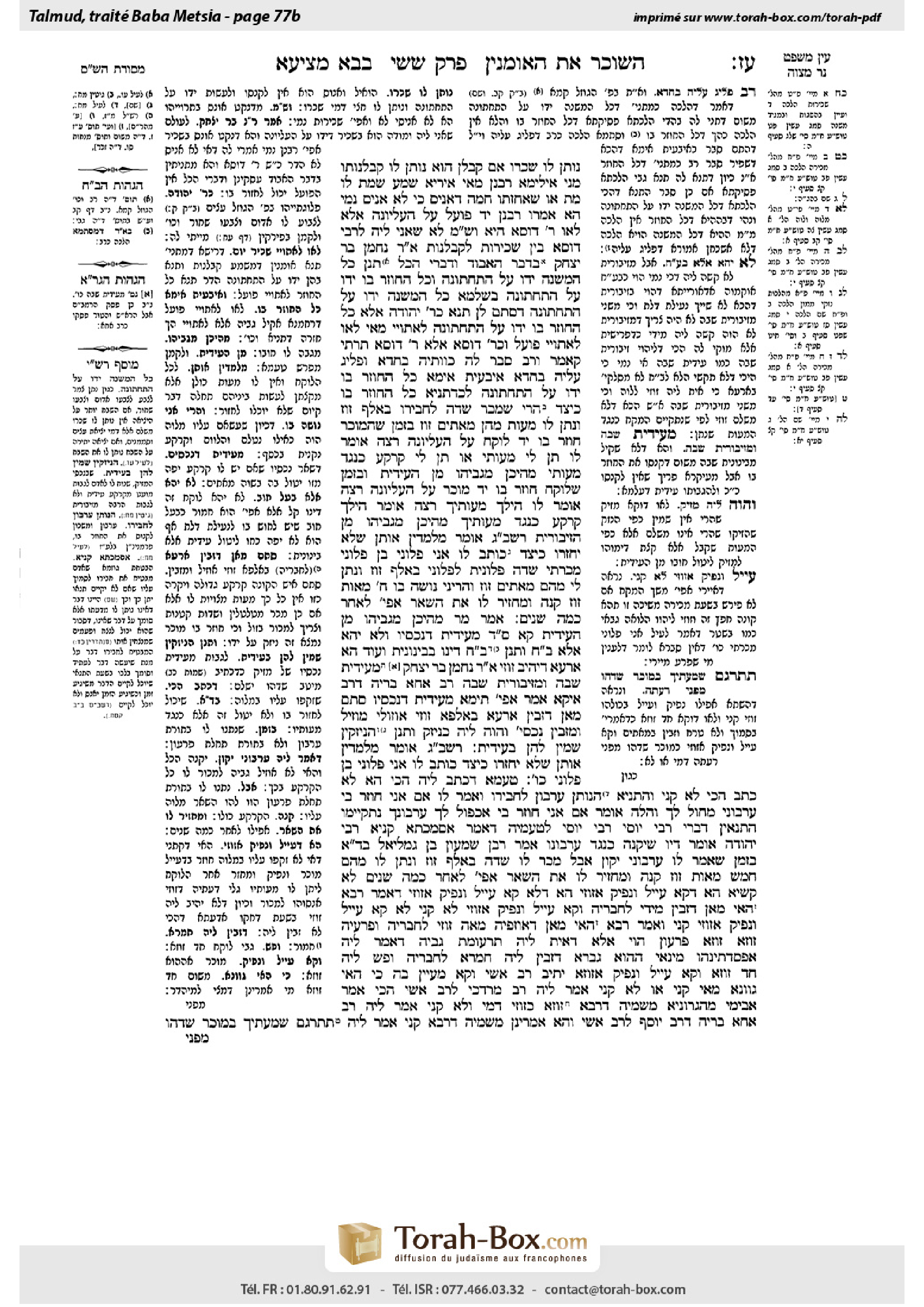
Bava Metzia 77b: Talmud study for Daf Yomi
Study the Talmud for Daf Yomi with scanned pages, Hebrew text, English translations from Sefaria and AI-generated French translations.
Passage selection and English or AI-generated French translation are available where the scan has annotations. Daf Study is independent of Torah-Box and Sefaria.
Browse Bava Metzia · בבא מציעא · All tractatesBava Metzia 77b text and translations
This page of Bava Metzia includes the Aramaic text, an English translation and an AI-generated French translation, alongside the scan above.
בבא מציעא ע״ז ב · Aramaic and Hebrew text
נוֹתֵן לוֹ שְׂכָרוֹ, אִם קַבְּלָן הוּא – נוֹתֵן לוֹ קַבְּלָנוּתוֹ.
מַנִּי? אִילֵּימָא רַבָּנַן, מַאי אִירְיָא שָׁמַע שֶׁמֵּת לוֹ מֵת אוֹ שֶׁאֲחָזַתּוּ חַמָּה דַּאֲנִיס, כִּי לָא אֲנִיס נָמֵי – הָא אֲמַרוּ רַבָּנַן יַד פּוֹעֵל עַל הָעֶלְיוֹנָה! אֶלָּא לָאו רַבִּי דּוֹסָא הִיא, וּשְׁמַע מִינַּהּ לָא שָׁאנֵי לֵיהּ לְרַבִּי דּוֹסָא בֵּין שְׂכִירוּת לְקַבְּלָנוּת.
אָמַר רַב נַחְמָן בַּר יִצְחָק: בְּדָבָר הָאָבוּד, וְדִבְרֵי הַכֹּל.
תְּנַן: כׇּל הַמְשַׁנֶּה יָדוֹ עַל הַתַּחְתּוֹנָה, וְכׇל הַחוֹזֵר בּוֹ יָדוֹ עַל הַתַּחְתּוֹנָה. בִּשְׁלָמָא כׇּל הַמְשַׁנֶּה יָדוֹ עַל הַתַּחְתּוֹנָה, דִּסְתַם לַן תַּנָּא כְּרַבִּי יְהוּדָה. אֶלָּא כׇּל הַחוֹזֵר בּוֹ יָדוֹ עַל הַתַּחְתּוֹנָה לְאֵתוֹיֵי מַאי? לָאו לְאֵתוֹיֵי פּוֹעֵל וּכְרַבִּי דּוֹסָא?
אֶלָּא רַבִּי דּוֹסָא תַּרְתֵּי קָאָמַר, וְרַב סָבַר לַהּ כְּווֹתֵיהּ בַּחֲדָא וּפָלֵיג עֲלֵיהּ בַּחֲדָא.
אִיבָּעֵית אֵימָא: ״כָּל הַחוֹזֵר בּוֹ יָדוֹ עַל הַתַּחְתּוֹנָה״, לְכִדְתַנְיָא: כׇּל הַחוֹזֵר בּוֹ כֵּיצַד? הֲרֵי שֶׁמָּכַר שָׂדֶה לַחֲבֵירוֹ בְּאֶלֶף זוּז, וְנָתַן לוֹ מָעוֹת מֵהֶן מָאתַיִם זוּז. בִּזְמַן שֶׁהַמּוֹכֵר חוֹזֵר בּוֹ – יַד לוֹקֵחַ עַל הָעֶלְיוֹנָה.
רָצָה – אוֹמֵר לוֹ: ״תֵּן לִי מְעוֹתַי״, אוֹ: ״תֵּן לִי קַרְקַע כְּנֶגֶד מְעוֹתַי״. מֵהֵיכָן מַגְבֵּיהוּ? מִן הָעִידִּית. וּבִזְמַן שֶׁלּוֹקֵחַ חוֹזֵר בּוֹ – יַד מוֹכֵר עַל הָעֶלְיוֹנָה, רָצָה אוֹמֵר לוֹ: ״הֵילָךְ מְעוֹתֶיךָ״, רָצָה אוֹמֵר ״הֵילָךְ קַרְקַע כְּנֶגֶד מְעוֹתֶיךָ״. מֵהֵיכָן מַגְבֵּיהוּ? מִן הַזִּיבּוּרִית.
רַבָּן שִׁמְעוֹן בֶּן גַּמְלִיאֵל אוֹמֵר: מְלַמְּדִין אוֹתָן שֶׁלֹּא יַחְזְרוּ. כֵּיצַד? כּוֹתֵב לוֹ: ״אֲנִי פְּלוֹנִי בֶּן פְּלוֹנִי מָכַרְתִּי שָׂדֶה פְּלוֹנִית לִפְלוֹנִי בְּאֶלֶף זוּז, וְנָתַן לִי מֵהֶם מָאתַיִם זוּז, וַהֲרֵינִי נוֹשֶׁה בּוֹ שְׁמוֹנֶה מֵאוֹת זוּז״, קָנָה וּמַחֲזִיר לוֹ אֶת הַשְּׁאָר, אֲפִילּוּ לְאַחַר כַּמָּה שָׁנִים.
אָמַר מָר: מֵהֵיכָן מַגְבֵּיהוּ? מִן הָעִידִּית. קָא סָלְקָא דַּעְתָּךְ מֵעִידִּית דִּנְכָסָיו. וְלֹא יְהֵא אֶלָּא בַּעַל חוֹב! וּתְנַן: בַּעַל חוֹב דִּינוֹ בְּבֵינוֹנִית. וְעוֹד: הָא אַרְעָא דְּיָהֵיב זוּזֵי?
אָמַר רַבִּי נַחְמָן בַּר יִצְחָק: מֵעִידִּית שֶׁבָּהּ, וּמִזִּיבּוּרִית שֶׁבָּהּ.
רַב אַחָא בְּרֵיהּ דְּרַב אִיקָא אָמַר: אֲפִילּוּ תֵּימָא מֵעִידִּית דִּנְכָסָיו, סְתַם מַאן דְּזָבֵין אַרְעָא בְּאַלְפָּא זוּזֵי – אוֹזוֹלֵי מוֹזֵיל וּמְזַבֵּין נְכָסָיו, וְהָוֵה לֵיהּ כְּנִיזָּק. וּתְנַן: הַנִּיזָּקִין שָׁמִין לָהֶן בְּעִידִּית.
רַבָּן שִׁמְעוֹן בֶּן גַּמְלִיאֵל אוֹמֵר: מְלַמְּדִין אוֹתָן שֶׁלֹּא יַחְזְרוּ. כֵּיצַד? כּוֹתֵב לוֹ: ״אֲנִי פְּלוֹנִי בֶּן פְּלוֹנִי כּוּ׳״. טַעְמָא דִּכְתַב לֵיהּ הָכִי, הָא לָא כְּתַב הָכִי – לָא קָנֵי?
וְהָתַנְיָא: הַנּוֹתֵן עֵרָבוֹן לַחֲבֵירוֹ וְאָמַר לוֹ ״אִם אֲנִי חוֹזֵר בִּי, עֶרְבוֹנִי מָחוּל לָךְ״, וְהַלָּה אוֹמֵר: ״אִם אֲנִי חוֹזֵר בִּי, אֶכְפּוֹל לָךְ עֶרְבוֹנְךָ״ – נִתְקַיְּימוּ הַתְּנָאִין, דִּבְרֵי רַבִּי יוֹסֵי.
רַבִּי יוֹסֵי לְטַעְמֵיהּ דְּאָמַר: אַסְמַכְתָּא קָנְיָא.
רַבִּי יְהוּדָה אוֹמֵר: דַּיּוֹ שֶׁיִּקְנֶה כְּנֶגֶד עֶרְבוֹנוֹ. אָמַר רַבָּן שִׁמְעוֹן בֶּן גַּמְלִיאֵל: בַּמֶּה דְּבָרִים אֲמוּרִים – בִּזְמַן שֶׁאָמַר לוֹ ״עֶרְבוֹנִי יִקּוֹן״. אֲבָל מָכַר לוֹ שָׂדֶה בְּאֶלֶף זוּז וְנָתַן לוֹ מֵהֶם חֲמֵשׁ מֵאוֹת זוּז – קָנָה, וּמַחְזִיר לוֹ אֶת הַשְּׁאָר אֲפִילּוּ לְאַחַר כַּמָּה שָׁנִים!
לָא קַשְׁיָא: הָא דְּקָא עָיֵיל וְנָפֵיק אַזּוּזֵי, הָא דְּלָא קָא עָיֵיל וְנָפֵיק אַזּוּזֵי.
דְּאָמַר רָבָא: הַאי מַאן דְּזַבֵּין מִידֵּי לְחַבְרֵיהּ וְקָא עָיֵיל וְנָפֵיק אַזּוּזֵי – לָא קָנֵי. לָא קָא עָיֵיל וְנָפֵיק אַזּוּזֵי – קָנֵי.
וְאָמַר רָבָא: הַאי מַאן דְּאוֹזְפֵיהּ מְאָה זוּזֵי לְחַבְרֵיהּ וּפַרְעֵיהּ זוּזָא זוּזָא – פֵּרָעוֹן הָוֵי, אֶלָּא דְּאִית לֵיהּ תַּרְעוֹמֶת גַּבֵּיהּ. דְּאָמַר לֵיהּ: אַפְסַדְתִּינְהוּ מִינַּאי.
הָהוּא גַּבְרָא דְּזַבֵּין לֵיהּ חֲמָרָא לְחַבְרֵיהּ וּפָשׁ לֵיהּ חַד זוּזָא, וְקָא עָיֵיל וְנָפֵיק אַזּוּזָא. יָתֵיב רַב אָשֵׁי וְקָא מְעַיֵּין בַּהּ: כִּי הַאי גַוְונָא מַאי: קָנֵי אוֹ לָא קָנֵי? אֲמַר לֵיהּ רַב מָרְדֳּכַי לְרַב אָשֵׁי: הָכִי אָמַר אֲבִימִי מֵהַגְרוֹנְיָא מִשְּׁמֵיהּ דְּרָבָא: זוּזָא כְּזוּזֵי דָּמֵי, וְלָא קָנֵי.
אֲמַר לֵיהּ רַב אַחָא בְּרֵיהּ דְּרַב יוֹסֵף לְרַב אָשֵׁי: וְהָא אָמְרִינַן מִשְּׁמֵיהּ דְּרָבָא קָנֵי! אֲמַר לֵיהּ: תִּתַּרְגַּם שְׁמַעְתָּיךָ בְּמוֹכֵר שָׂדֵהוּ
Bava Metzia 77b · English translation
he gives him his wage; if he is a contractor, he gives him his contracted payment?
The Gemara explains: Whose opinion does this baraita follow? If we say it is in accordance with the opinion of the Rabbis, why does the baraita rule that he receives his full payment specifically in a case when the laborer heard that a relative of his died, or if he was gripped with fever, where he was unable to work due to circumstances beyond his control? When he is not compelled by circumstances beyond his control to stop working, this should also be the halakha. After all, the Rabbis said that the laborer is at an advantage. Rather, is it not correct to say that this baraita is in accordance with the opinion of Rabbi Dosa? And one can learn from it that Rabbi Dosa does not differentiate between hired work and contracted work in this regard.
Rav Naḥman bar Yitzḥak said: The ruling of this baraita is stated with regard to a matter that involves financial loss if the work is not completed. Consequently, the employer is at an advantage, unless the laborer is compelled to stop working due to circumstances beyond his control, in which case everyone agrees that he receives his full wages.
We learned in the mishna: Whoever changes the terms accepted by both parties is at a disadvantage, and whoever reneges on an agreement is at a disadvantage. The Gemara asks: Granted, with regard to the statement: Whoever changes is at a disadvantage, one can understand this, as the tanna taught us an unattributed mishna in accordance with the opinion of Rabbi Yehuda, indicating that this is the halakha. But concerning the clause: Whoever reneges is at a disadvantage, what does it serve to add? Does it not serve to add the halakha of a laborer, and this is in accordance with the opinion of Rabbi Dosa, who holds that workers may not renege?
Evidently, Rav’s ruling does not accord with the opinion of Rabbi Dosa. Rather, Rabbi Dosa is saying two halakhot, and Rav holds in accordance with his opinion in one matter and disagrees with his opinion in one matter. Rav does not agree with Rabbi Dosa’s ruling that laborers are at a disadvantage, but he does agree with him with regard to the manner of calculating wages.
If you wish, say a different interpretation of the mishna. The phrase: Whoever reneges is at a disadvantage, is not discussing employment arrangements, but is referring to that which is taught in a baraita: Whoever reneges is at a disadvantage; how so? If one sold a field to another for one thousand dinars, and the buyer gave him two hundred dinars as a down payment, and then one of them reneged, when the seller reneges on his commitment, the buyer is at an advantage.
Consequently, if the buyer desires, he may say to him: Give me back my money that I gave you as a down payment, or give me land corresponding to the value of my money. If you will not give me all the land as per our agreement, I should at least receive land in proportion to the money I already paid you. From which type of land does the seller give the buyer? From superior-quality land. And when the buyer reneges, the seller is at an advantage: If he desires, the seller says to him: Take your money, and if he desires, he says to him: Take land corresponding to the value of your money that you already paid. From which type of land does the seller give the buyer? Even from inferior-quality land.
The baraita continues: Rabban Shimon ben Gamliel says: We teach them from the outset not to renege, so that the agreement will not be canceled and end in conflict. How so? The seller writes for him a bill of sale that states: I, so-and-so, son of so-and-so, sold such and such a field to so-and-so for one thousand dinars, and of them he gave me two hundred dinars. And therefore, now he owes me eight hundred dinars. In this manner, the buyer acquires the entire field, and the buyer returns the remaining eight hundred dinars to the seller even after several years. The remainder of the payment for the field has been transformed into a standard written loan.
The Master said in the baraita: From which type of land does the seller give the buyer? From superior-quality land. It may enter your mind to say that this means from the most superior-quality land of all of the seller’s property. The Gemara asks: But even if the buyer is considered to be like only a regular creditor, we learned in a mishna (Gittin 48b) that a creditor has the right only to intermediate-quality land, not superior-quality land. And furthermore, there is this specific plot of land, for which the buyer paid money. Why should he receive superior-quality land?
Rav Naḥman bar Yitzḥak said: When the baraita refers to the type of land that may be claimed after the buyer or seller reneges, it means from the most superior-quality land that is in the agreed-upon plot of land, or from the most inferior-quality land that is in it.
Rav Aḥa, son of Rav Ika, said: You may even say that the baraita means from the most superior-quality land of all of the seller’s property, as there is a specific reason why that should be the case here: Ordinarily, one who buys land for one thousand dinars will not have such a large sum on hand to carry out the transaction. Rather, he will significantly reduce the price of his possessions and sell them at a loss, so as to obtain the money. If the seller reneges and the buyer does not acquire this large plot of land, he will have suffered a significant loss, and he will be like an injured party, and we learned the same mishna: The court appraises superior-quality land for payment to injured parties. Therefore, in this case too, the seller must provide land of the highest quality.
§ It is further stated in the baraita that Rabban Shimon ben Gamliel says: We teach them not to renege. How so? He writes for him: I, so-and-so, son of so-and-so, sold such and such a field to so-and-so for one thousand dinars, and of them he gave me two hundred dinars. And therefore, now he owes me eight hundred dinars. This effects acquisition of the field for the buyer immediately. The Gemara asks: The reason they cannot renege is that the seller wrote this for the buyer in the contract. Evidently, if not for this being specified in a document the buyer does not acquire the field immediately.
The Gemara asks: But isn’t it taught in a baraita: With regard to one who gives a down payment to another, and says to him: If I renege, my down payment is forfeited to you, and the other person says to him: If I renege, I will double your down payment for you, the conditions are in effect; i.e., the court will enforce the conditions stipulated between them in this contract. This is the statement of Rabbi Yosei.
The Gemara comments: Rabbi Yosei conforms to his standard line of reasoning, as he says: A transaction with inconclusive consent [asmakhta] effects acquisition. Even though it is a commitment that he undertook based on his certainty that he would never be forced to fulfill the condition, it is considered a full-fledged commitment.
The Gemara continues its discussion of the baraita. Rabbi Yehuda says: It is sufficient that the down payment effects acquisition of merchandise commensurate with the amount of his down payment. Rabban Shimon ben Gamliel said: In what case is this statement said? It is when the buyer said to the seller: My down payment will effect acquisition of the merchandise. But if one sold another a field for one thousand dinars, and the buyer paid him five hundred dinars of that sum, he has acquired the entire field, and he returns the rest of the money to the seller even after several years have passed. Evidently, Rabban Shimon ben Gamliel maintains that even if they do not have an explicit contract, the buyer’s first payment finalizes the sale, rendering the remaining payment a standard loan. If so, why does the previous baraita state that Rabban Shimon ben Gamliel holds that this contract must be in writing?
The Gemara responds: This is not difficult. This ruling, that the down payment serves to effect acquisition only if they specified in writing that the remaining payment would be considered a loan, is stated with regard to a case where the seller goes in and goes out for money, i.e., demonstrates that he is in need of cash. Therefore, unless the acquisition was stated in writing, the buyer acquires the entire field only when he pays the entire sum. That ruling, that the down payment effects full acquisition regardless of whether or not it is written in a contract, is stated with regard to a case where he does not go in and go out for money.
This is as Rava says: With regard to one who sells an item to another and then goes in and goes out for money, the buyer has not acquired it, as it is clear that the seller sold it only because he needed the money immediately. Since the seller did not receive the money he wanted right away, the transaction is null. If he does not go in and go out for money, the buyer has acquired it, and the rest of the payment is considered like a loan that must be repaid in the future.
And Rava says: With regard to one who lent one hundred dinars to another and the borrower paid it back one dinar at a time, this is a valid repayment. But the lender has grounds for a grievance against him for repaying him in this manner, as he can say to him: You have caused me to lose out, as it is easier to use a lump sum than a few coins at a time.
§ The Gemara relates: There was a certain man who sold his donkey to another, and one dinar was still owed to him, and the seller went in and went out for his dinar. Rav Ashi sat and examined this situation, asking: In a case like this, what is the halakha? Has he acquired the donkey or has he not acquired it? Rav Mordekhai said to Rav Ashi: This is what Avimi of Hagronya said in the name of Rava: One dinar is considered to be like multiple dinars, and therefore he has not acquired it.
Rav Aḥa, son of Rav Yosef, said to Rav Ashi: But we say in the name of Rava that in this case he has acquired it. Rav Ashi said to him, in resolution of the apparent contradiction between these two versions of Rava’s ruling: Interpret your halakha with regard to one who sells his field
Bava Metzia 77b · Traduction française (IA)
il lui donne son salaire ; s'il est un entrepreneur, il lui donne le paiement convenu ?
La Guemara explique : De quel avis suit ce baraïta ? Si nous disons qu'il suit l'avis des Rabbins, pourquoi ce baraïta règle-t-il que l'ouvrier reçoit son salaire complet spécifiquement dans le cas où l'ouvrier a appris que l'un de ses parents est mort, ou s'il est tombé malade, où il n'a pu travailler en raison de circonstances hors de son contrôle ? Quand il n'est pas contraint par des circonstances hors de son contrôle à arrêter de travailler, cela devrait aussi être la halakha. Après tout, les Rabbins ont dit que l'ouvrier est favorisé. Plutôt, n'est-ce pas correct de dire que ce baraïta suit l'avis de Rabbi Dosa ? Et l'on peut en tirer la conclusion que Rabbi Dosa ne distingue pas entre un ouvrier engagé et un entrepreneur dans ce sens.
Rav Naḥman bar Yitzḥak a dit : La décision de ce baraïta est formulée concernant une affaire impliquant une perte financière si le travail n'est pas achevé. Par conséquent, l'employeur est favorisé, sauf si l'ouvrier est contraint à arrêter de travailler en raison de circonstances hors de son contrôle, dans ce cas, tout le monde convient qu'il reçoit son salaire complet.
Nous avons appris dans la Michna : Celui qui change les termes convenus par les deux parties est désavantagé, et celui qui rompt un accord est désavantagé. La Guemara pose la question : D'accord, concernant la déclaration : Celui qui change est désavantagé, on peut comprendre cela, car le tanna nous a appris une Michna non attribuée conformément à l'avis de Rabbi Yehuda, indiquant que c'est la halakha. Mais concernant la clause : Celui qui rompt est désavantagé, à quoi sert d'ajouter cela ? N'est-ce pas pour ajouter la halakha concernant l'ouvrier, et cela est conforme à l'avis de Rabbi Dosa, qui considère que les ouvriers ne peuvent pas rompre un accord ?
Évidemment, le jugement de Rav ne correspond pas à l'avis de Rabbi Dosa. Plutôt, Rabbi Dosa énonce deux halakhot, et Rav suit son avis dans une matière et s'y oppose dans une autre. Rav ne s'accorde pas avec le jugement de Rabbi Dosa concernant le désavantage des ouvriers, mais il s'accorde avec lui concernant la manière de calculer les salaires.
Si vous le souhaitez, dites une autre interprétation de la Michna. La phrase : Celui qui rompt est désavantagé, ne parle pas des arrangements de travail, mais fait référence à ce qui est enseigné dans une baraïta : Celui qui rompt est désavantagé ; comment ? Si l'un a vendu un champ à un autre pour mille dinars, et que l'acheteur lui a donné deux cents dinars comme acompte, et que l'un d'eux rompt, quand le vendeur rompt son engagement, l'acheteur est désavantagé.
Par conséquent, si l'acheteur le souhaite, il peut dire au vendeur : Rends-moi l'argent que j'ai donné comme acompte, ou donne-moi un terrain correspondant à la valeur de mon argent. Si tu ne me donnes pas tout le terrain selon notre accord, je devrais au moins recevoir un terrain proportionnel à l'argent que j'ai déjà payé. De quel type de terrain le vendeur donne-t-il à l'acheteur ? De terrain de qualité supérieure. Et quand l'acheteur rompt, le vendeur est favorisé : s'il le souhaite, le vendeur dit à l'acheteur : Prends ton argent, et s'il le souhaite, il dit à l'acheteur : Prends un terrain correspondant à la valeur de ton argent que tu as déjà payé. De quel type de terrain le vendeur donne-t-il à l'acheteur ? Même de terrain de qualité inférieure.
Le baraïta continue : Rabban Shimon ben Gamliel dit : Nous enseignons dès le début de ne pas rompre, afin que l'accord ne soit pas annulé et ne finisse pas en conflit. Comment ? Le vendeur écrit pour lui un acte de vente qui stipule : Je, tel et tel, fils de tel et tel, ai vendu tel et tel champ à tel et tel pour mille dinars, et de ceux-ci il m'a donné deux cents dinars. Et donc, maintenant il me doit huit cents dinars. Ainsi, l'acheteur acquiert l'ensemble du champ, et l'acheteur rend au vendeur les huit cents dinars restants même après plusieurs années. Le reste du paiement pour le champ est transformé en prêt écrit standard.
Le Maître a dit dans le baraïta : De quel type de terrain le vendeur donne-t-il à l'acheteur ? De terrain de qualité supérieure. Il peut entrer en vous l'idée que cela signifie du terrain de la plus haute qualité de tout le terrain du vendeur. La Guemara pose la question : Mais même si l'acheteur est considéré comme un simple créancier ordinaire, nous avons appris dans une michna (Gittin 48b) que le créancier a le droit uniquement à un terrain de qualité intermédiaire, pas à un terrain de qualité supérieure. Et de plus, il y a ce terrain spécifique, pour lequel l'acheteur a payé de l'argent. Pourquoi devrait-il recevoir un terrain de qualité supérieure ?
Rav Naḥman bar Yitzḥak a dit : Quand le baraïta fait référence au type de terrain que l'on peut revendiquer après que l'acheteur ou le vendeur ait rompu, cela signifie du terrain de la plus haute qualité qui est dans le terrain convenu, ou du terrain de la plus basse qualité qui est dans ce terrain.
Rav Aḥa, fils de Rav Ika, a dit : Vous pouvez même dire que le baraïta signifie du terrain de la plus haute qualité de tout le terrain du vendeur, car il y a une raison spécifique pour que cela soit ainsi : Ordinairement, celui qui achète un terrain pour mille dinars n'aura pas une telle somme à la main pour effectuer la transaction. Plutôt, il réduira considérablement le prix de ses biens et les vendra à perte, afin d'obtenir l'argent. Si le vendeur rompt et que l'acheteur ne récupère pas ce grand terrain, il subira une perte considérable, et il sera comme une personne blessée, et nous avons appris la même michna : Le tribunal évalue un terrain de qualité supérieure pour le paiement aux personnes blessées. Par conséquent, dans ce cas également, le vendeur doit fournir un terrain de la plus haute qualité.
§ Il est également mentionné dans la baraïta que Rabban Shimon ben Gamliel dit : Nous ne leur enseignons pas de déroger. Comment cela ? Il écrit pour lui : Je, tel et tel, fils de tel et tel, ai vendu telle et telle terre à tel et tel pour mille dinars, et de ceux-ci il m'a donné deux cents dinars. Et donc, maintenant il me doit huit cents dinars. Cela permet à l'acheteur d'acquérir la terre immédiatement. La Guemara demande : La raison pour laquelle ils ne peuvent pas déroger est que le vendeur a écrit cela pour l'acheteur dans le contrat. Évidemment, si ce n'était pas spécifié dans un document, l'acheteur ne serait pas en droit d'acquérir la terre immédiatement.
La Guemara demande : Mais n'est-ce pas enseigné dans une baraïta : Concernant celui qui verse un acompte à un autre et dit à celui-ci : Si je déroge, mon acompte est perdu à toi, et l'autre personne dit à lui : Si je déroge, je doublerai ton acompte pour toi, les conditions sont en vigueur ; c'est-à-dire que la cour exécutera les conditions stipulées entre eux dans ce contrat. C'est la déclaration de Rabbi Yosei.
La Guemara commente : Rabbi Yosei s'aligne sur sa ligne de raisonnement habituelle, car il dit : Une transaction avec un consentement indéterminé [asmakhta] permet l'acquisition. Même si c'est un engagement qu'il a entrepris sur la base de sa certitude qu'il ne serait jamais contraint de remplir la condition, il est considéré comme un engagement plein et entier.
La Guemara poursuit sa discussion de la baraïta. Rabbi Yéhuda dit : Il suffit que l'acompte permette l'acquisition de marchandises correspondant à la somme de l'acompte. Rabban Shimon ben Gamliel dit : Dans quel cas cette déclaration est-elle faite ? C'est lorsque l'acheteur dit au vendeur : Mon acompte permet l'acquisition des marchandises. Mais si l'un a vendu à l'autre un champ pour mille dinars, et que l'acheteur lui a payé cinq cents dinars de cette somme, il a acquis l'ensemble du champ, et il rend le reste de l'argent au vendeur même après plusieurs années. Évidemment, Rabban Shimon ben Gamliel maintient que même s'ils n'ont pas un contrat explicite, le premier paiement de l'acheteur termine la vente, rendant le reste du paiement un prêt normal. Si c'est ainsi, pourquoi la baraïta précédente dit-elle que Rabban Shimon ben Gamliel considère que ce contrat doit être écrit ?
La Guemara répond : Ce n'est pas difficile. Cette décision, selon laquelle l'acompte permet l'acquisition uniquement si ils ont spécifié par écrit que le reste du paiement serait considéré comme un prêt, est énoncée dans le cas où le vendeur va et vient pour de l'argent, c'est-à-dire qu'il montre qu'il a besoin d'argent immédiatement. Par conséquent, sauf si l'acquisition était spécifiée par écrit, l'acheteur ne peut acquérir l'ensemble du champ qu'une fois avoir payé la totalité de la somme. Cette décision, selon laquelle l'acompte permet l'acquisition complète indépendamment de l'écriture du contrat, est énoncée dans le cas où il ne va pas et ne vient pas pour de l'argent.
C'est ce que Rava dit : Concernant celui qui vend un objet à un autre et qui va et vient pour de l'argent, l'acheteur n'a pas acquis l'objet, car il est clair que le vendeur a vendu uniquement parce qu'il avait besoin d'argent immédiatement. Puisque le vendeur n'a pas reçu l'argent qu'il voulait tout de suite, la transaction est nulle. Si il ne va pas et ne vient pas pour de l'argent, l'acheteur a acquis l'objet, et le reste du paiement est considéré comme un prêt à rembourser ultérieurement.
Et Rava dit : Concernant celui qui a prêté cent dinars à un autre et que le prêteur a remboursé un dinar à la fois, cela constitue un remboursement valide. Mais le prêteur a des raisons de se plaindre contre lui pour ce mode de remboursement, car il peut lui dire : Tu as causé à moi une perte, car il est plus facile d'utiliser une somme unique qu'un petit nombre de pièces.
§ La Guemara rapporte : Il y avait un certain homme qui avait vendu son âne à un autre, et un dinar était encore dû à lui, et le vendeur avait va et vient pour son dinar. Rav Ashi s'est assis et a examiné cette situation, en demandant : Dans un cas comme celui-ci, quelle est la halakha ? A-t-il acquis l'âne ou non ? Rav Mordekhai a dit à Rav Ashi : C'est ce que Avimi de Hagronya a dit en nom de Rava : Un dinar est considéré comme plusieurs dinars, et donc il n'a pas acquis l'âne.
Rav Acha, fils de Rav Yosef, a dit à Rav Ashi : Mais nous disons en nom de Rava que dans ce cas il l'a acquis. Rav Ashi a dit à lui, pour résoudre la contradiction apparente entre ces deux versions de la décision de Rava : Interprète ta halakha dans le cas d'un homme qui vend son champ
Traduction française générée par IA à partir de l’édition anglaise de Sefaria. Vérifie toujours un passage avec le texte source.
Text from Sefaria: William Davidson Edition - Vocalized Aramaic (CC BY NC); William Davidson Edition - English (CC BY NC).