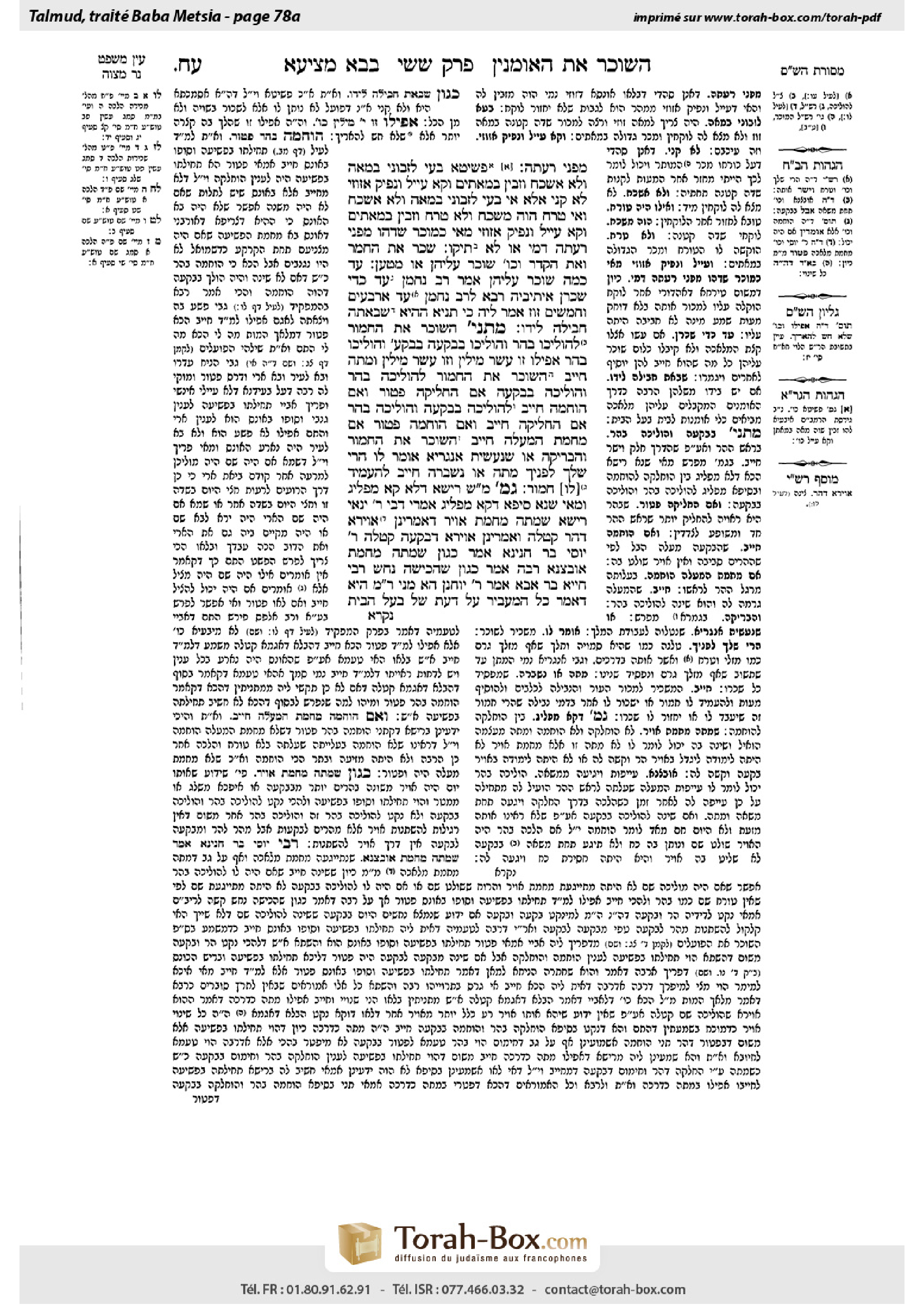
Bava Metzia 78a: Talmud study for Daf Yomi
Study the Talmud for Daf Yomi with scanned pages, Hebrew text, English translations from Sefaria and AI-generated French translations.
Passage selection and English or AI-generated French translation are available where the scan has annotations. Daf Study is independent of Torah-Box and Sefaria.
Browse Bava Metzia · בבא מציעא · All tractatesBava Metzia 78a text and translations
This page of Bava Metzia includes the Aramaic text, an English translation and an AI-generated French translation, alongside the scan above.
בבא מציעא ע״ח א · Aramaic and Hebrew text
מִפְּנֵי רָעָתָהּ.
פְּשִׁיטָא: בָּעֵי לְזַבּוֹנֵי בִּמְאָה וְלָא אַשְׁכַּח, וְזַבֵּין בְּמָאתַיִם, וְקָא עָיֵיל וְנָפֵיק אַזּוּזֵי – לָא קָנֵי. אֶלָּא אִי בָּעֵי לְזַבּוֹנֵי בִּמְאָה וְלָא אַשְׁכַּח, וְאִי טָרַח הֲוָה מַשְׁכַּח, וְלָא טְרַח וְזַבֵּין בְּמָאתַיִם, וְקָא עָיֵיל וְנָפֵיק אַזּוּזֵי – מַאי: כְּמוֹכֵר שָׂדֵהוּ מִפְּנֵי רָעָתָהּ דָּמֵי, אוֹ לָא? תֵּיקוּ.
שָׂכַר אֶת הַחַמָּר וְאֶת הַקַּדָּר וְכוּ׳ שׂוֹכֵר עֲלֵיהֶן אוֹ מַטְעָן. עַד כַּמָּה שׂוֹכֵר עֲלֵיהֶן? אָמַר רַב נַחְמָן: עַד כְּדֵי שְׂכָרָן.
אֵיתִיבֵיהּ רָבָא לְרַב נַחְמָן: עַד אַרְבָּעִים וַחֲמִשִּׁים זוּז! אָמַר לֵיהּ: כִּי תַּנְיָא הָהִיא – שֶׁבָּאתָה חֲבִילָה לְיָדוֹ.
מַתְנִי׳ הַשּׂוֹכֵר אֶת הַחֲמוֹר לְהוֹלִיכוֹ בָּהָר וְהוֹלִיכוֹ בַּבִּקְעָה, בַּבִּקְעָה וְהוֹלִיכוֹ בָּהָר, אֲפִילּוּ זוֹ עֶשֶׂר מִילִין וְזוֹ עֶשֶׂר מִילִין, וּמֵתָה – חַיָּיב. הַשּׂוֹכֵר אֶת הַחֲמוֹר לְהוֹלִיכָהּ בָּהָר וְהוֹלִיכָה בַּבִּקְעָה, אִם הֶחְלִיקָה – פָּטוּר, וְאִם הוּחֲמָה – חַיָּיב. לְהוֹלִיכָהּ בַּבִּקְעָה וְהוֹלִיכָה בָּהָר, אִם הֶחְלִיקָה – חַיָּיב, וְאִם הוּחַמָּה – פָּטוּר, אִם מֵחֲמַת הַמַּעֲלָה – חַיָּיב.
הַשּׂוֹכֵר אֶת הַחֲמוֹר וְהִבְרִיקָה אוֹ שֶׁנַּעֲשֵׂית אַנְגַּרְיָא – אוֹמֵר לוֹ: הֲרֵי שֶׁלְּךָ לְפָנֶיךָ. מֵתָה אוֹ נִשְׁבְּרָה – חַיָּיב לְהַעֲמִיד [לוֹ] חֲמוֹר.
גְּמָ׳ מַאי שְׁנָא רֵישָׁא דְּלָא קָא מְפַלֵּיג, וּמַאי שְׁנָא סֵיפָא דְּקָא מְפַלֵּיג?
אָמְרִי דְּבֵי רַבִּי יַנַּאי: רֵישָׁא שֶׁמֵּתָה מֵחֲמַת אֲוִיר, דְּאָמְרִינַן אַוֵּירָא דְהַר קַטְלַהּ, וְאָמְרִינַן אַוֵּירָא דְבִקְעָה קַטְלַהּ. רַבִּי יוֹסֵי בַּר חֲנִינָא אָמַר: כְּגוֹן שֶׁמֵּתָה מֵחֲמַת אוּבְצָנָא. רַבָּה אָמַר: כְּגוֹן שֶׁהִכִּישָׁהּ נָחָשׁ.
רַבִּי חִיָּיא בַּר אַבָּא אָמַר רַבִּי יוֹחָנָן: הָא מַנִּי רַבִּי מֵאִיר הִיא, דְּאָמַר: כׇּל הַמַּעֲבִיר עַל דַּעַת שֶׁל בַּעַל הַבַּיִת,
Bava Metzia 78a · English translation
due to its poor quality. In other words, he was eager to sell not due to financial pressure, but because he wanted to get rid of this low-value field. His persistent demands for every last dinar are due to his fear that the buyer will change his mind and cancel the transaction.
The Gemara discusses a similar case. It is obvious that if one wants to sell his property for one hundred dinars but does not find a buyer, and in actuality he sells property for two hundred, and goes in and goes out for money, the buyer has not acquired the field, as it is clear that the seller performed the transaction due to financial straits. But if he wants to sell his property for one hundred and does not find a willing buyer, and the case was that if he troubled himself he would find one, and instead he did not trouble himself and sells property for two hundred, and then he goes in and goes out for money, what is the halakha? Is he considered like one who sells a field due to its poor quality or not? No answer was found, and therefore the Gemara states that this dilemma shall stand unresolved.
§ The mishna teaches that if one hired a donkey driver or a potter and they reneged, and the goods would be lost, he may hire other workers at a higher price at the former’s expense, or deceive them to make them agree to return to work. The Gemara asks: Up to what amount may he hire at their expense? Rav Naḥman said: Up to their wages, i.e., if the first workers did part of the work and the employer had not yet paid them, he may add the amount he owes the original workers to the new workers’ wage.
Rava raised an objection to Rav Naḥman: But it was taught in a baraita that he can hire at their expense for up to forty or fifty dinars. Rav Naḥman said to him: When that baraita is taught it is with regard to a case where the bundle has come into his possession, i.e., the original worker left his tool kit with the employer. In this situation, the employer has more financial leverage, as he can sell the contents of the bundle to cover even higher costs.
MISHNA: With regard to one who rents a donkey to lead it on a mountain but he led it in a valley, or one who rents a donkey to lead it in a valley but he led it on a mountain, even if this path is ten mil and that one is also ten mil, and the animal dies, he is liable. With regard to one who rents a donkey to lead it on a mountain but he led it in a valley, if it slipped and injured itself he is exempt, but if it died of heatstroke he is liable, as it was the walk in the hotter valley that caused its death. With regard to one who rents a donkey to lead it in a valley but he led it on a mountain, if it slipped he is liable, because this was caused by the mountainous terrain, but if it died of heatstroke he is exempt. If it suffered from heatstroke due to the ascent, he is liable.
With regard to one who rents a donkey and it became ill or was seized for public service [angarya], the owner can say to the renter: That which is yours is before you, and he is not required to reimburse the renter or to supply him with another donkey. If the animal died or its leg broke, the owner is obligated to provide the renter with another donkey.
GEMARA: The Gemara asks: What is different about the first clause, where the tanna does not distinguish between the various ways in which the animal might have died, as he rules that the renter is always liable, and what is different about the latter clause, where he does distinguish between whether the animal was injured through slipping or heatstroke?
The Gemara answers: A Sage from the school of Rabbi Yannai said: The first clause is referring to a case where it died on account of the air, as we say that the air of the mountains killed it and we can equally say that the air of the valley killed it. A change in weather such that the animal is exposed to weather conditions he is unaccustomed to can be lethal. Rabbi Yosei bar Ḥanina said: The mishna is referring to a case where it died on account of exhaustion [uvtzena], as it can be assumed that this was caused by the weather. Rabba said: The mishna is speaking of a case where a snake bit it, as this is just as likely to happen in one place as it is in the other.
Conversely, Rabbi Ḥiyya bar Abba said that Rabbi Yoḥanan said: In accordance with whose opinion is this statement of the first clause of the mishna? It is in accordance with the opinion of Rabbi Meir, who says: Anyone who diverges from the intention of the employer by acting against their agreement
Bava Metzia 78a · Traduction française (IA)
en raison de sa mauvaise qualité. En d'autres termes, il était désireux de vendre non pas en raison de difficultés financières, mais parce qu'il voulait se débarrasser de ce champ de faible valeur. Ses exigences persistantes pour chaque dernier dinar sont dues à sa peur que l'acheteur change d'avis et annule la transaction.
La Guemara discute d'un cas similaire. Il est évident que si l'on veut vendre sa propriété pour cent dinars mais ne trouve pas d'acheteur, et en réalité il vend sa propriété pour deux cents, et entre et sort pour l'argent, l'acheteur n'a pas acquis le champ, car il est clair que le vendeur a effectué la transaction en raison de difficultés financières. Mais si l'on veut vendre sa propriété pour cent et ne trouve pas d'acheteur disposé, et que le cas était que s'il s'efforçait il trouverait un acheteur, et qu'au lieu de s'efforcer il vend sa propriété pour deux cents, et ensuite entre et sort pour l'argent, quelle est la halakha ? Est-il considéré comme celui qui vend un champ en raison de sa mauvaise qualité ou non ? Aucune réponse n'a été trouvée, et par conséquent la Guemara affirme que ce dilemme restera sans solution.
§ La Michna enseigne que si l'on a embauché un conducteur de mule ou un potier et qu'ils ont décliné, et que les biens seraient perdus, il peut embaucher d'autres ouvriers à un prix plus élevé au détriment des premiers, ou tromper pour les inciter à revenir travailler. La Guemara demande : Jusqu'à quel montant peut-il embaucher au détriment des premiers ? Rav Naḥman a dit : Jusqu'à leurs salaires, c'est-à-dire si les premiers ouvriers avaient déjà effectué partie du travail et que l'employeur n'avait pas encore payé, il peut ajouter l'argent dû aux premiers ouvriers au salaire des nouveaux.
Rava souleva une objection contre Rav Naḥman : Mais il a été enseigné dans une baraïta qu'il peut embaucher à leur charge jusqu'à quarante ou cinquante dinars. Rav Naḥman répondit à Rava : Lorsque cette baraïta est enseignée, c'est dans un cas où le paquet est entré en son possession, c'est-à-dire que l'ouvrier original a laissé son kit d'outils avec l'employeur. Dans ce cas, l'employeur a plus de levier financier, car il peut vendre le contenu du paquet pour couvrir même des coûts plus élevés.
MICHNA : Concernant celui qui loue une mule pour la conduire en montagne mais l'a conduite en vallée, ou celui qui loue une mule pour la conduire en vallée mais l'a conduite en montagne, même si ce chemin est de dix mil et que celui-ci est également de dix mil, et que l'animal meurt, il est responsable. Concernant celui qui loue une mule pour la conduire en montagne mais l'a conduite en vallée, si elle glisse et se blesse, il est exempt, mais si elle meurt d'épuisement, il est responsable, car c'est le chemin en vallée plus chaud qui a causé sa mort. Concernant celui qui loue une mule pour la conduire en vallée mais l'a conduite en montagne, si elle glisse, il est responsable, car cela a été causé par le terrain montagneux, mais si elle meurt d'épuisement, il est exempt. Si elle meurt d'épuisement en raison de l'ascension, il est responsable.
Concernant celui qui loue une mule et qu'elle est malade ou saisie pour service public [angarya], le propriétaire peut dire au locataire : Ce qui est à toi est devant toi, et il n'est pas tenu de réparer le locataire ou de lui fournir une autre mule. Si l'animal meurt ou si sa jambe se brise, le propriétaire est tenu de fournir au locataire une autre mule.
GUEMARA : La Guemara demande : Qu'est-ce qui diffère dans la première clause, où le tanna ne distingue pas entre les différentes façons dont l'animal pourrait être mort, car il établit que le locataire est toujours responsable, et qu'est-ce qui diffère dans la seconde clause, où il distingue entre si l'animal s'est blessé en glissant ou par épuisement ?
La Guemara répond : Un Sage de la maison de Rabbi Yannai a dit : La première clause fait référence à un cas où l'animal est mort à cause de l'air, car nous disons que l'air des montagnes l'a tué et nous pouvons aussi dire que l'air de la vallée l'a tué. Un changement de temps tel que l'animal est exposé à des conditions climatiques qu'il n'est pas habitué peut être fatal. Rabbi Yosei bar Ḥanina a dit : La Michna fait référence à un cas où l'animal est mort à cause de l'épuisement [uvtzena], car on peut supposer que cela a été causé par le temps. Rabba a dit : La Michna parle d'un cas où un serpent l'a mordu, car cela peut aussi bien arriver dans l'un ou l'autre lieu.
Inversement, Rabbi Ḥiyya bar Abba a dit que Rabbi Yoḥanan a dit : Selon l'opinion de qui est cette déclaration de la première clause de la Michna ? C'est selon l'opinion de Rabbi Meir, qui dit : Quiconque s'écarte de l'intention du propriétaire en agissant contre son accord
Traduction française générée par IA à partir de l’édition anglaise de Sefaria. Vérifie toujours un passage avec le texte source.
Text from Sefaria: William Davidson Edition - Vocalized Aramaic (CC BY NC); William Davidson Edition - English (CC BY NC).