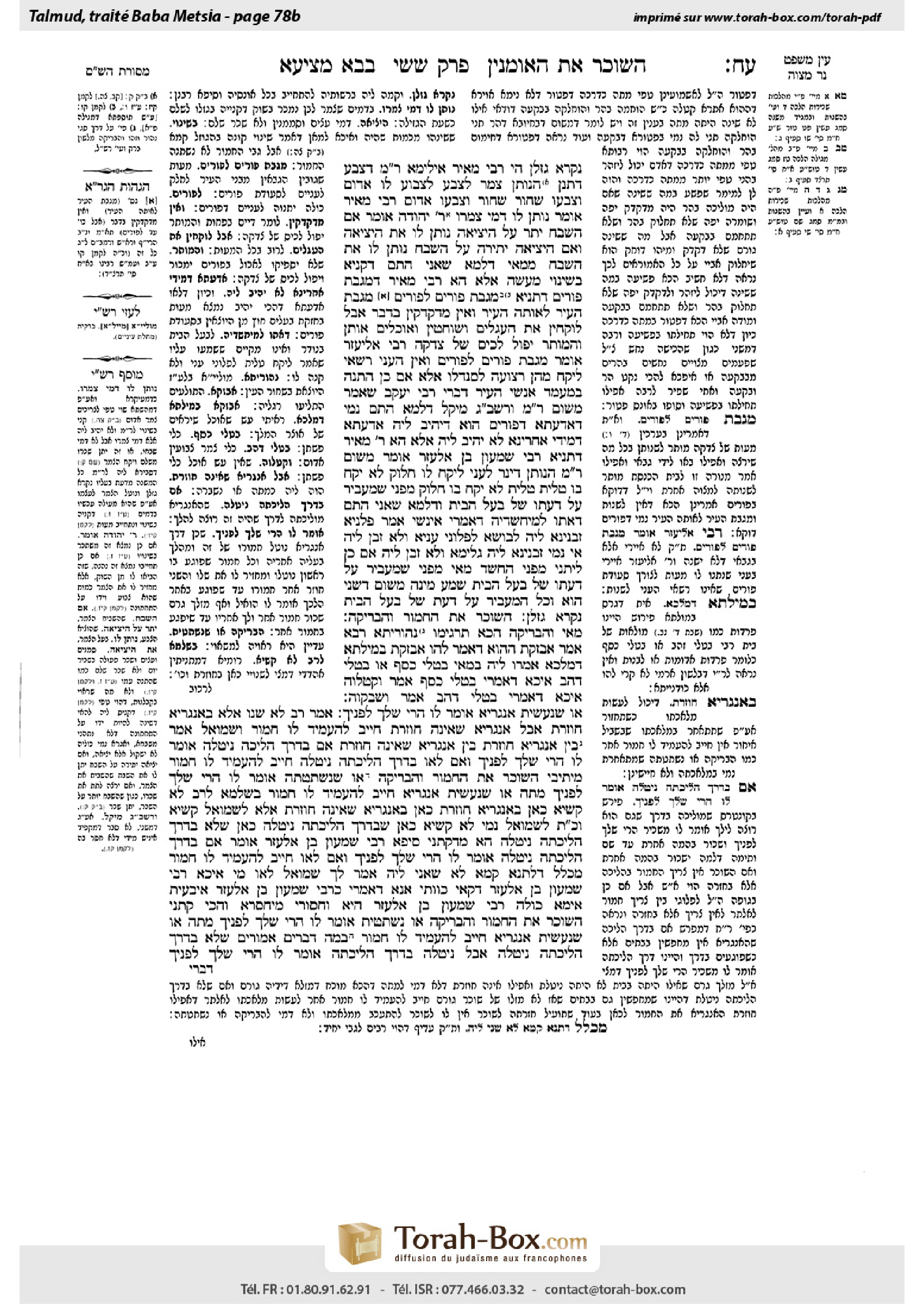
Bava Metzia 78b: Talmud study for Daf Yomi
Study the Talmud for Daf Yomi with scanned pages, Hebrew text, English translations from Sefaria and AI-generated French translations.
Passage selection and English or AI-generated French translation are available where the scan has annotations. Daf Study is independent of Torah-Box and Sefaria.
Browse Bava Metzia · בבא מציעא · All tractatesBava Metzia 78b text and translations
This page of Bava Metzia includes the Aramaic text, an English translation and an AI-generated French translation, alongside the scan above.
בבא מציעא ע״ח ב · Aramaic and Hebrew text
נִקְרָא גַּזְלָן.
הֵי רַבִּי מֵאִיר? אִילֵימָא רַבִּי מֵאִיר דְּצַבָּע, דִּתְנַן: הַנּוֹתֵן צֶמֶר לַצַבָּע לִצְבּוֹעַ לוֹ אָדוֹם וּצְבָעוֹ שָׁחוֹר, שָׁחוֹר וּצְבָעוֹ אָדוֹם, רַבִּי מֵאִיר אוֹמֵר: נוֹתֵן לוֹ דְּמֵי צַמְרוֹ.
רַבִּי יְהוּדָה אוֹמֵר: אִם הַשֶּׁבַח יָתֵר עַל הַיְּצִיאָה – נוֹתֵן לוֹ אֶת הַיְּצִיאָה, וְאִם הַיְּצִיאָה יְתֵירָה עַל הַשֶּׁבַח – נוֹתֵן לוֹ אֶת הַשֶּׁבַח.
מִמַּאי: דִּלְמָא שָׁאנֵי הָתָם דְּקַנְיֵאּ בְּשִׁינּוּי מַעֲשֶׂה?
אֶלָּא הָא רַבִּי מֵאִיר דְּמִגְבַּת פּוּרִים, דְּתַנְיָא: מִגְבַּת פּוּרִים – לְפוּרִים. מִגְבַּת הָעִיר – לְאוֹתָהּ הָעִיר, וְאֵין מְדַקְדְּקִין בַּדָּבָר. אֲבָל לוֹקְחִין אֶת הָעֲגָלִים וְשׁוֹחֲטִין וְאוֹכְלִים אוֹתָן, וְהַמּוֹתָר יִפּוֹל לְכִיס שֶׁל צְדָקָה.
רַבִּי אֱלִיעֶזֶר אוֹמֵר: מִגְבַּת פּוּרִים לְפוּרִים, וְאֵין הֶעָנִי רַשַּׁאי לִיקַּח מֵהֶן רְצוּעָה לְסַנְדָּלוֹ, אֶלָּא אִם כֵּן הִתְנָה בְּמַעֲמַד אַנְשֵׁי הָעִיר, דִּבְרֵי רַבִּי יַעֲקֹב שֶׁאָמַר מִשּׁוּם רַבִּי מֵאִיר. וְרַבָּן שִׁמְעוֹן בֶּן גַּמְלִיאֵל מֵיקֵל.
דִּלְמָא הָתָם נָמֵי, דְּאַדַּעְתָּא דְפוּרִים הוּא דְּיָהֵיב לֵיהּ, אַדַּעְתָּא דְּמִידֵּי אַחֲרִינָא לָא יָהֵיב לֵיהּ.
אֶלָּא הָא רַבִּי מֵאִיר, דְּתַנְיָא, רַבִּי שִׁמְעוֹן בֶּן אֶלְעָזָר אוֹמֵר מִשּׁוּם רַבִּי מֵאִיר: הַנּוֹתֵן דִּינָר לְעָנִי לִיקַּח לוֹ חָלוּק – לֹא יִקַּח בּוֹ טַלִּית, טַלִּית – לֹא יִקַּח בּוֹ חָלוּק, מִפְּנֵי שֶׁמַּעֲבִיר עַל דַּעְתּוֹ שֶׁל בַּעַל הַבַּיִת.
וְדִלְמָא שָׁאנֵי הָתָם דְּאָתוּ לְמִחְשְׁדֵיהּ, דְּאָמְרִי אִינָשֵׁי, אֲמַר פְּלָנְיָא: זָבֵנְינָא לֵיהּ לְבוּשָׁא לִפְלוֹנִי עַנְיָא, וְלָא זְבַן לֵיהּ. אִי נָמֵי, זָבֵנְינָא לֵיהּ גְּלִימָא וְלָא זְבַן לֵיהּ.
אִם כֵּן, לִיתְנֵי: ״מִפְּנֵי הַחֲשָׁד״, מַאי: ״מִפְּנֵי שֶׁמַּעֲבִיר עַל דַּעְתּוֹ שֶׁל בַּעַל הַבַּיִת״ – שְׁמַע מִינַּהּ מִשּׁוּם דשַׁנִּי הוּא, וְכׇל הַמַּעֲבִיר עַל דַּעַת שֶׁל בַּעַל הַבַּיִת נִקְרָא גַּזְלָן.
הַשּׂוֹכֵר אֶת הַחֲמוֹר וְהִבְרִיקָה, מַאי ״וְהִבְרִיקָה״? הָכָא תַּרְגִּימוּ ״נְהוֹרִיתָא״. רָבָא אָמַר: אַבְזְקָת.
הָהוּא דַּאֲמַר לְהוּ: אַבְזְקָת בְּמֵילָתָא דְּמַלְכָּא, אֲמַרוּ לֵיהּ: בְּמַאי? בְּטַלֵּי כְסַף, אוֹ בְּטַלֵּי דְהַב? אִיכָּא דְּאָמְרִי: בְּטַלֵּי כְסַף אֲמַר, וְקַטְלוּהּ. אִיכָּא דְּאָמְרִי: בְּטַלֵּי דְהַב אֲמַר, וְשַׁבְקוּהּ.
אוֹ שֶׁנַּעֲשֵׂית אַנְגַּרְיָא, אוֹמֵר לוֹ: הֲרֵי שֶׁלְּךָ לְפָנֶיךָ. אָמַר רַב: לֹא שָׁנוּ אֶלָּא בְּאַנְגַּרְיָא חוֹזֶרֶת. אֲבָל אַנְגַּרְיָא שֶׁאֵינָהּ חוֹזֶרֶת, חַיָּיב לְהַעֲמִיד לוֹ חֲמוֹר.
וּשְׁמוּאֵל אָמַר: בֵּין אַנְגַּרְיָא חוֹזֶרֶת בֵּין אַנְגַּרְיָא שֶׁאֵינָהּ חוֹזֶרֶת, אִם בְּדֶרֶךְ הֲלִיכָה נִיטְּלָה – אוֹמֵר לוֹ: הֲרֵי שֶׁלְּךָ לְפָנֶיךָ. וְאִם לָאו בְּדֶרֶךְ הֲלִיכָתָהּ נִיטְּלָה – חַיָּיב לְהַעֲמִיד לוֹ חֲמוֹר.
מֵיתִיבִי: הַשּׂוֹכֵר אֶת הַחֲמוֹר וְהִבְרִיקָה אוֹ שֶׁנִּשְׁתַּטְּתָה, אוֹמֵר לוֹ: הֲרֵי שֶׁלְּךָ לְפָנֶיךָ. מֵתָה אוֹ שֶׁנַּעֲשֵׂית אַנְגַּרְיָא – חַיָּיב לְהַעֲמִיד לוֹ חֲמוֹר.
בִּשְׁלָמָא לְרַב לָא קַשְׁיָא: כָּאן בְּאַנְגַּרְיָא חוֹזֶרֶת, כָּאן בְּאַנְגַּרְיָא שֶׁאֵינָהּ חוֹזֶרֶת. אֶלָּא לִשְׁמוּאֵל קַשְׁיָא!
וְכִי תֵּימָא לִשְׁמוּאֵל נָמֵי לָא קַשְׁיָא: כָּאן שֶׁבְּדֶרֶךְ הֲלִיכָתָהּ נִיטְּלָה, כָּאן שֶׁלֹּא בְּדֶרֶךְ הֲלִיכָתָהּ נִיטְּלָה.
הָא מִדְּקָתָנֵי סֵיפָא: רַבִּי שִׁמְעוֹן בֶּן אֶלְעָזָר אוֹמֵר: אִם בְּדֶרֶךְ הֲלִיכָתָהּ נִיטְּלָה, אוֹמֵר לוֹ: הֲרֵי שֶׁלְּךָ לְפָנֶיךָ, וְאִם לָאו – חַיָּיב לְהַעֲמִיד לוֹ חֲמוֹר. מִכְּלָל דִּלְתַנָּא קַמָּא לָא שָׁאנֵי לֵיהּ!
אָמַר לְךָ שְׁמוּאֵל: לָאו מִי אִיכָּא רַבִּי שִׁמְעוֹן בֶּן אֶלְעָזָר דְּקָאֵי כְּווֹתִי? אֲנָא דַּאֲמַרִי כְּרַבִּי שִׁמְעוֹן בֶּן אֶלְעָזָר. אִיבָּעֵית אֵימָא כּוּלָּהּ רַבִּי שִׁמְעוֹן בֶּן אֶלְעָזָר הִיא, וְחַסּוֹרֵי מִיחַסְּרָא וְהָכִי קָתָנֵי: הַשּׂוֹכֵר אֶת הַחֲמוֹר וְהִבְרִיקָה אוֹ נִשְׁתַּטֵּית, אוֹמֵר לוֹ: הֲרֵי שֶׁלְּךָ לְפָנֶיךָ. מֵתָה אוֹ שֶׁנַּעֲשֵׂית אַנְגַּרְיָא – חַיָּיב לְהַעֲמִיד לוֹ חֲמוֹר. בַּמֶּה דְּבָרִים אֲמוּרִים – שֶׁלֹּא בְּדֶרֶךְ הֲלִיכָתָהּ נִיטְּלָה, אֲבָל נִיטְּלָה בְּדֶרֶךְ הֲלִיכָתָהּ – אוֹמֵר לוֹ: הֲרֵי שֶׁלְּךָ לְפָנֶיךָ.
Bava Metzia 78b · English translation
is called a robber. Since he contravened their agreement and did not receive approval of the other party, it is considered as though he stole the animal from its owner. A robber is liable for any damage that occurs, even due to circumstances beyond his control.
The Gemara asks: Which of Rabbi Meir’s statements indicates that this is his opinion? If we say that it is Rabbi Meir’s statement with regard to a dyer, this claim can be refuted. As we learned in a mishna (Bava Kamma 100b): With regard to one who gives wool to a dyer to dye it red for him, and instead he dyed it black, or to dye it black and he dyed it red, Rabbi Meir says: The dyer gives the owner of the wool the value of his wool.
Rabbi Yehuda says: If the value of the enhancement resulting from the dying exceeds the dyer’s expenses, then the owner of the wool gives the dyer the expenses. And if the expenses exceed the enhancement, he gives him the value of the enhancement. This apparently indicates that because the dyer diverged from the agreement, Rabbi Meir considers him a robber, which is why the dyer must refund the entire value of the wool.
The Gemara challenges this proof. From where do you know that this mishna is the source of Rabbi Meir’s opinion with regard to reneging on an agreement made with an employer? Perhaps it is different there, as the dyer acquired the wool by means of the physical change in a substance, and it is for that reason, not due to his divergence from the agreement, that he is comparable to a robber.
Rather, the source of the opinion of Rabbi Meir is the case of Purim collection. As it is taught in a baraita: The Purim collection, i.e., money collected for the Purim feast for paupers, may be used only for Purim; the city collection, i.e., money collected for poor people of a certain city, is given only for that city. And one does not scrutinize the matter by limiting the allocation for the poor to the exact costs of the meal and no more, but they acquire the calves and slaughter and eat them, and the remainder of the money, over and above the costs of the Purim feast, goes to the charity fund and is used for other charitable needs.
Rabbi Eliezer says that this is not the case. Rather, the Purim collection is only for the Purim feast, and it is not permitted for a poor person to purchase even a strap for his sandal from it unless he stipulated in the presence of the people of the city that he may do as he wishes with the money he receives. This is the statement of Rabbi Ya’akov, who said it in the name of Rabbi Meir. But Rabban Shimon ben Gamliel is lenient. This shows that according to Rabbi Meir the recipient may not diverge at all from the intention of the one who gave the charity.
The Gemara refutes this proof: Perhaps there too, this is considered an explicit condition, as it was with the intent that the poor person use it for Purim that he gave him money, but he did not give it to him with the intent that it be used for anything else. Consequently, that is why Rabbi Meir rules stringently in a case of this kind, where the recipient diverged from the intention of the giver.
Rather, the proof that Rabbi Meir maintains that one who diverges from an agreement is considered a robber is from this statement of Rabbi Meir, as it is taught in a baraita that Rabbi Shimon ben Elazar says in the name of Rabbi Meir: In the case of one who gives a dinar to a poor person to purchase a robe for himself, he may not purchase a cloak with it; if he gives him money to purchase a cloak, he may not purchase a robe with it, because in so doing he diverges from the intent of the homeowner, i.e., the giver.
The Gemara rejects this proof as well: Perhaps it is different there, as they will come to suspect the giver of going back on his word, for people will say that so-and-so said: I am purchasing clothing for such and such a poor person, but he did not actually purchase it. Alternatively, people will claim that he said: I am purchasing him a cloak, but he did not actually purchase it for him, as they do not see the poor person wearing the item they heard the giver promise to purchase for him. In other words, in this case the poor person might not diverge from the intent of the giver in order not to discredit the giver in the eyes of the public.
The Gemara responds: If so, if this is the reason, let the mishna teach: Because of suspicion. What is the meaning of the phrase: Because he diverges from the intent of the homeowner? Conclude from it that he is called a robber because he changed and departed from the terms of the agreement, and this shows that anyone who diverges from the intention of the employer is called a robber. Evidently, this ruling is in accordance with the opinion of Rabbi Meir.
§ The mishna teaches with regard to one who rents a donkey and it became ill [vehivrika], that the one who rented it to him bears no responsibility. The Gemara asks: What is the meaning of the term vehivrika? Here, in Babylonia, they interpreted it as light in the eye, a white spot that forms on the pupil of the donkey’s eye that impairs its vision. Rava said that it is referring to worm rot [avzeket], a disease of worms in the donkey’s foot.
With regard to the term worm rot, the Gemara relates: There was a certain individual who said to others: I saw worm rot on the king’s clothing. They said to him: On what did you see it? On silver, i.e., linen, items or on gold, i.e., woolen, items? There are those who say that he said he had seen it on silver items, and they killed him. Since worms are not found on linen garments, they realized that he must have been lying. There are those who say that he said he had seen it on gold items, and therefore they let him be.
§ The mishna teaches: Or if the donkey was seized for public service, the owner can say to the renter: That which is yours is before you. Rav says: They taught this halakha only with regard to temporary public service, i.e., the government confiscates the animal for a certain period of time, after which they return it. But in a case of permanent public service, where they confiscated the animal permanently, the owner is obligated to provide the renter with another donkey.
And Shmuel said: Whether the donkey was seized to perform a permanent public service or a temporary public service, if it was seized and then taken in the direction in which it was walking, i.e., the government officials led the animal in the direction it was already going, the owner can say to the renter: That which is yours is before you. The common practice was that when an animal was confiscated by government officials, the one who had been leading it would follow them until the officials found another animal. At this point, the officials would take the animal they just found and release the one they had previously seized. Therefore, the owner can insist that the renter follow the officials, who in any event are going in the direction he wishes to go, in order to retrieve the animal he had rented. But if it was seized and then taken not in the direction in which it was walking, but in a different direction, the owner is obligated to provide the renter with another donkey.
The Gemara raises an objection from a baraita: With regard to one who rents a donkey and it became ill or went mad, the owner can say to the renter: That which is yours is before you. If it died or was seized for public service, the owner is obligated to provide the renter with another donkey.
Granted, according to the opinion of Rav this is not difficult, as he can explain that here, in the mishna, it is referring to permanent public service, and therefore the owner does not have to provide the renter with another donkey, whereas there, in the baraita, it is referring to temporary public service. Consequently, the owner must give the renter another donkey. But according to the opinion of Shmuel it is difficult.
And if you would say that according to the opinion of Shmuel too, it is not difficult, as he could resolve the apparent contradiction in a similar manner by explaining that here, in the mishna, it is referring to a case where it was seized and then taken in the direction in which it was walking, and there, in the baraita, it is referring to a case where it was seized and then taken not in the direction in which it was walking but in a different direction, this resolution is not possible.
This resolution cannot be accepted, because from the fact that the baraita teaches in the latter clause that Rabbi Shimon ben Elazar says: If it was seized and then taken in the direction in which it was walking the owner can say to the renter: That which is yours is before you, but if not the owner is obligated to provide the renter with another donkey, by inference one can learn that according to the opinion of the first tanna there is no difference whether or not the animal was seized and then taken in the direction in which it was walking. If so, the baraita is difficult to reconcile with Shmuel’s opinion.
The Gemara answers that Shmuel could say to you: Isn’t there the ruling of Rabbi Shimon ben Elazar, who holds in accordance with my opinion? I spoke in accordance with the ruling of Rabbi Shimon ben Elazar. If you wish, say instead that the entire baraita is in accordance with the opinion of Rabbi Shimon ben Elazar, and it is incomplete, and this is what it is teaching: With regard to one who rents a donkey and it became ill or went mad, the owner can say to the renter: That which is yours is before you. If it died or was seized for public service, the owner is obligated to provide the renter with another donkey. In what case is this statement said? When it is seized and then taken not in the direction in which it was walking but in a different direction, but if it was seized and then taken in the direction in which it was walking, the owner can say to the renter: That which is yours is before you.
Bava Metzia 78b · Traduction française (IA)
il est appelé voleur. Puisqu'il a violé leur accord et n'a pas obtenu l'approbation de l'autre partie, on considère qu'il a volé l'animal à son propriétaire. Le voleur est tenu responsable de tout dommage survenant, même en raison de circonstances au-delà de son contrôle.
Le Guemara demande : Quelle déclaration de Rabbi Meir indique que c'est son avis ? Si nous disons que c'est la déclaration de Rabbi Meir concernant un teinturier, cette affirmation peut être réfutée. Comme nous l'avons appris dans une mitsva (Bava Kamma 100b) : Concernant celui qui donne du laine à un teinturier pour la teindre en rouge, et qu'il la teint en noir, ou pour la teindre en noir et qu'il la teint en rouge, Rabbi Meir dit : Le teinturier doit donner au propriétaire de la laine la valeur de sa laine.
Rabbi Yéhuda dit : Si la valeur de l'amélioration résultant de la teinture excède les dépenses du teinturier, alors le propriétaire de la laine doit donner au teinturier ses dépenses. Et si les dépenses excèdent l'amélioration, il doit lui donner la valeur de l'amélioration. Cela semble indiquer que puisque le teinturier s'est écarté de l'accord, Rabbi Meir considère qu'il est un voleur, ce qui est la raison pour laquelle le teinturier doit rembourser la valeur totale de la laine.
Le Guemara remet en question cette preuve. D'où savez-vous que cette mitsva est la source de l'opinion de Rabbi Meir concernant la rupture d'un accord avec un employeur ? Peut-être est-ce différent là, car le teinturier a acquis la laine par le changement physique d'une substance, et c'est pour cette raison, et non en raison de son écart par rapport à l'accord, qu'il est comparable à un voleur.
Au contraire, la source de l'opinion de Rabbi Meir est le cas de la collecte de Purim. Comme il est enseigné dans une baraïta : La collecte de Purim, c'est-à-dire l'argent collecté pour le festin de Purim en faveur des pauvres, peut être utilisé uniquement pour Purim ; la collecte de la ville, c'est-à-dire l'argent collecté pour les pauvres d'une certaine ville, est donnée uniquement pour cette ville. Et on ne limite pas la répartition pour les pauvres à la somme exacte des coûts du repas, mais on achète des veaux, on les sacrifie et on les mange, et le reste de l'argent, au-delà des coûts du festin de Purim, va au fonds de charité et est utilisé pour d'autres besoins charitables.
Rabbi Eliezer dit que ce n'est pas le cas. Plutôt, la collecte de Purim est uniquement pour le festin de Purim, et il n'est pas permis à un pauvre d'acheter même une bride pour ses sandales à partir d'elle, sauf s'il a stipulé en présence des habitants de la ville qu'il peut faire ce qu'il veut avec l'argent qu'il reçoit. C'est la déclaration de Rabbi Yaakov, qui l'a dit au nom de Rabbi Meir. Mais Rabban Shimon ben Gamliel est plus indulgent. Cela montre que selon Rabbi Meir, le destinataire ne doit pas diverger du tout de l'intention de celui qui a donné la charité.
Le Guemara réfute cette preuve : Peut-être est-ce aussi considéré comme une condition explicite, comme c'était le cas avec l'intention que le pauvre utilise l'argent pour Purim qu'il lui a donné, mais il ne l'a pas donné avec l'intention qu'il soit utilisé pour autre chose. Ainsi, c'est pourquoi Rabbi Meir régit strictement dans un cas de ce genre, où le destinataire s'écarte de l'intention de celui qui a donné la charité.
Au contraire, la preuve que Rabbi Meir maintient que celui qui s'écarte d'un accord est considéré comme un voleur provient de cette déclaration de Rabbi Meir, comme il est enseigné dans une baraïta que Rabbi Shimon ben Elazar dit au nom de Rabbi Meir : Dans le cas où l'on donne un dinar à un pauvre pour qu'il achète une robe pour lui-même, il ne peut pas acheter un manteau avec ; si l'on lui donne de l'argent pour acheter un manteau, il ne peut pas acheter une robe avec, car ainsi il s'écarte de l'intention du propriétaire, c'est-à-dire du donneur.
Le Guemara rejette cette preuve également : Peut-être est-ce différent là, car on pourrait soupçonner le donneur de revenir sur sa parole, car les gens diraient que tel et tel a dit : Je vais acheter des vêtements pour tel et tel pauvre, mais il n'a pas effectivement acheté. Ou bien, les gens affirmeraient qu'il a dit : Je vais acheter un manteau pour lui, mais il n'a pas effectivement acheté pour lui, car ils ne voient pas le pauvre porter l'article qu'ils ont entendu le donneur promettre d'acheter pour lui. En d'autres termes, dans ce cas, le pauvre pourrait ne pas s'éloigner de l'intention du donneur pour ne pas discréditer le donneur aux yeux du public.
Le Guemara répond : Si c'est ainsi, alors si c'est la raison, la mitsva devrait enseigner : En raison de la suspicion. Quelle est la signification de la phrase : Parce qu'il s'écarte de l'intention du propriétaire ? En concluant de cela qu'il est appelé voleur parce qu'il a changé et s'est éloigné des termes de l'accord, cela montre que toute personne qui s'écarte de l'intention de l'employeur est appelée voleur. Évidemment, cette décision est en conformité avec l'opinion de Rabbi Meir.
§ La mitsva enseigne concernant celui qui loue un âne et qu'il est devenu malade [vehivrika], que celui qui l'a loué ne porte pas de responsabilité. Le Guemara demande : Quelle est la signification du terme vehivrika ? Ici, en Babylonie, ils l'ont interprété comme étant une tache blanche qui se forme sur la pupille de l'œil de l'âne qui altère sa vision. Rava a dit qu'il s'agit de la pourriture par vers [avzeket], une maladie de vers dans le pied de l'âne.
Concernant le terme pourriture par vers, le Guemara rapporte : Il y avait un certain individu qui a dit à d'autres : J'ai vu la pourriture par vers sur la robe du roi. Ils lui ont demandé : Sur quoi as-tu vu cela ? Sur l'argent, c'est-à-dire les vêtements en lin, ou sur l'or, c'est-à-dire les vêtements en laine ? Certains disent qu'il a dit qu'il avait vu cela sur les vêtements en argent, et ils l'ont tué. Puisqu'il n'y a pas de vers sur les vêtements en lin, ils ont compris qu'il mentait. D'autres disent qu'il a dit qu'il avait vu cela sur les vêtements en or, et donc ils l'ont laissé vivre.
§ La Michna enseigne : Ou bien si le chameau avait été saisi pour un service public, l'propriétaire peut dire au locataire : Ce qui est à toi est devant toi. Rav dit : Ils ont enseigné cette halakha uniquement concernant un service public temporaire, c'est-à-dire que l'administration confisque l'animal pendant une certaine période, après quoi ils le rendent. Mais dans le cas d'un service public permanent, où l'animal a été confisqué définitivement, l'propriétaire est tenu de fournir au locataire un autre chameau.
Et Shmuel a dit : Qu'importe que le chameau ait été saisi pour un service public permanent ou temporaire, si l'animal a été saisi et ensuite conduit dans la direction où il marchait, c'est-à-dire que les fonctionnaires ont conduit l'animal dans la direction qu'il prenait déjà, l'propriétaire peut dire au locataire : Ce qui est à toi est devant toi. La pratique courante était que lorsqu'un animal était confisqué par les fonctionnaires, celui qui le guidait suivait les fonctionnaires jusqu'à ce qu'ils trouvent un autre animal. À ce moment-là, les fonctionnaires prenaient l'animal qu'ils viennent de trouver et libéraient celui qu'ils avaient précédemment saisi. Ainsi, l'propriétaire peut exiger que le locataire suive les fonctionnaires, qui, en tout cas, vont dans la direction qu'il souhaite, afin de récupérer l'animal qu'il avait loué. Mais si l'animal a été saisi et ensuite conduit dans une direction différente de celle où il marchait, l'propriétaire est tenu de fournir au locataire un autre chameau.
La Guemara soulève une objection à partir d'une baraïta : Concernant celui qui loue un chameau et celui-ci devient malade ou fou, l'propriétaire peut dire au locataire : Ce qui est à toi est devant toi. Si l'animal meurt ou est saisi pour un service public, l'propriétaire est tenu de fournir au locataire un autre chameau.
D'accord, selon l'opinion de Rav, cela n'est pas difficile, car il peut expliquer que, dans la Michna, il s'agit d'un service public permanent, et donc l'propriétaire n'a pas à fournir au locataire un autre chameau, tandis que dans la baraïta, il s'agit d'un service public temporaire. Ainsi, l'propriétaire doit fournir au locataire un autre chameau. Mais selon l'opinion de Shmuel, cela est difficile.
Et si vous dites que selon l'opinion de Shmuel aussi, cela n'est pas difficile, car il pourrait résoudre la contradiction apparemment existante de la même manière en expliquant que, dans la Michna, il s'agit d'un cas où l'animal a été saisi et conduit dans la direction où il marchait, et dans la baraïta, il s'agit d'un cas où l'animal a été saisi et conduit dans une direction différente de celle où il marchait, cette résolution n'est pas possible.
Cette résolution ne peut pas être acceptée, car à partir du fait que la baraïta enseigne dans la clause ultérieure que Rabbi Shimon ben Elazar dit : Si l'animal a été saisi et conduit dans la direction où il marchait, l'propriétaire peut dire au locataire : Ce qui est à toi est devant toi, mais si ce n'est pas le cas, l'propriétaire est tenu de fournir au locataire un autre chameau, on peut en déduire que selon l'opinion du premier tanna, il n'y a pas de différence si l'animal a été saisi et conduit dans la direction où il marchait ou non. Si c'est ainsi, la baraïta est difficile à concilier avec l'opinion de Shmuel.
La Guemara répond que Shmuel pourrait dire à vous : N'y a-t-il pas la décision de Rabbi Shimon ben Elazar, qui suit mon opinion ? J'ai parlé selon la décision de Rabbi Shimon ben Elazar. Si vous le souhaitez, dites plutôt que toute la baraïta est selon l'opinion de Rabbi Shimon ben Elazar, et qu'elle est incomplète, et c'est ce qu'elle enseigne : Concernant celui qui loue un âne et celui-ci devient malade ou fou, l'propriétaire peut dire au locataire : Ce qui est à toi est devant toi. Si l'animal meurt ou est saisi pour un service public, l'propriétaire est tenu de fournir au locataire un autre âne. Dans quel cas cette déclaration est-elle faite ? Lorsque l'animal a été saisi et conduit dans une direction différente de celle où il marchait, mais si l'animal a été saisi et conduit dans la direction où il marchait, l'propriétaire peut dire au locataire : Ce qui est à toi est devant toi.
Traduction française générée par IA à partir de l’édition anglaise de Sefaria. Vérifie toujours un passage avec le texte source.
Text from Sefaria: William Davidson Edition - Vocalized Aramaic (CC BY NC); William Davidson Edition - English (CC BY NC).