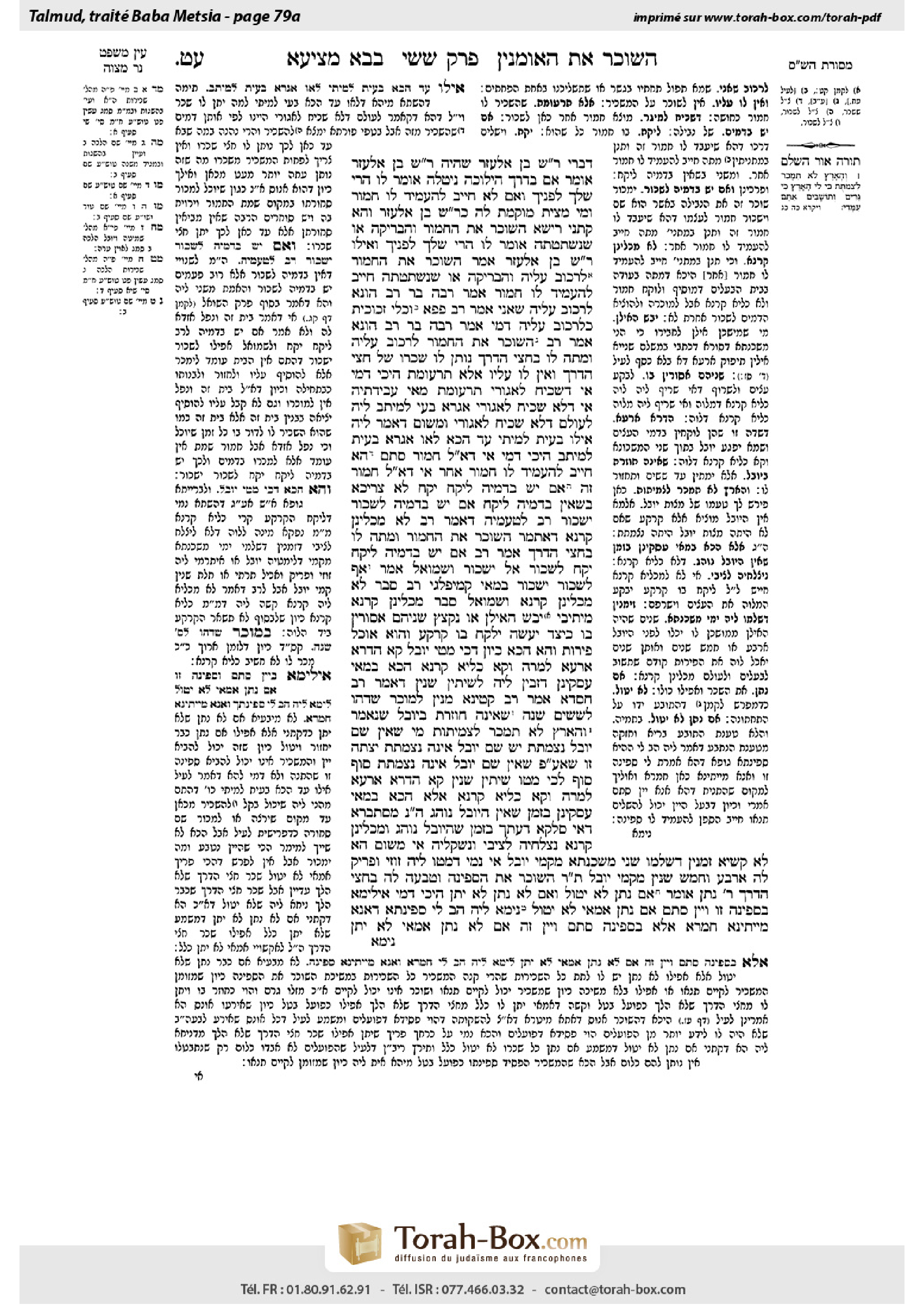
Bava Metzia 79a: Talmud study for Daf Yomi
Study the Talmud for Daf Yomi with scanned pages, Hebrew text, English translations from Sefaria and AI-generated French translations.
Passage selection and English or AI-generated French translation are available where the scan has annotations. Daf Study is independent of Torah-Box and Sefaria.
Browse Bava Metzia · בבא מציעא · All tractatesBava Metzia 79a text and translations
This page of Bava Metzia includes the Aramaic text, an English translation and an AI-generated French translation, alongside the scan above.
בבא מציעא ע״ט א · Aramaic and Hebrew text
דִּבְרֵי רַבִּי שִׁמְעוֹן בֶּן אֶלְעָזָר. שֶׁהָיָה רַבִּי שִׁמְעוֹן בֶּן אֶלְעָזָר אוֹמֵר: אִם בְּדֶרֶךְ הִילּוּכָהּ נִיטְּלָה – אוֹמֵר לוֹ: הֲרֵי שֶׁלְּךָ לְפָנֶיךָ, וְאִם לֹא – חַיָּיב לְהַעֲמִיד לוֹ חֲמוֹר.
וּמִי מָצֵית מוֹקְמַתְּ לַהּ כְּרַבִּי שִׁמְעוֹן בֶּן אֶלְעָזָר? וְהָא קָתָנֵי רֵישָׁא: הַשּׂוֹכֵר אֶת הַחֲמוֹר וְהִבְרִיקָה אוֹ שֶׁנִּשְׁתַּטְּתָה, אוֹמֵר לוֹ: הֲרֵי שֶׁלְּךָ לְפָנֶיךָ. וְאִילּוּ רַבִּי שִׁמְעוֹן בֶּן אֶלְעָזָר אָמַר: הַשּׂוֹכֵר אֶת הַחֲמוֹר לִרְכּוֹב עָלֶיהָ וְהִבְרִיקָה אוֹ שֶׁנִּשְׁתַּטְּתָה – חַיָּיב לְהַעֲמִיד לוֹ חֲמוֹר!
אָמַר רַבָּה בַּר רַב הוּנָא: לִרְכּוֹב עָלֶיהָ שָׁאנֵי. אָמַר רַב פָּפָּא: וּכְלֵי זְכוּכִית – כְּלִרְכּוֹב עָלֶיהָ דָּמֵי.
אָמַר רַבָּה בַּר רַב הוּנָא אָמַר רַב: הַשּׂוֹכֵר אֶת הַחֲמוֹר לִרְכּוֹב עָלֶיהָ וּמֵתָה לוֹ בַּחֲצִי הַדֶּרֶךְ, נוֹתֵן לוֹ שְׂכָרוֹ שֶׁל חֲצִי הַדֶּרֶךְ, וְאֵין לוֹ עָלָיו אֶלָּא תַּרְעוֹמֶת.
הֵיכִי דָמֵי? אִי דִּשְׁכִיחַ לְאֹגוֹרֵי – תַּרְעוֹמֶת מַאי עֲבִידְתֵּיהּ? אִי דְּלָא שְׁכִיחַ לְאֹגוֹרֵי – אַגְרָא בָּעֵי לְמִיתַּב לֵיהּ!
לְעוֹלָם דְּלָא שְׁכִיחַ לְאֹגוֹרֵי, וּמִשּׁוּם דְּאָמַר לֵיהּ: אִילּוּ בָּעֵית לְמֵיתֵי עַד הָכָא – לָאו אַגְרָא בָּעֵית לְמִיתַּב?
הֵיכִי דָּמֵי? אִי דַּאֲמַר לֵיהּ: ״חֲמוֹר סְתָם״ – הָא חַיָּיב לְהַעֲמִיד לוֹ חֲמוֹר אַחֵר. אִי דַּאֲמַר לֵיהּ: ״חֲמוֹר זֶה״, אִם יֵשׁ בְּדָמֶיהָ לִיקַּח יִקַּח!
לָא צְרִיכָא: בְּשֶׁאֵין בְּדָמֶיהָ לִיקַּח. אִם יֵשׁ בְּדָמֶיהָ לִשְׂכּוֹר – יִשְׂכּוֹר, רַב לְטַעְמֵיהּ, דְּאָמַר רַב: לָא מְכַלֵּינַן קַרְנָא.
דְּאִתְּמַר: הַשּׂוֹכֵר אֶת הַחֲמוֹר וּמֵתָה לוֹ בַּחֲצִי הַדֶּרֶךְ. אָמַר רַב: אִם יֵשׁ בְּדָמֶיהָ לִיקַּח – יִקַּח, לִשְׂכּוֹר – אַל יִשְׂכּוֹר. וּשְׁמוּאֵל אָמַר: אַף לִשְׂכּוֹר – יִשְׂכּוֹר.
בְּמַאי קָמִיפַּלְגִי? רַב סָבַר: לָא מְכַלֵּינַן קַרְנָא. וּשְׁמוּאֵל סָבַר: מְכַלֵּינַן קַרְנָא.
מֵיתִיבִי, יָבֵשׁ הָאִילָן אוֹ נִקְצַץ – שְׁנֵיהֶם אֲסוּרִין בּוֹ. כֵּיצַד יַעֲשֶׂה? יִלָּקַח בּוֹ קַרְקַע, וְהוּא אוֹכֵל פֵּירוֹת. וְהָא הָכָא, כֵּיוָן דְּכִי מָטֵי יוֹבֵל קָא הָדְרָא אַרְעָא לְמָרַהּ, וְקָא כָלְיָא קַרְנָא!
הָכָא בְּמַאי עָסְקִינַן – דְּזַבֵּין לֵיהּ לְשִׁתִּין שְׁנִין. דְּאָמַר רַב חִסְדָּא אָמַר רַב קַטִּינָא: מִנַּיִן לַמּוֹכֵר שָׂדֵהוּ לְשִׁשִּׁים שָׁנָה שֶׁאֵינָהּ חוֹזֶרֶת בַּיּוֹבֵל – שֶׁנֶּאֱמַר: ״וְהָאָרֶץ לֹא תִמָּכֵר לִצְמִיתוּת״. מִי שֶׁאֵין שָׁם יוֹבֵל – נִצְמֶתֶת, יֵשׁ שָׁם יוֹבֵל – אֵינָהּ נִצְמֶתֶת. יָצְתָה זוֹ, שֶׁאַף עַל פִּי שֶׁאֵין שָׁם יוֹבֵל – אֵינָהּ נִצְמֶתֶת.
סוֹף סוֹף, לְכִי מָטוּ שִׁיתִּין שְׁנִין – קָא הָדְרָא אַרְעָא לְמָרַהּ, וְקָא כָלְיָא קַרְנָא! אֶלָּא, הָכָא בְּמַאי עָסְקִינַן – בִּזְמַן שֶׁאֵין הַיּוֹבֵל נוֹהֵג. הָכִי נָמֵי מִסְתַּבְּרָא, דְּאִי סָלְקָא דַעְתָּךְ בִּזְמַן שֶׁהַיּוֹבֵל נוֹהֵג וּמְכַלֵּינַן קַרְנָא, נִצְלְחֵיהּ לְצִיבֵי וְנִשְׁקְלֵיהּ!
אִי מִשּׁוּם הָא – לָא קַשְׁיָא: זִמְנִין דְּשָׁלְמוּ שְׁנֵי מַשְׁכַּנְתָּא מִקַּמֵּי יוֹבֵל. אִי נָמֵי דְּמָטוּ לֵיהּ זוּזֵי וּפָרֵיק לַהּ אַרְבַּע וְחָמֵשׁ שְׁנִין מִקַּמֵּי יוֹבֵל.
תָּנוּ רַבָּנַן: הַשּׂוֹכֵר אֶת הַסְּפִינָה וְטָבְעָה לָהּ בַּחֲצִי הַדֶּרֶךְ, רַבִּי נָתָן אוֹמֵר: אִם נָתַן – לֹא יִטּוֹל, וְאִם לֹא נָתַן – לֹא יִתֵּן.
הֵיכִי דָמֵי? אִילֵּימָא בִּסְפִינָה זוֹ וְיַיִן סְתָם, אִם נָתַן אַמַּאי לֹא יִטּוֹל? נֵימָא לֵיהּ: הַב לִי סְפִינְתָּא, דַּאֲנָא מַיְיתֵינָא חַמְרָא. אֶלָּא בִּסְפִינָה סְתָם וְיַיִן זֶה, אִם לֹא נָתַן אַמַּאי לֹא יִתֵּן?
Bava Metzia 79a · English translation
This is the statement of Rabbi Shimon ben Elazar, as Rabbi Shimon ben Elazar would say: If the animal was seized and then taken in the direction in which it was walking, the owner can say to the renter: That which is yours is before you, but if not, the owner is obligated to provide the renter with another donkey.
The Gemara asks: And can you establish this entire baraita in accordance with the opinion of Rabbi Shimon ben Elazar? But the first clause teaches: With regard to one who rents a donkey and it became ill or went mad, the owner can say to the renter: That which is yours is before you. And yet Rabbi Shimon ben Elazar said in a different baraita: With regard to one who rents a donkey to ride on it, and it becomes ill or goes mad, the owner is obligated to provide the renter with another donkey.
Rabba bar Rav Huna said that this is not a contradiction. The case of one who takes a donkey to ride on is different, as he requires a donkey that walks steadily. A sick donkey is no better than a dead one for this purpose. Rav Pappa said: And acquiring a donkey so that it should carry glass vessels is considered to be like riding on it, as glass vessels also require steady walking to prevent the load from falling.
Rabba bar Rav Huna says that Rav says: In the case of one who rents a donkey to ride on it and it died halfway through the journey, the renter gives the owner his fee for half of the journey, but the renter has nothing but a grievance against the owner. He has no legal claim against the owner over the fact that he now has to go to great trouble to find another donkey.
The Gemara asks: What are the circumstances? If this is referring to a place where donkeys are available for rent, what is the purpose of this grievance? He does not have any cause for grievance in this case, as he can simply rent another donkey and has not lost anything. If it is a place where donkeys are not available for rent, should he be required to give the owner his fee? After all, the donkey failed to perform the task for which it was rented.
The Gemara explains: Actually, it is referring to a place where donkeys are not available for rent, and the renter must pay the owner due to the fact that the owner of the donkey can say to him: Had you wanted to come to here, i.e., halfway through the journey, wouldn’t you have had to pay a fee? Therefore, pay me for the distance that my donkey carried you.
The Gemara further inquires: What are the circumstances? If this is referring to a case where the owner said to him: I am renting you an unspecified donkey, the owner is obligated to provide him with another donkey. Since the owner promised him a donkey, if the first donkey is no longer available, he must give him another one. If it is referring to a case where he said to him: I am renting you this particular donkey, then if there is enough money to be gained from selling its carcass to purchase another donkey, let the renter purchase another one.
The Gemara responds: No, it is necessary to state this halakha only in a case where there is not enough money to be gained from the sale of its carcass to purchase another donkey. The Gemara asks: Even so, if there is enough money to be gained from the sale of its carcass to hire another donkey, let him rent another donkey and continue along his way. What grounds are there for grievance? The Gemara explains that Rav conforms to his standard line of reasoning, as Rav said: One may not fully deplete the principal in order to pay rental fees. Consequently, the renter has no right to sell the carcass, so as not to deplete the entire monetary value of the donkey.
This is as it was stated in a dispute between amora’im on this issue: With regard to one who rents a donkey and it died halfway through the journey, Rav says: If there is enough money to be gained from the sale of its carcass to purchase another donkey, the renter may purchase one, but if there is enough money only to rent another donkey, he may not rent one. Shmuel says: Even if there is enough money to be gained from the sale of its carcass only to rent another donkey, he may rent one.
The Gemara asks: With regard to what do they disagree? The Gemara answers: Rav holds that one may not fully deplete the principal, and as the carcass now constitutes the principal value of the donkey, one may not use the proceeds of its sale to pay rental fees, as nothing will be left to return to the owner. And Shmuel holds that one may fully deplete the principal.
The Gemara raises an objection to Rav’s opinion from a baraita (Tosefta, Arakhin 5:1), which discusses the case of a borrower who gives his lender a tree as a security for a loan so that the lender may eat an amount of its fruit up to the value of the loan. If the tree dried up or was cut down, it is prohibited for both the borrower and lender to use the body of the tree. What should be done? Land should be purchased with the proceeds from the sale of what is left of the tree, and the lender enjoys the profits of that land. The Gemara explains the objection: And yet here, once the Jubilee Year arrives, that purchased land will return to its original owner. It will not remain with the borrower after the loan has been repaid. And it will turn out that the principal is fully depleted, as the borrower will be left with nothing.
The Gemara responds: With what are we dealing here? We are dealing with a case where he purchased the field for sixty years. As Rav Ḥisda says that Rav Ketina says: From where is it derived with regard to one who sells his field for sixty years or any fixed length of time, that it does not return to its original owner in the Jubilee Year? As it is stated: “And the land shall not be sold in perpetuity” (Leviticus 25:23). This prohibition applies to land which, if there were no Jubilee Year, would be sold in perpetuity, but as there is a Jubilee Year it is not sold in perpetuity. That excludes this case, where the field is sold for a fixed length of time, as even though there is no Jubilee Year it is not sold in perpetuity.
The Gemara raises a difficulty: Ultimately, when the end of those sixty years arrives, the land will return to its owner, and at that point the principal will be fully depleted. The Gemara answers: Rather, with what are we dealing here? We are dealing with a period when the halakhot of the Jubilee Year are not in effect, as one can purchase land in perpetuity when the Jubilee Year is not observed. The Gemara adds support for this explanation: This too stands to reason, as, if it enters your mind that this halakha is referring to a period when the halakhot of the Jubilee Year are in effect and the ruling is that the principal may be fully depleted, why undertake a complicated transaction? Let the lender simply cut the tree into branches for kindling, and take it and sell it right away.
The Gemara responds: If the challenge to Rav’s opinion is due to that baraita, it is not difficult. There may be times that the years during which the lender is entitled to the collateral are completed before the arrival of the Jubilee Year, in which case the land would revert to the borrower for a certain amount of time, and therefore the principal is not necessarily fully depleted. Alternatively, it is possible that money comes into the borrower’s possession and he redeems the field four or five years before the arrival of the Jubilee Year. In this case the principal will not be fully depleted, as he repays the loan before the land is returned.
§ The Sages taught: With regard to one who rents a boat, and it sunk halfway through the journey, Rabbi Natan says: If the renter already gave money for the boat, he does not receive a refund, but if he has not yet given money he does not give it after the boat has sunk.
The Gemara asks: What are the circumstances of this contract? If we say that the owner stated he was renting him this particular boat and the renter said that he was transporting unspecified wine, then even if he gave money, why should he not receive a refund? Let him say to the owner: Give me the boat so that I can transport wine, and if you cannot do so, refund the rental fee so that I can rent another boat. Rather, one could say that this is referring to a situation where the owner said he would rent him an unspecified boat, and the renter said that he would transport this particular wine. But in that case, even if he did not give money, why should he not give the owner the rental fee?
Bava Metzia 79a · Traduction française (IA)
C'est la déclaration du Rabbi Shimon ben Elazar, comme le Rabbi Shimon ben Elazar le disait : Si l'animal a été saisi et emmené dans la direction où il marchait, l'owner peut dire au locataire : Ce qui est à toi est devant toi, mais si ce n'est pas le cas, l'owner est tenu de fournir au locataire un autre âne.
La Guemara pose la question : Et pouvez-vous établir cette baraïta en conformité avec l'opinion du Rabbi Shimon ben Elazar ? Mais la première clause enseigne : Concernant celui qui loue un âne et qu'il devient malade ou fou, l'owner peut dire au locataire : Ce qui est à toi est devant toi. Et pourtant, le Rabbi Shimon ben Elazar a dit dans une autre baraïta : Concernant celui qui loue un âne pour monter dessus, et qu'il devient malade ou fou, l'owner est tenu de fournir au locataire un autre âne.
Rabba bar Rav Huna dit que cela n'est pas une contradiction. Le cas de celui qui prend un âne pour monter dessus est différent, car il exige un âne qui marche droit. Un âne malade n'est pas meilleur qu'un âne mort à cet effet. Rav Pappa dit : Et l'acquisition d'un âne pour transporter des vases en verre est considérée comme monter dessus, car les vases en verre nécessitent également une marche stable pour éviter que la charge ne tombe.
Rabba bar Rav Huna dit que Rav dit : Dans le cas où l'on loue un âne pour monter dessus et qu'il meurt à mi-chemin du trajet, le locataire paie à l'owner la somme correspondant à la moitié du trajet, mais le locataire n'a qu'une plainte contre l'owner. Il n'a pas de revendication légale contre l'owner concernant le fait qu'il doit maintenant se donner beaucoup de peine pour trouver un autre âne.
La Guemara pose la question : Quelles sont les circonstances ? Si cela fait référence à un lieu où des ânes sont loués, à quoi sert cette plainte ? Il n'a pas de cause de plainte dans ce cas, car il peut simplement louer un autre âne et n'a pas perdu quoi que ce soit. Si c'est un lieu où des ânes ne sont pas loués, devrait-il être tenu de payer à l'owner sa somme ? Après tout, l'âne n'a pas accompli la tâche pour laquelle il était loué.
La Guemara explique : En réalité, cela fait référence à un lieu où des ânes ne sont pas loués, et le locataire doit payer à l'owner en raison du fait que l'owner de l'âne peut lui dire : Si tu voulais venir ici, c'est-à-dire à mi-chemin du trajet, ne l'aurais-tu pas dû payer une somme ? Donc, paie-moi pour la distance que mon âne t'a porté.
La Guemara pose une autre question : Quelles sont les circonstances ? Si cela fait référence à un cas où l'owner a dit au locataire : Je te loue un âne indéterminé, l'owner est tenu de lui fournir un autre âne. Comme l'owner a promis un âne, si le premier âne n'est plus disponible, il doit lui en donner un autre. Si c'est un cas où il a dit au locataire : Je te loue cet âne particulier, alors si l'argent obtenu en vendant son cadavre est suffisant pour acheter un autre âne, que le locataire achète un autre.
La Guemara répond : Non, il est nécessaire d'énoncer cette halakha uniquement dans un cas où l'argent obtenu en vendant son cadavre n'est pas suffisant pour acheter un autre âne. La Guemara pose la question : Même ainsi, si l'argent obtenu en vendant son cadavre est suffisant pour louer un autre âne, que le locataire loue un autre âne et continue son chemin. Quelle est la base de sa plainte ? La Guemara explique que Rav suit sa ligne de raisonnement habituelle, car Rav a dit : On ne doit pas détruire entièrement le principal pour payer les loyers. Par conséquent, le locataire n'a pas le droit de vendre le cadavre, afin de ne pas détruire toute la valeur monétaire de l'âne.
C'est comme il a été dit dans un débat entre des amoraïm sur cette question : Concernant celui qui loue un âne et qu'il meurt à mi-chemin du trajet, Rav dit : Si l'argent obtenu en vendant son cadavre est suffisant pour acheter un autre âne, le locataire peut en acheter un, mais si l'argent obtenu est suffisant seulement pour louer un autre âne, il ne peut pas le louer. Shmuel dit : Même si l'argent obtenu en vendant son cadavre est suffisant seulement pour louer un autre âne, il peut le louer.
La Guemara pose la question : Sur quel point s'opposent-ils ? La Guemara répond : Rav considère que l'on ne doit pas détruire entièrement le principal, et comme le cadavre constitue maintenant la valeur principale de l'âne, on ne doit pas utiliser les recettes de sa vente pour payer les loyers, car il ne restera rien à rendre à l'owner. Et Shmuel considère que l'on peut détruire entièrement le principal.
La Guemara soulève une objection contre l'opinion de Rav à partir d'une baraïta (Tosefta, Arakhin 5:1), qui discute du cas d'un emprunteur qui donne à son prêteur un arbre comme garantie pour un prêt, afin que le prêteur puisse manger une quantité de ses fruits équivalente à la valeur du prêt. Si l'arbre sèche ou est coupé, il est interdit à la fois à l'emprunteur et au prêteur d'utiliser le corps de l'arbre. Que faire ? Acheter un terrain avec les recettes de la vente de ce qui reste de l'arbre, et le prêteur profite des profits de ce terrain. La Guemara explique cette objection : Et pourtant, une fois que l'année sabbatique arrive, ce terrain reviendra à son propriétaire d'origine. Il ne restera pas avec le prêteur après que le prêt ait été remboursé. Et il se trouvera que le principal est entièrement détruit, car l'emprunteur restera avec rien.
La Guemara répond : De quoi sommes-nous en train de parler ? Nous parlons d’un cas où l’acheteur a acheté le champ pour soixante ans. Comme Rav Ḥisda dit que Rav Ketina dit : D’où tire-t-on que celui qui vend son champ pour soixante ans ou pour une durée fixe, ne le retrouve pas en année de Jubilé chez son propriétaire originel ? Comme il est dit : « Et le champ ne sera pas vendu en perpetuité » (Lévitique 25:23). Cette interdiction s’applique à un champ qui, s’il n’y avait pas d’année de Jubilé, serait vendu en perpetuité, mais comme il y a une année de Jubilé, il n’est pas vendu en perpetuité. Cela exclut ce cas, où le champ est vendu pour une durée fixe, car même s’il n’y a pas d’année de Jubilé, il n’est pas vendu en perpetuité.
La Guemara soulève une difficulté : Finalement, lorsque la durée de soixante ans arrive, le champ reviendra à son propriétaire, et à ce moment-là, le principal sera entièrement épuisé. La Guemara répond : Plutôt, de quoi sommes-nous en train de parler ? Nous parlons d’une période où les halakhot de l’année de Jubilé ne sont pas en vigueur, car l’on peut acheter un champ en perpetuité lorsque l’année de Jubilé n’est pas observée. La Guemara ajoute un soutien à cette explication : Cela aussi est logique, car, si vous pensez que cette halakha parle d’une période où les halakhot de l’année de Jubilé sont en vigueur et que la décision est que le principal peut être entièrement épuisé, pourquoi entreprendre une transaction compliquée ? L’emprunteur pourrait simplement couper les branches des arbres pour en faire du bois de chauffage, et les vendre immédiatement.
La Guemara répond : Si la difficulté envers l’opinion de Rav vient de cette baraïta, ce n’est pas difficile. Il peut y avoir des moments où les années pendant lesquelles l’emprunteur est autorisé à garder le garant sont terminées avant l’arrivée de l’année de Jubilé, dans ce cas le champ reviendrait à l’emprunteur pendant un certain temps, et donc le principal n’est pas nécessairement entièrement épuisé. Alternativement, il est possible que de l’argent entre dans la possession de l’emprunteur et qu’il rachète le champ quatre ou cinq ans avant l’arrivée de l’année de Jubilé. Dans ce cas, le principal ne sera pas entièrement épuisé, car il rembourse le prêt avant que le champ ne revienne.
§ Les Sages enseignent : En ce qui concerne celui qui loue un bateau, et que ce bateau coule à la moitié du voyage, Rabbi Natan dit : Si le locataire a déjà payé l’argent pour le bateau, il ne reçoit pas d’indemnité, mais si il n’a pas encore payé, il ne paie pas après que le bateau a coulé.
La Guemara pose une question : Quelles sont les circonstances de ce contrat ? Si nous disons que le propriétaire a dit qu’il loue à l’emprunteur ce bateau particulier et que l’emprunteur a dit qu’il transportait du vin indéterminé, alors même s’il a payé, pourquoi ne devrait-il pas recevoir un remboursement ? Lui dit au propriétaire : Donnez-moi le bateau afin que je transporte le vin, et si vous ne pouvez pas le faire, remboursez le loyer afin que je puisse louer un autre bateau. Plutôt, on pourrait dire que cela fait référence à un cas où le propriétaire a dit qu’il louerait à l’emprunteur un bateau indéterminé, et que l’emprunteur a dit qu’il transporterait ce vin particulier. Mais dans ce cas, même s’il n’a pas payé, pourquoi ne devrait-il pas payer le loyer au propriétaire ?
Traduction française générée par IA à partir de l’édition anglaise de Sefaria. Vérifie toujours un passage avec le texte source.
Text from Sefaria: William Davidson Edition - Vocalized Aramaic (CC BY NC); William Davidson Edition - English (CC BY NC).