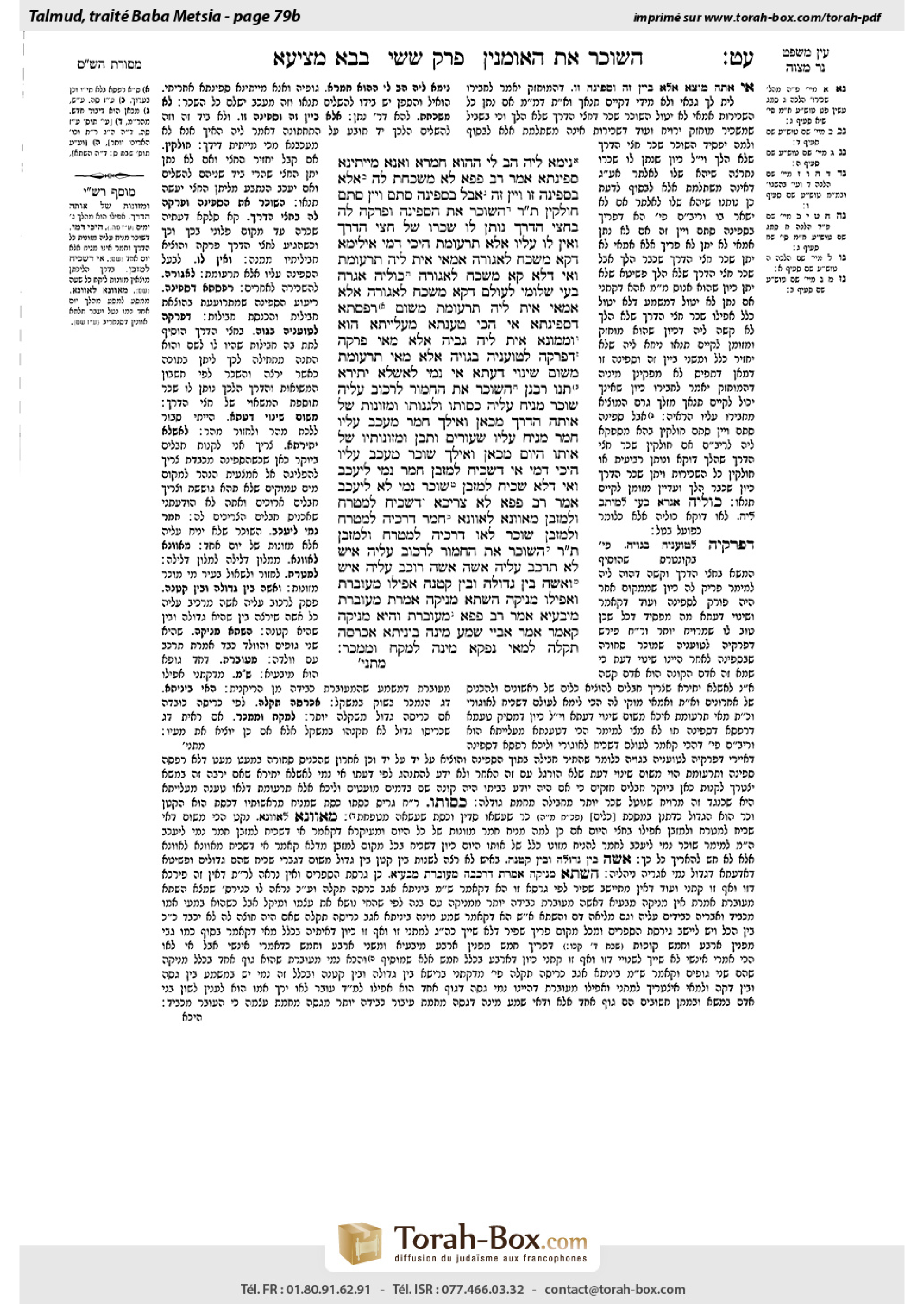
Bava Metzia 79b: Talmud study for Daf Yomi
Study the Talmud for Daf Yomi with scanned pages, Hebrew text, English translations from Sefaria and AI-generated French translations.
Passage selection and English or AI-generated French translation are available where the scan has annotations. Daf Study is independent of Torah-Box and Sefaria.
Browse Bava Metzia · בבא מציעא · All tractatesBava Metzia 79b text and translations
This page of Bava Metzia includes the Aramaic text, an English translation and an AI-generated French translation, alongside the scan above.
בבא מציעא ע״ט ב · Aramaic and Hebrew text
נֵימָא לֵיהּ: הַב לִי הָהוּא חַמְרָא וַאֲנָא מַיְיתֵינָא סְפִינְתָּא.
אָמַר רַב פָּפָּא: לָא מַשְׁכַּחַתְּ לַהּ אֶלָּא בִּסְפִינָה זוֹ וְיַיִן זֶה. אֲבָל בִּסְפִינָה סְתָם וְיַיִן סְתָם – חוֹלְקִין.
תָּנוּ רַבָּנַן: הַשּׂוֹכֵר אֶת הַסְּפִינָה וּפְרָקָהּ לָהּ בַּחֲצִי הַדֶּרֶךְ – נוֹתֵן לוֹ שְׂכָרוֹ שֶׁל חֲצִי הַדֶּרֶךְ, וְאֵין לוֹ עָלָיו אֶלָּא תַּרְעוֹמֶת. הֵיכִי דָּמֵי? אִילֵּימָא דְּקָא מַשְׁכַּח לְאֹגוֹרַהּ – אַמַּאי אִית לֵיהּ תַּרְעוֹמֶת? וְאִי דְּלָא קָא מַשְׁכַּח לְאֹגוֹרַהּ – כּוּלֵּיהּ אַגְרַהּ בָּעֵי שַׁלּוֹמֵי!
לְעוֹלָם דְּקָא מַשְׁכַּח לְאֹגוֹרַהּ, אֶלָּא אַמַּאי אִית לֵיהּ תַּרְעוֹמֶת – מִשּׁוּם רַפְסְתָא דִסְפִינְתָּא. אִי הָכִי, טַעַנְתָּא מְעַלַּיְיתָא הִוא וּמָמוֹנָא אִית לֵיהּ גַּבֵּיהּ.
אֶלָּא מַאי פְּרָקָהּ – דְּפַרְקֵהּ לְטוּעְנֵיהּ בְּגַוַּיהּ. אֶלָּא מַאי תַּרְעוֹמֶת – מִשּׁוּם שִׁינּוּי דַּעְתָּא. אִי נָמֵי לְאַשְׁלָא יַתִּירָא.
תָּנוּ רַבָּנַן: הַשּׂוֹכֵר אֶת הַחֲמוֹר לִרְכּוֹב עָלֶיהָ – שׂוֹכֵר מַנִּיחַ עָלֶיהָ כְּסוּתוֹ וּלְגִנוֹתוֹ וּמְזוֹנוֹת שֶׁל אוֹתָהּ הַדֶּרֶךְ, מִכָּאן וְאֵילָךְ – חַמָּר מְעַכֵּב עָלָיו. חַמָּר מַנִּיחַ עָלָיו שְׂעוֹרִים וְתֶבֶן וּמְזוֹנוֹתָיו שֶׁל אוֹתוֹ הַיּוֹם, מִכָּאן וְאֵילָךְ – שׂוֹכֵר מְעַכֵּב עָלָיו.
הֵיכִי דָמֵי? אִי דִּשְׁכִיחַ לְמִזְבַּן – חַמָּר נָמֵי לִיעַכֵּב, וְאִי דְּלָא שְׁכִיחַ לְמִזְבַּן – שׂוֹכֵר נָמֵי לָא לִיעַכֵּב!
אָמַר רַב פָּפָּא: לָא צְרִיכָא דִּשְׁכִיחַ לְמִטְרַח וּלְמִזְבַּן מֵאַוּוֹנָא לְאַוּוֹנָא, חַמָּר דַּרְכֵּיהּ לְמִטְרַח וּלְמִזְבַּן. שׂוֹכֵר לָאו דַּרְכֵּיהּ לְמִטְרַח וּלְמִזְבַּן.
תָּנוּ רַבָּנַן: הַשּׂוֹכֵר אֶת הַחֲמוֹר לִרְכּוֹב עָלֶיהָ אִישׁ – לֹא תִּרְכַּב עָלֶיהָ אִשָּׁה. אִשָּׁה – רוֹכֵב עָלֶיהָ אִישׁ. וְאִשָּׁה, בֵּין גְּדוֹלָה וּבֵין קְטַנָּה, אֲפִילּוּ מְעוּבֶּרֶת, וַאֲפִילּוּ מְנִיקָה.
הַשְׁתָּא מְנִיקָה אָמְרַתְּ, מְעוּבֶּרֶת מִיבַּעְיָא? אָמַר רַב פָּפָּא: מְעוּבֶּרֶת וְהִיא מְנִיקָה קָאָמַר.
אָמַר אַבָּיֵי: שְׁמַע מִינַּהּ בִּינִיתָא אַכְּרֵסַהּ תָּקְלָה. לְמַאי נָפְקָא מִינַּהּ? לְמִקָּח וּמִמְכָּר.
Bava Metzia 79b · English translation
Let the owner say to him: Give me that wine and I will bring a boat. Since that particular wine is gone, the renter cannot comply with his request, and therefore he should have to pay the rental fee.
Rav Pappa said: You find the correct application of Rabbi Natan’s ruling only in a case where the two parties stipulated this specific boat and that specific wine. Since neither party can fulfill his part of the agreement, the money remains where it is. But if they stipulated an unspecified boat and unspecified wine, as they can both complete the agreement, they divide the rental fee, i.e., the renter pays half.
The Sages taught: With regard to one who rents a boat and unloads it [uferakah] halfway through the journey, the renter gives the owner his rental fee for half the journey, and the owner of the boat has nothing but a grievance against him. The Gemara asks: What are the circumstances? If we say that this is referring to a situation where the owner can find someone else to whom he can rent out the boat, why does he have grounds for a grievance? And if it is referring to a case where he cannot find another to whom he can rent it out, the renter should be required to pay the full rental fee, as he reneged on his commitment to rent the boat for the entire trip.
The Gemara answers: Actually, this is referring to a case where the owner can find someone else to whom he can rent out the boat. But why does he have cause for a grievance? Because of the wear and tear on the boat due to the additional loading and unloading of cargo, which was not taken into account in their agreement. The Gemara asks: If so, that is a proper legal claim, and the owner of the boat has not merely a grievance against the renter, but cause for claiming monetary restitution from him.
Rather, what is the meaning of the term perakah? This means that the renter unloaded more of his own cargo into the boat halfway through the journey. Accordingly, the baraita is ruling that the renter must pay a fee for the additional cargo only for the second half of the journey. The Gemara asks: But if so, what is the grievance? Why should the owner object to this arrangement at all? The Gemara explains that the grievance is due to the change from the renter’s prior intention, as they had not agreed upon the addition of this additional cargo when they performed the transaction. Alternatively, the grievance is because of the extra rope that was necessary to secure the additional cargo.
The Sages taught in a baraita: With regard to one who rents a donkey to ride on it, the renter may place on it his garment, his water jug, and food for that journey. Beyond those items, the donkey driver, who would take the renter on the journey, may prevent him from placing anything on the animal by saying that he does not wish to further burden the donkey. The donkey driver may place on it barley and hay for the donkey and his own food for that first day alone. Beyond those items, the renter may prevent him from placing anything on the animal.
The Gemara asks: What are the circumstances? If this is referring to a situation where food is available for purchase, the donkey driver should also be able to prevent the renter from bringing food for the entire journey, and if it is a case where food is not available for purchase, the renter should also not be able to prevent the donkey driver from loading on the donkey his own food for the entire journey.
Rav Pappa said: No, the ruling of the baraita is necessary in a situation where food is available for one who goes to the trouble to purchase it from one station [me’avna] to the next station. Since it is the manner of a donkey driver to go to the trouble to purchase food, he may load the animal only with food for that day, whereas it is not the manner of the renter to go to the trouble to purchase food, and therefore he may take food with him for the entire journey.
The Sages taught: With regard to one who rents a donkey with the understanding that a man will ride upon it, a woman may not ride upon it. If he rented it with the understanding that a woman will ride upon it, a man may ride upon it. And if he rented it with the understanding that a woman will ride upon it, any female may ride upon it, whether she is an adult woman or a minor girl. And even a pregnant woman, despite her additional weight, and even a nursing woman who takes the child with her may ride upon it.
The Gemara asks: Now that you said that the owner cannot prevent even a nursing woman from riding upon the donkey, despite the fact that this involves the weight of two people, is it necessary to say that a pregnant woman may ride upon the donkey? Rav Pappa said: The tanna spoke of a pregnant woman who is also nursing, as there is additional weight.
Abaye said: You can learn from the fact that a pregnant woman is considered heavier than the average woman that the weight of a fish [binita] is in its belly, i.e., weight increases according to the size of its belly. The Gemara asks: What is the practical difference resulting from Abaye’s statement with regard to a fish? The Gemara explains: It is with regard to the halakhot of buying and selling, so that one can know how to evaluate the weight of a fish, and calculate its value accordingly.
Bava Metzia 79b · Traduction française (IA)
Que l'propriétaire dise à l'autre : Donne-moi ce vin et je te ferai venir un bateau. Puisque ce vin particulier est parti, le locataire ne peut pas respecter sa demande, et donc il devrait payer le loyer.
Rav Pappa a dit : Vous trouvez l'application correcte de la décision de Rabbi Natan uniquement dans un cas où les deux parties ont stipulé ce bateau particulier et ce vin particulier. Puisque ni l'une ni l'autre ne peuvent remplir leur partie de l'accord, l'argent reste là où il est. Mais si ils ont stipulé un bateau indéterminé et un vin indéterminé, puisqu'ils peuvent tous deux accomplir l'accord, ils divisent le loyer, c'est-à-dire que le locataire paie la moitié.
Les Sages ont enseigné : En ce qui concerne celui qui loue un bateau et décharge la moitié du trajet, le locataire paie au propriétaire le loyer pour la moitié du trajet, et le propriétaire du bateau n'a que des griefs contre lui. La Guemara demande : Quelles sont les circonstances ? Si nous disons que cela fait référence à un cas où le propriétaire peut trouver quelqu'un d'autre à qui il peut louer le bateau, pourquoi a-t-il des griefs ? Et si cela fait référence à un cas où il ne peut pas trouver quelqu'un d'autre à qui il peut le louer, le locataire devrait être tenu de payer le loyer complet, car il a dérogé à son engagement de louer le bateau pour l'ensemble du trajet.
La Guemara répond : En réalité, cela fait référence à un cas où le propriétaire peut trouver quelqu'un d'autre à qui il peut louer le bateau. Mais pourquoi a-t-il des griefs ? À cause de l'usure du bateau en raison du surcharge et du déchargement supplémentaire des marchandises, qui n'était pas pris en compte dans leur accord. La Guemara demande : Si c'est ainsi, c'est une revendication légale valide, et le propriétaire du bateau n'a pas seulement des griefs contre le locataire, mais une cause pour réclamer une compensation monétaire.
Plutôt, quelle est la signification du terme perakah ? Cela signifie que le locataire a déchargé plus de ses propres marchandises dans le bateau à la moitié du trajet. Ainsi, la baraïta déclare que le locataire doit payer un frais pour les marchandises supplémentaires uniquement pour la seconde moitié du trajet. La Guemara demande : Mais si c'est ainsi, pourquoi le propriétaire s'oppose-t-il ? La Guemara explique que le grief provient du changement par rapport à l'intention initiale du locataire, car ils n'avaient pas convenu de l'ajout de ces marchandises supplémentaires lors de la transaction. Alternativement, le grief provient du fait que l'attache supplémentaire nécessaire pour sécuriser ces marchandises était nécessaire.
Les Sages ont enseigné dans une baraïta : En ce qui concerne celui qui loue un âne pour monter dessus, le locataire peut placer sur lui son vêtement, son récipient d'eau et la nourriture pour ce voyage. Au-delà de ces objets, le conducteur d'âne, qui emmène le locataire sur le trajet, peut l'empêcher de placer quelque chose sur l'animal en disant qu'il ne souhaite pas encharger davantage l'âne. Le conducteur d'âne peut placer sur l'animal du blé et des foin pour l'âne et son propre repas pour la première journée seulement. Au-delà de ces objets, le locataire peut l'empêcher de placer quelque chose sur l'animal.
La Guemara demande : Quelles sont les circonstances ? Si cela fait référence à un cas où les aliments sont disponibles à l'achat, le conducteur d'âne devrait également pouvoir empêcher le locataire de transporter des aliments pour l'ensemble du voyage, et si c'est un cas où les aliments ne sont pas disponibles à l'achat, le locataire devrait également ne pas pouvoir empêcher le conducteur d'âne de charger sur l'âne ses propres aliments pour l'ensemble du voyage.
Rav Pappa a dit : Non, la décision de la baraïta est nécessaire dans un cas où les aliments sont disponibles pour celui qui se donne la peine d'acheter d'une station [me’avna] à l'autre. Puisque c'est la manière du conducteur d'âne de se donner la peine d'acheter des aliments, il peut charger l'animal uniquement avec des aliments pour la journée, tandis que ce n'est pas la manière du locataire de se donner la peine d'acheter des aliments, et donc il peut prendre des aliments avec lui pour l'ensemble du voyage.
Les Sages ont enseigné : En ce qui concerne celui qui loue un âne avec l'intention qu'un homme monte dessus, une femme ne peut pas monter dessus. Si il l'a loué avec l'intention qu'une femme monte dessus, un homme peut monter dessus. Et si il l'a loué avec l'intention qu'une femme monte dessus, toute femme peut monter dessus, qu'elle soit une femme adulte ou une jeune fille. Et même une femme enceinte, malgré son poids supplémentaire, et même une femme allaitante qui emmène son enfant peut monter dessus.
La Guemara demande : Maintenant que vous avez dit que le propriétaire ne peut pas empêcher même une femme allaitante de monter sur l'âne, malgré le fait que cela implique le poids de deux personnes, est-il nécessaire de dire qu'une femme enceinte peut monter sur l'âne ? Rav Pappa a dit : Le tanna parlait d'une femme enceinte qui est aussi allaitante, car il y a un poids supplémentaire.
Abaye a dit : Vous pouvez apprendre cela du fait que la femme enceinte est considérée comme plus lourde que la femme moyenne, que le poids d'un poisson [binita] est dans son ventre, c'est-à-dire que le poids augmente selon la taille de son ventre. La Guemara demande : Quelle est la différence pratique résultant de l'affirmation d'Abaye concernant un poisson ? La Guemara explique : Cela concerne les halakhot d'achat et de vente, afin que l'on sache comment évaluer le poids d'un poisson et calculer sa valeur en conséquence.
Traduction française générée par IA à partir de l’édition anglaise de Sefaria. Vérifie toujours un passage avec le texte source.
Text from Sefaria: William Davidson Edition - Vocalized Aramaic (CC BY NC); William Davidson Edition - English (CC BY NC).