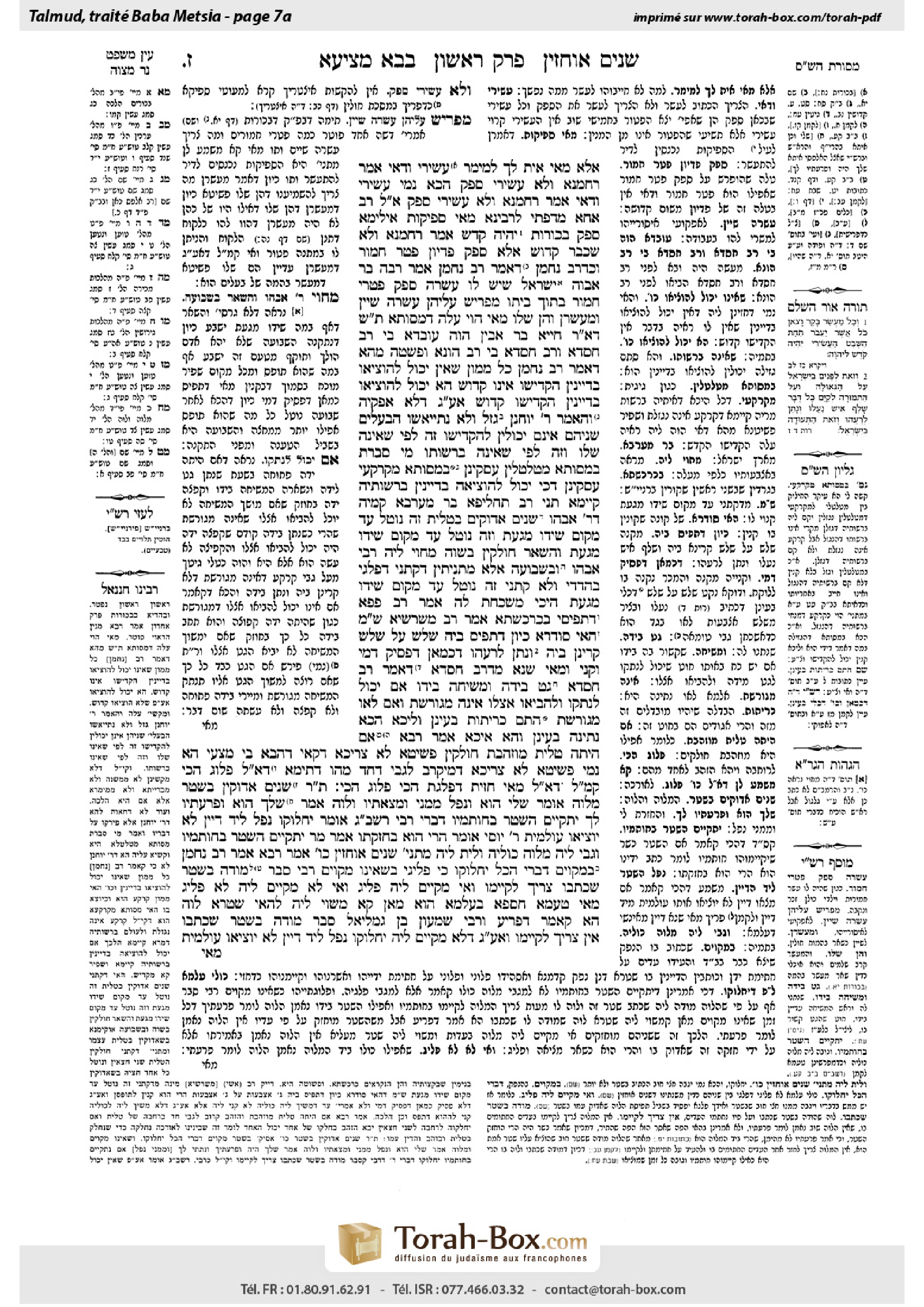
Bava Metzia 7a: Talmud study for Daf Yomi
Study the Talmud for Daf Yomi with scanned pages, Hebrew text, English translations from Sefaria and AI-generated French translations.
Passage selection and English or AI-generated French translation are available where the scan has annotations. Daf Study is independent of Torah-Box and Sefaria.
Browse Bava Metzia · בבא מציעא · All tractatesBava Metzia 7a text and translations
This page of Bava Metzia includes the Aramaic text, an English translation and an AI-generated French translation, alongside the scan above.
בבא מציעא ז׳ א · Aramaic and Hebrew text
אֶלָּא מַאי אִית לָךְ לְמֵימַר, עֲשִׂירִי וַדַּאי אָמַר רַחֲמָנָא וְלֹא עֲשִׂירִי סָפֵק. הָכָא נָמֵי: עֲשִׂירִי וַדַּאי אָמַר רַחֲמָנָא וְלֹא עֲשִׂירִי סָפֵק.
אֲמַר לֵיהּ רַב אַחָא מִדִּפְתִּי לְרָבִינָא: מַאי סְפֵיקוֹת? אִילֵּימָא סְפֵק בְּכוֹרוֹת, ״יִהְיֶה קֹדֶשׁ״ אָמַר רַחֲמָנָא, וְלֹא שֶׁכְּבָר קָדוֹשׁ.
אֶלָּא סְפֵק פִּדְיוֹן פֶּטֶר חֲמוֹר, וְכִדְרַב נַחְמָן. דְּאָמַר רַב נַחְמָן אָמַר רַבָּה בַּר אֲבוּהּ: יִשְׂרָאֵל שֶׁיֵּשׁ לוֹ עֲשָׂרָה סְפֵק פִּטְרֵי חֲמוֹר בְּתוֹךְ בֵּיתוֹ – מַפְרִישׁ עֲלֵיהֶן עֲשָׂרָה שֵׂיִין, וּמְעַשְּׂרָן, וְהֵן שֶׁלּוֹ.
מַאי הָוֵי עֲלַהּ דְּמַסּוּתָא? תָּא שְׁמַע, דְּאָמַר רַבִּי חִיָּיא בַּר אָבִין: הֲוָה עוֹבָדָא בֵּי רַב חִסְדָּא וְרַב חִסְדָּא בֵּי רַב הוּנָא, וּפַשְׁטַהּ מֵהָא דְּאָמַר רַב נַחְמָן: כׇּל מָמוֹן שֶׁאֵין יָכוֹל לְהוֹצִיאוֹ בְּדַיָּינִין, הִקְדִּישׁוֹ – אֵינוֹ קָדוֹשׁ.
הָא יָכוֹל לְהוֹצִיאוֹ בְּדַיָּינִין, הִקְדִּישׁוֹ – קָדוֹשׁ, אַף עַל גַּב דְּלָא אַפְּקֵיהּ. וְהָאָמַר רַבִּי יוֹחָנָן: גָּזַל וְלֹא נִתְיָיאֲשׁוּ הַבְּעָלִים – שְׁנֵיהֶם אֵינָם יְכוֹלִין לְהַקְדִּישׁוֹ. זֶה – לְפִי שֶׁאֵינָהּ שֶׁלּוֹ, וְזֶה – לְפִי שֶׁאֵינָהּ בִּרְשׁוּתוֹ.
מִי סָבְרַתְּ בְּמַסּוּתָא מִטַּלְטְלִין עָסְקִינַן? בְּמַסּוּתָא מְקַרְקְעֵי עָסְקִינַן, דְּכִי יָכוֹל לְהוֹצִיאָה בְּדַיָּינִין, בִּרְשׁוּתֵיהּ קָיְימָא.
תָּנֵי רַב תַּחְלִיפָא בַּר מַעְרְבָא קַמֵּיהּ דְּרַבִּי אֲבָהוּ: שְׁנַיִם אֲדוּקִים בְּטַלִּית – זֶה נוֹטֵל עַד מָקוֹם שֶׁיָּדוֹ מַגַּעַת, וְזֶה נוֹטֵל עַד מָקוֹם שֶׁיָּדוֹ מַגַּעַת, וְהַשְּׁאָר חוֹלְקִין בְּשָׁוֶה. מַחְוֵי לֵיהּ רַבִּי אֲבָהוּ: וּבִשְׁבוּעָה.
אֶלָּא מַתְנִיתִין, דְּקָתָנֵי דְּפָלְגִי בַּהֲדָדֵי, וְלָא קָתָנֵי זֶה נוֹטֵל עַד מְקוֹם שֶׁיָּדוֹ מַגַּעַת, הֵיכִי מַשְׁכַּחַתְּ לַהּ? אָמַר רַב פָּפָּא: דִּתְפִיסִי בְּכַרְכְּשָׁתָא.
אָמַר רַב מְשַׁרְשְׁיָא, שְׁמַע מִינַּהּ: הַאי סוּדָרָא, כֵּיוָן דְּתָפֵיס בֵּיהּ שָׁלֹשׁ עַל שָׁלֹשׁ, קָרֵינַן בֵּיהּ ״וְנָתַן לְרֵעֵהוּ״.
דִּכְמַאן דִּפְסִיק דְּמֵי, וְקָנֵי.
וּמַאי שְׁנָא מִדְּרַב חִסְדָּא, דְּאָמַר רַב חִסְדָּא: גֵּט בְּיָדָהּ וּמְשִׁיחָה בְּיָדוֹ, אִם יָכוֹל לְנַתְּקוֹ וְלַהֲבִיאוֹ אֶצְלוֹ – אֵינָהּ מְגוֹרֶשֶׁת, וְאִם לָאו – מְגוֹרֶשֶׁת!
הָתָם כְּרִיתוּת בָּעֵינַן, וְלֵיכָּא. הָכָא נְתִינָה בָּעֵינַן, וְהָא אִיכָּא.
אָמַר רָבָא: אִם הָיְתָה טַלִּית מוּזְהֶבֶת – חוֹלְקִין. פְּשִׁיטָא? לָא צְרִיכָא, דְּקָאֵי דַּהֲבָא בֵּי מִצְעֵי.
הָא נָמֵי פְּשִׁיטָא! לָא צְרִיכָא דְּמִיקְרַב לְגַבֵּי דְּחַד. מַהוּ דְּתֵימָא דַּאֲמַר לֵיהּ: פְּלוֹג הָכִי, קָא מַשְׁמַע לַן דַּאֲמַר לֵיהּ: מַאי חָזֵית דְּפָלְגַתְּ הָכִי? פְּלוֹג הָכִי.
תָּנוּ רַבָּנַן: שְׁנַיִם אֲדוּקִין בִּשְׁטָר, מַלְוֶה אוֹמֵר: שֶׁלִּי הוּא, וְנָפַל מִמֶּנִּי וּמְצָאתִיו, וְלֹוֶה אָמַר: שֶׁלְּךָ הוּא, וּפְרַעְתִּיו לָךְ – יִתְקַיֵּים הַשְּׁטָר בְּחוֹתְמָיו, דִּבְרֵי רַבִּי.
רַבָּן שִׁמְעוֹן בֶּן גַּמְלִיאֵל אוֹמֵר: יַחְלוֹקוּ.
נָפַל לְיַד דַּיָּין – לֹא יוֹצִיאוֹ עוֹלָמִית. רַבִּי יוֹסֵי אוֹמֵר: הֲרֵי הוּא בְּחֶזְקָתוֹ.
אָמַר מָר: יִתְקַיֵּים הַשְּׁטָר בְּחוֹתְמָיו. וְגָבֵי לֵיהּ מַלְוֶה כּוּלֵּיהּ. וְלֵית לֵיהּ מַתְנִיתִין? שְׁנַיִם אוֹחֲזִין כּוּ׳!
אָמַר רָבָא אָמַר רַב נַחְמָן: בִּמְקוּיָּם – דִּבְרֵי הַכֹּל יַחְלוֹקוּ, כִּי פְּלִיגִי בְּשֶׁאֵינוֹ מְקוּיָּם.
רַבִּי סָבַר: מוֹדֶה בִּשְׁטָר שֶׁכְּתָבוֹ – צָרִיךְ לְקַיְּימוֹ. וְאִי מְקַיֵּים לֵיהּ פָּלֵיג, וְאִי לָא מְקַיֵּים לֵיהּ לָא פָּלֵיג.
מַאי טַעְמָא? חַסְפָּא בְּעָלְמָא הוּא, מַאן קָא מְשַׁוֵּי לֵיהּ לְהַאי שְׁטָרָא – לֹוֶה, הָא קָאָמַר דִּפְרִיעַ.
וְרַבִּי שִׁמְעוֹן בֶּן גַּמְלִיאֵל סָבַר: מוֹדֶה בִּשְׁטָר שֶׁכְּתָבוֹ אֵין צָרִיךְ לְקַיְּימוֹ, וְאַף עַל גַּב דְּלָא מְקַיֵּים לֵיהּ – יַחְלוֹקוּ.
נָפַל לְיַד דַּיָּין לֹא יוֹצִיאוֹ עוֹלָמִית,
Bava Metzia 7a · English translation
Rather, what have you to say to explain why one is not required to tithe his flock in a case where a counted animal jumped back into the pen? The Merciful One states: “And all the tithe of the herd or the flock, anyone that passes under the rod, the tenth shall be sacred to the Lord” (Leviticus 27:32), from which it is derived that a certain tenth animal must be tithed, but not an uncertain tenth, i.e., an animal that is not certainly the tenth. Here too, the entire flock is exempt from tithe because the Merciful One states that a certain tenth animal must be designated as tithe and not an uncertain tenth, i.e., an animal that is not certainly subject to tithe. Therefore, there is proof from the baraita that if a priest seizes an animal whose status as firstborn is uncertain, the court removes it from his possession.
Rav Aḥa of Difti said to Ravina: What are these animals of uncertain status that that are subject to tithe according to the mishna? If we say that the reference is to animals whose status as firstborns is uncertain, the Merciful One states: “The tenth shall be sacred to the Lord,” indicating that the tithe animal becomes sacred only when it is designated as tithe, from which it is inferred: But not an animal that is already sacred for a different reason. Therefore, since an animal whose status as firstborn is uncertain is already considered sacred due to the uncertainty, the sanctity of animal tithe would not apply to it.
Rather, the mishna must be referring to a case of an uncertain redemption of a firstborn donkey, i.e., a lamb used as redemption for a donkey whose status as firstborn is uncertain. And this is in accordance with the statement of Rav Naḥman, as Rav Naḥman says that Rabba bar Avuh says: An Israelite who has ten donkeys whose status as firstborn is uncertain in his home separates ten lambs to redeem them, and tithes the lambs, separating one as a tithe, and they all belong to him, as a priest cannot prove that he is entitled to any of the ten.
The Gemara asks: What halakhic conclusion was reached about this matter of the bathhouse? Come and hear a conclusion, as Rabbi Ḥiyya bar Avin said: There was a similar incident that was brought before the school of Rav Ḥisda, and Rav Ḥisda brought the case before the school of Rav Huna, and Rav Huna resolved the issue based on that which Rav Naḥman says: With regard to any property that one cannot recover from the possession of another party by legal process, if he consecrated it while it was in the possession of the other party the consecration is not valid.
The Gemara questions Rav Naḥman’s statement: By inference, is it so that if one can recover the property from the other party by legal process, and he consecrated it, the consecration is valid, although he has not yet recovered it? But doesn’t Rabbi Yoḥanan say: In a case where one robbed another of an item and the owner did not despair of retrieving it, neither the owner nor the robber can consecrate it; this one, the robber, because it is not his, and that one, the owner, because it is not in his possession? The indication is that one cannot consecrate even his own item if it is not in his possession.
The Gemara answers: Did you think that in the case of the bathhouse we are dealing with a movable bath? No, we are dealing with a bath that is excavated in the ground, in which case once its owner can recover it by legal process there is no need to take possession of it, as it already exists in his possession.
§ Rav Taḥalifa from the West, i.e., Eretz Yisrael, taught this baraita before Rabbi Abbahu: If two people are grasping a garment, this one takes up to where his hand reaches, and that one takes up to where his hand reaches, and they divide the remainder, the part of the garment that is in the grasp of neither, equally. Rabbi Abbahu indicated by means of a hand gesture that Rav Taḥalifa should add: And this is with the proviso that they take an oath.
The Gemara asks: But then how can you find a case where the halakha in the mishna applies? As the mishna teaches that they divide the garment between them, and does not teach that this one takes up to where his hand reaches and that one does likewise. Rav Pappa said: The mishna is discussing a case where neither of them is grasping the garment itself, but rather they are holding onto the fringes [bekarkashta] of the garment. Therefore, each is required to take an oath and they divide the garment between them.
Rav Mesharshiyya said: Learn a halakha with regard to the symbolic transfer of a cloth as a formal act of acquisition from Rav Pappa’s statement: The entire cloth need not change hands. Rather, once the recipient of the cloth has grasped three by three fingerbreadths of the cloth, which is the minimum size of a cloth that can be considered a utensil, the transaction takes effect, as we consider such an action to be an implementation of the verse upon which acquisition by means of a cloth is based: “Now this was the custom in former times in Israel…to confirm all things: A man drew off his shoe, and gave it to his neighbor; and this was the attestation in Israel” (Ruth 4:7).
This is because such an amount of the cloth is significant enough to be considered as though it were severed from the rest of the cloth, and therefore when the recipient grasps it, it effects the acquisition, even though the rest of the cloth is still in the hand of the other party.
The Gemara asks: But in what way is this case different from the ruling of Rav Ḥisda? As Rav Ḥisda said: In a case where a husband placed a bill of divorce in his wife’s hand, and a string attached to the bill of divorce remained in his hand, if the husband can still pull the bill of divorce out of her hand and bring it to him, she is not divorced; and if he is not able to do so, e.g., if the string is too flimsy, then she is divorced. This indicates that as long as part of the bill of divorce remains in his hand, it is not considered as though he gave it to her.
The Gemara answers: There, in the case of a bill of divorce, we require that it accomplish a complete severance between the husband and wife, and as long as the husband continues to have some hold on the bill of divorce there is no complete severance. By contrast, here, in the case of a transaction by means of a cloth, we require an act of giving, and there is a valid act of giving even if only part of the cloth was given.
Rava says: Even if the garment was fashioned with gold thread, they divide it. The Gemara asks: Isn’t this obvious? Why would a gold garment have a different halakha? The Gemara answers: No, it is necessary to state this halakha in a case where the gold is in the middle of the garment, neither in one’s hand nor in the other’s.
The Gemara challenges: This too is obvious; the halakha is that they divide the remainder. The Gemara answers: No, it is necessary to state this halakha in a case where the gold is closer to one of them, though it is not in his grasp. Lest you say that the one to whom the gold is closer can say to the other: Divide it in this manner, along the middle line of the garment between us, leaving most of the gold in my possession, Rava therefore teaches us that they divide the gold equally. The reason is that the other litigant can say to him in response: What did you see that led you to divide it in that manner, e.g., lengthwise? Divide it in this manner, e.g., widthwise, so that the gold will be divided equally between us.
§ The Sages taught in a baraita (Tosefta 1:8): In a case where two people, a creditor and a debtor, are grasping a promissory note, and the creditor says: The promissory note is mine, as the debt has not yet been repaid, and I merely dropped it and I subsequently found it, and the debtor says: The promissory note was once yours, i.e., you lent me the money, but I already repaid you, and you therefore gave me the note, in that case the promissory note must be ratified through its signatories for the creditor to collect the debt. In other words, the court must first ascertain the validity of the promissory note by verifying that the signatures of the witnesses are authentic. This is the statement of Rabbi Yehuda HaNasi.
Rabban Shimon ben Gamliel says: The creditor and the debtor divide the debt attested to in the promissory note, i.e., the debtor is liable to pay half the amount, due to uncertainty as to who is telling the truth.
If a promissory note fell into the possession of a judge and the two parties do not agree as to which of them it belongs, either to the creditor, and the debt has yet to have been repaid, or to the debtor, and the debt was repaid, it may never be removed from the judge’s possession to collect the debt until proof is provided. Rabbi Yosei says: The promissory note retains its presumptive status of validity and the litigants proceed in accordance with its contents.
The Gemara discusses the baraita. The Master said that the promissory note must be ratified through its signatories. And does this indicate that once it is ratified, the creditor collects the entire debt? But doesn’t Rabbi Yehuda HaNasi hold in accordance with the halakha taught in the mishna with regard to two people holding a garment, that they divide the garment? Here too, each party should be entitled half the promissory note, and the debtor should therefore be obligated to pay only half the debt.
Rava says that Rav Naḥman says: In a case where the promissory note was ratified by the court, everyone agrees that the litigants divide it, and the debtor repays only half of the debt. They disagree with regard to a case where it was not ratified.
Rabbi Yehuda HaNasi holds that even when a debtor admits that he wrote a promissory note, the creditor must ratify it in court in order for the creditor to collect the debt. And therefore, if he ratifies the promissory note in court he divides it with the debtor, and if he does not ratify it he does not divide it with the debtor. If he is unable to ratify the signatures of the witnesses, he receives nothing even if the debtor admits that he borrowed the money.
What is the reason for Rabbi Yehuda HaNasi’s opinion? He holds that an unratified promissory note is merely a shard. Who renders this document a valid promissory note? The debtor does. The validity of the note is solely dependent on the corroboration of the debtor, and doesn’t the debtor say that the debt mentioned in the promissory note was repaid? Therefore, the note is worthless unless it is ratified by the witnesses in court.
And Rabbi Shimon ben Gamliel holds that if a debtor admits that he wrote a promissory note, the creditor is not required to ratify it in court in order for the creditor to collect the debt. And therefore, even if the creditor does not ratify it, the promissory note is valid, and they divide it.
It is taught in the baraita that if a promissory note fell into the possession of a judge it may never be removed from his possession until proof is provided.
Bava Metzia 7a · Traduction française (IA)
En effet, que dis-tu pour expliquer pourquoi on ne doit pas tithier un troupeau dans un cas où un animal compté est revenu dans la cour? L'Éternel dit : « Et toute la dîme du bétail ou du troupeau, celui qui passera sous le bâton, la dixième sera sainte à l'Éternel » (Lévitique 27:32), d'où on déduit qu'un animal spécifique doit être tenu pour dîme, mais pas une dîme incertaine, c'est-à-dire un animal dont on n'est pas certain qu'il soit la dixième. Ici aussi, l'ensemble du troupeau est exempt de dîme, car l'Éternel dit qu'un animal spécifique doit être désigné comme dîme, et non une dîme incertaine, c'est-à-dire un animal dont on n'est pas certain qu'il soit soumis à la dîme. Ainsi, il y a une preuve tirée de la baraïta : si un prêtre saisit un animal dont le statut de premier-né est incertain, la cour le retire de son possession.
Rav Aḥa de Difti dit à Ravina : Quels sont ces animaux dont le statut est incertain et qui sont soumis à la dîme selon la mitsva? Si nous disons que la référence est aux animaux dont le statut de premier-né est incertain, l'Éternel dit : « La dixième sera sainte à l'Éternel », indiquant que l'animal dîme devient saint uniquement lorsqu'il est désigné comme dîme, d'où on déduit : mais pas un animal qui est déjà saint pour une autre raison. Ainsi, puisque l'animal dont le statut de premier-né est incertain est déjà considéré comme saint en raison de l'incertitude, la sainteté de la dîme ne s'applique pas à lui.
En effet, la mitsna doit se référer à un cas d'incertitude concernant le rachat d'un âne premier-né, c'est-à-dire un agneau utilisé pour racheter un âne dont le statut de premier-né est incertain. Et cela correspond à la déclaration de Rav Naḥman, car Rav Naḥman dit que Rabba bar Avuh a dit : Un Israélite qui possède dix ânes dont le statut de premier-né est incertain chez lui sépare dix agneaux pour les racher, et il tithise les agneaux, en séparant un comme dîme, et tous lui appartiennent, car un prêtre ne peut prouver qu'il a droit à l'un des dix.
La Guemara pose la question : Quelle conclusion halakhique a-t-on tirée de cette affaire du bain ? Viens écouter une conclusion, car Rabbi Ḥiyya bar Avin a dit : Il y avait un cas similaire qui a été soumis à la maison de Rav Ḥisda, et Rav Ḥisda a soumis le cas à la maison de Rav Huna, et Rav Huna a résolu l'affaire en se basant sur ce que Rav Naḥman a dit : Concernant toute propriété dont on ne peut récupérer la possession par procédure légale, si l'on a consacré cette propriété pendant qu'elle était en possession de l'autre partie, la consécration n'est pas valide.
La Guemara questionne la déclaration de Rav Naḥman : Par déduction, est-ce que c'est ainsi que si l'on peut récupérer la propriété par procédure légale, et qu'on a consacré cette propriété, la consécration est valide, même si l'on n'a pas encore récupéré la propriété ? Mais ne dit pas Rabbi Yoḥanan : Dans un cas où l'un a volé à l'autre un objet et que l'owner n'a pas perdu espoir de le récupérer, ni l'owner ni le voleur ne peuvent consacrer cet objet ; celui-ci, le voleur, car ce n'est pas le sien, et celui-là, l'owner, car il n'est pas en sa possession ? L'indication est que l'on ne peut consacrer même son propre objet s'il n'est pas en sa possession.
La Guemara répond : Croyais-tu que dans le cas du bain, nous parlons d'un bain mobile ? Non, nous parlons d'un bain excavé dans le sol, dans lequel cas une fois que l'owner peut récupérer la propriété par procédure légale, il n'y a pas besoin de prendre possession de celle-ci, car elle existe déjà en sa possession.
§ Rav Taḥalifa du West, c'est-à-dire d'Israël, enseignait cette baraïta devant Rabbi Abbahu : Si deux personnes saisissent une robe, celle-ci prend jusqu'au point où sa main atteint, et celle-là jusqu'au point où sa main atteint, et elles divisent le reste, la partie de la robe qui n'est pas saisie par personne, également. Rabbi Abbahu indiqua par un geste de la main que Rav Taḥalifa devait ajouter : Et cela est conditionnel à ce qu'ils prennent un serment.
La Guemara pose la question : Mais alors comment peut-on trouver un cas où la halakha de la mitsva s'applique ? Comme la mitsva enseigne qu'ils divisent la robe entre eux, et ne mentionne pas que celle-ci prend jusqu'au point où sa main atteint et celle-là jusqu'au point où sa main atteint. Rav Pappa dit : La mitsva parle d'un cas où ni l'un ni l'autre ne saisissent la robe elle-même, mais plutôt les franges [bekarkashta] de la robe. Ainsi, chacun doit prendre un serment et ils divisent la robe entre eux.
Rav Mesharshiyya dit : Apprends une halakha concernant le transfert symbolique d'un tissu comme acte formel d'acquisition à partir de la déclaration de Rav Pappa : Le tissu entier n'a pas besoin de changer de main. En effet, une fois que le destinataire du tissu a saisi trois doigts par trois doigts de tissu, qui est la taille minimale d'un tissu considéré comme un ustensile, l'acquisition est effective, car nous considérons cette action comme une mise en œuvre de la parole sur laquelle l'acquisition par tissu est basée : « C'était la coutume en Israël autrefois… pour confirmer toutes les choses : un homme tirait son sandale et la donnait à son voisin ; et c'était la preuve en Israël » (Ruth 4:7).
C'est parce que cette quantité de tissu est suffisante pour être considérée comme séparée du reste du tissu, et donc lorsque le destinataire le saisit, cela effectue l'acquisition, même si le reste du tissu est encore en main de l'autre partie.
La Guemara pose la question : Mais dans quelle mesure ce cas diffère-t-il de la décision de Rav Ḥisda ? Comme Rav Ḥisda a dit : Dans un cas où un mari a mis un divorce dans la main de sa femme, et une corde attachée au divorce restait dans sa main, si le mari peut encore tirer le divorce de sa main et le lui apporter, elle n'est pas divorcée ; et si il ne peut pas le faire, par exemple si la corde est trop fragile, alors elle est divorcée. Cela indique que tant que partie du divorce reste dans sa main, il n'est pas considéré comme s'il l'avait donné à sa femme.
Le Guemara répond : Là, dans le cas d'un acte de divorce, nous exigeons qu'il accomplisse une séparation complète entre le mari et la femme, et tant que le mari continue à avoir un lien sur l'acte de divorce, il n'y a pas de séparation complète. En revanche, ici, dans le cas d'une transaction par l'intermédiaire d'un tissu, nous exigeons un acte de don, et il existe un acte de don valide même si seulement une partie du tissu a été donnée.
Rava dit : Même si la robe était tissée avec des fils d'or, ils la divisent. Le Guemara demande : Ce n'est pas évident ? Pourquoi un vêtement d'or aurait-il une halakha différente ? Le Guemara répond : Non, il est nécessaire d'énoncer cette halakha dans un cas où l'or est au milieu de la robe, ni dans la main de l'un ni dans celle de l'autre.
Le Guemara conteste : Cela est aussi évident ; la halakha est que l'on divise le reste. Le Guemara répond : Non, il est nécessaire d'énoncer cette halakha dans un cas où l'or est plus proche de l'un d'eux, bien qu'il ne soit pas dans sa possession. De peur que celui à qui l'or est le plus proche ne dise à l'autre : Divise-le ainsi, le long de la ligne médiane de la robe entre nous, laissant la plupart de l'or en ma possession, Rava enseigne donc que l'on divise l'or de manière égale. La raison est que l'autre partie peut répondre à celui-ci : Qu'est-ce que tu as vu qui t'a conduit à le diviser ainsi, par exemple, en longueur ? Divise-le ainsi, par exemple, en largeur, afin que l'or soit divisé équitablement entre nous.
§ Les Sages ont enseigné dans une baraïta (Tosefta 1:8) : Dans un cas où deux personnes, un créancier et un débiteur, tiennent un billet de change, et le créancier dit : Ce billet de change m'appartient, car la dette n'a pas encore été remboursée, et je l'ai simplement lâché et je l'ai ensuite trouvé, et le débiteur dit : Ce billet de change était autrefois tien, c'est-à-dire que tu m'as prêté de l'argent, mais je t'ai déjà remboursé, et tu m'as donc rendu le billet, dans ce cas le billet de change doit être validé par les signataires pour que le créancier puisse récupérer la dette. En d'autres termes, le tribunal doit d'abord vérifier la validité du billet de change en confirmant que les signatures des témoins sont authentiques. C'est l'opinion de Rabbi Yéhuda HaNasi.
Rabban Shimon ben Gamliel dit : Le créancier et le débiteur divisent la dette attestée par le billet de change, c'est-à-dire que le débiteur est tenu de payer la moitié de la somme, en raison de l'incertitude sur celui qui dit la vérité.
Si un billet de change est tombé entre les mains d'un juge et que les deux parties ne s'accordent pas sur celui à qui il appartient, soit au créancier et la dette n'a pas encore été remboursée, soit au débiteur et la dette a été remboursée, il ne peut jamais être retiré des mains du juge pour récupérer la dette jusqu'à ce qu'une preuve soit fournie. Rabbi Yosei dit : Le billet de change conserve son statut présomptif de validité et les parties poursuivent conformément à son contenu.
Le Guemara discute de la baraïta. Le Maître dit que le billet de change doit être validé par les signataires. Et cela indique-t-il que, une fois validé, le créancier récupère toute la dette ? Mais ne tient-il pas Rabbi Yéhuda HaNasi à la halakha enseignée dans la mishna concernant deux personnes tenant une robe, qu'elles divisent la robe ? Ici aussi, chaque partie devrait être propriétaire du billet de change, et le débiteur devrait donc être tenu de payer seulement la moitié de la dette.
Rava dit que Rav Naḥman dit : Dans un cas où le billet de change a été validé par le tribunal, tout le monde convient que les parties le divisent, et le débiteur rembourse seulement la moitié de la dette. Ils s'opposent concernant un cas où il n'a pas été validé.
Rabbi Yéhuda HaNasi tient que même lorsque un débiteur admet qu'il a écrit un billet de change, le créancier doit le valider en cour pour que le créancier puisse récupérer la dette. Et donc, s'il valide le billet de change en cour, il le divise avec le débiteur, et s'il ne le valide pas, il ne le divise pas avec le débiteur. Si il ne peut pas valider les signatures des témoins, il ne reçoit rien même si le débiteur admet qu'il a emprunté l'argent.
Quelle est la raison de l'opinion de Rabbi Yéhuda HaNasi ? Il considère que le billet de change non validé est simplement un fragment. Qui rend ce document un billet de change valide ? Le débiteur. La validité du billet dépend uniquement de la corroboration du débiteur, et ne dit-il pas le débiteur que la dette mentionnée dans le billet de change a été remboursée ? Ainsi, le billet est inutile à moins qu'il ne soit validé par les témoins en cour.
Et Rabbi Shimon ben Gamliel considère que si un débiteur admet qu'il a écrit un billet de change, le créancier n'est pas tenu de le valider en cour pour que le créancier puisse récupérer la dette. Et donc, même si le créancier ne le valide pas, le billet de change est valide, et ils le divisent.
Il est enseigné dans la baraïta que si un billet de change est tombé entre les mains d'un juge, il ne peut jamais être retiré de ses mains jusqu'à ce qu'une preuve soit fournie.
Traduction française générée par IA à partir de l’édition anglaise de Sefaria. Vérifie toujours un passage avec le texte source.
Text from Sefaria: William Davidson Edition - Vocalized Aramaic (CC BY NC); William Davidson Edition - English (CC BY NC).