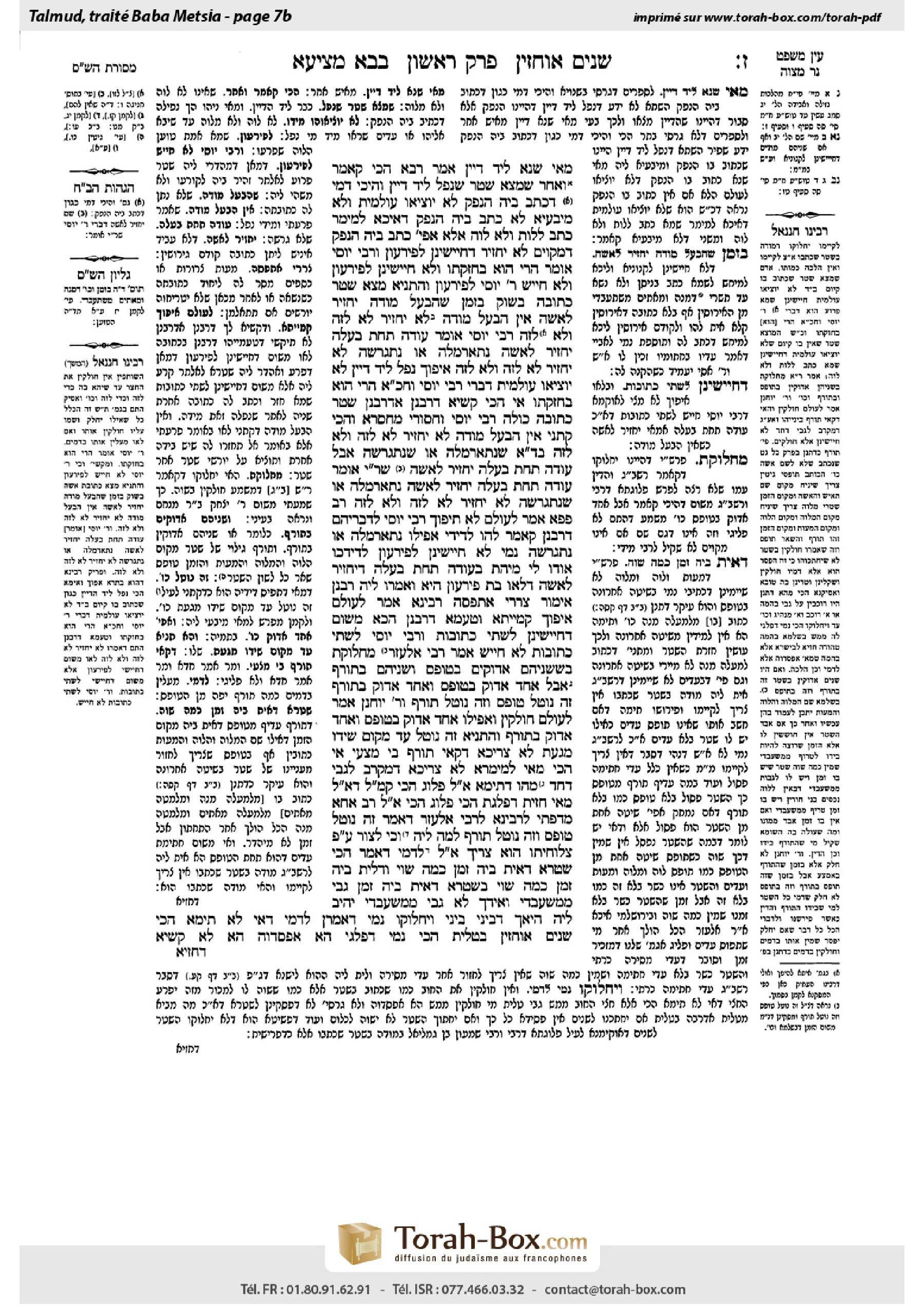
Bava Metzia 7b: Talmud study for Daf Yomi
Study the Talmud for Daf Yomi with scanned pages, Hebrew text, English translations from Sefaria and AI-generated French translations.
Passage selection and English or AI-generated French translation are available where the scan has annotations. Daf Study is independent of Torah-Box and Sefaria.
Browse Bava Metzia · בבא מציעא · All tractatesBava Metzia 7b text and translations
This page of Bava Metzia includes the Aramaic text, an English translation and an AI-generated French translation, alongside the scan above.
בבא מציעא ז׳ ב · Aramaic and Hebrew text
מַאי שְׁנָא לְיַד דַּיָּין? אָמַר רָבָא, הָכִי קָאָמַר: וְאַחֵר שֶׁמָּצָא שְׁטָר שֶׁנָּפַל לְיַד דַּיָּין, וְהֵיכִי דָּמֵי – דִּכְתַב בֵּיהּ הֶנְפֵּק, לֹא יוֹצִיאוֹ עוֹלָמִית.
וְלָא מִיבַּעְיָא לָא כְּתַב בֵּיהּ הֶנְפֵּק, דְּאִיכָּא לְמֵימַר כָּתַב לִלְוֹת וְלֹא לָוָה, אֶלָּא אֲפִילּוּ כְּתַב בֵּיהּ הֶנְפֵּק, דִּמְקוּיָּם – לֹא יַחֲזִיר, דְּחָיְישִׁינַן לְפֵירָעוֹן.
וְרַבִּי יוֹסֵי אוֹמֵר: הֲרֵי הוּא בְּחֶזְקָתוֹ וְלָא חָיְישִׁינַן לְפֵירָעוֹן. וְלָא חָיֵישׁ רַבִּי יוֹסֵי לְפֵירָעוֹן?
וְהָתַנְיָא: מָצָא שְׁטַר כְּתוּבָּה בַּשּׁוּק, בִּזְמַן שֶׁהַבַּעַל מוֹדֶה – יַחֲזִיר לָאִשָּׁה, אֵין הַבַּעַל מוֹדֶה – לֹא יַחֲזִיר לֹא לָזֶה וְלֹא לָזֶה.
רַבִּי יוֹסֵי אוֹמֵר: עוֹדָהּ תַּחַת בַּעֲלָהּ – יַחֲזִיר לָאִשָּׁה. נִתְאַרְמְלָה אוֹ נִתְגָּרְשָׁה – לֹא יַחֲזִיר לֹא לָזֶה וְלֹא לָזֶה.
אֵיפוֹךְ: נָפַל לְיַד דַּיָּין לֹא יוֹצִיאוֹ עוֹלָמִית, דִּבְרֵי רַבִּי יוֹסֵי. וַחֲכָמִים אוֹמְרִים: הֲרֵי הוּא בְּחֶזְקָתוֹ.
אִי הָכִי קַשְׁיָא דְּרַבָּנַן אַדְּרַבָּנַן!
שְׁטַר כְּתוּבָּה, כּוּלָּהּ רַבִּי יוֹסֵי, וְחַסּוֹרֵי מְחַסְּרָא וְהָכִי קָתָנֵי: אֵין הַבַּעַל מוֹדֶה – לֹא יַחֲזִיר לֹא לָזֶה וְלֹא לָזֶה. בַּמֶּה דְּבָרִים אֲמוּרִים – שֶׁנִּתְאַרְמְלָה אוֹ שֶׁנִּתְגָּרְשָׁה, אֲבָל עוֹדָהּ תַּחַת בַּעֲלָהּ – יַחֲזִיר לָאִשָּׁה, שֶׁרַבִּי יוֹסֵי אוֹמֵר: עוֹדָהּ תַּחַת בַּעֲלָהּ – יַחֲזִיר לָאִשָּׁה, נִתְאַרְמְלָה אוֹ שֶׁנִּתְגָּרְשָׁה – לֹא יַחֲזִיר לֹא לָזֶה וְלֹא לָזֶה.
רַב פָּפָּא אָמַר: לְעוֹלָם לָא תֵּיפוֹךְ, רַבִּי יוֹסֵי לְדִבְרֵיהֶם דְּרַבָּנַן קָאָמַר לְהוּ.
לְדִידִי אֲפִילּוּ נִתְאַרְמְלָה אוֹ נִתְגָּרְשָׁה נָמֵי לָא חָיְישִׁינַן לְפֵירָעוֹן. לְדִידְכוּ אוֹדוֹ לִי מִיהַת בְּעוֹדָהּ תַּחַת בַּעֲלָהּ, דְּיַחֲזִיר לָאִשָּׁה, דְּלָאו בַּת פֵּירָעוֹן הִיא.
וַאֲמַרוּ לֵיהּ רַבָּנַן: אֵימוֹר צְרָרֵי אַתְפְּסָה.
רָבִינָא אָמַר: לְעוֹלָם אֵיפוֹךְ קַמַּיְיתָא. וְטַעְמָא דְּרַבָּנַן הָכָא, מִשּׁוּם דְּחָיְישִׁינַן לִשְׁתֵּי כְתוּבּוֹת. וְרַבִּי יוֹסֵי לִשְׁתֵּי כְתוּבּוֹת לָא חָיֵישׁ.
אָמַר רַבִּי אֶלְעָזָר: מַחֲלוֹקֶת בְּשֶׁשְּׁנֵיהֶם אֲדוּקִים בַּטּוֹפֶס, וּשְׁנֵיהֶם בַּתּוֹרֶף. אֲבָל אֶחָד אָדוּק בַּטּוֹפֶס וְאֶחָד אָדוּק בַּתּוֹרֶף – זֶה נוֹטֵל טוֹפֶס, וְזֶה נוֹטֵל תּוֹרֶף. וְרַבִּי יוֹחָנָן אָמַר: לְעוֹלָם חוֹלְקִין.
וַאֲפִילּוּ אֶחָד אָדוּק בַּטּוֹפֶס וְאֶחָד בַּתּוֹרֶף. וְהָתַנְיָא: זֶה נוֹטֵל עַד מָקוֹם שֶׁיָּדוֹ מַגַּעַת! לָא צְרִיכָא דְּקָאֵי תּוֹרֶף בֵּי מִצְעֵי.
אִי הָכִי מַאי לְמֵימְרָא? לָא צְרִיכָא דִּמְקָרַב לְגַבֵּי דְחַד. מַהוּ דְּתֵימָא: אָמַר לֵיהּ פְּלוֹג הָכִי, קָא מַשְׁמַע לַן דְּאָמַר לֵיהּ: מַאי חָזֵית דְּפָלְגַתְּ הָכִי? פְּלוֹג הָכִי.
אֲמַר לֵיהּ רַב אַחָא מִדִּפְתִּי לְרָבִינָא: לְרַבִּי אֶלְעָזָר דְּאָמַר זֶה נוֹטֵל טוֹפֶס וְזֶה נוֹטֵל תּוֹרֶף, לְמָה לֵיהּ? וְכִי לָצוּר עַל פִּי צְלוֹחִיתוֹ הוּא צָרִיךְ?
אֲמַר לֵיהּ: לִדְמֵי.
דְּאָמַר הָכִי: שְׁטָרָא דְּאִית בֵּיהּ זְמַן, כַּמָּה שָׁוֵי? וּדְלֵית בֵּיהּ זְמַן, כַּמָּה שָׁוֵי? בִּשְׁטָרָא דְּאִית בֵּיהּ זְמַן – גָּבֵי מִמְּשַׁעְבְּדֵי. וְאִידַּךְ – לָא גָּבֵי מִמְּשַׁעְבְּדֵי. יָהֵיב לֵיהּ הֵיאַךְ דְּבֵינֵי בֵּינֵי.
״וְיַחְלוֹקוּ״ נָמֵי דַּאֲמַרַן לְדָמֵי. דְּאִי לָא תֵּימָא הָכִי, שְׁנַיִם אוֹחֲזִין בְּטַלִּית הָכִי נָמֵי דְּפָלְגִי? הָא אַפְסְדוּהּ! הָא לָא קַשְׁיָא,
Bava Metzia 7b · English translation
The Gemara asks: What is different about the case where the promissory note fell into the possession of a judge, such that the creditor cannot retrieve it to collect the debt? Rava said this is what the baraita is saying: But in the case of another individual, who is neither the debtor nor the creditor, who found a promissory note that had already fallen into the possession of a judge, it may never be removed from his possession until proof is provided. And what are the circumstances? What does it mean that the promissory note had fallen into the possession of a judge? It is a case where the court wrote in the promissory note a ratification certifying that it examined and ratified the note and it can be used to collect the debt.
And the reason the baraita refers specifically to these circumstances is that it is not necessary to state that in a case where there is no ratification written in the promissory note that the creditor cannot use it to collect the debt; as it can be said that the debtor wrote the document because he intended to borrow the money, but he ultimately did not borrow it. Rather, the baraita states that even in a case where there is a ratification written in the promissory note, as it is now a ratified promissory note, the finder should not return it to the creditor, as we suspect that there was repayment, i.e., that the debtor may have repaid the debt, and he lost the promissory note.
The Gemara discusses the continuation of the baraita: And Rabbi Yosei says: The promissory note retains its presumptive status. The Gemara explains: And we do not suspect that there was repayment; had the debt been repaid the debtor would have immediately destroyed the promissory note. The Gemara asks: But does Rabbi Yosei not suspect that there was repayment?
But isn’t it taught in a baraita: If one found a marriage contract in the marketplace, in a case when the husband admits that he has not yet paid the amount written in the contract to his wife, the finder must return the document to the wife. In a case when the husband does not admit this, but instead claims that he has already paid the amount written in the contract, the one who found it should not return it to this one, the husband, or to that one, the wife.
Rabbi Yosei says that there is a distinction between different situations: If the wife is still under the auspices of her husband, i.e., she is still married to him, the one who found the marriage contract must return it to the wife because presumably the husband did not pay her the amount specified in the marriage contract during their marriage. If the wife was widowed or divorced, he should not return it to this party, the husband or his heirs, or to that party, the wife, as perhaps she already received payment and the contract was later lost by her husband or his heirs. In this case, Rabbi Yosei suspects that there was payment.
The Gemara answers: Reverse the order of the tanna’im in the baraita and teach it as follows: If the promissory note fell into the possession of a judge, it may never be removed; this is the statement of Rabbi Yosei. And the Rabbis say: It retains its presumptive status.
The Gemara asks: If so, the contradiction between the statement of the Rabbis in this baraita and the statement of the Rabbis with regard to the case of the marriage contract is difficult. Whereas according to the emended version of the baraita the Rabbis do not take into account the possibility that the debt was repaid, in the case of the marriage contract the Rabbis take this possibility into account.
The Gemara resolves the problem: The baraita that discusses the marriage contract is entirely in accordance with the opinion of Rabbi Yosei; it contains no dispute. And the baraita is incomplete, and this is what it is teaching: In a case where the husband does not admit that he did not pay the marriage contract, the one who found it should not return it to this party or to that party. In what case is this statement said? It is said in a case where the woman was widowed or divorced. But if she is still under the auspices of her husband, the finder must return it to the wife. As Rabbi Yosei says: If she is still under the auspices of her husband, the finder must return it to the wife. If she was widowed or divorced, he should not return it to this party or to that party.
Rav Pappa said: Actually, do not reverse the opinions in the baraita, but instead resolve the contradiction differently: Rabbi Yosei was telling the Rabbis what the halakha should be in the case of a marriage contract according to their statement, i.e., according to their opinion that one who finds a promissory note needs to take into account that the debt may have been repaid already.
His statement should be understood as follows: In my opinion, even if she was widowed or divorced we do not suspect that there was payment. But according to your opinion, concede to me, in any event, that while she is still under the auspices of her husband the finder should return the document to the wife, as the marriage contract is not yet subject to payment. Since the husband is not yet liable to pay, it is unlikely that he paid.
And the Rabbis said to him in response: Even if they are still married, say that he gave her bundles of money, and in exchange she gave him back the marriage contract. If the finder then returns the marriage contract to the wife, that would enable her to collect the sum twice.
Ravina said: Actually, reverse the order of the tanna’im in the first baraita, which discusses one who finds a promissory note, and resolve the contradiction between the different statements of the Rabbis as follows: The reason for the opinion of the Rabbis here, that a marriage contract cannot be returned to the wife, is that we suspect that the husband wrote two marriage contracts; after the first marriage contract was lost, the husband had to write a second one in its stead. Returning to the wife the marriage contract that was found would enable her to collect twice. And Rabbi Yosei holds that it should be returned to the wife because he does not suspect that the husband wrote two marriage contracts; in his opinion, it is a rare occurrence.
§ Rabbi Elazar says: With regard to the dispute between Rabban Shimon ben Gamliel and Rabbi Yehuda HaNasi in the case of a creditor and a debtor both grasping a promissory note, Rabban Shimon ben Gamliel holds that they divide the promissory note evenly, specifically in a case where both are grasping the standard part of the promissory note, i.e., the part that contains the standard formulation of the note, or both are grasping the essential part of the promissory note, where the names of the creditor and debtor are written, as well as the amount owed and the date. But if one of them is grasping the standard part and the other one is grasping the essential part, they divide the promissory note between them based on the section that each of them is holding; this one takes the standard part and that one takes the essential part. And Rabbi Yoḥanan says: Actually, they divide everything equally.
The Gemara asks with regard to Rabbi Yoḥanan’s statement: And does he hold that this is the halakha even in a case where one is grasping the standard part and one the essential part? But isn’t it taught in the baraita that was cited above with regard to a garment: This one takes up to where his hand reaches and that one takes up to where his hand reaches? Here as well, if one is grasping the standard part and the other is grasping the essential part, they should take the parts they are holding. The Gemara answers: No, this halakha that Rabbi Yoḥanan stated is necessary for a case where the essential part is located in the middle. He was not discussing the case where one was grasping the standard part and the other one was grasping the essential part. In that case, he would agree that each takes the part he was grasping.
The Gemara asks: If so, what is the purpose of stating that they divide it equally? That is obvious. The Gemara answers: No, it is necessary in a case where the essential part of the document is closer to one of them. Lest you say that the one to whom the essential part is closer can say to the other one: Divide it in this manner, leaving the essential part on my side, Rabbi Yoḥanan teaches us that the other one can say to him in response: What did you see that led you to divide it in that manner? Divide it in this manner, so that we will both share the essential part.
Rav Aḥa of Difti said to Ravina: According to the opinion of Rabbi Elazar, who says this one takes the standard part and that one takes the essential part, why do either of them need it? Does he need half of the document to cover the opening of his flask? Having half a promissory note is of no legal consequence.
Ravina said to him: The division in question is not division of the document itself, with each taking half of the paper. It is a division of its monetary value, as the value of each section of the promissory note is compared to the value of the other.
The one grasping the essential part of the promissory note, which contains the date, can say this: Consider a promissory note that has the date written on it; how much is it worth? And consider a promissory note that does not have the date written on it; how much is it worth? The significance of writing the date is that if a creditor is in possession of a promissory note that has the date written on it, he can collect his debt even from liened property that has been sold by the debtor to another individual after taking the loan. But if a creditor is in possession of the other kind of promissory note, i.e., one that does not have the date written on it, he cannot collect his debt from liened property. Therefore, the other party, who is grasping the standard part of the document, gives him the difference between the two values.
And this is also true in general, with regard to cases where we said that the two litigants divide the disputed item: The reference is to the monetary value, and not division of the actual item. As, if you do not say so, but rather you hold that the item itself is divided, in the case of two people who come to court holding a garment, do they also divide the garment itself into two? But by doing so they would ruin it. The Gemara rejects this proof: This is not difficult, as it is possible to explain that they actually cut the garment in two.
Bava Metzia 7b · Traduction française (IA)
La Guemara pose la question : Quelle est la particularité du cas où l'ordre de paiement est tombé entre les mains d'un juge, de sorte que le créancier ne peut le récupérer pour exiger le paiement de la dette ? Rava dit que c'est ce que dit la baraïta : Mais dans le cas d'une autre personne, qui n'est ni le débiteur ni le créancier, qui a trouvé un ordre de paiement qui avait déjà été mis entre les mains d'un juge, il ne peut jamais être retiré de sa possession jusqu'à ce qu'une preuve soit apportée. Et quels sont les circonstances ? De quoi signifie-t-il que l'ordre de paiement ait été mis entre les mains d'un juge ? C'est un cas où le tribunal a inscrit dans l'ordre de paiement une ratification certifiant qu'il avait examiné et validé l'ordre de paiement et qu'il peut être utilisé pour exiger le paiement de la dette.
Et la raison pour laquelle la baraïta fait référence spécifiquement à ces circonstances est que cela n'est pas nécessaire de préciser que dans le cas où il n'y a pas de ratification inscrite dans l'ordre de paiement, le créancier ne peut pas utiliser cet ordre de paiement pour exiger le paiement de la dette ; on peut dire que le débiteur a rédigé le document parce qu'il avait l'intention de prêter de l'argent, mais il n'a finalement pas prêter cet argent. Plutôt, la baraïta indique que même dans le cas où il y a une ratification inscrite dans l'ordre de paiement, comme il s'agit désormais d'un ordre de paiement validé, le trouver ne doit pas le rendre au créancier, car on soupçonne qu'il y a eu un paiement, c'est-à-dire que le débiteur pourrait avoir payé la dette et avoir perdu l'ordre de paiement.
La Guemara discute de la continuation de la baraïta : Et Rabbi Yosei dit : L'ordre de paiement conserve son statut présomptif. La Guemara explique : Et on ne soupçonne pas qu'il y ait eu un paiement ; si la dette avait été payée, le débiteur aurait immédiatement détruit l'ordre de paiement. La Guemara pose la question : Mais ne soupçonne-t-il pas Rabbi Yosei que le paiement a eu lieu ?
Mais n'est-il pas enseigné dans une baraïta : Si l'on a trouvé un contrat de mariage dans le marché, dans le cas où le mari admet qu'il n'a pas encore payé la somme indiquée dans le contrat à sa femme, le trouver doit rendre le document à la femme. Dans le cas où le mari ne l'admet pas, mais affirme avoir déjà payé la somme indiquée dans le contrat, le trouver ne doit pas rendre le document à ce dernier, le mari, ou à celle-ci, la femme.
Rabbi Yosei dit qu'il y a une distinction entre des situations différentes : Si la femme est encore sous la tutelle de son mari, c'est-à-dire qu'elle est encore mariée, le trouver doit rendre le document à la femme, car on suppose que le mari n'a pas payé la somme indiquée dans le contrat de mariage pendant leur mariage. Si la femme est veuve ou divorcée, il ne doit pas rendre le document à ce dernier, le mari ou ses héritiers, ou à celle-ci, la femme, car peut-être elle a déjà reçu le paiement et le contrat a été perdu par le mari ou ses héritiers. Dans ce cas, Rabbi Yosei soupçonne qu'il y a eu un paiement.
La Guemara répond : Inversez l'ordre des tannaïm dans la baraïta et enseignez-la ainsi : Si le contrat de paiement est tombé entre les mains d'un juge, il ne peut jamais être retiré ; c'est l'opinion de Rabbi Yosei. Et les Rabbins disent : Il conserve son statut présomptif.
La Guemara pose la question : Si c'est ainsi, la contradiction entre l'opinion des Rabbins dans cette baraïta et l'opinion des Rabbins concernant le cas du contrat de mariage est difficile. Alors que selon la version corrigée de la baraïta, les Rabbins ne tiennent pas compte de la possibilité que la dette ait été payée, dans le cas du contrat de mariage, les Rabbins tiennent compte de cette possibilité.
La Guemara résout le problème : La baraïta qui discute du contrat de mariage est entièrement conforme à l'opinion de Rabbi Yosei ; elle ne contient pas de débat. Et la baraïta est incomplète, et c'est ce qu'elle enseigne : Dans le cas où le mari ne reconnaît pas qu'il n'a pas payé le contrat de mariage, celui qui a trouvé le document ne doit pas le rendre à ce dernier ou à celui-ci. Dans quel cas cette déclaration est-elle dite ? Elle est dite dans le cas où la femme est veuve ou divorcée. Mais si elle est encore sous la tutelle de son mari, celui qui a trouvé le document doit le rendre à la femme. Comme Rabbi Yosei dit : Si elle est encore sous la tutelle de son mari, celui qui a trouvé le document doit le rendre à la femme. Si elle est veuve ou divorcée, il ne doit pas le rendre à ce dernier ou à celui-ci.
Rav Pappa dit : En réalité, ne faites pas l'inversion des opinions dans la baraïta, mais résolvez la contradiction différemment : Rabbi Yosei disait aux Rabbins ce que la halakha devrait être dans le cas d'un contrat de mariage selon leur déclaration, c'est-à-dire selon leur opinion que celui qui trouve un ordre de paiement doit prendre en compte la possibilité que la dette ait déjà été payée.
Sa déclaration doit être comprise ainsi : Selon mon avis, même si elle est veuve ou divorcée, on ne soupçonne pas qu'il y ait eu un paiement. Mais selon votre avis, cédez-moi, dans tous les cas, que pendant qu'elle est encore sous la tutelle de son mari, le trouver doit rendre le document à la femme, car le contrat de mariage n'est pas encore soumis à un paiement. Puisque le mari n'est pas encore tenu de payer, il est peu probable qu'il l'ait payé.
Et les Rabbins lui répondent : Même s'ils sont encore mariés, dites qu'il lui a donné des ballots de monnaie, et en échange elle lui a rendu le contrat de mariage. Si le trouver rend alors le contrat de mariage à la femme, cela permettrait à celle-ci de récupérer la somme deux fois.
Ravina a dit : En réalité, inversez l'ordre des tannaïm dans la première baraïta, qui discute d'une personne qui trouve un billet de change, et résolvez la contradiction entre les différentes déclarations des Rabbis comme suit : La raison de l'opinion des Rabbis ici, que le contrat de mariage ne peut être rendu à la femme, est que nous soupçonnons que l'époux a écrit deux contrats de mariage ; après que le premier contrat de mariage ait été perdu, l'époux a dû écrire un second en son lieu. Rendre au femme le contrat de mariage trouvé permettrait à celle-ci de récupérer doublement. Et Rabbi Yosei maintient qu'il doit être rendu à la femme, car il ne soupçonne pas que l'époux ait écrit deux contrats de mariage ; selon son avis, c'est une occurrence rare.
§ Rabbi Elazar dit : En ce qui concerne le débat entre Rabban Shimon ben Gamliel et Rabbi Yehuda HaNasi dans le cas d'un créancier et d'un débiteur qui s'emparent tous deux d'un billet de change, Rabban Shimon ben Gamliel affirme qu'ils divisent le billet de change équitablement, spécifiquement dans le cas où les deux s'emparent de la partie standard du billet de change, c'est-à-dire la partie contenant la formule standard du billet, ou les deux s'emparent de la partie essentielle du billet de change, où les noms du créancier et du débiteur sont inscrits, ainsi que le montant dû et la date. Mais si l'un d'eux s'empare de la partie standard et l'autre de la partie essentielle, ils divisent le billet de change entre eux selon la section que chacun d'eux tient ; celui-ci prend la partie standard et celui-là la partie essentielle. Et Rabbi Yoḥanan dit : En réalité, ils divisent tout équitablement.
Le Guemara pose la question concernant l'affirmation de Rabbi Yoḥanan : Et est-ce qu'il maintient que c'est la halakha même dans le cas où l'un s'empare de la partie standard et l'autre de la partie essentielle ? Mais n'est-ce pas enseigné dans la baraïta citée ci-dessus concernant un vêtement : Celui-ci prend jusqu'au bout de sa main et celui-là jusqu'au bout de sa main ? Ici aussi, si l'un s'empare de la partie standard et l'autre de la partie essentielle, ils devraient prendre les parties qu'ils tiennent. Le Guemara répond : Non, cette halakha que Rabbi Yoḥanan a énoncée est nécessaire dans le cas où la partie essentielle est située au milieu. Il ne discutait pas du cas où l'un s'empare de la partie standard et l'autre de la partie essentielle. Dans ce cas, il serait d'accord que chacun prenne la partie qu'il tenait.
Le Guemara pose la question : Si c'est ainsi, à quoi sert d'énoncer qu'ils divisent équitablement ? Cela est évident. Le Guemara répond : Non, cela est nécessaire dans le cas où la partie essentielle du document est plus proche de l'un d'eux. De peur que celui à qui la partie essentielle est plus proche ne dise à l'autre : Divisez-le ainsi, laissant la partie essentielle de mon côté, Rabbi Yoḥanan nous enseigne que l'autre peut lui répondre : Qu'as-tu vu qui t'a fait diviser ainsi ? Divise-le ainsi, afin que nous partagions tous deux la partie essentielle.
Rav Aḥa de Difti a dit à Ravina : Selon l'opinion de Rabbi Elazar, qui dit que celui-ci prend la partie standard et celui-là la partie essentielle, pourquoi ont-ils besoin de cela ? A-t-il besoin de la moitié du document pour couvrir l'ouverture de son flacon ? Avoir la moitié d'un billet de change n'a aucune conséquence juridique.
Ravina dit à lui : La division en question n'est pas la division du document lui-même, avec chacun prenant la moitié du papier. Il s'agit d'une division de sa valeur monétaire, car la valeur de chaque section du billet de change est comparée à la valeur de l'autre.
Celui qui s'empare de la partie essentielle du billet de change, qui contient la date, peut dire ceci : Considérez un billet de change dont la date est inscrite ; combien vaut-il ? Et considérez un billet de change dont la date n'est pas inscrite ; combien vaut-il ? L'importance d'écrire la date est que si un créancier est en possession d'un billet de change dont la date est inscrite, il peut récupérer son créance même à partir d'un bien hypothéqué qui a été vendu par le débiteur à un autre individu après avoir pris le prêt. Mais si un créancier est en possession du autre type de billet de change, c'est-à-dire celui dont la date n'est pas inscrite, il ne peut pas récupérer son créance à partir d'un bien hypothéqué. Par conséquent, l'autre partie, qui s'empare de la partie standard du document, lui donne la différence entre les deux valeurs.
Et cela est également vrai dans le général, concernant les cas où nous avons dit que les deux parties divisent l'objet litigieux : La référence est à la valeur monétaire, et non à la division de l'objet lui-même. En effet, si vous ne dites pas cela, mais que vous maintenez que l'objet lui-même est divisé, dans le cas de deux personnes qui viennent devant le tribunal avec un vêtement, divisent-ils aussi le vêtement lui-même en deux ? Mais en le faisant, ils le détruiront. Le Guemara rejette cette preuve : Ce n'est pas difficile, car on peut expliquer que l'on peut effectivement couper le vêtement en deux.
Traduction française générée par IA à partir de l’édition anglaise de Sefaria. Vérifie toujours un passage avec le texte source.
Text from Sefaria: William Davidson Edition - Vocalized Aramaic (CC BY NC); William Davidson Edition - English (CC BY NC).