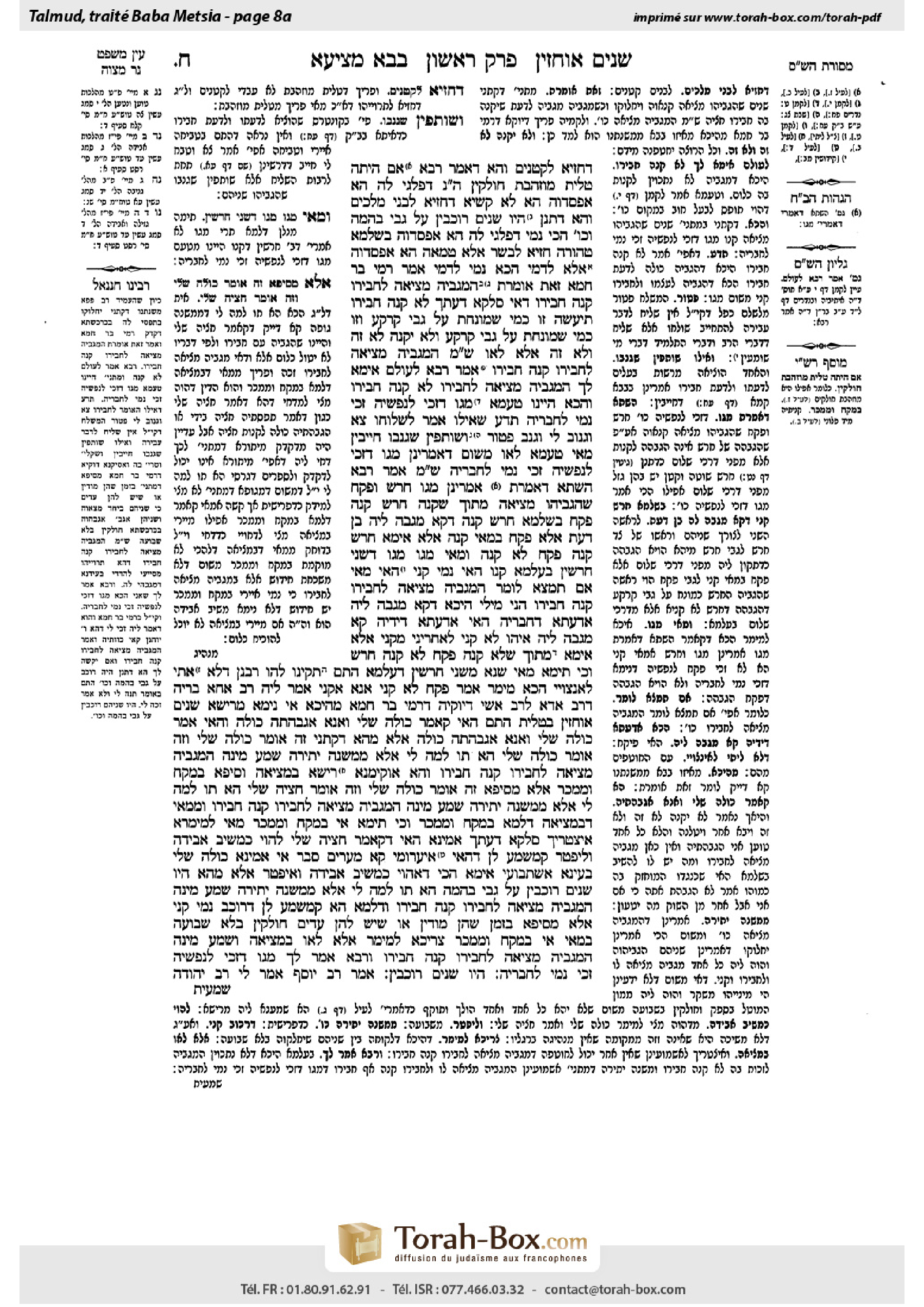
Bava Metzia 8a: Talmud study for Daf Yomi
Study the Talmud for Daf Yomi with scanned pages, Hebrew text, English translations from Sefaria and AI-generated French translations.
Passage selection and English or AI-generated French translation are available where the scan has annotations. Daf Study is independent of Torah-Box and Sefaria.
Browse Bava Metzia · בבא מציעא · All tractatesBava Metzia 8a text and translations
This page of Bava Metzia includes the Aramaic text, an English translation and an AI-generated French translation, alongside the scan above.
בבא מציעא ח׳ א · Aramaic and Hebrew text
דְּחַזְיָא לִקְטַנִּים.
וְהָא דְּאָמַר רָבָא: אִם הָיְתָה טַלִּית מוּזְהֶבֶת – חוֹלְקִין, הָכִי נָמֵי דְּפָלְגִי לַהּ, הָא אַפְסְדוּהָ! הָא לָא קַשְׁיָא, דְּחַזְיָא לִבְנֵי מְלָכִים.
וְהָא דִּתְנַן: הָיוּ שְׁנַיִם רוֹכְבִין עַל גַּבֵּי בְּהֵמָה וְכוּ׳, הָכִי נָמֵי דְּפָלְגִי לַהּ? הָא אַפְסְדוּהָ! בִּשְׁלָמָא טְהוֹרָה – חַזְיָא לְבָשָׂר. אֶלָּא טְמֵאָה, הָא אַפְסְדוּהָ! אֶלָּא לִדְמֵי, הָכָא נָמֵי לִדְמֵי.
אָמַר רָמֵי בַּר חָמָא: זֹאת אוֹמֶרֶת, הַמַּגְבִּיהַּ מְצִיאָה לַחֲבֵירוֹ – קָנָה חֲבֵירוֹ.
דְּאִי סָלְקָא דַּעְתָּךְ לֹא קָנָה חֲבֵירוֹ, תֵּיעָשֶׂה זוֹ כְּמִי שֶׁמּוּנַּחַת עַל גַּבֵּי קַרְקַע, וְזוֹ כְּמִי שֶׁמּוּנַּחַת עַל גַּבֵּי קַרְקַע, וְלֹא יִקְנֶה לֹא זֶה וְלֹא זֶה. אֶלָּא לָאו שְׁמַע מִינַּהּ: הַמַּגְבִּיהַּ מְצִיאָה לַחֲבֵירוֹ – קָנָה חֲבֵירוֹ.
אָמַר רָבָא, לְעוֹלָם אֵימָא לָךְ: הַמַּגְבִּיהַּ מְצִיאָה לַחֲבֵירוֹ – לֹא קָנָה חֲבֵירוֹ. וְהָכָא הַיְינוּ טַעְמָא: מִגּוֹ דְּזָכֵי לְנַפְשֵׁיהּ זָכֵי נָמֵי לְחַבְרֵיהּ.
תִּדַּע שֶׁאִילּוּ אָמַר לִשְׁלוּחוֹ: ״צֵא וּגְנוֹב לִי״, וְגָנַב – פָּטוּר. וְשׁוּתָּפִין שֶׁגָּנְבוּ – חַיָּיבִין. מַאי טַעְמָא? לָאו מִשּׁוּם דְּאָמְרִינַן: מִגּוֹ דְּזָכֵי לְנַפְשֵׁיהּ זָכֵי נָמֵי לְחַבְרֵיהּ. שְׁמַע מִינַּהּ.
אָמַר רָבָא, הַשְׁתָּא דְּאָמְרַתְּ אָמְרִינַן מִגּוֹ: חֵרֵשׁ וּפִקֵּחַ שֶׁהִגְבִּיהוּ מְצִיאָה, מִתּוֹךְ שֶׁקָּנָה חֵרֵשׁ – קָנָה פִּקֵּחַ.
בִּשְׁלָמָא חֵרֵשׁ קָנָה – דְּקָא מַגְבַּהּ לֵיהּ בֶּן דַּעַת. אֶלָּא פִּקֵּחַ בְּמַאי קָנָה?
אֶלָּא אֵימָא: חֵרֵשׁ – קָנָה, פִּקֵּחַ – לָא קָנָה. וּמַאי מִגּוֹ? מִגּוֹ דִּשְׁנֵי חֵרְשִׁין בְּעָלְמָא קָנוּ, הַאי נָמֵי קָנֵי.
הַאי מַאי? אִם תִּמְצָא לוֹמַר הַמַּגְבִּיהַּ מְצִיאָה לַחֲבֵירוֹ קָנָה חֲבֵירוֹ, הָנֵי מִילֵּי הֵיכָא דְּקָא מַגְבַּהּ לֵיהּ אַדַּעְתָּא דְּחַבְרֵיהּ. הַאי אַדַּעְתָּא דִּידֵיהּ קָא מַגְבַּהּ לֵיהּ, אִיהוּ לָא קָנֵי – לְאַחֲרִינֵי מַקְנֵי?!
אֶלָּא אֵימָא: מִתּוֹךְ שֶׁלֹּא קָנָה פִּקֵּחַ – לֹא קָנָה חֵרֵשׁ.
וְכִי תֵּימָא, מַאי שְׁנָא מִשְּׁנֵי חֵרְשִׁין דְּעָלְמָא – הָתָם תַּקִּינוּ לְהוּ רַבָּנַן דְּלָא אָתֵי לְאִנְּצוֹיֵי. הָכָא מֵימָר אָמַר: פִּקֵּחַ לָא קָנֵי, אֲנָא אֶקְנֵי?
אֲמַר לֵיהּ רַב אַחָא בְּרֵיהּ דְּרַב אַדָּא לְרַב אָשֵׁי: דִּיּוּקֵיהּ דְּרָמֵי בַּר חָמָא מֵהֵיכָא? אִי נֵימָא מֵרֵישָׁא ״שְׁנַיִם אוֹחֲזִין בְּטַלִּית״, הָתָם הַאי קָאָמַר ״כּוּלָּהּ שֶׁלִּי וַאֲנָא אַגְּבַּהְתַּהּ כּוּלַּהּ״, וְהַאי אָמַר ״כּוּלָּהּ שֶׁלִּי וַאֲנָא אַגְּבַּהְתַּהּ כּוּלַּהּ״.
אֶלָּא מֵהָא דְּקָתָנֵי ״זֶה אוֹמֵר כּוּלָּהּ שֶׁלִּי וְזֶה אוֹמֵר כּוּלָּהּ שֶׁלִּי״ הָא תּוּ לְמָה לִי? אֶלָּא מִמִּשְׁנָה יְתֵירָה שְׁמַע מִינַּהּ: הַמַּגְבִּיהַּ מְצִיאָה לַחֲבֵירוֹ – קָנָה חֲבֵירוֹ.
וְהָא אוֹקֵימְנָא רֵישָׁא בִּמְצִיאָה, וְסֵיפָא בְּמִקָּח וּמִמְכָּר!
אֶלָּא מִסֵּיפָא: ״זֶה אוֹמֵר כּוּלָּהּ שֶׁלִּי וְזֶה אוֹמֵר חֶצְיָהּ שֶׁלִּי״, הָא תּוּ לְמָה לִי? אֶלָּא מִמִּשְׁנָה יְתֵירָה שְׁמַע מִינַּהּ: הַמַּגְבִּיהַּ מְצִיאָה לַחֲבֵירוֹ – קָנָה חֲבֵירוֹ.
וּמִמַּאי דְּבִמְצִיאָה? דִּלְמָא בְּמִקָּח וּמִמְכָּר?
וְכִי תֵּימָא: אִי בְּמִקָּח וּמִמְכָּר מַאי לְמֵימְרָא? אִיצְטְרִיךְ, סָלְקָא דַּעְתָּךְ אָמֵינָא הַאי דְּקָאָמַר ״חֶצְיָהּ שֶׁלִּי״ לֶהֱוֵי כְּמֵשִׁיב אֲבֵידָה וְלִיפְּטַר. קָמַשְׁמַע לַן דְּהַאי אִיעָרוֹמֵי קָא מַעֲרִים. סָבַר: אִי אָמֵינָא ״כּוּלָּהּ שֶׁלִּי״, בָּעֵינָא אִשְׁתְּבוֹעֵי, אֵימָא הָכִי, דְּאֶהְוֵי כְּמֵשִׁיב אֲבֵידָה וְאִיפְּטַר!
אֶלָּא מֵהָא, הָיוּ שְׁנַיִם רוֹכְבִין עַל גַּבֵּי בְּהֵמָה, הָא תּוּ לְמָה לִי? אֶלָּא מִמִּשְׁנָה יְתֵירָה שְׁמַע מִינַּהּ: הַמַּגְבִּיהַּ מְצִיאָה לַחֲבֵירוֹ – קָנָה חֲבֵירוֹ.
וְדִלְמָא, הָא קָמַשְׁמַע לַן דְּרוֹכֵב נָמֵי קָנֵי!
אֶלָּא מִסֵּיפָא: בִּזְמַן שֶׁהֵן מוֹדִין אוֹ שֶׁיֵּשׁ לָהֶן עֵדִים – חוֹלְקִין בְּלֹא שְׁבוּעָה. בְּמַאי? אִי בְּמִקָּח וּמִמְכָּר, צְרִיכָא לְמֵימַר?! אֶלָּא לָאו בִּמְצִיאָה, וּשְׁמַע מִינַּהּ הַמַּגְבִּיהַּ מְצִיאָה לַחֲבֵירוֹ קָנָה חֲבֵירוֹ.
וְרָבָא אָמַר לָךְ: מִגּוֹ דְּזָכֵי לְנַפְשֵׁיהּ זָכֵי נָמֵי לְחַבְרֵיהּ.
הָיוּ שְׁנַיִם רוֹכְבִין. אָמַר רַב יוֹסֵף, אָמַר לִי רַב יְהוּדָה:
Bava Metzia 8a · English translation
This is because each party receives an item that has monetary value, as it is fit to be made into a garment for small children.
The Gemara asks: But as for that which Rava said, that if the garment was fashioned with gold thread they divide it, does that also mean that they divide the garment itself? By doing so they would ruin it. The Gemara answers: That is not difficult, as after the garment is divided it is fit to be made into a garment for the children of kings or wealthy people. Therefore, it is not ruined.
The Gemara asks: But with regard to that which we learned in the mishna (2a): If two people were sitting on an animal and each of them claims to own the entire animal, they each take an oath and divide the animal, does that also mean that they divide the animal itself? By doing so they would ruin it. Granted, if it is a kosher animal it is fit to be slaughtered and divided between them for the meat. But if it is a non-kosher animal, slaughtering it and dividing the carcass would ruin it and render it worthless. Rather, clearly they divide its monetary value. Here too, in the other cases where the ruling is to divide the item, it means that the litigants divide its monetary value and not the item itself.
§ Based on an inference from the mishna on 2a, Rami bar Ḥama says: That is to say: In a case of one who performs an act of acquisition by lifting a found item on behalf of another, the other person, i.e., the latter, acquires ownership of the item.
Rami bar Ḥama explains his inference: As, if it enters your mind that if one lifts a found item for another the other does not acquire the item, this garment has not been acquired by either of the two litigants, as each prevents the other’s acquisition. If that were the case, this part of the garment, held by one of them, would be considered as though it is still lying on the ground, and that part of the garment, held by the other one, would be considered as though it is still lying on the ground, and neither this one nor that one acquires it; if a third party takes it, it is his. Rather, isn’t it correct to conclude from it that in a case of one who performs an act of acquisition by lifting a found item on behalf of another, the other person acquires the item?
Rava said: This is not a proof, as actually I could say to you that in a case of one who performs an act of acquisition by lifting a found item solely on behalf of another, the other person does not acquire the item. And here in the mishna, this is the reason the two litigants acquire the garment: Since each of the litigants acquires part of the garment for himself, he also acquires the other part for the other one.
Rava adds: Know that one who acquires an item for himself can acquire part of it for another, as, if someone says to his agent: Go out and steal an item for me, and the agent stole that item, the one who sent him is exempt from liability, due to the principle that there is no agency for sin; but partners who stole an item together are both liable even if only one of them actually lifted the item. What is the reason that they are both liable? Is it not because we say that since the one who lifted the item acquires part of it for himself, he also acquires the other part for the other one, his partner? The Gemara concludes: Learn from it that this principle is correct.
Rava said in continuation of his statement: Now that you said that we say: Since [miggo] one acquires part of an item for himself he can also acquire the other part for another, another halakha can be derived: In a case of a deaf-mute and a mentally competent person who lifted a found item simultaneously, since the deaf-mute acquires his part of the item, the mentally competent person also acquires his portion.
The Gemara asks: Granted, the deaf-mute acquires his portion of the found item, as a mentally competent person lifted it for him; since the mentally competent person acquired his own part, he also acquired the other part for the deaf-mute. But how does the mentally competent person acquire his part? He needs the deaf-mute to acquire it for him, and a deaf-mute cannot acquire an item for another.
Rather, say Rava’s statement differently: The deaf-mute acquires his part, but the mentally competent person does not acquire his part. And what is the principle of miggo from which Rava derives this halakha? It is not the principle that one who acquires a found item for himself can acquire part of it for another as well, but rather: Since [miggo] in general two deaf-mutes who pick up an item simultaneously acquire it, in this case too, the deaf-mute acquires it, even though the mentally competent person does not acquire it.
The Gemara asks: What is this derivation? Even if you say that in a case of one who performs an act of acquisition by lifting a found item on behalf of another, the other person acquires it, as Rami bar Ḥama says, this statement applies only where he lifts it with the intention of having the other person acquire the item. But in this case, the mentally competent person lifted the item with the intention of acquiring it for himself; he had no intention of acquiring it for the deaf-mute. If he does not acquire the item for himself, does he acquire it for others?
Rather, say that since the mentally competent person does not acquire any part of the found item, the deaf-mute does not acquire it either.
And if you would say: In what way is this case different from the general case of an item that was found by two deaf-mutes, in which they both acquire it? The answer is that there, in that case, the Sages instituted an ordinance for them that they both acquire the item so that they will not come to quarrel with others who want to take the item from them due to the fact that a deaf-mute lacks the halakhic ability to acquire the item. Here, in the case of the deaf-mute and the mentally competent person, the deaf-mute says to himself: If even the mentally competent person does not acquire the item, can I acquire it? Therefore, in that case, he will not quarrel if others take the item from him.
Rav Aḥa, son of Rav Adda, said to Rav Ashi: From where in the mishna is Rami bar Ḥama’s inference drawn? If we say that he infers it from the first clause of the mishna, i.e., the case of two people holding a garment, isn’t the case there one in which this one says: All of it is mine, and I lifted the entire garment; and that one says: All of it is mine, and I lifted the entire garment? How can the halakha where one acquires an item for another be inferred from that case?
Rather, he infers it from that which is taught later in the mishna: This one says all of it is mine and that one says all of it is mine. Why do I need this case as well? The first case, where each one says: I found it, is sufficient. Rather, learn from the superfluous case in the mishna that even if they lifted it simultaneously, they divide it and a third party has no right to take it, as in a case of one who performs an act of acquisition by lifting a found item on behalf of another, the other person acquires the item.
The Gemara asks: But that clause in the mishna is not superfluous; didn’t we already establish (2a) that the first clause is referring to a dispute over a found item, and the latter clause is referring to a case of buying and selling, where each party claims that he is the one who bought the item from its seller?
Rather, Rami bar Ḥama infers his ruling from the latter clause of the mishna, i.e., the case where this one says all of it is mine and that one says half of it is mine. Why do I need this case as well? What does it add to the previous cases? Rather, learn from this superfluous case in the mishna that in a case of one who performs an act of acquisition by lifting a found item on behalf of another, the other person acquires the item.
The Gemara asks: And from where is it inferred that this clause is referring to the case of a found item? Perhaps it is referring to a case of buying and selling.
And if you would say: If it were referring to a case of buying and selling, what would be the purpose of stating it, as it adds no novel ruling? One could answer that it was necessary to teach this additional case, as otherwise it might enter your mind to say that the one who says: Half of it is mine, should be considered the equivalent of one returning a lost item; he could have claimed that the garment was entirely his, and instead he conceded half of it to the other party and consequently he should be exempt from taking an oath. To counter this, the mishna teaches us that he is not exempt, as perhaps this person is employing artifice. Perhaps he is thinking: If I say that all of it is mine I will need to take an oath. I will state this claim, that half of it is mine, as I will thereby be considered the equivalent of one returning a lost item, and I will be exempt from taking an oath. Therefore, this clause is not superfluous; it teaches that this litigant is not considered the equivalent of one returning a lost item.
Rather, Rami bar Ḥama infers his ruling from this clause: If two people were sitting on an animal, and each of them claims that it is his, each of them takes an oath and they divide the value of the animal. Why do I need this case as well? It teaches no novel halakha. Rather, learn from this superfluous clause in the mishna that in a case of one who performs an act of acquisition by lifting a found item on behalf of another, the other person acquires the item.
The Gemara asks: But perhaps this mishna teaches us that one who sits on an animal also acquires it, even though he has not caused the animal to move.
Rather, Rami bar Ḥama inferred his ruling from the last clause in the mishna: When they each admit to the validity of the other’s claim or when they have witnesses attesting to their claims, they divide it without taking an oath. To what case is the mishna referring? If it is referring to a case of buying and selling, does it need to be said? Rather, is it not referring to a found item? Accordingly, the reason they divide the item is that they knowingly lifted it together, and they intended to acquire it for both of them. And learn from it that in a case of one who performs an act of acquisition by lifting a found item on behalf of another, the other person acquires the item.
The Gemara comments: And Rava said to you that this clause is based on a different principle: When one acquires an item, since he acquires it for himself he can also acquire part of it for another person.
§ The mishna teaches: If two people were sitting on an animal, or one was sitting on the animal and the other one was leading it, and each claims ownership of the animal, they must each take an oath and they divide it. Rav Yosef said: Rav Yehuda said to me:
Bava Metzia 8a · Traduction française (IA)
C'est parce que chaque partie reçoit un objet ayant une valeur monétaire, car il est adapté à être transformé en vêtement pour des enfants.
La Guemara pose la question : Mais concernant ce que Rava a dit, à savoir que si le vêtement était tissé avec des fils d'or, ils le partagent, cela signifie-t-il aussi qu'ils partagent le vêtement lui-même ? En le faisant, ils le détruiront. La Guemara répond : Ce n'est pas difficile, car après que le vêtement ait été partagé, il est adapté à être transformé en vêtement pour les enfants des rois ou des personnes aisées. Par conséquent, il n'est pas détruit.
La Guemara pose la question : Mais concernant ce que nous avons appris dans la Michna (2a) : Si deux personnes étaient assises sur un animal et chacune revendique la propriété totale de l'animal, ils prennent tous deux un serment et partagent l'animal, cela signifie-t-il aussi qu'ils partagent l'animal lui-même ? En le faisant, ils le détruiront. Bien sûr, si c'est un animal kasher, il est adapté à être sacrifié et partagé entre eux pour la viande. Mais si c'est un animal non kasher, sacrifier et partager le cadavre le détruirait et le rendrait inutile. Par conséquent, ils partagent clairement la valeur monétaire de l'objet. De même, dans les autres cas où la décision est de partager l'objet, cela signifie que les parties divisent sa valeur monétaire et non l'objet lui-même.
§ En se basant sur une déduction tirée de la Michna du 2a, Rami bar Ḥama dit : Cela signifie que, dans le cas d'une personne qui effectue un acte d'acquisition en soulevant un objet trouvé pour un autre, la personne à qui l'objet a été soulevé, c'est-à-dire celle-ci, acquiert la propriété de l'objet.
Rami bar Ḥama explique sa déduction : Si l'idée vous vient que soulever un objet trouvé pour un autre ne permet pas à celui-ci d'acquérir l'objet, alors ce vêtement n'a pas été acquis par l'une ou l'autre des parties en litige, car chacun empêche l'acquisition de l'autre. Si c'était le cas, cette partie du vêtement, tenue par l'un d'eux, serait considérée comme si elle était encore sur le sol, et cette autre partie du vêtement, tenue par l'autre, serait considérée comme si elle était encore sur le sol, et ni l'un ni l'autre ne l'acquiert ; si un tiers le prend, c'est lui. Par conséquent, n'est-ce pas correct de conclure de cela que dans le cas d'une personne qui effectue un acte d'acquisition en soulevant un objet trouvé pour un autre, la personne à qui l'objet a été soulevé acquiert l'objet ?
Rava dit : Ce n'est pas une preuve, car en réalité je pourrais dire à vous que dans le cas d'une personne qui effectue un acte d'acquisition en soulevant un objet trouvé uniquement pour un autre, celle-ci ne possède pas l'objet. Et ici, dans la Michna, c'est la raison pour laquelle les deux parties acquièrent le vêtement : car chacune des parties acquiert une partie du vêtement pour elle-même, elle acquiert aussi l'autre partie pour l'autre.
Rava ajoute : Sachez que celui qui acquiert un objet pour lui-même peut acquérir une partie de celui-ci pour un autre, car, si quelqu'un dit à son agent : Sortez et volez un objet pour moi, et l'agent vole cet objet, celui qui l'a envoyé est exempt de responsabilité, en raison du principe que l'agence ne sert pas à la transgression ; mais les associés qui ont volé un objet ensemble sont tous deux responsables même si seul l'un d'eux a effectivement soulevé l'objet. Pourquoi sont-ils tous deux responsables ? N'est-ce pas parce que nous disons que puisque celui qui a soulevé l'objet acquiert une partie de celui-ci pour lui-même, il acquiert aussi l'autre partie pour son associé ? La Guemara conclut : Apprenez-en que ce principe est correct.
Rava dit en continuant son discours : Maintenant que vous dites que nous disons : Puisque [miggo] celui qui acquiert une partie d'un objet pour lui-même peut aussi acquérir l'autre partie pour un autre, une autre halakha peut être déduite : Dans le cas d'un sourd-muet et d'une personne saine d'esprit qui ont soulevé un objet trouvé simultanément, puisque le sourd-muet acquiert sa part de l'objet trouvé, la personne saine d'esprit acquiert aussi sa part.
La Guemara pose la question : Cela est admis, le sourd-muet acquiert sa part de l'objet trouvé, car une personne saine d'esprit l'a soulevé pour lui ; puisque la personne saine d'esprit a acquis sa propre part, elle a aussi acquis l'autre part pour le sourd-muet. Mais comment la personne saine d'esprit acquiert-elle sa propre part ? Elle a besoin que le sourd-muet l'acquière pour elle, et un sourd-muet ne peut pas acquérir un objet pour un autre.
Par contre, dites plutôt que le discours de Rava doit être interprété ainsi : Le sourd-muet acquiert sa part, mais la personne saine d'esprit ne acquiert pas sa propre part. Et quel est le principe de miggo d'après lequel Rava déduit cette halakha ? Ce n'est pas le principe que celui qui acquiert un objet trouvé pour lui-même peut aussi acquérir une partie de celui-ci pour un autre, mais plutôt : Puisque [miggo] en général deux sourds-muets qui ramassent un objet simultanément l'acquièrent, dans ce cas-ci aussi, le sourd-muet l'acquiert, même si la personne saine d'esprit ne l'acquiert pas.
La Guemara pose la question : Quelle est cette déduction ? Même si vous dites que dans le cas d'une personne qui effectue un acte d'acquisition en soulevant un objet trouvé pour un autre, l'autre personne acquiert l'objet, comme Rami bar Ḥama le dit, cette déclaration s'applique uniquement dans le cas où il souleve l'objet avec l'intention de faire acquérir l'objet à l'autre. Mais dans ce cas, la personne saine d'esprit a soulevé l'objet avec l'intention d'en acquérir la propriété pour lui-même ; elle n'avait pas l'intention d'en acquérir la propriété pour le sourd-muet. Si elle ne peut pas acquérir l'objet pour elle-même, peut-elle l'acquérir pour les autres ?
Par contre, dites que puisque la personne saine d'esprit ne peut acquérir aucune part de l'objet trouvé, le sourd-muet ne l'acquiert pas non plus.
Et si l'on disait : De quelle manière ce cas diffère-t-il du cas général d'un objet trouvé par deux sourds-muets, dans lequel ils acquièrent tous les deux l'objet ? La réponse est que là, dans ce cas, les Sages ont institué une ordonnance pour qu'ils acquièrent tous les deux l'objet afin qu'ils ne viennent pas à se disputer avec d'autres qui veulent prendre l'objet d'eux en raison du fait qu'un sourd-muet manque de la capacité halakhique d'acquérir l'objet. Ici, dans le cas du sourd-muet et de la personne saine d'esprit, le sourd-muet dit à lui-même : Même si la personne saine d'esprit ne peut pas acquérir l'objet, puis-je l'acquérir ? Ainsi, dans ce cas, il ne se disputerait pas s'il est pris l'objet par d'autres.
Rav Acha, fils de Rav Adda, dit à Rav Ashi : D'où dans la mitsna est-il tiré l'inférence de Rami bar Ḥama ? Si l'on dit qu'il l'infère du premier verset de la mitsna, c'est-à-dire le cas de deux personnes tenant une robe, n'est-ce pas un cas où l'un dit : Tout est à moi, et j'ai soulevé toute la robe ; et l'autre dit : Tout est à moi, et j'ai soulevé toute la robe ? Comment peut-on inférer la halakha où l'un acquiert un objet pour l'autre à partir de ce cas ?
Plutôt, il l'infère de ce qui est enseigné plus tard dans la mitsna : Celui-ci dit tout est à moi et celui-là dit tout est à moi. Pourquoi ai-je besoin de ce cas également ? Le premier cas, où chacun dit : Je l'ai trouvé, suffit. Plutôt, apprendre de ce cas superflu dans la mitsna que même s'ils l'ont soulevé simultanément, ils le divisent et un tiers n'a pas le droit de le prendre, comme dans un cas où l'on effectue un acte d'acquisition en soulevant un objet trouvé à la place d'un autre, l'autre personne acquiert l'objet.
La Guemara demande : Mais cette clause de la mitsna n'est pas superflue ; n'avons-nous pas déjà établi (2a) que la première clause fait référence à une dispute sur un objet trouvé, et la seconde clause fait référence à un cas d'achat et de vente, où chaque partie affirme qu'il est celui qui a acheté l'objet auprès de son vendeur ?
Plutôt, Rami bar Ḥama infère sa décision de la seconde clause de la mitsna, c'est-à-dire le cas où celui-ci dit tout est à moi et celui-là dit la moitié est à moi. Pourquoi ai-je besoin de ce cas également ? Qu'ajoute-t-il aux cas précédents ? Plutôt, apprendre de ce cas superflu dans la mitsna que dans un cas où l'on effectue un acte d'acquisition en soulevant un objet trouvé à la place d'un autre, l'autre personne acquiert l'objet.
La Guemara demande : Et d'où infère-t-on que cette clause fait référence au cas d'un objet trouvé ? Peut-être fait-elle référence à un cas d'achat et de vente.
Et si l'on disait : Si cela faisait référence à un cas d'achat et de vente, à quoi bon le mentionner, puisque cela n'apporte aucune nouvelle décision halakhique ? On pourrait répondre que cela était nécessaire pour enseigner ce cas supplémentaire, afin que l'on ne pense pas que celui qui dit : La moitié est à moi, soit considéré comme équivalent à celui qui rend un objet perdu ; il pourrait affirmer que la robe est entièrement à lui, et au lieu de cela il reconnaît la moitié à l'autre partie et par conséquent il devrait être exempt de jurer. Pour contrecarrer cela, la mitsna nous enseigne que ce litigeant n'est pas exempt, car peut-être cette personne utilise un artifice. Peut-être pense-t-il : Si je dis que tout est à moi, je devrai jurer. Je formulerai cette revendication, que la moitié est à moi, car ainsi je serai considéré comme équivalent à celui qui rend un objet perdu, et je serai exempt de jurer. Ainsi, ce verset n'est pas superflu ; il enseigne que ce litigeant n'est pas considéré comme équivalent à celui qui rend un objet perdu.
Plutôt, Rami bar Ḥama infère sa décision de ce verset : Si deux personnes étaient assises sur un animal, et chacun d'eux affirme que c'est son animal, chacun d'eux jure et ils divisent la valeur de l'animal. Pourquoi ai-je besoin de ce cas également ? Il ne nous enseigne pas une nouvelle halakha. Plutôt, apprendre de ce cas superflu dans la mitsna que dans un cas où l'on effectue un acte d'acquisition en soulevant un objet trouvé à la place d'un autre, l'autre personne acquiert l'objet.
La Guemara demande : Mais peut-être cette mitsna nous enseigne que celui qui est assis sur un animal acquiert également l'animal, même s'il n'a pas fait bouger l'animal.
Plutôt, Rami bar Ḥama tire sa décision de la dernière clause de la mitsva : Lorsqu'ils admettent mutuellement la validité de la revendication de l'autre ou lorsqu'ils ont des témoins attestant de leurs revendications, ils divisent l'objet sans jurer. À quel cas la mitsva fait-elle référence ? Si elle fait référence à un cas d'achat et de vente, a-t-elle besoin d'être mentionnée ? Plutôt, n'est-ce pas fait référence à un objet trouvé ? Ainsi, la raison pour laquelle ils divisent l'objet est qu'ils ont intentionnellement soulevé l'objet ensemble et qu'ils souhaitaient acquérir l'objet pour les deux. Et apprendre de cela que dans un cas où l'on effectue un acte d'acquisition en soulevant un objet trouvé à la place d'un autre, l'autre personne acquiert l'objet.
La Guemara commente : Et Rava a dit à vous que cette clause est basée sur un principe différent : Lorsqu'on acquiert un objet, puisqu'on l'acquiert pour soi-même, on peut aussi acquérir une partie pour un autre.
§ La Michna enseigne : Si deux personnes étaient assises sur un animal, ou si l'une était assise sur l'animal et l'autre le guidait, et chacun revendique la propriété de l'animal, ils doivent tous deux jurer et ils divisent l'animal. Rav Yosef a dit : Rav Yehuda m'a dit :
Traduction française générée par IA à partir de l’édition anglaise de Sefaria. Vérifie toujours un passage avec le texte source.
Text from Sefaria: William Davidson Edition - Vocalized Aramaic (CC BY NC); William Davidson Edition - English (CC BY NC).