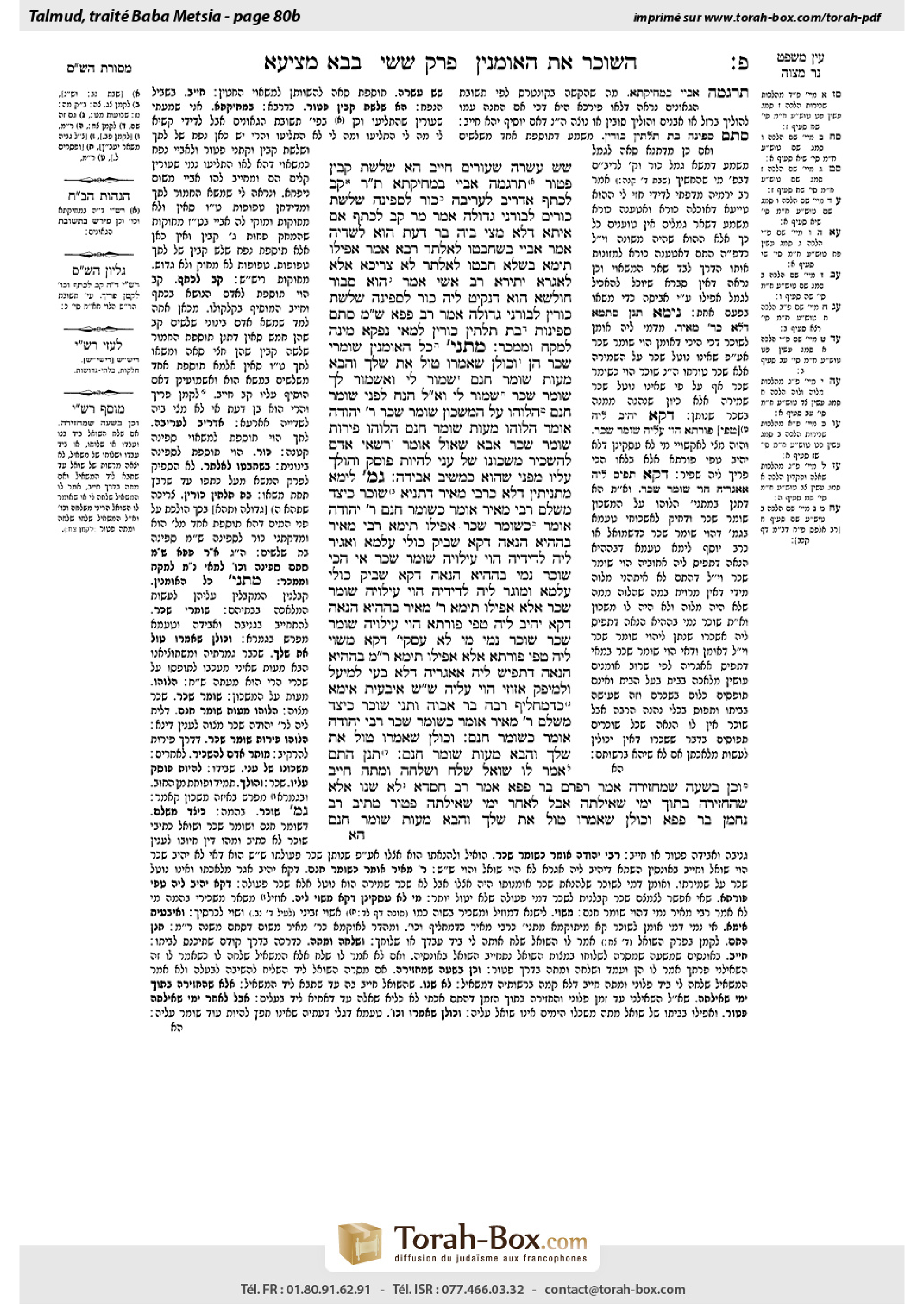
Bava Metzia 80b: Talmud study for Daf Yomi
Study the Talmud for Daf Yomi with scanned pages, Hebrew text, English translations from Sefaria and AI-generated French translations.
Passage selection and English or AI-generated French translation are available where the scan has annotations. Daf Study is independent of Torah-Box and Sefaria.
Browse Bava Metzia · בבא מציעא · All tractatesBava Metzia 80b text and translations
This page of Bava Metzia includes the Aramaic text, an English translation and an AI-generated French translation, alongside the scan above.
בבא מציעא פ׳ ב · Aramaic and Hebrew text
שֵׁשׁ עֶשְׂרֵה שְׂעוֹרִים – חַיָּיב. הָא שְׁלֹשֶׁת קַבִּין – פָּטוּר! תַּרְגְּמַהּ אַבָּיֵי: בִּמְחִיקָתָא.
תָּנוּ רַבָּנַן: קַב לְכַתָּף, אַדְרִיב לַעֲרֵיבָה. כּוֹר לִסְפִינָה, שְׁלֹשֶׁת כּוֹרִים לְבוּרְנִי גְּדוֹלָה.
אָמַר מָר: קַב לְכַתָּף. אִם אִיתָא דְּלָא מָצֵי בֵּיהּ בַּר דַּעַת הוּא, לִשְׁדְּיֵהּ! אָמַר אַבָּיֵי: בְּשֶׁחֲבָטוֹ לְאַלְתַּר. רָבָא אָמַר: אֲפִילּוּ תֵּימָא בְּשֶׁלֹּא חֲבָטוֹ לְאַלְתַּר, לָא צְרִיכָא אֶלָּא לְאַגְרָא יַתִּירָא. רַב אָשֵׁי אָמַר: הוּא סָבוּר חוּלְשָׁא הוּא דְּנָקֵיט לֵיהּ.
כּוֹר לִסְפִינָה, שְׁלֹשֶׁת כּוֹרִין לְבוּרְנִי גְּדוֹלָה. אָמַר רַב פָּפָּא: שְׁמַע מִינַּהּ סְתָם סְפִינוֹת בַּת תְּלָתִין כּוֹרִין. לְמַאי נָפְקָא מִינַּהּ? לְמִקָּח וּמִמְכָּר.
מַתְנִי׳ כׇּל הָאוּמָּנִין – שׁוֹמְרֵי שָׂכָר הֵן. וְכוּלָּן שֶׁאָמְרוּ: טוֹל אֶת שֶׁלְּךָ וְהָבֵא מָעוֹת – שׁוֹמֵר חִנָּם. שְׁמוֹר לִי וְאֶשְׁמוֹר לָךְ – שׁוֹמֵר שָׂכָר. שְׁמוֹר לִי, וְאָמַר לוֹ: הַנַּח לְפָנַי – שׁוֹמֵר חִנָּם.
הִלְוָהוּ עַל הַמַּשְׁכּוֹן – שׁוֹמֵר שָׂכָר. רַבִּי יְהוּדָה אוֹמֵר: הִלְוָהוּ מָעוֹת – שׁוֹמֵר חִנָּם, הִלְוָהוּ פֵּירוֹת – שׁוֹמֵר שָׂכָר. אַבָּא שָׁאוּל אוֹמֵר: רַשַּׁאי אָדָם לְהַשְׂכִּיר מַשְׁכּוֹנוֹ שֶׁל עָנִי לִהְיוֹת פּוֹסֵק וְהוֹלֵךְ עָלָיו, מִפְּנֵי שֶׁהוּא כְּמֵשִׁיב אֲבֵידָה.
גְּמָ׳ לֵימָא מַתְנִיתִין דְּלָא כְּרַבִּי מֵאִיר? דְּתַנְיָא: שׂוֹכֵר כֵּיצַד מְשַׁלֵּם? רַבִּי מֵאִיר אוֹמֵר: כְּשׁוֹמֵר חִנָּם. רַבִּי יְהוּדָה אוֹמֵר: כְּשׁוֹמֵר שָׂכָר.
אֲפִילּוּ תֵּימָא רַבִּי מֵאִיר, בְּהַהִיא הֲנָאָה דְּקָא שָׁבֵיק כּוּלֵּי עָלְמָא וְאָגַיר לֵיהּ לְדִידֵיהּ – הָוֵי עִילָּוֵיהּ שׁוֹמֵר שָׂכָר. אִי הָכִי, שׂוֹכֵר נָמֵי בְּהַהִיא הֲנָאָה דְּקָא שָׁבֵיק כּוּלֵּי עָלְמָא וּמוֹגַר לֵיהּ לְדִידֵיהּ – הָוֵי עִילָּוֵיהּ שׁוֹמֵר שָׂכָר.
אֶלָּא: אֲפִילּוּ תֵּימָא רַבִּי מֵאִיר, בְּהַהִיא הֲנָאָה דְּקָא יָהֵיב לֵיהּ טְפֵי פּוּרְתָּא – הָוֵי עִילָּוֵיהּ שׁוֹמֵר שָׂכָר.
שׂוֹכֵר נָמֵי! מִי לָא עָסְקִינַן דְּקָא מְשַׁוֵּי לֵיהּ טְפֵי פּוּרְתָּא. אֶלָּא אֲפִילּוּ תֵּימָא רַבִּי מֵאִיר, בְּהַהִיא הֲנָאָה דְּתָפֵישׂ לֵיהּ אַאַגְרֵיהּ, דְּלָא בָּעֵי לְמֵיעַל וּלְמִיפַּק אַזּוּזֵי – הָוֵי עֲלֵיהּ שׁוֹמֵר שָׂכָר.
אִיבָּעֵית אֵימָא, כִּדְמַחְלֵיף רַבָּה בַּר אֲבוּהּ וְתָנֵי: שׂוֹכֵר כֵּיצַד מְשַׁלֵּם? רַבִּי מֵאִיר אוֹמֵר: כְּשׁוֹמֵר שָׂכָר, רַבִּי יְהוּדָה אוֹמֵר: כְּשׁוֹמֵר חִנָּם.
וְכוּלָּן שֶׁאָמְרוּ: ״טוֹל אֶת שֶׁלְּךָ וְהָבֵא מָעוֹת״ – שׁוֹמֵר חִנָּם. תְּנַן הָתָם: אָמַר לוֹ שׁוֹאֵל ״שַׁלַּח״, וְשִׁלְּחָהּ וּמֵתָה – חַיָּיב, וְכֵן בְּשָׁעָה שֶׁמַּחְזִירָהּ.
אָמַר רַפְרָם בַּר פָּפָּא אָמַר רַב חִסְדָּא: לֹא שָׁנוּ אֶלָּא שֶׁהֶחְזִירָהּ בְּתוֹךְ יְמֵי שְׁאֵילָתָהּ. אֲבָל לְאַחַר יְמֵי שְׁאֵילָתָהּ – פָּטוּר. מֵתִיב רַב נַחְמָן בַּר פָּפָּא: וְכוּלָּן שֶׁאָמְרוּ ״טוֹל אֶת שֶׁלְּךָ וְהָבֵא מָעוֹת״ – שׁוֹמֵר חִנָּם.
Bava Metzia 80b · English translation
sixteen se’a of barley, he is liable. This indicates that if he added only three kav, i.e., half a se’a, he is exempt. Abaye interpreted the baraita as referring to smoothed-over barley, a precisely measured load, where the volume of the barley was not measured with heaped measuring utensils, but leveled flat. Consequently, it is roughly a se’a less than the usual amount.
§ The Sages taught: A kav is too large an addition for a porter, and therefore if the porter is injured by the additional weight, the owner must pay him. An adriv, half a kor, is too large an addition for a small boat [areiva]; a kor is too large an addition for a regular boat; three kor is too large an addition for a large ship [burnei].
The Master said: A kav is too large an addition for a porter. The Gemara asks: If it is so, that he cannot withstand this load, the porter is a sensible person; let him throw it off and avoid injury. Abaye said: This is referring to a case where the load knocked him down immediately, before he could remove it from his back. Rava said: Even if you say that it is referring to a case where it did not knock him down immediately the baraita is not difficult, as it is necessary only with regard to the extra pay that he can demand for this addition. Rav Ashi said: Even if the porter is a sensible man, perhaps he thought it was a momentary weakness that seized him and did not realize that the load itself was excessive.
§ The baraita teaches: A kor is too large an addition for a regular boat; three kor is too large an addition for a large ship. Rav Pappa said: Learn from here that unspecified boats can bear thirty kor, i.e., this is the volume of a ship’s cargo. The reason for this claim is that in all these cases the addition that causes damage is one-thirtieth of the normal load. The Gemara asks: What is the practical difference resulting from this observation? The Gemara answers: The difference is with regard to the halakhot of buying and selling, i.e., one who purchases a boat of unspecified dimensions should know that this is its expected capacity.
MISHNA: All artisans and laborers who take raw materials to their homes are considered paid bailees for those items until they return them to the owner. And with regard to all those who said to the owner: I finished the work, and therefore take what is yours, i.e., this item, and bring money in its stead, from that point on each of them is considered an unpaid bailee. If one person says to another: Safeguard my property for me and I will safeguard your property for you, each of them is a paid bailee, as each receives the services of the other as payment for his safeguarding. If one says: Safeguard for me, and the other says to him: Place it before me, the second individual is an unpaid bailee.
One who lent to another based on collateral is a paid bailee for the collateral. Rabbi Yehuda says: One who lent another money is an unpaid bailee for the collateral, whereas one who lent another produce is a paid bailee. Abba Shaul says: It is permitted for a person to rent out a poor person’s collateral that was given to him for a loan, so that by setting a rental price for it he will thereby progressively reduce the debt, i.e., the lender will subtract the rental money he receives from the amount owed by the borrower, because this is considered like returning a lost item. The borrower profits from this arrangement, whereas if the lender does not use the collateral in this manner it provides benefit to no one.
GEMARA: The Gemara suggests: Let us say that the mishna is not in accordance with the opinion of Rabbi Meir, as it is taught in a baraita: With regard to a renter, whose legal status is not stated explicitly in the Torah, how does he pay in the event that a rented article is lost or stolen? Rabbi Meir says: He pays like an unpaid bailee, i.e., only in cases where the loss of the item was due to his negligence. Rabbi Yehuda says: He pays like a paid bailee, i.e., even in cases where the loss of the item was not due to his negligence. Skilled laborers are similar to renters, as they take possession of the item to earn a profit from it, and the mishna teaches that skilled laborers are like paid bailees. Consequently, the ruling of the mishna is apparently not in accordance with the opinion of Rabbi Meir.
The Gemara rejects this claim. You may even say that the mishna is in accordance with the opinion of Rabbi Meir, and the reason skilled laborers are considered like paid bailees is that through that benefit that the worker receives from the fact that the owner of the item leaves aside everyone else and hires him, he becomes a paid bailee over the item. The Gemara challenges this reasoning: If so, with regard to a renter as well, it can be said that through that benefit he receives from the fact that the owner leaves aside everyone else and rents to him, he should become a paid bailee over the item.
Rather, in light of this refutation the Gemara suggests a different reason that you may even say that the mishna is in accordance with the opinion of Rabbi Meir: Through that benefit that the skilled laborer receives from the fact that the owner gives him a little more money, he becomes a paid bailee. Since it is impossible to calculate the precise sum to which a skilled laborer is entitled, it is assumed that he is slightly overpaid.
The Gemara asks: With regard to a renter as well, are we not dealing even with a case where the owner gives him a little more value for his money, and yet Rabbi Meir claims that he is considered like an unpaid bailee? Rather, you may even say that the mishna is in accordance with the opinion of Rabbi Meir for a different reason: Through that benefit that the skilled laborer receives from the fact that he holds onto the item so that he is not required to go in and go out for his money, he becomes a paid bailee over the item.
If you wish, say instead that the mishna can be explained in accordance with the opinion of Rabbi Meir without these explanations, as Rabba bar Avuh reversed the opinions and teaches that the baraita says: With regard to a renter, how does he pay? Rabbi Meir says: Like a paid bailee; Rabbi Yehuda says: Like an unpaid bailee.
§ The mishna teaches: And in the case of all those who said to the owner: Take what is yours, i.e., this item, and bring money in its stead, each of them is considered an unpaid bailee. We learned in a mishna there (98b): If the borrower said to the lender: Send the animal that you agreed to lend me with the person whom you said would deliver it, and he sent it to him and it died on the way, the borrower is liable, and similarly when he returns it. The borrower is responsible for the animal as long as it has not actually been returned to the owner.
Rafram bar Pappa said that Rav Ḥisda said: They taught this halakha only when the borrower returned it during the period of its loan, as he accepted responsibility for the animal for the stipulated duration of the loan. But if he returned it after the period of its loan, he is exempt, as once the duration of the loan is complete he no longer has the status of a borrower. Rav Naḥman bar Pappa raises an objection from the mishna: And all those who said: Take what is yours and bring money, each of them is considered an unpaid bailee.
Bava Metzia 80b · Traduction française (IA)
seize-sea de blé, il est responsable. Cela indique que s'il a ajouté seulement trois kav, c'est-à-dire la moitié d'un sea, il est exempt. Abaye a interprété la baraïta comme se référant à du blé nivelé, une charge mesurée précisément, où le volume du blé n'était pas mesuré avec des ustensiles de mesure remplis, mais nivelé à la surface. Par conséquent, cela représente approximativement un sea de moins que la quantité habituelle.
§ Les Sages ont enseigné : Un kav est trop lourd pour un porteur, et donc si le porteur est blessé par le poids supplémentaire, l'owner doit le réparer. Un adriv, c'est-à-dire la moitié d'un kor, est trop lourd pour un petit bateau [areiva] ; un kor est trop lourd pour un bateau normal ; trois kor est trop lourd pour un grand navire [burnei].
Le Maître a dit : Un kav est trop lourd pour un porteur. La Guemara demande : Si c’est ainsi, qu’il ne peut pas supporter ce fardeau, le porteur est un homme sensé ; qu’il jette le fardeau et évite ainsi la blessure. Abaye a dit : Cela se réfère à un cas où le fardeau l’a fait tomber immédiatement, avant qu’il ne puisse le retirer de son dos. Rava a dit : Même si vous dites que cela se réfère à un cas où il ne l’a pas fait tomber immédiatement, la baraïta n’est pas difficile, car il s’agit uniquement de l’augmentation de salaire qu’il peut exiger pour cette addition. Rav Ashi a dit : Même si le porteur est un homme sensé, peut-être qu’il a cru qu’il s’agissait d’une faiblesse momentanée qui l’a saisi et n’a pas réalisé que le fardeau lui-même était excessif.
§ La baraïta enseigne : Un kor est trop lourd pour un bateau ordinaire ; trois kor est trop lourd pour un grand navire. Rav Pappa a dit : Apprenez-en ici que les bateaux non spécifiés peuvent supporter trente kor, c’est-à-dire que c’est la capacité de cargaison d’un navire. La raison de cette affirmation est que dans tous ces cas, l’ajout qui cause un préjudice est un trentième du fardeau normal. La Guemara demande : Quelle est la différence pratique résultant de cette observation ? La Guemara répond : La différence est concernant les halakhot d’achat et de vente, c’est-à-dire que celui qui achète un bateau de dimensions non spécifiées doit savoir que c’est sa capacité attendue.
MICHNA : Tous les artisans et ouvriers qui apportent des matériaux bruts chez eux sont considérés comme des dépositaires rémunérés pour ces objets jusqu’à ce qu’ils les remettent à l’propriétaire. Et concernant tous ceux qui ont dit à l’propriétaire : J’ai terminé le travail, et donc je prends ce qui est à toi, c’est-à-dire cet objet, et je t’apporte de l’argent à la place, à partir de ce moment, chacun d’eux est considéré comme un dépositaire non rémunéré. Si une personne dit à une autre : Garde mes biens pour moi et je garde tes biens pour toi, chacun d’eux est un dépositaire rémunéré, car chacun reçoit les services de l’autre comme paiement pour sa garde. Si l’un dit : Garde pour moi, et l’autre dit à lui : Place-le devant moi, la deuxième personne est un dépositaire non rémunéré.
Celui qui a prêté de l'argent à un autre en garantie est un dépositaire rémunéré pour la garantie. Rabbi Yéhuda dit : Celui qui prête de l'argent à un autre est un dépositaire non rémunéré pour la garantie, tandis que celui qui prête des produits est un dépositaire rémunéré. Abba Shaul dit : Il est permis à une personne de louer la garantie d'un pauvre qui lui a été donnée en prêt, afin que, en fixant un prix de location, il réduise progressivement la dette, c'est-à-dire que le prêteur retranche de l'argent de location qu'il reçoit du montant dû au prêteur, car cela est considéré comme rendre un objet perdu. Le prêteur en bénéficie de cette disposition, tandis que si le prêteur ne utilise pas la garantie ainsi, cela ne profite à personne.
GUEMARA : La Guemara suggère : Disons que la Michna n'est pas en conformité avec l'opinion de Rabbi Méir, car il est enseigné dans une baraïta : En ce qui concerne un locataire, dont le statut juridique n'est pas explicitement mentionné dans la Torah, comment paie-t-il en cas de perte ou de vol de l'objet loué ? Rabbi Méir dit : Il paie comme un dépositaire non rémunéré, c'est-à-dire uniquement dans les cas où la perte de l'objet est due à son négligence. Rabbi Yéhuda dit : Il paie comme un dépositaire rémunéré, c'est-à-dire même dans les cas où la perte de l'objet n'est pas due à sa négligence. Les ouvriers qualifiés sont semblables aux locataires, car ils prennent possession de l'objet pour en tirer un profit, et la Michna enseigne que les ouvriers qualifiés sont comme des dépositaires rémunérés. Ainsi, la décision de la Michna semble être clairement en désaccord avec l'opinion de Rabbi Méir.
La Guemara rejette cette affirmation. On peut même dire que la Michna est en conformité avec l'opinion de Rabbi Méir, et la raison pour laquelle les ouvriers qualifiés sont considérés comme des dépositaires rémunérés est que grâce au bénéfice que l'ouvrier reçoit du fait que l'owner met de côté tout le monde d'autre et l'engage, il devient un dépositaire rémunéré sur l'objet. La Guemara remet en question cette raison : Si c'est ainsi, en ce qui concerne un locataire également, on pourrait dire que grâce au bénéfice qu'il reçoit du fait que l'owner met de côté tout le monde d'autre et le loue, il devrait devenir un dépositaire rémunéré sur l'objet.
Plutôt, en lumière de cette réfutation, la Guemara suggère une autre raison : on peut même dire que la Michna est en conformité avec l'opinion de Rabbi Méir : grâce au bénéfice que l'ouvrier qualifié reçoit du fait que l'owner lui donne un peu plus d'argent, il devient un dépositaire rémunéré. Puisque il est impossible de calculer la somme exacte à laquelle l'ouvrier qualifié est dû, on suppose qu'il est légèrement surestimé.
La Guemara pose la question : En ce qui concerne un locataire également, ne sommes-nous pas en présence d'un cas où l'owner lui donne un peu plus de valeur pour son argent, et pourtant Rabbi Méir affirme qu'il est considéré comme un dépositaire non rémunéré ? Plutôt, on peut même dire que la Michna est en conformité avec l'opinion de Rabbi Méir pour une autre raison : grâce au bénéfice que l'ouvrier qualifié reçoit du fait qu'il garde l'objet afin de ne pas avoir à entrer et sortir pour récupérer son argent, il devient un dépositaire rémunéré sur l'objet.
Si tu le souhaites, dis plutôt que la mitsna peut être expliquée conformément à l'opinion du Rabbi Meir sans ces explications, car Rabba bar Avuh a inversé les opinions et enseigne que la baraïta dit : En ce qui concerne un locataire, comment paie-t-il ? Le Rabbi Meir dit : Comme un baal késoubon payé ; le Rabbi Yéhuda dit : Comme un baal késoubon non payé.
§ La mitsna enseigne : Et dans le cas de tous ceux qui dirent à l'propriétaire : Prends ce qui t'appartient, c'est-à-dire cet objet, et apporte de l'argent à la place, chacun d'entre eux est considéré comme un baal késoubon non payé. Nous avons appris dans une mitsna là (98b) : Si le prêteur dit au prêteur : Envoie l'animal que tu as convenu de me prêter avec la personne que tu as dit qu'elle le livrerait, et il l'a envoyé à lui et l'animal est mort en chemin, le prêteur est responsable, et de même lorsqu'il le rend. Le prêteur est responsable de l'animal tant qu'il n'a pas été réellement rendu à l'propriétaire.
Rafram bar Pappa dit que Rav Ḥisda dit : Ils ont enseigné cette halakha seulement lorsque le prêteur le rendait durant la période de prêt, car il avait accepté la responsabilité pour l'animal pendant la durée stipulée du prêt. Mais s'il le rendait après la période de prêt, il est exempt, car une fois que la durée du prêt est achevée, il ne possède plus le statut de prêteur. Rav Naḥman bar Pappa émet une objection à partir de la mitsna : Et tous ceux qui dirent : Prends ce qui t'appartient et apporte de l'argent, chacun d'entre eux est considéré comme un baal késoubon non payé.
Traduction française générée par IA à partir de l’édition anglaise de Sefaria. Vérifie toujours un passage avec le texte source.
Text from Sefaria: William Davidson Edition - Vocalized Aramaic (CC BY NC); William Davidson Edition - English (CC BY NC).