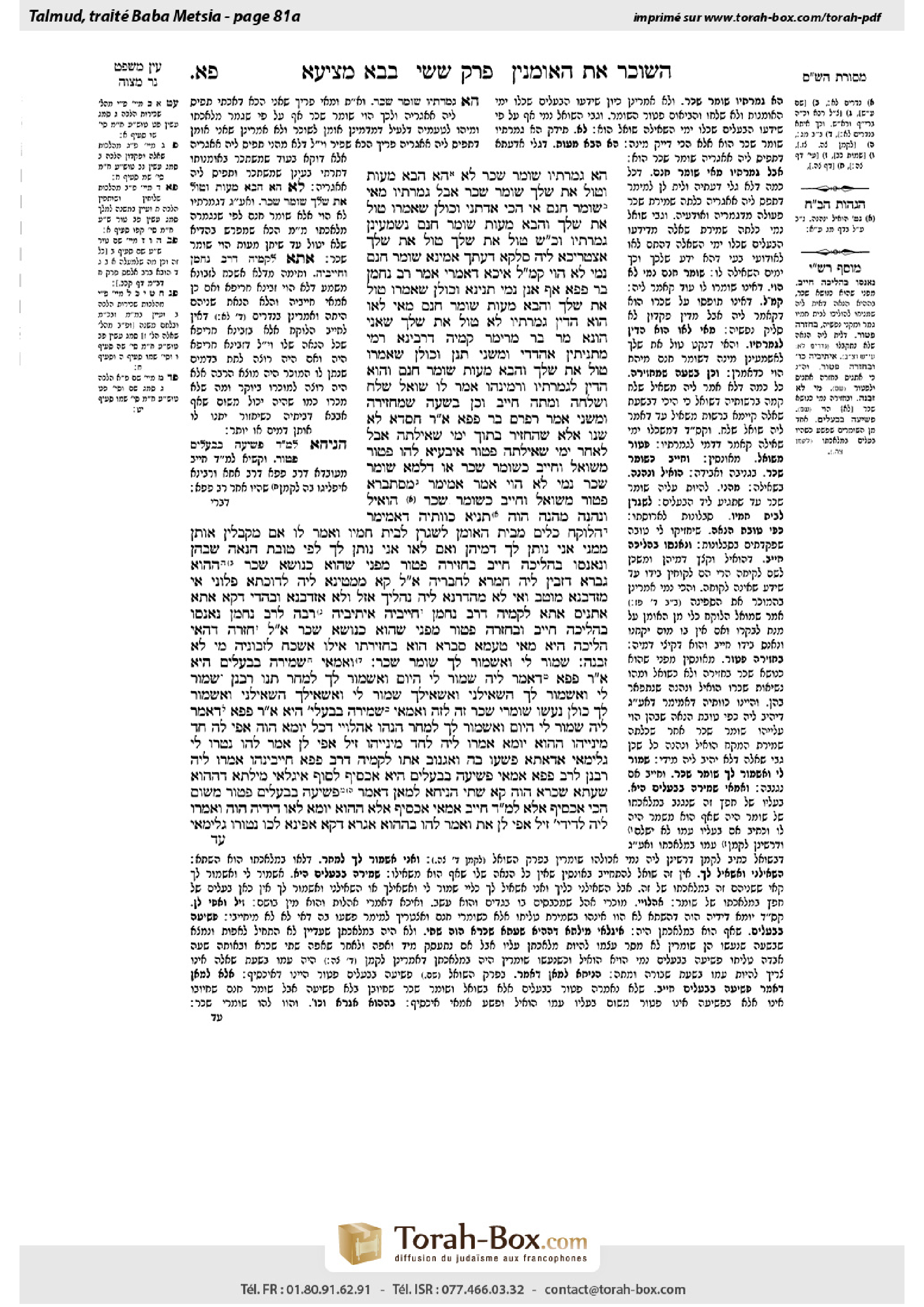
Bava Metzia 81a: Talmud study for Daf Yomi
Study the Talmud for Daf Yomi with scanned pages, Hebrew text, English translations from Sefaria and AI-generated French translations.
Passage selection and English or AI-generated French translation are available where the scan has annotations. Daf Study is independent of Torah-Box and Sefaria.
Browse Bava Metzia · בבא מציעא · All tractatesBava Metzia 81a text and translations
This page of Bava Metzia includes the Aramaic text, an English translation and an AI-generated French translation, alongside the scan above.
בבא מציעא פ״א א · Aramaic and Hebrew text
הָא ״גְּמַרְתִּיו״ – שׁוֹמֵר שָׂכָר. לָא, הָא ״הָבֵא מָעוֹת וְטוֹל אֶת שֶׁלְּךָ״ – שׁוֹמֵר שָׂכָר.
אֲבָל ״גְּמַרְתִּיו״ מַאי שׁוֹמֵר חִנָּם? אִי הָכִי, אַדְּתָנֵי ״וְכוּלָּן שֶׁאָמְרוּ טוֹל אֶת שֶׁלְּךָ וְהָבֵא מָעוֹת – שׁוֹמֵר חִנָּם״, נַשְׁמְעִינַן ״גְּמַרְתִּיו״, וְכׇל שֶׁכֵּן ״טוֹל אֶת שֶׁלְּךָ״!
״טוֹל אֶת שֶׁלְּךָ״ אִצְטְרִיכָא לֵיהּ. סָלְקָא דַּעְתָּךְ אָמֵינָא: שׁוֹמֵר חִנָּם נָמֵי לָא הָוֵי, קָא מַשְׁמַע לַן.
אִיכָּא דְּאָמְרִי, אָמַר רַב נַחְמָן בַּר פָּפָּא: אַף אֲנַן נָמֵי תְּנֵינָא, וְכוּלָּן שֶׁאָמְרוּ ״טוֹל אֶת שֶׁלְּךָ וְהָבֵא מָעוֹת״ – שׁוֹמֵר חִנָּם, מַאי לָאו הוּא הַדִּין ״גְּמַרְתִּיו״. לֹא, ״טוֹל אֶת שֶׁלְּךָ״ שָׁאנֵי.
הוּנָא מָר בַּר מָרִימָר קַמֵּיהּ דְּרָבִינָא רָמֵי מַתְנִיתִין אַהֲדָדֵי וּמְשַׁנֵּי. תְּנַן: וְכוּלָּן שֶׁאָמְרוּ ״טוֹל אֶת שֶׁלְּךָ וְהָבֵא מָעוֹת״ – שׁוֹמֵר חִנָּם. וְהוּא הַדִּין לִ״גְמַרְתִּיו״. וּרְמִינְהוּ: אָמַר לוֹ שׁוֹאֵל ״שַׁלַּח״, וְשִׁלְּחָהּ וּמֵתָה – חַיָּיב. וְכֵן בְּשָׁעָה שֶׁמַּחְזִירָהּ. וּמְשַׁנֵּי, אָמַר רַפְרָם בַּר פָּפָּא אָמַר רַב חִסְדָּא: לֹא שָׁנוּ אֶלָּא שֶׁהֶחְזִיר בְּתוֹךְ יְמֵי שְׁאֵילָתָהּ, אֲבָל לְאַחַר יְמֵי שְׁאֵילָתָהּ, פָּטוּר.
אִיבַּעְיָא לְהוּ: פָּטוּר מִשּׁוֹאֵל וְחַיָּיב כְּשׁוֹמֵר שָׂכָר, אוֹ דִּלְמָא שׁוֹמֵר שָׂכָר נָמֵי לָא הָוֵי? אָמַר אַמֵּימָר: מִסְתַּבְּרָא פָּטוּר מִשּׁוֹאֵל וְחַיָּיב כְּשׁוֹמֵר שָׂכָר, הוֹאִיל וְנֶהֱנֶה מְהַנֶּה הָוֵה.
תַּנְיָא כְּווֹתֵיהּ דְּאַמֵּימָר: הַלּוֹקֵחַ כֵּלִים מִבֵּית הָאוּמָּן לְשַׁגְּרָן לְבֵית חָמִיו, וְאָמַר לוֹ: אִם מְקַבְּלִין אוֹתָן מִמֶּנִּי – אֲנִי נוֹתֵן לְךָ דְּמֵיהֶן, וְאִם לָאו – אֲנִי נוֹתֵן לְךָ לְפִי טוֹבַת הֲנָאָה שֶׁבָּהֶן, וְנֶאֶנְסוּ בַּהֲלִיכָה – חַיָּיב,
בַּחֲזִירָה – פָּטוּר, מִפְּנֵי שֶׁהוּא כְּנוֹשֵׂא שָׂכָר.
הָהוּא גַּבְרָא דְּזַבֵּין לֵיהּ חֲמָרָא לְחַבְרֵיהּ, אֲמַר לֵיהּ: קָא מַמְטֵינָא לַיהּ לְדוּכְתָּא פְּלוֹנִי, אִי מִזְדַּבְּנָא – מוּטָב, וְאִי לָא – מַהְדַּרְנָא לַיהּ נִהֲלָיךְ. אֲזַל וְלָא אִזְדַּבְּנָא, וּבַהֲדֵי דְּקָא אָתֵא אִתְּנִיס. אֲתָא לְקַמֵּיהּ דְּרַב נַחְמָן, חַיְּיבֵיהּ.
אֵיתִיבֵיהּ רַבָּה לְרַב נַחְמָן: נֶאֶנְסוּ, בַּהֲלִיכָה – חַיָּיב, וּבַחֲזָרָה – פָּטוּר, מִפְּנֵי שֶׁהוּא כְּנוֹשֵׂא שָׂכָר!
אֲמַר לֵיהּ: חֲזָרָה דְּהַאי – הֲלִיכָה הִיא. מַאי טַעְמָא? סְבָרָה הוּא: בַּחֲזִירָתוֹ, אִילּוּ אַשְׁכַּח לְזַבּוֹנֵיהּ מִי לָא זַבְּנֵהּ?
״שְׁמוֹר לִי וְאֶשְׁמוֹר לָךְ״ – שׁוֹמֵר שָׂכָר. וְאַמַּאי? שְׁמִירָה בִּבְעָלִים הִיא! אָמַר רַב פָּפָּא: דַּאֲמַר לֵיהּ ״שְׁמוֹר לִי הַיּוֹם וְאֶשְׁמוֹר לְךָ לְמָחָר״.
תָּנוּ רַבָּנַן: ״שְׁמוֹר לִי וְאֶשְׁמוֹר לָךְ״, ״הַשְׁאִילֵנִי וְאַשְׁאִילֶךָ״, ״שְׁמוֹר לִי וְאַשְׁאִילֶךָ״, ״הַשְׁאִילֵנִי וְאֶשְׁמוֹר לָךְ״ – כּוּלָּן נַעֲשׂוּ שׁוֹמְרֵי שָׂכָר זֶה לָזֶה. וְאַמַּאי, שְׁמִירָה בִּבְעָלִים הִיא! אָמַר רַב פָּפָּא: דַּאֲמַר לֵיהּ, ״שְׁמוֹר לִי הַיּוֹם וְאֶשְׁמוֹר לְךָ לְמָחָר״.
הָנְהוּ אַהֲלוֹיֵי דְּכֹל יוֹמָא הֲוָה אָפֵי לְה[וּ] חַד מִינַּיְיהוּ. הָהוּא יוֹמָא אֲמַרוּ לֵיהּ לְחַד מִינַּיְיהוּ: זִיל אֲפִי לַן. אֲמַר לְהוּ: נְטַרוּ לִי גְּלִימַאי. אַדַּאֲתָא פְּשַׁעוּ בֵּהּ (וְאִגְּנוּב) [וְאִגְּנִיב] אֲתוֹ. לְקַמֵּיהּ דְּרַב פָּפָּא, חַיְּיבִינְהוּ.
אֲמַרוּ לֵיהּ רַבָּנַן לְרַב פָּפָּא: אַמַּאי? פְּשִׁיעָה בִּבְעָלִים הִיא! אִכְּסִיף. לְסוֹף אִיגַּלַּאי מִילְּתָא דְּהָהוּא שַׁעְתָּא שִׁכְרָא הֲוָה קָא שָׁתֵי.
הָנִיחָא לְמַאן דְּאָמַר פְּשִׁיעָה בִּבְעָלִים פָּטוּר – מִשּׁוּם הָכִי אִכְּסִיף, אֶלָּא לְמַאן דְּאָמַר חַיָּיב – אַמַּאי אִכְּסִיף? אֶלָּא הָהוּא יוֹמָא לָאו דִּידֵיהּ הֲוָה, וַאֲמַרוּ לֵיהּ לְדִידֵיהּ: זִיל אֲפִי לַן אַתְּ, וַאֲמַר לְהוּ: בְּהָהוּא אַגְרָא דְּקָא אָפֵינָא לְכוּ נְטוּרוּ גְּלִימַאי.
Bava Metzia 81a · English translation
This indicates that if the skilled laborer said only: I completed the work with it, he is considered a paid bailee, i.e., even after he completes the work the item remains within his responsibility. The Gemara rejects this line of reasoning: No, this is not what should be deduced from the mishna. Rather, the correct deduction is that one who says: Give money first and then take what is yours, is a paid bailee.
The Gemara asks: But if that is the case, when one says only: I completed the work with it, what is the halakha? Is he considered an unpaid bailee? If so, rather than teaching a new halakha in the mishna: And all those who say: Take what is yours and bring money, each of them is considered an unpaid bailee, let it teach us instead the halakha of one who says: I completed the work with it, and it can be deduced that all the more so is this the halakha if he says to him: Take what is yours.
The Gemara rejects this line of reasoning: The case of take what is yours must be taught explicitly. Otherwise, it might enter your mind to say that once he issues this statement, he is not considered even an unpaid bailee and retains no responsibility whatsoever for the item. Therefore, the mishna teaches us that even in this case he is still considered an unpaid bailee and continues to bear certain responsibilities.
There are those who say that there is a different version of this discussion. Rather than challenging that Rav Ḥisda’s opinion is opposed by the ruling of the mishna, Rav Naḥman bar Pappa said: We, too, learn a proof for Rav Ḥisda’s statement from the mishna: And all those who say: Take what is yours and bring money, each of them is considered an unpaid bailee. What, is it not correct to say that the same is true when he says: I have completed the work with it? The Gemara rejects this claim. No, the case of one who says take what is yours is different, as stated above, as one might think that this statement frees the laborer of all responsibility.
The Gemara cites a third version of this discussion. Huna Mar bar Mareimar raised a contradiction between the mishnayot before Ravina and resolved it himself. We learned in the mishna: And all those who say: Take what is yours and bring money, each of them is considered an unpaid bailee. And apparently the same is true for one who said: I completed the work with it. And Huna Mar bar Mareimar raises a contradiction from the aforementioned mishna: If the borrower said to the lender: Send the animal to me, and he sent it to him and it died on the way, the borrower is liable, and similarly when he returns it. And he resolves this contradiction in accordance with that which Rafram bar Pappa said that Rav Ḥisda said: They taught this halakha only when he returned it during the period of its loan. But if he returned it after the period of its loan, he is exempt.
§ A dilemma was raised before the Sages: When Rav Ḥisda said that a borrower who returned the item after the period of the loan is exempt, is he exempt only from the strict obligations of a borrower, but he remains liable as a paid bailee, or perhaps he is also not liable as a paid bailee? Ameimar said: It stands to reason that he is exempt as a borrower but is still liable as a paid bailee. Ameimar’s reasoning is that since he previously had benefit, he must provide benefit in return, by safeguarding the item as a paid bailee until the item reaches the owner’s possession.
It is taught in a baraita (Tosefta, Bava Batra 6:5) in accordance with the opinion of Ameimar: With regard to one who takes vessels from an artisan’s house to send them as a gift to his father-in-law’s house, and he said to the artisan: If they accept them from me as a gift I will give you the money for them, and if not, i.e., if they return the gift, I will give you money in accordance with the financial advantage I received from them, i.e., I will pay you the benefit that I accrued through their knowledge that I tried to send them a gift; and an accident happened to the vessels and they were broken, if this incident occurred on their way to the recipient the customer is liable.
If they broke on the way back he is exempt, because he is like a paid bailee, who is not liable for accidents. If this individual, who pays for the financial advantage he received, is considered a paid bailee, all the more so should this apply to a borrower who returned the item after the period of the loan, in accordance with the opinion of Ameimar, as he did not offer to pay anything.
The Gemara relates: There was a certain man who sold a donkey to another. The buyer said to him: I will bring it to such and such a place; if it is sold, well and good; and if not, I will return it to you. He went and it was not sold, and on his way back the donkey was injured in an accident. The case came before Rav Naḥman, who deemed the buyer liable to pay.
Rabba raised an objection to Rav Naḥman from the baraita: If an accident happened to the vessels on their way to the recipient, the customer is liable; if they broke on the way back he is exempt, because he is like a paid bailee. If so, why did you deem this buyer liable, when the accident occurred on his return?
Rav Naḥman said to Rabba that there is a difference between the cases, as the way back of this one is considered like the way to the recipient. What is the reason for this? It is based on logical reasoning: Even on his way back, if he found an opportunity to sell the donkey, wouldn’t he have sold it? Therefore, as he was in possession of the animal the entire time, the halakha treats his going and returning equally, and he retains the responsibility of a borrower until he actually returns the animal to its owner.
§ The mishna teaches: With regard to one who says to another: Safeguard my property for me and I will safeguard your property for you, each of them is a paid bailee. The Gemara asks: But why is this the halakha? It is a case of safeguarding with the owners. There is a principle that a bailee is exempt from paying for the damage if the owner of the item is present with the bailee or in his employ when he is safeguarding the item. Rav Pappa said: The mishna means that he said to him: Safeguard my property for me today and I will safeguard your property for you tomorrow. At the time of his safeguarding, the owner was not in the bailee’s employ.
The Sages taught in a baraita (Tosefta 7:10): If one said: Safeguard my property for me and I will safeguard your property for you, or: Lend money to me and I will lend money to you, or: Safeguard my property for me and I will lend money to you, or: Lend money to me and I will safeguard your property for you, they all become paid bailees for each other. The Gemara asks: Why are they liable as paid bailees? Is this not a situation of safeguarding with the owners? Rav Pappa again said: This is referring to a case where he said to him: Safeguard my property for me today and I will safeguard your property for you tomorrow.
The Gemara relates: There were certain ice plant dealers [ahaluyei], and every day one of them would have a turn to bake for the group. One day the others said to one of them: Go and bake for us. He said to them: Safeguard my cloak for me. Before he came back they were negligent with it and it was stolen. They came for judgment before Rav Pappa, and he deemed them liable to pay for the cloak.
The Rabbis said to Rav Pappa: Why did you deem them liable to pay? This is akin to a case of negligence by a bailee while he is with the owners, as the owner of the cloak was baking for them at the time the cloak was stolen due to their negligence. Rav Pappa was embarrassed over his apparent mistake. Ultimately, it was discovered that at that time, when the cloak was stolen, the cloak owner was drinking beer and not baking. Since he was not doing work for them, this was not a case of safeguarding with the owner, and therefore Rav Pappa’s ruling was vindicated.
The Gemara comments: This works out well according to the one who says that in a case of negligence by a bailee while he is with the owners he is exempt; due to that reason Rav Pappa was embarrassed. But according to the one who says that in a case of negligence he is liable even while he is with the owners, why was Rav Pappa embarrassed? Rather, this is what actually happened: That day was not his turn to bake, and they said to him: You go and bake for us, and he said to them: As payment for baking for you when it is not my turn, safeguard my cloak. In other words, they were paid bailees.
Bava Metzia 81a · Traduction française (IA)
Cela indique que si le travailleur qualifié a dit seulement : J'ai achevé le travail avec cela, il est considéré comme un dépositaire payé, c'est-à-dire, même après avoir achevé le travail, l'objet reste sous sa responsabilité. La Guemara rejette cette ligne de raisonnement : Non, cela ne doit pas être déduit de la mitsna. Plutôt, la déduction correcte est que celui qui dit : Donnez-moi de l'argent d'abord et ensuite prenez ce qui est à vous, est un dépositaire payé.
La Guemara pose la question : Mais si c'est le cas, lorsque l'on dit seulement : J'ai achevé le travail avec cela, quelle est la halakha ? Est-il considéré comme un dépositaire non payé ? Si oui, plutôt que de faire apprendre une nouvelle halakha dans la mitsna : Et tous ceux qui disent : Prenez ce qui est à vous et apportez de l'argent, chacun d'eux est considéré comme un dépositaire non payé, il aurait pu nous apprendre plutôt la halakha de celui qui dit : J'ai achevé le travail avec cela, et on pourrait déduire que cela est encore plus vrai si l'on dit à lui : Prenez ce qui est à vous.
La Guemara rejette cette ligne de raisonnement : Le cas de « prenez ce qui est à vous » doit être enseigné explicitement. Sinon, on pourrait penser que dès qu'il émet cette déclaration, il n'est plus considéré comme un dépositaire non payé et ne retient plus aucune responsabilité. Par conséquent, la mitsna nous apprend que même dans ce cas, il est encore considéré comme un dépositaire non payé et continue de porter certaines responsabilités.
Certains disent qu'il existe une autre version de cette discussion. Plutôt que de contester que l'opinion de Rav Ḥisda est opposée à la décision de la mitsna, Rav Naḥman bar Pappa a dit : Nous aussi, nous tirons une preuve pour l'opinion de Rav Ḥisda à partir de la mitsna : Et tous ceux qui disent : Prenez ce qui est à vous et apportez de l'argent, chacun d'eux est considéré comme un dépositaire non payé. Qu'est-ce que cela signifie ? N'est-ce pas correct de dire que c'est aussi vrai lorsqu'il dit : J'ai achevé le travail avec cela ? La Guemara rejette cette affirmation. Non, le cas de celui qui dit « prenez ce qui est à vous » est différent, comme mentionné ci-dessus, car on pourrait penser que cette déclaration libère le travailleur de toute responsabilité.
La Guemara cite une troisième version de cette discussion. Huna Mar bar Mareimar a soulevé une contradiction entre les mitsnayot avant Ravina et l'a résolue lui-même. Nous avons appris dans la mitsna : Et tous ceux qui disent : Prenez ce qui est à vous et apportez de l'argent, chacun d'eux est considéré comme un dépositaire non payé. Et apparemment, c'est aussi vrai pour celui qui a dit : J'ai achevé le travail avec cela. Et Huna Mar bar Mareimar soulève une contradiction à partir de la mitsna mentionnée ci-dessus : Si le prêteur a dit au prêteur : Envoie-moi l'animal, et il l'a envoyé et il est mort en chemin, le prêteur est responsable, et de même lorsqu'il le rend. Et il résout cette contradiction conformément à ce que Rafram bar Pappa a dit que Rav Ḥisda a dit : Ils ont enseigné cette halakha seulement lorsqu'il l'a rendu pendant la période de prêt. Mais s'il l'a rendu après la période de prêt, il est exempt.
§ Un dilemme a été soulevé devant les Sages : Lorsque Rav Ḥisda a dit qu'un prêteur qui rend l'objet après la période de prêt est exempt, est-il exempt seulement des obligations strictes du prêteur, mais il reste responsable comme un dépositaire payé, ou peut-être est-il également exempt comme un dépositaire payé ? Ameimar a dit : Il est logique qu'il soit exempt comme prêteur mais reste responsable comme un dépositaire payé. La raison d'Ameimar est que puisqu'il avait précédemment un bénéfice, il doit fournir un bénéfice en retour, en préservant l'objet comme un dépositaire payé jusqu'à ce que l'objet arrive en possession du propriétaire.
Il est enseigné dans une baraïta (Tosefta, Bava Batra 6:5) conformément à l'opinion d'Ameimar : Concernant celui qui prend des objets d'une maison d'artisan pour les envoyer en cadeau à la maison de son beau-père, et il a dit à l'artisan : Si ils les acceptent de moi comme un cadeau, je vous donnerai l'argent pour eux, et si non, c'est-à-dire s'ils renvoient le cadeau, je vous donnerai de l'argent selon le bénéfice que j'ai reçu de leur connaissance que j'ai essayé d'envoyer un cadeau ; et un accident est arrivé aux objets et ils sont cassés, si cet incident s'est produit sur le chemin vers le destinataire, le client est responsable.
Si ils se sont cassés sur le chemin du retour, il est exempt, car il est comme un dépositaire payé, qui n'est pas responsable des accidents. Si cette personne, qui paie pour le bénéfice qu'elle a reçu, est considérée comme un dépositaire payé, encore plus cela s'applique à un prêteur qui a rendu l'objet après la période de prêt, conformément à l'opinion d'Ameimar, car il n'a pas offert de payer quoi que ce soit.
La Guemara rapporte : Il y avait un certain homme qui a vendu un âne à un autre. L'acheteur lui a dit : Je vais l'apporter à telle et telle place ; si on le vend, c'est bien ; et si non, je le rapporterai à vous. Il est parti et il n'a pas été vendu, et sur le chemin du retour l'âne a été blessé dans un accident. Le cas est venu devant Rav Naḥman, qui a considéré l'acheteur comme responsable de payer.
Rabba a soulevé un objet contre Rav Naḥman à partir de la baraïta : Si un accident est arrivé aux objets sur le chemin vers le destinataire, le client est responsable ; si ils se sont cassés sur le chemin du retour, il est exempt, car il est comme un dépositaire payé. Si c'est ainsi, pourquoi avez-vous considéré cet acheteur comme responsable, lorsque l'accident s'est produit sur son retour ?
Rav Naḥman a dit à Rabba qu'il y a une différence entre les cas, car le chemin du retour de celui-ci est considéré comme le chemin vers le destinataire. Quelle est la raison de cela ? C'est basé sur un raisonnement logique : Même sur son chemin du retour, s'il avait trouvé une opportunité de vendre l'âne, n'aurait-il pas vendu ? Par conséquent, comme il était en possession de l'animal tout le temps, la halakha traite son aller et retour de manière égale, et il conserve la responsabilité du prêteur jusqu'à ce qu'il rende réellement l'animal à son propriétaire.
§ La Michna enseigne : Concernant celui qui dit à un autre : Garde mon bien pour moi et je garde ton bien pour toi, chacun d’eux est un dépositaire rémunéré. La Guemara demande : Mais pourquoi cette halakha ? C’est un cas de garde avec les propriétaires. Il y a un principe selon lequel le dépositaire est exempt de payer pour le dommage si le propriétaire de l’objet est présent avec le dépositaire ou en son service lorsqu’il garde l’objet. Rav Pappa a dit : La Michna signifie qu’il a dit à lui : Garde mon bien pour moi aujourd’hui et je garde ton bien pour toi demain. À l’époque de sa garde, le propriétaire n’était pas en service du dépositaire.
Les Sages ont enseigné dans une baraïta (Tosefta 7:10) : Si l’un dit à l’autre : Garde mon bien pour moi et je garde ton bien pour toi, ou : Prête-moi de l’argent et je prête de l’argent à toi, ou : Garde mon bien pour moi et je prête de l’argent à toi, ou : Prête-moi de l’argent et je garde ton bien pour toi, ils deviennent tous des dépositaires rémunérés les uns envers les autres. La Guemara demande : Pourquoi sont-ils responsables comme des dépositaires rémunérés ? N’est-ce pas un cas de garde avec les propriétaires ? Rav Pappa a de nouveau dit : Cela fait référence à un cas où il a dit à lui : Garde mon bien pour moi aujourd’hui et je garde ton bien pour toi demain.
La Guemara rapporte : Il y avait certains détaillants de glace [ahaluyei], et chaque jour l’un d’eux avait son tour de cuire pour le groupe. Un jour, les autres dirent à l’un d’eux : Va cuire pour nous. Il leur dit : Garde ma cape pour moi. Avant qu’il revienne, ils négligèrent la cape et elle fut volée. Ils vinrent devant Rav Pappa pour obtenir un jugement, et il déclara qu’ils étaient responsables de la cape.
Les Rabbins dirent à Rav Pappa : Pourquoi as-tu estimé qu'ils étaient responsables ? Cela ressemble à un cas de négligence du dépositaire pendant qu'il est avec les propriétaires, car le propriétaire de la cape cuisait pour eux à l'époque où la cape fut volée à cause de leur négligence. Rav Pappa fut embarrassé par son erreur apparente. Finalement, il fut découvert que, à ce moment-là, lorsque la cape fut volée, le propriétaire de la cape buvait de la bière et ne cuisait pas. Puisqu'il ne faisait pas de travail pour eux, ce n'était pas un cas de garde avec le propriétaire, et donc le jugement de Rav Pappa fut justifié.
La Guemara commente : Cela s'explique bien selon celui qui dit qu'en cas de négligence du dépositaire pendant qu'il est avec les propriétaires, il est exempt ; à cause de cela, Rav Pappa fut embarrassé. Mais selon celui qui dit qu'en cas de négligence il est responsable même pendant qu'il est avec les propriétaires, pourquoi Rav Pappa fut-il embarrassé ? Plutôt, c'est ce qui s'est réellement produit : Ce jour-là, ce n'était pas son tour de cuire, et ils dirent à lui : Tu vas cuire pour nous, et il leur dit : En échange de cuire pour vous quand ce n'est pas mon tour, garde ma cape. En d'autres termes, ils étaient des dépositaires rémunérés.
Traduction française générée par IA à partir de l’édition anglaise de Sefaria. Vérifie toujours un passage avec le texte source.
Text from Sefaria: William Davidson Edition - Vocalized Aramaic (CC BY NC); William Davidson Edition - English (CC BY NC).