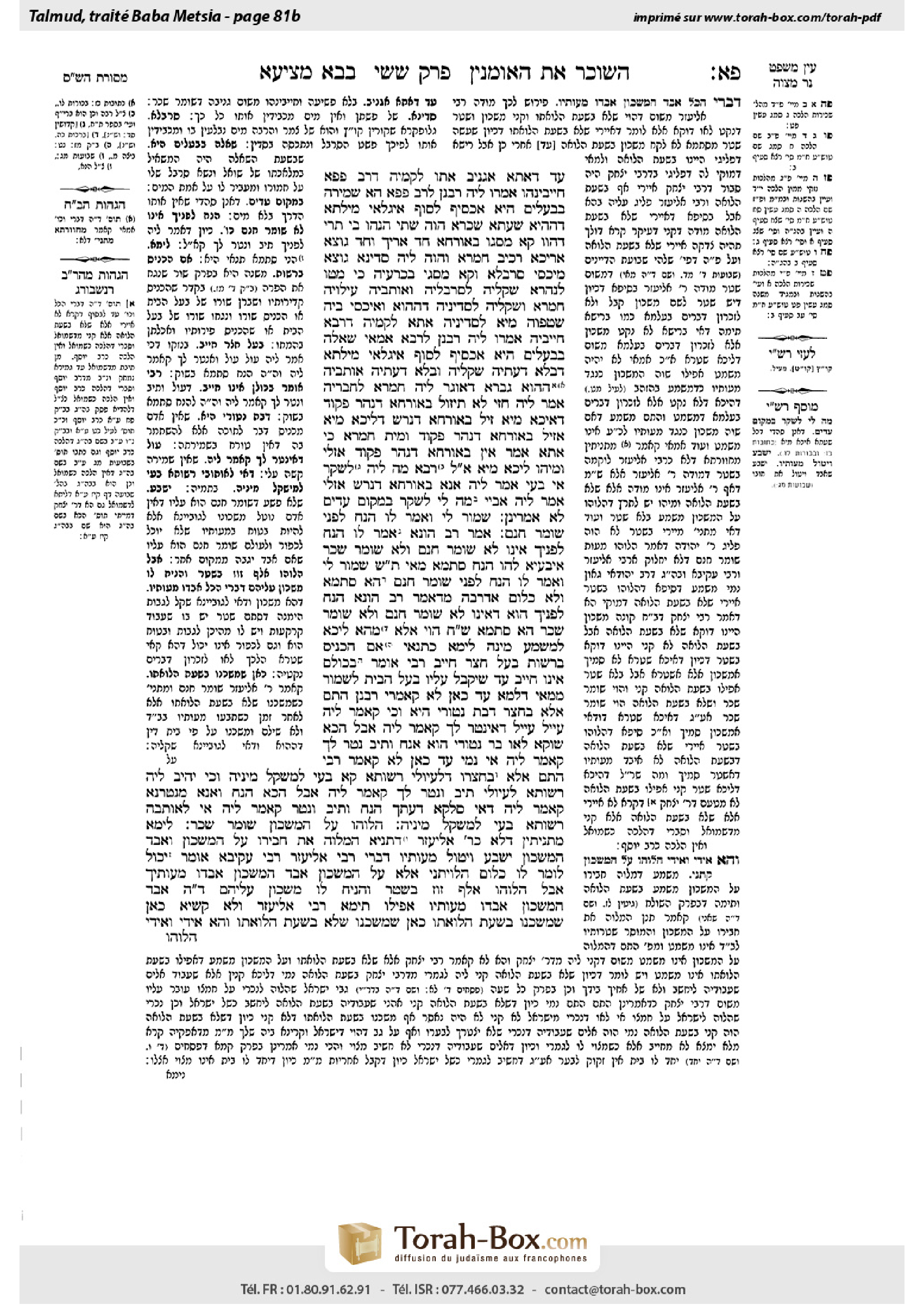
Bava Metzia 81b: Talmud study for Daf Yomi
Study the Talmud for Daf Yomi with scanned pages, Hebrew text, English translations from Sefaria and AI-generated French translations.
Passage selection and English or AI-generated French translation are available where the scan has annotations. Daf Study is independent of Torah-Box and Sefaria.
Browse Bava Metzia · בבא מציעא · All tractatesBava Metzia 81b text and translations
This page of Bava Metzia includes the Aramaic text, an English translation and an AI-generated French translation, alongside the scan above.
בבא מציעא פ״א ב · Aramaic and Hebrew text
עַד דַּאֲתָא – אִגְּנִיב. אֲתוֹ לְקַמֵּיהּ דְּרַב פָּפָּא חַיְּיבִינְהוּ. אֲמַרוּ לֵיהּ רַבָּנַן לְרַב פָּפָּא: הָא שְׁמִירָה בִּבְעָלִים הִיא! אִכְּסִיף. לְסוֹף אִיגַּלַּאי מִילְּתָא דְּהַהִיא שַׁעְתָּא שִׁכְרָא הֲוָה שָׁתֵי.
הָנְהוּ בֵּי תְרֵי דַּהֲווֹ קָא מְסַגּוּ בְּאוֹרְחָא, חַד אֲרִיךְ וְחַד גּוּצָא. אֲרִיכָא רְכִיב חֲמָרָא וַהֲוָה לֵיהּ סְדִינָא, גּוּצָא מִיכַּסֵּי סַרְבָּלָא וְקָא מְסַגֵּי בְּכַרְעֵיהּ. כִּי מְטוֹ לְנַהֲרָא, שַׁקְלֵיהּ לְסַרְבָּלֵיהּ וְאוֹתְבֵיהּ עִילָּוֵי חֲמָרָא, וְשַׁקְלֵיהּ לִסְדִינֵיהּ דְּהָהוּא וְאִיכַּסִּי בֵּיהּ. שַׁטְפוּהּ מַיָּא לִסְדִינֵיהּ.
אֲתָא לְקַמֵּיהּ דְּרָבָא, חַיְּיבֵיהּ. אֲמַרוּ לֵיהּ רַבָּנַן לְרָבָא: אַמַּאי? שְׁאֵלָה בִּבְעָלִים הִיא! אִכְּסִיף. לְסוֹף אִיגַּלַּאי מִילְּתָא דִּבְלָא דַּעְתֵּיהּ שַׁקְלֵיהּ, וּבְלָא דַּעְתֵּיהּ אוֹתְבֵיהּ.
הָהוּא גַּבְרָא דְּאוֹגַר לֵיהּ חֲמָרָא לְחַבְרֵיהּ, אֲמַר לֵיהּ: חֲזִי, לָא תֵּיזוֹל בְּאוֹרְחָא דִּנְהַר פְּקוֹד דְּאִיכָּא מַיָּא, זִיל בְּאוֹרְחָא דְנַרֶשׁ דְּלֵיכָּא מַיָּא. אָזֵיל בְּאוֹרְחָא דִּנְהַר פְּקוֹד וּמִית חַמְרָא. כִּי אֲתָא, אָמַר: אִין, בְּאוֹרְחָא דִּנְהַר פְּקוֹד אֲזַלִי, וּמִיהוּ לֵיכָּא מַיָּא.
אֲמַר לֵיהּ רָבָא: מָה לֵיהּ לְשַׁקֵּר, אִי בָּעֵי אֲמַר לֵיהּ: אֲנָא בְּאוֹרְחָא דְנַרֶשׁ אֲזַלִי. אֲמַר לֵיהּ אַבָּיֵי: ״מָה לִי לְשַׁקֵּר״ בִּמְקוֹם עֵדִים – לָא אָמְרִינַן.
״שְׁמוֹר לִי״, וְאָמַר לוֹ ״הַנַּח לְפָנַי״ – שׁוֹמֵר חִנָּם. אָמַר רַב הוּנָא: אָמַר לוֹ הַנַּח לְפָנֶיךָ – אֵינוֹ לֹא שׁוֹמֵר חִנָּם וְלֹא שׁוֹמֵר שָׂכָר. אִיבַּעְיָא לְהוּ: הַנַּח סְתָמָא, מַאי? תָּא שְׁמַע: שְׁמוֹר לִי וְאָמַר לוֹ הַנַּח לְפָנַי – שׁוֹמֵר חִנָּם. הָא סְתָמָא – וְלֹא כְּלוּם.
אַדְּרַבָּה, מִדְּאָמַר רַב הוּנָא: ״הַנַּח לְפָנֶיךָ״ – הוּא דְּאֵינוֹ לֹא שׁוֹמֵר חִנָּם וְלֹא שׁוֹמֵר שָׂכָר, הָא סְתָמָא שׁוֹמֵר חִנָּם הָוֵי! אֶלָּא מֵהָא לֵיכָּא לְמִשְׁמַע מִינַּהּ.
לֵימָא כְּתַנָּאֵי: אִם הִכְנִיס בִּרְשׁוּת בַּעַל חָצֵר – חַיָּיב. רַבִּי אוֹמֵר: בְּכוּלָּם אֵינוֹ חַיָּיב עַד שֶׁיְּקַבֵּל עָלָיו בַּעַל הַבַּיִת לִשְׁמוֹר.
מִמַּאי? דִּלְמָא עַד כָּאן לָא קָאָמְרִי רַבָּנַן הָתָם אֶלָּא בְּחָצֵר דְּבַת נַטּוֹרֵי הִיא, וְכִי קָאָמַר לֵיהּ ״עַיֵּיל״ – ״עַיֵּיל דְּאִינְטַר לָךְ״ קָאָמַר לֵיהּ. אֲבָל הָכָא, שׁוּקָא לָאו בַּר נַטּוֹרֵי הוּא, ״אַנַּח וְתִיב נְטַר לָךְ״ קָאָמַר לֵיהּ.
אִי נָמֵי: עַד כָּאן לָא קָאָמַר רַבִּי הָתָם אֶלָּא בַּחֲצֵירוֹ, דִּלְעַיּוֹלֵי רְשׁוּתָא קָא בָעֵי לְמִשְׁקַל מִינֵּיהּ וְכִי יָהֵיב לֵיהּ רְשׁוּתָא לְעַיּוֹלֵי – ״תִּיב וְנַטַּר לָךְ״ קָאָמַר לֵיהּ. אֲבָל הָכָא – ״הַנַּח וַאֲנָא מְנַטַּרְנָא״ קָאָמַר לֵיהּ. דְּאִי סָלְקָא דַעְתָּךְ ״הַנַּח וְתִיב וְנַטַּר״ קָאָמַר לֵיהּ, אִי לְאוֹתֹבֵה, רְשׁוּתָא בָּעֵי לְמִשְׁקַל מִינֵּיהּ?
הִלְוָהוּ עַל הַמַּשְׁכּוֹן – שׁוֹמֵר שָׂכָר. לֵימָא מַתְנִיתִין דְּלָא כְּרַבִּי אֱלִיעֶזֶר? דְּתַנְיָא: הַמַּלְוֶה אֶת חֲבֵירוֹ עַל הַמַּשְׁכּוֹן וְאָבַד הַמַּשְׁכּוֹן – יִשָּׁבַע וְיִטּוֹל מְעוֹתָיו, דִּבְרֵי רַבִּי אֱלִיעֶזֶר.
רַבִּי עֲקִיבָא אוֹמֵר: יָכוֹל לוֹמַר לוֹ: כְּלוּם הִלְוִיתַנִי אֶלָּא עַל הַמַּשְׁכּוֹן? אָבַד הַמַּשְׁכּוֹן – אָבְדוּ מְעוֹתֶיךָ. אֲבָל הִלְוָהוּ אֶלֶף זוּז בִּשְׁטָר וְהִנִּיחַ לוֹ מַשְׁכּוֹן עֲלֵיהֶם, דִּבְרֵי הַכֹּל: אָבַד הַמַּשְׁכּוֹן – אָבְדוּ מְעוֹתָיו.
אֲפִילּוּ תֵּימָא רַבִּי אֱלִיעֶזֶר, וְלָא קַשְׁיָא: כָּאן – שֶׁמִּשְׁכְּנוֹ בִּשְׁעַת הַלְוָאָתוֹ, כָּאן – שֶׁמִּשְׁכְּנוֹ שֶׁלֹּא בִּשְׁעַת הַלְוָאָתוֹ.
וְהָא אִידֵּי וְאִידֵּי,
Bava Metzia 81b · English translation
Before he came back it was stolen. They came before Rav Pappa, who deemed them liable to pay. The Sages said to Rav Pappa: This is a case of safeguarding with the owners. Rav Pappa was embarrassed. Ultimately it was discovered that at that time the cloak owner was drinking beer and not baking, and therefore this was not a case of safeguarding with the owners.
The Gemara relates: An incident occurred with these two people who were going on the way, one of whom was tall and one of whom was short. The tall one was riding on a donkey and he had a sheet. The short one was covered with a woolen cloak [sarbela] and was walking on foot. When the short one reached a river, he took his cloak and placed it on the donkey in order to keep the cloak dry, and he took that tall man’s sheet and covered himself with it, and the water washed away his sheet.
The tall man came for judgment before Rava, who deemed the short man liable to pay for the sheet. The Rabbis said to Rava: Why did you deem him liable to pay? This is a case of borrowing with the owners present. Rava was embarrassed. Ultimately, it was discovered that the short man took the sheet without the tall man’s knowledge and placed it back without his knowledge, and therefore this was not borrowing, but theft.
The Gemara relates that there was a certain man who rented a donkey to another. The owner said to the renter: Look, do not go on the path of Nehar Pekod, where there is water and the donkey is likely to drown. Instead, go on the path of Neresh, where there is no water. The renter went on the path of Nehar Pekod and the donkey died. When he came back, he said: Yes, I went on the path of Nehar Pekod; but there was no water there, and therefore the donkey’s death was caused by other factors.
Rava said: The renter’s claim is accepted, due to the reasoning of: Why should he lie? In other words, if this man wanted to lie, he could have told the donkey’s owner: I went on the path of Neresh, as the owner instructed. Abaye said to Rava: We do not say the principle of: Why would I lie, in a place where there are witnesses. Since witnesses can be summoned to establish conclusively whether there was water along the path of Nehar Pekod, the reasoning that the renter could have stated a different claim is not employed.
§ The mishna teaches that if one says to another: Safeguard my property for me, and the other says to him: Place it before me, the second individual is an unpaid bailee. Rav Huna said: If the second individual said to him: Place it down before yourself, he is neither an unpaid bailee nor a paid bailee, and he has no responsibility at all. A dilemma was raised before the Sages: If he said simply: Place it down, without specifying further, what is the halakha? The Gemara attempts to provide an answer from the mishna. Come and hear: If one says to another: Safeguard my property for me, and the other says to him: Place it before me, the second individual is an unpaid bailee. This indicates that an unspecified statement is nothing.
The Gemara rejects this inference: On the contrary, one can infer the opposite from that which Rav Huna says: If the second individual said to him: Place it down in front of yourself, it is in this case that he is neither an unpaid bailee nor a paid bailee. This indicates that if he said simply: Place it down, without specifying further, he is an unpaid bailee. Rather, no inference is to be learned from this mishna, as the inferences are contradictory concerning this halakha.
The Gemara suggests: Let us say that this matter is the subject of a dispute between tanna’im, as it was taught in a mishna (Bava Kamma 47b): If one brought his items into the courtyard of another with the permission of the owner of the courtyard and they were damaged there, the owner of the courtyard is liable. Rabbi Yehuda HaNasi says: In all cases he is liable only if the owner of the courtyard explicitly accepts upon himself to safeguard the items. That mishna is apparently referring to one who places his items in a yard without specification, and the tanna’im disagreed on the question of liability; it therefore has a parallel application to the case in this mishna.
The Gemara refutes this claim. From where do you know that these cases are parallel? Perhaps the Rabbis there say their opinion only in a courtyard, which can be safeguarded, and therefore when the owner of the courtyard allowed the other to bring his items into the courtyard and said to him: Place them in, what he was saying to him was: Place them in so that I can safeguard it for you. But here, in a market, which is a place where goods cannot be safeguarded, he was actually saying to him: Place it down and sit and safeguard it yourself.
Alternatively, one can say the opposite: Perhaps Rabbi Yehuda HaNasi says his ruling, that the owner of the courtyard is not liable, only there, in his courtyard, as he requires permission from the owner of the courtyard to enter, and when the owner of the courtyard gave him permission to enter, all he said to him was: Sit and safeguard it. But here, in the market, when he said to the owner of the item: Place it down, he was saying to him: Place it down and I will safeguard it for you. As if it enters your mind that he was saying to him: Place it down and sit and safeguard it yourself, does the owner of the item really require permission from him to put an item down in a public place? In light of these suggestions, there is not necessarily a connection between the two mishnayot.
§ The mishna teaches: One who lent to another based on collateral is a paid bailee for the collateral. The Gemara comments: Let us say that the mishna is not in accordance with the opinion of Rabbi Eliezer. As it is taught in a baraita: With regard to one who lends to another based on collateral and the collateral was lost, the lender takes an oath that he was not negligent in his safeguarding, and then he may take his money that he lent him. This is the statement of Rabbi Eliezer, who apparently maintains that the lender took the collateral as proof of the loan, and therefore he is considered an unpaid bailee, who is liable for negligence unless he takes an oath.
The baraita continues: Rabbi Akiva says that the borrower can say to him: Didn’t you lend to me only based on the collateral? If the collateral is lost, your money is lost. In other words, the collateral was taken as security for the debt. But if he lent him one thousand dinars by means of a promissory note and the borrower left him collateral against the money, everyone agrees that if the collateral is lost, his money is lost. In this case it cannot be claimed that the collateral was held as proof of the debt, as there is a document attesting to the debt. Consequently, it was evidently taken as security corresponding to the loan, which means that if the collateral is lost, the lender loses his money.
The Gemara refutes this suggestion: Even if you say that the mishna is in accordance with the opinion of Rabbi Eliezer, it is not difficult. Here, the baraita is referring to a case where the lender took his collateral at the time of his loan, and therefore the collateral served as proof of the loan, whereas there, the mishna is referring to a case where the lender took his collateral later, not at the time of his loan, to enhance his ability to collect payment. In this latter case, the collateral is clearly security for the money, and therefore he is considered a paid bailee.
The Gemara raises a difficulty: But don’t both this and that, the mishna and the baraita,
Bava Metzia 81b · Traduction française (IA)
Avant qu'il ne revienne, il avait été volé. Ils se présentèrent devant Rav Pappa, qui considérait qu'ils étaient tenus de payer. Les Sages dirent à Rav Pappa : C'est un cas de garde avec les propriétaires. Rav Pappa fut embarrassé. Finalement, il fut découvert que, à ce moment-là, le propriétaire du manteau buvait de la bière et ne faisait pas de pain, et donc ce n'était pas un cas de garde avec les propriétaires.
La Guemara rapporte : Un incident eut lieu avec ces deux personnes qui voyageaient, l'un étant grand et l'autre petit. Le grand montait sur un âne et avait un linge. Le petit, couvert d'un manteau de laine [sarbela], marchait à pied. Lorsque le petit arriva à un fleuve, il prit son manteau et le posa sur l'âne afin de le garder sec, et il prit le linge du grand et s'en couvrit, et l'eau emporta le linge du grand.
Le grand homme vint devant Rava, qui considérait que le petit homme était tenu de payer pour le linge. Les Rabbins dirent à Rava : Pourquoi as-tu considéré qu'il était tenu de payer ? C'est un cas de prêter avec les propriétaires présents. Rava fut embarrassé. Finalement, il fut découvert que le petit homme avait pris le linge sans la connaissance du grand et l'avait remis sans sa connaissance, et donc ce n'était pas un prêt, mais un vol.
La Guemara rapporte qu'il y avait un certain homme qui loua un âne à un autre. L'owner dit au locataire : Regarde, ne va pas sur le chemin de Nehar Pekod, où il y a de l'eau et l'âne est susceptible de mourir noyé. Au contraire, va sur le chemin de Neresh, où il n'y a pas d'eau. Le locataire alla sur le chemin de Nehar Pekod et l'âne mourut. Lorsqu'il revint, il dit : Oui, j'ai suivi le chemin de Nehar Pekod ; mais il n'y avait pas d'eau là, et donc la mort de l'âne était due à d'autres causes.
Rava dit : La revendication du locataire est acceptée, en raison du raisonnement suivant : Pourquoi ment-il ? Autrement dit, si cet homme voulait mentir, il aurait pu dire à l'owner de l'âne : J'ai suivi le chemin de Neresh, comme l'owner l'avait ordonné. Abaye dit à Rava : Nous ne disons pas le principe de : Pourquoi menterais-je, dans un lieu où il y a des témoins. Puisque des témoins peuvent être convoqués pour établir de manière certaine s'il y avait de l'eau sur le chemin de Nehar Pekod, le raisonnement selon lequel le locataire aurait pu avancer une revendication différente n'est pas utilisé.
§ La mitsna enseigne que si l'un dit à l'autre : Garde mes biens pour moi, et l'autre dit à lui : Place-les devant moi, la deuxième personne est un dépositaire non rémunéré. Rav Huna dit : Si la deuxième personne dit à lui : Place-les devant toi, il n'est ni un dépositaire non rémunéré ni un dépositaire rémunéré, et il n'a aucune responsabilité. Un dilemme fut soulevé devant les Sages : Si il a simplement dit : Place-les, sans préciser davantage, quelle est la halakha ? La Guemara tente de fournir une réponse à partir de la mitsna. Viens écouter : Si l'un dit à l'autre : Garde mes biens pour moi, et l'autre dit à lui : Place-les devant moi, la deuxième personne est un dépositaire non rémunéré. Cela indique que l'expression non spécifiée est rien.
La Guemara rejette cette déduction : Au contraire, on peut déduire l'inverse à partir de ce que Rav Huna dit : Si la deuxième personne dit à lui : Place-le devant toi, c'est dans ce cas-là qu'il n'est ni un dépositaire non rémunéré ni un dépositaire rémunéré. Cela indique que si on a simplement dit : Place-le, sans préciser davantage, il est un dépositaire non rémunéré. En réalité, aucune déduction ne doit être tirée de cette mitsva, car les déductions sont contradictoires concernant cette halakha.
La Guemara suggère : Disons que cette question est l'objet d'un débat entre les tannaïm, comme il a été enseigné dans une mitsva (Bava Kamma 47b) : Si l'un apporte ses objets dans le cour de quelqu'un avec la permission du propriétaire du cour, et qu'ils sont endommagés là, le propriétaire du cour est responsable. Rabbi Yehuda HaNasi dit : Dans tous les cas, il est responsable uniquement si le propriétaire du cour accepte explicitement de garder les objets. Cette mitsva semble se référer à quelqu'un qui place ses objets dans un cour sans précision, et les tannaïm ont divergé sur la question de la responsabilité ; il en résulte donc une application parallèle au cas de cette mitsva.
La Guemara réfute cette affirmation. D'où sais-tu que ces cas sont parallèles ? Peut-être les Rabbins là-bas disent leur opinion uniquement dans un cour, qui peut être gardé, et donc lorsque le propriétaire du cour permet à l'autre de lui apporter ses objets dans le cour et dit à lui : Place-les, ce qu'il disait à lui était : Place-les afin que je les garde pour toi. Mais ici, dans un marché, un lieu où les biens ne peuvent pas être gardés, il disait en réalité à lui : Place-le et assieds-toi et garde-le toi-même.
Une autre alternative est de dire l'inverse : Peut-être Rabbi Yehuda HaNasi exprime son avis selon lequel le propriétaire du cour n'est pas responsable, uniquement là, dans son cour, car il exige la permission du propriétaire du cour pour entrer, et lorsque le propriétaire du cour lui a donné la permission d'entrer, tout ce qu'il a dit à lui était : Assieds-toi et garde-le. Mais ici, dans le marché, lorsque il a dit au propriétaire des objets : Place-le, il disait à lui : Place-le et je vais le garder pour toi. Comme si cela entrait dans ton esprit qu'il disait à lui : Place-le et assieds-toi et garde-le toi-même, est-ce que le propriétaire des objets a besoin de la permission de lui pour poser un objet dans un lieu public ? En lumière de ces suggestions, il n'y a pas nécessairement de lien entre les deux mitsnayot.
§ La Michna enseigne : Celui qui prête à un autre en garantie est un dépositaire payé pour la garantie. La Guemara commente : Disons que la Michna ne suit pas l'opinion de Rabbi Éliezer. Comme il est enseigné dans une baraïta : En ce qui concerne celui qui prête à un autre en garantie et que la garantie est perdue, le prêteur jure qu'il n'a pas négligé dans son gardiennage, et ensuite il peut récupérer l'argent qu'il a prêté. C'est l'opinion de Rabbi Éliezer, qui semble maintenir que le prêteur a pris la garantie comme preuve du prêt, et donc il est considéré comme un dépositaire non payé, qui est responsable de négligence à moins qu'il ne jure.
La baraïta continue : Rabbi Akiva dit que le prêteur peut dire à celui qui lui a prêté : N'as-tu pas prêté à moi uniquement en garantie ? Si la garantie est perdue, ton argent est perdu. En d'autres termes, la garantie a été prise comme caution pour le prêt. Mais si il lui a prêté mille drachmes par un billet de change et que le prêteur lui a laissé une garantie contre l'argent, tout le monde convient que si la garantie est perdue, son argent est perdu. Dans ce cas, on ne peut pas affirmer que la garantie a été tenue comme preuve du prêt, car il y a un document attestant du prêt. Par conséquent, il a été clairement pris comme caution correspondant au prêt, ce qui signifie que si la garantie est perdue, le prêteur perd son argent.
La Guemara réfute cette suggestion : Même si vous dites que la Michna suit l'opinion de Rabbi Éliezer, cela n'est pas difficile. Ici, la baraïta fait référence à un cas où le prêteur a pris sa garantie au moment du prêt, et donc la garantie a servi de preuve du prêt, tandis que là, la Michna fait référence à un cas où le prêteur a pris sa garantie plus tard, pas au moment du prêt, pour renforcer sa capacité à récupérer l'argent. Dans ce dernier cas, la garantie est clairement une caution pour l'argent, et donc il est considéré comme un dépositaire payé.
La Guemara soulève une difficulté : Mais ne sont-ils pas tous les deux, la Michna et la baraïta,
Traduction française générée par IA à partir de l’édition anglaise de Sefaria. Vérifie toujours un passage avec le texte source.
Text from Sefaria: William Davidson Edition - Vocalized Aramaic (CC BY NC); William Davidson Edition - English (CC BY NC).