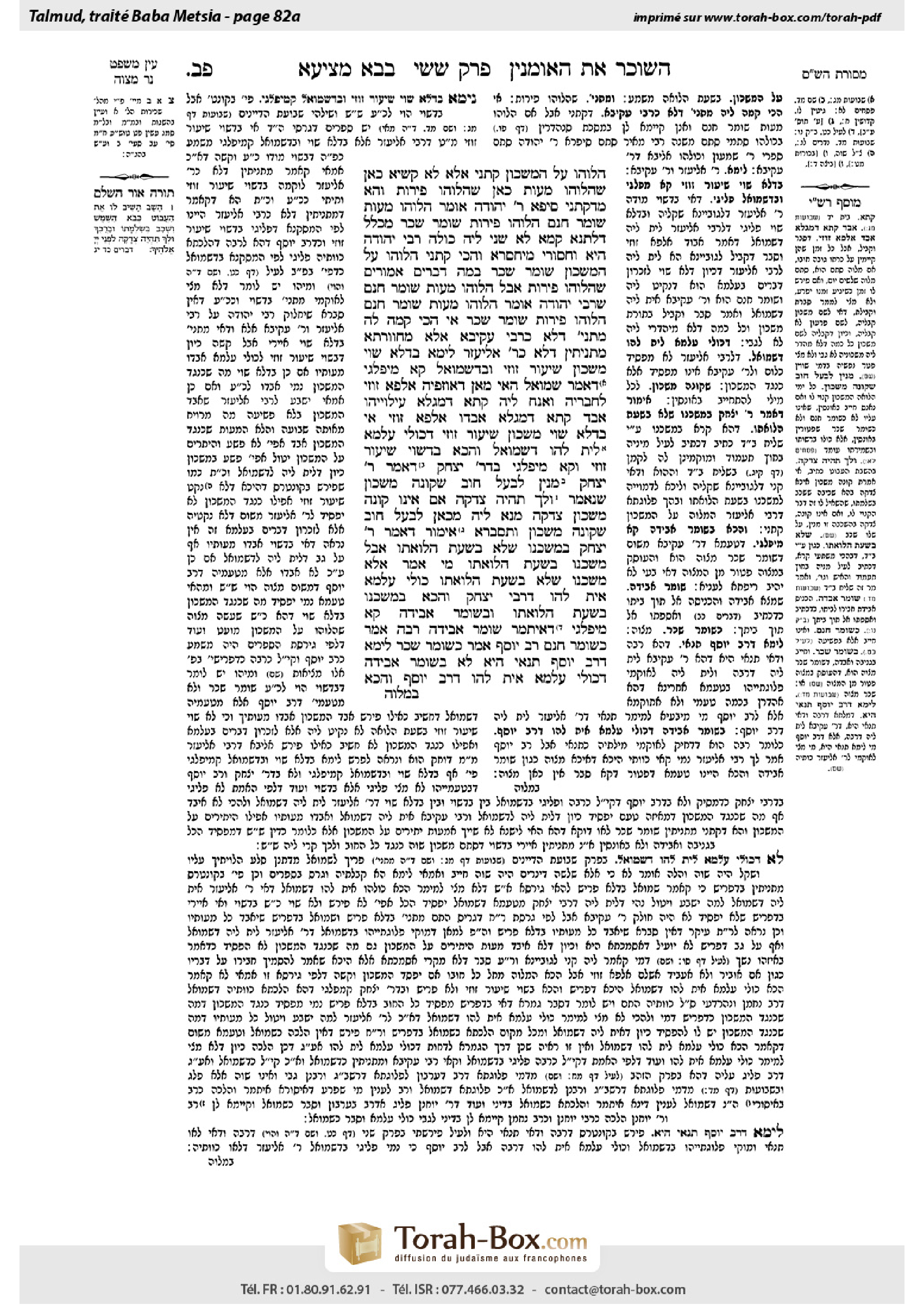
Bava Metzia 82a: Talmud study for Daf Yomi
Study the Talmud for Daf Yomi with scanned pages, Hebrew text, English translations from Sefaria and AI-generated French translations.
Passage selection and English or AI-generated French translation are available where the scan has annotations. Daf Study is independent of Torah-Box and Sefaria.
Browse Bava Metzia · בבא מציעא · All tractatesBava Metzia 82a text and translations
This page of Bava Metzia includes the Aramaic text, an English translation and an AI-generated French translation, alongside the scan above.
בבא מציעא פ״ב א · Aramaic and Hebrew text
הִלְוָהוּ עַל הַמַּשְׁכּוֹן קָתָנֵי! אֶלָּא לָא קַשְׁיָא: כָּאן – שֶׁהִלְוָהוּ מָעוֹת, כָּאן – שֶׁהִלְוָהוּ פֵּירוֹת.
וְהָא מִדְּקָתָנֵי סֵיפָא, רַבִּי יְהוּדָה אוֹמֵר: הִלְוָהוּ מָעוֹת – שׁוֹמֵר חִנָּם, הִלְוָהוּ פֵּירוֹת – שׁוֹמֵר שָׂכָר. מִכְלָל דִּלְתַנָּא קַמָּא לָא שָׁנֵי לֵיהּ!
כּוּלַּהּ רַבִּי יְהוּדָה הִיא, וְחַסּוֹרֵי מִיחַסְּרָא וְהָכִי קָתָנֵי: הִלְוָהוּ עַל הַמַּשְׁכּוֹן – שׁוֹמֵר שָׂכָר, בַּמֶּה דְּבָרִים אֲמוּרִים – שֶׁהִלְוָהוּ פֵּירוֹת, אֲבָל הִלְוָהוּ מָעוֹת – שׁוֹמֵר חִנָּם. שֶׁרַבִּי יְהוּדָה אוֹמֵר: הִלְוָהוּ מָעוֹת – שׁוֹמֵר חִנָּם, הִלְוָהוּ פֵּירוֹת – שׁוֹמֵר שָׂכָר.
אִי הָכִי, קָמָה לַהּ מַתְנִיתִין דְּלָא כְּרַבִּי עֲקִיבָא. אֶלָּא מְחַוַּורְתָּא מַתְנִיתִין דְּלָא כְּרַבִּי אֱלִיעֶזֶר.
לֵימָא בִּדְלָא שָׁוֵי מַשְׁכּוֹן שִׁיעוּר זוּזֵי, וּבְדִשְׁמוּאֵל קָא מִיפַּלְגִי. דְּאָמַר שְׁמוּאֵל: הַאי מַאן דְּאוֹזְפֵיהּ אַלְפָּא זוּזֵי לְחַבְרֵיהּ וְאַנַּח לֵיהּ קַתָּא דְמַגְּלָא עִילָּוַיְיהוּ, אֲבַד קַתָּא דְמַגְּלָא – אֲבַדוּ אַלְפָּא זוּזֵי.
אִי בִּדְלָא שָׁוֵי מַשְׁכּוֹן שִׁיעוּר זוּזֵי – דְּכוּלֵּי עָלְמָא לֵית לְהוּ דִּשְׁמוּאֵל, וְהָכָא בִּדְשָׁוֵי שִׁיעוּר זוּזֵי, וְקָא מִיפַּלְגִי בִּדְרַבִּי יִצְחָק.
דְּאָמַר רַבִּי יִצְחָק: מִנַּיִן לְבַעַל חוֹב שֶׁקּוֹנֶה מַשְׁכּוֹן, שֶׁנֶּאֱמַר: ״וּלְךָ תִּהְיֶה צְדָקָה״. אִם אֵינוֹ קוֹנֶה מַשְׁכּוֹן, צְדָקָה מְנָא לֵיהּ? מִכָּאן לְבַעַל חוֹב שֶׁקּוֹנֶה מַשְׁכּוֹן.
וְתִסְבְּרָא? אֵימוֹר דְּאָמַר רַבִּי יִצְחָק בְּמִשְׁכְּנוֹ שֶׁלֹּא בִּשְׁעַת הַלְוָאָתוֹ, אֲבָל מִשְׁכְּנוֹ בִּשְׁעַת הַלְוָאָתוֹ – מִי אָמַר?
אֶלָּא מִשְׁכְּנוֹ שֶׁלֹּא בִּשְׁעַת הַלְוָאָתוֹ – כּוּלֵּי עָלְמָא אִית לְהוּ דְּרַבִּי יִצְחָק. וְהָכָא בְּמִשְׁכְּנוֹ בִּשְׁעַת הַלְוָאָתוֹ, וּבְשׁוֹמֵר אֲבֵידָה קָא מִיפַּלְגִי. דְּאִיתְּמַר: שׁוֹמֵר אֲבֵידָה, רַבָּה אָמַר: כְּשׁוֹמֵר חִנָּם, רַב יוֹסֵף אָמַר: כְּשׁוֹמֵר שָׂכָר.
לֵימָא דְּרַב יוֹסֵף תַּנָּאֵי הִיא? לָא, בְּשׁוֹמֵר אֲבֵידָה – דְּכוּלֵּי עָלְמָא אִית לְהוּ דְּרַב יוֹסֵף, וְהָכָא
Bava Metzia 82a · English translation
teach the same phrase: One who lent to another based on collateral, which indicates that the collateral was given at the time of the loan? Rather, the Gemara proposes a different resolution: It is not difficult. Here, the baraita is referring to a case where he lent him money, whereas there, the mishna is referring to a situation where he lent him produce. Since produce will spoil, the lender benefits from the deal, as he will receive fresher produce in return. Therefore, he is considered a paid bailee for the collateral.
The Gemara raises a difficulty: But from the fact that the latter clause of the mishna teaches that Rabbi Yehuda says: One who lent another money is an unpaid bailee, whereas one who lent another produce is a paid bailee, by inference you can conclude that according to the first tanna there is no difference between one who lends money and one who lends produce. If so, the proposed resolution does not fit the text.
The Gemara responds: The entire mishna is in accordance with the opinion of Rabbi Yehuda, and the mishna is incomplete and this is what it is teaching: One who lent to another based on collateral is a paid bailee. In what case is this statement said? When he lent him produce. But if he lent him money, he is an unpaid bailee. As Rabbi Yehuda says: One who lent another money is an unpaid bailee with regard to the collateral, whereas one who lent produce is a paid bailee.
The Gemara raises a difficulty: If that is so, it turns out that the mishna is established not in accordance with the opinion of Rabbi Akiva. This is problematic, as most of the Sages of the mishna were Rabbi Akiva’s students, and anonymous mishnayot are generally presumed to follow his rulings. Rather, it is clear that the mishna is not in accordance with the opinion of Rabbi Eliezer.
The Gemara suggests: Let us say that the dispute between Rabbi Akiva and Rabbi Eliezer applies only in a case where the collateral is not equal to the monetary value of the loan, and they disagree with regard to a statement of Shmuel. As Shmuel says: With regard to one who lends one thousand dinars to another and the borrower puts before the lender as collateral for the loan the handle of a sickle, which is worth only a small fraction of the loan, nevertheless, if the sickle is lost, the thousand dinars are lost. The Gemara is suggesting that Rabbi Akiva would agree with this ruling, whereas Rabbi Eliezer would disagree with it.
The Gemara rejects this suggestion: If the case is one where the collateral is not equal to the amount of money constituting the loan, everyone holds that the halakha is not in accordance with the opinion of Shmuel. But here the dispute is referring to a situation where the collateral does equal the amount of the money constituting the loan, and they disagree with regard to a statement of Rabbi Yitzḥak.
As Rabbi Yitzḥak says: From where is it derived that a creditor acquires collateral given to him and is considered its owner as long as the item is in his possession? It is derived from a verse, as it is stated: “You shall return the pledge to him when the sun goes down that he may sleep in his garment, and bless you; and it shall be a righteousness for you before the Lord your God” (Exodus 24:13). Rabbi Yitzḥak infers: If the creditor does not acquire the collateral, then from where is the righteousness involved in returning it? In this case, the creditor would not be giving up anything of his own. From here it is derived that a creditor acquires the collateral.
The Gemara rejects this suggestion: And can you understand it that way? You can say that Rabbi Yitzḥak stated this halakha in a case where he took his collateral not at the time of his loan but at a later stage, in order to collect his debt. But did Rabbi Yitzḥak say this ruling in a situation where he took his collateral at the time of his loan?
Rather, if he took his collateral not at the time of his loan, everyone holds in accordance with the opinion of Rabbi Yitzḥak. And here it is discussing a case where he took his collateral at the time of his loan, and Rabbi Eliezer and Rabbi Akiva disagree with regard to the case of a bailee of a lost item. As it was stated that amora’im disagreed concerning the responsibility of the bailee for a lost item. If someone found a lost item and it is subsequently lost or stolen from him, what responsibility does he bear toward the owner? Rabba said: This individual is considered to be like an unpaid bailee. Rav Yosef said: He is like a paid bailee.
The Gemara suggests: Let us say that the opinion of Rav Yosef is the subject of a dispute between tanna’im. There is no question that Rabba’s opinion is the subject of a dispute between tanna’im, as Rabbi Akiva’s opinion cannot be reconciled with his ruling: If one who takes collateral for his loan is considered a paid bailee, the same certainly applies to one who goes out of his way to safeguard a lost item. The Gemara is asking whether there is any way to explain Rav Yosef’s ruling in accordance with the opinions of both tanna’im, or if he must accept that Rabbi Eliezer disputes his opinion. The Gemara responds: No, it is possible with regard to a bailee for a lost item that everyone holds in accordance with the opinion of Rav Yosef, even Rabbi Eliezer. And here, in the baraita,
Bava Metzia 82a · Traduction française (IA)
enseigner la même phrase : Celui qui prête à un autre en garantie, ce qui indique que la garantie a été donnée au moment du prêt ? Plutôt, la Guemara propose une résolution différente : Ce n'est pas difficile. Ici, la baraïta fait référence à un cas où il a prêté de l'argent, tandis que là, la Michna fait référence à une situation où il a prêté des produits. Puisque les produits se gâtent, le prêteur bénéficie de l'opération, car il recevra des produits plus frais en retour. Par conséquent, il est considéré comme un dépositaire payé pour la garantie.
La Guemara soulève une difficulté : Mais à partir du fait que la dernière clause de la Michna enseigne que Rabbi Yéhuda dit : Celui qui prête de l'argent à un autre est un dépositaire non payé, tandis que celui qui prête des produits est un dépositaire payé, on peut conclure par l'inférence que selon le premier tanna, il n'y a pas de différence entre celui qui prête de l'argent et celui qui prête des produits. Si c'est ainsi, la résolution proposée ne correspond pas au texte.
La Guemara répond : L'ensemble de la Michna est selon l'opinion de Rabbi Yéhuda, et la Michna est incomplète, et c'est ce qu'elle enseigne : Celui qui prête à un autre en garantie est un dépositaire payé. Dans quel cas cette déclaration est-elle faite ? Lorsqu'il a prêté des produits. Mais s'il a prêté de l'argent, il est un dépositaire non payé. Comme Rabbi Yéhuda dit : Celui qui prête de l'argent à un autre est un dépositaire non payé concernant la garantie, tandis que celui qui prête des produits est un dépositaire payé.
La Guemara soulève une difficulté : Si c'est ainsi, il en ressort que la Michna n'est pas établie selon l'opinion de Rabbi Akiva. Cela est problématique, car la plupart des Sages de la Michna étaient des élèves de Rabbi Akiva, et les Mishnayot anonymes sont généralement supposées suivre ses décisions. Plutôt, il est clair que la Michna n'est pas selon l'opinion de Rabbi Eliezer.
La Guemara suggère : Disons que le débat entre Rabbi Akiva et Rabbi Eliezer s'applique uniquement à un cas où la garantie n'est pas égale à la valeur monétaire du prêt, et qu'ils divergent concernant une déclaration de Shmuel. Comme Shmuel dit : Concernant celui qui prête mille dinars à un autre et que l'emprunteur présente à l'emprunteur comme garantie la poignée d'une faucille, qui n'est valable que pour une petite fraction du prêt, néanmoins, si la faucille est perdue, les mille dinars sont perdus. La Guemara suggère que Rabbi Akiva serait d'accord avec cette décision, tandis que Rabbi Eliezer en serait déçu.
La Guemara rejette cette suggestion : Si le cas est celui où la garantie n'est pas égale à la somme monétaire du prêt, tout le monde considère que la halakha ne suit pas l'opinion de Shmuel. Mais ici, le débat concerne un cas où la garantie est égale à la somme monétaire du prêt, et ils divergent concernant une déclaration de Rabbi Yitzhak.
Comme Rabbi Yitzhak dit : D'où est tiré le fait qu'un créancier acquiert la garantie qu'il reçoit et est considéré comme son propriétaire tant que l'objet est en son possession ? Il est tiré d'un verset, comme il est dit : « Tu rendras le garant à lui quand le soleil se couchera, afin qu'il dorme dans sa robe, et qu'il te bénisse ; et cela sera une justice pour toi devant l'Éternel ton Dieu » (Exode 24:13). Rabbi Yitzhak infère : Si le créancier n'acquiert pas la garantie, alors d'où vient la justice impliquée dans son retour ? Dans ce cas, le créancier ne donnerait pas quelque chose de sien. D'où il est tiré que le créancier acquiert la garantie.
La Guemara rejette cette suggestion : Et pouvez-vous comprendre cela ainsi ? Vous pouvez dire que Rabbi Yitzhak a formulé cette halakha dans un cas où il a pris sa garantie pas au moment du prêt mais à une étape ultérieure, afin de récupérer sa dette. Mais Rabbi Yitzhak a-t-il formulé cette décision dans un cas où il a pris sa garantie au moment du prêt ?
Plutôt, si l'on a pris la garantie pas au moment du prêt, tout le monde suit l'opinion de Rabbi Yitzhak. Et ici, il s'agit d'un cas où l'on a pris la garantie au moment du prêt, et Rabbi Eliezer et Rabbi Akiva divergent concernant le cas d'un dépositaire d'un objet perdu. Comme il a été dit que les amoraïm divergent concernant la responsabilité du dépositaire d'un objet perdu. Si quelqu'un a trouvé un objet perdu et qu'il est ensuite perdu ou volé, quelle responsabilité porte-t-il envers l'owner ? Rabba a dit : Cette personne est considérée comme un dépositaire non payé. Rav Yosef a dit : Il est comme un dépositaire payé.
La Guemara suggère : Disons que l'opinion de Rav Yosef est le sujet d'un débat entre les tannaïm. Il n'y a aucun doute que l'opinion de Rabba est le sujet d'un débat entre les tannaïm, car l'opinion de Rabbi Akiva ne peut pas être conciliée avec sa décision : Si celui qui prend une garantie pour son prêt est considéré comme un dépositaire payé, la même chose s'applique certainement à celui qui va de son propre chef préserver un objet perdu. La Guemara demande si il y a un moyen d'expliquer la décision de Rav Yosef selon les opinions des deux tannaïm, ou s'il doit accepter que Rabbi Eliezer dispute son opinion. La Guemara répond : Non, il est possible concernant un dépositaire d'un objet perdu que tout le monde suit l'opinion de Rav Yosef, même Rabbi Eliezer. Et ici, dans la baraïta,
Traduction française générée par IA à partir de l’édition anglaise de Sefaria. Vérifie toujours un passage avec le texte source.
Text from Sefaria: William Davidson Edition - Vocalized Aramaic (CC BY NC); William Davidson Edition - English (CC BY NC).