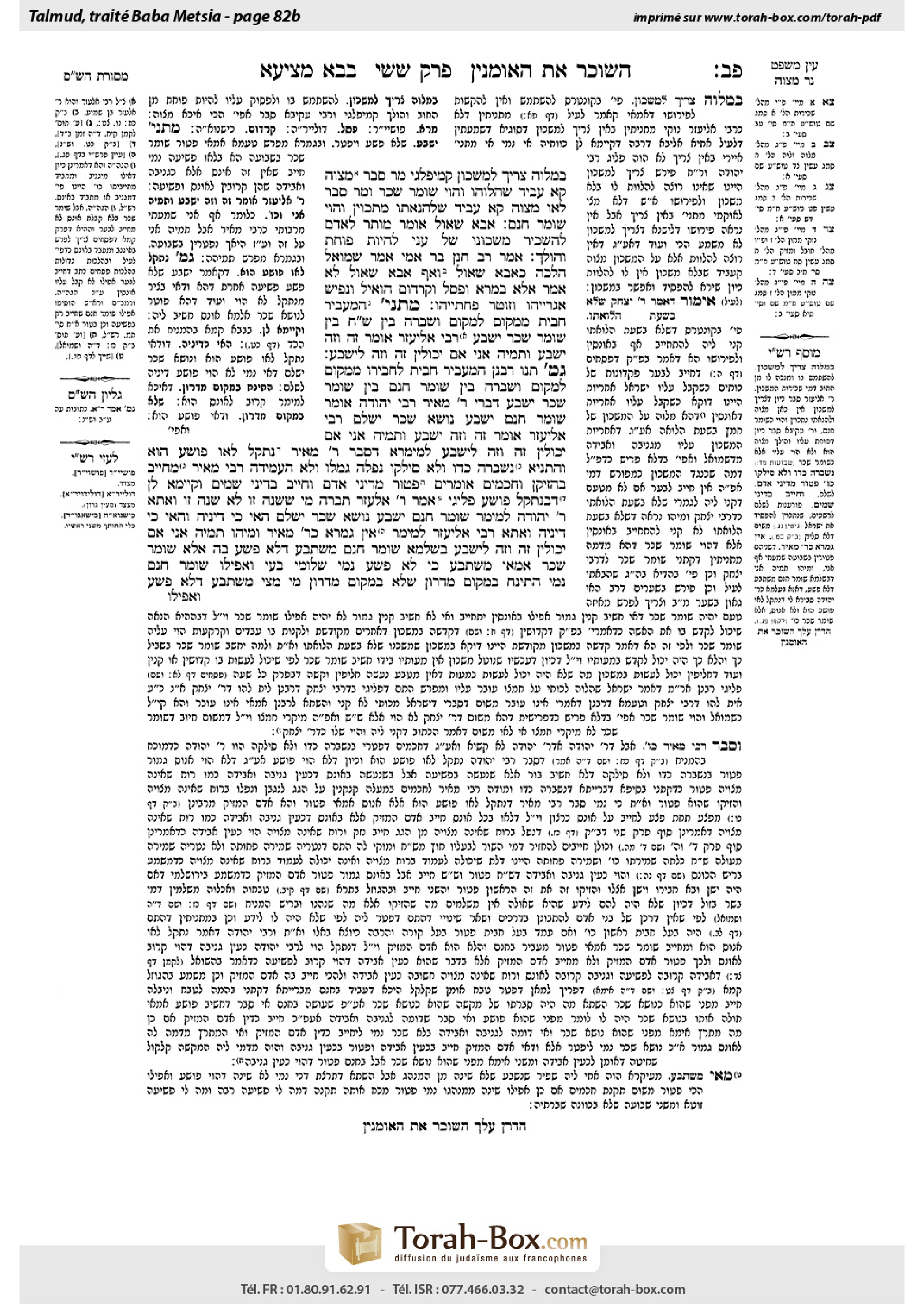
Bava Metzia 82b: Talmud study for Daf Yomi
Study the Talmud for Daf Yomi with scanned pages, Hebrew text, English translations from Sefaria and AI-generated French translations.
Passage selection and English or AI-generated French translation are available where the scan has annotations. Daf Study is independent of Torah-Box and Sefaria.
Browse Bava Metzia · בבא מציעא · All tractatesBava Metzia 82b text and translations
This page of Bava Metzia includes the Aramaic text, an English translation and an AI-generated French translation, alongside the scan above.
בבא מציעא פ״ב ב · Aramaic and Hebrew text
בְּמִלְוֶה צָרִיךְ לְמַשְׁכּוֹן קָמִיפַּלְגִי. מָר סָבַר: מִצְוָה קָא עָבֵיד שֶׁהִלְוָהוּ, וְהָוֵי שׁוֹמֵר שָׂכָר. וּמָר סָבַר: לָאו מִצְוָה קָא עָבֵיד, שֶׁלַּהֲנָאָתוֹ מִתְכַּוֵּין, וְהָוֵי שׁוֹמֵר חִנָּם.
אַבָּא שָׁאוּל אוֹמֵר: מוּתָּר לָאָדָם לְהַשְׂכִּיר מַשְׁכּוֹנוֹ שֶׁל עָנִי לִהְיוֹת פּוֹחֵת וְהוֹלֵךְ. אָמַר רַב חָנָן בַּר אַמֵּי אָמַר שְׁמוּאֵל: הֲלָכָה כְּאַבָּא שָׁאוּל. וְאַף אַבָּא שָׁאוּל לָא אָמַר אֶלָּא בְּמָרָא וּפָסָל וְקַרְדּוֹם, הוֹאִיל וּנְפִישׁ אַגְרַיְיהוּ וְזוּטַר פְּחָתַיְיהוּ.
מַתְנִי׳ הַמַּעֲבִיר חָבִית מִמָּקוֹם לְמָקוֹם וּשְׁבָרָהּ, בֵּין שׁוֹמֵר חִנָּם בֵּין שׁוֹמֵר שָׂכָר – יִשָּׁבַע. רַבִּי אֱלִיעֶזֶר אוֹמֵר: זֶה וְזֶה יִשָּׁבַע, וְתָמֵיהַּ אֲנִי אִם יְכוֹלִין זֶה וָזֶה לִישָּׁבַע.
גְּמָ׳ תָּנוּ רַבָּנַן: הַמַּעֲבִיר חָבִית לַחֲבֵירוֹ מִמָּקוֹם לְמָקוֹם וּשְׁבָרָהּ, בֵּין שׁוֹמֵר חִנָּם בֵּין שׁוֹמֵר שָׂכָר – יִשָּׁבַע, דִּבְרֵי רַבִּי מֵאִיר. רַבִּי יְהוּדָה אוֹמֵר: שׁוֹמֵר חִנָּם – יִשָּׁבַע, נוֹשֵׂא שָׂכָר – יְשַׁלֵּם. רַבִּי אֱלִיעֶזֶר אוֹמֵר: זֶה וְזֶה יִשָּׁבַע, וְתָמֵיהַּ אֲנִי אִם יְכוֹלִין זֶה וָזֶה לִישָּׁבַע.
לְמֵימְרָא דְּסָבַר רַבִּי מֵאִיר נִתְקַל לָאו פּוֹשֵׁעַ הוּא? וְהָתַנְיָא: נִשְׁבְּרָה כַּדּוֹ וְלֹא סִילְּקָהּ נָפְלָה גְּמַלּוֹ וְלֹא הֶעֱמִידָהּ, רַבִּי מֵאִיר מְחַיֵּיב בְּהֶיזֵּיקָן, וַחֲכָמִים אוֹמְרִים: פָּטוּר מִדִּינֵי אָדָם וְחַיָּיב בְּדִינֵי שָׁמַיִם. וְקַיְימָא לַן דִּבְנִתְקַל פּוֹשֵׁעַ פְּלִיגִי!
אָמַר רַבִּי אֶלְעָזָר: תִּבְרַהּ, מִי שֶׁשָּׁנָה זוֹ לֹא שָׁנָה זוֹ. וַאֲתָא רַבִּי יְהוּדָה לְמֵימַר: שׁוֹמֵר חִנָּם – יִשָּׁבַע, נוֹשֵׂא שָׂכָר – יְשַׁלֵּם. הַאי כִּי דִינֵיהּ וְהַאי כִּי דִינֵיהּ. וַאֲתָא רַבִּי אֱלִיעֶזֶר לְמֵימַר: אִין, גְּמָרָא כְּרַבִּי מֵאִיר. וּמִיהוּ תָּמֵיהַּ אֲנִי אִם יְכוֹלִין זֶה וָזֶה לִישָּׁבַע.
בִּשְׁלָמָא שׁוֹמֵר חִנָּם מִשְׁתְּבַע דְּלָא פְּשַׁע בַּהּ: אֶלָּא שׁוֹמֵר שָׂכָר אַמַּאי מִשְׁתְּבַע? כִּי לָא פְּשַׁע נָמֵי שַׁלּוֹמֵי בָּעֵי. וַאֲפִילּוּ שׁוֹמֵר חִנָּם נָמֵי, הָתִינַח בִּמְקוֹם מִדְרוֹן. שֶׁלֹּא בִּמְקוֹם מִדְרוֹן, מִי מָצֵי מִשְׁתְּבַע דְּלָא פְּשַׁע בַּהּ!
Bava Metzia 82b · English translation
they disagree with regard to a lender who needs the collateral, i.e., the lender wants to use the collateral and deduct the value of its use from the amount of the loan. One Sage, Rabbi Akiva, holds that he is performing a mitzva in that he lent to him, and therefore he is considered a paid bailee. And one Sage, Rabbi Eliezer, holds that he is not performing a mitzva, as his intention is to lend for his own benefit. And consequently he is considered an unpaid bailee for the collateral.
§ The mishna teaches that Abba Shaul says: It is permitted for a person to rent out a poor person’s collateral that was given to him for a loan, so that he shall set a rental price for it and thereby progressively reduce the debt, because this is considered like returning a lost item. Rav Ḥanan bar Ami says that Shmuel says: The halakha is in accordance with the opinion of Abba Shaul, but even Abba Shaul said his ruling only with regard to a hoe, a chisel, and an ax, since the remuneration from these utensils is great and their depreciation is small.
MISHNA: With regard to one who was transporting a barrel from one place to another and he broke it, whether he was an unpaid bailee or a paid bailee, if he takes an oath that he was not negligent he is exempt from payment. Rabbi Eliezer says: Both this one, an unpaid bailee, and that one, a paid bailee, must take an oath to exempt themselves from payment, but I wonder whether both this one and that one can take an oath. In other words, this is the halakha that I heard from my teachers, but I do not understand their ruling.
GEMARA: The Sages taught: With regard to one who was transporting a barrel for another person from one place to another and he broke it, whether he was an unpaid bailee or a paid bailee, if he takes an oath that he was not negligent, he is exempt from payment. This is the statement of Rabbi Meir. Rabbi Yehuda says: An unpaid bailee takes an oath and does not pay, but a paid bailee pays. Rabbi Eliezer says: This one and that one take an oath, and I wonder whether both this one and that one can take an oath.
The Gemara analyzes these opinions. Is that to say that Rabbi Meir holds that one who stumbles is not considered negligent, but the victim of an accident? But isn’t it taught in a baraita: If one’s pitcher broke in a public place and he did not remove it from there, or if his camel fell and he did not stand it up, Rabbi Meir renders him liable for the damage they caused? And the Rabbis say that he is exempt according to human laws but is liable according to the laws of Heaven. Although the court cannot impose liability, nevertheless he is morally culpable. And we maintain that they disagree with regard to the question of whether one who stumbles is negligent. This indicates that Rabbi Meir holds that one who stumbles is considered negligent.
Rabbi Elazar said: Break the mishna, as he who taught this did not teach that, i.e., there are two traditions with regard to Rabbi Meir’s opinion. And Rabbi Yehuda came to say a different ruling: An unpaid bailee takes an oath and does not pay while a paid bailee pays, this one in accordance with his law and that one in accordance with his law, as an unpaid bailee is exempt from liability for theft and loss, while a paid bailee is liable in those cases and exempt only in cases of circumstances beyond his control. And Rabbi Eliezer came to say: Yes, there is a tradition that is in accordance with the opinion of Rabbi Meir, as I learned from my teachers, but I wonder whether both this one and that one can take an oath.
The Gemara asks: Granted, an unpaid bailee takes an oath that he was not negligent with regard to the barrel, as required by Torah law, but why does a paid bailee take an oath? Even if he was not negligent he is still required to pay, as he is obligated to pay for theft and loss. And even with regard to an unpaid bailee, this works out well if the barrel broke on an inclined plane [midron], as the accident occurred due to the difficulty of transporting it, but if it broke not on an inclined plane but under different circumstances, how can he take an oath that he was not negligent with it? Evidently his negligence caused the accident.
Bava Metzia 82b · Traduction française (IA)
ils divergent quant à un prêteur qui a besoin du garant, c'est-à-dire que le prêteur veut utiliser le garant et déduire la valeur de son utilisation du montant du prêt. Un Sage, Rabbi Akiva, affirme qu'il accompli une mitsva en prêtant à l'autre, et par conséquent il est considéré comme un dépositaire rémunéré. Un autre Sage, Rabbi Eliezer, affirme qu'il ne réalise pas une mitsva, car son intention est de prêter à son propre bénéfice. Et par conséquent il est considéré comme un dépositaire non rémunéré pour le garant.
§ La mitsna enseigne que Abba Shaul dit : Il est permis à une personne de louer le garant d'une personne pauvre qui lui a été donné pour un prêt, afin qu'il fixe un prix de location et ainsi réduise progressivement la dette, car cela est considéré comme rendre un objet perdu. Rav Ḥanan bar Ami dit que Shmuel dit : La halakha suit l'opinion d'Abba Shaul, mais même Abba Shaul a formulé sa décision uniquement concernant un faux, un marteau et une hache, car la rémunération de ces ustensiles est grande et leur dépréciation est faible.
MITSNA : Concernant celui qui transportait une barrique d'un lieu à un autre et qui l'a cassée, qu'il soit un dépositaire non rémunéré ou un dépositaire rémunéré, si il jure qu'il n'était pas négligent, il est exempt de paiement. Rabbi Eliezer dit : Ce dernier, le dépositaire non rémunéré, et celui-là, le dépositaire rémunéré, doivent tous deux jurer pour s'exonorer de paiement, mais je me demande si ces deux-là peuvent tous deux jurer. En d'autres termes, c'est la halakha que j'ai entendue de mes maîtres, mais je ne comprends pas leur décision.
GUEMARA : Les Sages enseignent : Concernant celui qui transportait une barrique pour une autre personne d'un lieu à un autre et qui l'a cassée, qu'il soit un dépositaire non rémunéré ou un dépositaire rémunéré, s'il jure qu'il n'était pas négligent, il est exempt de paiement. C'est l'opinion de Rabbi Meir. Rabbi Yehuda dit : Le dépositaire non rémunéré jure et ne paie pas, mais le dépositaire rémunéré paie. Rabbi Eliezer dit : Ce dernier et celui-là jurent, et je me demande si ces deux-là peuvent tous deux jurer.
La Guemara analyse ces opinions. Est-ce que cela signifie que Rabbi Meir considère que celui qui trébuche n'est pas considéré comme négligent, mais la victime d'un accident ? Mais n'est-il pas enseigné dans une baraïta : Si un pot de son propriétaire se brise dans un lieu public et qu'il ne le retire pas de là, ou si son chameau tombe et qu'il ne le relève pas, Rabbi Meir le rend responsable des dommages causés ? Et les Rabbins disent qu'il est exempt selon les lois humaines mais responsable selon les lois du Ciel. Bien que le tribunal ne puisse imposer une responsabilité, il est néanmoins moralement responsable. Et nous maintenons que cela diverge concernant la question de savoir si celui qui trébuche est négligent. Cela indique que Rabbi Meir considère que celui qui trébuche est considéré comme négligent.
Rabbi Elazar dit : Casser la mitsna, car celui qui a enseigné cela n'a pas enseigné cela, c'est-à-dire qu'il y a deux traditions concernant l'opinion de Rabbi Meir. Et Rabbi Yehuda est venu pour formuler une décision différente : Le dépositaire non rémunéré jure et ne paie pas, tandis que le dépositaire rémunéré paie, celui-ci selon sa loi et celui-là selon sa loi, car le dépositaire non rémunéré est exempt de responsabilité pour vol et perte, tandis que le dépositaire rémunéré est responsable dans ces cas et exempt uniquement dans les cas de circonstances hors de son contrôle. Et Rabbi Eliezer est venu pour dire : Oui, il y a une tradition qui suit l'opinion de Rabbi Meir, car j'ai appris cela de mes maîtres, mais je me demande si ces deux-là peuvent tous deux jurer.
La Guemara pose la question : D'accord, le dépositaire non rémunéré jure qu'il n'était pas négligent concernant la barrique, comme requis par la loi divine, mais pourquoi le dépositaire rémunéré jure-t-il ? Même s'il n'était pas négligent, il est toujours tenu de payer, car il est tenu de payer pour vol et perte. Et même concernant le dépositaire non rémunéré, cela fonctionne bien si la barrique s'est cassée sur une pente [midron], car l'accident s'est produit en raison de la difficulté du transport, mais si elle s'est cassée sans être sur une pente mais sous d'autres circonstances, comment peut-il jurer qu'il n'était pas négligent avec cela ? Évidemment, sa négligence a causé l'accident.
Traduction française générée par IA à partir de l’édition anglaise de Sefaria. Vérifie toujours un passage avec le texte source.
Text from Sefaria: William Davidson Edition - Vocalized Aramaic (CC BY NC); William Davidson Edition - English (CC BY NC).