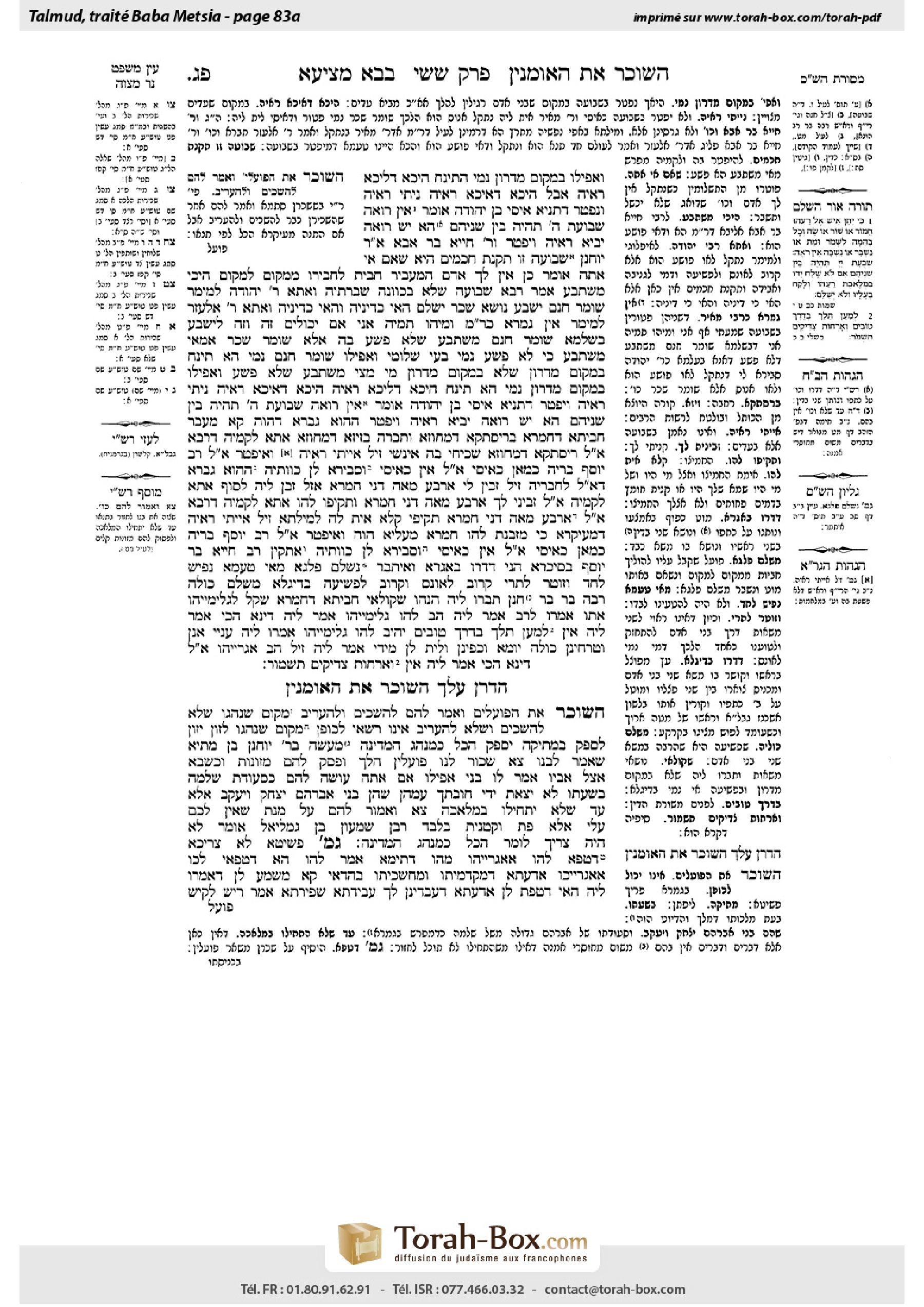
Bava Metzia 83a: Talmud study for Daf Yomi
Study the Talmud for Daf Yomi with scanned pages, Hebrew text, English translations from Sefaria and AI-generated French translations.
Passage selection and English or AI-generated French translation are available where the scan has annotations. Daf Study is independent of Torah-Box and Sefaria.
Browse Bava Metzia · בבא מציעא · All tractatesBava Metzia 83a text and translations
This page of Bava Metzia includes the Aramaic text, an English translation and an AI-generated French translation, alongside the scan above.
בבא מציעא פ״ג א · Aramaic and Hebrew text
וַאֲפִילּוּ בִּמְקוֹם מִדְרוֹן נָמֵי – הֲתִינַח הֵיכָא דְּלֵיכָּא רְאָיָה, אֲבָל הֵיכָא דְּאִיכָּא רְאָיָה – נַיְתֵי רְאָיָה וְנִפְּטַר. דְּתַנְיָא, אִיסִי בֶּן יְהוּדָה אוֹמֵר: ״אֵין רֹאֶה שְׁבֻעַת ה׳ תִּהְיֶה בֵּין שְׁנֵיהֶם״, הָא יֵשׁ רוֹאֶה – יָבִיא רְאָיָה וְיִפָּטֵר.
וְרַבִּי חִיָּיא בַּר אַבָּא אָמַר רַבִּי יוֹחָנָן: שְׁבוּעָה זוֹ תַּקָּנַת חֲכָמִים הִיא, שֶׁאִם אִי אַתָּה אוֹמֵר כֵּן – אֵין לְךָ אָדָם הַמַּעֲבִיר חָבִית לַחֲבֵירוֹ מִמָּקוֹם לְמָקוֹם.
הֵיכִי מִשְׁתְּבַע? אָמַר רָבָא: שְׁבוּעָה שֶׁלֹּא בְּכַוּוֹנָה שְׁבַרְתִּיהָ. וַאֲתָא רַבִּי יְהוּדָה לְמֵימַר: שׁוֹמֵר חִנָּם יִשָּׁבַע, נוֹשֵׂא שָׂכָר יְשַׁלֵּם, הַאי כְּדִינֵיהּ וְהַאי כְּדִינֵיהּ. וַאֲתָא רַבִּי אֶלְעָזָר לְמֵימַר: אִין, גְּמָרָא כְּרַבִּי מֵאִיר, וּמִיהוּ, תָּמֵיהַּ אֲנִי אִם יְכוֹלִים זֶה וָזֶה לִישָּׁבַע.
בִּשְׁלָמָא שׁוֹמֵר חִנָּם – מִשְׁתְּבַע שֶׁלֹּא פָּשַׁע בָּהּ. אֶלָּא שׁוֹמֵר שָׂכָר, אַמַּאי מִשְׁתְּבַע? כִּי לָא פְּשַׁע נָמֵי בָּעֵי שַׁלּוֹמֵי. וַאֲפִילּוּ שׁוֹמֵר חִנָּם נָמֵי, הָא תִּינַח בִּמְקוֹם מִדְרוֹן. שֶׁלֹּא בִּמְקוֹם מִדְרוֹן, מִי מָצֵי מִשְׁתְּבַע שֶׁלֹּא פָּשַׁע?
וַאֲפִילּוּ בִּמְקוֹם מִדְרוֹן נָמֵי, הָא תִּינַח הֵיכָא דְּלֵיכָּא רְאָיָה, הֵיכָא דְּאִיכָּא רְאָיָה – נַיְתֵי רְאָיָה וְיִפָּטֵר. דְּתַנְיָא, אִיסִי בֶּן יְהוּדָה אוֹמֵר: ״אֵין רֹאֶה שְׁבֻעַת ה׳ תִּהְיֶה בֵּין שְׁנֵיהֶם״ הָא יֵשׁ רוֹאֶה – יָבִיא רְאָיָה וְיִפָּטֵר.
הָהוּא גַּבְרָא דַּהֲוָה קָא מְעַבַּר חָבִיתָא דְחַמְרָא בְּרִיסְתְּקָא דְמָחוֹזָא, וְתַבְרַהּ בְּזִיזָא דְמָחוֹזָא. אֲתָא לְקַמֵּיהּ דְּרָבָא. אֲמַר לֵיהּ: רִיסְתְּקָא דְמָחוֹזָא שְׁכִיחִי בַּהּ אִינָשֵׁי, זִיל, אַיְיתִי רְאָיָה וְאִיפְּטַר. אֲמַר לֵיהּ רַב יוֹסֵף בְּרֵיהּ: כְּמַאן כְּאִיסִי? אֲמַר לֵיהּ: אִין כְּאִיסִי, וּסְבִירָא לַן כְּווֹתֵיהּ.
הָהוּא גַּבְרָא דַּאֲמַר לֵיהּ לְחַבְרֵיהּ: זִיל זְבֵין לִי אַרְבַּע מְאָה דַּנֵּי חַמְרָא. אֲזַל זְבַן לֵיהּ. לְסוֹף אֲתָא לְקַמֵּיהּ, אֲמַר לֵיהּ: זְבִינֵי לָךְ אַרְבַּע מְאָה דַּנֵּי חַמְרָא וּתְקִיפוּ לְהוּ.
אֲתָא לְקַמֵּיהּ דְּרָבָא, אֲמַר לֵיהּ: אַרְבַּע מְאָה דַּנֵּי חַמְרָא תְּקִיפִי קָלָא אִית לַהּ לְמִילְּתָא, זִיל אַיְיתִי רְאָיָה דְּמֵעִיקָּרָא כִּי מְזַבְּנַתְּ לְהוּ חַמְרָא מְעַלְּיָא הֲוָה, וְאִיפְּטַר. אֲמַר לֵיהּ רַב יוֹסֵף בְּרֵיהּ: כְּמַאן כְּאִיסִי? אֲמַר לֵיהּ: אִין כְּאִיסִי, וּסְבִירָא לַן כְּווֹתֵיהּ.
אַתְקֵין רַב חִיָּיא בַּר יוֹסֵף בְּסִיכְרָא: הָנֵי דְּדָרוּ בְּאַגְרָא וְאִיתְּבַר – נְשַׁלֵּם פַּלְגָא. מַאי טַעְמָא – נְפִישׁ לְחַד וְזוּטַר לִתְרֵי, קָרוֹב לְאוֹנֶס וְקָרוֹב לִפְשִׁיעָה. בְּדִיגְלָא – מְשַׁלֵּם כּוּלַּהּ.
רַבָּה בַּר בַּר חָנָן תְּבַרוּ לֵיהּ הָנְהוּ שָׁקוֹלָאֵי חָבִיתָא דְחַמְרָא, שְׁקַל לִגְלִימַיְיהוּ. אֲתוֹ אֲמַרוּ לְרַב. אֲמַר לֵיהּ: הַב לְהוּ גְּלִימַיְיהוּ. אֲמַר לֵיהּ דִּינָא הָכִי? אֲמַר לֵיהּ: אִין, ״לְמַעַן תֵּלֵךְ בְּדֶרֶךְ טוֹבִים״. יְהַיב לְהוּ גְּלִימַיְיהוּ. אֲמַרוּ לֵיהּ: עַנְיֵי אֲנַן, וְטָרְחִינַן כּוּלֵּהּ יוֹמָא, וְכָפֵינַן, וְלֵית לַן מִידֵּי. אֲמַר לֵיהּ: זִיל הַב אַגְרַיְיהוּ. אֲמַר לֵיהּ דִּינָא הָכִי? אֲמַר לֵיהּ: אִין, ״וְאׇרְחוֹת צַדִּיקִים תִּשְׁמֹר״.
הֲדַרַן עֲלָךְ הַשּׂוֹכֵר אֶת הָאוּמָּנִין
מַתְנִי׳ הַשּׂוֹכֵר אֶת הַפּוֹעֲלִים וְאָמַר לָהֶם לְהַשְׁכִּים וּלְהַעֲרִיב, מָקוֹם שֶׁנָּהֲגוּ שֶׁלֹּא לְהַשְׁכִּים וְשֶׁלֹּא לְהַעֲרִיב – אֵינוֹ רַשַּׁאי לְכוֹפָן. מָקוֹם שֶׁנָּהֲגוּ לָזוּן – יָזוּן, לְסַפֵּק בִּמְתִיקָה – יְסַפֵּק, הַכֹּל כְּמִנְהַג הַמְּדִינָה.
מַעֲשֶׂה בְּרַבִּי יוֹחָנָן בֶּן מַתְיָא שֶׁאָמַר לִבְנוֹ: צֵא שְׂכוֹר לָנוּ פּוֹעֲלִין. הָלַךְ וּפָסַק לָהֶם מְזוֹנוֹת.
וּכְשֶׁבָּא אֵצֶל אָבִיו, אָמַר לוֹ: בְּנִי, אֲפִילּוּ אִם אַתָּה עוֹשֶׂה לָהֶם כִּסְעוּדַת שְׁלֹמֹה בִּשְׁעָתוֹ – לֹא יָצָאתָ יְדֵי חוֹבָתְךָ עִמָּהֶן, שֶׁהֵן בְּנֵי אַבְרָהָם יִצְחָק וְיַעֲקֹב. אֶלָּא עַד שֶׁלֹּא יַתְחִילוּ בִּמְלָאכָה צֵא וֶאֱמוֹר לָהֶם: עַל מְנָת שֶׁאֵין לָכֶם עָלַי אֶלָּא פַּת וְקִטְנִית בִּלְבָד. רַבָּן שִׁמְעוֹן בֶּן גַּמְלִיאֵל אוֹמֵר: לֹא הָיָה צָרִיךְ לוֹמַר, הַכֹּל כְּמִנְהַג הַמְּדִינָה.
גְּמָ׳ פְּשִׁיטָא! לָא צְרִיכָא דִּטְפָא לְהוּ אַאַגְרַיְיהוּ. מַהוּ דְּתֵימָא, אֲמַר לְהוּ: הָא דִּטְפַאי לְכוּ אַאַגְרַיְיכוּ אַדַּעְתָּא דְּמַקְדְּמִיתוּ וּמְחַשְּׁכִיתוּ בַּהֲדַאי, קָא מַשְׁמַע לַן דַּאֲמַרוּ לֵיהּ: הַאי דִּטְפֵת לַן – אַדַּעְתָּא דְּעָבְדִינַן לָךְ עֲבִידְתָּא שַׁפִּירְתָּא.
אָמַר רֵישׁ לָקִישׁ:
Bava Metzia 83a · English translation
And even on an inclined plane, this works out well where there is no evidence, i.e., in a case without witnesses. But where there is evidence, let him bring evidence and be exempt. Why then is he forced to take an oath? As it is taught in a baraita: Isi ben Yehuda says, with regard to the verse: “And it died or was hurt or driven away without an eyewitness, an oath of the Lord shall be between them” (Exodus 22:9–10), that one can infer from here that if there is an eyewitness, let him bring evidence and be exempt.
The Gemara previously cited Rabbi Elazar’s answer to the apparent contradiction between the statements of Rabbi Meir, which was followed by an analysis of the various opinions of the tanna’im. The Gemara presents a different interpretation. And Rabbi Ḥiyya bar Abba says that Rabbi Yoḥanan says: There is no difficulty with the oath proposed by Rabbi Meir, as this oath is a decree of the Sages for the betterment of the world. The reason for this oath is that if you do not say so, that an unpaid bailee who broke the barrel in transport can exempt himself by means of an oath, you will have no person who will be willing to transport a barrel for another from one place to another, due to the fear that it might break and he will have to pay.
The Gemara asks: How exactly does he take an oath? Rava said that the phrasing is: I take an oath that I broke it unintentionally. And Rabbi Yehuda came to say: An unpaid bailee takes an oath, while a paid bailee pays, this one in accordance with his law and that one in accordance with his law. And Rabbi Elazar came to say: Yes, there is a tradition in accordance with the opinion of Rabbi Meir. But I wonder whether both this one and that one can take an oath.
Granted, an unpaid bailee takes an oath that he was not negligent with regard to the barrel, but why does a paid bailee take an oath? Even if he was not negligent, he is still required to pay. And even with regard to an unpaid bailee, this works out well if the barrel was broken on an inclined plane, but if it broke not on an inclined plane but under different circumstances, how can he take an oath that he was not negligent with it?
And even on an inclined plane, this works out well where there is no evidence. But where there is evidence, let him bring evidence and be exempt. As it is taught in a baraita: Isi ben Yehuda says, with regard to the verse: “And it died or was hurt or driven away without an eyewitness, an oath of the Lord shall be between them” (Exodus 22:9–10), that one can infer from here that if there is an eyewitness, let him bring evidence and be exempt.
The Gemara relates: There was a certain man who transported a barrel of wine in the market [beristeka] of Meḥoza and broke it on one of the protrusions of a wall in Meḥoza. The case came before Rava, who said to him: With regard to the market of Meḥoza, people are generally found there. Go and bring evidence in your favor and you will be exempt. Rav Yosef, Rava’s son, said to him: In accordance with whose opinion did you issue this ruling? In accordance with the opinion of Isi ben Yehuda? Rava said to him: Yes, I ruled in accordance with the ruling of Isi, and we hold in accordance with his opinion.
The Gemara relates a similar incident. There was a certain man who said to another: Go and buy for me four hundred pitchers of wine. The second man went and bought them for him. Ultimately, he came before the first man and said to him: I bought four hundred pitchers of wine for you, but they fermented.
The case came before Rava, who said to the second man: If four hundred pitchers of wine had fermented, this matter would generate publicity, i.e., people would have heard of this occurrence. Consequently, go and bring proof that initially, when you purchased the pitchers, the wine was good, and you will be exempt. Rav Yosef, Rava’s son, said to him: In accordance with whose opinion did you issue this ruling? According to that of Isi ben Yehuda? Rava said to him: Yes, I ruled in accordance with the ruling of Isi, and we hold in accordance with his opinion.
The Gemara relates: Rav Ḥiyya bar Yosef issued a decree in the city of Sikhra, where he was the presiding Sage: With regard to those who carry loads on a pole [be’agra] and the item breaks, they must pay half. What is the reason? Such a pole is used to carry loads that are too much for one individual to carry and too little for two. Consequently, this breakage is close to an accident and equally close to negligence, and therefore they compromise with a payment of half liability. If he carried it with a digla, a wooden tool designed for double loads, he pays in full, as the use of such a tool indicates that he was carrying a load beyond the capacity of a single individual to bear and therefore acted negligently.
The Gemara relates an incident involving Rabba bar bar Ḥanan: Certain porters broke his barrel of wine after he had hired them to transport the barrels. He took their cloaks as payment for the lost wine. They came and told Rav. Rav said to Rabba bar bar Ḥanan: Give them their cloaks. Rabba bar bar Ḥanan said to him: Is this the halakha? Rav said to him: Yes, as it is written: “That you may walk in the way of good men” (Proverbs 2:20). Rabba bar bar Ḥanan gave them their cloaks. The porters said to Rav: We are poor people and we toiled all day and we are hungry and we have nothing. Rav said to Rabba bar bar Ḥanan: Go and give them their wages. Rabba bar bar Ḥanan said to him: Is this the halakha? Rav said to him: Yes, as it is written: “And keep the paths of the righteous” (Proverbs 2:20).
MISHNA: With regard to one who hires laborers and tells them to rise exceptionally early and to continue working until exceptionally late, if this is in a locale where laborers are not accustomed to rising so early or to continuing to work until so late, the employer is not permitted to compel them to do so. In a locale where employers are accustomed to feeding their laborers, the employer must feed them. If they are in a locale where an employer is accustomed to providing their laborers with sweet foods, he must provide such food. Everything is in accordance with the regional custom in these matters.
There was an incident involving Rabbi Yoḥanan ben Matya, who said to his son: Go out and hire laborers for us. His son went, hired them, and pledged to provide sustenance for them as a term of their employment, without specifying the details.
And when he came back to his father and reported what he had done, Rabbi Yoḥanan ben Matya said to him: My son, even if you were to prepare a feast for them like that of King Solomon in his time, you would not have fulfilled your obligation to them, as they are the descendants of Abraham, Isaac, and Jacob. Rather, before they begin engaging in their labor, go out and say to them: The stipulation that food will be provided is on the condition that you have the right to claim from me only a meal of bread and legumes, which is the typical meal given to laborers. Rabban Shimon ben Gamliel says: Rabbi Yoḥanan ben Matya’s son did not need to state this condition, as the principle is that everything is in accordance with the regional custom.
GEMARA: With regard to the mishna’s statement that an employer may not compel his laborers to rise exceptionally early and continue working until exceptionally late, the Gemara asks: Isn’t this obvious? By what right can he force them to do so? The Gemara explains: No, the mishna’s ruling is necessary only in a case where the employer increased their wages beyond the standard in that place. Lest you say that the employer could say to the laborers: The fact that I increased your wages was with the understanding that you would rise early and continue working late for me, the mishna therefore teaches us that the laborers can say in response to the employer: The fact that you increased our wages was with the understanding that we would perform quality work for you, not that we would work longer hours.
§ Reish Lakish says:
Bava Metzia 83a · Traduction française (IA)
Et même sur une pente, cela fonctionne bien dans le cas où il n'y a pas de témoins, c'est-à-dire dans un cas sans témoins. Mais dans le cas où il y a des témoins, qu'il apporte des preuves et soit exempt. Pourquoi alors est-il contraint de jurer ? Comme il est enseigné dans une baraïta : Isi ben Yéhuda dit, concernant la parole : « Et s'il est mort ou blessé ou expulsé sans témoin, un serment du Seigneur sera entre eux » (Exode 22:9-10), qu'on peut en déduire ici que si un témoin est présent, qu'il apporte des preuves et soit exempt.
Le Guemara a précédemment cité la réponse de Rabbi Eléazar à l'apparente contradiction entre les déclarations de Rabbi Meir, suivie d'une analyse des divers opinions des tannaïm. Le Guemara présente une interprétation différente. Et Rabbi Chiyah bar Abba dit que Rabbi Yochanan dit : Il n'y a pas de difficulté avec le serment proposé par Rabbi Meir, car ce serment est un décret des Sages pour le bien du monde. La raison de ce serment est que si l'on ne dit pas cela, c'est-à-dire qu'un porteur non rémunéré qui a cassé le tonneau en transportant peut s'écarter par un serment, on n'aura plus de personne qui acceptera de transporter un tonneau pour un autre d'un lieu à un autre, à cause de la crainte qu'il puisse se briser et qu'il doive payer.
Le Guemara demande : Comment exactement prend-on un serment ? Rava dit que la formulation est : « Je jure que j'ai cassé cela sans intention. » Et Rabbi Yéhuda dit : Le porteur non rémunéré prend un serment, tandis que le porteur rémunéré paie, celui-ci selon sa loi et celui-là selon sa loi. Et Rabbi Eléazar dit : Oui, il y a une tradition selon l'opinion de Rabbi Meir. Mais je me demande si à la fois celui-ci et celui-là peuvent prendre un serment.
D'accord, un porteur non rémunéré prend un serment qu'il n'était pas négligent concernant le tonneau, mais pourquoi un porteur rémunéré prend-il un serment ? Même s'il n'était pas négligent, il est toujours tenu de payer. Et même concernant un porteur non rémunéré, cela fonctionne bien si le tonneau s'est brisé sur une pente, mais si ce n'est pas sur une pente mais dans des circonstances différentes, comment peut-il prendre un serment qu'il n'était pas négligent à son égard ?
Et même sur une pente, cela fonctionne bien dans le cas où il n'y a pas de preuve. Mais dans le cas où il y a des preuves, qu'il apporte des preuves et soit exempt. Comme il est enseigné dans une baraïta : Isi ben Yéhuda dit, concernant la parole : « Et s'il est mort ou blessé ou expulsé sans témoin, un serment du Seigneur sera entre eux » (Exode 22:9-10), qu'on peut en déduire ici que si un témoin est présent, qu'il apporte des preuves et soit exempt.
Le Guemara rapporte : Il y avait un certain homme qui transportait un tonneau de vin dans le marché [beristeka] de Méhoza et l'avait cassé sur l'une des saillies d'un mur de Méhoza. Le cas est venu devant Rava, qui a dit à lui : Concernant le marché de Méhoza, les gens y sont généralement présents. Allez chercher des preuves en votre faveur et vous serez exempt. Rav Yosef, le fils de Rava, a dit à lui : Selon l'opinion de qui avez-vous rendu ce jugement ? Selon celle d'Isi ben Yéhuda ? Rava a dit à lui : Oui, j'ai rendu ce jugement selon la décision d'Isi, et nous suivons son opinion.
Le Guemara rapporte un incident similaire. Il y avait un certain homme qui dit à un autre : Va acheter pour moi quatre cents outres de vin. L'autre homme est allé et les a achetées pour lui. Finalement, il est venu devant le premier homme et lui a dit : J'ai acheté quatre cents outres de vin pour toi, mais elles ont fermenté.
Le cas est venu devant Rava, qui a dit à l'homme second : Si quatre cents outres de vin avaient fermenté, cela générerait de la publicité, c'est-à-dire que les gens auraient entendu parler de cet événement. Par conséquent, va chercher des preuves que lorsque tu as acheté les outres, le vin était bon, et tu seras exempt. Rav Yosef, le fils de Rava, a dit à lui : Selon l'opinion de qui as-tu rendu ce jugement ? Selon celle d'Isi ben Yéhuda ? Rava a dit à lui : Oui, j'ai rendu ce jugement selon la décision d'Isi, et nous suivons son opinion.
Le Guemara rapporte : Rav Chiyah bar Yosef a rendu un décret dans la ville de Sikhra, où il était le sage principal : Concernant ceux qui portent des charges sur une poutre [be'agra] et l'objet se brise, ils doivent payer la moitié. Quelle est la raison ? Une telle poutre est utilisée pour porter des charges trop lourdes pour une seule personne et trop légères pour deux. Par conséquent, cette casse est proche d'un accident et tout aussi proche de négligence, et donc ils s'entendent sur un paiement de moitié. Si il l'a porté avec un digla, un outil en bois conçu pour des charges doubles, il paie en totalité, car l'utilisation d'un tel outil indique qu'il portait une charge au-delà de la capacité d'une seule personne à porter et donc agissait négligemment.
Le Guemara rapporte un incident concernant Rabba bar bar Ḥanan : Certains porteurs ont cassé son tonneau de vin après qu'il les eut engagés pour transporter les tonneaux. Il a pris leurs manteaux comme paiement pour le vin perdu. Ils sont venus et ont dit à Rav. Rav a dit à Rabba bar bar Ḥanan : Donne-leur leurs manteaux. Rabba bar bar Ḥanan a dit à lui : C'est-ce que la halakha ? Rav a dit à lui : Oui, comme il est écrit : « Que vous marchiez sur les chemins des justes » (Proverbes 2:20). Rabba bar bar Ḥanan a donné leurs manteaux. Les porteurs ont dit à Rav : Nous sommes des gens pauvres et nous avons travaillé toute la journée et nous sommes affamés et nous n'avons rien. Rav a dit à Rabba bar bar Ḥanan : Va et donne-leur leurs salaires. Rabba bar bar Ḥanan a dit à lui : C'est-ce que la halakha ? Rav a dit à lui : Oui, comme il est écrit : « Et garde les chemins des justes » (Proverbes 2:20).
MICHNA : Concernant celui qui embauche des ouvriers et leur dit de se lever exceptionnellement tôt et de continuer à travailler jusqu'exceptionnellement tard, si cela se passe dans une région où les ouvriers ne sont pas habitués à se lever si tôt ou à travailler si tard, l'employeur n'est pas autorisé à les obliger à le faire. Dans une région où les employeurs sont habitués à nourrir leurs ouvriers, l'employeur doit les nourrir. Si ce sont dans une région où un employeur est habitué à fournir à ses ouvriers des aliments sucrés, il doit leur fournir de tels aliments. Tout est en conformité avec la coutume locale concernant ces questions.
Il y avait un cas concernant Rabbi Yoḥanan ben Matya, qui dit à son fils : Va-t'en et embauche des ouvriers pour nous. Son fils alla, embaucha les ouvriers et s'engagea à leur fournir de la nourriture comme condition de leur emploi, sans préciser les détails.
Et lorsqu'il revint auprès de son père et rapporta ce qu'il avait fait, Rabbi Yoḥanan ben Matya lui dit : Mon fils, même si tu avais préparé un festin pour eux semblable à celui de roi Salomon à son époque, tu n'aurais pas accompli ton devoir envers eux, car ils sont les descendants d'Abraham, d'Isaac et de Jacob. Plutôt, avant qu'ils ne commencent leur travail, va les trouver et dis-leur : La stipulation selon laquelle la nourriture sera fournie est conditionnelle au fait que tu as le droit de revendiquer de moi uniquement un repas de pain et de légumes, qui est le repas typique donné aux ouvriers. Rabban Shimon ben Gamliel dit : Le fils de Rabbi Yoḥanan ben Matya n'avait pas besoin de formuler cette condition, car le principe est que tout est en conformité avec la coutume locale.
GUEMARA : Concernant la déclaration de la Michna selon laquelle un employeur ne peut pas obliger ses ouvriers à se lever exceptionnellement tôt et à continuer à travailler jusqu'exceptionnellement tard, la Guemara demande : N'est-ce pas évident ? Sur quel droit peut-il les forcer à le faire ? La Guemara explique : Non, la décision de la Michna est nécessaire uniquement dans le cas où l'employeur a augmenté leurs salaires au-delà du standard de la région. De peur que vous ne disiez que l'employeur pourrait dire aux ouvriers : L'augmentation de vos salaires a été faite sous l'entente que vous vous levez tôt et que vous travaillez tard pour moi, la Michna nous enseigne donc que les ouvriers peuvent répondre à l'employeur : L'augmentation de nos salaires a été faite sous l'entente que nous ferions un travail de qualité pour vous, pas que nous travaillerions plus longtemps.
§ Reish Lakish dit :
Traduction française générée par IA à partir de l’édition anglaise de Sefaria. Vérifie toujours un passage avec le texte source.
Text from Sefaria: William Davidson Edition - Vocalized Aramaic (CC BY NC); William Davidson Edition - English (CC BY NC).