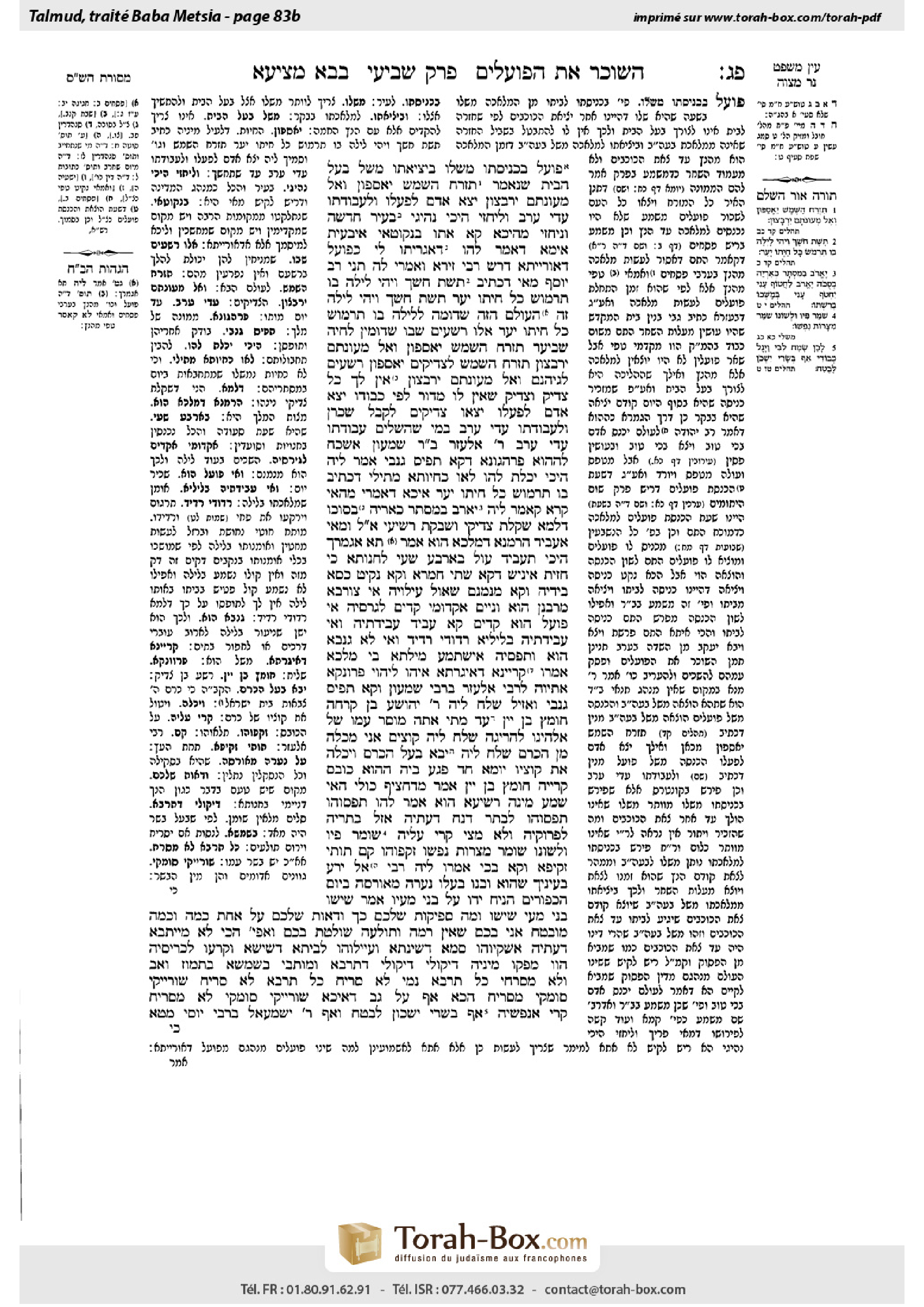
Bava Metzia 83b: Talmud study for Daf Yomi
Study the Talmud for Daf Yomi with scanned pages, Hebrew text, English translations from Sefaria and AI-generated French translations.
Passage selection and English or AI-generated French translation are available where the scan has annotations. Daf Study is independent of Torah-Box and Sefaria.
Browse Bava Metzia · בבא מציעא · All tractatesBava Metzia 83b text and translations
This page of Bava Metzia includes the Aramaic text, an English translation and an AI-generated French translation, alongside the scan above.
בבא מציעא פ״ג ב · Aramaic and Hebrew text
פּוֹעֵל בִּכְנִיסָתוֹ מִשֶּׁלּוֹ, בִּיצִיאָתוֹ מִשֶּׁל בַּעַל הַבַּיִת, שֶׁנֶּאֱמַר: ״תִּזְרַח הַשֶּׁמֶשׁ יֵאָסֵפוּן וְאֶל מְעוֹנֹתָם יִרְבָּצוּן. יֵצֵא אָדָם לְפׇעֳלוֹ וְלַעֲבֹדָתוֹ עֲדֵי עָרֶב״.
וְלִיחְזֵי הֵיכִי נְהִיגִי – בְּעִיר חֲדָשָׁה. וְנִיחְזֵי מֵהֵיכָא קָא אָתוּ – בְּנָקוֹטָאֵי. אִיבָּעֵית אֵימָא: דְּאָמַר לְהוּ – דְּאָגְרִיתוּ לִי כְּפוֹעֵל דְּאוֹרָיְיתָא.
דָּרֵשׁ רַבִּי זֵירָא וְאָמְרִי לַהּ, תָּנֵי רַב יוֹסֵף: מַאי דִּכְתִיב ״תָּשֶׁת חֹשֶׁךְ וִיהִי לָיְלָה בּוֹ תִרְמֹשׂ כׇּל חַיְתוֹ יָעַר״. ״תָּשֶׁת חֹשֶׁךְ וִיהִי לָיְלָה״ – זֶה הָעוֹלָם הַזֶּה שֶׁדּוֹמֶה לְלַיְלָה. ״בּוֹ תִרְמֹשׂ כׇּל חַיְתוֹ יָעַר״ – אֵלּוּ רְשָׁעִים שֶׁבּוֹ, שֶׁדּוֹמִין לְחַיָּה שֶׁבַּיַּעַר.
״תִּזְרַח הַשֶּׁמֶשׁ יֵאָסֵפוּן וְאֶל מְעוֹנֹתָם יִרְבָּצוּן״. ״תִּזְרַח הַשֶּׁמֶשׁ״ – לַצַּדִּיקִים, ״יֵאָסֵפוּן״ – רְשָׁעִים לְגֵיהִנָּם, ״וְאֶל מְעוֹנֹתָם יִרְבָּצוּן״ – אֵין לָךְ כׇּל צַדִּיק וְצַדִּיק שֶׁאֵין לוֹ מָדוֹר לְפִי כְבוֹדוֹ. ״יֵצֵא אָדָם לְפׇעֳלוֹ״ – יֵצְאוּ צַדִּיקִים לְקַבֵּל שְׂכָרָן, ״וְלַעֲבֹדָתוֹ עֲדֵי עָרֶב״ – בְּמִי שֶׁהִשְׁלִים עֲבוֹדָתוֹ עֲדֵי עָרֶב.
רַבִּי אֶלְעָזָר בְּרַבִּי שִׁמְעוֹן אַשְׁכַּח לְהָהוּא פַּרְהַגְוָנָא דְּקָא תָפֵיס גַּנָּבֵי, אֲמַר לֵיהּ: הֵיכִי יָכְלַתְּ לְהוּ, לָאו כְּחֵיוָתָא מְתִילִי, דִּכְתִיב: ״בּוֹ תִרְמֹשׂ כׇּל חַיְתוֹ יָעַר״? אִיכָּא דְּאָמְרִי מֵהַאי קְרָא קָאָמַר לֵיהּ: ״יֶאֱרֹב בַּמִּסְתָּר כְּאַרְיֵה בְסֻכֹּה״. דִּלְמָא שָׁקְלַתְּ צַדִּיקֵי וְשָׁבְקַתְּ רַשִּׁיעֵי?
אֲמַר לֵיהּ: וּמַאי אֶעֱבֵיד? הַרְמָנָא דְמַלְכָּא הוּא. אֲמַר: תָּא אַגְמְרָךְ הֵיכִי תַּעֲבֵיד. עוּל בְּאַרְבַּע שָׁעֵי לְחָנוּתָא, כִּי חָזֵית אִינִישׁ דְּקָא שָׁתֵי חַמְרָא וְקָא נָקֵיט כָּסָא בִּידֵיהּ וְקָא מְנַמְנֵם, שְׁאוֹל עִילָּוֵיהּ.
אִי צוּרְבָּא מֵרַבָּנַן הוּא וְנָיֵים – אקַדּוֹמֵי קַדֵּים לְגִרְסֵיהּ. אִי פּוֹעֵל הוּא – קָדֵים קָא עָבֵיד עֲבִידְתֵּיהּ, וְאִי עֲבִידְתֵּיהּ בְּלֵילְיָא – רַדּוֹדֵי רַדֵּיד. וְאִי לָא – גַּנָּבָא הוּא וְתִפְסֵיהּ.
אִישְׁתְּמַע מִילְּתָא בֵּי מַלְכָּא, אֲמַרוּ: קַרְיָינָא דְאִיגַּרְתָּא אִיהוּ לֶיהֱוֵי פַּרְוַנְקָא. אַתְיוּהּ לְרַבִּי אֶלְעָזָר בְּרַבִּי שִׁמְעוֹן, וְקָא תָפֵיס גַּנָּבֵי וְאָזֵיל. שְׁלַח לֵיהּ רַבִּי יְהוֹשֻׁעַ בֶּן קׇרְחָה חוֹמֶץ בֶּן יַיִן! עַד מָתַי אַתָּה מוֹסֵר עַמּוֹ שֶׁל אֱלֹהֵינוּ לַהֲרִיגָה?
שְׁלַח לֵיהּ: קוֹצִים אֲנִי מְכַלֶּה מִן הַכֶּרֶם. שְׁלַח לֵיהּ: יָבֹא בַּעַל הַכֶּרֶם וִיכַלֶּה אֶת קוֹצָיו. יוֹמָא חַד פְּגַע בֵּיהּ הָהוּא כּוֹבֵס, קַרְיֵיהּ ״חוֹמֶץ בֶּן יַיִן״. אָמַר: מִדַּחֲצִיף כּוּלֵּי הַאי – שְׁמַע מִינַּהּ רַשִּׁיעָא הוּא. אֲמַר לְהוּ: תִּפְסוּהּ. תַּפְסוּהּ.
לְבָתַר דְּנָח דַּעְתֵּיהּ, אֲזַל בָּתְרֵיהּ לְפָרוֹקֵיהּ וְלָא מָצֵי. קָרֵי עֲלֵיהּ: ״שֹׁמֵר פִּיו וּלְשׁוֹנוֹ שֹׁמֵר מִצָּרוֹת נַפְשׁוֹ״. זַקְפוּהּ. קָם תּוּתֵי זְקִיפָא וְקָא בָכֵי. אֲמַרוּ לֵיהּ: רַבִּי, אַל יֵרַע בְּעֵינֶיךָ שֶׁהוּא וּבְנוֹ בָּעֲלוּ נַעֲרָה מְאוֹרָסָה בְּיוֹם הַכִּפּוּרִים.
הִנִּיחַ יָדוֹ עַל בְּנֵי מֵעָיו אָמַר: שִׂישׂוּ בְּנֵי מֵעַי, שִׂישׂוּ! וּמָה סְפֵיקוֹת שֶׁלָּכֶם כָּךְ, וַדָּאוֹת שֶׁלָּכֶם – עַל אַחַת כַּמָּה וְכַמָּה. מוּבְטָח אֲנִי בָּכֶם, שֶׁאֵין רִמָּה וְתוֹלֵעָה שׁוֹלֶטֶת בָּכֶם.
וַאֲפִילּוּ הָכִי לָא מְיַיתְּבָא דַּעְתֵּיהּ. אַשְׁקְיוּהּ סַמָּא דְשִׁינְתָּא וְעַיְּילוּהּ לְבֵיתָא דְשֵׁישָׁא וּקְרַעוּ לִכְרֵיסֵיהּ. הֲווֹ מַפְּקִי מִינֵּיהּ דִּיקּוּלֵי דִּיקּוּלֵי דְּתַרְבָּא וּמוֹתְבִי בְּשִׁמְשָׁא בְּתַמּוּז וְאָב וְלָא מַסְרְחִי.
כֹּל תַּרְבָּא נָמֵי לָא (סריח) [מַסְרַח]! כֹּל תַּרְבָּא (לָא סְרִיחַ), [כִּי אִית בֵּהּ] שֻׁרְיָקֵי סֻמָּקֵי מַסְרַח. הָכָא, אַף עַל גַּב דְּאִכָּא שֻׁרְיָקֵי סֻמָּקֵי – לָא מַסְרַח. קָרֵי אַנַּפְשֵׁהּ: ״אַף בְּשָׂרִי יִשְׁכֹּן לָבֶטַח״.
וְאַף רַבִּי יִשְׁמָעֵאל בְּרַבִּי יוֹסֵי מְטָא
Bava Metzia 83b · English translation
A laborer’s entrance into the city from the field at the end of a day’s work is at his own expense, i.e., he must work until the very end of the day before returning home, and he is not paid for his travel time. In contrast, his departure to work is at his employer’s expense, i.e., he may travel after sunrise, which is time that he is paid for. The source for this is as it is stated: “The sun rises; they slink away and couch in their dens; man goes forth to his work and to his labor until the evening” (Psalms 104:22–23). This verse indicates that people set out to work only from sunrise, but they work until the very end of the day.
The Gemara asks: But if employment practices are in accordance with regional custom, how can a source be cited from a verse? Let us see how they are accustomed to working in that place. The Gemara answers: The statement of Reish Lakish is with regard to a new city, which does not yet have an accepted practice. The Gemara asks: Even so, let us see from which city the laborers originally came, and let them follow the customs of that city. The Gemara answers: This is a case of an eclectic group of laborers, who came from many different cities. The Gemara offers an alternative answer: If you wish, say instead that the employer said to the laborer: I am hiring you as a laborer by Torah law. According to this explanation, Reish Lakish is detailing the halakha by Torah law.
With regard to the aforementioned psalm, the Gemara notes: Rabbi Zeira interpreted a verse homiletically, and some say that Rav Yosef taught in a baraita: What is the meaning of that which is written: “You make darkness and it is night, in which all the beasts of the forest creep forth” (Psalms 104:20)? “You make darkness and it is night”; this is referring to this world, which resembles nighttime. “In which all the beasts of the forest creep forth”; these are the wicked in this world, who resemble a beast of the forest, as the wicked have great influence in this world.
With regard to the World-to-Come, the verse states: “The sun rises; they slink away and couch in their dens” (Psalms 104:22). “The sun rises” for the righteous, and “they slink away,” i.e., the wicked go to Gehenna. As for the phrase: “And couch in their dens,” it is interpreted as follows: You will not have a single righteous person who will not have his own residence in the World-to-Come, as befitting his dignity. With regard to the phrase: “Man goes forth to his work,” it indicates that the righteous go forth to receive their reward. Finally, the phrase: “And to his labor until the evening” (Psalms 104:22), teaches that the verse is referring to one who has completed his labor by the evening, i.e., before the evening of his lifetime, his death.
The Gemara relates a story that involves rising early. Rabbi Elazar, son of Rabbi Shimon, found a certain officer [parhagavna] whose responsibility was to arrest thieves. He said to the officer: How are you able to arrest them? Aren’t they likened to beasts, as it is written: “You make darkness and it is night, in which all the beasts of the forest creep forth” (Psalms 104:20)? There are those who say that he said to him a proof from this verse: “He lies in wait in a secret place as a lion in his lair, he lies in wait to catch the poor; he catches the poor when he draws him up in his net” (Psalms 10:9). Since the wicked are so devious, perhaps you apprehend the righteous and leave the wicked alone?
The officer said to him: But what should I do? It is the king’s edict [harmana] that I must arrest thieves, and I am performing my job to the best of my ability. Rabbi Elazar, son of Rabbi Shimon, said to him: Come and I will instruct you how you should do it. At the fourth hour of the day enter the tavern. When you see someone drinking wine, holding his cup in his hand, and dozing, inquire about his background.
If he is a Torah scholar and is dozing, assume that he rose early in the morning for his studies. If he is a daytime laborer, assume that he rose early and performed his work. And if his work is at night and no one heard him working, it is possible that this is because he draws copper wires, which is a form of labor that does not produce noise. And if he is none of these, he is a thief, and you should arrest him, as it can be assumed that he was awake the previous night because he was stealing, and that is why he is now dozing off.
This matter of the advice of Rabbi Elazar, son of Rabbi Shimon, was heard in the king’s palace. The king’s ministers said: Let the reader of the letter be its messenger [parvanka], i.e., since Rabbi Elazar, son of Rabbi Shimon, offered this advice, he should be the one to implement it. They brought Rabbi Elazar, son of Rabbi Shimon, to the authorities who appointed him to this task, and he proceeded to arrest thieves. Rabbi Yehoshua ben Korḥa sent Rabbi Elazar, son of Rabbi Shimon, the following message: You are vinegar, son of wine, i.e., you are wicked in comparison to your father, the righteous Rabbi Shimon, just as vinegar is spoiled wine. Until when will you inform on the nation of our God to be sentenced to execution by a gentile king’s court?
Rabbi Elazar, son of Rabbi Shimon, sent a message back to him: I am merely eradicating thorns from the vineyard, i.e., I am removing the wicked from the Jewish people. Rabbi Yehoshua ben Korḥa sent back to him: Let the Owner of the vineyard, i.e., God, come and eradicate His own thorns. It is not your place to do this. The Gemara relates: One day, a certain laundryman met Rabbi Elazar, son of Rabbi Shimon, and called him vinegar, son of wine. Rabbi Elazar, son of Rabbi Shimon, said: From the fact that this man acted so insolently by vilifying a Torah scholar, one can conclude that he is a wicked person. He told the authorities: Arrest that man. They arrested him and condemned him to death.
After his mind settled, i.e., when his anger abated, Rabbi Elazar, son of Rabbi Shimon, regretted his hasty decision. He went after the laundryman in order to ransom him and save him from execution, but he was unable to do so. He read the verse about him: “Whoever keeps his mouth and his tongue, keeps his soul from troubles” (Proverbs 21:23), i.e., had the laundryman not issued his derogatory comment he would have been spared this fate. Ultimately, they hanged the laundryman. Rabbi Elazar, son of Rabbi Shimon, stood beneath the gallows and wept. Those who were present said to him: Our teacher, let it not be bad in your eyes that you caused his death, as this laundryman was a wholly wicked person; you should know that he and his son both engaged in intercourse with a betrothed young woman on Yom Kippur.
Upon hearing this, Rabbi Elazar, son of Rabbi Shimon, placed his hand upon his belly, over his innards, and said: Rejoice, my innards, rejoice! If your mere suspicions are so accurate, all the more so your certainties must be correct. If the condemnation of this man based upon the suspicions raised by his insolence proved to be correct, the identification of thieves in accordance with logical reasoning must certainly be accurate. I am assured about you, my innards, that worm and maggot will not affect you, which is a sign of a completely righteous person.
Nevertheless, his mind was not calmed. He decided to test himself. He arranged for people to give him a sedative to drink, and they brought him into a house of marble, where surgeries were performed, and cut open his belly. They removed baskets upon baskets of fat from it, placed them in the hot sun in the summer months of Tammuz and Av, and the fat did not putrefy. In this manner, Rabbi Elazar, son of Rabbi Shimon, received proof that his decisions were correct and that he was a wholly righteous individual.
The Gemara questions what the proof was: This is not sufficient proof, as all fat that is not attached to flesh does not putrefy. The Gemara answers: True, all fat not attached to flesh does not putrefy, but the red veins within the fat do putrefy. Here, by contrast, although there were red veins in the fat, they did not putrefy, which is a sign of his righteousness. Rabbi Elazar, son of Rabbi Shimon, read the verses about himself: “I have set the Lord always before me…therefore my heart is glad, and my glory rejoices; my flesh also dwells in safety” (Psalms 16:8–9).
The Gemara relates: And a similar incident also occurred to Rabbi Yishmael, son of Rabbi Yosei, i.e., he too was appointed head officer.
Bava Metzia 83b · Traduction française (IA)
L'entrée du travailleur dans la ville depuis le champ à la fin d'une journée de travail est à ses frais, c'est-à-dire qu'il doit travailler jusqu'au bout de la journée avant de rentrer chez lui, et il n'est pas rémunéré pour le temps de trajet. À l'inverse, son départ pour le travail est à son employeur, c'est-à-dire qu'il peut voyager après le lever du soleil, ce qui est rémunéré. La source de cela est telle qu'il est dit : « Le soleil se lève ; ils s'éloignent et s'allongent dans leurs tanières ; l'homme sort à son travail et à son labeur jusqu'au soir » (Psaumes 104:22-23). Cette versette indique que les gens partent au travail seulement à l'aube, mais qu'ils travaillent jusqu'au bout de la journée.
Le Guemara pose la question : Mais si les pratiques d'emploi sont conformes aux usages locaux, comment peut-on citer une source d'une versette ? Voyons comment ils sont habitués à travailler dans cette région. Le Guemara répond : La déclaration de Reish Lakish est relative à une nouvelle ville, qui n'a pas encore d'usage établi. Le Guemara pose une autre question : Même ainsi, voyons d'abord de quelle ville les travailleurs sont originaires, et qu'ils suivent les coutumes de cette ville. Le Guemara répond : Il s'agit d'un groupe éclectique de travailleurs, qui sont partis de différentes villes. Le Guemara propose une autre réponse : Si tu veux, dis plutôt que l'employeur a dit au travailleur : Je t'engage comme travailleur selon la Loi. Selon cette explication, Reish Lakish décrit la halakha selon la Loi.
Concernant le psaume mentionné précédemment, le Guemara note : Rabbi Zeira a interprété une versette de manière allégorique, et certains disent que Rav Yosef a enseigné dans une baraïta : Quelle est la signification de ce qui est écrit : « Tu fais l'obscurité et c'est la nuit, dans laquelle toutes les bêtes de la forêt sortent » (Psaumes 104:20) ? « Tu fais l'obscurité et c'est la nuit » : cela fait référence à ce monde, qui ressemble à la nuit. « Dans laquelle toutes les bêtes de la forêt sortent » : ce sont les méchants de ce monde, qui ressemblent à des bêtes de la forêt, car les méchants ont une grande influence dans ce monde.
Concernant le Monde à Venir, la versette dit : « Le soleil se lève ; ils s'éloignent et s'allongent dans leurs tanières » (Psaumes 104:22). « Le soleil se lève » pour les justes, et « ils s'éloignent », c'est-à-dire les méchants vont en Gehenna. En ce qui concerne la phrase : « Et s'allongent dans leurs tanières », cela est interprété comme suit : Tu n'auras pas un seul justes qui ne disposera pas d'une résidence propre dans le Monde à Venir, conformément à son honneur. En ce qui concerne la phrase : « L'homme sort à son travail », cela indique que les justes sortent pour recevoir leur récompense. Enfin, la phrase : « Et à son labeur jusqu'au soir » (Psaumes 104:22) enseigne que la versette fait référence à celui qui a terminé son labeur avant le soir, c'est-à-dire avant le soir de sa vie, son décès.
Le Guemara raconte une histoire concernant l'art de se lever tôt. Rabbi Elazar, fils de Rabbi Shimon, a trouvé un certain officier [parhagavna] dont la responsabilité était d'arrêter les voleurs. Il lui a dit : Comment peux-tu arrêter les voleurs ? Ne sont-ils pas comparés à des bêtes, comme il est écrit : « Tu fais l'obscurité et c'est la nuit, dans laquelle toutes les bêtes de la forêt sortent » (Psaumes 104:20) ? Certains disent qu'il lui a donné une preuve à partir de cette versette : « Il attend en un lieu secret comme un lion dans son antre, il attend pour capturer le pauvre ; il capture le pauvre quand il le tire dans son filet » (Psaumes 10:9). Puisque les méchants sont si rusés, peut-être que tu appréhendes les justes et laisses les méchants en paix ?
L'officier a répondu à lui : Mais que dois-je faire ? C'est l'édit du roi [harmana] que je dois arrêter les voleurs, et je fais mon travail au mieux de mes capacités. Rabbi Elazar, fils de Rabbi Shimon, a dit à lui : Viens, je vais t'enseigner comment tu dois le faire. À la quatrième heure de la journée, entre dans la taverne. Quand tu vois quelqu'un qui boit du vin, qui tient son verre à la main et qui s'endort, interroge son origine.
Si c'est un savant de la Torah et qu'il s'endort, suppose qu'il s'est levé tôt en matinée pour ses études. Si c'est un travailleur de jour, suppose qu'il s'est levé tôt et a effectué son travail. Et si son travail est la nuit et que personne n'a entendu son travail, il est possible que cela soit parce qu'il tire des fils de cuivre, qui est une forme de travail qui ne produit pas de bruit. Et si ce n'est pas l'un de ces cas, il est un voleur, et tu dois l'arrêter, car on peut supposer qu'il était réveillé la nuit précédente parce qu'il volait, et c'est pourquoi il s'endort maintenant.
Cette affaire de l'avis de Rabbi Elazar, fils de Rabbi Shimon, a été entendue dans le palais du roi. Les ministres du roi dirent : Fais le lecteur de la lettre être son messager [parvanka], c'est-à-dire que puisque Rabbi Elazar, fils de Rabbi Shimon, a donné cet avis, il devrait être celui qui l'applique. Ils amenèrent Rabbi Elazar, fils de Rabbi Shimon, devant les autorités qui l'avaient chargé de cette tâche, et il procéda à l'arrestation des voleurs. Rabbi Yehoshua ben Korḥa envoya à Rabbi Elazar, fils de Rabbi Shimon, le message suivant : Tu es du vinaigre, fils du vin, c'est-à-dire que tu es mauvais par rapport à ton père, le juste Rabbi Shimon, tout comme le vinaigre est du vin corrompu. Jusqu'à quand vas-tu informer le peuple de notre Dieu pour être condamné à la peine de mort par un tribunal d'un roi païen ?
Rabbi Elazar, fils de Rabbi Shimon, envoya un message en retour à lui : Je suis simplement en train d'éliminer les épines du vignoble, c'est-à-dire que je retire les méchants du peuple juif. Rabbi Yehoshua ben Korḥa envoya en retour à lui : Fais venir le propriétaire du vignoble, c'est-à-dire Dieu, pour éliminer Ses propres épines. Ce n'est pas à toi de le faire. Le Guemara rapporte : Un jour, un certain blanchisseur rencontra Rabbi Elazar, fils de Rabbi Shimon, et l'appela du vinaigre, fils du vin. Rabbi Elazar, fils de Rabbi Shimon, dit : D'après le fait que cet homme a agi ainsi impudément en vilipendant un savant de la Torah, on peut conclure qu'il est un méchant. Il dit aux autorités : Arrêtez cet homme. Ils l'arrêtèrent et le condamnèrent à mort.
Après que son esprit se fut calmé, c'est-à-dire lorsque sa colère s'était apaisée, le Rabbi Eléazar, fils du Rabbi Shimon, regretta sa décision hâtive. Il alla après le laveur afin de le racheter et de le sauver de l'exécution, mais il ne put le faire. Il lut la parole concernant lui : « Celui qui garde sa bouche et sa langue, garde son âme de malheurs » (Proverbes 21:23), c'est-à-dire qu'avec l'observation du laveur n'ayant pas fait ce commentaire dégradant, il aurait été épargné de ce sort. Finalement, ils pendirent le laveur. Le Rabbi Eléazar, fils du Rabbi Simon, se tint sous la potence et pleura. Ceux qui étaient présents lui dirent : Notre maître, ne permettez pas que cela vous soit pénible, que vous ayez causé sa mort, car ce laveur était un homme entièrement méchant ; vous devriez savoir qu'il et son fils ont tous deux eu des relations avec une jeune fiancée le jour de l'Expiation.
En entendant cela, le Rabbi Eléazar, fils du Rabbi Simon, posa sa main sur son ventre, sur ses entrailles, et dit : Réjouis-toi, mes entrailles, réjouis-toi ! Si tes simples soupçons sont si précis, combien plus encore tes certitudes doivent être exactes. Si la condamnation de cet homme, fondée sur les soupçons évoqués par son insolence, s'est révélée exacte, l'identification des voleurs selon la raison logique doit certainement être exacte. Je suis assuré, mes entrailles, que les vers et les vers de terre ne vous affecteront pas, ce qui est un signe d'un homme entièrement juste.
Cependant, son esprit ne se calma pas. Il décida de se tester. Il fit préparer un calmant à boire, et on l'amena dans une maison de marbre, où des opérations chirurgicales étaient effectuées, et on ouvrit son ventre. On retira des seaux de graisse, on les plaça au soleil brûlant durant les mois d'Av et de Tammouz, et la graisse ne putrissait pas. Ainsi, le Rabbi Eléazar, fils du Rabbi Simon, obtint la preuve que ses décisions étaient justes et qu'il était un homme entièrement juste.
La Guemara questionne la nature de la preuve : cela n'est pas une preuve suffisante, car toute la graisse non attachée à la chair ne putrifie pas. La Guemara répond : Vrai, toute la graisse non attachée à la chair ne putrifie pas, mais les veines rouges à l'intérieur de la graisse putrissent. Ici, par contre, bien qu'il y ait des veines rouges dans la graisse, elles ne putrissèrent pas, ce qui est un signe de sa justesse. Le Rabbi Eléazar, fils du Rabbi Simon, a lu les versets concernant lui-même : « J'ai mis le Seigneur toujours devant moi... donc mon cœur est joyeux, et ma gloire se réjouit ; ma chair aussi demeure en sécurité » (Psaumes 16:8–9).
La Guemara rapporte : Un incident similaire s'est également produit au Rabbi Yishmael, fils du Rabbi Yosei, c'est-à-dire qu'il fut également nommé chef de la garde.
Traduction française générée par IA à partir de l’édition anglaise de Sefaria. Vérifie toujours un passage avec le texte source.
Text from Sefaria: William Davidson Edition - Vocalized Aramaic (CC BY NC); William Davidson Edition - English (CC BY NC).