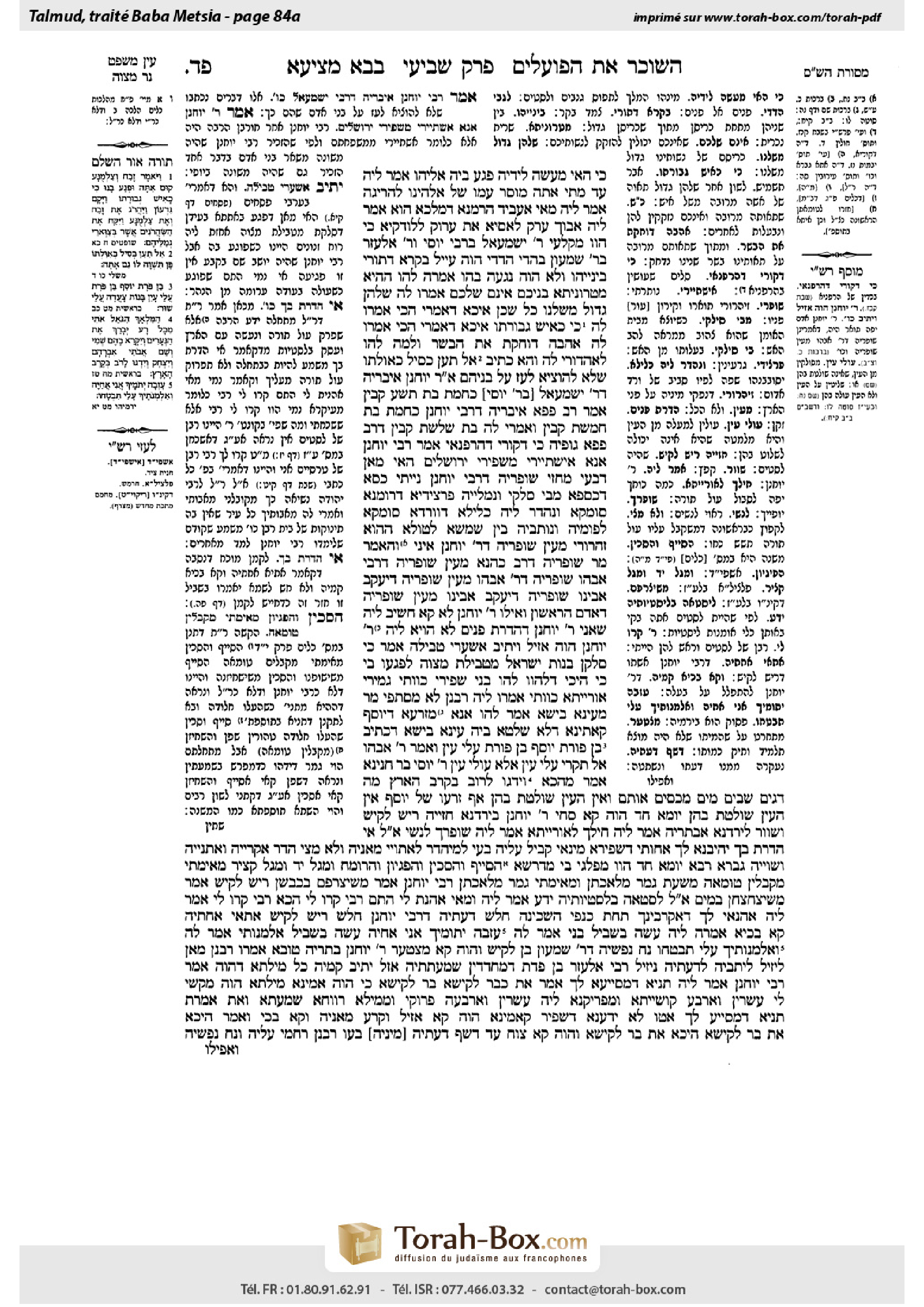
Bava Metzia 84a: Talmud study for Daf Yomi
Study the Talmud for Daf Yomi with scanned pages, Hebrew text, English translations from Sefaria and AI-generated French translations.
Passage selection and English or AI-generated French translation are available where the scan has annotations. Daf Study is independent of Torah-Box and Sefaria.
Browse Bava Metzia · בבא מציעא · All tractatesBava Metzia 84a text and translations
This page of Bava Metzia includes the Aramaic text, an English translation and an AI-generated French translation, alongside the scan above.
בבא מציעא פ״ד א · Aramaic and Hebrew text
כִּי הַאי מַעֲשֶׂה לִידֵיהּ. פְּגַע בֵּיהּ אֵלִיָּהוּ,
אֲמַר לֵיהּ: עַד מָתַי אַתָּה מוֹסֵר עַמּוֹ שֶׁל אֱלֹהֵינוּ לַהֲרִיגָה? אֲמַר לֵיהּ: מַאי אֶעֱבֵיד? הַרְמָנָא דְמַלְכָּא הוּא! אֲמַר לֵיהּ: אֲבוּךְ עֲרַק לְאַסְיָא, אַתְּ עֲרוֹק לְלוּדְקִיָּא.
כִּי הֲווֹ מִקַּלְעִי רַבִּי יִשְׁמָעֵאל בְּרַבִּי יוֹסֵי וְרַבִּי אֶלְעָזָר בְּרַבִּי שִׁמְעוֹן בַּהֲדֵי הֲדָדֵי, הֲוָה עָיֵיל בַּקְרָא דְתוֹרֵי בֵּינַיְיהוּ וְלָא הֲוָה נָגְעָה בְּהוּ.
אֲמַרָה לְהוּ הָהִיא מַטְרוֹנִיתָא: בְּנֵיכֶם אֵינָם שֶׁלָּכֶם. אֲמַרוּ לַהּ: שֶׁלָּהֶן גָּדוֹל מִשֶּׁלָּנוּ. כׇּל שֶׁכֵּן. אִיכָּא דְאָמְרִי, הָכִי אֲמַרוּ לַהּ: ״כִּי כָאִישׁ גְּבוּרָתוֹ״. אִיכָּא דְאָמְרִי הָכִי, אֲמַרוּ לַהּ: ״אַהֲבָה דּוֹחֶקֶת אֶת הַבָּשָׂר״.
וּלְמָה לְהוּ לְאַהְדּוֹרֵי לַהּ? וְהָא כְּתִיב: ״אַל תַּעַן כְּסִיל כְּאִוַּלְתּוֹ״! שֶׁלֹּא לְהוֹצִיא לַעַז עַל בְּנֵיהֶם.
אָמַר רַבִּי יוֹחָנָן: אֵיבְרֵיהּ דְּרַבִּי יִשְׁמָעֵאל [בְּרַבִּי יוֹסֵי] כְּחֵמֶת בַּת תֵּשַׁע קַבִּין. אָמַר רַב פָּפָּא: אֵיבְרֵיהּ דְּרַבִּי יוֹחָנָן כְּחֵמֶת בַּת חֲמֵשֶׁת קַבִּין, וְאָמְרִי לַהּ בַּת שְׁלֹשֶׁת קַבִּין. דְּרַב פָּפָּא גּוּפֵיהּ כִּי דְקוּרֵי דְּהַרְפְּנָאֵי.
אָמַר רַבִּי יוֹחָנָן: אֲנָא אִשְׁתַּיַּירִי מִשַּׁפִּירֵי יְרוּשָׁלַיִם הַאי מַאן דְּבָעֵי מִחְזֵי שׁוּפְרֵיהּ דְּרַבִּי יוֹחָנָן, נַיְיתֵי כָּסָא דְכַסְפָּא מִבֵּי סִלְקֵי, וּנְמַלְּיֵיהּ פַּרְצִידַיָּא דְּרוּמָּנָא סוּמָּקָא, וְנַהְדַּר לֵיהּ כְּלִילָא דְּוַורְדָּא סוּמָּקָא לְפוּמֵּיהּ, וְנוֹתְבֵיהּ בֵּין שִׁמְשָׁא לְטוּלָּא, (הָהוּא) [הָנְהוּ] זַהֲרוּרֵי מֵעֵין שׁוּפְרֵיהּ דְּרַבִּי יוֹחָנָן.
אִינִי? וְהָאָמַר מָר: שׁוּפְרֵיהּ דְּרַב כָּהֲנָא מֵעֵין שׁוּפְרֵיהּ דְּרַבִּי אֲבָהוּ, שׁוּפְרֵיהּ דְּרַבִּי אֲבָהוּ מֵעֵין שׁוּפְרֵיהּ דְּיַעֲקֹב אָבִינוּ, שׁוּפְרֵיהּ דְּיַעֲקֹב אָבִינוּ מֵעֵין שׁוּפְרֵיהּ דְּאָדָם הָרִאשׁוֹן! וְאִילּוּ רַבִּי יוֹחָנָן לָא קָא חָשֵׁיב לֵיהּ! שָׁאנֵי רַבִּי יוֹחָנָן, דְּהַדְרַת פָּנִים לָא הַוְיָא לֵיהּ.
רַבִּי יוֹחָנָן הֲוָה אָזֵיל וְיָתֵיב אַשַּׁעֲרֵי טְבִילָה, אֲמַר: כִּי סָלְקָן בְּנוֹת יִשְׂרָאֵל מִטְּבִילַת מִצְוָה לִפְגְּעוּ בִּי, כִּי הֵיכִי דְּלֶהֱווֹ לְהוּ בְּנֵי שַׁפִּירֵי כְּווֹתִי, גְּמִירִי אוֹרָיְיתָא כְּווֹתִי.
אֲמַרוּ לֵיהּ רַבָּנַן: לָא מִסְתְּפֵי מָר מֵעֵינָא בִּישָׁא? אֲמַר לְהוּ: אֲנָא מִזַּרְעָא דְּיוֹסֵף קָאָתֵינָא, דְּלָא שָׁלְטָא בֵּיהּ עֵינָא בִּישָׁא. דִּכְתִיב: ״בֵּן פֹּרָת יוֹסֵף בֵּן פֹּרָת עֲלֵי עָיִן״, וְאָמַר רַבִּי אֲבָהוּ: אַל תִּקְרֵי ״עֲלֵי עָיִן״ אֶלָּא ״עוֹלֵי עָיִן״.
רַבִּי יוֹסֵי בַּר חֲנִינָא אֲמַר מֵהָכָא: ״וְיִדְגּוּ לָרֹב בְּקֶרֶב הָאָרֶץ״, מָה דָּגִים שֶׁבַּיָּם מַיִם מְכַסִּים אוֹתָם וְאֵין הָעַיִן שׁוֹלֶטֶת בָּהֶן – אַף זַרְעוֹ שֶׁל יוֹסֵף אֵין הָעַיִן שׁוֹלֶטֶת בָּהֶן.
יוֹמָא חַד הֲוָה קָא סָחֵי רַבִּי יוֹחָנָן בְּיַרְדְּנָא. חַזְיֵיהּ רֵישׁ לָקִישׁ וּשְׁוַור לְיַרְדְּנָא אַבָּתְרֵיהּ. אֲמַר לֵיהּ חֵילָךְ לְאוֹרָיְיתָא. אֲמַר לֵיהּ שׁוּפְרָךְ לְנָשֵׁי. אֲמַר לֵיהּ אִי הָדְרַתְּ בָּךְ יָהֵיבְנָא לָךְ אֲחוֹתִי, דְּשַׁפִּירָא מִינַּאי. קַבֵּיל עֲלֵיהּ. בָּעֵי לְמִיהְדַּר לְאֵתוֹיֵי מָאנֵיהּ וְלָא מָצֵי הָדַר.
אַקְרְיֵיהּ וְאַתְנְיֵיהּ וְשַׁוְּיֵיהּ גַּבְרָא רַבָּא. יוֹמָא חַד הֲווֹ מִפַּלְגִי בֵּי מִדְרְשָׁא: הַסַּיִיף וְהַסַּכִּין וְהַפִּגְיוֹן וְהָרוֹמַח וּמַגַּל יָד וּמַגַּל קָצִיר מֵאֵימָתַי מְקַבְּלִין טוּמְאָה – מִשְּׁעַת גְּמַר מְלַאכְתָּן.
וּמֵאֵימָתַי גְּמַר מְלַאכְתָּן? רַבִּי יוֹחָנָן אוֹמֵר: מִשֶּׁיְּצָרְפֵם בַּכִּבְשָׁן. רֵישׁ לָקִישׁ אָמַר: מִשֶּׁיְּצַחְצְחֵן בְּמַיִם. אֲמַר לֵיהּ לִסְטָאָה בְּלִסְטְיוּתֵיהּ יָדַע. אֲמַר לֵיהּ: וּמַאי אַהֲנֵית לִי? הָתָם ״רַבִּי״ קָרוּ לִי, הָכָא ״רַבִּי״ קָרוּ לִי! אֲמַר לֵיהּ: אַהֲנַאי לָךְ דַּאֲקָרְבִינָּךְ תַּחַת כַּנְפֵי הַשְּׁכִינָה.
חֲלַשׁ דַּעְתֵּיהּ דְּרַבִּי יוֹחָנָן, חֲלַשׁ רֵישׁ לָקִישׁ. אֲתַאי אֲחָתֵיהּ קָא בָכְיָא. אֲמַרָה לֵיהּ: עֲשֵׂה בִּשְׁבִיל בָּנַי! אֲמַר לַהּ: ״עׇזְבָה יְתֹמֶיךָ אֲנִי אֲחַיֶּה״. עֲשֵׂה בִּשְׁבִיל אַלְמְנוּתִי! אֲמַר לַהּ: ״וְאַלְמְנוֹתֶיךָ עָלַי תִּבְטָחוּ״.
נָח נַפְשֵׁיהּ דְּרַבִּי שִׁמְעוֹן בֶּן לָקִישׁ, וַהֲוָה קָא מִצְטַעַר רַבִּי יוֹחָנָן בָּתְרֵיהּ טוּבָא. אֲמַרוּ רַבָּנַן: מַאן לֵיזִיל לְיַתֹּבֵיהּ לְדַעְתֵּיהּ? נֵיזִיל רַבִּי אֶלְעָזָר בֶּן פְּדָת, דִּמְחַדְּדָין שְׁמַעְתָּתֵיהּ.
אֲזַל יְתֵיב קַמֵּיהּ. כֹּל מִילְּתָא דַּהֲוָה אָמַר רַבִּי יוֹחָנָן אֲמַר לֵיהּ: תַּנְיָא דִּמְסַיְּיעָא לָךְ. אֲמַר: אַתְּ כְּבַר לְקִישָׁא?! בַּר לְקִישָׁא, כִּי הֲוָה אָמֵינָא מִילְּתָא, הֲוָה מַקְשֵׁי לִי עֶשְׂרִין וְאַרְבַּע קוּשְׁיָיתָא, וּמְפָרְקִינָא לֵיהּ עֶשְׂרִין וְאַרְבְּעָה פֵּרוּקֵי, וּמִמֵּילָא רָוְוחָא שְׁמַעְתָּא. וְאַתְּ אָמְרַתְּ: ״תַּנְיָא דִּמְסַיַּיע לָךְ״, אַטּוּ לָא יָדַעְנָא דְּשַׁפִּיר קָאָמֵינָא?
הֲוָה קָא אָזֵיל וְקָרַע מָאנֵיהּ וְקָא בָכֵי וְאָמַר: ״הֵיכָא אַתְּ בַּר לָקִישָׁא, הֵיכָא אַתְּ בַּר לָקִישָׁא״! וַהֲוָה קָא צָוַח עַד דְּשָׁף דַּעְתֵּיהּ מִינֵּיהּ. בְּעוֹ רַבָּנַן רַחֲמֵי עֲלֵיהּ וְנָח נַפְשֵׁיהּ.
Bava Metzia 84a · English translation
Elijah the prophet encountered him
and said to him: Until when will you inform on the nation of our God to be sentenced to execution? Rabbi Yishmael, son of Rabbi Yosei, said to Elijah: What should I do? It is the king’s edict that I must obey. Elijah said to him: Faced with this choice, your father fled to Asia. You should flee to Laodicea rather than accept this appointment.
§ With regard to these Sages, the Gemara adds: When Rabbi Yishmael, son of Rabbi Yosei, and Rabbi Elazar, son of Rabbi Shimon, would meet each other, it was possible for a pair of oxen to enter and fit between them, under their bellies, without touching them, due to their excessive obesity.
A certain Roman noblewoman [matronita] once said to them: Your children are not really your own, as due to your obesity it is impossible that you engaged in intercourse with your wives. They said to her: Theirs, i.e., our wives’ bellies, are larger than ours. She said to them: All the more so you could not have had intercourse. There are those who say that this is what they said to her: “For as the man is, so is his strength” (Judges 8:21), i.e., our sexual organs are proportionate to our bellies. There are those who say that this is what they said to her: Love compresses the flesh.
The Gemara asks: And why did they respond to her audacious and foolish question? After all, it is written: “Answer not a fool according to his folly, lest you also be like him” (Proverbs 26:4). The Gemara answers: They answered her in order not to cast aspersions on the lineage of their children.
The Gemara continues discussing the bodies of these Sages: Rabbi Yoḥanan said: The organ of Rabbi Yishmael, son of Rabbi Yosei, was the size of a jug of nine kav. Rav Pappa said: The organ of Rabbi Yoḥanan was the size of a jug of five kav, and some say it was the size of a jug of three kav. Rav Pappa himself had a belly like the baskets [dikurei] made in Harpanya.
With regard to Rabbi Yoḥanan’s physical features, the Gemara adds that Rabbi Yoḥanan said: I alone remain of the beautiful people of Jerusalem. The Gemara continues: One who wishes to see something resembling the beauty of Rabbi Yoḥanan should bring a new, shiny silver goblet from the smithy and fill it with red pomegranate seeds [partzidaya] and place a diadem of red roses upon the lip of the goblet, and position it between the sunlight and shade. That luster is a semblance of Rabbi Yoḥanan’s beauty.
The Gemara asks: Is that so? Was Rabbi Yoḥanan so beautiful? But doesn’t the Master say: The beauty of Rav Kahana is a semblance of the beauty of Rabbi Abbahu; the beauty of Rabbi Abbahu is a semblance of the beauty of Jacob, our forefather; and the beauty of Jacob, our forefather, is a semblance of the beauty of Adam the first man, who was created in the image of God. And yet Rabbi Yoḥanan is not included in this list. The Gemara answers: Rabbi Yoḥanan is different from these other men, as he did not have a beauty of countenance, i.e., he did not have a beard.
The Gemara continues to discuss Rabbi Yoḥanan’s beauty. Rabbi Yoḥanan would go and sit by the entrance to the ritual bath. He said to himself: When Jewish women come up from their immersion for the sake of a mitzva, after their menstruation, they should encounter me first, so that they have beautiful children like me, and sons learned in Torah like me. This is based on the idea that the image upon which a woman meditates during intercourse affects the child she conceives.
The Rabbis said to Rabbi Yoḥanan: Isn’t the Master worried about being harmed by the evil eye by displaying yourself in this manner? Rabbi Yoḥanan said to them: I come from the offspring of Joseph, over whom the evil eye does not have dominion, as it is written: “Joseph is a fruitful vine, a fruitful vine by a fountain [alei ayin]” (Genesis 49:22); and Rabbi Abbahu says: Do not read the verse as saying: “By a fountain [alei ayin]”; rather, read it as: Those who rise above the evil eye [olei ayin]. Joseph’s descendants are not susceptible to the influence of the evil eye.
Rabbi Yosei bar Ḥanina said that this idea is derived from here: “And let them grow [veyidgu] into a multitude in the midst of the earth” (Genesis 48:16). Just as with regard to fish [dagim] in the sea, the water covers them and the evil eye therefore has no dominion over them, as they are not seen, so too, with regard to the offspring of Joseph, the evil eye has no dominion over them.
The Gemara relates: One day, Rabbi Yoḥanan was bathing in the Jordan River. Reish Lakish saw him and jumped into the Jordan, pursuing him. At that time, Reish Lakish was the leader of a band of marauders. Rabbi Yoḥanan said to Reish Lakish: Your strength is fit for Torah study. Reish Lakish said to him: Your beauty is fit for women. Rabbi Yoḥanan said to him: If you return to the pursuit of Torah, I will give you my sister in marriage, who is more beautiful than I am. Reish Lakish accepted upon himself to study Torah. Subsequently, Reish Lakish wanted to jump back out of the river to bring back his clothes, but he was unable to return, as he had lost his physical strength as soon as he accepted the responsibility to study Torah upon himself.
Rabbi Yoḥanan taught Reish Lakish Bible, and taught him Mishna, and turned him into a great man. Eventually, Reish Lakish became one of the outstanding Torah scholars of his generation. One day the Sages of the study hall were engaging in a dispute concerning the following baraita: With regard to the sword, the knife, the dagger [vehapigyon], the spear, a hand sickle, and a harvest sickle, from when are they susceptible to ritual impurity? The baraita answers: It is from the time of the completion of their manufacture, which is the halakha with regard to metal vessels in general.
These Sages inquired: And when is the completion of their manufacture? Rabbi Yoḥanan says: It is from when one fires these items in the furnace. Reish Lakish said: It is from when one scours them in water, after they have been fired in the furnace. Rabbi Yoḥanan said to Reish Lakish: A bandit knows about his banditry, i.e., you are an expert in weaponry because you were a bandit in your youth. Reish Lakish said to Rabbi Yoḥanan: What benefit did you provide me by bringing me close to Torah? There, among the bandits, they called me: Leader of the bandits, and here, too, they call me: Leader of the bandits. Rabbi Yoḥanan said to him: I provided benefit to you, as I brought you close to God, under the wings of the Divine Presence.
As a result of the quarrel, Rabbi Yoḥanan was offended, which in turn affected Reish Lakish, who fell ill. Rabbi Yoḥanan’s sister, who was Reish Lakish’s wife, came crying to Rabbi Yoḥanan, begging that he pray for Reish Lakish’s recovery. She said to him: Do this for the sake of my children, so that they should have a father. Rabbi Yoḥanan said to her the verse: “Leave your fatherless children, I will rear them” (Jeremiah 49:11), i.e., I will take care of them. She said to him: Do so for the sake of my widowhood. He said to her the rest of the verse: “And let your widows trust in Me.”
Ultimately, Rabbi Shimon ben Lakish, Reish Lakish, died. Rabbi Yoḥanan was sorely pained over losing him. The Rabbis said: Who will go to calm Rabbi Yoḥanan’s mind and comfort him over his loss? They said: Let Rabbi Elazar ben Pedat go, as his statements are sharp, i.e., he is clever and will be able to serve as a substitute for Reish Lakish.
Rabbi Elazar ben Pedat went and sat before Rabbi Yoḥanan. With regard to every matter that Rabbi Yoḥanan would say, Rabbi Elazar ben Pedat would say to him: There is a ruling which is taught in a baraita that supports your opinion. Rabbi Yoḥanan said to him: Are you comparable to the son of Lakish? In my discussions with the son of Lakish, when I would state a matter, he would raise twenty-four difficulties against me in an attempt to disprove my claim, and I would answer him with twenty-four answers, and the halakha by itself would become broadened and clarified. And yet you say to me: There is a ruling which is taught in a baraita that supports your opinion. Do I not know that what I say is good? Being rebutted by Reish Lakish served a purpose; your bringing proof to my statements does not.
Rabbi Yoḥanan went around, rending his clothing, weeping and saying: Where are you, son of Lakish? Where are you, son of Lakish? Rabbi Yoḥanan screamed until his mind was taken from him, i.e., he went insane. The Rabbis prayed and requested for God to have mercy on him and take his soul, and Rabbi Yoḥanan died.
Bava Metzia 84a · Traduction française (IA)
Eliehou le prophète l'a rencontré
et lui a dit : Jusqu'à quand informeras-tu le peuple de notre Dieu afin qu'il soit condamné à la mort ? Rabbi Yishmael, fils de Rabbi Yosei, a répondu à Eliehou : Que dois-je faire ? C'est l'édit du roi que je dois obéir. Eliehou a dit à lui : Face à ce choix, ton père a fui vers l'Asie. Tu devrais fuir vers Laodicée plutôt que d'accepter ce poste.
§ En ce qui concerne ces Sages, le Guemara ajoute : Lorsque Rabbi Yishmael, fils de Rabbi Yosei, et Rabbi Elazar, fils de Rabbi Shimon, se rencontraient, il était possible pour un couple de bœufs d'entrer et de s'engouffrer entre eux, sous leurs ventres, sans les toucher, à cause de leur obésité excessive.
Une certaine noble romaine [matronita] a un jour dit à eux : Vos enfants ne sont pas vraiment vos propres enfants, car, à cause de votre obésité, il est impossible que vous ayez eu des relations avec vos épouses. Ils lui ont répondu : Leur, c'est-à-dire les ventres de nos épouses, sont plus grands que les nôtres. Elle a dit à eux : Cela ne fait que confirmer que vous ne pouviez pas avoir des relations. Certains disent que c'est ce qu'ils lui ont dit : « Comme l'homme est, ainsi est sa force » (Juges 8:21), c'est-à-dire que nos organes sexuels sont proportionnés à nos ventres. D'autres disent que c'est ce qu'ils lui ont dit : L'amour comprime la chair.
Le Guemara se demande : Et pourquoi ont-ils répondu à cette question audacieuse et stupide ? Après tout, il est écrit : « Réponds à un fou selon sa folie, afin que tu ne sois pas comme lui » (Proverbes 26:4). Le Guemara répond : Ils ont répondu à elle afin de ne pas salir la lignée de leurs enfants.
Le Guemara continue à parler des corps de ces Sages : Rabbi Yoḥanan a dit : L'organe de Rabbi Yishmael, fils de Rabbi Yosei, était de la taille d'un tonneau de neuf kav. Rav Pappa a dit : L'organe de Rabbi Yoḥanan était de la taille d'un tonneau de cinq kav, et certains disent qu'il était de la taille d'un tonneau de trois kav. Rav Pappa lui-même avait un ventre comme les paniers [dikurei] faits à Harpanya.
En ce qui concerne les traits physiques de Rabbi Yoḥanan, le Guemara ajoute que Rabbi Yoḥanan a dit : Je suis le seul restant des beaux de Jérusalem. Le Guemara continue : Celui qui veut voir quelque chose ressemblant à la beauté de Rabbi Yoḥanan devrait apporter un verre d'argent nouveau et brillant du forgeron et le remplir de graines de pommes de pin rouges [partzidaya] et placer un diadème de roses rouges sur le bord du verre, et le placer entre la lumière et l'ombre. Ce lustre est une ressemblance de la beauté de Rabbi Yoḥanan.
Le Guemara se demande : Est-ce vrai ? Rabbi Yoḥanan était donc si beau ? Mais ne dit-on pas le Maître : La beauté de Rav Kahana est une ressemblance de la beauté de Rabbi Abbahu ; la beauté de Rabbi Abbahu est une ressemblance de la beauté de Jacob, notre père ; et la beauté de Jacob, notre père, est une ressemblance de la beauté d'Adam, le premier homme, créé à l'image de Dieu. Et pourtant, Rabbi Yoḥanan n'est pas inclus dans cette liste. Le Guemara répond : Rabbi Yoḥanan est différent de ces autres hommes, car il n'avait pas une beauté de visage, c'est-à-dire il n'avait pas de barbe.
Le Guemara continue à parler de la beauté de Rabbi Yoḥanan. Rabbi Yoḥanan allait s'asseoir à l'entrée de la mikvé. Il se disait : Lorsque les femmes juives montent s'immerger pour une mitsva, après leur menstruation, elles devraient me rencontrer en premier, afin qu'elles aient des enfants beaux comme moi et des fils savants en Torah comme moi. Cela s'appuie sur l'idée que l'image sur laquelle une femme médite pendant les relations affecte l'enfant qu'elle conçoit.
Les Rabbins dirent à Rabbi Yoḥanan : N'est-ce pas que le Maître a peur d'être atteint par l'œil mauvais en se montrant ainsi ? Rabbi Yoḥanan dit à eux : Je viens de la descendance de Joseph, sur qui l'œil mauvais n'a pas de pouvoir, car il est écrit : « Joseph est une vigne fructueuse, une vigne fructueuse au-dessus de l'œil mauvais [olei ayin] » (Genèse 49:22) ; et Rabbi Abbahu dit : Ne lis pas la verset comme disant : « près d'une source [alei ayin] » ; lis-le plutôt comme : ceux qui s'élèvent au-dessus de l'œil mauvais [olei ayin]. Les descendants de Joseph ne sont pas sujets à l'influence de l'œil mauvais.
Rabbi Yosei bar Ḥanina dit que cette idée est tirée d'ici : « Et qu'ils grandissent [veyidgu] en multitude au milieu de la terre » (Genèse 48:16). Tout comme les poissons [dagim] dans la mer, l'eau les couvre et l'œil mauvais n'a donc pas de pouvoir sur eux, car ils ne sont pas vus, de même, les descendants de Joseph sont exempts de l'influence de l'œil mauvais.
Le Guemara rapporte : Un jour, Rabbi Yoḥanan se baignait dans le fleuve Jourdain. Reish Lakish le vit et sauta dans le Jourdain, le poursuivant. À cette époque, Reish Lakish était le chef d'une bande de pillards. Rabbi Yoḥanan dit à Reish Lakish : Ta force est adaptée à l'étude de la Torah. Reish Lakish dit à lui : Ta beauté est adaptée aux femmes. Rabbi Yoḥanan dit à lui : Si tu reviens à l'étude de la Torah, je te donnerai ma sœur en mariage, qui est plus belle que moi. Reish Lakish accepta de s'engager à étudier la Torah. Par la suite, Reish Lakish voulait sauter hors du fleuve pour récupérer ses vêtements, mais il ne put pas revenir, car il avait perdu sa force physique dès qu'il s'était engagé à étudier la Torah.
Rabbi Yoḥanan enseigna à Reish Lakish la Bible, la Michna, et le transforma en un grand homme. Finalement, Reish Lakish devint l'un des grands savants de la Torah de son époque. Un jour, les Sages de la salle de étude étaient engagés dans un débat concernant la baraïta suivante : En ce qui concerne l'épée, le couteau, le couteau de poche [vehapigyon], la lance, la faucille de la main, et la faucille de moisson, à partir de quand sont-ils sujets à la souillure rituelle ? La baraïta répond : C'est à partir du moment de la fin de leur fabrication, ce qui est la halakha concernant les récipients métalliques en général.
Ces Sages demandèrent : À quel moment la fabrication est-elle achevée ? Rabbi Yoḥanan dit : C'est à partir du moment où l'on brûle ces objets dans le four. Reish Lakish dit : C'est à partir du moment où l'on les nettoie à l'eau, après qu'ils ont été brûlés dans le four. Rabbi Yoḥanan dit à Reish Lakish : Un voleur connaît son métier, c'est-à-dire que vous êtes un expert en armes, car vous étiez un voleur dans votre jeunesse. Reish Lakish dit à Rabbi Yoḥanan : Quel bénéfice m'avez-vous apporté en m'approchant de la Torah ? Là-bas, parmi les voleurs, ils m'appelaient : Chef des voleurs, et ici aussi, ils m'appellent : Chef des voleurs. Rabbi Yoḥanan dit à lui : J'ai apporté un bénéfice à vous, car j'ai rapproché vous de Dieu, sous les ailes de la présence divine.
À cause de cette querelle, Rabbi Yoḥanan fut offensé, ce qui affecta à son tour Reish Lakish, qui tomba malade. La sœur de Rabbi Yoḥanan, qui était la femme de Reish Lakish, vint pleurer auprès de Rabbi Yoḥanan, implorant qu'il prie pour la guérison de Reish Lakish. Elle lui dit : Faites-le pour le compte de mes enfants, afin qu'ils aient un père. Rabbi Yoḥanan lui dit la parole : « Laissez vos orphelins, je les éleverai » (Jérémie 49 : 11), c'est-à-dire que je les prendrai en charge. Elle lui dit : Faites-le pour le compte de mon veuvage. Il lui dit la suite de la parole : « Et que vos veuves confient en moi. »
Finalement, Rabbi Shimon ben Lakish, Reish Lakish, mourut. Rabbi Yoḥanan fut profondément attristé par la perte de celui-ci. Les Sages dirent : Qui ira apaiser l'esprit de Rabbi Yoḥanan et le consoler de sa perte ? Ils dirent : Envoyez Rabbi Elazar ben Pedat, car ses paroles sont percutantes, c'est-à-dire qu'il est intelligent et pourra servir de remplacement à Reish Lakish.
Rabbi Elazar ben Pedat alla s'asseoir devant Rabbi Yoḥanan. Concernant chaque sujet que Rabbi Yoḥanan disait, Rabbi Elazar ben Pedat lui disait : Il y a un enseignement qui est rapporté dans une baraïta qui soutient votre opinion. Rabbi Yoḥanan dit à lui : Es-tu comparable au fils de Lakish ? Dans mes discussions avec le fils de Lakish, quand je disais une chose, il soulevait vingt-quatre difficultés contre moi pour tenter de réfuter mon affirmation, et je répondais à lui avec vingt-quatre réponses, et la halakha elle-même devenait plus claire et plus large. Et pourtant tu me dis : Il y a un enseignement qui est rapporté dans une baraïta qui soutient votre opinion. Ne sais-je pas que ce que je dis est bon ? Être contredit par Reish Lakish avait un but ; votre apport de preuve à mes déclarations n'en a pas.
Rabbi Yoḥanan erra, déchirant ses vêtements, pleurant et disant : Où es-tu, fils de Lakish ? Où es-tu, fils de Lakish ? Rabbi Yoḥanan cria jusqu'à ce que son esprit lui soit arraché, c'est-à-dire qu'il devint fou. Les Sages priaient et demandaient à Dieu de lui accorder miséricorde et de prendre son âme, et Rabbi Yoḥanan mourut.
Traduction française générée par IA à partir de l’édition anglaise de Sefaria. Vérifie toujours un passage avec le texte source.
Text from Sefaria: William Davidson Edition - Vocalized Aramaic (CC BY NC); William Davidson Edition - English (CC BY NC).