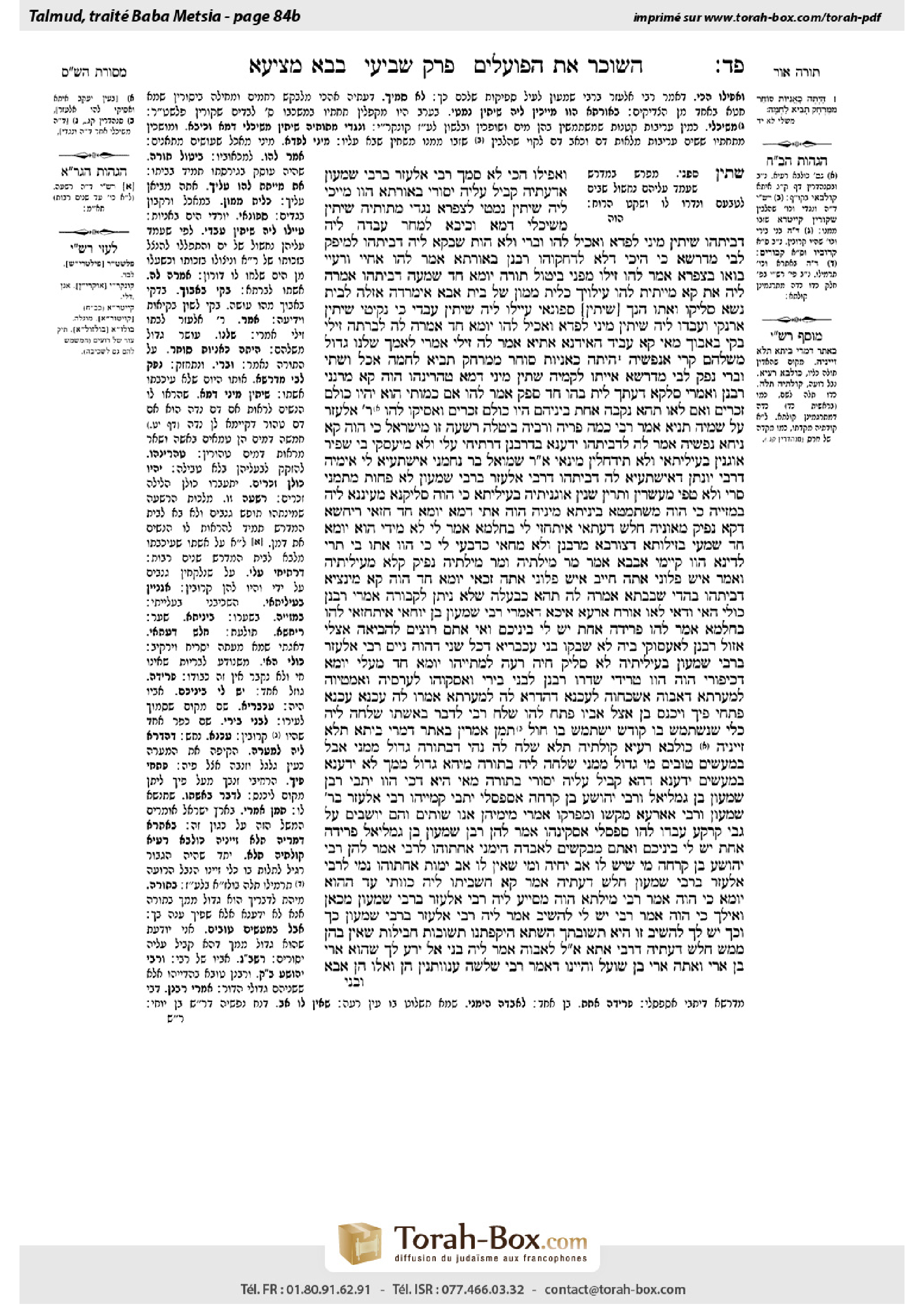
Bava Metzia 84b: Talmud study for Daf Yomi
Study the Talmud for Daf Yomi with scanned pages, Hebrew text, English translations from Sefaria and AI-generated French translations.
Passage selection and English or AI-generated French translation are available where the scan has annotations. Daf Study is independent of Torah-Box and Sefaria.
Browse Bava Metzia · בבא מציעא · All tractatesBava Metzia 84b text and translations
This page of Bava Metzia includes the Aramaic text, an English translation and an AI-generated French translation, alongside the scan above.
בבא מציעא פ״ד ב · Aramaic and Hebrew text
וַאֲפִילּוּ הָכִי לָא סְמַךְ רַבִּי אֶלְעָזָר בְּרַבִּי שִׁמְעוֹן אַדַּעְתֵּיהּ, קַבֵּיל עֲלֵיהּ יִסּוּרֵי. בְּאוּרְתָּא הֲווֹ מָיְיכִי לֵיהּ שִׁיתִּין נַמְטֵי, לְצַפְרָא נָגְדִי מִתּוּתֵיהּ שִׁיתִּין מְשִׁיכְלֵי דְּמָא וְכִיבָא.
לִמְחַר עֲבַדָה לֵיהּ דְּבֵיתְהוּ שִׁיתִּין מִינֵי לַפְדָּא וְאָכֵיל לְהוּ וּבָרֵי. וְלָא הֲוָת שָׁבְקָא לֵיהּ דְּבֵיתְהוּ לְמִיפַּק לְבֵי מִדְרְשָׁא כִּי הֵיכִי דְּלָא לִדְחֲקוּהוּ רַבָּנַן.
בְּאוּרְתָּא אֲמַר לְהוּ: אַחַיי וְרֵעַי, בּוֹאוּ! בְּצַפְרָא אֲמַר לְהוּ: זִילוּ מִפְּנֵי בִּיטּוּל תּוֹרָה. יוֹמָא חַד שְׁמַעָה דְּבֵיתְהוּ, אֲמַרָה לֵיהּ: אַתְּ קָא מַיְיתֵית לְהוּ עִילָּוָיךְ! כִּלִּיתָ מָמוֹן שֶׁל בֵּית אַבָּא. אִימְּרַדָה, אֲזַלָה לְבֵית נָשָׁא.
סְלִיקוּ וַאֲתוֹ הָנָךְ [שִׁיתִּין] סָפוֹנָאֵי, עֲיַילוּ לֵיהּ שִׁיתִּין עַבְדֵי כִּי נְקִיטִי שִׁיתִּין אַרְנָקֵי, וַעֲבַדוּ לֵיהּ שִׁיתִּין מִינֵי לַפְדָּא וְאָכֵיל לְהוּ.
יוֹמָא חַד, אֲמַרָה לַהּ לְבַרְתַּהּ: זִילִי בְּקַי בַּאֲבוּךְ מַאי קָא עָבֵיד הָאִידָּנָא? אָתְיָא, אֲמַר לַהּ: זִילִי אֱמַרִי לְאִימִּיךְ: שֶׁלָּנוּ, גָּדוֹל מִשֶּׁלָּהֶם. קָרֵי אַנַּפְשֵׁיהּ: ״הָיְתָה כׇּאֳנִיּוֹת סוֹחֵר מִמֶּרְחָק תָּבִיא לַחְמָהּ״. אֲכַל וּשְׁתִי וּבְרִי נְפַק לְבֵי מִדְרְשָׁא.
אַיְיתוֹ לְקַמֵּיהּ שִׁיתִּין מִינֵי דְּמָא – טַהֲרִינְהוּ. הֲוָה קָא מְרַנְּנִי רַבָּנַן וְאָמְרִי: סָלְקָא דַעְתָּךְ לֵית בְּהוּ חַד סָפֵק?! אָמַר לְהוּ: אִם כְּמוֹתִי הוּא – יִהְיוּ כּוּלָּם זְכָרִים, וְאִם לָאו – תְּהֵא נְקֵבָה אַחַת בֵּינֵיהֶם. הָיוּ כּוּלָּם זְכָרִים. וְאַסִּיקוּ לְהוּ ״רַבִּי אֶלְעָזָר״ עַל שְׁמֵיהּ.
תַּנְיָא, אָמַר רַבִּי: כַּמָּה פְּרִיָּה וּרְבִיָּה בִּיטְּלָה רְשָׁעָה זוֹ מִיִּשְׂרָאֵל.
כִּי הֲוָה קָא נָיְחָא נַפְשֵׁיהּ, אֲמַר לַהּ לִדְבֵיתְהוּ: יָדַעְנָא בִּדְרַבָּנַן דִּרְתִיחִי עֲלַי, וְלָא מִיעַסְקִי בִּי שַׁפִּיר. אַוגְנְיַן בְּעִילִּיתַאי וְלָא תִּדְחֲלִין מִינַּאי. אָמַר רַבִּי שְׁמוּאֵל בַּר נַחְמָנִי: אִישְׁתַּעְיָא לִי אִימֵּיהּ דְּרַבִּי יוֹנָתָן, דְּאִישְׁתַּעְיָא לַהּ דְּבֵיתְהוּ דְּרַבִּי אֶלְעָזָר בְּרַבִּי שִׁמְעוֹן: לָא פָּחוֹת מִתַּמְנֵי סְרֵי, וְלָא טְפֵי מֵעֶשְׂרִין וּתְרֵין שְׁנִין אַוגְנֵיתֵיהּ בְּעִילִּיתָא.
כִּי הֲוָה סָלְיקָנָא מְעַיְּנָנָא לֵיהּ בְּמַזְיֵיהּ, כִּי הֲוָה מִשְׁתַּמְטָא בִּינִיתָא מִינֵּיהּ הֲוָה אָתֵי דְּמָא. יוֹמָא חַד חֲזַאי רִיחְשָׁא דְּקָא נָפֵיק מֵאוּנֵּיהּ, חֲלַשׁ דַּעְתַּאי. אִיתְחֲזִי לִי בְּחֶלְמָא אֲמַר לִי: לָא מִידֵּי הוּא, יוֹמָא חַד שָׁמְעִי בְּזִלוּתָא דְּצוּרְבָּא מֵרַבָּנַן וְלָא מַחַאי כִּדְבָעֵי לִי.
כִּי הֲווֹ אָתוּ בֵּי תְרֵי לְדִינָא, הֲווֹ קָיְימִי אַבָּבָא, אָמַר מָר מִילְּתֵיהּ וּמַר מִילְּתֵיהּ נָפֵיק קָלָא מֵעִילִּיתֵיהּ, וְאָמַר: אִישׁ פְּלוֹנִי אַתָּה חַיָּיב, אִישׁ פְּלוֹנִי אַתָּה זַכַּאי. יוֹמָא חַד הֲוָה קָא מִינַּצְיָא דְּבֵיתְהוּ בַּהֲדֵי שִׁבָבְתָּא, אֲמַרָה לַהּ: תְּהֵא כְּבַעֲלַהּ שֶׁלֹּא נִיתַּן לִקְבוּרָה. אָמְרִי רַבָּנַן: כּוּלֵּי הַאי וַדַּאי לָאו אוֹרַח אַרְעָא.
אִיכָּא דְּאָמְרִי, רַבִּי שִׁמְעוֹן בֶּן יוֹחַאי אִיתְחֲזַאי לְהוּ בְּחֶלְמָא, אֲמַר לְהוּ: פְּרֵידָה אַחַת יֵשׁ לִי בֵּינֵיכֶם, וְאִי אַתֶּם רוֹצִים לַהֲבִיאָהּ אֶצְלִי? אֲזוּל רַבָּנַן לְאִעֲסוֹקֵי בֵּיהּ, לָא שְׁבַקוּ בְּנֵי עַכְבְּרַיָּא, דְּכֹל שְׁנֵי דַּהֲוָה נָיֵים רַבִּי אֶלְעָזָר בְּרַבִּי שִׁמְעוֹן בְּעִילִּיתֵיהּ לָא סְלִיק חַיָּה רָעָה לְמָתַיְיהוּ.
יוֹמָא חַד מַעֲלֵי יוֹמָא דְכִיפּוּרֵי הֲוָה, הֲווֹ טְרִידִי. שַׁדַּרוּ רַבָּנַן לִבְנֵי בֵירֵי וְאַסְּקוּהוּ לְעַרְסֵיהּ וְאַמְטְיוּהּ לִמְעָרְתָּא דַאֲבוּהּ. אַשְׁכְּחוּהָ לְעַכְנָא דְּהָדְרָא לַהּ לִמְעָרְתָּא. אֲמַרוּ לַהּ: עַכְנָא עַכְנָא! פִּתְחִי פִּיךְ וְיִכָּנֵס בֵּן אֵצֶל אָבִיו. פְּתַחָ[ה] לְהוּ.
שָׁלַח רַבִּי לְדַבֵּר בְּאִשְׁתּוֹ, שְׁלַחָה לֵיהּ: כְּלִי שֶׁנִּשְׁתַּמֵּשׁ בּוֹ קוֹדֶשׁ יִשְׁתַּמֵּשׁ בּוֹ חוֹל? תַּמָּן אָמְרִין: בַּאֲתַר דְּמָרֵי בֵיתָא תְּלָא זְיָינֵיהּ, כּוּלְבָּא רָעֲיָא קוּלְּתֵיהּ תְּלָא. שְׁלַח לַהּ: נְהִי דִּבְתוֹרָה גָּדוֹל מִמֶּנִּי, אֲבָל בְּמַעֲשִׂים טוֹבִים מִי גָּדוֹל מִמֶּנִּי? שְׁלַחָה לֵיהּ: בְּתוֹרָה מִיהָא גָּדוֹל מִמְּךָ לָא יָדְעָנָא, בְּמַעֲשִׂים יָדְעָנָא, דְּהָא קַבֵּיל עֲלֵיהּ יִסּוּרֵי.
בְּתוֹרָה מַאי הִיא? דְּכִי הֲווֹ יָתְבִי רַבָּן שִׁמְעוֹן בֶּן גַּמְלִיאֵל וְרַבִּי יְהוֹשֻׁעַ בֶּן קׇרְחָה אַסַּפְסַלֵּי, יָתְבִי קַמַּיְיהוּ רַבִּי אֶלְעָזָר בְּרַבִּי שִׁמְעוֹן וְרַבִּי אַאַרְעָא.
מַקְשׁוּ וּמְפָרְקוּ. אָמְרִי: מִימֵיהֶן אָנוּ שׁוֹתִים וְהֵם יוֹשְׁבִים עַל גַּבֵּי קַרְקַע?! עֲבַדוּ לְהוּ סַפְסַלֵּי אַסְּקִינְהוּ.
אָמַר לָהֶן רַבָּן שִׁמְעוֹן בֶּן גַּמְלִיאֵל: פְּרֵידָה אַחַת יֵשׁ לִי בֵּינֵיכֶם, וְאַתֶּם מְבַקְּשִׁים לְאַבְּדָהּ הֵימֶנִי? אֲחֲתוּהּ לְרַבִּי. אָמַר לָהֶן רַבִּי יְהוֹשֻׁעַ בֶּן קׇרְחָה: מִי שֶׁיֵּשׁ לוֹ אָב יִחְיֶה, וּמִי שֶׁאֵין לוֹ אָב יָמוּת? אֲחֲתוּהּ נָמֵי לְרַבִּי אֶלְעָזָר בְּרַבִּי שִׁמְעוֹן. חֲלַשׁ דַּעְתֵּיהּ, אָמַר: קָא חָשְׁבִיתוּ לֵיהּ כְּווֹתִי?
עַד הָהוּא יוֹמָא כִּי הֲוָה אָמַר רַבִּי מִילְּתָא הֲוָה מְסַיַּיע לֵיהּ רַבִּי אֶלְעָזָר בְּרַבִּי שִׁמְעוֹן: מִכָּאן וְאֵילָךְ כִּי הֲוָה אָמַר רַבִּי ״יֵשׁ לִי לְהָשִׁיב״, אָמַר לֵיהּ רַבִּי אֶלְעָזָר בְּרַבִּי שִׁמְעוֹן: כָּךְ וְכָךְ יֵשׁ לְךָ לְהָשִׁיב, זוֹ הִיא תְּשׁוּבָתְךָ. הַשְׁתָּא הִיקַּפְתָּנוּ תְּשׁוּבוֹת חֲבִילוֹת שֶׁאֵין בָּהֶן מַמָּשׁ.
חֲלַשׁ דַּעְתֵּיהּ דְּרַבִּי. אֲתָא אֲמַר לֵיהּ לַאֲבוּהּ. אֲמַר לֵיהּ: בְּנֵי, אַל יֵרַע לָךְ, שֶׁהוּא אֲרִי בֶּן אֲרִי וְאַתָּה אֲרִי בֶּן שׁוּעָל.
הַיְינוּ דְּאָמַר רַבִּי: שְׁלֹשָׁה עִנְוְותָנִין הֵן, וְאֵלּוּ הֵן: אַבָּא,
Bava Metzia 84b · English translation
§ After this digression, the Gemara returns to the story of Rabbi Elazar, son of Rabbi Shimon. And although his flesh did not putrefy, even so Rabbi Elazar, son of Rabbi Shimon, still did not rely on his own opinion, as he was worried that he may have erred in one of his decisions. He accepted afflictions upon himself as atonement for his possible sins. At night his attendants would spread out sixty felt bed coverings for him. In the morning, despite the bed coverings, they would remove sixty basins of blood and pus from underneath him.
The following day, i.e., every morning, his wife would prepare for him sixty types of relish [lifda] made from figs, and he would eat them and become healthy. His wife, concerned for his health, would not allow him to go to the study hall, so that the Rabbis would not push him beyond his limits.
In the evening, he would say to his pains: My brothers and my friends, come! In the morning he would say to them: Go away, due to the dereliction of Torah study that you cause me. One day his wife heard him inviting his pains. She said to him: You are bringing the pains upon yourself. You have diminished the money of my father’s home due to the costs of treating your self-imposed afflictions. She rebelled against him and went back to her father’s home, and he was left with no one to care for him.
Meanwhile, there were these sixty sailors who came and entered to visit Rabbi Elazar, son of Rabbi Shimon. They brought him sixty servants, each bearing sixty purses, and prepared him sixty types of relish and he ate them. When they had encountered trouble at sea, these sailors had prayed to be saved in the merit of Rabbi Elazar, son of Rabbi Shimon. Upon returning to dry land, they presented him with these gifts.
One day, the wife of Rabbi Elazar, son of Rabbi Shimon, said to her daughter: Go and check on your father and see what he is doing now. The daughter came to her father, who said to her: Go and tell your mother that ours is greater than theirs, i.e., my current financial status is greater than that of your father’s household. He read the verse about himself: “She is like the merchant-ships; she brings her food from afar” (Proverbs 31:14). As he was unhindered by his wife from going to the study hall, Rabbi Elazar, son of Rabbi Shimon, ate and drank and became healthy and went out to the study hall.
The students brought sixty questionable samples of blood before him for inspection, to determine whether or not they were menstrual blood. He deemed them all ritually pure, thereby permitting the women to engage in intercourse with their husbands. The Rabbis of the academy were murmuring about Rabbi Elazar, son of Rabbi Shimon, and saying: Can it enter your mind that there is not one uncertain sample among them? He must be mistaken. Rabbi Elazar, son of Rabbi Shimon, said to them: If the halakha is in accordance with my ruling, let all the children born from these women be males. And if not, let there be one female among them. It turned out that all of the children were males, and they were called Elazar in his name.
It is taught in a baraita that Rabbi Yehuda HaNasi lamented and said concerning the wife of Rabbi Elazar, son of Rabbi Shimon: How much procreation has this evil woman prevented from the Jewish people. She caused women not to have children by preventing her husband from going to the study hall and rendering his halakhic rulings.
As Rabbi Elazar, son of Rabbi Shimon, was dying, he said to his wife: I know that the Rabbis are angry at me for arresting several thieves who are their relatives, and therefore they will not properly tend to my burial. When I die, lay me in my attic and do not be afraid of me, i.e., do not fear that anything will happen to my corpse. Rabbi Shmuel bar Naḥmani said: Rabbi Yonatan’s mother told me that the wife of Rabbi Elazar, son of Rabbi Shimon, told her: I laid him in the attic for no less than eighteen years and for no more than twenty-two years.
His wife continued: When I would go up to the attic I would check his hair, and when a hair would fall out from his head, blood would come and appear in its place, i.e., his corpse did not decompose. One day I saw a worm emerging from his ear, and I became very distressed that perhaps his corpse had begun to decompose. My husband appeared to me in a dream and said to me: It is no matter for concern. Rather, this is a consequence for a sin of mine, as one day I heard a Torah scholar being insulted and I did not protest as I should have. Therefore, I received this punishment in my ear, measure for measure.
During this period, when two people would come for adjudication of a dispute, they would stand by the doorway to the home of Rabbi Elazar, son of Rabbi Shimon. One litigant would state his side of the matter, and the other litigant would state his side of the matter. A voice would issue forth from his attic, saying: So-and-so, you are guilty; so-and-so, you are innocent. The Gemara relates: One day, the wife of Rabbi Elazar, son of Rabbi Shimon, was quarreling with a neighbor. The neighbor said to her as a curse: This woman should be like her husband, who was not buried. When word spread that Rabbi Elazar, son of Rabbi Shimon, had not been buried, the Rabbis said: This much, i.e., now that the matter is known, to continue in this state is certainly not proper conduct, and they decided to bury him.
There are those who say that the Sages found out that Rabbi Elazar, son of Rabbi Shimon, had not been buried when Rabbi Shimon ben Yoḥai, his father, appeared to them in a dream and said to them: I have a single fledgling among you, i.e., my son, and you do not wish to bring it to me by burying him next to me. Consequently, the Sages went to tend to his burial. The residents of Akhbaria, the town where the corpse of Rabbi Elazar, son of Rabbi Shimon, was resting, did not allow them to do so, as they realized that all the years that Rabbi Elazar, son of Rabbi Shimon, had been resting in his attic, no wild beast had entered their town. The townspeople attributed this phenomenon to his merit and they did not want to lose this protection.
One day, which was Yom Kippur eve, everyone in the town was preoccupied with preparations for the Festival. The Rabbis sent a message to the residents of the adjacent town of Biri instructing them to help remove the body of Rabbi Elazar, son of Rabbi Shimon, from the attic, and they removed his bier and brought it to his father’s burial cave. They found a serpent [le’akhna] that had placed its tail in its mouth and completely encircled the entrance to the cave, denying them access. They said to it: Serpent, serpent! Open your mouth to allow a son to enter next to his father. It opened its mouth for them and uncoiled, and they buried Rabbi Elazar, son of Rabbi Shimon, alongside his father.
The Gemara continues: After this incident, Rabbi Yehuda HaNasi sent a messenger to speak with the wife of Rabbi Elazar, son of Rabbi Shimon, and propose marriage. She sent a message to him in response: Shall a vessel used by someone sacred, i.e., Rabbi Elazar, son of Rabbi Shimon, be used by someone who is, relative to him, profane? There, in Eretz Yisrael, they say that she used the colloquial adage: In the location where the master of the house hangs his sword, shall the contemptible shepherd hang his basket [kultei]? Rabbi Yehuda HaNasi sent a message back to her: Granted that in Torah he was greater than I, but was he greater than I in pious deeds? She sent a message back to him: Whether he was greater than you in Torah I do not know; but I do know that he was greater than you in pious deeds, as he accepted afflictions upon himself.
The Gemara asks: With regard to Torah knowledge, what is the event that demonstrated the superiority of Rabbi Elazar, son of Rabbi Shimon, over Rabbi Yehuda HaNasi? The Gemara answers: When Rabban Shimon ben Gamliel and Rabbi Yehoshua ben Korḥa, the leading Sages of the generation, were sitting on benches [asafselei] teaching Torah along with the other Sages, the youthful pair Rabbi Elazar, son of Rabbi Shimon, and Rabbi Yehuda HaNasi would sit before them on the ground out of respect.
These two young students would engage in discussions with the Sages, in which they would raise difficulties and answer them brilliantly. Seeing the young scholars’ brilliance, the leading Sages said: From their waters we drink, i.e., we are learning from them, and they are the ones sitting on the ground? Benches were prepared for Rabbi Elazar, son of Rabbi Shimon, and Rabbi Yehuda HaNasi, and they were promoted to sit alongside the other Sages.
Rabban Shimon ben Gamliel said to the other Sages present: I have a single fledgling among you, i.e., my son Rabbi Yehuda HaNasi, and you are seeking to take it from me? By promoting my son to such a prestigious position at such a young age, his chances of being adversely affected by the evil eye are greatly increased. They demoted Rabbi Yehuda HaNasi to sit on the ground, at his father’s request. Rabbi Yehoshua ben Korḥa said to the Sages: Should one who has a father to care for him, i.e., Rabbi Yehuda HaNasi, be demoted so that he may live, while the other one, who does not have a father to care for him, i.e., Rabbi Elazar, son of Rabbi Shimon, should be allowed to die? Upon hearing his argument, the Sages also demoted Rabbi Elazar, son of Rabbi Shimon, without explaining to him the reason for his demotion. He became offended and said to them: You are equating Rabbi Yehuda HaNasi to me, by demoting us together. In fact, I am much greater than he.
As a result of that incident, the relationship of Rabbi Elazar, son of Rabbi Shimon, with Rabbi Yehuda HaNasi changed. Up until that day, when Rabbi Yehuda HaNasi would state a matter of Torah, Rabbi Elazar, son of Rabbi Shimon, would support him by citing proofs for his opinion. From this point forward, when they were discussing a subject and Rabbi Yehuda HaNasi would say: I have an argument to respond, Rabbi Elazar, son of Rabbi Shimon, would preempt him by saying to him: Such and such is what you have to respond, and this is the refutation of your claim. Now that you asked these questions, you have surrounded us with bundles of refutations that have no substance, i.e., you have forced us to give unnecessary answers. Rabbi Elazar, son of Rabbi Shimon, would anticipate Rabbi Yehuda HaNasi’s comments and immediately dismiss them as having no value.
Rabbi Yehuda HaNasi became offended. He came and told his father what had transpired. Rabban Shimon ben Gamliel said to him: My son, do not let his actions offend you, as he is a lion, son of a lion, and you are a lion, son of a fox. Rabbi Elazar’s father, Rabbi Shimon, was a renowned Sage, and therefore Rabbi Elazar’s sagacity is not surprising. In any event, this incident demonstrates the superiority of Rabbi Elazar, son of Rabbi Shimon, to Rabbi Yehuda HaNasi with regard to knowledge of Torah.
The Gemara concludes: This incident is the background to a statement which Rabbi Yehuda HaNasi said: There are three prototypical modest people, and they are: Father, i.e., Rabban Shimon ben Gamliel;
Bava Metzia 84b · Traduction française (IA)
§ Après cette digression, la Guemara reprend l'histoire du Rabbi Eléazar, fils du Rabbi Shimon. Et bien que sa chair ne se fût pas putréfiée, même ainsi, le Rabbi Eléazar, fils du Rabbi Shimon, ne s'appuya pas sur son propre avis, car il redoutait qu'il eût commis une erreur dans l'une de ses décisions. Il s'imposait des afflictions comme expiation pour ses possibles péchés. La nuit, ses serviteurs étendaient soixante couvertures de laine pour lui. Le matin, malgré les couvertures, ils retiraient soixante bassins de sang et de pus sous lui.
Le lendemain, c'est-à-dire chaque matin, sa femme préparait pour lui soixante types de condiments [lifda] faits de figues, et il les mangeait et se rétablissait. Sa femme, préoccupée par sa santé, ne permettait pas qu'il aille à la salle de study, afin que les Rabbins ne le poussent pas au-delà de ses forces.
Le soir, il disait à ses douleurs : Mes frères et mes amis, venez ! Le matin, il disait à elles : Allez-vous-en, à cause de l'abandon de l'étude de la Torah que vous me causez. Un jour, sa femme l'entendit inviter ses douleurs. Elle lui dit : Vous vous infligez des douleurs. Vous avez diminué la richesse de la maison de mon père à cause des coûts de vos afflictions imposées. Elle s'est révoltée contre lui et est retournée chez son père, et il resta seul sans personne pour le soigner.
En même temps, il y avait soixante marins qui vinrent rendre visite au Rabbi Eléazar, fils du Rabbi Shimon. Ils lui apportèrent soixante serviteurs, chacun portant soixante sacs, et préparèrent pour lui soixante types de condiments qu'il mangea. Lorsqu'ils eurent des ennuis en mer, ces marins prièrent afin d'être sauvés en mérite du Rabbi Eléazar, fils du Rabbi Shimon. En revenant sur terre ferme, ils lui offrirent ces présents.
Un jour, la femme du Rabbi Eléazar, fils du Rabbi Shimon, dit à sa fille : Va voir ton père et vois ce qu'il fait maintenant. La fille vint chez son père, qui lui dit : Va et dis à ta mère que notre situation est supérieure à la leur, c'est-à-dire que mon statut financier actuel est supérieur à celui de la maison de ton père. Il cita la parole sur lui : « Elle est comme les navires marchands ; elle apporte sa nourriture de loin » (Proverbes 31:14). Comme il n'était pas empêché par sa femme d'aller à la salle de étude, le Rabbi Eléazar, fils du Rabbi Shimon, mangea et but, se rétablit et sortit à la salle de étude.
Les étudiants apportèrent devant lui soixante échantillons incertains de sang pour qu'il les examine afin de déterminer s'ils étaient du sang menstruel. Il les déclara tous rituellement purs, permettant ainsi aux femmes de s'unir à leurs maris. Les Rabbins de l'académie murmuraient sur le Rabbi Eléazar, fils du Rabbi Shimon, et disaient : Est-ce que tu penses qu'il n'y a pas un seul échantillon incertain parmi eux ? Il doit être en erreur. Le Rabbi Eléazar, fils du Rabbi Shimon, dit à eux : Si la halakha suit mon jugement, que tous les enfants nés de ces femmes soient des garçons. Et si ce n'est pas le cas, qu'il y ait une fille parmi eux. Il s'avéra que tous les enfants étaient des garçons, et ils furent appelés Eléazar en son nom.
Il est enseigné dans une baraïta que le Rabbi Yéhouda HaNasi pleura et dit concernant la femme du Rabbi Eléazar, fils du Rabbi Shimon : Combien de procréations cette femme mauvaise a-t-elle empêchées au peuple juif. Elle a fait en sorte que les femmes ne fassent pas d'enfants en empêchant son mari d'aller à la salle de study et de rendre ses jugements halakhiques.
Lorsque le Rabbi Eléazar, fils du Rabbi Shimon, mourait, il dit à sa femme : Je sais que les Rabbins sont en colère contre moi pour avoir arrêté plusieurs voleurs qui sont leurs parents, et donc ils ne prendront pas soin correctement de mon enterrement. Lorsque je mourrai, place-moi dans mon grenier et ne crains pas de moi, c'est-à-dire ne crains pas que quelque chose arrive à mon corps. Le Rabbi Shmuel bar Naḥmani dit : La mère du Rabbi Yonatan me dit que la femme du Rabbi Eléazar, fils du Rabbi Shimon, me dit : J'ai placé lui dans le grenier pendant au moins dix-huit ans et pas plus de vingt-deux ans.
Sa femme continua : Lorsque je montais au grenier, je vérifiais ses cheveux, et lorsque un cheveu tombait de sa tête, du sang apparaissait à sa place, c'est-à-dire que son corps ne se putréfiait pas. Un jour, je vis un ver sortir de son oreille, et je me suis beaucoup inquiétée que peut-être son corps avait commencé à se putréfier. Mon mari apparut à moi en rêve et me dit : Ne t'inquiète pas. Cela est la conséquence d'un péché que j'ai commis, car un jour j'ai entendu un savant de la Torah être insulté et je n'ai pas protesté comme je devais. Donc, j'ai reçu cette punition dans mon oreille, mesure pour mesure.
Pendant cette période, lorsqu'il y avait deux personnes qui venaient pour un jugement sur un litige, ils se tenaient à la porte de la maison du Rabbi Eléazar, fils du Rabbi Shimon. L'un des litigants déclara son côté, et l'autre litigant déclara son côté. Une voix sortait du grenier, disant : Cet homme-là, tu es coupable ; cet homme-là, tu es innocent. La Guemara rapporte : Un jour, la femme du Rabbi Eléazar, fils du Rabbi Shimon, se disputait avec un voisin. Le voisin lui dit comme une malédiction : Cette femme devrait être comme son mari, qui n'a pas été enterré. Lorsque la nouvelle se répandit que le Rabbi Eléazar, fils du Rabbi Shimon, n'avait pas été enterré, les Rabbins dirent : Cela suffit, c'est-à-dire maintenant que la chose est connue, continuer dans cet état n'est certainement pas une conduite appropriée, et ils décidèrent de l'enterrer.
Il y a ceux qui disent que les Sages ont découvert que Rabbi Eléazar, fils de Rabbi Shim'on, n'avait pas été enterré lorsque Rabbi Shim'on ben Yochai, son père, est apparu à eux en rêve et a dit : J'ai un seul petit oiseau parmi vous, c'est-à-dire mon fils, et vous ne souhaitez pas me le ramener en l'enterrant à mes côtés. Ainsi, les Sages sont allés s'occuper de son enterrement. Les habitants d'Akhbaria, la ville où le corps de Rabbi Eléazar, fils de Rabbi Shim'on, reposait, ne leur ont pas permis de le faire, car ils avaient compris que pendant toutes les années que Rabbi Eléazar, fils de Rabbi Shim'on, avait reposé dans son grenier, aucun animal sauvage n'avait pénétré dans leur ville. Les habitants de la ville attribuaient ce phénomène à son mérite et ne voulaient pas perdre cette protection.
Un jour, qui était la veille de Yom Kippour, tout le monde dans la ville était occupé par les préparatifs pour la fête. Les Rabbins envoyèrent un message aux habitants de la ville voisine de Biri pour leur demander d'aider à retirer le corps de Rabbi Eléazar, fils de Rabbi Shim'on, du grenier, et ils retirèrent son bier et le conduisirent dans la tombe de son père. Ils trouvèrent un serpent [le'akhna] qui avait placé sa queue dans sa bouche et entourait complètement l'entrée de la tombe, refusant leur accès. Ils dirent au serpent : Serpent, serpent ! Ouvre ta bouche pour permettre à un fils d'entrer à côté de son père. Il ouvrit sa bouche pour eux et se déroula, et ils enterrèrent Rabbi Eléazar, fils de Rabbi Shim'on, auprès de son père.
La Guemara continue : Après cet incident, Rabbi Yéhouda HaNasi envoya un messager pour parler à la femme de Rabbi Eléazar, fils de Rabbi Shim'on, et proposer le mariage. Elle envoya un message en réponse : Un vase utilisé par quelqu'un saint, c'est-à-dire Rabbi Eléazar, fils de Rabbi Shim'on, peut-il être utilisé par quelqu'un qui est, par rapport à lui, impur ? Là, en Terre d'Israël, on dit qu'elle utilisait l'adage courant : Dans le lieu où le maître de la maison accroche son épée, le berger méprisable accroche-t-il son panier [kultei] ? Rabbi Yéhouda HaNasi envoya un message en retour à elle : C'est vrai qu'en Torah il était supérieur à moi, mais était-il supérieur à moi en vertus ? Elle envoya un message en retour à lui : Je ne sais pas si en Torah il était supérieur à vous, mais je sais qu'il était supérieur à vous en vertus, car il s'est imposé des afflictions sur lui-même.
La Guemara pose la question : En ce qui concerne la connaissance de la Torah, quel événement a démontré la supériorité de Rabbi Eléazar, fils de Rabbi Shim'on, par rapport à Rabbi Yéhouda HaNasi ? La Guemara répond : Lorsque Rabban Shim'on ben Gamliel et Rabbi Yéhoshua ben Korcha, les Sages principaux de leur génération, étaient assis sur des bancs [asafselei] pour enseigner la Torah avec les autres Sages, les jeunes pairs Rabbi Eléazar, fils de Rabbi Shim'on, et Rabbi Yéhouda HaNasi s'assoyaient à leurs pieds en signe de respect.
Ces deux jeunes élèves discutaient avec les Sages, soulevaient des difficultés et répondaient brillamment. Voyant la brillance des jeunes savants, les Sages principaux dirent : De leurs eaux nous buvons, c'est-à-dire nous apprenons d'eux, et ils sont ceux qui s'assoyent à leurs pieds ? Des bancs furent préparés pour Rabbi Eléazar, fils de Rabbi Shim'on, et Rabbi Yéhouda HaNasi, et ils furent promus pour s'asseoir aux côtés des autres Sages.
Rabban Shim'on ben Gamliel dit aux autres Sages présents : J'ai un seul petit oiseau parmi vous, c'est-à-dire mon fils Rabbi Yéhouda HaNasi, et vous cherchez à me le prendre ? En le promouvant à un tel poste prestigieux à un si jeune âge, ses chances d'être affecté par le regard mauvais sont grandement augmentées. Ils firent descendre Rabbi Yéhouda HaNasi pour s'asseoir à terre, à la demande de son père. Rabbi Yéhoshua ben Korcha dit aux Sages : Devrait-on dégrader celui qui a un père à qui s'occuper, c'est-à-dire Rabbi Yéhouda HaNasi, afin qu'il vive, tandis que l'autre, qui n'a pas de père à qui s'occuper, c'est-à-dire Rabbi Eléazar, fils de Rabbi Shim'on, devrait mourir ? En entendant son argument, les Sages firent descendre également Rabbi Eléazar, fils de Rabbi Shim'on, sans lui expliquer la raison de sa dégradation. Il s'offensa et dit à eux : Vous égalez Rabbi Yéhouda HaNasi à moi en le dégradant, en fait je suis bien plus grand que lui.
En conséquence de cet incident, la relation de Rabbi Eléazar, fils de Rabbi Shim'on, avec Rabbi Yéhouda HaNasi changea. Jusqu'à ce jour, lorsque Rabbi Yéhouda HaNasi énonçait une question de Torah, Rabbi Eléazar, fils de Rabbi Shim'on, le soutenait en citant des preuves pour son opinion. À partir de ce moment, lorsqu'ils discutaient d'un sujet et que Rabbi Yéhouda HaNasi disait : J'ai un argument à répondre, Rabbi Eléazar, fils de Rabbi Shim'on, anticipait en disant à lui : C'est ce que vous avez à répondre, et c'est la réfutation de votre affirmation. Maintenant que vous avez posé ces questions, vous nous avez entourés de faisceaux de réfutations sans fondement, c'est-à-dire vous nous avez forcé à donner des réponses inutiles. Rabbi Eléazar, fils de Rabbi Shim'on, anticipait les commentaires de Rabbi Yéhouda HaNasi et les rejetait immédiatement comme n'ayant aucune valeur.
Rabbi Yéhouda HaNasi s'offensa. Il vint et raconta à son père ce qui s'était passé. Rabban Shim'on ben Gamliel lui dit : Mon fils, ne laisse pas ses actions t'offenser, car il est un lion, fils d'un lion, et tu es un lion, fils d'un renard. Le père de Rabbi Eléazar, Rabbi Shim'on, était un Sage célèbre, donc la sagesse de Rabbi Eléazar n'est pas surprenante. En tout cas, cet incident démontre la supériorité de Rabbi Eléazar, fils de Rabbi Shim'on, par rapport à Rabbi Yéhouda HaNasi en ce qui concerne la connaissance de la Torah.
La Guemara conclut : Cet incident est le contexte d'une déclaration que Rabbi Yéhouda HaNasi a faite : Il y a trois personnes typiques modestes, et elles sont : le père, c'est-à-dire Rabban Shim'on ben Gamliel ;
Traduction française générée par IA à partir de l’édition anglaise de Sefaria. Vérifie toujours un passage avec le texte source.
Text from Sefaria: William Davidson Edition - Vocalized Aramaic (CC BY NC); William Davidson Edition - English (CC BY NC).