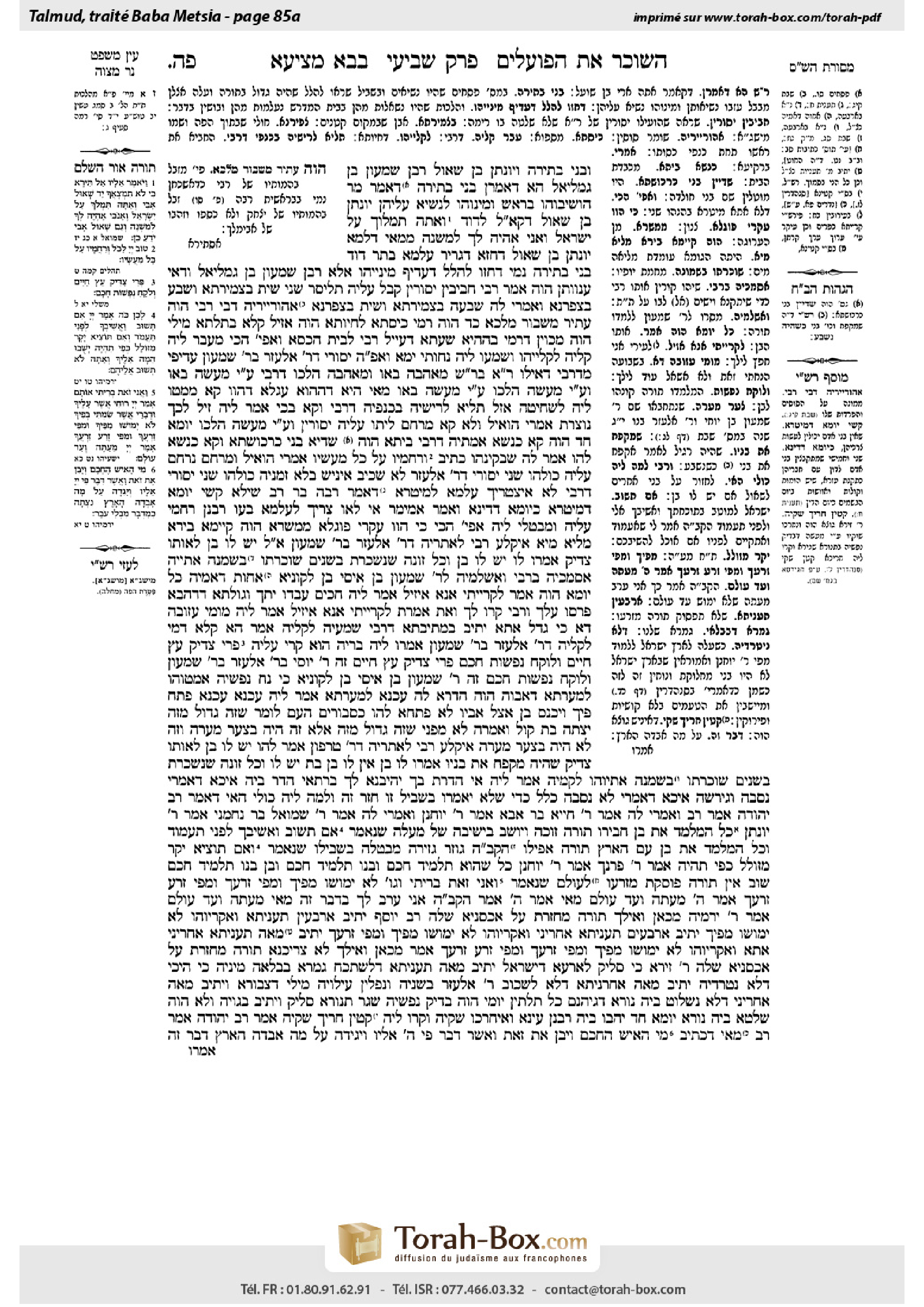
Bava Metzia 85a: Talmud study for Daf Yomi
Study the Talmud for Daf Yomi with scanned pages, Hebrew text, English translations from Sefaria and AI-generated French translations.
Passage selection and English or AI-generated French translation are available where the scan has annotations. Daf Study is independent of Torah-Box and Sefaria.
Browse Bava Metzia · בבא מציעא · All tractatesBava Metzia 85a text and translations
This page of Bava Metzia includes the Aramaic text, an English translation and an AI-generated French translation, alongside the scan above.
בבא מציעא פ״ה א · Aramaic and Hebrew text
וּבְנֵי בְתִירָה, וְיוֹנָתָן בֶּן שָׁאוּל. רַבָּן שִׁמְעוֹן בֶּן גַּמְלִיאֵל – הָא דַּאֲמַרַן: בְּנֵי בְתִירָה, דְּאָמַר מָר הוֹשִׁיבוּהוּ בָּרֹאשׁ וּמִינּוּהוּ לְנָשִׂיא עֲלֵיהֶן. יוֹנָתָן בֶּן שָׁאוּל, דְּקָאָמַר לֵיהּ לְדָוִד: ״וְאַתָּה תִּמְלֹךְ עַל יִשְׂרָאֵל וַאֲנִי אֶהְיֶה לְּךָ לְמִשְׁנֶה״.
מִמַּאי? דִּלְמָא יוֹנָתָן בֶּן שָׁאוּל דַּחֲזָא דִּגְרִיר עָלְמָא בָּתַר דָּוִד, בְּנֵי בְתִירָה נָמֵי דַּחֲזוֹ לְהִלֵּל דַּעֲדִיף מִינַּיְיהוּ, אֶלָּא רַבָּן שִׁמְעוֹן בֶּן גַּמְלִיאֵל וַדַּאי עִנְוְותָן הֲוָה.
אָמַר רַבִּי, חֲבִיבִין יִסּוּרִין. קַבֵּל עֲלֵיהּ תְּלֵיסַר שְׁנֵי: שֵׁית בִּצְמִירְתָּא, וּשְׁבַע (בְּצַפְרִנָא) [בְּצַפְדִּינָא], וְאָמְרִי לַהּ: שִׁבְעָה בִּצְמִירְתָּא, וְשֵׁית (בְּצַפְרִנָא).
אַהוּרְיָירֵיהּ דְּבֵי רַבִּי הֲוָה עַתִּיר מִשַּׁבּוּר מַלְכָּא. כַּד הֲוָה רָמֵי כִּיסְתָּא לְחֵיוָתָא הֲוָה אָזֵיל קָלָא בִּתְלָתָא מִילֵּי. הֲוָה מְכַוֵּין דְּרָמֵי בְּהַהִיא שַׁעְתָּא דְּעָיֵיל רַבִּי לְבֵית הַכִּסֵּא, וַאֲפִילּוּ הָכִי (מ)עָבַר לֵיהּ קָלֵיהּ לְקָלַיְיהוּ וְשָׁמְעוּ לֵיהּ נָחוֹתֵי יַמָּא.
וַאֲפִילּוּ הָכִי, יִסּוּרֵי דְּרַבִּי אֶלְעָזָר בְּרַבִּי שִׁמְעוֹן עֲדִיפִי מִדְּרַבִּי. דְּאִילּוּ רַבִּי אֶלְעָזָר בְּרַבִּי שִׁמְעוֹן מֵאַהֲבָה בָּאוּ וּמֵאַהֲבָה הָלְכוּ. דְּרַבִּי, עַל יְדֵי מַעֲשֶׂה בָּאוּ וְעַל יְדֵי מַעֲשֶׂה הָלְכוּ.
עַל יְדֵי מַעֲשֶׂה בָּאוּ מַאי הִיא – דְּהָהוּא עִגְלָא דַּהֲווֹ קָא מַמְטוּ לֵיהּ לִשְׁחִיטָה. אֲזַל תַּלְיֵאּ לְרֵישֵׁיהּ בְּכַנְפֵיהּ דְּרַבִּי וְקָא בָכֵי. אֲמַר לֵיהּ: זִיל, לְכָךְ נוֹצַרְתָּ. אָמְרִי הוֹאִיל וְלָא קָא מְרַחֵם – לֵיתוֹ עֲלֵיהּ יִסּוּרִין.
וְעַל יְדֵי מַעֲשֶׂה הָלְכוּ, יוֹמָא חַד הֲוָה קָא כָנְשָׁא אַמְּתֵיהּ דְּרַבִּי בֵּיתָא, הֲוָה שָׁדְיָא בְּנֵי כַּרְכּוּשְׁתָּא וְקָא כָנְשָׁא לְהוּ. אֲמַר לַהּ: שִׁבְקִינְהוּ, כְּתִיב: ״וְרַחֲמָיו עַל כׇּל מַעֲשָׂיו״, אֲמַרוּ: הוֹאִיל וּמְרַחֵם – נְרַחֵם עֲלֵיהּ.
כּוּלְּהוּ שְׁנֵי יִסּוּרֵי דְּרַבִּי אֶלְעָזָר לָא שָׁכֵיב אִינִישׁ בְּלָא זִמְנֵיהּ. כּוּלְּהוּ שְׁנֵי יִסּוּרֵי דְּרַבִּי לָא אִיצְטְרִיךְ עָלְמָא לְמִיטְרָא. דְּאָמַר רַבָּה בַּר רַב שֵׁילָא: קְשֵׁי יוֹמָא דְמִיטְרָא כְּיוֹמָא דְּדִינָא. וְאָמַר אַמֵּימָר: אִי לָאו צְרִיךְ לְעָלְמָא – בָּעוּ רַבָּנַן רַחֲמֵי עֲלֵיהּ וּמְבַטְּלִי לֵיהּ. אֲפִילּוּ הָכִי, כִּי הֲווֹ עָקְרִי פּוּגְלָא מִמֵּשָׁרָא הֲוָה קָיְימָא בֵּירָא מַלְיָא מַיָּא.
אִיקְּלַע רַבִּי לְאַתְרֵיהּ דְּרַבִּי אֶלְעָזָר בְּרַבִּי שִׁמְעוֹן, אָמַר לָהֶם: יֵשׁ לוֹ בֵּן לְאוֹתוֹ צַדִּיק? אָמְרוּ לוֹ: יֵשׁ לוֹ בֵּן. וְכׇל זוֹנָה שֶׁנִּשְׂכֶּרֶת בִּשְׁנַיִם שׂוֹכַרְתּוֹ בִּשְׁמֹנָה. אַתְיֵיהּ, אַסְמְכֵיהּ בְּרַבִּי וְאַשְׁלְמֵיהּ לְרַבִּי שִׁמְעוֹן בֶּן אִיסִי בֶּן לָקוֹנְיָא אֲחוּהָ דְּאִמֵּיהּ.
כֹּל יוֹמָא הֲוָה אָמַר: לְקִרְיָיתִי אֲנָא אָזֵיל. אֲמַר לֵיהּ: חַכִּים עָבְדוּ יָתָךְ, וְגוּלְּתָא דְּדַהֲבָא פָּרְסוּ עֲלָךְ, וְרַבִּי קָרוּ לָךְ, וְאַתְּ אָמְרַתְּ לְקִרְיָיתִי אֲנָא אָזֵיל! אֲמַר לֵיהּ: מוֹמֵי עֲזוּבָה דָּא. כִּי גְדַל אֲתָא יְתֵיב בִּמְתִיבְתָּא דְרַבִּי. שַׁמְעֵיהּ לְקָלֵיהּ, אָמַר: הָא קָלָא דָּמֵי לְקָלֵיהּ דְּרַבִּי אֶלְעָזָר בְּרַבִּי שִׁמְעוֹן. אֲמַרוּ לֵיהּ: בְּרֵיהּ הוּא.
קָרֵי עֲלֵיהּ: ״פְּרִי צַדִּיק עֵץ חַיִּים וְלֹקֵחַ נְפָשׁוֹת חָכָם״. ״פְּרִי צַדִּיק עֵץ חַיִּים״ – זֶה רַבִּי יוֹסֵי בְּרַבִּי אֶלְעָזָר בְּרַבִּי שִׁמְעוֹן. ״וְלֹקֵחַ נְפָשׁוֹת חָכָם״ – זֶה רַבִּי שִׁמְעוֹן בֶּן אִיסִי בֶּן לָקוֹנְיָא.
כִּי נָח נַפְשֵׁיהּ (אמטוהו) [אַמְטְיוּהּ] לִמְעָרְתָּא דַאֲבוּהּ. הֲוָה הָדְרָא לַהּ עַכְנָא לִמְעָרְתָּא. אֲמַר לֵיהּ: עַכְנָא עַכְנָא! פְּתַח פִּיךָ וְיִכָּנֵס בֵּן אֵצֶל אָבִיו. לָא פְּתַחָא לְהוּ. כִּסְבוּרִים הָעָם לוֹמַר שֶׁזֶּה גָּדוֹל מִזֶּה.
יָצְתָה בַּת קוֹל וְאָמְרָה: לֹא מִפְּנֵי שֶׁזֶּה גָּדוֹל מִזֶּה, אֶלָּא זֶה הָיָה בְּצַעַר מְעָרָה, וְזֶה לֹא הָיָה בְּצַעַר מְעָרָה.
אִיקְּלַע רַבִּי לְאַתְרֵיהּ דְּרַבִּי טַרְפוֹן, אֲמַר לְהוּ: יֵשׁ לוֹ בֵּן לְאוֹתוֹ צַדִּיק שֶׁהָיָה מְקַפֵּחַ אֶת בָּנָיו? אָמְרוּ לוֹ: בֵּן אֵין לוֹ, בֵּן בַּת יֵשׁ לוֹ, וְכׇל זוֹנָה שֶׁנִּשְׂכֶּרֶת בִּשְׁנַיִם שׂוֹכַרְתּוֹ בִּשְׁמֹנָה.
אַתְיוּהּ לְקַמֵּיהּ, אֲמַר לֵיהּ: אִי הָדְרַתְּ בָּךְ – יָהֵיבְנָא לָךְ בַּרְתַּאי. הֲדַר בֵּיהּ. אִיכָּא דְּאָמְרִי: נַסְבַהּ וְגָירְשַׁהּ. אִיכָּא דְאָמְרִי: לָא נַסְבַהּ כְּלָל, כְּדֵי שֶׁלֹּא יֹאמְרוּ בִּשְׁבִיל זוֹ חָזַר זֶה.
וּלְמָה לֵיהּ כּוּלֵּי הַאי, דְּאָמַר רַב יְהוּדָה אָמַר רַב, וְאָמְרִי לַהּ אָמַר רַבִּי חִיָּיא בַּר אַבָּא אָמַר רַבִּי יוֹחָנָן, וְאָמְרִי לַהּ אָמַר רַבִּי שְׁמוּאֵל בַּר נַחְמָנִי אָמַר רַבִּי יוֹנָתָן: כׇּל הַמְלַמֵּד אֶת בֶּן חֲבֵירוֹ תּוֹרָה זוֹכֶה וְיוֹשֵׁב בִּישִׁיבָה שֶׁל מַעְלָה, שֶׁנֶּאֱמַר: ״אִם תָּשׁוּב וַאֲשִׁיבְךָ לְפָנַי תַּעֲמֹד״.
וְכׇל הַמְלַמֵּד אֶת בֶּן עַם הָאָרֶץ תּוֹרָה – אֲפִילּוּ הַקָּדוֹשׁ בָּרוּךְ הוּא גּוֹזֵר גְּזֵירָה, מְבַטְּלָהּ בִּשְׁבִילוֹ, שֶׁנֶּאֱמַר: ״וְאִם תּוֹצִיא יָקָר מִזּוֹלֵל כְּפִי תִהְיֶה״.
אָמַר רַבִּי פַּרְנָךְ אָמַר רַבִּי יוֹחָנָן: כׇּל שֶׁהוּא תַּלְמִיד חָכָם, וּבְנוֹ תַּלְמִיד חָכָם וּבֶן בְּנוֹ תַּלְמִיד חָכָם – שׁוּב אֵין תּוֹרָה פּוֹסֶקֶת מִזַּרְעוֹ לְעוֹלָם, שֶׁנֶּאֱמַר: ״וַאֲנִי זֹאת בְּרִיתִי וְגוֹ׳ לֹא יָמוּשׁוּ מִפִּיךָ וּמִפִּי זַרְעֲךָ וּמִפִּי זֶרַע זַרְעֲךָ אָמַר ה׳ מֵעַתָּה וְעַד עוֹלָם״.
מַאי ״אָמַר ה׳״? אָמַר הַקָּדוֹשׁ בָּרוּךְ הוּא: אֲנִי עָרֵב לְךָ בְּדָבָר זֶה. מַאי ״מֵעַתָּה וְעַד עוֹלָם״? אָמַר רַבִּי יִרְמְיָה: מִכָּאן וְאֵילָךְ תּוֹרָה מְחַזֶּרֶת עַל אַכְסַנְיָא שֶׁלָּהּ.
רַב יוֹסֵף יְתֵיב אַרְבְּעִין תַּעֲנִיָּתָא, וְאַקְרְיוּהּ ״לֹא יָמוּשׁוּ מִפִּיךָ״. יְתֵיב אַרְבָּעִים תַּעֲנִיָּתָא אַחֲרִינֵי, וְאַקְרְיוּהוּ ״לֹא יָמוּשׁוּ מִפִּיךָ וּמִפִּי זַרְעֲךָ״. יְתֵיב (מְאָה) [אַרְבְּעִין] תַּעֲנִיָּתָא אַחְרָינְיָאתָא, וְאַקְרְיוּהּ ״לֹא יָמוּשׁוּ מִפִּיךָ וּמִפִּי זַרְעֲךָ וּמִפִּי זֶרַע זַרְעֲךָ״. אָמַר: מִכָּאן וְאֵילָךְ לָא צְרִיכְנָא – תּוֹרָה מְחַזֶּרֶת עַל אַכְסַנְיָא שֶׁלָּהּ.
רַבִּי זֵירָא כִּי סְלֵיק לְאַרְעָא דְיִשְׂרָאֵל יָתֵיב מְאָה תַּעֲנִיָּתָא דְּלִשְׁתַּכַּח תַּלְמוּדָא בַּבְלָאָה מִינֵּיהּ, כִּי הֵיכִי דְּלָא נִטְרְדֵיהּ. יְתֵיב מְאָה אַחְרָנְיָתָא דְּלָא לִשְׁכּוֹב רַבִּי אֶלְעָזָר בִּשְׁנֵיהּ, וְנָפְלִין עִילָּוֵיהּ מִילֵּי דְצִבּוּרָא. וִיתֵיב מְאָה אַחֲרִינֵי, דְּלָא נִשְׁלוֹט בֵּיהּ נוּרָא דְגֵיהִנָּם.
כֹּל תְּלָתִין יוֹמֵי הֲוָה בָּדֵיק נַפְשֵׁיהּ: שְׁגַר תַּנּוּרָא סְלֵיק וִיתֵיב בְּגַוֵּיהּ וְלָא הֲוָה שָׁלְטָא בֵּיהּ נוּרָא. יוֹמָא חַד יְהַבוּ בֵּיהּ רַבָּנַן עֵינָא וְאִיחֲרַכוּ שָׁקֵיהּ, וּקְרוֹ לֵיהּ ״קָטִין חֲרִיךְ שָׁקֵיהּ״.
אָמַר רַב יְהוּדָה אָמַר רַב: מַאי דִּכְתִיב ״מִי הָאִישׁ הֶחָכָם וְיָבֵן אֶת זֹאת וַאֲשֶׁר דִּבֶּר פִּי ה׳ אֵלָיו וְיַגִּדָהּ עַל מָה אָבְדָה הָאָרֶץ״, דָּבָר זֶה
Bava Metzia 85a · English translation
the sons of Beteira; and Jonathan, son of Saul. The Gemara discusses each case: The incident revealing the modesty of Rabban Shimon ben Gamliel is that which we just said, as he referred to himself modestly as a fox. The sons of Beteira were exceptionally modest, as they served in the position of Nasi and yet abdicated their positions in favor of Hillel when he emigrated from Babylonia to Eretz Yisrael. As the Master said: The sons of Beteira, upon recognizing that Hillel was a superior expert in halakha, seated him at the head and appointed him Nasi over them (see Pesaḥim 66a). Jonathan, son of Saul, was extremely modest, as he said to David: “And you shall be king over Israel, and I shall be second to you” (I Samuel 23:17), despite the fact that his father, Saul, was the current king.
The Gemara asks: From where do we know that the aforementioned men were truly modest? Perhaps Jonathan, son of Saul, relinquished his rights to the kingship not due to modesty, but because he saw that the world, i.e., the masses, were drawn after David, and he felt he had no other recourse. With regard to the sons of Beteira also, perhaps they abdicated only because they saw that Hillel was greater than they, as he was able to answer questions that they could not resolve. The Gemara adds: But Rabban Shimon ben Gamliel certainly was a truly modest individual.
§ The Gemara returns to the previous incident. When he heard that the greatness of Rabbi Elazar, son of Rabbi Shimon, was due to his suffering, Rabbi Yehuda HaNasi said to himself: Afflictions are evidently precious. He accepted thirteen years of afflictions upon himself; six years of stones in the kidneys and seven years of scurvy [bitzfarna]. And some say it was seven years of stones in the kidneys and six years of scurvy.
The Gemara relates: The stableman [ahuriyareih] of the house of Rabbi Yehuda HaNasi was wealthier than King Shapur of Persia, due to Rabbi Yehuda HaNasi’s abundant livestock. When the stableman would place fodder before the livestock, the sound of their lowing would travel the distance of three mil. He would calculate the right moment so that he would place the fodder before the animals at precisely that time when Rabbi Yehuda HaNasi entered the latrine, so that the lowing of the animals would drown out Rabbi Yehuda HaNasi’s screams of pain. But even so, Rabbi Yehuda HaNasi’s voice was so loud that it overcame the sound of the livestock, and even sailors heard it out at sea.
The Gemara says: But even so, the afflictions of Rabbi Elazar, son of Rabbi Shimon, were greater than those of Rabbi Yehuda HaNasi. The reason is that whereas the afflictions of Rabbi Elazar, son of Rabbi Shimon, came upon him out of love, and left him out of love, i.e., they were solely the result of his own request, not because he deserved them, those of Rabbi Yehuda HaNasi came upon him due to an incident and left him due to another incident.
The Gemara stated that Rabbi Yehuda HaNasi’s suffering came upon him due to an incident. What was that incident that led to his suffering? The Gemara answers that there was a certain calf that was being led to slaughter. The calf went and hung its head on the corner of Rabbi Yehuda HaNasi’s garment and was weeping. Rabbi Yehuda HaNasi said to it: Go, as you were created for this purpose. It was said in Heaven: Since he was not compassionate toward the calf, let afflictions come upon him.
The Gemara explains the statement: And left him due to another incident. One day, the maidservant of Rabbi Yehuda HaNasi was sweeping his house. There were young weasels [karkushta] lying about, and she was in the process of sweeping them out. Rabbi Yehuda HaNasi said to her: Let them be, as it is written: “The Lord is good to all; and His mercies are over all His works” (Psalms 145:9). They said in Heaven: Since he was compassionate, we shall be compassionate on him, and he was relieved of his suffering.
The Gemara relates: During all the years of the suffering of Rabbi Elazar, son of Rabbi Shimon, no one died prematurely, as his afflictions atoned for the entire generation. During all the years of the suffering of Rabbi Yehuda HaNasi, the world did not require any rain, as the moisture of the dew was sufficient. As Rabba bar Rav Sheila said: A day of rain is as difficult as a day of judgment, due to the damage that storms and flooding can cause. And Ameimar said: Were it not for the fact that rain is needed by people, the Sages would pray for mercy and annul it, due to the nuisances of rain. And even so, despite the fact that there was no rain all those years, when a radish was uprooted from its row in the field, there remained in its place a hole filled with water, due to the moisture in the earth.
The Gemara continues discussing Rabbi Yehuda HaNasi’s relationship with Rabbi Elazar, son of Rabbi Shimon. Once Rabbi Yehuda HaNasi arrived at the place of Rabbi Elazar, son of Rabbi Shimon. He said to the locals: Does that righteous person have a son? They said to him: He has a son who is wayward, and any prostitute who hires herself out to others for two coins hires him for eight, due to his handsomeness. Upon hearing this report, Rabbi Yehuda HaNasi resolved to extricate Rabbi Elazar’s son from his plight. He brought him back with him, ordained him as a rabbi, and gave him over to Rabbi Shimon ben Isi ben Lakonya, the brother of the boy’s mother, to teach him Torah.
Each day, the boy would say: I am going back to my town, because it was difficult for him to study. Rabbi Shimon ben Isi ben Lakonya said to him: You have been made wise, and a golden cloak has been spread over you when you were ordained, and you are called by the title Rabbi, and yet you say: I am going back to my town? The boy said to him: I vow [momei] that this thought of leaving is now abandoned, i.e., I will stay and improve my ways. When the boy matured and became a Torah scholar, he came and sat in the academy of Rabbi Yehuda HaNasi. Rabbi Yehuda HaNasi heard his voice and said: This voice is similar to the voice of Rabbi Elazar, son of Rabbi Shimon. Those who were present said to him: It is his son.
Rabbi Yehuda HaNasi read the verse about him: “The fruit of the righteous is a tree of life; and he that is wise wins souls” (Proverbs 11:30). The Gemara explains, with regard to the phrase “the fruit of the righteous,” that this is referring to Rabbi Yosei, son of Rabbi Elazar, son of Rabbi Shimon, who was the son of a righteous individual and became a great scholar in his own right. When the verse states: “And he that is wise wins souls,” this is referring to Rabbi Shimon ben Isi ben Lakonya, who successfully helped Rabbi Yosei reach his potential.
When this Rabbi Yosei died, he was brought to his father’s cave for burial. A serpent encircled the entrance of the cave, denying any access. Those present said to it: Serpent, serpent! Open your mouth, so that a son may enter next to his father. The serpent did not open its mouth for them. The people there thought that Rabbi Yosei was denied burial alongside his father because this one, Rabbi Elazar, son of Rabbi Shimon, was greater than that one, Rabbi Yosei.
A Divine Voice emerged and said: It is not because this one is greater than that one; rather, it is because this one, Rabbi Elazar, experienced the suffering of the cave, while that one, i.e., Rabbi Yosei, did not experience suffering of the cave. Rabbi Elazar, son of Rabbi Shimon, suffered with his father for thirteen years in a cave while hiding from the Romans (see Shabbat 33b).
The Gemara relates a similar incident: Once Rabbi Yehuda HaNasi arrived at the place of Rabbi Tarfon. He said to the townspeople: Does that righteous person, Rabbi Tarfon, who would take an oath by the life of his children, have a son? Rabbi Tarfon was wont to take oaths by the lives of his children (see Oholot 16:1). They said to him: He does not have a son, but he has a grandson, a son from his daughter, and every prostitute who is hired for two coins hires him for eight.
The townspeople brought Rabbi Tarfon’s grandson before Rabbi Yehuda HaNasi, who said to him: If you repent from your evil ways, I will give you my daughter in marriage. He repented and became a righteous individual. There are those who say that he married Rabbi Yehuda HaNasi’s daughter and subsequently divorced her. There are those who say that he did not marry her at all, so that it would not be said about him: It was for the sake of that woman that this man repented.
§ The Gemara asks: And why did Rabbi Yehuda HaNasi exert himself so much to save these wayward sons? The Gemara answers: It is because of that which Rav Yehuda says that Rav says, and some say that which Rabbi Ḥiyya bar Abba says that Rabbi Yoḥanan says, and some say that which Rabbi Shmuel bar Naḥmani says that Rabbi Yonatan says: Anyone who teaches Torah to the son of another merits to sit and study in the heavenly academy, as it is stated: “Therefore so says the Lord: If you return, and I bring you back, you shall stand before Me” (Jeremiah 15:19). This verse, which is addressed to Jeremiah, indicates that if he is able to cause the Jewish people to return to God, he himself will be brought to stand before God.
And anyone who teaches Torah to the son of an ignoramus achieves such an exalted status that even if the Holy One, Blessed be He, were to issue a harsh decree, He may nullify it for his sake, as it is stated in the continuation of the verse: “And if you bring forth the precious out of the worthless, you shall be as My mouth,” i.e., you will be like the mouth of God that can rescind a decree.
The Gemara relates other statements pertaining to Torah scholars and their descendants. Rabbi Parnakh says that Rabbi Yoḥanan says: With regard to anyone who is a Torah scholar, and whose son is a Torah scholar, and whose grandson is a Torah scholar, the Torah will never again cease from his descendants, as it is stated: “And as for Me, this is My covenant…My spirit that is upon you, and My words which I have put in your mouth, shall not depart out of your mouth, nor out of the mouth of your seed, nor out of the mouth of your seed’s seed, says the Lord, from now and forever” (Isaiah 59:21).
The Gemara asks: What is the significance of the phrase “says the Lord”? The Gemara answers that the Holy One, Blessed be He, said: I am your guarantor in this matter. The Gemara asks: What is the meaning of the phrase “from now and forever”? The verse mentioned only three generations. Rabbi Yirmeya says: The verse means that from this point forward, after three generations, the Torah returns to its lodging, i.e., the Torah is now ingrained in the family.
The Gemara relates that Rav Yosef fasted forty fasts so that the Torah would become ingrained in his family, and he was read the verse in a dream: “My words…shall not depart out of your mouth.” He fasted an additional forty fasts and he was read: “Shall not depart out of your mouth, nor out of the mouth of your seed.” He fasted an additional one hundred fasts. In a dream, he came and was read the conclusion of the verse: “Shall not depart out of your mouth, nor out of the mouth of your seed, nor out of the mouth of your seed’s seed.” He said: From this point forward I do not need to fast anymore, as I am now assured that the Torah will return to its lodging.
The Gemara relates a similar occurrence: When Rabbi Zeira ascended from Babylonia to Eretz Yisrael, he fasted one hundred fasts so that he would forget the Babylonian method of studying Gemara, so that it would not hinder him from adapting to the unique style of study prevalent in Eretz Yisrael. He fasted an additional one hundred fasts so that Rabbi Elazar, ben Pedat, would not die during his lifetime, which would have caused the burden of communal matters to fall upon him. As dean of the Torah academy, Rabbi Elazar ben Pedat was in charge of all public affairs, leaving Rabbi Zeira unencumbered to study Torah. Rabbi Zeira fasted an additional one hundred fasts so that the fire of Gehenna should not affect him.
The Gemara relates with regard to Rabbi Zeira: Every thirty days, he would examine himself to ascertain if he remained on his exalted level. He would ignite an oven, climb in, and sit inside it, and the fire would not affect him. One day, the Sages gave him the evil eye, i.e., they were envious of him, and his legs became singed in the fire. And from then on they referred to him as: The short one with singed legs.
§ The Gemara discusses the topic of the acquisition of Torah knowledge. Rav Yehuda says that Rav says: What is the meaning of that which is written: “Who is the wise man, that he may understand this? And who is he to whom the mouth of the Lord has spoken, that he may declare it? Why has the land been lost and laid waste like a wilderness, so that none passes through?” (Jeremiah 9:11). This matter, i.e., the question: Why has the land been lost,
Bava Metzia 85a · Traduction française (IA)
les fils de Bétéira ; et Jonathan, fils de Saül. La Guemara discute chaque cas : L'incident qui révèle la modestie de Rabban Shimon ben Gamliel est celui que nous venons de dire, car il se référait à lui-même modestement comme un renard. Les fils de Bétéira étaient exceptionnellement modestes, car ils occupaient le poste de Nasi et cependant renonçaient à leurs fonctions en faveur de Hillel lorsqu'il est parti de Babylone vers la Terre d'Israël. Comme le Maître a dit : Les fils de Bétéira, en reconnaissant que Hillel était un expert supérieur en halakha, l'ont placé à la tête et l'ont désigné comme leur Nasi (voir Pessa'him 66a). Jonathan, fils de Saül, était extrêmement modeste, car il a dit à David : « Et tu seras roi d'Israël, et je serai second à toi » (I Samuel 23:17), malgré le fait que son père, Saül, était le roi actuel.
La Guemara pose la question : D'où savons-nous que ces hommes étaient véritablement modestes ? Peut-être Jonathan, fils de Saül, a renoncé à ses droits au trône non pas par modestie, mais parce qu'il voyait que le monde, c'est-à-dire la masse, était attiré par David, et il se sentait sans autre recours. En ce qui concerne les fils de Bétéira également, peut-être ont-ils renoncé uniquement parce qu'ils ont vu que Hillel était supérieur à eux, car il était capable de répondre aux questions qu'ils ne pouvaient pas résoudre. La Guemara ajoute : Mais Rabban Shimon ben Gamliel était certainement une personne véritablement modeste.
§ La Guemara revient à l'incident précédent. Lorsqu'il a appris que la grandeur de Rabbi Elazar, fils de Rabbi Shimon, était due à ses souffrances, Rabbi Yehuda HaNasi a pensé à lui-même : Les afflictions sont manifestement précieuses. Il s'est imposé treize ans de souffrances ; six ans de pierres dans les reins et sept ans de scorbut [bitzfarna]. Et certains disent que ce fut sept ans de pierres dans les reins et six ans de scorbut.
La Guemara rapporte : Le garde des troupeaux [ahuriyareih] de la maison de Rabbi Yehuda HaNasi était plus riche que le roi Shapur de Perse, en raison de la multitude d'animaux de Rabbi Yehuda HaNasi. Lorsque le garde des troupeaux plaçait de la nourriture devant les bêtes, le bruit de leurs mugissements parcourait une distance de trois mil. Il calculait le bon moment pour placer la nourriture devant les animaux exactement à l'heure où Rabbi Yehuda HaNasi entrait dans la chambre de toilette, afin que les mugissements des bêtes puissent étouffer les cris de douleur de Rabbi Yehuda HaNasi. Mais même ainsi, la voix de Rabbi Yehuda HaNasi était si forte qu'elle surpassait le bruit des bêtes, et même les marins l'entendaient en mer.
La Guemara dit : Mais même ainsi, les afflictions de Rabbi Elazar, fils de Rabbi Shimon, étaient supérieures à celles de Rabbi Yehuda HaNasi. La raison est que les afflictions de Rabbi Elazar, fils de Rabbi Shimon, sont venues de l'amour et sont parties par l'amour, c'est-à-dire qu'elles étaient uniquement le résultat de sa propre demande, pas parce qu'il les méritait, tandis que celles de Rabbi Yehuda HaNasi sont venues à cause d'un incident et sont parties à cause d'un autre incident.
La Guemara a dit que les afflictions de Rabbi Yehuda HaNasi sont venues à cause d'un incident. Quel était cet incident qui a conduit à ses afflictions ? La Guemara répond que c'était un veau qui était conduit à la boucherie. Le veau est allé et a posé sa tête sur le coin de la robe de Rabbi Yehuda HaNasi et pleurait. Rabbi Yehuda HaNasi a dit à lui : Va, car tu as été créé à cette fin. Il a été dit au Ciel : Puisque il n'était pas compatissant envers le veau, des afflictions viendront sur lui.
La Guemara explique la déclaration : Et il est parti à cause d'un autre incident. Un jour, la servante de Rabbi Yehuda HaNasi balayait sa maison. Il y avait des jeunes martres [karkushta] qui étaient étalées, et elle était en train de les balayer. Rabbi Yehuda HaNasi lui a dit : Laisse-les, car il est écrit : « L'Éternel est bon pour tous ; et ses miséricordes sont sur toutes ses œuvres » (Psaumes 145:9). Ils ont dit au Ciel : Puisque il était compatissant, nous serons compatissants envers lui, et il a été soulagé de ses afflictions.
La Guemara rapporte : Pendant toutes les années des afflictions de Rabbi Elazar, fils de Rabbi Shimon, personne n'est mort prématurément, car ses afflictions ont expié pour toute la génération. Pendant toutes les années des afflictions de Rabbi Yehuda HaNasi, le monde n'avait pas besoin de pluie, car la moiteur de la rosée était suffisante. Comme Rabba bar Rav Sheila a dit : Un jour de pluie est aussi difficile qu'un jour de jugement, en raison des dégâts que les tempêtes et les inondations peuvent causer. Et Ameimar a dit : S'il n'était pas nécessaire que la pluie soit nécessaire pour les gens, les Sages prieraient pour la miséricorde et l'annuleraient, en raison des désagréments de la pluie. Et même ainsi, malgré le fait qu'il n'y avait pas de pluie pendant toutes ces années, lorsque un radis était arraché de sa rangée dans le champ, il restait dans sa place un trou rempli d'eau, en raison de la moiteur du sol.
La Guemara continue de discuter de la relation de Rabbi Yehuda HaNasi avec Rabbi Elazar, fils de Rabbi Shimon. Un jour, Rabbi Yehuda HaNasi est arrivé au lieu de Rabbi Elazar, fils de Rabbi Shimon. Il a dit aux habitants : Ce justicier a-t-il un fils ? Ils lui ont répondu : Il a un fils qui est déviant, et toute prostituée qui se vend à deux sous se le vend à huit, en raison de sa beauté. En entendant ce rapport, Rabbi Yehuda HaNasi a décidé d'extraire le fils de Rabbi Elazar de sa détresse. Il l'a ramené avec lui, l'a ordonné rabbin, et l'a confié à Rabbi Shimon ben Isi ben Lakonya, le frère de la mère du garçon, pour l'enseigner la Torah.
Chaque jour, le garçon disait : Je vais retourner chez moi, car c'était difficile pour lui d'étudier. Rabbi Shimon ben Isi ben Lakonya a dit à lui : Tu es devenu sage, et un manteau d'or a été étendu sur toi lorsque tu as été ordonné, et tu es appelé par le titre de Rabbi, et pourtant tu dis : Je vais retourner chez moi ? Le garçon a dit à lui : Je jure [momei] que cette pensée de partir est maintenant abandonnée, c'est-à-dire que je resterai et je m'améliorerai. Lorsque le garçon est devenu adulte et un savant de la Torah, il est venu et a pris place dans l'académie de Rabbi Yehuda HaNasi. Rabbi Yehuda HaNasi a entendu sa voix et a dit : Cette voix est semblable à la voix de Rabbi Elazar, fils de Rabbi Shimon. Ceux qui étaient présents lui ont dit : C'est son fils.
Rabbi Yehuda HaNasi a lu la parole : « Le fruit du juste est un arbre de vie ; et celui qui est sage gagne des âmes » (Proverbes 11:30). La Guemara explique, en ce qui concerne la phrase « le fruit du juste », que cela fait référence à Rabbi Yosei, fils de Rabbi Elazar, fils de Rabbi Shimon, qui était le fils d'une personne juste et est devenu lui-même un grand savant. Lorsque la parole dit : « Et celui qui est sage gagne des âmes », cela fait référence à Rabbi Shimon ben Isi ben Lakonya, qui a réussi à aider Rabbi Yosei à atteindre son potentiel.
Lorsque ce Rabbi Yosei est décédé, il a été amené dans la grotte de son père pour être enterré. Un serpent entourait l'entrée de la grotte, refusant tout accès. Les personnes présentes dirent au serpent : Serpent, serpent ! Ouvre ta bouche, afin qu'un fils puisse entrer à côté de son père. Le serpent ne s'est pas ouvert pour eux. Les gens présents pensaient que Rabbi Yosei n'avait pas pu être enterré auprès de son père parce que celui-ci, Rabbi Elazar, fils de Rabbi Shimon, était plus grand que celui-là, Rabbi Yosei.
Une Voix Divine est sortie et a dit : Ce n'est pas parce que celui-ci est plus grand que celui-là ; plutôt, c'est parce que celui-ci, Rabbi Elazar, a connu la souffrance de la grotte, tandis que celui-là, c'est-à-dire Rabbi Yosei, n'a pas connu la souffrance de la grotte. Rabbi Elazar, fils de Rabbi Shimon, a souffert avec son père pendant treize ans dans une grotte tout en fuyant les Romains (voir Shabbat 33b).
La Guemara rapporte un incident similaire : Un jour, Rabbi Yehuda HaNasi est arrivé au lieu de Rabbi Tarfon. Il a dit aux habitants : Ce justicier, Rabbi Tarfon, qui jurait par la vie de ses enfants, a-t-il un fils ? Rabbi Tarfon avait l'habitude de jurer par la vie de ses enfants (voir Oholot 16:1). Ils lui dirent : Il n'a pas de fils, mais il a un petit-fils, un fils de sa fille, et toute prostituée engagée pour deux sous engage lui pour huit.
Les habitants ont amené le petit-fils de Rabbi Tarfon devant Rabbi Yehuda HaNasi, qui lui a dit : Si tu t'abandonnes à tes mauvaises façons, je te donnerai ma fille en mariage. Il s'est repent et est devenu un justicier. Il y a ceux qui disent qu'il a épousé la fille de Rabbi Yehuda HaNasi et qu'il l'a ensuite divorcée. Il y a ceux qui disent qu'il ne l'a pas épousée du tout, afin qu'on ne dise pas à son sujet : C'est à cause de cette femme que cet homme s'est repent.
§ La Guemara demande : Et pourquoi Rabbi Yehuda HaNasi s'est-il si beaucoup efforcé de sauver ces fils déviant ? La Guemara répond : C'est à cause de ce que Rav Yehuda dit que Rav dit, et certains disent que ce que Rabbi Ḥiyya bar Abba dit que Rabbi Yoḥanan dit, et certains disent que ce que Rabbi Shmuel bar Naḥmani dit que Rabbi Yonatan dit : Quiconque enseigne la Torah à l'enfant d'un autre mérite de s'asseoir et d'étudier dans l'académie céleste, comme il est dit : « Donc ainsi dit l'Éternel : Si tu reviens, et je t'apporterai de retour, tu seras devant Moi » (Jérémie 15:19). Cette parole, qui s'adresse à Jérémie, indique que s'il est capable de faire revenir le peuple juif vers Dieu, lui-même sera amené à se tenir devant Dieu.
Et quiconque enseigne la Torah à l'enfant d'un ignorant atteint un statut si exalté que même si l'Éternel, le Béni soit-il, émet un décret sévère, Il pourrait le nulifier à son sujet, comme il est dit dans la continuation de la parole : « Et si tu fais sortir le précieux du médiocre, tu seras comme Ma bouche », c'est-à-dire que tu seras comme la bouche de l'Éternel qui peut annuler un décret.
La Guemara rapporte d'autres déclarations concernant les savants de la Torah et leurs descendants. Rabbi Parnakh dit que Rabbi Yoḥanan dit : En ce qui concerne quiconque est un savant de la Torah, et dont le fils est un savant de la Torah, et dont le petit-fils est un savant de la Torah, la Torah ne cesserait jamais de ses descendants, comme il est dit : « Et quant à Moi, ceci est mon alliance… Mon esprit qui est sur toi, et mes paroles que j'ai mis dans ta bouche, ne partiront pas de ta bouche, ni de la bouche de ton fils, ni de la bouche de ton fils de fils, dit l'Éternel, d'ici et pour toujours » (Isaïe 59:21).
La Guemara demande : Quel est le sens de la phrase « dit l'Éternel » ? La Guemara répond que l'Éternel, le Béni soit-il, a dit : Je suis votre garant dans cette affaire. La Guemara demande : Quel est le sens de la phrase « d'ici et pour toujours » ? La parole mentionnée ne mentionne que trois générations. Rabbi Yirmeya dit : La parole signifie que depuis ce point, après trois générations, la Torah retourne à son logis, c'est-à-dire que la Torah est maintenant ancrée dans la famille.
La Guemara rapporte que Rav Yosef a jeûné quarante jeûnes afin que la Torah s'incruste dans sa famille, et il lui fut lu la parole dans un rêve : « Mes paroles… ne partiront pas de ta bouche. » Il jeûna une autre quarantaine de jeûnes et il lui fut lu : « Ne partiront pas de ta bouche, ni de la bouche de ton fils. » Il jeûna une autre centaine de jeûnes. Dans un rêve, il vint et lui fut lu la conclusion de la parole : « Ne partiront pas de ta bouche, ni de la bouche de ton fils, ni de la bouche de ton fils de fils. » Il dit : À partir de ce point, je n'ai plus besoin de jeûner, car je suis maintenant assuré que la Torah retournera à son logis.
La Guemara rapporte un événement similaire : Lorsque Rabbi Zeira monta de Babylone en Eretz Yisrael, il jeûna cent jeûnes afin d'oublier la méthode babylonienne d'étude de la Guemara, afin qu'elle ne l'empêche pas d'adapter son style d'étude à celui prévalant en Eretz Yisrael. Il jeûna une autre centaine de jeûnes afin que Rabbi Elazar, ben Pedat, ne meure pas pendant sa vie, ce qui aurait causé la charge des affaires publiques à retomber sur lui. En tant que décan de l'académie de la Torah, Rabbi Elazar ben Pedat était en charge de toutes les affaires publiques, laissant Rabbi Zeira libre d'étudier la Torah. Rabbi Zeira jeûna une autre centaine de jeûnes afin que le feu de Gehenna ne l'atteigne pas.
La Guemara relate sur Rabbi Zéira : Tous les trente jours, il se faisait examiner pour savoir s'il restait sur son niveau exalté. Il allumait un four, montait à l'intérieur et s'asseyait dedans, et le feu ne l'atteignait pas. Un jour, les Sages lui ont donné le regard mauvais, c'est-à-dire qu'ils étaient jaloux de lui, et ses jambes sont devenues brûlées dans le feu. À partir de ce moment, on l'appelait : L'homme court aux jambes brûlées.
§ La Guemara discute du sujet de l'acquisition des connaissances de la Torah. Rav Yéhuda dit que Rav dit : De quelle manière faut-il comprendre ce qui est écrit : « Qui est le sage, qu'il comprenne cela ? Et qui est celui à qui la bouche du Seigneur a parlé, qu'il l'annonce ? Pourquoi la terre a-t-elle été perdue et ravagée comme une steppe, de sorte qu'aucun homme ne passe par là ? » (Jérémie 9 : 11). Ce sujet, c'est-à-dire la question : Pourquoi la terre a-t-elle été perdue,
Traduction française générée par IA à partir de l’édition anglaise de Sefaria. Vérifie toujours un passage avec le texte source.
Text from Sefaria: William Davidson Edition - Vocalized Aramaic (CC BY NC); William Davidson Edition - English (CC BY NC).