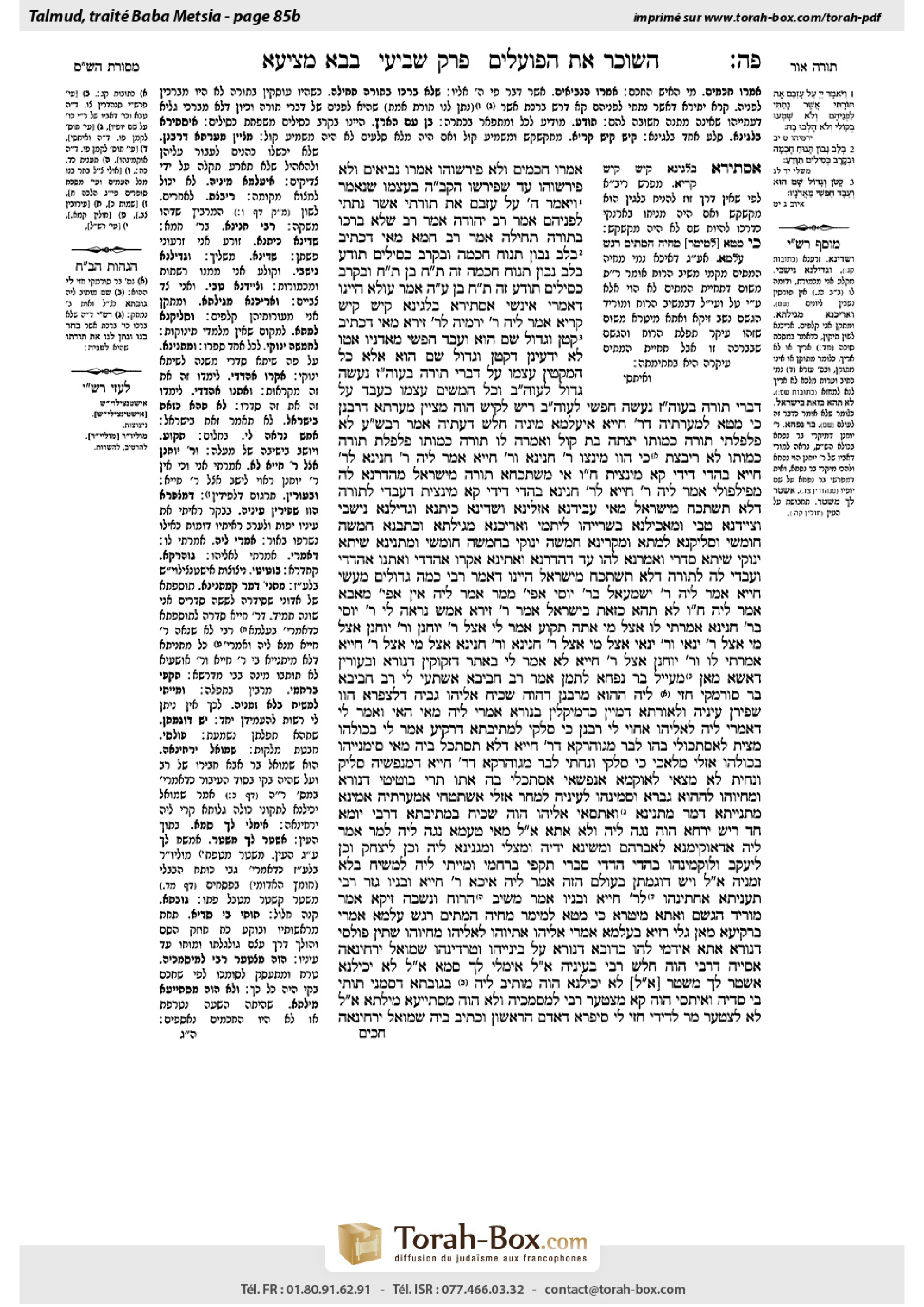
Bava Metzia 85b: Talmud study for Daf Yomi
Study the Talmud for Daf Yomi with scanned pages, Hebrew text, English translations from Sefaria and AI-generated French translations.
Passage selection and English or AI-generated French translation are available where the scan has annotations. Daf Study is independent of Torah-Box and Sefaria.
Browse Bava Metzia · בבא מציעא · All tractatesBava Metzia 85b text and translations
This page of Bava Metzia includes the Aramaic text, an English translation and an AI-generated French translation, alongside the scan above.
בבא מציעא פ״ה ב · Aramaic and Hebrew text
אָמְרוּ חֲכָמִים וְלֹא פֵּירְשׁוּהוּ, אָמְרוּ נְבִיאִים וְלֹא פֵּירְשׁוּהוּ, עַד שֶׁפֵּירְשׁוֹ הַקָּדוֹשׁ בָּרוּךְ הוּא בְּעַצְמוֹ, שֶׁנֶּאֱמַר: ״וַיֹּאמֶר ה׳ עַל עׇזְבָם אֶת תּוֹרָתִי אֲשֶׁר נָתַתִּי לִפְנֵיהֶם״. אָמַר רַב יְהוּדָה אָמַר רַב: שֶׁלֹּא בֵּרְכוּ בַּתּוֹרָה תְּחִילָּה.
אָמַר רַב חָמָא: מַאי דִּכְתִיב ״בְּלֵב נָבוֹן תָּנוּחַ חׇכְמָה וּבְקֶרֶב כְּסִילִים תִּוָּדֵעַ״, ״בְּלֵב נָבוֹן תָּנוּחַ חׇכְמָה״ – זֶה תַּלְמִיד חָכָם בֶּן תַּלְמִיד חָכָם, ״וּבְקֶרֶב כְּסִילִים תִּוָּדֵעַ״ – זֶה תַּלְמִיד חָכָם בֶּן עַם הָאָרֶץ. אָמַר עוּלָּא: הַיְינוּ דְּאָמְרִי אִינָשֵׁי: אִסְתֵּירָא בְּלָגִינָא קִישׁ קִישׁ קָרְיָא.
אֲמַר לֵיהּ רַבִּי יִרְמְיָה לְרַבִּי זֵירָא: מַאי דִּכְתִיב ״קָטֹן וְגָדוֹל שָׁם הוּא וְעֶבֶד חׇפְשִׁי מֵאֲדֹנָיו״? אַטּוּ לָא יָדְעִינַן דְּקָטֹן וְגָדוֹל שָׁם הוּא? אֶלָּא כׇּל הַמַּקְטִין עַצְמוֹ עַל דִּבְרֵי תוֹרָה בָּעוֹלָם הַזֶּה – נַעֲשָׂה גָּדוֹל לָעוֹלָם הַבָּא, וְכׇל הַמֵּשִׂים עַצְמוֹ כְּעֶבֶד עַל דִּבְרֵי תוֹרָה בָּעוֹלָם הַזֶּה – נַעֲשֶׂה חׇפְשִׁי לָעוֹלָם הַבָּא.
רֵישׁ לָקִישׁ הֲוָה מְצַיֵּין מְעָרָתָא דְּרַבָּנַן, כִּי מְטָא לִמְעָרְתֵּיהּ דְּרַבִּי חִיָּיא אִיעֲלַמָא מִינֵּיהּ. חֲלַשׁ דַּעְתֵּיהּ. אֲמַר: רִבּוֹנוֹ שֶׁל עוֹלָם! לֹא פִּלְפַּלְתִּי תּוֹרָה כְּמוֹתוֹ? יָצְתָה בַּת קוֹל וְאָמְרָה לוֹ: תּוֹרָה כְּמוֹתוֹ פִּלְפַּלְתָּ, תּוֹרָה כְּמוֹתוֹ לֹא רִיבַּצְתָּ.
כִּי הֲווֹ מִינְּצוּ רַבִּי חֲנִינָא וְרַבִּי חִיָּיא, אֲמַר לֵיהּ רַבִּי חֲנִינָא לְרַבִּי חִיָּיא: בַּהֲדֵי דִּידִי קָא מִינְּצֵית? חַס וְחָלִילָה, אִי מִשְׁתַּכְחָא תּוֹרָה מִיִּשְׂרָאֵל – מַהְדַּרְנָא לַהּ מִפִּילְפּוּלַי. אֲמַר לֵיהּ רַבִּי חִיָּיא לְרַבִּי חֲנִינָא: בַּהֲדֵי דִּידִי קָא מִינְּצֵית? דַּעֲבַדִי לְתוֹרָה דְּלֹא תִּשְׁתַּכַּח מִיִּשְׂרָאֵל.
מַאי עָבֵידְנָא – אָזֵילְנָא וְשָׁדֵינָא כִּיתָּנָא וְגָדֵילְנָא נִישְׁבֵּי, וְצָיֵידְנָא טְבֵי וּמַאֲכֵילְנָא בִּשְׂרַיְיהוּ לְיַתְמֵי, וְאָרֵיכְנָא מְגִילָּתָא וְכָתֵבְנָא חֲמִשָּׁה חוּמְשֵׁי, וְסָלֵיקְנָא לְמָתָא וּמַקְרֵינָא חַמְשָׁה יָנוֹקֵי בְּחַמְשָׁה חוּמְשֵׁי, וּמַתְנֵינָא שִׁיתָּא יָנוֹקֵי שִׁיתָּא סִדְרֵי, וְאָמַרְנָא לְהוּ: עַד דְּהָדַרְנָא וְאָתֵינָא אַקְרוֹ אַהֲדָדֵי וְאַתְנוֹ אַהֲדָדֵי וַעֲבַדִי לַהּ לְתוֹרָה דְּלֹא תִּשְׁתַּכַּח מִיִּשְׂרָאֵל.
הַיְינוּ דְּאָמַר רַבִּי: כַּמָּה גְּדוֹלִים מַעֲשֵׂי חִיָּיא! אֲמַר לֵיהּ רַבִּי יִשְׁמָעֵאל בְּרַבִּי יוֹסֵי: אֲפִילּוּ מִמָּר? אֲמַר לֵיהּ: אִין. אֲפִילּוּ מֵאַבָּא? אֲמַר לֵיהּ: חַס וְחָלִילָה! לֹא תְּהֵא כְּזֹאת בְּיִשְׂרָאֵל.
אָמַר רַבִּי זֵירָא: אֶמֶשׁ נִרְאָה לִי רַבִּי יוֹסֵי בְּרַבִּי חֲנִינָא. אָמַרְתִּי לוֹ: אֵצֶל מִי אַתָּה תָּקוּעַ? אָמַר לִי: אֵצֶל רַבִּי יוֹחָנָן. וְרַבִּי יוֹחָנָן אֵצֶל מִי? אֵצֶל רַבִּי יַנַּאי. וְרַבִּי יַנַּאי אֵצֶל מִי? אֵצֶל רַבִּי חֲנִינָא. וְרַבִּי חֲנִינָא אֵצֶל מִי? אֵצֶל רַבִּי חִיָּיא. אָמַרְתִּי לוֹ: וְרַבִּי יוֹחָנָן אֵצֶל רַבִּי חִיָּיא לֹא? אָמַר לִי: בַּאֲתַר דְּזִקּוּקִין דְּנוּרָא וּבָעוֹרִין דְּאֶשָּׁא – מַאן מְעַיֵּיל בַּר נַפָּחָא לְתַמָּן?!
אָמַר רַב חֲבִיבָא: אִשְׁתַּעִי לִי רַב חֲבִיבָא בַּר סוּרְמָקֵי, חֲזֵי לֵיהּ הָהוּא מֵרַבָּנַן דַּהֲוָה שְׁכִיחַ אֵלִיָּהוּ גַּבֵּיהּ, דִּלְצַפְרָא הֲווֹ שַׁפִּירָן עֵינֵיהּ, וּלְאוּרְתָּא דָּמְיָין כִּדְמִיקַּלְיָן בְּנוּרָא. אֲמַרִי לֵיהּ: מַאי הַאי? וַאֲמַר לִי: דַּאֲמַרִי לֵיהּ לְאֵלִיָּהוּ: אַחְוִי לִי רַבָּנַן כִּי סָלְקִי לִמְתִיבְתָּא דְּרָקִיעַ. אָמַר לִי: בְּכוּלְּהוּ מָצֵית אִסְתַּכּוֹלֵי בְּהוּ, לְבַר מִגּוּהַרְקָא דְּרַבִּי חִיָּיא דְּלָא תִּסְתַּכֵּל בֵּיהּ. מַאי סִימָנַיְיהוּ? בְּכוּלְּהוּ אָזְלִי מַלְאֲכֵי כִּי סָלְקִי וְנָחֲתִי, לְבַר מִגּוּהַרְקָא דְּרַבִּי חִיָּיא דְּמִנַּפְשֵׁיהּ סָלֵיק וּנְחֵית.
לָא מְצַאי לְאוֹקְמָא אַנַּפְשַׁאי, אִסְתַּכַּלִי בָּהּ: אֲתוֹ תְּרֵי בּוּטִיטֵי דְנוּרָא וּמַחְיוּהּו לְהָהוּא גַּבְרָא וְסַמּוֹנְהוּ לְעֵינֵיהּ. לִמְחַר אֲזַלִי אִשְׁתַּטַּחִי אַמְּעָרְתֵּיהּ, אָמֵינָא: מַתְנְיָיתָא דְּמָר מַתְנֵינָא, וְאִתַּסַּאי.
אֵלִיָּהוּ הֲוָה שְׁכִיחַ בִּמְתִיבְתָּא דְּרַבִּי, יוֹמָא חַד רֵישׁ יַרְחָא הֲוָה, נְגַהּ לֵיהּ וְלָא אֲתָא. אֲמַר לֵיהּ: מַאי טַעְמָא נְגַהּ לֵיהּ לְמָר? אֲמַר לֵיהּ: אַדְּאוֹקֵימְנָא לְאַבְרָהָם וּמָשֵׁינָא יְדֵיהּ וּמְצַלֵּי וּמַגְנֵינָא לֵיהּ, וְכֵן לְיִצְחָק וְכֵן לְיַעֲקֹב. וְלוֹקְמִינְהוּ בַּהֲדֵי הֲדָדֵי! סָבַרי: תָּקְפִי בְּרַחֲמֵי וּמַיְיתִי לֵיהּ לְמָשִׁיחַ בְּלָא זִמְנֵיהּ.
אֲמַר לֵיהּ: וְיֵשׁ דּוּגְמָתָן בָּעוֹלָם הַזֶּה? אֲמַר לֵיהּ: אִיכָּא רַבִּי חִיָּיא וּבָנָיו. גְּזַר רַבִּי תַּעֲנִיתָא, אַחְתִינְהוּ לְרַבִּי חִיָּיא וּבָנָיו. אֲמַר ״מַשִּׁיב הָרוּחַ״ – וּנְשַׁבָה זִיקָא. אֲמַר ״מוֹרִיד הַגֶּשֶׁם״ – וַאֲתָא מִיטְרָא, כִּי מְטָא לְמֵימַר ״מְחַיֵּה הַמֵּתִים״ – רְגַשׁ עָלְמָא.
אָמְרִי בִּרְקִיעָא: מַאן גַּלִּי רָזַיָּא בְּעָלְמָא? אָמְרִי: אֵלִיָּהוּ. אַתְיוּהּ לְאֵלִיָּהוּ מַחְיוּהּ שִׁתִּין פּוּלְסֵי דְנוּרָא. אֲתָא אִידְּמִי לְהוּ כְּדוּבָּא דְנוּרָא, עָל בֵּינַיְיהוּ וְטַרְדִינְהוּ.
שְׁמוּאֵל יַרְחִינָאָה אָסְיֵיהּ דְּרַבִּי הֲוָה. חֲלַשׁ רַבִּי בְּעֵינֵיהּ. אֲמַר לֵיהּ: אֶימְלֵי לָךְ סַמָּא. אֲמַר לֵיהּ: לָא יָכֵילְנָא. אֶשְׁטַר לָךְ מִשְׁטָר. אֲמַר לֵיהּ: לָא יָכֵילְנָא. הֲוָה מוֹתֵיב לֵיהּ בְּגוּבְתָּא דְסַמָּנֵי תּוּתֵי בֵּי סַדְיֵיהּ, וְאִיתַּסִּי.
הֲוָה קָא מִצְטַעַר, רַבִּי לְמִסְמְכֵיהּ וְלָא הֲוָה מִסְתַּיְּיעָא מִילְּתָא. אֲמַר לֵיהּ: לָא לִצְטַעַר מָר, לְדִידִי חֲזֵי לִי סִיפְרָא דְּאָדָם הָרִאשׁוֹן, וּכְתִיב בֵּיהּ: שְׁמוּאֵל יַרְחִינָאָה
Bava Metzia 85b · English translation
was stated by the Sages, i.e., the wise man mentioned in the verse, and yet they could not explain it. It was stated by the prophets, i.e., those to whom the mouth of the Lord has spoken, and yet they could not explain it, until the Holy One, Blessed be He, Himself explained it, as it is stated in the next verse: “And the Lord says: Because they have forsaken My Torah which I set before them” (Jeremiah 9:12). Rav Yehuda says that Rav says: This does not mean that the Jewish people ceased Torah study altogether; rather, they did not recite a blessing on the Torah prior to its study, as they did not regard Torah study as a sacred endeavor.
Rav Ḥama says: What is the meaning of that which is written: “In the heart of him that has discernment wisdom rests; but in the inward part of fools it makes itself known” (Proverbs 14:33)? “In the heart of him who has discernment wisdom rests”; this is a Torah scholar, son of a Torah scholar. “But in the inward part of fools it makes itself known”; this is a Torah scholar, son of an ignoramus, as his wisdom stands out in contrast to the foolishness of the rest of his family. Ulla said: This explains the adage that people say: A small coin in an empty barrel calls: Kish, kish, i.e., it rattles loudly, whereas a coin in a barrel full of coins is not heard.
Rabbi Yirmeya said to Rabbi Zeira: What is the meaning of that which is written with regard to the World-to-Come: “The humble and great are there; and the servant is free from his master” (Job 3:19)? Is that to say that we do not know that the humble and the great are there in the World-to-Come? Rather, this is the meaning of the verse: Anyone who humbles himself over matters of Torah in this world becomes great in the World-to-Come; and anyone who establishes himself as a servant over matters of Torah in this world becomes free in the World-to-Come.
§ The Gemara continues discussing the greatness of the Sages. Reish Lakish was demarcating burial caves of the Sages. When he arrived at the cave of Rabbi Ḥiyya, the precise location of his grave eluded him. Reish Lakish became distressed, as he was apparently unworthy of finding the grave. He said: Master of the Universe! Did I not analyze the Torah like Rabbi Ḥiyya? A Divine Voice emerged and said to him: You did analyze the Torah like him, but you did not disseminate Torah like him.
The Gemara relates: When Rabbi Ḥanina and Rabbi Ḥiyya would debate matters of Torah, Rabbi Ḥanina would say to Rabbi Ḥiyya: Do you think you can debate with me? Heaven forbid! If the Torah were forgotten from the Jewish people, I could restore it with my powers of analysis and intellectual acumen. Rabbi Ḥiyya said to Rabbi Ḥanina: Do you think you can debate with me? You cannot compare yourself to me, as I am acting to ensure that the Torah will not be forgotten by the Jewish people.
Rabbi Ḥiyya elaborated: What do I do to this end? I go and sow flax seeds and twine nets with the flax, and then I hunt deer and feed their meat to orphans. Next I prepare parchment from their hides and I write the five books of the Torah on them. I go to a city and teach five children the five books, one book per child, and I teach six other children the six orders of the Mishna, and I say to them: Until I return and come here, read each other the Torah and teach each other the Mishna. This is how I act to ensure that the Torah will not be forgotten by the Jewish people.
The Gemara notes that this is what Rabbi Yehuda HaNasi said: How great are the deeds of Rabbi Ḥiyya! Rabbi Yishmael, son of Rabbi Yosei, said to Rabbi Yehuda HaNasi: Are his deeds even greater than the Master’s, i.e., yours? Rabbi Yehuda HaNasi said to him: Yes. Rabbi Yishmael persisted: Are they even greater than those of my father, Rabbi Yosei? Rabbi Yehuda HaNasi said to him: Heaven forbid! Such a statement shall not be heard among the Jewish people, that someone is greater than your father, Rabbi Yosei.
The Gemara continues discussing the greatness of Rabbi Ḥiyya. Rabbi Zeira said: Last night, Rabbi Yosei, son of Rabbi Ḥanina, appeared to me in a dream. I said to him: Near whom are you placed in the upper realms? He said to me: Near Rabbi Yoḥanan. I asked: And Rabbi Yoḥanan is near whom? He replied: Near Rabbi Yannai. And Rabbi Yannai is near whom? Near Rabbi Ḥanina. And Rabbi Ḥanina is near whom? Near Rabbi Ḥiyya. Rabbi Zeira added: I said to Rabbi Yosei: But isn’t Rabbi Yoḥanan worthy of being placed near Rabbi Ḥiyya? He said to me: In a place of fiery sparks and burning fires, who can bring Rabbi Yoḥanan, son of Nappaḥa, there?
Rav Ḥaviva said: Rav Ḥaviva bar Surmakei told me: I once saw one of the Sages whom Elijah the prophet would visit, and his eyes looked beautiful and healthy in the morning, but appeared to be charred by fire in the evening. I said to him: What is this phenomenon? And he said to me: I said to Elijah: Show me the Sages upon their ascension to the heavenly academy. Elijah said to me: You may gaze at all of them except for those in the chariot [miguharka] of Rabbi Ḥiyya, upon whom you may not gaze. I asked Elijah: What are the signs of Rabbi Ḥiyya’s chariot, so I will know when not to look? He said: Angels accompany all of the other Sages’ chariots as they ascend and descend, except for the chariot of Rabbi Ḥiyya, which ascends and descends of its own accord, due to his greatness.
The Sage relating this story continued: I was unable to restrain myself, and I gazed upon Rabbi Ḥiyya’s chariot. Two fiery flames came and struck that man, i.e., me, and blinded his eyes. The next day, I went and prostrated on Rabbi Ḥiyya’s burial cave in supplication. I said: I study the baraitot of the Master, Rabbi Ḥiyya; please pray on my behalf. And my vision was healed, but my eyes remained scorched.
The Gemara relates another incident involving Elijah the prophet. Elijah was often found in the academy of Rabbi Yehuda HaNasi. One day it was a New Moon, the first of the month, and Elijah was delayed and did not come to the academy. Later, Rabbi Yehuda HaNasi said to Elijah: What is the reason that the Master was delayed? Elijah said to him: I had to wake up Abraham, wash his hands, and wait for him to pray, and then lay him down again. And similarly, I followed the same procedure for Isaac, and similarly for Jacob in turn. Rabbi Yehuda HaNasi asked Elijah: And let the Master wake them all together. Elijah responded: I maintain that if I were to wake all three to pray at the same time, they would generate powerful prayers and bring the Messiah prematurely.
Rabbi Yehuda HaNasi said to Elijah: And is there anyone alive in this world who is comparable to them and can produce such efficacious prayers? Elijah said to him: There are Rabbi Ḥiyya and his sons. Rabbi Yehuda HaNasi decreed a fast, and the Sages brought Rabbi Ḥiyya and his sons down to the pulpit to pray on behalf of the congregation. Rabbi Ḥiyya recited the phrase in the Amida prayer: Who makes the wind blow, and the wind blew. Rabbi Ḥiyya recited the next phrase: Who makes the rain fall, and rain fell. When he was about to say the phrase: Who revives the dead, the world trembled.
They said in heaven: Who is the revealer of secrets in the world? They said in response: It is Elijah. Elijah was brought to heaven, whereupon he was beaten with sixty fiery lashes. Elijah came back down to earth disguised as a bear of fire. He came among the congregation and distracted them from their prayers, preventing Rabbi Ḥiyya from reciting the phrase: Who revives the dead.
§ The Gemara relates: Shmuel Yarḥina’a was the physician of Rabbi Yehuda HaNasi. One time, Rabbi Yehuda HaNasi felt a pain in his eye. Shmuel said to him: I will place a medication in your eye. Rabbi Yehuda HaNasi said to him: I cannot have the medication placed directly in my eye, as I am afraid it will cause me too much pain. Shmuel said to him: I will apply a salve above your eye, not directly in it. Rabbi Yehuda HaNasi said to him: Even that I cannot bear. Shmuel placed the medication in a tube of herbs beneath his pillow, and Rabbi Yehuda HaNasi was healed.
Rabbi Yehuda HaNasi made efforts to ordain Shmuel Yarḥina’a as a rabbi but was unsuccessful, as Shmuel always demurred. Shmuel Yarḥina’a said to him: The Master should not be upset about my refusal, as I know that I am not destined to be ordained as a rabbi. I myself saw the book of Adam the first man, which contains the genealogy of the human race, and it is written in it that Shmuel Yarḥina’a
Bava Metzia 85b · Traduction française (IA)
a été dit par les Sages, c'est-à-dire le sage mentionné dans la versette, et pourtant ils n'ont pas pu l'expliquer. Cela a été dit par les prophètes, c'est-à-dire ceux auxquels la bouche du Seigneur a parlé, et pourtant ils n'ont pas pu l'expliquer, jusqu'au Saint, béni soit-Il, Lui-même l'a expliqué, comme il est dit dans la versette suivante : « Et le Seigneur dit : Parce qu'ils ont abandonné Ma Torah que je leur ai mise devant eux » (Jérémie 9:12). Rav Yehuda dit que Rav dit : cela ne signifie pas que le peuple juif a cessé totalement d'étudier la Torah ; plutôt, ils n'ont pas récité une berakha sur la Torah avant d'en faire l'étude, car ils ne considéraient pas l'étude de la Torah comme une entreprise sacrée.
Rav Ḥama dit : Quelle est la signification de ce qui est écrit : « Dans le cœur de celui qui a discernement, la sagesse repose ; mais dans la partie intérieure des imbéciles, elle se fait connaître » (Proverbes 14:33) ? « Dans le cœur de celui qui a discernement, la sagesse repose » ; c'est un savant, fils d'un savant. « Mais dans la partie intérieure des imbéciles, elle se fait connaître » ; c'est un savant, fils d'un ignorant, car sa sagesse se distingue par contraste avec la bêtise du reste de sa famille. Ulla dit : cela explique l'adage que les gens disent : une petite monnaie dans un tonneau vide appelle : Kish, Kish, c'est-à-dire qu'elle résonne fort, tandis qu'une monnaie dans un tonneau plein de monnaies n'est pas entendue.
Rabbi Yirmeya dit à Rabbi Zeira : Quelle est la signification de ce qui est écrit concernant le Monde à Venir : « Les humbles et les grands y sont ; et l'esclave est libre de son maître » (Job 3:19) ? Est-ce dire que nous ne savons pas que les humbles et les grands y sont dans le Monde à Venir ? Plutôt, c'est la signification de la versette : celui qui s'humilie sur les affaires de la Torah dans ce monde devient grand dans le Monde à Venir ; et celui qui s'établit comme un esclave sur les affaires de la Torah dans ce monde devient libre dans le Monde à Venir.
§ Le Guemara continue à discuter la grandeur des Sages. Reish Lakish marquait les tombes des Sages. Lorsqu'il arriva à la tombe de Rabbi Ḥiyya, la localisation précise de son tombeau lui échappait. Reish Lakish s'effondra en désespoir, car il semblait être indigné de trouver la tombe. Il dit : Maître du Monde ! N'ai-je pas analysé la Torah comme Rabbi Ḥiyya ? Une Voix Divine émergea et dit à lui : Tu as analysé la Torah comme lui, mais tu n'as pas diffusé la Torah comme lui.
Le Guemara rapporte : Lorsque Rabbi Ḥanina et Rabbi Ḥiyya débattaient sur des questions de Torah, Rabbi Ḥanina disait à Rabbi Ḥiyya : Penses-tu pouvoir débattre avec moi ? Dieu forbid ! Si la Torah était oubliée du peuple juif, je pourrais la restaurer avec mes pouvoirs d'analyse et mon acuité intellectuelle. Rabbi Ḥiyya disait à Rabbi Ḥanina : Penses-tu pouvoir débattre avec moi ? Tu ne peux pas te comparer à moi, car je m'efforce d'assurer que la Torah ne sera pas oubliée par le peuple juif.
Rabbi Ḥiyya expliqua : Qu'est-ce que je fais à cette fin ? Je vais et je sème des graines de lin, je tisse des filets avec le lin, puis je chasse des cerfs et je nourris leur viande aux orphelins. Ensuite, je prépare des parchemins de leurs peaux et j'écris les cinq livres de la Torah dessus. Je vais dans une ville et je fais étudier cinq enfants les cinq livres, un livre par enfant, et je fais étudier six autres enfants les six ordres du Michna, et je dis à eux : Jusqu'à ce que je revienne et vienne ici, lisez-vous mutuellement la Torah et enseignez-vous mutuellement le Michna. C'est ainsi que j'agis pour assurer que la Torah ne sera pas oubliée par le peuple juif.
Le Guemara souligne que c'est ce que Rabbi Yehuda HaNasi a dit : Quelle grandeur sont les œuvres de Rabbi Ḥiyya ! Rabbi Yishmael, fils de Rabbi Yosei, dit à Rabbi Yehuda HaNasi : Ses œuvres ne sont-elles pas même plus grandes que celles du Maître, c'est-à-dire les tiennes ? Rabbi Yehuda HaNasi dit à lui : Oui. Rabbi Yishmael persista : Ne sont-elles pas même plus grandes que celles de mon père, Rabbi Yosei ? Rabbi Yehuda HaNasi dit à lui : Dieu forbid ! Une telle déclaration ne doit pas être entendue parmi le peuple juif, que quelqu'un soit plus grand que ton père, Rabbi Yosei.
Le Guemara continue à discuter la grandeur de Rabbi Ḥiyya. Rabbi Zeira dit : La nuit dernière, Rabbi Yosei, fils de Rabbi Ḥanina, est apparu à moi en rêve. Je lui dis : À qui es-tu placé dans les hauteurs ? Il me dit : Proche de Rabbi Yoḥanan. Je demandai : Et Rabbi Yoḥanan est proche de qui ? Il répondit : Proche de Rabbi Yannai. Et Rabbi Yannai est proche de qui ? Proche de Rabbi Ḥanina. Et Rabbi Ḥanina est proche de qui ? Proche de Rabbi Ḥiyya. Rabbi Zeira ajouta : Je dis à Rabbi Yosei : Mais n'est-ce pas Rabbi Yoḥanan qui mérite d'être placé proche de Rabbi Ḥiyya ? Il me dit : Dans un lieu de flammes et de feux brûlants, qui peut amener Rabbi Yoḥanan, fils de Nappaḥa, là ?
Rav Ḥaviva dit : Rav Ḥaviva bar Surmakei me dit : J'ai un jour vu l'un des Sages que le prophète Elie visitait, et ses yeux regardaient beaux et sains le matin, mais apparaissaient brûlés par le feu le soir. Je lui dis : Quel est ce phénomène ? Et il me dit : J'ai dit à Elie : Montre-moi les Sages lors de leur ascension à l'académie céleste. Elie me dit : Tu peux regarder tous d'entre eux sauf ceux dans la charrette de Rabbi Ḥiyya, sur lesquels tu ne dois pas regarder. Je demandai à Elie : Quels sont les signes de la charrette de Rabbi Ḥiyya, afin que je sache quand ne pas regarder ? Il me dit : Des anges accompagnent toutes les charrettes des autres Sages lorsqu'ils montent et descendent, sauf la charrette de Rabbi Ḥiyya, qui monte et descend d'elle-même, en raison de sa grandeur.
Le Sage racontant cette histoire continua : Je n'ai pas pu m'en empêcher, et j'ai contemplé la charrette de Rabbi Ḥiyya. Deux flammes de feu sont venues et m'ont frappé, c'est-à-dire moi, et ont aveuglé mes yeux. Le lendemain, je suis allé me prosterner sur la tombe de Rabbi Ḥiyya en prière. J'ai dit : Je étudie les baraitot du Maître, Rabbi Ḥiyya ; prie pour moi. Et ma vision fut guérie, mais mes yeux restèrent brûlés.
La Guemara rapporte un autre incident concernant le prophète Elie. Elie était souvent présent dans l'académie du maître Yéhouda HaNasi. Un jour, il s'agissait d'un nouveau mois, le premier du mois, et Elie était en retard et n'était pas venu à l'académie. Plus tard, le maître Yéhouda HaNasi demanda à Elie : Quelle est la raison pour laquelle le maître était en retard ? Elie répondit à lui : J'ai dû réveiller Abraham, laver ses mains, et attendre qu'il prie, puis le recoucher. De même, j'ai suivi la même procédure pour Isaac, et de même pour Jacob à son tour. Le maître Yéhouda HaNasi demanda à Elie : Et pourquoi ne pas réveiller tous les trois ensemble ? Elie répondit : Je maintiens que si je réveillais les trois pour prier en même temps, leurs prières seraient puissantes et apporteraient le Messie précocement.
Le maître Yéhouda HaNasi demanda à Elie : Et y a-t-il quelqu'un vivant dans ce monde comparable à eux et capable de produire de telles prières efficaces ? Elie répondit à lui : Il y a Rabbi Hiyaa et ses fils. Le maître Yéhouda HaNasi institua un jeûne, et les Sages amenèrent Rabbi Hiyaa et ses fils sur l'estrade pour prier au nom de la communauté. Rabbi Hiyaa récita la phrase dans la prière Amida : Celui qui fait souffler le vent, et le vent souffla. Rabbi Hiyaa récita la prochaine phrase : Celui qui fait tomber la pluie, et la pluie tomba. Lorsqu'il était sur le point de dire la phrase : Celui qui ressuscite les morts, le monde trembla.
On dit au Ciel : Qui est le révélateur des secrets dans le monde ? On répondit : C'est Elie. Elie fut amené au Ciel, où il fut frappé de soixante coups de fouet enflammés. Elie revint sur terre dissimulé sous la forme d'un ours de feu. Il entra parmi la congrégation et les distraignit de leurs prières, empêchant Rabbi Hiyaa de réciter la phrase : Celui qui ressuscite les morts.
§ La Guemara rapporte : Shmuel Yarḥina’a était le médecin du maître Yéhouda HaNasi. Une fois, le maître Yéhouda HaNasi ressentit une douleur dans son œil. Shmuel lui dit : Je vais mettre un médicament dans ton œil. Le maître Yéhouda HaNasi lui dit : Je ne peux pas avoir le médicament mis directement dans mon œil, car j'ai peur qu'il me fasse trop mal. Shmuel lui dit : Je vais appliquer un onguent au-dessus de ton œil, pas directement dedans. Le maître Yéhouda HaNasi lui dit : Même cela, je ne le supporte pas. Shmuel mit le médicament dans un tube d'herbes sous son oreiller, et le maître Yéhouda HaNasi guéri.
Le maître Yéhouda HaNasi fit des efforts pour ordonner Shmuel Yarḥina’a comme rabbin mais fut infructueux, car Shmuel refusait toujours. Shmuel Yarḥina’a dit au maître : Le maître ne devrait pas être déçu par mon refus, car je sais que je ne suis pas destiné à être ordonné comme rabbin. Moi-même, j'ai vu le livre d'Adam le premier homme, qui contient la généalogie de l'humanité, et il est écrit dedans que Shmuel Yarḥina’a est destiné à être un médecin.
Traduction française générée par IA à partir de l’édition anglaise de Sefaria. Vérifie toujours un passage avec le texte source.
Text from Sefaria: William Davidson Edition - Vocalized Aramaic (CC BY NC); William Davidson Edition - English (CC BY NC).