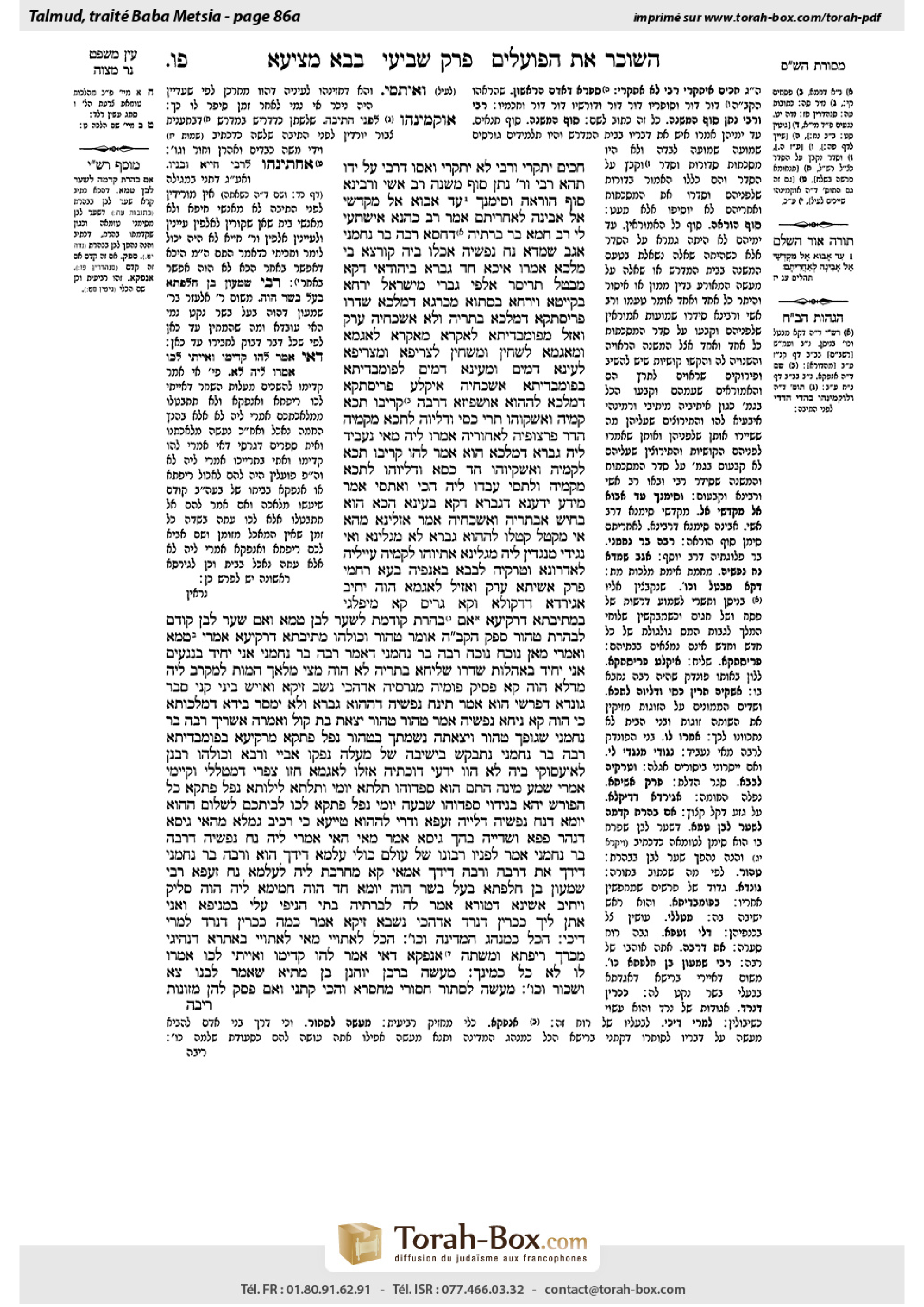
Bava Metzia 86a: Talmud study for Daf Yomi
Study the Talmud for Daf Yomi with scanned pages, Hebrew text, English translations from Sefaria and AI-generated French translations.
Passage selection and English or AI-generated French translation are available where the scan has annotations. Daf Study is independent of Torah-Box and Sefaria.
Browse Bava Metzia · בבא מציעא · All tractatesBava Metzia 86a text and translations
This page of Bava Metzia includes the Aramaic text, an English translation and an AI-generated French translation, alongside the scan above.
בבא מציעא פ״ו א · Aramaic and Hebrew text
חַכִּים יִתְקְרֵי, וְרַבִּי לָא יִתְקְרֵי. וְאַסּוּ דְּרַבִּי עַל יָדוֹ תְּהֵא. רַבִּי וְרַבִּי נָתָן – סוֹף מִשְׁנָה. רַב אָשֵׁי וְרָבִינָא – סוֹף הוֹרָאָה.
וְסִימָנָךְ: ״עַד אָבוֹא אֶל מִקְדְּשֵׁי אֵל אָבִינָה לְאַחֲרִיתָם״.
אָמַר רַב כָּהֲנָא, אִישְׁתַּעִי לִי רַב חָמָא בַּר בְּרַתֵּיה דְּחַסָּא: רַבָּה בַּר נַחְמָנִי אַגַּב שְׁמָדָא נָח נַפְשֵׁיהּ. אֲכַלוּ בֵּיהּ קוּרְצָא בֵּי מַלְכָּא, אֲמַרוּ: אִיכָּא חַד גַּבְרָא בִּיהוּדָאֵי דְּקָא מְבַטֵּל תְּרֵיסַר אַלְפֵי גַּבְרֵי מִיִּשְׂרָאֵל יַרְחָא בְּקַיְיטָא וְיַרְחָא בְּסִתְוָא מִכְּרָגָא דְּמַלְכָּא.
שַׁדַּרוּ פְּרֵיסְתְּקָא דְמַלְכָּא בָּתְרֵיהּ וְלָא אַשְׁכְּחֵיהּ. עֲרַק וַאֲזַל מִפּוּמְבְּדִיתָא לְאַקְרָא, מֵאַקְרָא לְאַגְמָא, וּמֵאַגְמָא לְשִׁחִין, וּמִשִּׁחִין לִצְרִיפָא, וּמִצְּרִיפָא לְעֵינָא דְמַיִם, וּמֵעֵינָא דְמַיִם לְפוּמְבְּדִיתָא. בְּפוּמְבְּדִיתָא אַשְׁכְּחֵיהּ. אִיקְּלַע פְּרֵיסְתְּקָא דְמַלְכָּא לְהָהוּא אוּשְׁפִּיזָא דְּרַבָּה. קָרִיבוּ תַּכָּא קַמֵּיהּ וְאַשְׁקוּהוּ תְּרֵי כָּסֵי, וְדַלְיוּהּ לְתַכָּא מִקַּמֵּיהּ הֲדַר פַּרְצוּפֵיהּ לַאֲחוֹרֵיהּ.
אֲמַרוּ לֵיהּ: מַאי נַעֲבֵיד לֵיהּ? גַּבְרָא דְמַלְכָּא הוּא! אֲמַר לְהוּ: קָרִיבוּ תַּכָּא לְקַמֵּיהּ, וְאַשְׁקוּהּ חַד כָּסָא, וְדַלְיוּהּ לְתַכָּא מִקַּמֵּיהּ וְלִתַּסֵּי. עֲבַדוּ לֵיהּ הָכִי וְאִתַּסִּי. אֲמַר: מִידָּע יָדַעְנָא דְּגַבְרָא דְּקָא בָעֵינָא הָכָא הוּא. בְּחֵישׁ אַבָּתְרֵיהּ וְאַשְׁכְּחֵיהּ. אֲמַר: אָזֵלְינָא מֵהָא, אִי מִקְטָל קָטְלוּ לְהָהוּא גַּבְרָא – לָא מְגַלֵּינָא, וְאִי נַגֹּידֵי מְנַגְּדִין לֵיהּ – מְגַלֵּינָא.
אַתְיוּהּ לְקַמֵּיהּ, עַיְּילֵיהּ לְאִדְּרוֹנָא וְטַרְקֵיהּ לְבָבָא בְּאַנְפֵּיהּ. בְּעָא רַחֲמֵי, פְּרַק אֲשִׁיתָא עֲרַק וַאֲזַל לְאַגְמָא. הֲוָה יָתֵיב אַגִּירְדָּא דְּדִקּוּלָא וְקָא גָרֵיס. קָא מִיפַּלְגִי בִּמְתִיבְתָּא דִרְקִיעָא: אִם בַּהֶרֶת קוֹדֶמֶת לְשֵׂעָר לָבָן – טָמֵא, וְאִם שֵׂעָר לָבָן קוֹדֵם לַבַּהֶרֶת – טָהוֹר.
סָפֵק – הַקָּדוֹשׁ בָּרוּךְ הוּא אוֹמֵר: טָהוֹר, וְכוּלְּהוּ מְתִיבְתָּא דִרְקִיעָא אָמְרִי: טָמֵא. וְאָמְרִי: מַאן נוֹכַח? נוֹכַח רַבָּה בַּר נַחְמָנִי. דְּאָמַר רַבָּה בַּר נַחְמָנִי: אֲנִי יָחִיד בִּנְגָעִים, אֲנִי יָחִיד בְּאֹהָלוֹת.
שַׁדַּרוּ שְׁלִיחָא בָּתְרֵיהּ. לָא הֲוָה מָצֵי מַלְאַךְ הַמָּוֶת לְמִקְרַב לֵיהּ, מִדְּלָא הֲוָה קָא פָסֵיק פּוּמֵּיהּ מִגִּרְסֵיהּ. אַדְּהָכִי נְשַׁב זִיקָא וַאֲוַושׁ בֵּינֵי קְנֵי, סְבַר גּוּנְדָּא דְפָרָשֵׁי הוּא. אֲמַר: תִּינַח נַפְשֵׁיהּ דְּהָהוּא גַּבְרָא, וְלָא יִמְּסַר בִּידָא דְמַלְכוּתָא.
כִּי הֲוָה קָא נָיְחָא נַפְשֵׁיהּ, אֲמַר: טָהוֹר, טָהוֹר. יָצָאת בַּת קוֹל וְאָמְרָה: אַשְׁרֶיךָ רַבָּה בַּר נַחְמָנִי שֶׁגּוּפְךָ טָהוֹר, וְיָצָאתָה נִשְׁמָתְךָ בְּטָהוֹר. נְפַל פִּתְקָא מֵרְקִיעָא בְּפוּמְבְּדִיתָא: רַבָּה בַּר נַחְמָנִי נִתְבַּקֵּשׁ בִּיְשִׁיבָה שֶׁל מַעְלָה. נְפַקוּ אַבָּיֵי וְרָבָא וְכוּלְּהוּ רַבָּנַן לְאִיעֲסוֹקֵי בֵּיהּ. לָא הֲווֹ יָדְעִי דּוּכְתֵּיהּ. אֲזַלוּ לְאַגְמָא חֲזוֹ צִפְּרֵי דִּמְטַלְּלִי וְקָיְימִי, אָמְרִי: שְׁמַע מִינַּהּ הָתָם הוּא.
סַפְדוּהּ תְּלָתָא יוֹמֵי וּתְלָתָא לֵילָוָתָא. נְפַל פִּתְקָא: כׇּל הַפּוֹרֵשׁ יְהֵא בְּנִידּוּי. סַפְדוּהּ שִׁבְעָה יוֹמֵי. נְפַל פִּתְקָא: לְכוּ לְבֵיתְכֶם לְשָׁלוֹם.
הָהוּא יוֹמָא דְּנָח נַפְשֵׁיהּ דַּלְיֵיהּ זַעְפָּא וּדְרִי לְהָהוּא טַיָּיעָא כִּי רְכִיב גַּמְלָא מֵהַאי גִּיסָא דִּנְהַר פָּפָּא וְשַׁדְיֵיהּ בְּהָךְ גִּיסָא. אֲמַר: מַאי הַאי? אָמְרִי לֵיהּ: נָח נַפְשֵׁיהּ דְּרַבָּה בַּר נַחְמָנִי. אָמַר לְפָנָיו: רִבּוֹנוֹ שֶׁל עוֹלָם! כּוּלֵּי עָלְמָא דִּידָךְ הוּא, וְרַבָּה בַּר נַחְמָנִי דִּידָךְ, אַתְּ דְּרַבָּה וְרַבָּה דִּידָךְ – אַמַּאי קָא מַחְרְבַתְּ לֵיהּ לְעָלְמָא? נָח זַעְפָּא.
רַבִּי שִׁמְעוֹן בֶּן חֲלַפְתָּא בַּעַל בָּשָׂר הֲוָה. יוֹמָא חַד הֲוָה חַמִּימָא לֵיהּ, הֲוָה סָלֵיק וְיָתֵיב אַשִּׁינָּא דְטוּרָא. אֲמַר לַהּ לִבְרַתֵּיהּ: בִּתִּי, הָנִיפִי עָלַי בִּמְנִיפָא, וַאֲנִי אֶתֵּן לִיךְ כִּכָּרִין דְּנֵרְדְּ. אַדְּהָכִי נְשַׁבָא זִיקָא, אֲמַר: כַּמָּה כַּכְּרִין דְּנֵרְדְּ לְמָרֵי דֵּיכִי.
הַכֹּל כְּמִנְהַג הַמְּדִינָה וְכוּ׳. הַכֹּל לְאֵתוֹיֵי מַאי? לְאֵתוֹיֵי בְּאַתְרָא דִּנְהִיגִי מִכְרַךְ רִיפְתָּא וּמִשְׁתֵּה אַנְפָּקָא. דְּאִי אָמַר לְהוּ קַדִּימוּ וְאַיְיתֵי לְכוּ, אָמְרוּ לֵיהּ: לָא כֹּל כְּמִינָךְ.
מַעֲשֶׂה בְּרַבָּן יוֹחָנָן בֶּן מַתְיָא שֶׁאָמַר לִבְנוֹ צֵא וּשְׂכוֹר וְכוּ׳. מַעֲשֶׂה לִסְתּוֹר! חַסּוֹרֵי מְחַסְּרָא וְהָכִי קָתָנֵי: וְאִם פָּסַק לָהֶם מְזוֹנוֹת
Bava Metzia 86a · English translation
shall be called a wise [ḥakim] physician, but he shall not be called rabbi, and Rabbi Yehuda HaNasi’s convalescence shall be through him. I also saw written there: Rabbi Yehuda HaNasi and Rabbi Natan are the end of the Mishna, i.e., the last of the tanna’im, the redactors of the Mishna. Rav Ashi and Ravina are the end of instruction, i.e., the end of the period of the amora’im, the redacting of the Talmud, which occurred after the period of the tanna’im.
And your mnemonic to remember that Rav Ashi and Ravina redacted the Talmud is the verse: “Until I entered into the sanctuary [mikdashei] of God, and considered [avina] their end” (Psalms 73:17). The sanctuary, mikdashei, alludes to Rav Ashi, while the term avina alludes to Ravina, which is a contraction of Rav Avina. The phrase: Their end, is interpreted as a reference to the redacting of the Talmud.
§ The Gemara relates another story discussing the greatness of the Sages. Rav Kahana said: Rav Ḥama, son of the daughter of Ḥasa, told me that Rabba bar Naḥmani died due to the fear of a decree of religious persecution. The Gemara explains: His enemies accused him [akhalu beih kurtza] of disloyalty in the king’s palace, as they said: There is one man from among the Jews who exempts twelve thousand Jewish men from the king’s head tax two months a year, one month in the summer and one month in the winter. Since many people would study in Rabba’s study hall during the months of Adar and Elul, he was being blamed for preventing those people from working during those months.
They sent a messenger [peristaka] of the king after him, but he was not able to find him. Rabba bar Naḥmani fled and went from Pumbedita to Akra, from Akra to Agma, from Agma to Shiḥin, from Shiḥin to Tzerifa, from Tzerifa to Eina Demayim, and from Eina Demayim back to Pumbedita. Ultimately, he was found in Pumbedita, as the king’s messenger arrived by chance at that same inn where Rabba bar Naḥmani was hiding. The inn attendants placed a tray before the messenger and gave him two cups to drink. They then removed the tray from before him and his face was miraculously turned backward.
The attendants said to Rabba bar Naḥmani: What should we do with him? He is the king’s man, and we cannot leave him like this. Rabba bar Naḥmani said to them: Place a tray before him and give him one cup to drink, and then remove the tray from before him and he will be healed. They did this, and he was healed. The messenger said: I am certain that the man I seek is here, as this unnatural event must have befallen me on his account. He searched for Rabba bar Naḥmani and found out where he was. The messenger said that they should tell Rabba bar Naḥmani: I will leave this inn and will not disclose your location. Even if they will kill that man, i.e., me, I will not disclose your location. But if they will beat him, me, I will disclose your whereabouts, as I cannot bear being tortured.
With that guarantee, they brought Rabba bar Naḥmani before the messenger. They took him into a small vestibule [le’idrona] and closed the door before him. Rabba bar Naḥmani prayed for mercy, and the wall crumbled. He fled and went to hide in a swamp. He was sitting on the stump of a palm tree and studying Torah alone. At that moment, the Sages in the heavenly academy were disagreeing with regard to a halakha of leprosy. In general, a leprous spot includes two signs of impurity, a bright white spot and a white hair. The basic halakha is that if the snow-white leprous sore [baheret] preceded the white hair then the afflicted person is ritually impure, but if the white hair preceded the baheret, he is pure.
The heavenly debate concerned a case of uncertainty as to which came first, the spot or the hair. The Holy One, Blessed be He, says: The individual is pure, but every other member of the heavenly academy says: He is impure. And they said: Who can arbitrate in this dispute? They agreed that Rabba bar Naḥmani should arbitrate, as Rabba bar Naḥmani once said: I am preeminent in the halakhot of leprosy and I am preeminent in the halakhot of ritual impurity imparted by tents.
They sent a messenger from heaven after him to take his soul up to the heavenly academy, but the Angel of Death was unable to approach Rabba bar Naḥmani, as his mouth did not cease from his Torah study. In the meantime, a wind blew and howled between the branches. Rabba bar Naḥmani thought that the noise was due to an infantry battalion [gunda] about to capture him. He said: Let that man, i.e., me, die and not be given over to the hands of the government. The Angel of Death was therefore able to take his soul.
As he was dying, he said in response to the dispute in heaven: It is pure; it is pure. A Divine Voice emerged from heaven and said: Happy are you, Rabba bar Naḥmani, as your body is pure and your soul left you with the word: Pure. A note [pitka] fell from heaven and landed in the academy of Pumbedita. The note read: Rabba bar Naḥmani was summoned to the heavenly academy, i.e., he has died. Abaye and Rava and all of the other Rabbis went out to tend to his burial; however, they did not know the location of his body. They went to the swamp and saw birds forming a shade and hovering over a certain spot. The Rabbis said: We can conclude from this that he is there.
The Rabbis lamented him for three days and three nights. A note fell from heaven, upon which was written: Anyone who removes himself from the lamentations shall be ostracized. Accordingly, they lamented him for seven days. Another note fell from heaven, stating: Go to your homes in peace.
On that day when Rabba bar Naḥmani died, a hurricane lifted a certain Arab [taya’a] merchant while he was riding his camel. The hurricane carried him from one side of the Pappa River and threw him onto the other side. He said: What is this? Those present said to him: Rabba bar Naḥmani has died. He said before God: Master of the Universe! The entire world is Yours and Rabba bar Naḥmani is also Yours. You are to Rabba and Rabba is to You, i.e., you are beloved to each other. If so, why are You destroying the world on his account? The storm subsided.
The Gemara concludes its earlier discussion of obese Sages (84a). Rabbi Shimon ben Ḥalafta was obese. One day he was particularly hot and went and sat on a mountain boulder to cool himself off. He said to his daughter: My daughter, fan me with a fan, and as a gift I will give you packages of spikenard. In the meantime, a strong wind blew. He said: How many packages of spikenard do I owe to the overseers of this wind?
§ The Gemara returns to its discussion of the mishna (83a), which teaches that an employer must provide his laborers with sustenance, all in accordance with the regional custom. The Gemara asks: What is added by the inclusive term: All? The Gemara answers: This serves to include a place where it is customary for the laborers to eat bread and drink a quarter-log [anpaka] of wine. As, if in such a case the employer were to say to them: Arise early in the morning and I will bring you this sustenance, so as not to waste work time, they may say to him: It is not in your power to compel us to do so.
§ The mishna teaches that there was an incident involving Rabbi Yoḥanan ben Matya, who said to his son: Go out and hire laborers for us. His son hired the laborers and stipulated that he would provide sustenance for them. The Gemara asks: After the mishna has stated that all practices are in accordance with the regional custom, how can it cite this incident, which seems to contradict the previous ruling, as Rabbi Yoḥanan ben Matya and his son did not follow the regional custom? The Gemara answers: The mishna is incomplete and this is what it is teaching: All practices are in accordance with the regional custom, but if the employer pledged to provide sustenance for them,
Bava Metzia 86a · Traduction française (IA)
il sera appelé un médecin sage [ḥakim], mais on ne le dira pas rabbi, et la convalescence de Rabbi Yehuda HaNasi sera par lui. J’ai également vu écrit là : Rabbi Yehuda HaNasi et Rabbi Natan sont la fin de la Michna, c’est-à-dire les derniers des tanna’im, les rédacteurs de la Michna. Rav Ashi et Ravina sont la fin de l’enseignement, c’est-à-dire la fin de la période des amora’im, la rédaction du Talmud, qui s’est produite après la période des tanna’im.
Et votre mnémonique pour retenir que Rav Ashi et Ravina ont rédigé le Talmud est la verset : « Jusqu’à ce que je pénètre dans le sanctuaire [mikdashei] de Dieu, et que je considère [avina] leur fin » (Psaumes 73:17). Le sanctuaire, mikdashei, fait allusion à Rav Ashi, tandis que le terme avina fait allusion à Ravina, qui est une contraction de Rav Avina. La phrase : Leur fin, est interprétée comme une référence à la rédaction du Talmud.
§ Le Guemara rapporte une autre histoire discutant la grandeur des Sages. Rav Kahana dit : Rav Ḥama, fils de la fille de Ḥasa, m’a dit que Rabba bar Naḥmani est mort à cause de la peur d’un décret de persécution religieuse. Le Guemara explique : Ses ennemis l’accusaient [akhalu beih kurtza] de trahison dans la cour du roi, car ils disaient : Il y a un homme parmi les Juifs qui exempt douze mille hommes juifs du droit de tête du roi deux mois par an, un mois en été et un mois en hiver. Puisque beaucoup de gens étudiaient dans la salle de Rabba pendant les mois d’Adar et d’Elul, il était blâmé pour empêcher ces gens de travailler pendant ces mois.
Ils envoyèrent un messager [peristaka] du roi après lui, mais il ne put pas le trouver. Rabba bar Naḥmani s’enfuit et alla de Pumbedita à Akra, d’Akra à Agma, d’Agma à Shiḥin, de Shiḥin à Tzerifa, de Tzerifa à Eina Demayim, et d’Eina Demayim de nouveau à Pumbedita. Finalement, il fut trouvé à Pumbedita, car le messager du roi arriva par hasard à l’hôtel même où Rabba bar Naḥmani se cachait. Les employés de l’hôtel placèrent une assiette devant le messager et lui donnèrent deux verres à boire. Ils retirèrent ensuite l’assiette devant lui et son visage fut miraculeusement retourné.
Les employés dirent à Rabba bar Naḥmani : Que devons-nous faire avec lui ? Il est l’homme du roi, et nous ne pouvons pas le laisser ainsi. Rabba bar Naḥmani dit à eux : Placez une assiette devant lui et donnez-lui un verre à boire, puis retirez l’assiette devant lui et il sera guéri. Ils firent cela, et il fut guéri. Le messager dit : Je suis certain que l’homme que je cherche est ici, car cet événement inhabituel doit avoir eu lieu à cause de lui. Il chercha Rabba bar Naḥmani et découvrit où il était. Le messager dit qu’ils devaient dire à Rabba bar Naḥmani : Je quitterai cet hôtel et ne révélerai pas votre localisation. Même si on va tuer cet homme, c’est-à-dire moi, je ne révélerai pas votre localisation. Mais si on me bat, je révélerai votre lieu, car je ne peux pas supporter d’être torturé.
Avec cette garantie, ils amenèrent Rabba bar Naḥmani devant le messager. Ils le prirent dans une petite vestibule [le’idrona] et fermèrent la porte devant lui. Rabba bar Naḥmani pria pour la miséricorde, et le mur s’effondra. Il s’enfuit et alla se cacher dans un marais. Il était assis sur le tronc d’un palmier et étudia la Torah seul. À ce moment, les Sages de l’académie céleste étaient en désaccord concernant une halakha de lèpre. En général, une tache de lèpre inclut deux signes d’impureté, une tache blanche brillante et un cheveu blanc. La halakha fondamentale est que si la tache blanche de lèpre [baheret] précède le cheveu blanc, la personne atteinte est impure rituellement, mais si le cheveu blanc précède la baheret, il est pur.
Le débat céleste concernait un cas d’incertitude sur l’ordre, la tache ou le cheveu. Le Saint, le Très Haut, dit : La personne est pure, mais chaque autre membre de l’académie céleste dit : Il est impur. Et ils dirent : Qui peut arbitrer dans ce débat ? Ils convinrent que Rabba bar Naḥmani devrait arbitrer, car Rabba bar Naḥmani avait dit : Je suis supérieur dans les halakhot de lèpre et je suis supérieur dans les halakhot de l’impureté rituelle transmise par les tentes.
Ils envoyèrent un messager du ciel après lui pour le prendre à l’académie céleste, mais l’Ange de la Mort ne put approcher Rabba bar Naḥmani, car sa bouche ne cessa pas d’étudier la Torah. Pendant ce temps, un vent souffla et hurla entre les branches. Rabba bar Naḥmani pensa que le bruit était dû à une unité de marche [gunda] sur le point de le capturer. Il dit : Que cet homme, c’est-à-dire moi, meure et ne soit pas livré aux mains de l’administration. L’Ange de la Mort put donc prendre son âme.
À son décès, il dit en réponse au débat céleste : Il est pur ; il est pur. Une Voix Divine émergea du ciel et dit : Heureux es-tu, Rabba bar Naḥmani, car ton corps est pur et ton âme t’a quitté avec le mot : Pur. Une note [pitka] tomba du ciel et atterrit dans l’académie de Pumbedita. La note disait : Rabba bar Naḥmani a été convoqué à l’académie céleste, c’est-à-dire il est mort. Abaye et Rava et tous les autres Rabbins sortirent pour s’occuper de son enterrement ; cependant, ils ne savaient pas la localisation de son corps. Ils allèrent dans le marais et virent des oiseaux formant une ombre et planant sur un certain endroit. Les Rabbins dirent : Nous pouvons conclure de cela qu’il est là.
Les Rabbins pleurèrent pour lui trois jours et trois nuits. Une note tomba du ciel, sur laquelle était écrit : Quiconque s’éloigne des lamentations sera ostracisé. Ainsi, ils pleurèrent pour lui sept jours. Une autre note tomba du ciel, indiquant : Allez dans vos maisons en paix.
Le jour où Rabba bar Naḥmani est mort, un ouragan a soulevé un certain marchand arabe [taya’a] alors qu'il montait sur son chameau. L'ouragan l'a emporté d'un côté du fleuve Pappa et l'a jeté de l'autre côté. Il a dit : Qu'est-ce que c'est que cela ? Ceux qui étaient présents lui ont dit : Rabba bar Naḥmani est mort. Il a dit devant Dieu : Seigneur du Monde, le monde entier est à Toi et Rabba bar Naḥmani est aussi à Toi. Tu es aimé par Rabba et Rabba est aimé par Toi, c'est-à-dire que vous êtes chers l'un à l'autre. Si c'est ainsi, pourquoi détruis-tu le monde à cause de lui ? L'ouragan s'est calmé.
La Guemara conclut sa discussion précédente sur les Sages obèses (84a). Rabbi Shimon ben Ḥalafta était obèse. Un jour, il faisait très chaud et il est allé s'asseoir sur une pierre de montagne pour se rafraîchir. Il a dit à sa fille : Ma fille, souffle-moi avec un ventilateur, et en récompense je te donnerai des paquets de nard. Pendant ce temps, un vent fort soufflait. Il a dit : Combien de paquets de nard dois-je donner aux surveillants de ce vent ?
§ La Guemara reprend sa discussion sur la michna (83a), qui enseigne que l'employeur doit fournir à ses ouvriers de la nourriture et des boissons, conformément à la coutume locale. La Guemara demande : Quel est l'ajout du terme inclusif : Tous ? La Guemara répond : Cela sert à inclure un lieu où il est coutumier que les ouvriers mangent du pain et boivent un quart de log [anpaka] de vin. Ainsi, si dans un tel cas l'employeur disait à ses ouvriers : Lève-toi tôt le matin et je te fournirai ce repas, afin de ne pas perdre du temps de travail, ils pourraient lui répondre : Ce n'est pas en ton pouvoir de nous obliger à le faire.
§ La Michna enseigne qu'il y avait un incident concernant Rabbi Yoḥanan ben Matya, qui a dit à son fils : Sortez et embauchez des ouvriers pour nous. Son fils a embauché les ouvriers et a stipulé qu'il fournirait du pain à ceux-ci. La Guemara demande : Après que la Michna ait dit que toutes les pratiques sont conformes à la coutume locale, comment peut-elle citer cet incident, qui semble contredire la décision précédente, puisque Rabbi Yoḥanan ben Matya et son fils n'ont pas suivi la coutume locale ? La Guemara répond : La Michna est incomplète et c'est ce qu'elle enseigne : Toutes les pratiques sont conformes à la coutume locale, mais si l'employeur promet de fournir du pain à ceux-ci,
Traduction française générée par IA à partir de l’édition anglaise de Sefaria. Vérifie toujours un passage avec le texte source.
Text from Sefaria: William Davidson Edition - Vocalized Aramaic (CC BY NC); William Davidson Edition - English (CC BY NC).