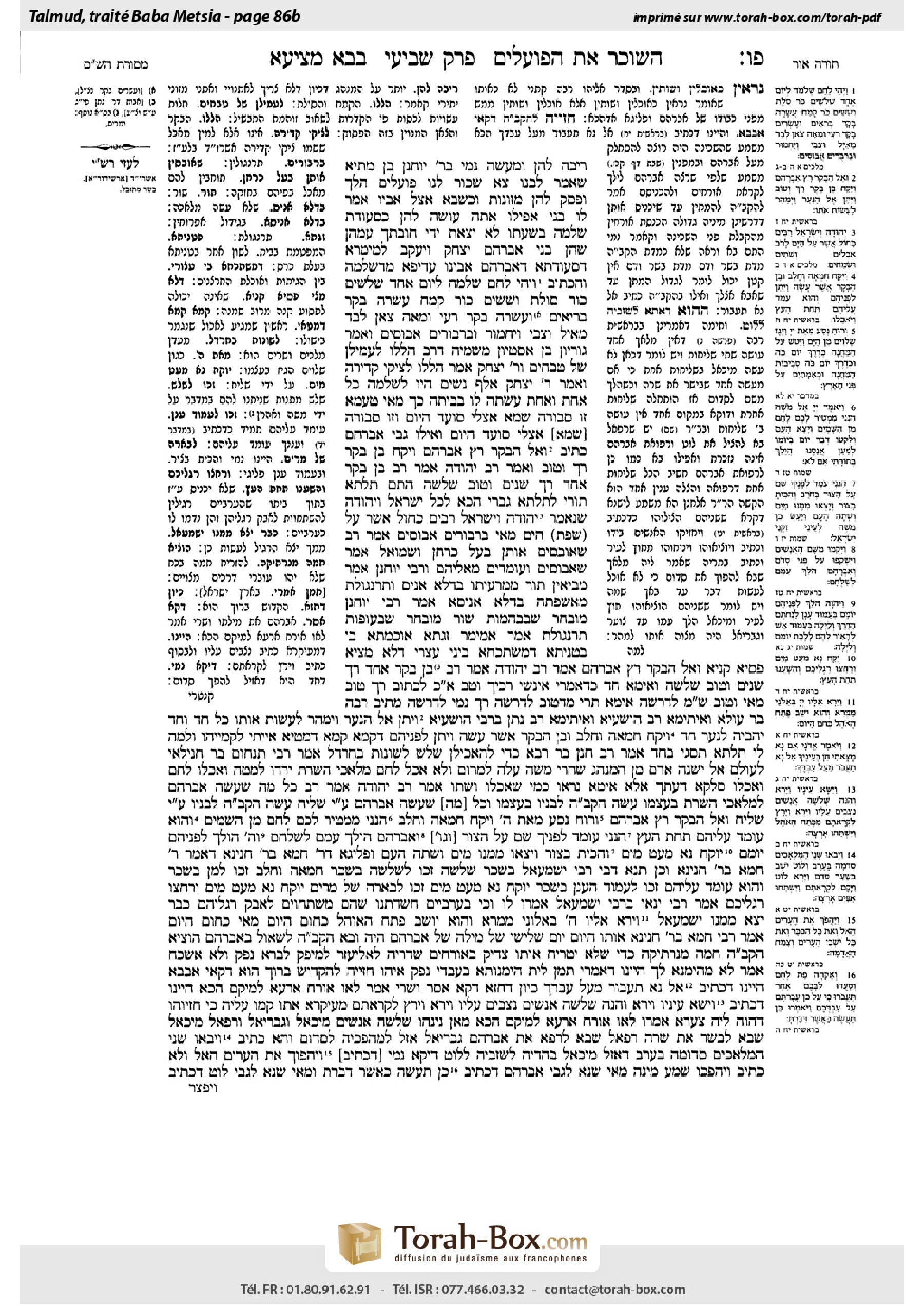
Bava Metzia 86b: Talmud study for Daf Yomi
Study the Talmud for Daf Yomi with scanned pages, Hebrew text, English translations from Sefaria and AI-generated French translations.
Passage selection and English or AI-generated French translation are available where the scan has annotations. Daf Study is independent of Torah-Box and Sefaria.
Browse Bava Metzia · בבא מציעא · All tractatesBava Metzia 86b text and translations
This page of Bava Metzia includes the Aramaic text, an English translation and an AI-generated French translation, alongside the scan above.
בבא מציעא פ״ו ב · Aramaic and Hebrew text
רִיבָּה לָהֶן. וּמַעֲשֶׂה נָמֵי בְּרַבִּי יוֹחָנָן בֶּן מַתְיָא שֶׁאָמַר לִבְנוֹ צֵא שְׂכוֹר לָנוּ פּוֹעֲלִים, הָלַךְ וּפָסַק לָהֶן מְזוֹנוֹת. וּכְשֶׁבָּא אֵצֶל אָבִיו, אָמַר לוֹ: בְּנִי, אֲפִילּוּ אַתָּה עוֹשֶׂה לָהֶן כִּסְעוּדַת שְׁלֹמֹה בִּשְׁעָתוֹ, לֹא יָצָאתָ יְדֵי חוֹבָתְךָ עִמָּהֶן, שֶׁהֵן בְּנֵי אַבְרָהָם יִצְחָק וְיַעֲקֹב.
לְמֵימְרָא דִּסְעוּדְתָּא דְּאַבְרָהָם אָבִינוּ עֲדִיפָא מִדִּשְׁלֹמֹה? וְהָכְתִיב: ״וַיְהִי לֶחֶם שְׁלֹמֹה לְיוֹם אֶחָד שְׁלֹשִׁים כֹּר סֹלֶת וְשִׁשִּׁים כֹּר קָמַח. עֲשָׂרָה בָּקָר בְּרִאִים וַעֲשָׂרָה בָּקָר רְעִי וּמֵאָה צֹאן לְבַד מֵאַיָּל וּצְבִי וְיַחְמוּר וּבַרְבֻּרִים אֲבוּסִים״! וְאָמַר גּוּרְיוֹן בֶּן אֲסִטְיוֹן מִשְּׁמֵיהּ דְּרַב: הַלָּלוּ לַעֲמִילָן שֶׁל טַבָּחִים. וְרַבִּי יִצְחָק אָמַר: הַלָּלוּ לְצִיקֵי קְדֵירָה.
וְאָמַר רַבִּי יִצְחָק: אֶלֶף נָשִׁים הָיוּ לִשְׁלֹמֹה, כׇּל אַחַת וְאַחַת עָשְׂתָה לוֹ בְּבֵיתָה כָּךְ. מַאי טַעְמָא – זוֹ סְבוּרָה שֶׁמָּא אֶצְלִי סוֹעֵד הַיּוֹם, וְזוֹ סְבוּרָה שֶׁמָּא אֶצְלִי סוֹעֵד הַיּוֹם. וְאִילּוּ גַּבֵּי אַבְרָהָם כְּתִיב: ״וְאֶל הַבָּקָר רָץ אַבְרָהָם וַיִּקַּח בֶּן בָּקָר רַךְ וָטוֹב״. וְאָמַר רַב יְהוּדָה אָמַר רַב: ״בֶּן בָּקָר״ – אֶחָד, ״רַךְ״ – שְׁנַיִם, ״וְטוֹב״ – שְׁלֹשָׁה!
הָתָם תְּלָתָא תּוֹרֵי לִתְלָתָא גַּבְרֵי, הָכָא לְכׇל יִשְׂרָאֵל וִיהוּדָה, שֶׁנֶּאֱמַר: ״יְהוּדָה וְיִשְׂרָאֵל רַבִּים כַּחוֹל אֲשֶׁר עַל הַיָּם״.
מַאי ״בַּרְבּוּרִים אֲבוּסִים״? אָמַר רַב: שֶׁאוֹבְסִים אוֹתָן בְּעַל כׇּרְחָן. וּשְׁמוּאֵל אָמַר: שֶׁאֲבוּסִים וְעוֹמְדִים מֵאֲלֵיהֶם. וְרַבִּי יוֹחָנָן אָמַר: מְבִיאִין תּוֹר מִמַּרְעִיתוֹ בִּדְלָא אֲנִיס, וְתַרְנְגוֹלֶת מֵאַשְׁפָּתָהּ בִּדְלָא אֲנִיסָא.
אָמַר רַבִּי יוֹחָנָן: מוּבְחָר שֶׁבַּבְּהֵמוֹת – שׁוֹר, מוּבְחָר שֶׁבָּעוֹפוֹת – תַּרְנְגוֹלֶת. אָמַר אַמֵּימָר: זָגְתָּא אוּכַּמְתָּא בֵּי בַטְנִיתָא דְּמִשְׁתַּכְחָא בֵּינֵי עַצְרֵי, דְּלָא מָצְיָא פָּסְיָא קַנְיָא.
״וְאֶל הַבָּקָר רָץ אַבְרָהָם״, אָמַר רַב יְהוּדָה אָמַר רַב: ״בֶּן בָּקָר״ – אֶחָד, ״רַךְ״ – שְׁנַיִם, ״וְטוֹב״ – שְׁלֹשָׁה. וְאֵימָא חַד, כִּדְאָמְרִי אִינָשֵׁי: רַכִּיךְ וְטָב!
אִם כֵּן, לִכְתּוֹב ״רַךְ טוֹב״, מַאי ״וָטוֹב״ – שְׁמַע מִינַּהּ לִדְרָשָׁה. אֵימָא תְּרֵי! מִדְּ״טוֹב״ לִדְרָשָׁה, ״רַךְ״ נָמֵי לִדְרָשָׁה.
מֵתִיב רַבָּה בַּר עוּלָּא, וְאִיתֵּימָא רַב הוֹשַׁעְיָא, וְאִיתֵּימָא רַב נָתָן בְּרַבִּי הוֹשַׁעְיָא: ״וַיִּתֵּן אֶל הַנַּעַר וַיְמַהֵר לַעֲשׂוֹת אֹתוֹ״, כֹּל חַד וְחַד יַהֲבֵיהּ לְנַעַר חַד. ״וַיִּקַּח חֶמְאָה וְחָלָב וּבֶן הַבָּקָר אֲשֶׁר עָשָׂה וַיִּתֵּן לִפְנֵיהֶם״, דְּקַמָּא קַמָּא דִּמְטָיא, אַיְיתִי לְקַמַּיְיהוּ.
וּלְמָה לִי תְּלָתָא? תִּסְגֵּי בְּחַד. אָמַר רַב חָנָן בַּר רָבָא: כְּדֵי לְהַאֲכִילָן שָׁלֹשׁ לְשׁוֹנוֹת בְּחַרְדָּל. אָמַר רַבִּי תַּנְחוּם בַּר חֲנִילַאי: לְעוֹלָם אַל יְשַׁנֶּה אָדָם מִן הַמִּנְהָג, שֶׁהֲרֵי מֹשֶׁה עָלָה לַמָּרוֹם וְלֹא אָכַל לֶחֶם, מַלְאֲכֵי הַשָּׁרֵת יָרְדוּ לְמַטָּה וְאָכְלוּ לֶחֶם. וְאָכְלוּ סָלְקָא דַּעְתָּךְ?! אֶלָּא אֵימָא: נִרְאוּ כְּמִי שֶׁאָכְלוּ וְשָׁתוּ.
אָמַר רַב יְהוּדָה אָמַר רַב: כׇּל מַה שֶּׁעָשָׂה אַבְרָהָם לְמַלְאֲכֵי הַשָּׁרֵת בְּעַצְמוֹ – עָשָׂה הַקָּדוֹשׁ בָּרוּךְ הוּא לְבָנָיו בְּעַצְמוֹ. וְכׇל מַה שֶּׁעָשָׂה אַבְרָהָם עַל יְדֵי שָׁלִיחַ – עָשָׂה הַקָּדוֹשׁ בָּרוּךְ הוּא לְבָנָיו עַל יְדֵי שָׁלִיחַ.
״וְאֶל הַבָּקָר רָץ אַבְרָהָם״, ״וְרוּחַ נָסַע מֵאֵת ה׳״. ״וַיִּקַּח חֶמְאָה וְחָלָב״, ״הִנְנִי מַמְטִיר לָכֶם לֶחֶם מִן הַשָּׁמָיִם״.
״וְהוּא עֹמֵד עֲלֵיהֶם תַּחַת הָעֵץ״, ״הִנְנִי עֹמֵד לְפָנֶיךָ שָּׁם עַל הַצּוּר [וְגוֹ׳]״. ״וְאַבְרָהָם הֹלֵךְ עִמָּם לְשַׁלְּחָם״, ״וַה׳ הֹלֵךְ לִפְנֵיהֶם יוֹמָם״.
״יֻקַּח נָא מְעַט מַיִם״, ״וְהִכִּיתָ בַצּוּר וְיָצְאוּ מִמֶּנּוּ מַיִם וְשָׁתָה הָעָם״.
וּפְלִיגָא דְּרַבִּי חָמָא בְּרַבִּי חֲנִינָא. דְּאָמַר רַבִּי חָמָא בְּרַבִּי חֲנִינָא, וְכֵן תָּנָא דְּבֵי רַבִּי יִשְׁמָעֵאל: בִּשְׂכַר שְׁלֹשָׁה – זָכוּ לִשְׁלֹשָׁה. בִּשְׂכַר ״חֶמְאָה וְחָלָב״ – זָכוּ לַמָּן; בִּשְׂכַר ״וְהוּא עֹמֵד עֲלֵיהֶם״ – זָכוּ לְעַמּוּד הֶעָנָן; בִּשְׂכַר ״יֻקַּח נָא מְעַט מַיִם״ – זָכוּ לִבְאֵרָהּ שֶׁל מִרְיָם.
״יֻקַּח נָא מְעַט מַיִם וְרַחֲצוּ רַגְלֵיכֶם״, אָמַר רַבִּי יַנַּאי בְּרַבִּי יִשְׁמָעֵאל, אָמְרוּ לוֹ: וְכִי בְּעַרְבִיִּים חֲשַׁדְתָּנוּ, שֶׁהֵם מִשְׁתַּחֲוִים לַאֲבַק רַגְלֵיהֶם, כְּבָר יָצָא מִמֶּנּוּ יִשְׁמָעֵאל.
״וַיֵּרָא אֵלָיו ה׳ בְּאֵלֹנֵי מַמְרֵא וְהוּא יֹשֵׁב פֶּתַח הָאֹהֶל כְּחֹם הַיּוֹם״. מַאי ״כְּחוֹם הַיּוֹם״? אָמַר רַבִּי חָמָא בְּרַבִּי חֲנִינָא: אוֹתוֹ הַיּוֹם יוֹם שְׁלִישִׁי שֶׁל מִילָה שֶׁל אַבְרָהָם הָיָה, וּבָא הַקָּדוֹשׁ בָּרוּךְ הוּא לִשְׁאוֹל בְּאַבְרָהָם, הוֹצִיא הַקָּדוֹשׁ בָּרוּךְ הוּא חַמָּה מִנַּרְתִּיקָהּ כְּדֵי שֶׁלֹּא יַטְרִיחַ אוֹתוֹ צַדִּיק בְּאוֹרְחִים.
שַׁדְּרֵיהּ לֶאֱלִיעֶזֶר לְמִיפַּק לְבָרָא. נְפַק וְלָא אַשְׁכַּח, אָמַר: לָא מְהֵימְנָא לָךְ. הַיְינוּ דְּאָמְרִי תַּמָּן: לֵית הֵימָנוּתָא בְּעַבְדֵי. נְפַק אִיהוּ חַזְיֵיהּ לְהַקָּדוֹשׁ בָּרוּךְ הוּא דְּקָאֵי אַבָּבָא. הַיְינוּ דִּכְתִיב: ״אַל נָא תַעֲבֹר מֵעַל עַבְדֶּךָ״.
כֵּיוָן דַּחֲזָא דְּקָא אָסַר וְשָׁרֵי, אֲמַר: לָאו אוֹרַח אַרְעָא לְמֵיקַם הָכָא. הַיְינוּ דִּכְתִיב: ״וַיִּשָּׂא עֵינָיו וַיַּרְא וְהִנֵּה שְׁלֹשָׁה אֲנָשִׁים נִצָּבִים עָלָיו וַיַּרְא וַיָּרׇץ לִקְרָאתָם״. מֵעִיקָּרָא אֲתוֹ קָמוּ עֲלֵיהּ, כִּי חַזְיוּהּ דַּהֲוָה לֵיהּ צַעֲרָא, אֲמַרוּ: לָאו אוֹרַח אַרְעָא לְמֵיקַם הָכָא.
מַאן נִינְהוּ שְׁלֹשָׁה אֲנָשִׁים – מִיכָאֵל וְגַבְרִיאֵל וּרְפָאֵל. מִיכָאֵל שֶׁבָּא לְבַשֵּׂר אֶת שָׂרָה, רְפָאֵל שֶׁבָּא לְרַפֵּא אֶת אַבְרָהָם, גַּבְרִיאֵל אֲזַל לְמֶהְפְּכַיהּ לִסְדוֹם. וְהָא כְּתִיב: ״וַיָּבֹאוּ שְׁנֵי הַמַּלְאָכִים סְדֹמָה בָּעֶרֶב״! דַּאֲזַל מִיכָאֵל בַּהֲדֵיהּ לְשֵׁזְבֵיהּ לְלוֹט. דַּיְקָא נָמֵי, דִּכְתִיב: ״וַיַּהֲפֹךְ אֶת הֶעָרִים הָאֵל״, וְלָא כְּתִיב ״וַיַּהַפְכוּ״ – שְׁמַע מִינַּהּ.
מַאי שְׁנָא לְגַבֵּי אַבְרָהָם, דִּכְתִיב: ״כֵּן תַּעֲשֶׂה כַּאֲשֶׁר דִּבַּרְתָּ״, וּמַאי שְׁנָא לְגַבֵּי לוֹט, דִּכְתִיב:
Bava Metzia 86b · English translation
he has increased his obligation to them, since if he had meant to give them no more than the accepted amount, he would not have made any stipulation at all. The mishna then continues: And there is also a supporting incident involving Rabbi Yoḥanan ben Matya, who said to his son: Go out and hire laborers for us. His son went, hired them, and pledged to provide sustenance for them as a term of their employment, without specifying the details. And when he came back to his father and reported what he had done, Rabbi Yoḥanan ben Matya said to him: My son, even if you were to prepare a feast for them like that of King Solomon in his time, you would not have fulfilled your obligation to them, as they are the descendants of Abraham, Isaac, and Jacob.
The Gemara asks: Is this to say that the feast of Abraham, our forefather, was superior to that of King Solomon? But isn’t it written: “And Solomon’s provision for one day was thirty measures of fine flour, and sixty measures of meal; ten fat oxen, and twenty oxen out of the pastures, and a hundred sheep, beside harts, and gazelles, and roebucks, and fatted fowl” (I Kings 5:2–3). And Guryon ben Asteyon says in the name of Rav: These measures of flour mentioned in the verse were used merely for the bakers’ well-worked dough [la’amilan] that was placed in the pot to absorb the steam. And Rabbi Yitzḥak says: These measures of flour were used for meat pudding, a mixture of wine, flour, and leftover meat, in a pot.
And Rabbi Yitzḥak further says: King Solomon had one thousand wives, each one of whom would prepare for him at her home a feast of such proportions. What is the reason that they did this? This wife reasoned: Perhaps he will feast with me today, and that wife reasoned: Perhaps he will feast with me today. But with regard to Abraham, it is written: “And Abraham ran to the herd, and fetched a calf tender and good” (Genesis 18:7), and Rav Yehuda says that Rav says, in explanation of the verse: “A calf” indicates one; the word “tender” means an additional one, i.e., two; “and good” indicates yet another one. This makes a total of three calves, a considerably smaller feast than that of Solomon.
The Gemara answers: There, with regard to Abraham, he prepared three oxen for three people, whereas here, in the case of Solomon, his wives would prepare a feast for the entire realms of Israel and Judah, as it is stated: “Judah and Israel were many, as the sand which is by the sea in multitude, eating and drinking and making merry” (I Kings 4:20). Abraham’s feast was proportionately greater than that of Solomon.
With regard to the verse cited in relation to King Solomon, the Gemara asks: What is the meaning of the term “fatted fowl [avusim]”? Rav says: It means that they are fed [ovsim] by force. Shmuel says: It means that they were fattened [avusim] and maintained on their own accord, i.e., they were naturally fat. Rabbi Yoḥanan says: Solomon’s feasts were of fine quality because they would bring from his herd an ox that had never been forced to work, and they would also bring a hen from its coop that had never been forced to lay eggs, and use those for the cuisine.
The Gemara cites a related statement of Rabbi Yoḥanan. Rabbi Yoḥanan says: The choicest of cattle is the ox. The choicest of fowl is the hen. With regard to the type of hen to which this is referring, Ameimar says: It is a fattened, black hen [zagta] that is found among the wine vats, which consumes so many grape seeds that it cannot take a step the length of a reed, due to its corpulence.
The Gemara returns to discuss the verse in Genesis: “And Abraham ran to the herd, and fetched a calf tender and good” (Genesis 18:7). Rav Yehuda says that Rav says: “A calf” is one; “tender” indicates an additional one, i.e., two; “and good” indicates another one, for a total of three calves. The Gemara asks: But why not say that the verse is referring to only one calf, as people say when describing a single item that it is tender and good?
The Gemara answers: If so, let the verse write: Tender, good. What is the significance of the term “and good,” which indicates an addition? Conclude from this that the verse is stated for the purpose of an exposition and is referring to more than one calf. The Gemara challenges: But one can still say there were only two calves. The Gemara answers: From the fact that the word “good” is written for an exposition, to include an additional calf, it may be inferred that the term “tender” is also written for an exposition and indicates yet another calf.
Rabba bar Ulla raises an objection, and some say it is Rav Hoshaya, and some say it is Rav Natan, son of Rabbi Hoshaya, who raises the objection: The verse states: “And he gave it to the servant; and he hastened to prepare it” (Genesis 18:7). The singular term “it” indicates that there was only one calf. The Gemara answers: Abraham gave each and every calf to one servant, i.e., he gave the three calves to three different servants. The Gemara raises a question from the verse: “And he took curd, and milk, and the calf which he had dressed, and set it before them” (Genesis 18:8), which again indicates that there was only one calf. The Gemara responds: The verse means that as each calf arrived prepared, he brought it before them, and he did not serve all three calves at once.
The Gemara asks: And why do I need three calves? One calf should be sufficient for three guests. Rav Ḥanan bar Rava said: Abraham prepared three calves in order to feed the guests three tongues with mustard, a particular delicacy. With regard to this incident, Rabbi Tanḥum bar Ḥanilai says: A person should never deviate from the local custom, as Moses ascended to heaven on high and did not eat bread while he was there, whereas the ministering angels descended down to this world, as guests visiting Abraham, and they ate bread. You say: And they ate bread? Can it enter your mind that they actually ate food? Rather, say that they merely appeared as though they ate and drank.
Rav Yehuda says that Rav says: Every action that Abraham performed himself for the ministering angels, the Holy One, Blessed be He, performed Himself for Abraham’s descendants. And every action that Abraham performed through a messenger, the Holy One, Blessed be He, likewise performed for his descendants through a messenger.
The Gemara elaborates: With regard to Abraham, the verse states: “And Abraham ran to the herd” (Genesis 18:7), bringing the meat himself, and in reference to God’s actions for Abraham’s descendants the verse states: “And there went forth a wind from the Lord, and brought across quails from the sea” (Numbers 11:31), that God brought meat to them. In reference to Abraham, the verse states: “And he took curd and milk” (Genesis 18:8), and God says to the Jewish people: “Behold, I will cause to rain bread from heaven for you” (Exodus 16:4), which shows that God gave food to the Jewish people.
With regard to Abraham, the verse states: “And he stood by them under the tree, and they ate” (Genesis 18:8), and in reference to God, the verse states: “Behold, I will stand before you there upon the rock in Horeb; and you shall strike the rock, and there shall come water out of it” (Exodus 17:6). In the case of Abraham it is written: “And Abraham went with them to bring them on the way” (Genesis 18:16), and the verse states: “And the Lord went before them by day” (Exodus 13:21).
By contrast, Abraham performed certain actions through an agent. He said: “Let now a little water be fetched” (Genesis 18:4), and correspondingly the verse states in reference to Moses, God’s messenger: “And you shall strike the rock, and there shall come water out of it, that the people may drink” (Exodus 17:6).
The Gemara notes: And in stating this, Rav disagrees with that statement of Rabbi Ḥama, son of Rabbi Ḥanina. As Rabbi Ḥama, son of Rabbi Ḥanina, says, and likewise the school of Rabbi Yishmael taught: In reward for three acts of hospitality that Abraham performed for the angels, his descendants merited three rewards. The Gemara elaborates: In reward for providing them with curd and milk, the Jewish people merited the manna; in reward for: “And he stood [omed] by them,” the Jews merited the pillar [amud] of cloud; in reward for Abraham saying: “Let now a little water be fetched,” they merited the well of Miriam. This statement does not distinguish between actions performed by Abraham himself and those performed by means of a messenger.
The Gemara continues its analysis of the verse: “Let now a little water be fetched and wash your feet” (Genesis 18:4). Rabbi Yannai, son of Rabbi Yishmael, said that the guests said to Abraham: Are you suspicious that we are Arabs who bow to the dust of their feet? Yishmael has already issued from him, i.e., your own son acts in this manner.
§ The Gemara expounds another verse involving Abraham: “And the Lord appeared to him by the terebinths of Mamre, as he sat in the tent door in the heat of the day” (Genesis 18:1). The Gemara asks: What is the meaning of “the heat of the day”? Rabbi Ḥama, son of Rabbi Ḥanina, says: That day was the third day after Abraham’s circumcision, and the Holy One, Blessed be He, came to inquire about the well-being of Abraham. The Holy One, Blessed be He, removed the sun from its sheath in order not to bother that righteous one with guests, i.e., God made it extremely hot that day to allow Abraham to recover from his circumcision, as he would not be troubled by passing travelers whom he would invite into his tent.
Despite the intense heat, Abraham wanted to invite guests. He sent Eliezer his slave to go outside to see if there were any passersby. Eliezer went out but did not find anyone. Abraham said to him: I do not believe you. The Gemara comments: This demonstrates the popular adage that people there, i.e., in Eretz Yisrael, say: Slaves do not have any credibility. The Gemara continues: Abraham himself went out and saw the Holy One, Blessed be He, standing at the entrance to his tent. This is as it is written: “My Lord, if now I have found favor in your eyes, do not leave Your servant” (Genesis 18:3), i.e., God’s presence was there, and Abraham asked Him for permission to attend to the travelers.
Once God saw Abraham tying and untying the bandage on his circumcision, God said: It is not proper conduct to stand here, i.e., it is not respectful to Abraham even for God to stand there. This is as it is written: “And he lifted up his eyes and looked, and, behold, three men stood over him; and when he saw them, he ran to meet them” (Genesis 18:2). The verse first states that they stood over him, and then it says that he ran to meet them. The Gemara reconciles this apparent contradiction: Initially, they came and stood over him. Upon seeing that he was in pain, they said: It is not proper conduct to stand here.
The Gemara continues: Who are these three men? They are the angels Michael, Gabriel, and Raphael: Michael, who came to announce to Sarah that she was to give birth to a son; Raphael, who came to heal Abraham after his circumcision; and Gabriel, who went to overturn Sodom. The Gemara asks: But it is written: “And the two angels came to Sodom in the evening” (Genesis 19:1). The Gemara answers that Michael went along with Gabriel to Sodom to save Lot. The Gemara notes: The language is also precise, as it is written: “And he overturned those cities” (Genesis 19:25), and it is not written: They overturned those cities. Conclude from it that only one angel overturned Sodom.
The Gemara asks: What is different with regard to the incident involving Abraham, where the angels acquiesced immediately to his request to remain with him, as it is written: “So do, as you have said” (Genesis 18:5), and what is different with regard to Lot, where they first displayed reluctance, as it is written:
Bava Metzia 86b · Traduction française (IA)
il a augmenté son obligation envers eux, car s'il avait voulu leur donner moins que la quantité acceptée, il n'aurait pas fait de stipulation du tout. La Michna continue alors ainsi : Il y a aussi un incident qui soutient cela, concernant Rabbi Yoḥanan ben Matya, qui dit à son fils : Va chercher des ouvriers pour nous. Son fils est parti, a embauché des ouvriers et a promis de leur fournir un aliment en échange de leur travail, sans préciser les détails. Et lorsqu'il est revenu rapporter à son père ce qu'il avait fait, Rabbi Yoḥanan ben Matya lui a dit : Mon fils, même si tu avais préparé un festin pour eux comme celui de roi Salomon à son époque, tu n'aurais pas rempli ton obligation envers eux, car ils sont les descendants d'Abraham, d'Isaac et de Jacob.
La Guemara demande : Est-ce que cela signifie que le festin d'Abraham, notre père, était supérieur à celui de roi Salomon ? Mais n'est-il pas écrit : « Et la provision de Salomon pour un jour était trente mesures de farine fine et soixante mesures de farine ordinaire ; dix bœufs gras et vingt bœufs des prairies, et cent brebis, outre des cerfs, des gazelles, des chevrelets et des oiseaux gras » (I Rois 5:2–3). Et Guryon ben Asteyon dit au nom de Rav : Ces mesures de farine mentionnées dans la parabole étaient utilisées uniquement pour la pâte bien travaillée des boulangeries qui était mise dans la marmite pour absorber la vapeur. Et Rabbi Yitzḥak dit : Ces mesures de farine étaient utilisées pour un ragoût de viande, un mélange de vin, de farine et de viande restante, dans une marmite.
Et Rabbi Yitzḥak ajoute encore : Salomon avait mille femmes, chacune desquelles préparait pour lui à sa maison un festin de cette ampleur. Pourquoi est-ce ainsi ? Cette femme raisonnait : Peut-être festinera-t-il avec moi aujourd'hui, et cette autre raisonnait : Peut-être festinera-t-il avec moi aujourd'hui. Quant à Abraham, il est écrit : « Et Abraham courut vers le troupeau, et il prit un veau jeune et bon » (Genèse 18:7), et Rav Yehuda dit que Rav explique ainsi la parole : « Un veau » indique un ; le mot « jeune » signifie un autre, c'est-à-dire deux ; « et bon » indique encore un autre, ce qui fait un total de trois veaux, un festin considérablement plus modeste que celui de Salomon.
La Guemara répond : Là, concernant Abraham, il prépara trois bœufs pour trois personnes, tandis que, dans le cas de Salomon, ses femmes préparaient un festin pour l'ensemble des terres d'Israël et de Juda, comme il est dit : « Juda et Israël étaient nombreux, comme la poussière par la mer, mangeant et buvant et se réjouissant » (I Rois 4:20). Le festin d'Abraham était proportionnellement plus grand que celui de Salomon.
Concernant la parole citée en rapport avec roi Salomon, la Guemara demande : Quelle est la signification du terme « oiseaux gras [avusim] » ? Rav dit : Cela signifie qu'ils étaient nourris [ovsim] par la force. Shmuel dit : Cela signifie qu'ils étaient gras [avusim] et maintenus naturellement, c'est-à-dire qu'ils étaient naturellement gras. Rabbi Yoḥanan dit : Les festins de Salomon étaient de qualité supérieure car ils apportaient d'abord un bœuf qui n'avait jamais été forcé à travailler, et une poule issue de son poulailler qui n'avait jamais été forcé à pondre, et ils utilisaient ces bêtes pour la cuisine.
La Guemara cite une déclaration de Rabbi Yoḥanan. Rabbi Yoḥanan dit : Le bœuf le plus précieux est l'ox. Le poulet le plus précieux est la poule. Concernant le type de poule à laquelle il fait référence, Ameimar dit : C'est une poule noire, grassouillette [zagta], trouvée parmi les tonneaux de vin, qui mange tant de graines de raisin qu'elle ne peut pas marcher sur une longueur de verge, à cause de sa corpulence.
La Guemara revient à la parole dans Genèse : « Et Abraham courut vers le troupeau, et il prit un veau jeune et bon » (Genèse 18:7). Rav Yehuda dit que Rav dit : « Un veau » est un ; « jeune » indique un autre, c'est-à-dire deux ; « et bon » indique un autre, pour un total de trois veaux. La Guemara demande : Mais pourquoi ne pas dire que la parole fait référence à un seul veau, comme les gens disent quand ils décrivent un seul objet qu'il est jeune et bon ?
La Guemara répond : Si c'est ainsi, la parole devrait écrire : jeune, bon. Quel est le sens du terme « et bon », qui indique une addition ? Concluez-en que la parole est écrite à l'intention d'une explication et fait référence à plus d'un veau. La Guemara conteste : On peut encore dire qu'il n'y avait que deux veaux. La Guemara répond : Du fait que le mot « bon » est écrit à l'intention d'une explication, pour inclure un autre veau, on peut en déduire que le terme « jeune » est également écrit à l'intention d'une explication et indique un autre veau.
Rabba bar Ulla soulève un objet, et certains disent que c'est Rav Hoshaya, et d'autres disent que c'est Rav Natan, fils de Rabbi Hoshaya, qui soulève l'objet : La Bible dit : « Et il le donna au serviteur ; et il hâta de le préparer » (Genèse 18:7). Le terme singulier « il » indique qu'il n'y avait qu'un seul veau. La Guemara répond : Abraham donna chaque veau à un serviteur, c'est-à-dire qu'il donna les trois veaux à trois serviteurs différents. La Guemara soulève une question à partir de la Bible : « Et il prit du lait, et du fromage, et le veau qu'il avait dressé, et il le posa devant eux » (Genèse 18:8), ce qui indique à nouveau qu'il n'y avait qu'un seul veau. La Guemara répond : La Bible signifie que, lorsque chaque veau arrivait prêt, il le présenta devant eux, et il ne servit pas les trois veaux en même temps.
La Guemara demande : Et pourquoi avoir besoin de trois veaux ? Un seul veau suffirait pour trois convives. Rav Ḥanan bar Rava dit : Abraham prépara trois veaux afin de nourrir les convives avec trois langues de moutarde, un délice particulier. Concernant cet incident, Rabbi Tanḥum bar Ḥanilai dit : Une personne ne devrait jamais s'écarter de la coutume locale, car Moïse monta au ciel et ne mangea pas de pain là-bas, tandis que les anges ministériels descendirent dans ce monde, comme des invités visitant Abraham, et ils mangèrent du pain. Tu dis : Et ils mangèrent du pain ? Est-ce que tu penses qu'ils ont vraiment mangé de la nourriture ? Plutôt, dis qu'ils n'ont fait qu'apparaître comme s'ils mangeaient et buvaient.
Rav Yehuda dit que Rav dit : Toute action que Abraham a accomplie lui-même pour les anges ministraux, le Saint, le Très Haut, l'a accomplie lui-même pour la descendance d'Abraham. Et toute action que Abraham a accomplie par un messager, le Saint, le Très Haut, l'a accomplie également pour sa descendance par un messager.
La Guemara développe : En ce qui concerne Abraham, la parabole dit : « Et Abraham courut vers le troupeau » (Genèse 18:7), apportant lui-même la viande, et en ce qui concerne les actions de Dieu pour la descendance d'Abraham, la parabole dit : « Et un vent vint du Seigneur, et porta des moineaux de la mer » (Nombres 11:31), c'est-à-dire que Dieu apporta la viande à eux. En ce qui concerne Abraham, la parabole dit : « Et il prit du lait et du fromage » (Genèse 18:8), et Dieu dit au peuple juif : « Voici, je ferai pleuvoir du pain du ciel pour vous » (Exode 16:4), ce qui montre que Dieu donna de la nourriture au peuple juif.
En ce qui concerne Abraham, la parabole dit : « Et il resta avec eux sous l'arbre, et ils mangèrent » (Genèse 18:8), et en ce qui concerne Dieu, la parabole dit : « Voici, je me tiens devant toi là, sur la roche d'Horeb ; et tu frapperas la roche, et de là sortira l'eau » (Exode 17:6). En ce qui concerne Abraham, il est écrit : « Et Abraham alla avec eux pour les conduire sur le chemin » (Genèse 18:16), et la parabole dit : « Et le Seigneur marcha devant eux de jour » (Exode 13:21).
Par contraste, Abraham accomplissait certaines actions par un agent. Il dit : « Apporte-moi un peu d'eau » (Genèse 18:4), et correspondamment la Parabole dit en ce qui concerne Moïse, le messager de Dieu : « Et tu frapperas la roche, et de là sortira l'eau, afin que le peuple boive » (Exode 17:6).
La Guemara note : Et en disant cela, Rav s'oppose à la déclaration de Rabbi Ḥama, fils de Rabbi Ḥanina. Car Rabbi Ḥama, fils de Rabbi Ḥanina, dit, et également l'école de Rabbi Yishmael enseigna : En récompense de trois actes d'hospitalité que Abraham accompli pour les anges, sa descendance méritèrent trois récompenses. La Guemara développe : En récompense de leur fournir du fromage et du lait, le peuple juif méritèrent le manna ; en récompense de « et il resta [omed] avec eux », les Juifs méritèrent la colonne de nuage ; en récompense d'Abraham dire : « Apporte-moi un peu d'eau », ils méritèrent la source de Miriam. Cette déclaration ne distingue pas entre les actions accomplies par Abraham lui-même et celles accomplies par l'intermédiaire d'un messager.
La Guemara continue son analyse de la parabole : « Apporte-moi un peu d'eau et lave tes pieds » (Genèse 18:4). Rabbi Yannai, fils de Rabbi Yishmael, dit que les hôtes dirent à Abraham : Es-tu soupçonneux que nous soyons des Arabes qui se prosternent sur la poussière de leurs pieds ? Yishmael a déjà sorti de lui, c'est-à-dire ton propre fils agit ainsi.
§ La Guemara commente une autre versette concernant Abraham : « Et le Seigneur apparut à lui sous les térébinthes de Mamre, alors qu'il était assis à la porte de la tente, dans la chaleur de la journée » (Genèse 18:1). La Guemara demande : Quelle est la signification de « la chaleur de la journée » ? Rabbi Ḥama, fils de Rabbi Ḥanina, dit : C'était le troisième jour après la circoncision d'Abraham, et le Saint, le Très Haut, vint s'informer de la santé d'Abraham. Le Saint, le Très Haut, retira le soleil de son fourreau afin de ne pas déranger ce justicier avec des hôtes, c'est-à-dire que Dieu fit une chaleur extrême ce jour-là pour permettre à Abraham de se remettre de sa circoncision, car il ne serait pas dérangé par les voyageurs qu'il inviterait à son abri.
Malgré la chaleur intense, Abraham voulait inviter des hôtes. Il envoya Eliezer, son serviteur, dehors pour voir s'il y avait des passants. Eliezer sortit mais ne trouva personne. Abraham dit à lui : Je ne te crois pas. La Guemara commente : Cela démontre l'adage populaire qui dit que les gens là-bas, c'est-à-dire en Terre d'Israël, disent : Les serviteurs n'ont aucune crédibilité. La Guemara continue : Abraham lui-même sortit et vit le Saint, le Très Haut, debout à l'entrée de sa tente. C'est comme il est écrit : « Mon Seigneur, si maintenant j'ai trouvé grâce à tes yeux, ne laisse pas ton serviteur » (Genèse 18:3), c'est-à-dire que la présence divine était là, et Abraham lui demanda la permission de s'occuper des voyageurs.
Une fois que Dieu vit Abraham attacher et détacher le pansement de sa circoncision, Dieu dit : Il n'est pas convenable de se tenir ici, c'est-à-dire il n'est pas respectueux envers Abraham même pour que Dieu se tienne là. C'est comme il est écrit : « Et il leva les yeux et regarda, et il vit trois hommes debout sur lui ; et lorsqu'il les vit, il courut les accueillir » (Genèse 18:2). La parabole commence par dire qu'ils étaient debout sur lui, puis dit qu'il courut les accueillir. La Guemara résout ce paradoxe apparent : Initialement, ils vinrent et se tenaient debout sur lui. En voyant qu'il était en souffrance, ils dirent : Il n'est pas convenable de se tenir ici.
La Guemara continue : Qui sont ces trois hommes ? Ce sont les anges Michel, Gabriel et Raphaël : Michel, qui vint annoncer à Sarah qu'elle allait donner naissance à un fils ; Raphaël, qui vint guérir Abraham après sa circoncision ; et Gabriel, qui alla renverser Sodome. La Guemara demande : Mais il est écrit : « Et les deux anges vinrent à Sodome à l'heure du soir » (Genèse 19:1). La Guemara répond que Michel accompagna Gabriel à Sodome pour sauver Lot. La Guemara note : La langue est aussi précise, car il est écrit : « Et il renversa ces villes » (Genèse 19:25), et il n'est pas écrit : Ils renversèrent ces villes. Concluez-en qu'un seul ange renversa Sodome.
La Guemara demande : Qu'est-ce qui diffère concernant l'incident d'Abraham, où les anges acceptèrent immédiatement sa demande de rester avec lui, comme il est écrit : « Fais comme tu as dit » (Genèse 18:5), et qu'est-ce qui diffère concernant Lot, où ils montrèrent d'abord de la réticence, comme il est écrit :
Traduction française générée par IA à partir de l’édition anglaise de Sefaria. Vérifie toujours un passage avec le texte source.
Text from Sefaria: William Davidson Edition - Vocalized Aramaic (CC BY NC); William Davidson Edition - English (CC BY NC).