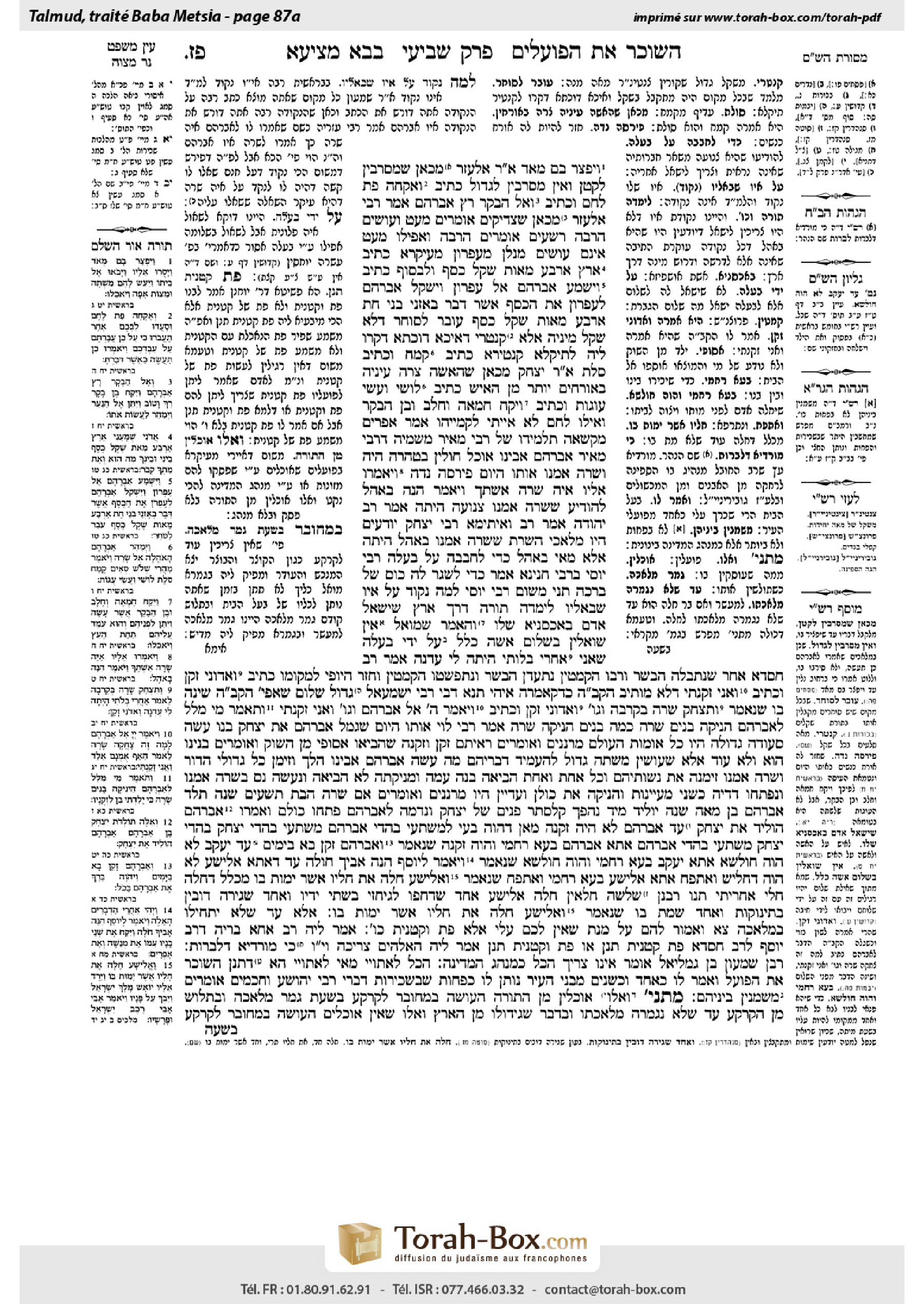
Bava Metzia 87a: Talmud study for Daf Yomi
Study the Talmud for Daf Yomi with scanned pages, Hebrew text, English translations from Sefaria and AI-generated French translations.
Passage selection and English or AI-generated French translation are available where the scan has annotations. Daf Study is independent of Torah-Box and Sefaria.
Browse Bava Metzia · בבא מציעא · All tractatesBava Metzia 87a text and translations
This page of Bava Metzia includes the Aramaic text, an English translation and an AI-generated French translation, alongside the scan above.
בבא מציעא פ״ז א · Aramaic and Hebrew text
״וַיִּפְצַר בָּם מְאֹד״? אָמַר רַבִּי אֶלְעָזָר: מִכָּאן שֶׁמְּסָרְבִין לְקָטָן, וְאֵין מְסָרְבִין לַגָּדוֹל.
כְּתִיב: ״וְאֶקְחָה פַת לֶחֶם״, וּכְתִיב: ״וְאֶל הַבָּקָר רָץ אַבְרָהָם״, אָמַר רַבִּי אֶלְעָזָר: מִכָּאן שֶׁצַּדִּיקִים אוֹמְרִים מְעַט וְעוֹשִׂים הַרְבֵּה, רְשָׁעִים אוֹמְרִים הַרְבֵּה, וַאֲפִילּוּ מְעַט אֵינָם עוֹשִׂים.
מְנָלַן, מֵעֶפְרוֹן. מֵעִיקָּרָא כְּתִיב: ״אֶרֶץ אַרְבַּע מֵאוֹת שֶׁקֶל כֶּסֶף״, וּלְבַסּוֹף כְּתִיב: ״וַיִּשְׁמַע אַבְרָהָם אֶל עֶפְרוֹן וַיִּשְׁקֹל אַבְרָהָם לְעֶפְרֹן אֶת הַכֶּסֶף אֲשֶׁר דִּבֶּר בְּאׇזְנֵי בְנֵי חֵת אַרְבַּע מֵאוֹת שֶׁקֶל כֶּסֶף עֹבֵר לַסֹּחֵר״, דְּלָא שְׁקַל מִינֵּיהּ אֶלָּא קִנְטְרֵי, דְּאִיכָּא דּוּכְתָּא דְּקָרֵי לֵיהּ לְתִיקְלָא ״קִנְטֵירָא״.
כְּתִיב ״קֶמַח״ וּכְתִיב ״סֹלֶת״. אָמַר רַבִּי יִצְחָק: מִכָּאן שֶׁהָאִשָּׁה צָרָה עֵינֶיהָ בְּאוֹרְחִים יוֹתֵר מִן הָאִישׁ.
כְּתִיב ״לוּשִׁי וַעֲשִׂי עֻגוֹת״, וּכְתִיב ״וַיִּקַּח חֶמְאָה וְחָלָב וּבֶן הַבָּקָר״, וְאִילּוּ לֶחֶם לָא אַיְיתִי לְקַמַּיְיהוּ!
אָמַר אֶפְרַיִם מִקְשָׁאָה תַּלְמִידוֹ שֶׁל רַבִּי מֵאִיר מִשְּׁמֵיהּ דְּרַבִּי מֵאִיר: אַבְרָהָם אָבִינוּ אוֹכֵל חוּלִּין בְּטׇהֳרָה הָיָה, וְשָׂרָה אִמֵּנוּ אוֹתוֹ הַיּוֹם פֵּירְסָה נִדָּה.
״וַיֹּאמְרוּ אֵלָיו אַיֵּה שָׂרָה אִשְׁתֶּךָ וַיֹּאמֶר הִנֵּה בָאֹהֶל״, לְהוֹדִיעַ שֶׁשָּׂרָה אִמֵּנוּ צְנוּעָה הָיְתָה. אָמַר רַב יְהוּדָה אָמַר רַב וְאִיתֵּימָא רַבִּי יִצְחָק: יוֹדְעִים הָיוּ מַלְאֲכֵי הַשָּׁרֵת שֶׁשָּׂרָה אִמֵּנוּ בָּאֹהֶל הָיְתָה, אֶלָּא מַאי ״בָּאֹהֶל״ – כְּדֵי לְחַבְּבָהּ עַל בַּעְלָהּ.
רַבִּי יוֹסֵי בְּרַבִּי חֲנִינָא אָמַר: כְּדֵי לְשַׁגֵּר לָהּ כּוֹס שֶׁל בְּרָכָה. תָּנֵי מִשּׁוּם רַבִּי יוֹסֵי: לָמָּה נָקוּד עַל אַיּוֹ שֶׁבְּ״אֵלָיו״ – לִימְּדָה תּוֹרָה דֶּרֶךְ אֶרֶץ, שֶׁיִּשְׁאַל אָדָם בָּאַכְסַנְיָא שֶׁלּוֹ. וְהָאָמַר שְׁמוּאֵל: אֵין שׁוֹאֲלִין בִּשְׁלוֹם אִשָּׁה כְּלָל! עַל יְדֵי בַּעְלָהּ שָׁאנֵי.
״אַחֲרֵי בְלֹתִי הָיְתָה לִּי עֶדְנָה״, אָמַר רַב חִסְדָּא: אַחַר שֶׁנִּתְבַּלָּה הַבָּשָׂר וְרַבּוּ הַקְּמָטִין – נִתְעַדֵּן הַבָּשָׂר וְנִתְפַּשְּׁטוּ הַקְּמָטִין, וְחָזַר הַיּוֹפִי לִמְקוֹמוֹ.
כְּתִיב ״וַאדֹנִי זָקֵן״, וּכְתִיב ״וַאֲנִי זָקַנְתִּי״ – דְּלָא מוֹתֵיב הַקָּדוֹשׁ בָּרוּךְ הוּא כִּדְקָאָמְרָה אִיהִי.
תָּנָא דְּבֵי רַבִּי יִשְׁמָעֵאל: גָּדוֹל שָׁלוֹם, שֶׁאֲפִילּוּ הַקָּדוֹשׁ בָּרוּךְ הוּא שִׁינָּה בּוֹ, שֶׁנֶּאֱמַר: ״וַתִּצְחַק שָׂרָה בְּקִרְבָּהּ וְגוֹ׳ וַאדֹנִי זָקֵן״, וּכְתִיב: ״וַיֹּאמֶר ה׳ אֶל אַבְרָהָם וְגוֹ׳ וַאֲנִי זָקַנְתִּי״.
״וַתֹּאמֶר מִי מִלֵּל לְאַבְרָהָם הֵנִיקָה בָנִים שָׂרָה״, כַּמָּה בָּנִים הֵנִיקָה שָׂרָה? אָמַר רַבִּי לֵוִי: אוֹתוֹ הַיּוֹם שֶׁגָּמַל אַבְרָהָם אֶת יִצְחָק בְּנוֹ עָשָׂה סְעוּדָה גְּדוֹלָה. הָיוּ כׇּל אוּמּוֹת הָעוֹלָם מְרַנְּנִים וְאוֹמְרִים: רְאִיתֶם זָקֵן וּזְקֵנָה שֶׁהֵבִיאוּ אֲסוּפִי מִן הַשּׁוּק וְאוֹמְרִים: בְּנֵינוּ הוּא, וְלֹא עוֹד אֶלָּא שֶׁעוֹשִׂין מִשְׁתֶּה גָּדוֹל לְהַעֲמִיד דִּבְרֵיהֶם!
מָה עָשָׂה אַבְרָהָם אָבִינוּ – הָלַךְ וְזִימֵּן כׇּל גְּדוֹלֵי הַדּוֹר, וְשָׂרָה אִמֵּנוּ זִימְּנָה אֶת נְשׁוֹתֵיהֶם. וְכׇל אַחַת וְאַחַת הֵבִיאָה בְּנָהּ עִמָּהּ, וּמְנִיקָתָהּ לֹא הֵבִיאָה, וְנַעֲשָׂה נֵס בְּשָׂרָה אִמֵּנוּ וְנִפְתְּחוּ דַּדֶּיהָ כִּשְׁנֵי מַעֲיָינוֹת, וְהֵנִיקָה אֶת כּוּלָּן. וַעֲדַיִין הָיוּ מְרַנְּנִים וְאוֹמְרִים: ״אִם שָׂרָה הֲבַת תִּשְׁעִים שָׁנָה תֵּלֵד, אַבְרָהָם בֶּן מֵאָה שָׁנָה יוֹלִיד״? מִיָּד נֶהְפַּךְ קְלַסְתֵּר פָּנִים שֶׁל יִצְחָק וְנִדְמָה לְאַבְרָהָם, פָּתְחוּ כּוּלָּם וְאָמְרוּ: ״אַבְרָהָם הוֹלִיד אֶת יִצְחָק״.
עַד אַבְרָהָם לֹא הָיָה זִקְנָה. מַאן דַּהֲוָה בָּעֵי (לְמִשְׁתַּעֵי) [לְאִישְׁתַּעוֹיֵי] בַּהֲדֵי אַבְרָהָם – מִשְׁתַּעֵי בַּהֲדֵי יִצְחָק. בַּהֲדֵי יִצְחָק מִשְׁתַּעֵי בַּהֲדֵי אַבְרָהָם. אֲתָא אַבְרָהָם בְּעָא רַחֲמֵי וַהֲוָה זִקְנָה, שֶׁנֶּאֱמַר: ״וְאַבְרָהָם זָקֵן בָּא בַּיָּמִים״.
עַד יַעֲקֹב לָא הֲוָה חוּלְשָׁא. אֲתָא יַעֲקֹב בְּעָא רַחֲמֵי וַהֲוָה חוּלְשָׁא, שֶׁנֶּאֱמַר: ״וַיֹּאמֶר לְיוֹסֵף הִנֵּה אָבִיךָ חֹלֶה״. עַד דַּאֲתָא אֱלִישָׁע לָא הֲוָה דְּחָלֵישׁ וְאִתְּפַח. אֲתָא אֱלִישָׁע בְּעָא רַחֲמֵי וְאִתְּפַח, שֶׁנֶּאֱמַר: ״וֶאֱלִישָׁע חָלָה אֶת חׇלְיוֹ אֲשֶׁר יָמוּת בּוֹ״ – מִכְּלָל דְּחָלָה חֹלִי אַחֲרִיתִי.
תָּנוּ רַבָּנַן: שְׁלֹשָׁה חֳלָאִין חָלָה אֱלִישָׁע – אֶחָד שֶׁדְּחָפוֹ לְגֵיחֲזִי בִּשְׁתֵּי יָדָיו, וְאֶחָד שֶׁגֵּירָה דּוּבִּין בַּתִּינוֹקוֹת, וְאֶחָד שֶׁמֵּת בּוֹ, שֶׁנֶּאֱמַר: ״וֶאֱלִישָׁע חָלָה אֶת חׇלְיוֹ אֲשֶׁר יָמוּת בּוֹ״.
אֶלָּא עַד שֶׁלֹּא יַתְחִילוּ בַּמְּלָאכָה צֵא וֶאֱמוֹר לָהֶם עַל מְנָת שֶׁאֵין לָכֶם עָלַי אֶלָּא פַּת וְקִטְנִית כּוּ׳. אֲמַר לֵיהּ רַב אַחָא בְּרֵיהּ דְּרַב יוֹסֵף לְרַב חִסְדָּא: פַּת קִטְנִית תְּנַן, אוֹ פַּת וְקִטְנִית תְּנַן? אֲמַר לֵיהּ הָאֱלֹהִים! צְרִיכָה וָיו כִּי מוּרְדְּיָא דְלִבְרוּת.
רַבָּן שִׁמְעוֹן בֶּן גַּמְלִיאֵל אוֹמֵר: אֵינוֹ צָרִיךְ, הַכֹּל כְּמִנְהַג הַמְּדִינָה. הַכֹּל לְאֵתוֹיֵי מַאי? לְאֵתוֹיֵי הָא דִּתְנַן: הַשּׂוֹכֵר אֶת הַפּוֹעֵל וְאָמַר לוֹ כְּאֶחָד וְכִשְׁנַיִם מִבְּנֵי הָעִיר – נוֹתֵן לוֹ כַּפָּחוּת שֶׁבַּשְּׂכִירוּת, דִּבְרֵי רַבִּי יְהוֹשֻׁעַ. וַחֲכָמִים אוֹמְרִים: מְשַׁמְּנִין בֵּינֵיהֶם.
מַתְנִי׳ וְאֵלּוּ אוֹכְלִין מִן הַתּוֹרָה: הָעוֹשֶׂה בִּמְחוּבָּר לַקַּרְקַע בִּשְׁעַת גְּמַר מְלָאכָה, וּבְתָלוּשׁ מִן הַקַּרְקַע עַד שֶׁלֹּא נִגְמְרָה מְלַאכְתּוֹ, וּבְדָבָר שֶׁגִּידּוּלוֹ מִן הָאָרֶץ. וְאֵלּוּ שֶׁאֵין אוֹכְלִים: הָעוֹשֶׂה בִּמְחוּבָּר לַקַּרְקַע
Bava Metzia 87a · English translation
“And he urged them greatly” (Genesis 19:3), only after which they acquiesced? Rabbi Elazar says: From here we learn that one may decline the request of a lesser man, but one may not decline the request of a great man.
The Gemara continues analyzing the same passage. It is written: “And I will fetch a morsel of bread, and satisfy your heart” (Genesis 18:5), and it is written: “And Abraham ran to the herd, and fetched a calf tender and good” (Genesis 18:7). Rabbi Elazar said: From here we learn that the righteous say little and do much, whereas the wicked say much and do not do even a little.
From where do we derive this principle that the wicked say much and do not do even a little? We derive it from Ephron. Initially, it is written that Ephron said to Abraham: “A piece of land worth four hundred shekels of silver, what is that between me and you?” (Genesis 23:15). And ultimately it is written: “And Abraham listened to Ephron; and Abraham weighed to Ephron the silver, which he had named in the hearing of the children of Heth, four hundred shekels of silver, current money with the merchant” (Genesis 23:16), i.e., shekels that could be used in any location. This teaches that not only did Ephron take shekels from Abraham, he took from him only centenaria [kantarei], i.e., superior coins, as there is a place where they call a shekel a centenarius.
The verse states: “Make ready quickly three measures of flour, fine flour” (Genesis 18:6). The Gemara questions the apparent redundancy. It is written: “Flour,” and it is also written: “Fine flour.” Rabbi Yitzḥak says: From here we learn that a woman is more stingy with guests than a man. Sarah wanted to use merely flour, and Abraham persuaded her to use fine flour.
The Gemara continues its analysis of the verses. It is written: “Knead it, and make cakes” (Genesis 18:6), and two verses later it is written: “And he took curd, and milk, and the calf which he prepared” (Genesis 18:8). Abraham served these items to the guests, and yet he did not bring bread before them despite having instructed Sarah to prepare baked goods.
Efrayim Miksha’a, disciple of Rabbi Meir, says in the name of Rabbi Meir: Abraham, our forefather, would eat non-sacred food only when he was in a state of ritual purity, i.e., he treated his food as though it were consecrated to God. And Sarah, our foremother, menstruated that day, which rendered the baked goods ritually impure, preventing Abraham from handling them. Therefore, they could not serve bread to their guests.
The next verse states: “And they said to him: Where is Sarah your wife? And he said: Behold, in the tent” (Genesis 18:9). The Gemara explains that this verse serves to inform us that Sarah, our foremother, was a modest woman, as she remained inside while the guests were present. Rav Yehuda says that Rav says, and some say it is Rabbi Yitzḥak who says: The ministering angels, who visited Abraham in the guise of travelers, knew that Sarah, our foremother, was inside the tent. Rather, what was the purpose of their eliciting Abraham’s response: In the tent? It was in order to endear her to her husband, by accentuating Sarah’s modesty.
Rabbi Yosei, son of Rabbi Ḥanina, says: They inquired about her in order to send her the cup of blessing. It is customary to recite Grace after Meals over a cup of wine, which is then distributed to those present. It is taught in the name of Rabbi Yosei: Why are there dots in the Torah scroll upon the letters alef, yod, and vav in the word “to him [eilav]”? These letters spell ayo, which means: Where is he? The Torah is teaching the proper etiquette, which is that a person should inquire of his hostess about his host, just as he should inquire about the welfare of his hostess from the host. The Gemara asks: But doesn’t Shmuel say: One may not inquire about the welfare of a woman at all, as this is immodest? The Gemara answers: A greeting by means of her husband is different. Asking a husband about his wife is not considered immodest.
The Gemara analyzes the verses that describe Sarah at the time: “And Sarah laughed within herself, saying: After I am waxed old [veloti] shall I have pleasure [edna]” (Genesis 18:12). Rav Ḥisda says: After the skin had worn out [nitballa] and become full of wrinkles, the skin once again became soft [nitadden] and her wrinkles smoothed out, and Sarah’s beauty returned to its place.
It is written that Sarah said: “And my lord is old” (Genesis 18:12), and it is written: “And the Lord said to Abraham: Why did Sarah laugh, saying: Shall I certainly bear a child, and I am old?” (Genesis 18:13). This verse indicates that the Holy One, Blessed be He, did not repeat to Abraham that which Sarah actually said, that her husband is old. Why did God change the wording of her statement so that she was referring to herself?
The school of Rabbi Yishmael taught: Peace is of such great importance that even the Holy One, Blessed be He, altered the truth for the sake of preserving peace, as it is stated: “And Sarah laughed within herself, saying: After I am waxed old shall I have pleasure, and my lord is old,” and it is written: “And the Lord said to Abraham: Why did Sarah laugh, saying: Shall I certainly bear a child, and I am old?”
In reference to Sarah having given birth to Isaac, the verse states: “And she said: Who would have said to Abraham that Sarah should nurse children?” (Genesis 21:7). The Gemara asks: How many children did Sarah nurse? Why does the verse use the plural form when she had only one child? Rabbi Levi says: That day when Abraham weaned his son Isaac, he prepared a great celebratory feast. All of the nations of the world were gossiping and saying to each other: See this old man and old woman who brought a foundling from the market and are saying: He is our son, and moreover they are making a great feast to bolster their claim.
What did Abraham, our forefather, do? He went and invited all of the great men of that generation, and Sarah, our foremother, invited their wives. Each and every one of the wives brought her child with her but did not bring her wet nurse. And a miracle occurred to Sarah, our foremother, and her breasts were opened like two springs, and she nursed all of these children. And still those people were gossiping and saying to each other: Even if Sarah, at ninety years of age, can give birth, can Abraham, at one hundred years of age, father a child? Immediately, the countenance of Isaac’s face transformed and appeared exactly like that of Abraham. Everyone exclaimed and said: “Abraham fathered Isaac” (Genesis 25:19).
§ The Gemara continues discussing Abraham: Until Abraham, there was no aging, i.e., old age was not physically recognizable. Consequently, one who wanted to speak to Abraham would mistakenly speak to Isaac, and vice versa: An individual who wanted to speak to Isaac would speak to Abraham, as they were indistinguishable. Abraham came and prayed for mercy, and aging was at last noticeable, as it is stated: “And Abraham was old, well stricken in age” (Genesis 24:1), which is the first time that aging is mentioned in the Bible.
Until Jacob, there was no illness leading up to death; rather, one would die suddenly. Jacob came and prayed for mercy, and illness was brought to the world, allowing one to prepare for his death, as it is stated: “And one said to Joseph: Behold, your father is sick” (Genesis 48:1), which is the first time that sickness preceding death is mentioned in the Bible. Until Elisha, one did not fall ill and then heal, as everyone who fell ill would die. Elisha came and prayed for mercy and he was healed, as it is written: “Now Elisha fell ill with his illness from which he was to die” (II Kings 13:14). By inference, one can derive that he had previously fallen ill with other illnesses from which he did not die.
The Sages taught: Elisha fell ill with three illnesses: One was due to the fact that he pushed Gehazi away with both hands, i.e., he banished Gehazi without granting him a chance to repent (see II Kings, chapter 5). One was due to the fact that he incited bears against young children (see II Kings 2:23–25). And one was the illness from which he died, as it is stated: “Now Elisha fell ill of his illness from which he was to die” (II Kings 13:14).
§ The mishna (83a) teaches that Rabbi Yoḥanan ben Matya said to his son: Rather, before they begin engaging in their labor, go out and say to them: The stipulation that food will be provided is on the condition that you have the right to claim from me only a meal of bread and legumes, which is the typical meal given to laborers. Rav Aḥa, son of Rav Yosef, said to Rav Ḥisda: Did we learn: Bread of legumes [pat kitnit], i.e., inferior-quality bread made of legumes, or did we learn: Bread and legumes [pat vekitnit]? Rav Ḥisda said to him: By God! That word vekitnit requires at its beginning the letter vav as large as an oar [mordeya] made of cypress wood [deliberot], i.e., pat vekitnit is undoubtedly the correct version.
§ The mishna teaches that Rabban Shimon ben Gamliel says: The son of Rabbi Yoḥanan ben Matya did not need to state this, as the principle is: Everything is in accordance with the regional custom. The Gemara asks: This term: Everything, serves to add what? What is the tanna including by this term? The Gemara answers: It serves to add that which we learned in a baraita: With regard to one who hires a laborer and said to him: I will pay you as one or two of the residents of the city are paid, he gives him wages in accordance with the lowest wage paid in that region. This is the statement of Rabbi Yehoshua. The Rabbis say: One divides the difference between the highest and lowest paid wages, thereby giving the wages to this laborer according to the average of the regional custom. This halakha is alluded to in the statement of Rabban Shimon ben Gamliel.
MISHNA: This mishna details the halakha that a laborer is permitted to eat from the produce with which he is working. And these laborers may eat by Torah law: A laborer who works with produce attached to the ground at the time of the completion of its work, e.g., harvesting produce; and a laborer who works with produce detached from the ground before the completion of its work, i.e., before it is sufficiently processed and thereby subject to tithes. And this is the halakha provided that they are working with an item whose growth is from the land. And these are laborers who may not eat: A laborer who works with produce attached to the ground
Bava Metzia 87a · Traduction française (IA)
"Et il les exhorta fort" (Genèse 19:3), seulement après cela ils acceptèrent ? Rabbi Eléazar dit : D'ici nous apprenons que l'on peut refuser la demande d'un homme mineur, mais l'on ne peut pas refuser la demande d'un homme grand.
La Guemara continue son analyse de ce passage. Il est écrit : "Et je vais chercher un morceau de pain, et je satisferai votre cœur" (Genèse 18:5), et il est écrit : "Et Abraham courut vers le troupeau, et il prit un veau jeune et bon" (Genèse 18:7). Rabbi Eléazar dit : D'ici nous apprenons que les justes parlent peu et font beaucoup, tandis que les méchants parlent beaucoup et ne font même pas un petit effort.
D'où tirons-nous ce principe que les méchants parlent beaucoup et ne font même pas un petit effort ? Nous le tirons d'Ephron. Initialement, il est écrit que Ephron dit à Abraham : "Un morceau de terre valant quatre cents sicles d'argent, qu'est-ce entre moi et toi ?" (Genèse 23:15). Et finalement, il est écrit : "Et Abraham écouta Ephron ; et Abraham pesa à Ephron l'argent, qui avait été nommé à l'oreille des enfants de Heth, quatre cents sicles d'argent, monnaie courante avec le marchand" (Genèse 23:16), c'est-à-dire des sicles qui pouvaient être utilisés n'importe où. Cela enseigne que non seulement Ephron prit des sicles d'Abraham, il prit de lui seulement des centenaires [kantarei], c'est-à-dire des pièces supérieures, car il y a un lieu où on appelle un sicle un centenarius.
Le verset dit : "Préparez rapidement trois mesures de farine, farine fine" (Genèse 18:6). La Guemara questionne l'apparente redondance. Il est écrit : "Farine", et il est aussi écrit : "Farine fine". Rabbi Yitzhak dit : D'ici nous apprenons que la femme est plus avare envers les hôtes que l'homme. Sarah voulait utiliser seulement de la farine, et Abraham l'a convaincue d'utiliser de la farine fine.
La Guemara continue son analyse des versets. Il est écrit : "Mélangez-la, et faites des galettes" (Genèse 18:6), et deux versets plus tard il est écrit : "Et il prit du fromage, du lait, et le veau qu'il avait préparé" (Genèse 18:8). Abraham servit ces aliments aux hôtes, et pourtant il ne présenta pas de pain avant eux malgré avoir instruit Sarah de préparer des pâtisseries.
Efrayim Miksha’a, disciple de Rabbi Meir, dit au nom de Rabbi Meir : Abraham, notre patriarche, ne mangeait que des aliments non sacrés lorsqu'il était dans un état de pureté rituelle, c'est-à-dire qu'il traitait son aliment comme s'il était consacré à Dieu. Et Sarah, notre mère, était en état de menstruation ce jour-là, ce qui rendait les pâtisseries impures rituellement, empêchant Abraham de les manipuler. Ainsi, ils ne pouvaient pas servir de pain aux hôtes.
Le verset suivant dit : "Et ils dirent à lui : Où est Sarah, ta femme ? Et il dit : Voici, dans la tente" (Genèse 18:9). La Guemara explique que ce verset sert à nous informer que Sarah, notre mère, était une femme modeste, car elle restait à l'intérieur pendant que les hôtes étaient présents. Rav Yéhuda dit que Rav dit, et certains disent que c'est Rabbi Yitzhak qui dit : Les anges ministères, qui visitèrent Abraham sous l'apparence de voyageurs, savaient que Sarah, notre mère, était à l'intérieur de la tente. En réalité, quel était le but de leur questionner Abraham à ce sujet : Dans la tente ? C'était afin de rapprocher sa femme de son mari, en accentuant la modestie de Sarah.
Rabbi Yosei, fils de Rabbi Ḥanina, dit : Ils ont interrogé sur elle afin d'envoyer la coupe de bénédiction. Il est coutumier de réciter la Bérit après les repas sur une coupe de vin, qui est ensuite distribuée à ceux présents. Il est enseigné au nom de Rabbi Yosei : Pourquoi y a-t-il des points dans la Torah sur les lettres alef, yod et vav dans le mot "à lui [eilav]" ? Ces lettres forment ayo, ce qui signifie : Où est-il ? La Torah enseigne la bonne politesse, qui est que l'on doive interroger sa hôtesse sur son hôte, tout comme l'on doit interroger le bien-être de sa hôtesse auprès de l'hôte. La Guemara demande : Mais ne dit pas Shmuel : On ne doit pas interroger sur le bien-être d'une femme du tout, car cela est immodeste ? La Guemara répond : Une salutation par l'intermédiaire de son mari est différente. Interroger un mari sur sa femme n'est pas considéré comme immodeste.
La Guemara analyse les versets qui décrivent Sarah à ce moment-là : "Et Sarah rit en elle-même, disant : Après que je sois vieillie [veloti], je trouverai-je du plaisir [edna]" (Genèse 18:12). Rav Ḥisda dit : Après que la peau ait été usée [nitballa] et devenue pleine de rides, la peau est de nouveau devenue douce [nitadden] et ses rides se sont lissées, et la beauté de Sarah est revenue à son lieu.
Il est écrit que Sarah dit : "Et mon seigneur est vieux" (Genèse 18:12), et il est écrit : "Et l'Éternel dit à Abraham : Pourquoi Sarah a-t-elle ri, disant : Je porterai certainement un enfant, et je suis vieille ?" (Genèse 18:13). Ce verset indique que l'Éternel, béni soit Son Nom, n'a pas répété à Abraham ce que Sarah avait réellement dit, que son mari était vieux. Pourquoi Dieu a-t-il changé la formulation de sa déclaration afin qu'elle fasse référence à elle-même ?
La maison de Rabbi Yishmael enseigna : La paix est d'une importance si grande que même l'Éternel, béni soit Son Nom, a modifié la vérité pour préserver la paix, comme il est dit : "Et Sarah rit en elle-même, disant : Après que je sois vieillie je trouverai-je du plaisir, et mon seigneur est vieux," et il est écrit : "Et l'Éternel dit à Abraham : Pourquoi Sarah a-t-elle ri, disant : Je porterai certainement un enfant, et je suis vieille ?"
En référence à Sarah ayant donné naissance à Isaac, le verset dit : "Et elle dit : Qui aurait dit à Abraham que Sarah devrait allaiter des enfants ?" (Genèse 21:7). La Guemara demande : Combien d'enfants Sarah a-t-elle allaité ? Pourquoi le verset utilise-t-il la forme plurielle alors qu'elle n'avait qu'un seul enfant ? Rabbi Levi dit : Ce jour-là où Abraham aitait son fils Isaac, il prépara un grand festin célébratoire. Tous les peuples du monde murmuraient et disaient les uns aux autres : Voyez ce vieillard et cette vieille femme qui ont ramené un orphelin du marché et disent : Il est notre fils, et de plus ils font un grand festin pour renforcer leur revendication.
Qu'avez-vous fait, Abraham, notre père, dit-on ? Il est allé inviter tous les grands hommes de cette génération, et Sarah, notre mère, a invité leurs épouses. Chacune des épouses apporta son enfant avec elle, mais ne présenta pas sa nourrice. Et un miracle advint à Sarah, notre mère, et ses seins s'ouvrirent comme deux sources, et elle alla nourrir tous ces enfants. Et encore, ces gens se chuchotaient mutuellement : Même si Sarah, à quatre-vingt-dix ans, peut donner naissance, Abraham, à cent ans, peut-il avoir un enfant ? Aussitôt, le visage d'Isaac changea et apparut exactement comme celui d'Abraham. Tout le monde s'exclama et dit : « Abraham a engendré Isaac » (Genèse 25:19).
§ La Guemara continue sur Abraham : Jusqu'à Abraham, il n'y avait pas d'âge, c'est-à-dire que l'âge ne se manifestait pas physiquement. Ainsi, celui qui voulait parler à Abraham parlait par erreur à Isaac, et vice versa : une personne qui voulait parler à Isaac parlait à Abraham, car ils étaient indistincts. Abraham vint prier pour la miséricorde, et l'âge devint enfin perceptible, comme il est dit : « Et Abraham était vieux, bien avancé en âge » (Genèse 24:1), ce qui est la première fois que l'âge est mentionné dans la Bible.
Jusqu'à Jacob, il n'y avait pas de maladie avant la mort ; on mourait soudainement. Jacob vint prier pour la miséricorde, et la maladie fut introduite dans le monde, permettant à l'individu de se préparer à sa mort, comme il est dit : « Et l'un dit à Joseph : Regarde, ton père est malade » (Genèse 48:1), ce qui est la première fois que la maladie précédant la mort est mentionnée dans la Bible. Jusqu'à Elie, on ne tombait pas malade et ne guérissait pas, car tout celui qui tombait malade mourait. Elie vint prier pour la miséricorde et fut guéri, comme il est écrit : « Maintenant, Elie tomba malade de sa maladie par laquelle il devait mourir » (Rois 2 13:14). Par déduction, on peut en déduire qu'il avait auparavant souffert d'autres maladies par lesquelles il ne mourut pas.
Les Sages enseignèrent : Elie tomba malade de trois maladies : l'une était due au fait qu'il avait expulsé Gehazi avec les deux mains, c'est-à-dire qu'il avait chassé Gehazi sans lui laisser l'occasion de se repentir (voir Rois 2, chapitre 5). L'une était due au fait qu'il avait provoqué des ours contre des enfants (voir Rois 2 2:23–25). Et l'une était la maladie par laquelle il mourut, comme il est dit : « Maintenant, Elie tomba malade de sa maladie par laquelle il devait mourir » (Rois 2 13:14).
§ La michna (83a) enseigne que Rabbi Yoḥanan ben Matya dit à son fils : Plutôt, avant qu'ils ne commencent à travailler, sortez et dites-leur : La stipulation selon laquelle la nourriture sera fournie est conditionnelle au fait que vous pouvez réclamer de moi uniquement un repas de pain et de légumes, ce qui est le repas typique donné aux travailleurs. Rav Aḥa, fils de Rav Yosef, dit à Rav Ḥisda : Nous avons appris : pain de légumes [pat kitnit], c'est-à-dire du pain de qualité inférieure fait de légumes, ou avons-nous appris : pain et légumes [pat vekitnit] ? Rav Ḥisda dit à lui : Par le Seigneur ! Ce mot vekitnit exige, à son début, la lettre vav aussi grande qu'un rameau de cèdre [mordeya] fait de bois de cèdre [deliberot], c'est-à-dire pat vekitnit est certainement la version correcte.
§ La Michna enseigne que Rabban Shimon ben Gamliel dit : Le fils de Rabbi Yoḥanan ben Matya n'avait pas besoin de dire cela, car le principe est : Tout est selon la coutume locale. La Guemara demande : Ce terme : Tout, sert-il à ajouter quelque chose ? Quel est le tanna inclus par ce terme ? La Guemara répond : Il sert à ajouter ce que nous avons appris dans une baraïta : Concernant celui qui embauche un travailleur et lui dit : Je te paierai comme un ou deux des habitants de la ville, il lui donne les salaires selon le salaire le plus bas payé dans cette région. C'est la déclaration de Rabbi Yehoshua. Les Rabbins disent : On divise la différence entre le salaire le plus élevé et le plus bas, et on donne ce salaire au travailleur selon la moyenne de la coutume locale. Cette halakha est suggérée par la déclaration de Rabban Shimon ben Gamliel.
MICHNA : Cette Michna détaille la halakha selon laquelle un travailleur est autorisé à manger de la production avec laquelle il travaille. Et ces travailleurs peuvent manger selon la loi divine : un travailleur qui travaille avec une production attachée au sol au moment de la fin de son travail, par exemple, la récolte de productions ; et un travailleur qui travaille avec une production détachée du sol avant la fin de son travail, c'est-à-dire avant qu'elle ne soit suffisamment traitée et donc soumise aux dîmes. Et ceci est la halakha, à condition qu'ils travaillent avec un objet dont la croissance provient du sol. Et ces sont les travailleurs qui ne peuvent pas manger : un travailleur qui travaille avec une production attachée au sol
Traduction française générée par IA à partir de l’édition anglaise de Sefaria. Vérifie toujours un passage avec le texte source.
Text from Sefaria: William Davidson Edition - Vocalized Aramaic (CC BY NC); William Davidson Edition - English (CC BY NC).