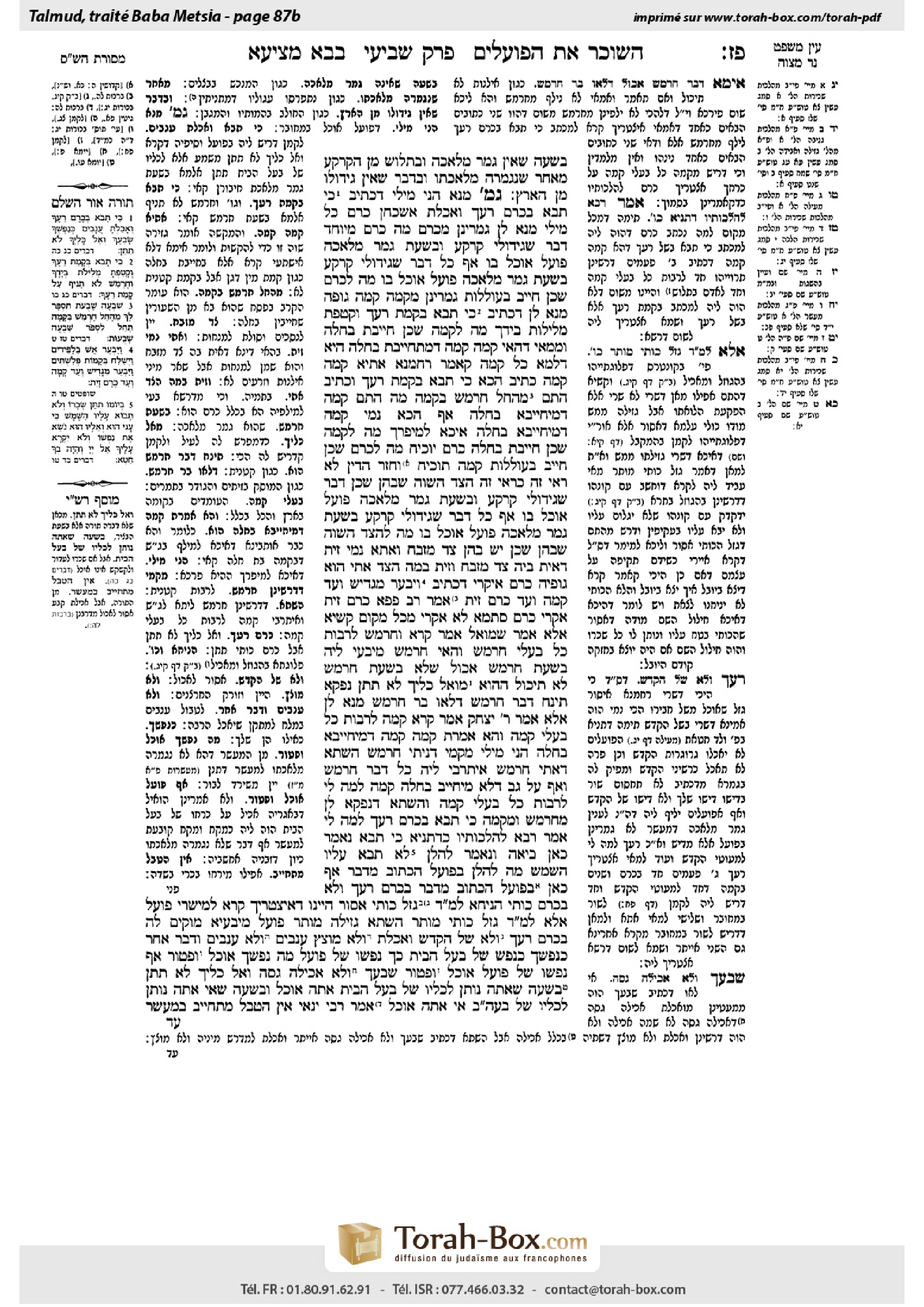
Bava Metzia 87b: Talmud study for Daf Yomi
Study the Talmud for Daf Yomi with scanned pages, Hebrew text, English translations from Sefaria and AI-generated French translations.
Passage selection and English or AI-generated French translation are available where the scan has annotations. Daf Study is independent of Torah-Box and Sefaria.
Browse Bava Metzia · בבא מציעא · All tractatesBava Metzia 87b text and translations
This page of Bava Metzia includes the Aramaic text, an English translation and an AI-generated French translation, alongside the scan above.
בבא מציעא פ״ז ב · Aramaic and Hebrew text
בְּשָׁעָה שֶׁאֵין גְּמַר מְלָאכָה, וּבְתָלוּשׁ מִן הַקַּרְקַע מֵאַחַר שֶׁנִּגְמְרָה מְלַאכְתּוֹ, וּבְדָבָר שֶׁאֵין גִּידּוּלוֹ מִן הָאָרֶץ.
גְּמָ׳ מְנָא הָנֵי מִילֵּי, דִּכְתִיב: ״כִּי תָבֹא בְּכֶרֶם רֵעֶךָ וְאָכַלְתָּ״. אַשְׁכְּחַן כֶּרֶם, כֹּל מִילֵּי מְנָא לַן?
גָּמְרִינַן מִכֶּרֶם: מָה כֶּרֶם מְיוּחָד, דָּבָר שֶׁגִּידּוּלֵי קַרְקַע, וּבִשְׁעַת גְּמַר מְלָאכָה פּוֹעֵל אוֹכֵל בּוֹ – אַף כׇּל דָּבָר שֶׁגִּידּוּלֵי קַרְקַע, בִּשְׁעַת גְּמַר מְלָאכָה פּוֹעֵל אוֹכֵל בּוֹ.
מָה לְכֶרֶם – שֶׁכֵּן חַיָּיב בְּעוֹלֵלוֹת! גָּמְרִינַן מִקָּמָה. קָמָה גּוּפַהּ מְנָא לַן? דִּכְתִיב: ״כִּי תָבֹא בְּקָמַת רֵעֶךָ וְקָטַפְתָּ מְלִילוֹת בְּיָדֶךָ״.
מָה לְקָמָה שֶׁכֵּן חַיֶּיבֶת בַּחַלָּה! וּמִמַּאי דְּהַאי קָמָה קָמָה דְּמִתְחַיֶּיבֶת בְּחַלָּה הִיא? דִּלְמָא כֹּל קָמָה קָאָמַר רַחֲמָנָא!
אָתְיָא ״קָמָה״ ״קָמָה״, כְּתִיב הָכָא ״כִּי תָבֹא בְּקָמַת רֵעֶךָ״, וּכְתִיב הָתָם ״מֵהָחֵל חֶרְמֵשׁ בַּקָּמָה״. מָה הָתָם קָמָה דְּמִיחַיְּיבָא בְּחַלָּה, אַף הָכָא נָמֵי קָמָה דְּמִיחַיְּיבָא בְּחַלָּה.
אִיכָּא לְמִיפְרַךְ: מָה לְקָמָה שֶׁכֵּן חַיֶּיבֶת בְּחַלָּה! כֶּרֶם יוֹכִיחַ. מָה לְכֶרֶם שֶׁכֵּן חַיָּיב בְּעוֹלֵלוֹת! קָמָה תּוֹכִיחַ.
וְחָזַר הַדִּין: לֹא רְאִי זֶה כִּרְאִי זֶה. הַצַּד הַשָּׁוֶה שֶׁבָּהֶן – שֶׁכֵּן דָּבָר שֶׁגִּידּוּלֵי קַרְקַע, וּבִשְׁעַת גְּמַר מְלָאכָה פּוֹעֵל אוֹכֵל בּוֹ. אַף כׇּל דָּבָר שֶׁגִּידּוּלֵי קַרְקַע בִּשְׁעַת גְּמַר מְלָאכָה פּוֹעֵל אוֹכֵל בּוֹ.
מָה לְהַצַּד הַשָּׁוֶה שֶׁבָּהֶן, שֶׁכֵּן יֵשׁ בָּהֶן צַד מִזְבֵּחַ. וַאֲתָא נָמֵי זַיִת, דְּאִית בֵּיהּ צַד מִזְבֵּחַ!
וְזַיִת בְּמָה הַצַּד אָתֵי? הוּא גּוּפֵיהּ כֶּרֶם אִיקְּרִי, דִּכְתִיב: ״וַיַּבְעֵר מִגָּדִישׁ וְעַד קָמָה וְעַד כֶּרֶם זָיִת״! אָמַר רַב פָּפָּא: ״כֶּרֶם זַיִת״ – אִקְּרֵי, ״כֶּרֶם״ סְתָמָא – לָא אִקְּרֵי.
מִכׇּל מָקוֹם קַשְׁיָא! אֶלָּא אָמַר שְׁמוּאֵל: אָמַר קְרָא ״וְחֶרְמֵשׁ״ לְרַבּוֹת כׇּל בַּעֲלֵי חֶרְמֵשׁ.
וְהַאי ״חֶרְמֵשׁ״ מִיבְּעֵי לֵיהּ: בִּשְׁעַת חֶרְמֵשׁ – אֱכוֹל, שֶׁלֹּא בִּשְׁעַת חֶרְמֵשׁ – לָא תֵּיכוֹל!
הָהוּא מִ״וְּאֶל כֶּלְיְךָ לֹא תִתֵּן״ נָפְקָא. תִּינַח דְּבַר חֶרְמֵשׁ, דְּלָאו בַּר חֶרְמֵשׁ מְנָא לַן?
אֶלָּא אָמַר רַבִּי יִצְחָק: אָמַר קְרָא ״קָמָה״ לְרַבּוֹת כׇּל בַּעֲלֵי קֹמָה. וְהָא אָמְרַתְּ: ״קָמָה״, קָמָה דְּמִיחַיְּיבָא בְּחַלָּה!
הָנֵי מִילֵּי מִקַּמֵּי דְּנֵיתֵי ״חֶרְמֵשׁ״, הַשְׁתָּא דְּאָתֵי ״חֶרְמֵשׁ״ – אִיתְרַבִּי לֵיהּ כֹּל דְּבַר חֶרְמֵשׁ, וְאַף עַל גַּב דְּלָא מִיחַיַּיב בְּחַלָּה. ״קָמָה״ לְמָה לִי – לְרַבּוֹת כׇּל בַּעֲלֵי קֹמָה.
וְהַשְׁתָּא דְּנָפְקָא לַן מֵחֶרְמֵשׁ וּמִקָּמָה ״כִּי תָבֹא בְּכֶרֶם רֵעֶךָ״ לְמָה לִי?
אָמַר רָבָא, לְהִלְכוֹתָיו. כִּדְתַנְיָא: ״כִּי תָבֹא״, נֶאֱמַר כָּאן בִּיאָה, וְנֶאֱמַר לְהַלָּן ״לֹא תָבוֹא עָלָיו הַשֶּׁמֶשׁ״, מָה לְהַלָּן בְּפוֹעֵל הַכָּתוּב מְדַבֵּר, אַף כָּאן בְּפוֹעֵל הַכָּתוּב מְדַבֵּר.
״בְּכֶרֶם רֵעֶךָ״, וְלֹא בְּכֶרֶם נׇכְרִי. הָנִיחָא לְמַאן דְּאָמַר גֶּזֶל נׇכְרִי אָסוּר, הַיְינוּ דְּאִיצְטְרִיךְ קְרָא לְמִישְׁרֵי פּוֹעֵל. אֶלָּא לְמַאן דְּאָמַר גֶּזֶל נׇכְרִי מוּתָּר – הַשְׁתָּא גְּזֵילָה מוּתָּר, פּוֹעֵל מִיבַּעְיָא?!
מוֹקֵים לַהּ: ״בְּכֶרֶם רֵעֶךָ״ – וְלֹא שֶׁל הֶקְדֵּשׁ. ״וְאָכַלְתָּ״ – וְלֹא מוֹצֵץ. ״עֲנָבִים״ וְלֹא עֲנָבִים וְדָבָר אַחֵר.
״כְּנַפְשְׁךָ״ – כְּנֶפֶשׁ שֶׁל בַּעַל הַבַּיִת כָּךְ נַפְשׁוֹ שֶׁל פּוֹעֵל. מָה נַפְשְׁךָ אוֹכֵל וּפָטוּר, אַף נַפְשׁוֹ שֶׁל פּוֹעֵל אוֹכֵל וּפָטוּר.
״שׇׂבְעֶךָ״, וְלֹא אֲכִילָה גַּסָּה. ״וְאַל כֶּלְיְךָ לֹא תִתֵּן״, בְּשָׁעָה שֶׁאַתָּה נוֹתֵן לְכֶלְיוֹ שֶׁל בַּעַל הַבַּיִת – אַתָּה אוֹכֵל, וּבְשָׁעָה שֶׁאִי אַתָּה נוֹתֵן לְכֶלְיוֹ שֶׁל בַּעַל הַבַּיִת – אִי אַתָּה אוֹכֵל.
אָמַר רַבִּי יַנַּאי: אֵין הַטֶּבֶל מִתְחַיֵּיב בְּמַעֲשֵׂר
Bava Metzia 87b · English translation
not at the time of the completion of its work, i.e., while it is still growing; and a laborer who works with produce detached from the ground after the completion of its work, when it is sufficiently processed and therefore subject to tithes; and a laborer who works with an item whose growth is not from the land.
GEMARA: The Gemara asks: From where are these matters, that a laborer may eat from produce attached to the ground, derived? The Gemara answers: As it is written: “When you come into your neighbor’s vineyard, then you may eat grapes until you have enough at your own pleasure; but you shall not put any in your vessel” (Deuteronomy 23:25). The Gemara asks: We find a source for a vineyard; from where do we derive that a laborer may likewise eat from any other type of produce?
The Gemara answers: We derive it from a comparison to the case of a vineyard: Just as a vineyard is unique in that it is an entity whose growth is from the ground, and the laborer eats from it at the time of the completion of its work, i.e., when he is harvesting the grapes, so too with regard to any entity whose growth is from the ground and it is at the time of the completion of its work, a laborer may eat from it.
The Gemara challenges this derivation: What is notable about a vineyard? It is notable in that the owner of a vineyard is obligated in the mitzva of olelot, the obligation to leave incomplete clusters of grapes for the poor (see Leviticus 19:10). Accordingly, one should not be able to derive the halakha of other types of produce from the halakha of a vineyard. The Gemara explains: We derive the halakha that a laborer may eat from other crops from the halakha that he may eat standing grain. The Gemara asks: And from where do we derive that he may eat standing grain itself? The Gemara answers: As it is written: “When you come into your neighbor’s standing grain, then you may pluck ears with your hand; but you shall not move a sickle on to your neighbor’s standing grain” (Deuteronomy 23:26).
The Gemara responds: What is notable about standing grain? It is notable in that the owner of dough prepared from grain is obligated in the mitzva of ḥalla. The Gemara asks an incidental question: And from where do you know that this standing grain mentioned in the verse is the same standing grain whose owner is obligated in the mitzva of ḥalla? Perhaps the Merciful One is discussing any standing produce, not only the five grains from which ḥalla must be separated.
The Gemara answers: The matter is derived by means of a verbal analogy between the term “standing” written here and the term “standing” written elsewhere. It is written here: “When you come into your neighbor’s standing grain” (Deuteronomy 23:26), and it is written there, with regard to harvesting the barley for the omer offering: “Seven weeks you shall count for yourself; from the time the sickle is first put to the standing grain” (Deuteronomy 16:9). Just as there, in the verse referring to the harvesting of the omer, it is the owner of standing grain who is obligated in the mitzva of ḥalla, as barley is one of the five grains, so too here, with regard to a laborer, it is discussing standing grain whose owner is obligated in the mitzva of ḥalla.
The Gemara resumes its discussion by reiterating its earlier question. The comparison between standing grain and other produce can be refuted as follows: What is notable about standing grain? It is notable in that the owner of dough prepared from grain is obligated in the mitzva of ḥalla. The Gemara answers: Let the case of a vineyard prove that this comparison is valid, as the mitzva of ḥalla does not apply to the produce of a vineyard, and yet a laborer may eat from it. The Gemara asks: What is notable about a vineyard? It is notable in that its owner is obligated in the mitzva of olelot. The Gemara responds: Let the case of standing grain prove that this is not a decisive factor, as its owner is not obligated in the mitzva of olelot and even so a laborer may eat from it.
Since no exact comparison can be drawn to either a vineyard or standing grain alone, the Gemara suggests a combined solution: The inference has reverted to its starting point. The aspect of this case, a vineyard, is not like the aspect of that case, standing grain. Their common denominator is that each one grows from the earth and at the time of the completion of its work the laborer may eat from it. So too, with regard to any type of produce that grows from the earth, at the time of the completion of its work, a laborer may eat from it.
The Gemara asks: What is unique about their common denominator? It is unique in that they have an aspect relating to the altar, i.e., the products of both a vineyard and standing grain differ from other types of produce in that they are both offered on the altar. Wine is brought for libations and flour in meal-offerings. The Gemara suggests tangentially: An olive should also be derived through this category of those products which a laborer may eat, as it too has an aspect relating to the altar, in the oil of meal-offerings.
The Gemara refutes this suggestion: And is the halakha of an olive derived from the common factor of the two types of produce mentioned earlier? But it itself is called the fruit of a vineyard [kerem], as it is written: “And he burned up both the piles of produce and the standing grain, and also the olive yards [kerem zayit]” (Judges 15:5). Rav Pappa said: This verse does not mean that an olive is considered the product of a vineyard, as in the verse it is called olive yard [kerem zayit], and it is not called a plain vineyard. Therefore, the halakha of olives must be derived by analogy from the common denominator.
The Gemara resumes its discussion: In any case, it is difficult, as there still has not been found a source according to which the halakha that a laborer may eat when he is working applies to all types of produce. Rather, Shmuel said: The verse states with regard to a laborer who may eat produce: “But you shall not move a sickle” (Deuteronomy 23:26). This serves to include all types of produce that are cut with a sickle.
The Gemara asks: But this word “sickle” is necessary to teach a different halakha with regard to a laborer: At the time of the sickle, i.e., when the work has been completed and the produce is being picked, you may eat. But when it is not yet the time of the sickle, you may not eat. If so, how can Shmuel use the term “sickle” as the source for the halakha that a laborer may eat all kinds of produce that are cut with a sickle?
The Gemara answers: That halakha, with regard to when a laborer may eat, is derived from the verse: “But you may not put any in your vessel” (Deuteronomy 23:25), as the Gemara will explain later. Therefore, the word “sickle” is not required to teach that halakha and can be used as the source of the halakha that a laborer may eat all kinds of produce that are cut with a sickle, as stated by Shmuel. The Gemara asks: Shmuel’s derivation works out well for any type of produce that requires a sickle for its harvest. But from where do we derive that the same applies to a type of produce that does not require a sickle for its harvest?
Rather, Rabbi Yitzḥak said that the halakha concerning which produce a laborer may eat is derived from a different source. The verse states: “Standing [kama]” (Deuteronomy 23:26), and the unmodified term kama serves to include any standing produce. The Gemara asks: But didn’t you say earlier that the term standing is referring specifically to standing produce whose owner is obligated in the mitzva of ḥalla, and not to other produce?
The Gemara answers: That matter applies before we derived a halakha from the mention of “sickle.” Now that a halakha was derived from “sickle,” any type of produce that requires a sickle for its harvesting is included, as stated earlier, and this applies even though the owner of that particular produce is not obligated in the mitzva of ḥalla. Accordingly, why do I need the term “standing”? It serves to include any standing produce.
The Gemara asks: And now that we have derived the halakha concerning which produce a laborer is entitled to eat both from the mention of “sickle” and from “standing,” why do I need the earlier verse: “When you come into your neighbor’s vineyard, then you may eat grapes until you have enough at your own pleasure; but you may not put any in your vessel” (Deuteronomy 23:25)?
The Gemara answers that Rava said: This verse is required for its unique halakhot, as it is taught in a baraita that the phrase “when you come [tavo]” is interpreted as follows: Coming [bia] is stated here, and coming is also stated there: “In the same day you shall give him his wages, and the sun shall not go down [tavo] upon it” (Deuteronomy 24:15). Just as there, in Deuteronomy, chapter 24, the verse is speaking of a laborer, so too here, in Deuteronomy, chapter 23, the verse is speaking of a laborer, despite the fact that this detail is not stated explicitly in the verse.
The baraita continues analyzing the verse: The phrase “in your neighbor’s vineyard” indicates that it is prohibited for a laborer to put the grapes in his vessel only while he is working in the vineyard of a Jew, but not in the vineyard of a gentile, where he may place grapes in his vessel. The Gemara digresses to discuss this point: This explanation works out well according to the one who says that robbery from a gentile is prohibited; this is why it was necessary for the verse to permit a laborer to eat the gentile’s grapes. But according to the one who says that robbery from a gentile is permitted, now that robbery itself is permitted, is it necessary to teach that a laborer in the vineyard of a gentile is permitted to put grapes in his vessel?
The Gemara answers: The one who maintains that robbery from a gentile is permitted interprets the phrase “in your neighbor’s vineyard” as teaching that a laborer may eat produce only in his neighbor’s vineyard, but he may not eat produce of consecrated property. The baraita continues: The term “then you may eat” indicates that a laborer must eat the entire grape and may not suck its juice and cast the rest away. The word “grapes” teaches that a laborer may eat only grapes by themselves and not grapes and something else, i.e., he may not use a condiment to make the grapes more palatable to enable him to eat an excessive amount.
The term: “At your own pleasure [kenafshekha]” (Deuteronomy 23:25), can also mean: As you are. Consequently, the term kenafshekha teaches that just as the halakha is concerning the owner of the vineyard himself, so is the halakha concerning you, the laborer himself: Just as the owner, alluded to by the term nafshekha, may eat from the produce before its labor is complete and is exempt from separating tithes, so too, the laborer himself may eat and is exempt from tithes.
The expression: “until you have enough” indicates that a laborer may eat until he is satiated, but he may not engage in excessive eating. The phrase “but you may not put any in your vessel” teaches that at a time when you put the grapes in the owner’s vessels, i.e., when harvesting the grapes, then you may eat, but at a time when you are not putting the grapes in the owner’s vessels, i.e., if the laborer is performing other tasks in the vineyard before harvesting, you may not eat.
§ Rabbi Yannai says: The owner of untithed produce is not obligated in the mitzva of tithing
Bava Metzia 87b · Traduction française (IA)
pas au moment de la fin de son travail, c'est-à-dire pendant qu'il est encore en croissance ; et un ouvrier qui travaille avec des produits détachés du sol après la fin de leur travail, lorsqu'ils sont suffisamment traités et donc soumis à l'offrande de dixièmes ; et un ouvrier qui travaille avec un objet dont la croissance ne provient pas du sol.
GUEMARA : La Guemara se demande : D'où sont tirés ces points, selon lesquels un ouvrier peut manger des produits attachés au sol ? La Guemara répond : Comme il est écrit : « Quand tu entreras dans le domaine de ton voisin, tu pourras manger des raisins jusqu'à ce que tu aies assez selon ton plaisir ; mais tu ne mettras aucun dans ton récipient » (Deutéronome 23:25). La Guemara se demande : Nous trouvons une source pour un domaine de vigne ; d'où tirons-nous que l'ouvrier peut également manger d'autres types de produits ?
La Guemara répond : Nous tirons cela d'une comparaison avec le cas d'un domaine de vigne : Tout comme un domaine de vigne est particulier dans le sens où sa croissance provient du sol, et l'ouvrier mange de lui au moment de la fin de son travail, c'est-à-dire lorsqu'il récolte les raisins, de même, concernant tout objet dont la croissance provient du sol et dont la fin de son travail arrive, l'ouvrier peut manger de lui.
La Guemara conteste cette dérivation : Qu'est-ce qui rend particulier un domaine de vigne ? C'est que l'propriétaire d'un domaine de vigne est tenu de la mitsva d'olelot, l'obligation de laisser des grappes incomplètes pour les pauvres (cf. Lévitique 19:10). Ainsi, on ne devrait pas pouvoir déduire la halakha des autres types de produits à partir de celle du domaine de vigne. La Guemara explique : Nous déduisons la halakha selon laquelle l'ouvrier peut manger d'autres cultures à partir de la halakha selon laquelle il peut manger du blé en rang. La Guemara se demande : D'où déduisons-nous que l'ouvrier peut manger du blé en rang ? La Guemara répond : Comme il est écrit : « Quand tu entreras dans le domaine de ton voisin, tu pourras arracher des épis avec ta main ; mais tu ne poseras pas la faux sur le blé en rang de ton voisin » (Deutéronome 23:26).
La Guemara répond : Qu'est-ce qui rend particulier le blé en rang ? C'est que l'propriétaire de la farine faite à partir de blé est tenu de la mitsva de challa. La Guemara se pose une question incidentelle : D'où sais-tu que ce blé en rang mentionné dans la parabole est le même blé en rang dont l'propriétaire est tenu de la mitsva de challa ? Peut-être que l'Éternel parle de toute production en rang, pas seulement des cinq céréales dont on sépare la challa.
La Guemara répond : Cette question est déduite par analogie verbale entre le terme « standing » écrit ici et le terme « standing » écrit ailleurs. Il est écrit ici : « Quand tu entreras dans le domaine de ton voisin, tu pourras arracher des épis avec ta main ; mais tu ne poseras pas la faux sur le blé en rang de ton voisin » (Deutéronome 23:26), et il est écrit ailleurs, concernant la récolte du froment pour l'offrande de l'omer : « Tu compteras sept semaines pour toi-même ; à partir du moment où la faux est mise sur le blé en rang » (Deutéronome 16:9). Tout comme là, dans la parabole concernant la récolte de l'omer, c'est l'propriétaire du blé en rang qui est tenu de la mitsva de challa, car le froment est l'une des cinq céréales, de même ici, concernant l'ouvrier, il s'agit du blé en rang dont l'propriétaire est tenu de la mitsva de challa.
La Guemara reprend sa discussion en réitérant sa question précédente. La comparaison entre le blé en rang et d'autres produits peut être réfutée comme suit : Qu'est-ce qui rend particulier le blé en rang ? C'est que l'propriétaire de la farine faite à partir de blé est tenu de la mitsva de challa. La Guemara répond : Laissons le cas d'un domaine de vigne prouver que cette comparaison est valide, car la mitsva de challa ne s'applique pas aux produits d'un domaine de vigne, et pourtant l'ouvrier peut manger de lui. La Guemara se demande : Qu'est-ce qui rend particulier un domaine de vigne ? C'est que son propriétaire est tenu de la mitsva d'olelot. La Guemara répond : Laissons le cas du blé en rang prouver que cela n'est pas un facteur décisif, car son propriétaire n'est pas tenu de la mitsva d'olelot et pourtant l'ouvrier peut manger de lui.
Puisque aucune comparaison exacte ne peut être tirée ni du domaine de vigne ni du blé en rang seul, la Guemara suggère une solution combinée : L'inférence est retournée à son point de départ. L'aspect de ce cas, le domaine de vigne, n'est pas comme l'aspect de l'autre cas, le blé en rang. Le point commun est que chacun pousse du sol et au moment de la fin de leur travail, le travailleur peut manger de lui. De même, concernant tout type de produit qui pousse du sol, au moment de la fin de son travail, le travailleur peut manger de lui.
La Guemara se demande : Qu'est-ce qui rend particulier ce point commun ? C'est particulier dans le sens où ils ont un aspect lié à l'autel, c'est-à-dire que les produits d'un domaine de vigne et du blé en rang diffèrent des autres types de produits dans le sens où ils sont tous offerts sur l'autel. Le vin est apporté pour les libations et la farine pour les offrandes de table. La Guemara suggère tangiquement : L'olive devrait également être déduite à partir de cette catégorie de produits dont le travailleur peut manger, car elle a aussi un aspect lié à l'autel, dans l'huile des offrandes de table.
La Guemara réfute cette suggestion : Et la halakha de l'olive est-elle déduite de ce facteur commun des deux types de produits mentionnés plus tôt ? Mais elle-même est appelée la production d'un domaine de vigne [kerem], comme il est écrit : « Et il brûla les tas de produits et le blé en rang, ainsi que les vergers d'olivier [kerem zayit] » (Juges 15:5). Rav Pappa dit : Cette citation ne signifie pas que l'olive est considérée comme le produit d'un domaine de vigne, car dans la citation elle est appelée « vergers d'olivier » [kerem zayit], et elle n'est pas appelée un domaine de vigne ordinaire. Ainsi, la halakha de l'olive doit être déduite par analogie à partir du point commun.
Le Guemara reprend sa discussion : En tout cas, c'est difficile, car il n'a pas encore été trouvé de source selon laquelle la halakha selon laquelle un ouvrier peut manger lorsqu'il travaille s'applique à tous les types de produits. Plutôt, Shmuel dit : La parole du texte qui stipule que l'ouvrier peut manger les produits est : « Mais tu ne devrais pas déplacer la faux » (Deutéronome 23:26). Cela sert à inclure tous les types de produits coupés avec une faux.
Le Guemara demande : Mais ce mot « faux » est nécessaire pour enseigner une autre halakha concernant l'ouvrier : Lors de la période de la faux, c'est-à-dire lorsque le travail est achevé et que les produits sont récoltés, on peut manger. Mais lorsque ce n'est pas encore la période de la faux, on ne peut pas manger. Si c'est ainsi, comment Shmuel peut-il utiliser le terme « faux » comme source pour la halakha selon laquelle l'ouvrier peut manger tous les types de produits coupés avec une faux ?
Le Guemara répond : Cette halakha concernant le moment où l'ouvrier peut manger est tirée du texte : « Mais tu ne devrais pas mettre aucun dans ton récipient » (Deutéronome 23:25), comme le Guemara l'expliquera plus tard. Ainsi, le mot « faux » n'est pas nécessaire pour enseigner cette halakha et peut être utilisé comme source pour la halakha selon laquelle l'ouvrier peut manger tous les types de produits coupés avec une faux, comme l'a dit Shmuel. Le Guemara demande : Cette dérivation de Shmuel fonctionne bien pour tout type de produit nécessitant une faux pour sa récolte. Mais d'où tirons-nous que cela s'applique également à un type de produit ne nécessitant pas une faux pour sa récolte ?
Plutôt, Rabbi Yitzḥak dit que la halakha concernant les produits dont l'ouvrier peut manger est tirée d'une source différente. Le texte stipule : « En position [kama] » (Deutéronome 23:26), et le terme non modifié kama sert à inclure tout produit en position. Le Guemara demande : Mais n'avez-vous pas dit plus tôt que le terme « en position » fait référence spécifiquement aux produits en position dont l'propriétaire est tenu de la mitsva de challa, et non aux autres produits ?
Le Guemara répond : Cette question s'applique avant que nous n'ayons tiré une halakha de la mention de « faux ». Maintenant qu'une halakha a été tirée du « faux », tout type de produit nécessitant une faux pour sa récolte est inclus, comme mentionné plus tôt, et cela s'applique même si l'propriétaire de ce produit particulier n'est pas tenu de la mitsva de challa. Ainsi, pourquoi ai-je besoin du terme « en position » ? Il sert à inclure tout produit en position.
Le Guemara demande : Et maintenant que nous avons tiré la halakha concernant les produits dont l'ouvrier est autorisé à manger à la fois de la mention de « faux » et de « en position », pourquoi ai-je besoin du verset précédent : « Quand tu entreras dans le domaine de ton voisin, tu pourras manger des raisins jusqu'à ce que tu aies assez selon ton plaisir ; mais tu ne devras pas mettre aucun dans ton récipient » (Deutéronome 23:25) ?
Le Guemara répond que Rava a dit : Ce verset est nécessaire pour ses halakhot spécifiques, car il est enseigné dans une baraïta que la phrase « quand tu entreras [tavo] » est interprétée ainsi : Entrer [bia] est mentionné ici, et entrer est aussi mentionné là : « Le même jour tu lui donneras son salaire, et le soleil ne descendra pas [tavo] sur cela » (Deutéronome 24:15). Aussi bien là, dans Deutéronome, chapitre 24, le verset parle d'un ouvrier, ainsi que là, dans Deutéronome, chapitre 23, le verset parle d'un ouvrier, malgré que ce détail n'est pas mentionné explicitement dans le verset.
La baraïta continue d'analyser le verset : La phrase « dans le domaine de ton voisin » indique que c'est interdit à l'ouvrier de mettre les raisins dans son récipient uniquement pendant qu'il travaille dans le domaine d'un Juif, mais pas dans le domaine d'un non-Juif, où il peut mettre les raisins dans son récipient. Le Guemara s'égare pour discuter ce point : Cette explication s'applique bien selon celui qui dit que le vol d'un non-Juif est interdit ; c'est pourquoi il a été nécessaire que le verset permette à l'ouvrier de manger les raisins du non-Juif. Mais selon celui qui dit que le vol d'un non-Juif est permis, maintenant que le vol lui-même est permis, est-il nécessaire d'enseigner que l'ouvrier dans le domaine d'un non-Juif est autorisé à mettre les raisins dans son récipient ?
Le Guemara répond : Celui qui maintient que le vol d'un non-Juif est permis interprète la phrase « dans le domaine de ton voisin » comme enseignant que l'ouvrier peut manger les produits uniquement dans le domaine de son voisin, mais pas dans le domaine des biens consacrés. La baraïta continue : Le terme « alors tu peux manger » indique que l'ouvrier doit manger toute la grappe et ne doit pas sucer son jus et jeter le reste. Le mot « grappes » enseigne que l'ouvrier peut manger uniquement des grappes pures et non des grappes avec quelque chose d'autre, c'est-à-dire qu'il ne peut pas utiliser un condiment pour rendre les grappes plus savoureuses afin de pouvoir manger en excès.
Le terme : « selon ton plaisir [kenafshekha] » (Deutéronome 23:25), peut aussi signifier : Comme toi. Ainsi, le terme kenafshekha enseigne que tout comme la halakha concerne l'propriétaire du domaine, elle concerne aussi toi, l'ouvrier : Tout comme l'propriétaire, désigné par le terme nafshekha, peut manger des produits avant que le travail ne soit achevé et est exempt de séparation des dîmes, ainsi l'ouvrier lui-même peut manger et est exempt des dîmes.
L'expression : « jusqu'à ce que tu aies assez » indique que l'ouvrier peut manger jusqu'à ce qu'il soit rassasié, mais il ne doit pas manger en excès. La phrase « mais tu ne devrais pas mettre aucun dans ton récipient » enseigne que lorsqu'on met les raisins dans le récipient de l'propriétaire, c'est-à-dire lors de la récolte des raisins, alors on peut manger, mais lorsqu'on ne met pas les raisins dans le récipient de l'propriétaire, c'est-à-dire si l'ouvrier effectue d'autres tâches dans le domaine avant la récolte, on ne peut pas manger.
§ Rabbi Yannai dit : L'propriétaire de produits non maïsés n'est pas tenu de la mitsva de titres
Traduction française générée par IA à partir de l’édition anglaise de Sefaria. Vérifie toujours un passage avec le texte source.
Text from Sefaria: William Davidson Edition - Vocalized Aramaic (CC BY NC); William Davidson Edition - English (CC BY NC).