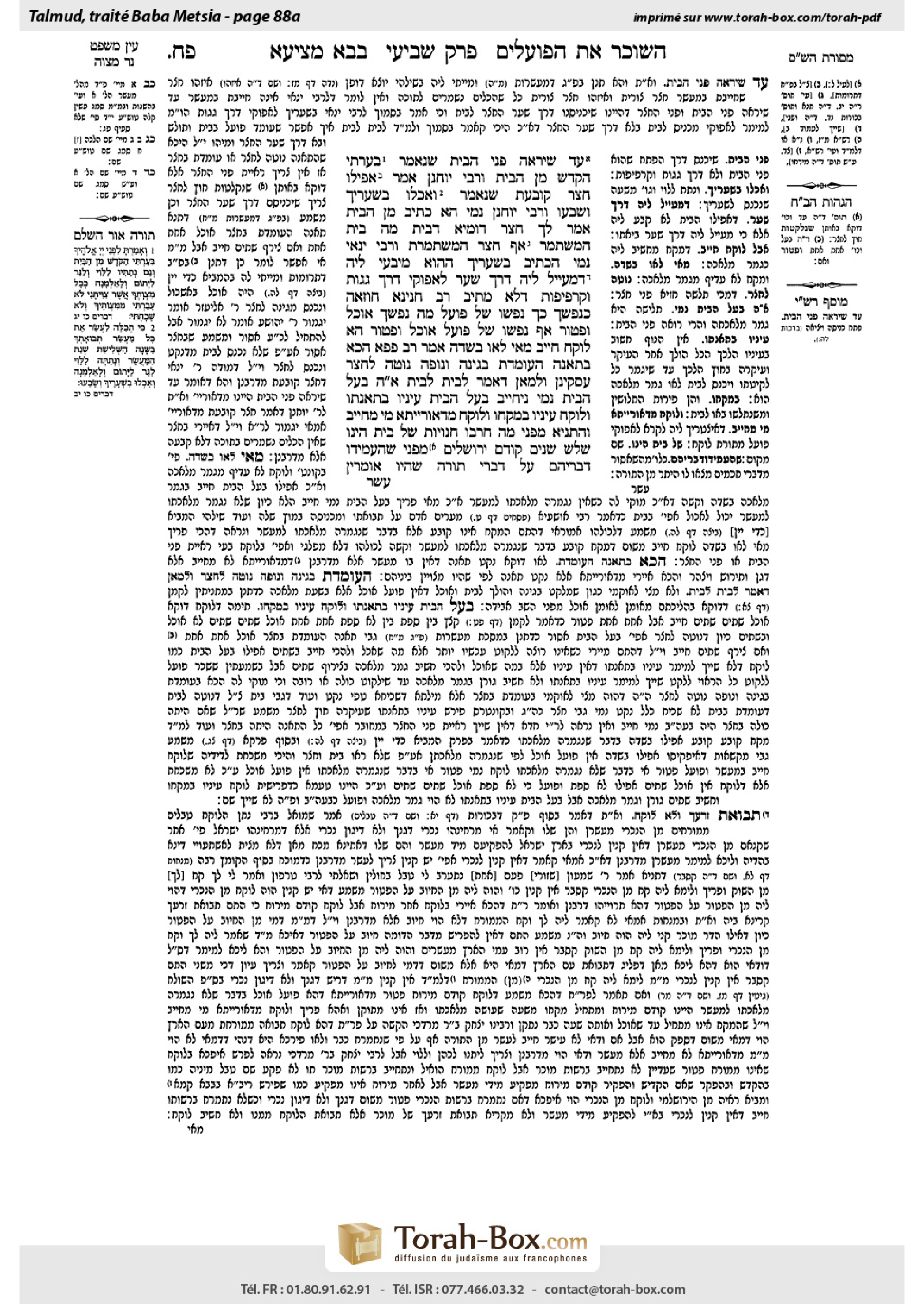
Bava Metzia 88a: Talmud study for Daf Yomi
Study the Talmud for Daf Yomi with scanned pages, Hebrew text, English translations from Sefaria and AI-generated French translations.
Passage selection and English or AI-generated French translation are available where the scan has annotations. Daf Study is independent of Torah-Box and Sefaria.
Browse Bava Metzia · בבא מציעא · All tractatesBava Metzia 88a text and translations
This page of Bava Metzia includes the Aramaic text, an English translation and an AI-generated French translation, alongside the scan above.
בבא מציעא פ״ח א · Aramaic and Hebrew text
עַד שֶׁיִּרְאֶה פְּנֵי הַבַּיִת, שֶׁנֶּאֱמַר: ״בִּעַרְתִּי הַקֹּדֶשׁ מִן הַבַּיִת״.
וְרַבִּי יוֹחָנָן אָמַר: אֲפִילּוּ חָצֵר קוֹבַעַת, שֶׁנֶּאֱמַר: ״וְאָכְלוּ בִשְׁעָרֶיךָ וְשָׂבֵעוּ״.
וְרַבִּי יוֹחָנָן נָמֵי, הָא כְּתִיב ״מִן הַבַּיִת״! אָמַר לָךְ: חָצֵר – דֻּמְיָא דְּבַיִת: מָה בַּיִת הַמִּשְׁתַּמֵּר – אַף חָצֵר הַמִּשְׁתַּמֶּרֶת.
וְרַבִּי יַנַּאי נָמֵי, הָכְתִיב ״בִּשְׁעָרֶיךָ״! הָהוּא מִיבְּעֵי לֵיהּ דִּמְעַיֵּיל לֵיהּ דֶּרֶךְ שַׁעַר, לְאַפּוֹקֵי דֶּרֶךְ גַּגּוֹת וְקַרְפֵּיפוֹת דְּלָא.
מֵתִיב רַב חֲנִינָא חוֹזָאָה: ״כְּנַפְשְׁךָ״ – כָּךְ נַפְשׁוֹ שֶׁל פּוֹעֵל, מָה נַפְשְׁךָ אוֹכֵל וּפָטוּר, אַף נַפְשׁוֹ שֶׁל פּוֹעֵל אוֹכֵל וּפָטוּר.
הָא לוֹקֵחַ חַיָּיב, מַאי לָאו בַּשָּׂדֶה?
אָמַר רַב פָּפָּא: הָכָא בִּתְאֵנָה הָעוֹמֶדֶת בְּגִינָּה וְנוֹפָהּ נוֹטֶה לְחָצֵר עָסְקִינַן, וּלְמַאן דְּאָמַר לְבַיִת – לְבַיִת.
אִי הָכִי בַּעַל הַבַּיִת נָמֵי נִיחַיַּיב! בַּעַל הַבַּיִת עֵינָיו בִּתְאֵנָתוֹ, וְלוֹקֵחַ עֵינָיו בְּמִקָּחוֹ.
וְלוֹקֵחַ מִדְּאוֹרָיְיתָא מִי מִחַיַּיב? וְהָתַנְיָא: מִפְּנֵי מָה חָרְבוּ חֲנוּיוֹת שֶׁל בֵּית הִינוֹ שָׁלֹשׁ שָׁנִים קוֹדֶם יְרוּשָׁלַיִם – מִפְּנֵי שֶׁהֶעֱמִידוּ דִּבְרֵיהֶם עַל דִּבְרֵי תוֹרָה. שֶׁהָיוּ אוֹמְרִין:
Bava Metzia 88a · English translation
until it sees the front of the house through which people enter and exit, and it is brought into the house through that entrance, as it is stated in the formula of the declaration of the tithes: “I have removed the consecrated from the house” (Deuteronomy 26:13), which indicates that the obligation to tithe produce whose purpose has not yet been designated applies only when it is brought into the house.
And Rabbi Yoḥanan says: Even bringing produce into the courtyard determines that the production process of the produce has been completed and that the produce is therefore subject to tithes, as it is stated in the confession of the tithes: “And I have given to the Levite, the stranger, the orphan, and the widow, and they shall eat in your gates and be satisfied” (Deuteronomy 26:12).
The Gemara asks: But according to Rabbi Yoḥanan also, isn’t it written: “From the house”? The Gemara answers: He could have said to you that the term “house” is not to be taken literally. Rather, it indicates that bringing untithed produce into a courtyard is similar to bringing it into a house, in the following way: Just as a house is a secured area, so too, the courtyard must be secured. An area that is accessible to the public is not considered a courtyard for the purposes of this halakha.
The Gemara asks: And according to Rabbi Yannai also, isn’t it written: “In your gates”? The Gemara answers: That term is necessary to teach that this halakha, that the production process is considered complete, applies only when one brings the produce into his house through the gate, i.e., the entranceway, to the exclusion of produce that was brought in through rooftops and enclosures, in which case the produce is not subject to tithes.
Rav Ḥanina Ḥoza’a raises an objection from a statement of the baraita mentioned earlier (87b): The term “at your own pleasure [kenafshekha]” can also mean: As you are. Consequently, the term kenafshekha teaches that just as the halakha is concerning the owner of the vineyard himself, so is the halakha concerning the laborer himself: Just as the owner, alluded to by the term nafshekha, may eat from the produce before its labor is complete and is exempt from separating tithes, so too, the laborer himself may eat and is exempt from tithes.
The objection of Rav Ḥanina Ḥoza’a is as follows: This indicates that only an owner and a laborer may eat from produce without tithing it; but one who buys produce is obligated by Torah law to separate tithes before partaking of it. What, is it not correct to conclude that this is the halakha even when he purchased the produce while it was still in the field, i.e., he is obligated to tithe the produce even though it has not entered his house or courtyard?
Rav Pappa said: Here, in the baraita, we are dealing with a fig tree that is standing in a garden outside a courtyard and its leaves are leaning into a courtyard, or, according to the one who says that the obligation to separate tithes applies when the produce is brought into the house, the branches are leaning into the house. Therefore, the produce entered the courtyard or house.
The Gemara asks: If so, the homeowner himself, not only the buyer, should also be obligated to separate tithes, as the produce is in either the courtyard or the house. The Gemara answers: The homeowner’s eyes are on his fig tree, i.e., his primary concern is the tree, not its produce, and the main part of the tree is outside the courtyard. But the buyer’s eyes are on his purchase, i.e., his focus is on the produce itself, which is in the space of the courtyard or house.
The Gemara asks: And is a buyer obligated by Torah law to tithe the produce he purchases? But isn’t it taught in a baraita: For what reason were the shops of Beit Hino, a town near Jerusalem, destroyed three years before the destruction of Jerusalem itself? It was because they based their practices strictly on matters of Torah, i.e., they did not adhere to the rabbinic safeguards. The baraita explains that they would say
Bava Metzia 88a · Traduction française (IA)
jusqu'au moment où il voit la façade de la maison par laquelle les gens entrent et sortent, et il est introduit dans la maison par cette entrée, comme il est dit dans la formule de la déclaration des dîmes : « J'ai ôté les choses consacrées de la maison » (Deutéronome 26:13), ce qui indique que l'obligation de dîmer les produits dont l'usage n'a pas encore été désigné s'applique uniquement lorsqu'ils sont introduits dans la maison.
Et Rabbi Yoḥanan dit : Même l'introduction des produits dans le cour de la maison détermine que le processus de production des produits est achevé et que les produits sont donc soumis aux dîmes, comme il est dit dans la confession des dîmes : « Et j'ai donné au Lévite, à l'étranger, à l'orphelin et à la veuve, et ils mangeront à vos portes et seront rassasiés » (Deutéronome 26:12).
Le Guemara demande : Mais selon Rabbi Yoḥanan également, n'est-il pas écrit : « De la maison » ? Le Guemara répond : Il aurait pu dire à vous que le terme « maison » ne doit pas être pris littéralement. Plutôt, il indique que l'introduction de produits non dîmés dans un cour est semblable à l'introduction dans une maison, de la manière suivante : Tout comme une maison est un lieu sécurisé, de même le cour doit être sécurisé. Un lieu accessible au public n'est pas considéré comme un cour pour l'effet de cette halakha.
Le Guemara demande : Et selon Rabbi Yannai également, n'est-il pas écrit : « Dans vos portes » ? Le Guemara répond : Ce terme est nécessaire pour enseigner que cette halakha, selon laquelle le processus de production est considéré comme achevé, s'applique uniquement lorsqu'on introduit les produits dans sa maison par la porte, c'est-à-dire l'entrée, excluant les produits apportés par les toits et les enclos, dans lesquels cas les produits ne sont pas soumis aux dîmes.
Rav Ḥanina Ḥoza’a soulève une objection à partir d'une déclaration d'une baraïta mentionnée plus tôt (87b) : Le terme « selon ton plaisir [kenafshekha] » peut aussi signifier : Comme tu es. Ainsi, le terme kenafshekha enseigne que tout comme la halakha concerne l'propriétaire du vigne, elle concerne aussi le travailleur lui-même : Tout comme l'propriétaire, allusionné par le terme nafshekha, peut manger des produits avant que leur travail ne soit achevé et est exempt de séparer les dîmes, de même le travailleur lui-même peut manger et est exempt de dîmes.
L'objection de Rav Ḥanina Ḥoza’a est la suivante : Cela indique que seul l'propriétaire et le travailleur peuvent manger des produits sans les dîmer ; mais celui qui achète des produits est tenu par la loi de la Torah de séparer les dîmes avant de les consommer. Qu'est-ce que cela ne signifie pas que conclure que c'est la halakha même s'il a acheté les produits alors qu'ils étaient encore dans le champ, c'est-à-dire qu'il est tenu de dîmer les produits même s'ils n'ont pas encore entré dans sa maison ou son cour ?
Rav Pappa dit : Ici, dans la baraïta, nous parlons d'un figuier qui est planté dans un jardin en dehors d'un cour et ses feuilles sont penchées vers un cour, ou, selon celui qui dit que l'obligation de séparer les dîmes s'applique lorsqu'on introduit les produits dans la maison, les branches sont penchées vers la maison. Ainsi, les produits sont entrés dans le cour ou la maison.
Le Guemara demande : Si c'est ainsi, le propriétaire lui-même, pas seulement l'acheteur, devrait être tenu de séparer les dîmes, puisque les produits sont dans le cour ou la maison. Le Guemara répond : Les yeux du propriétaire sont sur son figuier, c'est-à-dire sa préoccupation principale est l'arbre, pas ses fruits, et la principale partie de l'arbre est en dehors du cour. Mais les yeux de l'acheteur sont sur son achat, c'est-à-dire son attention est portée sur les produits eux-mêmes, qui sont dans l'espace du cour ou de la maison.
Le Guemara demande : Et l'acheteur est-il tenu par la loi de la Torah de dîmer les produits qu'il achète ? Mais n'est-il pas enseigné dans une baraïta : Pour quelle raison les boutiques de Beit Hino, une ville près de Jérusalem, ont-elles été détruites trois ans avant la destruction de Jérusalem elle-même ? C'était à cause qu'ils basaient leurs pratiques strictement sur des questions de Torah, c'est-à-dire qu'ils n'ont pas suivi les sécurités rabbiniques. La baraïta explique qu'ils disaient
Traduction française générée par IA à partir de l’édition anglaise de Sefaria. Vérifie toujours un passage avec le texte source.
Text from Sefaria: William Davidson Edition - Vocalized Aramaic (CC BY NC); William Davidson Edition - English (CC BY NC).