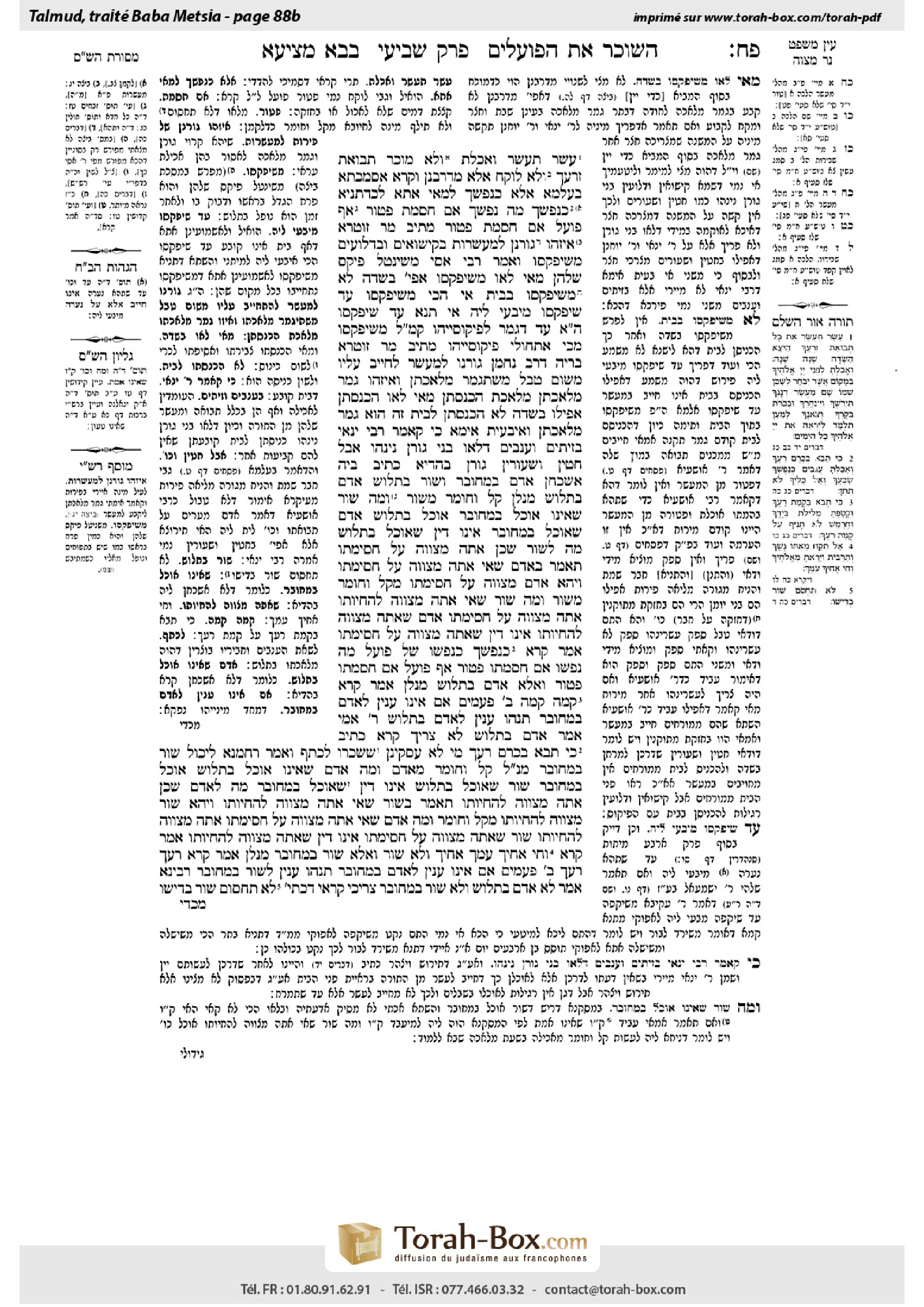
Bava Metzia 88b: Talmud study for Daf Yomi
Study the Talmud for Daf Yomi with scanned pages, Hebrew text, English translations from Sefaria and AI-generated French translations.
Passage selection and English or AI-generated French translation are available where the scan has annotations. Daf Study is independent of Torah-Box and Sefaria.
Browse Bava Metzia · בבא מציעא · All tractatesBava Metzia 88b text and translations
This page of Bava Metzia includes the Aramaic text, an English translation and an AI-generated French translation, alongside the scan above.
בבא מציעא פ״ח ב · Aramaic and Hebrew text
״עַשֵּׂר תְּעַשֵּׂר וְאָכַלְתָּ״ – וְלֹא מוֹכֵר. ״תְּבוּאַת זַרְעֶךָ״ – וְלֹא לוֹקֵחַ. אֶלָּא מִדְּרַבָּנַן, וּקְרָא אַסְמַכְתָּא בְּעָלְמָא.
אֶלָּא ״כְּנַפְשְׁךָ״ לְמַאי אֲתָא? לְכִדְתַנְיָא: ״כְּנַפְשְׁךָ״, מָה נַפְשְׁךָ אִם חָסַמְתָּ – פָּטוּר, אַף פּוֹעֵל אִם חָסַמְתָּ – פָּטוּר.
מֵתִיב מָר זוּטְרָא: אֵיזֶהוּ גּוֹרְנָן לְמַעַשְׂרוֹת? בַּקִּישּׁוּאִים וּבַדִּלּוּעִים מִשֶּׁיְּפַקֵּסוּ. וְאָמַר רַבִּי אַסִּי: מִשֶּׁיִּנָּטֵל פֵּיקֶס שֶׁלָּהֶן. מַאי לָאו מִשֶּׁיְּפַקֵּסוּ – אֲפִילּוּ בַּשָּׂדֶה!
לֹא מִשֶּׁיְּפַקְּסוּ בַּבַּיִת. אִי הָכִי, ״מִשֶּׁיְּפַקֵּסוּ״ ״עַד שֶׁיְּפַקֵּסוּ״ מִיבְּעֵי לֵיהּ!
אִי תְּנָא עַד שֶׁיְּפַקֵּסוּ – הֲוָה אָמֵינָא: עַד דְּגָמַר לְפִיקּוּסַיְיהוּ, קָא מַשְׁמַע לַן: מִשֶּׁיְּפַקְּסוּ, מִכִּי (אַתְחוֹלֵי) [מַתְחֵיל] פִּיקּוּסַיְיהוּ.
מֵתִיב מָר זוּטְרָא בְּרֵיהּ דְּרַב נַחְמָן: גּוֹרְנוֹ לְמַעֲשֵׂר לְחַיֵּיב עָלָיו מִשּׁוּם טֶבֶל מִשֶּׁתִּגָּמֵר מְלַאכְתָּן. וְאֵיזֶהוּ גְּמַר מְלַאכְתָּן – מְלֶאכֶת הַכְנָסָתָן. מַאי לָאו הַכְנָסָתָן אֲפִילּוּ בַּשָּׂדֶה!
לָא, הַכְנָסָתָן לַבַּיִת – זֶה הוּא גְּמַר מְלַאכְתָּן. וְאִיבָּעֵית אֵימָא: כִּי קָאָמַר רַבִּי יַנַּאי בְּזֵיתִים וַעֲנָבִים, דְּלָאו בְּנֵי גוֹרֶן נִינְהוּ. אֲבָל חִטִּין וּשְׂעוֹרִין – ״גּוֹרֶן״ בְּהֶדְיָא כְּתִיב בֵּיהּ.
אַשְׁכְּחַן אָדָם בִּמְחוּבָּר וְשׁוֹר בְּתָלוּשׁ. אָדָם בְּתָלוּשׁ מְנָלַן?
קַל וָחוֹמֶר מִשּׁוֹר: וּמָה שׁוֹר שֶׁאֵינוֹ אוֹכֵל בִּמְחוּבָּר – אוֹכֵל בְּתָלוּשׁ, אָדָם שֶׁאוֹכֵל בִּמְחוּבָּר אֵינוֹ דִּין שֶׁאוֹכֵל בְּתָלוּשׁ? מָה לְשׁוֹר שֶׁכֵּן אַתָּה מְצֻוֶּוה עַל חֲסִימָתוֹ, תֹּאמַר בְּאָדָם שֶׁאִי אַתָּה מְצֻוֶּוה עַל חֲסִימָתוֹ!
וִיהֵא אָדָם מְצֻוֶּוה עַל חֲסִימָתוֹ מִקַּל וָחוֹמֶר מִשּׁוֹר: וּמָה שׁוֹר שֶׁאִי אַתָּה מְצֻוֶּוה לְהַחְיוֹתוֹ, אַתָּה מְצֻוֶּוה עַל חֲסִימָתוֹ. אָדָם שֶׁאַתָּה מְצֻוֶּוה לְהַחְיוֹתוֹ – אֵינוֹ דִּין שֶׁאַתָּה מְצֻוֶּוה עַל חֲסִימָתוֹ?!
אָמַר קְרָא ״כְּנַפְשְׁךָ״, כְּנַפְשׁוֹ שֶׁל פּוֹעֵל: מָה נַפְשׁוֹ אִם חֲסַמְתּוֹ פָּטוּר – אַף פּוֹעֵל אִם חֲסַמְתּוֹ פָּטוּר.
וְאֶלָּא, אָדָם בְּתָלוּשׁ מְנָלַן? אָמַר קְרָא ״קָמָה״ ״קָמָה״ – שְׁתֵּי פְּעָמִים, אִם אֵינוֹ עִנְיָן לְאָדָם בִּמְחוּבָּר, תְּנֵהוּ עִנְיָן לְאָדָם בְּתָלוּשׁ.
רַבִּי אַמֵּי אָמַר: אָדָם בְּתָלוּשׁ לָא צְרִיךְ קְרָא. כְּתִיב: ״כִּי תָבֹא בְּכֶרֶם רֵעֶךָ״ – מִי לָא עָסְקִינַן שֶׁשְּׂכָרוֹ לְכַתֵּף, וְאָמַר רַחֲמָנָא לֵיכוֹל.
שׁוֹר בִּמְחוּבָּר מְנָלַן? קַל וָחֹמֶר מֵאָדָם: וּמָה אָדָם שֶׁאֵינוֹ אוֹכֵל בְּתָלוּשׁ – אוֹכֵל בִּמְחוּבָּר, שׁוֹר שֶׁאוֹכֵל בְּתָלוּשׁ – אֵינוֹ דִּין שֶׁאוֹכֵל בִּמְחוּבָּר? מָה לְאָדָם – שֶׁכֵּן אַתָּה מְצֻוֶּוה לְהַחְיוֹתוֹ, תֹּאמַר בְּשׁוֹר שֶׁאִי אַתָּה מְצֻוֶּוה לְהַחְיוֹתוֹ!
וִיהֵא שׁוֹר מְצֻוֶּוה לְהַחְיוֹתוֹ, מִקַּל וָחוֹמֶר: וּמָה אָדָם שֶׁאִי אַתָּה מְצֻוֶּוה עַל חֲסִימָתוֹ – אַתָּה מְצֻוֶּוה לְהַחְיוֹתוֹ, שׁוֹר שֶׁאַתָּה מְצֻוֶּוה עַל חֲסִימָתוֹ – אֵינוֹ דִּין שֶׁאַתָּה מְצֻוֶּוה לְהַחְיוֹתוֹ?!
אָמַר קְרָא: ״וְחֵי אָחִיךָ עִמָּךְ״, אָחִיךָ וְלֹא שׁוֹר. וְאֶלָּא, שׁוֹר בִּמְחוּבָּר מְנָלַן? אָמַר קְרָא: ״רֵעֶךָ״ ״רֵעֶךָ״ שְׁתֵּי פְּעָמִים, אִם אֵינוֹ עִנְיָן לְאָדָם בִּמְחוּבָּר – תְּנֵהוּ עִנְיָן לְשׁוֹר בִּמְחוּבָּר.
רָבִינָא אָמַר: לָא אָדָם בְּתָלוּשׁ וְלֹא שׁוֹר בִּמְחוּבָּר צְרִיכִי קְרָאֵי, דִּכְתִיב: ״לֹא תַחְסֹם שׁוֹר בְּדִישׁוֹ״.
Bava Metzia 88b · English translation
that a buyer need not tithe the produce he purchases, as derived from the verses: “You shall tithe all the produce of your planting, which is brought forth in the field year by year, and you shall eat before the Lord, your God” (Deuteronomy 14:22–23). They claimed that the phrases “you shall tithe…and you shall eat” indicate that only the one who eats the produce must tithe it, but not the one who sells it. Likewise, the phrase “the produce of your planting” teaches that the one who performs the planting must separate tithes, but not the one who buys it. Rather, the obligation of a buyer to separate tithes applies by rabbinic law, and the verse is cited as a mere support for this halakha. The residents of Beit Hino did not adhere to this rabbinic law and did not observe the halakha requiring the buyer to separate tithes.
It was stated previously that a buyer is not required to tithe produce by Torah law. If so, the same certainly applies to a laborer. Consequently, the term kenafshekha cannot serve to teach that a laborer may eat without tithing, as claimed earlier. The Gemara asks: Rather, what does kenafshekha come to teach? The Gemara answers: It comes to teach that which is taught in another baraita: Kenafshekha can mean: Like your own person. Just as with regard to your own person, i.e., the owner, if you muzzled yourself and did not eat from your field’s produce, you are exempt from liability for the transgression of: “You shall not muzzle an ox when it is treading out the grain” (Deuteronomy 25:4), so too with regard to a laborer, if you muzzled him, i.e., you did not allow him to eat, you are exempt from liability for the transgression of muzzling an ox while it is working.
Mar Zutra raises an objection from a mishna (Ma’asrot 1:5): With regard to different types of produce, what is the equivalent of their granary, i.e., the point at which the processing of various types of produce is completed so that they become subject to the halakhot of tithes? With regard to cucumbers and gourds, they become obligated from when they lose their blossom; and Rabbi Asi said: This means from when their blossom [pikas] is removed. The Gemara clarifies the objection from the mishna: What, is it not correct to say that the mishna means from when they lose their blossom, even while the produce is still in the field? This would mean that the produce is subject to the halakhot of tithes before it enters the house or the courtyard, which is not in accordance with the opinions of either Rabbi Yannai or Rabbi Yoḥanan.
The Gemara answers: No, the mishna means: From when they lose their blossom specifically in the house or courtyard, i.e., the house or courtyard renders the produce subject to tithes only when the produce loses its blossom. The Gemara asks: If so, the phrase: From when they lose their blossom, is inaccurate, as the mishna should have said: Until they lose their blossom. The expression: From when they lose their blossom, indicates that the obligation applies as soon as that happens, i.e., before the produce enters the courtyard or house. By contrast, the expression: Until they lose their blossom, indicates that the obligation does not come into effect until they lose their blossom, regardless of whatever else is done to them, i.e., only when they are in the house and they lose their blossom.
The Gemara answers: Had the mishna taught: Until they lose their blossom, I would say erroneously that the produce is not subject to tithes until their loss of blossom is complete, i.e., until all of the produce loses its blossoms. The expression: From when they lose their blossom, teaches us that the obligation to separate tithes takes effect from when they begin to lose their blossom.
Mar Zutra, son of Rav Naḥman, raises an objection from a baraita: With regard to produce, its granary for tithes, rendering one who eats it liable for violating the prohibition against untithed produce, is from when its work is completed. And what is meant by the completion of its work? This means the work of its being brought in. The Gemara discusses the meaning of being brought in. What, is it not correct to say that this is referring to its being brought into a pile, even while the produce is still in the field?
The Gemara rejects this suggestion: No, it means that its being brought into the house is considered the completion of its work. And if you wish, say instead: When Rabbi Yannai and Rabbi Yoḥanan say that types of produce are subject to tithes when they are brought into the house or courtyard, they were referring only to olives or grapes, which are not of a granary, i.e., since these types of produce are not processed in a granary, which is the typical criterion for rendering produce subject to tithes, they become subject to tithes when they are brought into a house or courtyard. But in the case of wheat or barley, a granary is explicitly written with regard to them (see Numbers 18:27, 30). Therefore, they are subject to tithes in the granary, even before they are brought into a house or courtyard.
§ The Gemara returns to its discussion with regard to the right of a laborer to eat while working: We found a source for the halakha that a person may eat from attached produce while working in the field; and likewise we found a source that an ox that is threshing must be allowed to eat from detached produce, as the verse states: “You shall not muzzle an ox in its threshing” (Deuteronomy 25:4). From where do we derive that a person, while working, may eat from detached produce?
The Gemara answers: This is derived by an a fortiori inference from the case of an ox. And if an ox, which one need not allow to eat from attached produce, must be allowed to eat from detached produce, then with regard to a person, who may eat from attached produce, is it not right that he may also eat from detached produce? The Gemara rejects this inference: What is notable about an ox? It is notable in that you are commanded concerning its muzzling. Can you say that a similar halakha should apply to a person, as you are not commanded with regard to his muzzling?
The Gemara asks: But let an employer be commanded concerning a person’s, i.e., his laborer’s, muzzling, from an a fortiori inference from an ox: And if with regard to an ox, which you are not commanded to sustain, as there is no mitzva to support ownerless oxen if they do not have food to eat, and yet you are commanded concerning its muzzling, with regard to a Jewish person, whom you are commanded to sustain if he is impoverished (see Leviticus 25:35–36), is it not right that you are commanded concerning his muzzling?
The Gemara answers: The halakha that one is not commanded concerning the muzzling of his laborer is derived from the fact that the verse states: “Kenafshekha,” which indicates that as you treat your own person, so is the halakha with regard to the person of the laborer. In other words, just as with regard to himself, the owner, if you muzzled yourself, you are exempt from punishment for violating the transgression of: “You shall not muzzle an ox in its threshing,” so too with regard to a laborer, if you muzzled him you are exempt from punishment for violating the transgression of muzzling an ox while it is working.
After refuting the a fortiori inference, the Gemara inquires: Rather, from where do we derive that a person may eat from detached produce? The Gemara answers: The verse states the term “standing,” “standing” twice: “When you come into your neighbor’s standing grain…but you shall not move a sickle on your neighbor’s standing grain” (Deuteronomy 23:26). If the second expression is not applied to the matter of the right of a person to eat from attached produce, as that halakha has been derived from the first mention of “standing,” apply it to the matter of the right of a person to eat from detached produce.
Rabbi Ami stated an alternative answer: A verse is not required to teach the right of a person to eat from detached produce, as it is written: “When you come into your neighbor’s vineyard, then you may eat grapes” (Deuteronomy 23:25). Are we not dealing even with a case in which the employer hired the laborer to transport the grapes out of the vineyard, and yet the Merciful One states that he may eat?
The Gemara asks: From where do we derive that an ox must be allowed to eat from attached produce? The Gemara answers: This is derived by an a fortiori inference from the case of a person. And if a person, who may not eat from detached produce, i.e., there is no explicit verse that permits him to do so, nevertheless may eat from attached produce, then with regard to an ox, which must be allowed to eat from detached produce, is it not right that it must also be allowed to eat from attached produce? The Gemara rejects this inference: What is notable about a person? He is notable in that you are commanded to sustain him. Can you say that a similar halakha should apply in a case of an ox, when you are not commanded to sustain it?
The Gemara asks: But let one be commanded to sustain an ox, to prevent the suffering of living creatures, by an a fortiori inference from the case of a person: And if, with regard to a person, where you are not commanded concerning his muzzling, nevertheless you are commanded to sustain him, then in the case of an ox, where you are commanded concerning its muzzling, is it not right that you are commanded to sustain it?
The Gemara rejects this suggestion: This cannot be the case, as the verse states: “And your brother shall live with you” (Leviticus 25:36), which indicates that the mitzva to provide sustenance applies only to your brother, but not to an ox. After refuting the a fortiori inference, the Gemara inquires: Rather, from where do we derive that an ox must be allowed to eat from attached produce? The Gemara answers: The verse states the term “your neighbor,” “your neighbor” twice (Deuteronomy 23:26). If the second expression is not applied to the matter of the right of a person to eat from attached produce, as that halakha has been derived from the first mention of “your neighbor,” apply it to the matter of an ox, that it must be allowed to eat from attached produce.
Ravina said: Verses are not necessary either for the halakha that a person may eat from detached produce, or for the halakha that an ox must be allowed to eat from attached produce, as it is written: “You shall not muzzle an ox in its threshing” (Deuteronomy 25:4).
Bava Metzia 88b · Traduction française (IA)
que l'acheteur n'a pas besoin de dîmer les produits qu'il achète, comme déduit des versets : « Vous dîmerez tout le produit de votre plantation, qui est sorti du champ chaque année, et vous mangerez devant l'Éternel, votre Dieu » (Deutéronome 14:22–23). Ils affirmaient que les phrases « vous dîmerez… et vous mangerez » indiquent que seul celui qui mange les produits doit dîmer, mais pas celui qui les vend. De même, la phrase « le produit de votre plantation » enseigne que celui qui effectue la plantation doit séparer les dîmes, mais pas celui qui les achète. En réalité, l'obligation de l'acheteur de séparer les dîmes s'applique selon la loi rabbinique, et le verset est cité comme simple support pour cette halakha. Les habitants de Beit Hino n'ont pas suivi cette loi rabbinique et n'ont pas observé la halakha exigeant que l'acheteur sépare les dîmes.
Il a été dit précédemment que l'acheteur n'est pas tenu de dîmer les produits selon la loi de la Torah. Si c'est ainsi, cela s'applique certainement également au travailleur. Par conséquent, le terme kenafshekha ne peut pas servir à enseigner que le travailleur peut manger sans dîmer, comme affirmé précédemment. La Guemara demande : Mais alors, à quoi sert kenafshekha ? La Guemara répond : Cela vient enseigner ce qui est enseigné dans une autre baraïta : Kenafshekha peut signifier : Comme votre propre personne. Aussi bien pour votre propre personne, c'est-à-dire l'owner, si vous avez étouffé vous-même et n'avez pas mangé du produit de votre champ, vous êtes exempt de responsabilité pour la transgression de : « Vous ne boucherez pas un bœuf lorsqu'il écrase le grain » (Deutéronome 25:4), de même pour un travailleur, si vous l'avez étouffé, c'est-à-dire si vous n'avez pas permis de manger, vous êtes exempt de responsabilité pour la transgression d'étouffer un bœuf lorsqu'il travaille.
Mar Zutra éleve une objection contre une mitsna (Ma’asrot 1:5) : Concernant différents types de produits, quel est l'équivalent de leur grenier, c'est-à-dire le point à partir duquel le traitement de différents types de produits est achevé afin qu'ils soient soumis aux halakhot des dîmes ? Concernant les concombres et les courges, ils deviennent obligatoires à partir du moment où ils perdent leur pédoncule ; et Rabbi Asi a dit : cela signifie à partir du moment où leur pédoncule [pikas] est retiré. La Guemara clarifie l'objection tirée de la mitsna : Qu'est-ce que cela ne serait pas correct de dire que la mitsna signifie à partir du moment où ils perdent leur pédoncule, même si le produit est encore dans le champ ? Cela signifierait que le produit est soumis aux halakhot des dîmes avant d'entrer dans la maison ou le jardin, ce qui n'est pas conforme aux opinions de Rabbi Yannai ou de Rabbi Yoḥanan.
La Guemara répond : Non, la mitsna signifie : À partir du moment où ils perdent leur pédoncule, spécifiquement dans la maison ou le jardin, c'est-à-dire que la maison ou le jardin rendent le produit soumis aux dîmes uniquement lorsque le produit perd son pédoncule. La Guemara demande : Si c'est ainsi, l'expression « à partir du moment où ils perdent leur pédoncule » est inexacte, car la mitsna aurait dû dire : jusqu'au moment où ils perdent leur pédoncule. L'expression « à partir du moment où ils perdent leur pédoncule » indique que l'obligation s'applique dès que cela arrive, c'est-à-dire avant que le produit n'entre dans le jardin ou la maison. À l'inverse, l'expression « jusqu'au moment où ils perdent leur pédoncule » indique que l'obligation ne prend effet que lorsque le pédoncule est perdu, indépendamment de ce qui est fait d'autre, c'est-à-dire uniquement lorsque le produit est dans la maison et qu'il perd son pédoncule.
La Guemara répond : Si la mitsna avait enseigné : jusqu'au moment où ils perdent leur pédoncule, je dirais à tort que le produit n'est soumis aux dîmes que lorsque la perte de pédoncule est achevée, c'est-à-dire jusqu'à ce que tous les produits perdent leurs pédoncules. L'expression : à partir du moment où ils perdent leur pédoncule, nous enseigne que l'obligation de séparer les dîmes s'applique dès que les pédoncules commencent à être perdus.
Mar Zutra, fils de Rav Naḥman, éleve une objection contre une baraïta : Concernant les produits, leur grenier pour les dîmes, rendant celui qui les mange responsable de la transgression de manger des produits non dîmés, est à partir du moment où leur travail est achevé. Et que signifie par le terme « la fin de leur travail » ? Cela signifie la fin de leur récolte. La Guemara discute du sens de « la fin de leur travail ». Qu'est-ce que cela ne serait pas correct de dire que cela fait référence à leur récolte dans une pile, même si le produit est encore dans le champ ?
La Guemara rejette cette suggestion : Non, cela signifie que leur récolte dans la maison est considérée comme la fin de leur travail. Et si vous le souhaitez, dites plutôt : Lorsque Rabbi Yannai et Rabbi Yoḥanan disent que les produits sont soumis aux dîmes lorsqu'ils sont récoltés dans la maison ou le jardin, ils faisaient référence uniquement aux olives ou aux raisins, qui ne sont pas de type de grenier, c'est-à-dire puisque ces types de produits ne sont pas traités dans un grenier, qui est le critère typique pour rendre les produits soumis aux dîmes, ils deviennent soumis aux dîmes lorsqu'ils sont récoltés dans une maison ou un jardin. Mais dans le cas du blé ou du froment, un grenier est explicitement mentionné concernant eux (voir Nombres 18:27, 30). Par conséquent, ils sont soumis aux dîmes dans le grenier, même avant d'être récoltés dans une maison ou un jardin.
§ La Guemara reprend sa discussion concernant le droit du travailleur à manger pendant qu'il travaille : Nous avons trouvé une source pour la halakha selon laquelle une personne peut manger des produits détachés pendant qu'elle travaille dans le champ ; de même, nous avons trouvé une source selon laquelle un bœuf qui écrase doit être autorisé à manger des produits détachés, comme le dit le verset : « Vous ne boucherez pas un bœuf lorsqu'il écrase le grain » (Deutéronome 25:4). D'où tirons-nous que la personne, pendant qu'elle travaille, peut manger des produits détachés ?
La Guemara répond : Cela est déduit par une inférence a fortiori à partir du cas du bœuf. Et si un bœuf, dont on n'a pas besoin d'autoriser à manger des produits attachés, doit être autorisé à manger des produits détachés, alors concernant une personne, qui peut manger des produits attachés, n'est-il pas juste qu'elle puisse aussi manger des produits détachés ? La Guemara rejette cette inférence : Qu'est-ce qui est notable dans un bœuf ? C'est notable dans le fait que vous êtes commandé concernant son bouchage. Pourriez-vous dire qu'une halakha similaire s'applique à une personne, puisque vous n'êtes pas commandé concernant son bouchage ?
Le Guemara pose la question : Mais qu’un employeur soit commandé concernant le muzzling de son ouvrier, c’est-à-dire de son travailleur, par une inférence a fortiori à partir d’un bœuf : Et si, concernant un bœuf, dont vous n’êtes pas commandé à le sustenter, car il n’y a pas de mitsva de sustenter un bœuf orphelin s’il n’a pas de nourriture, et pourtant vous êtes commandé concernant son muzzling, concernant un Juif, dont vous êtes commandé à le sustenter s’il est pauvre (cf. Lévitique 25:35–36), n’est-il pas juste que vous soyez commandé concernant son muzzling ?
Le Guemara répond : La halakha selon laquelle on n’est pas commandé concernant le muzzling de son ouvrier est dérivée du fait que le verset dit : « Kenafshekha », ce qui indique que comme vous traitez votre propre personne, ainsi est la halakha concernant la personne de l’ouvrier. En d’autres termes, tout comme concernant lui-même, l’employeur, si vous muez vous-même, vous êtes exempt de punition pour avoir violé la transgression : « Tu ne museras pas un bœuf en son meunier », ainsi aussi concernant un ouvrier, si vous muez lui, vous êtes exempt de punition pour avoir violé la transgression du muzzling d’un bœuf en train de travailler.
Après avoir réfuté l’inférence a fortiori, le Guemara interroge : Plutôt, d’où dérivons-nous que l’homme peut manger des produits détachés ? Le Guemara répond : Le verset mentionne le terme « standing », « standing » deux fois : « Quand tu entreras dans le grain de ton voisin, mais tu ne devras pas t’emparer d’un faucard sur le grain de ton voisin » (Deutéronome 23:26). Si le second terme n’est pas appliqué à la question du droit de l’homme à manger des produits détachés, comme cette halakha a été dérivée de la première mention de « standing », applique-le à la question du droit de l’homme à manger des produits détachés.
Rabbi Ami a donné une réponse alternative : Un verset n’est pas nécessaire pour enseigner le droit de l’homme à manger des produits détachés, car il est écrit : « Quand tu entreras dans le domaine de ton voisin, alors tu pourras manger des raisins » (Deutéronome 23:25). Ne sommes-nous pas même dans un cas où l’employeur a engagé l’ouvrier pour transporter les raisins hors du domaine, et pourtant le Très Miséricordieux dit qu’il peut manger ?
Le Guemara pose la question : D’où dérivons-nous que le bœuf doit être autorisé à manger des produits attachés ? Le Guemara répond : Cela est dérivé par une inférence a fortiori du cas de l’homme. Et si l’homme, dont on n’est pas commandé à le sustenter, c’est-à-dire qu’il n’y a pas de verset explicite qui permette cela, peut toutefois manger des produits attachés, alors concernant un bœuf, dont on doit le sustenter, n’est-il pas juste qu’il doive aussi être autorisé à manger des produits attachés ? Le Guemara rejette cette inférence : Qu’est-ce qui est notable dans l’homme ? Il est notable dans le sens où vous êtes commandé à le sustenter. Pourriez-vous dire qu’une halakha similaire s’applique dans le cas d’un bœuf, lorsque vous n’êtes pas commandé à le sustenter ?
Le Guemara pose la question : Mais qu’on soit commandé à sustenter un bœuf, pour prévenir la souffrance des créatures vivantes, par une inférence a fortiori du cas de l’homme : Et si, concernant l’homme, où vous n’êtes pas commandé concernant son muzzling, néanmoins vous êtes commandé à le sustenter, alors concernant un bœuf, où vous êtes commandé concernant son muzzling, n’est-il pas juste que vous soyez commandé à le sustenter ?
Le Guemara rejette cette suggestion : Cela ne peut pas être le cas, car le verset dit : « Et ton frère habitera avec toi » (Lévitique 25:36), ce qui indique que la mitsva de fournir de la nourriture s’applique uniquement à ton frère, mais pas à un bœuf. Après avoir réfuté l’inférence a fortiori, le Guemara interroge : Plutôt, d’où dérivons-nous que le bœuf doit être autorisé à manger des produits attachés ? Le Guemara répond : Le verset mentionne le terme « ton voisin », « ton voisin » deux fois (Deutéronome 23:26). Si le second terme n’est pas appliqué à la question du droit de l’homme à manger des produits attachés, comme cette halakha a été dérivée de la première mention de « ton voisin », applique-le à la question du bœuf, qui doit être autorisé à manger des produits attachés.
Ravina dit : Les versets ne sont pas nécessaires pour la halakha selon laquelle l’homme peut manger des produits détachés, ni pour la halakha selon laquelle le bœuf doit être autorisé à manger des produits attachés, car il est écrit : « Tu ne museras pas un bœuf en son meunier » (Deutéronome 25:4).
Traduction française générée par IA à partir de l’édition anglaise de Sefaria. Vérifie toujours un passage avec le texte source.
Text from Sefaria: William Davidson Edition - Vocalized Aramaic (CC BY NC); William Davidson Edition - English (CC BY NC).