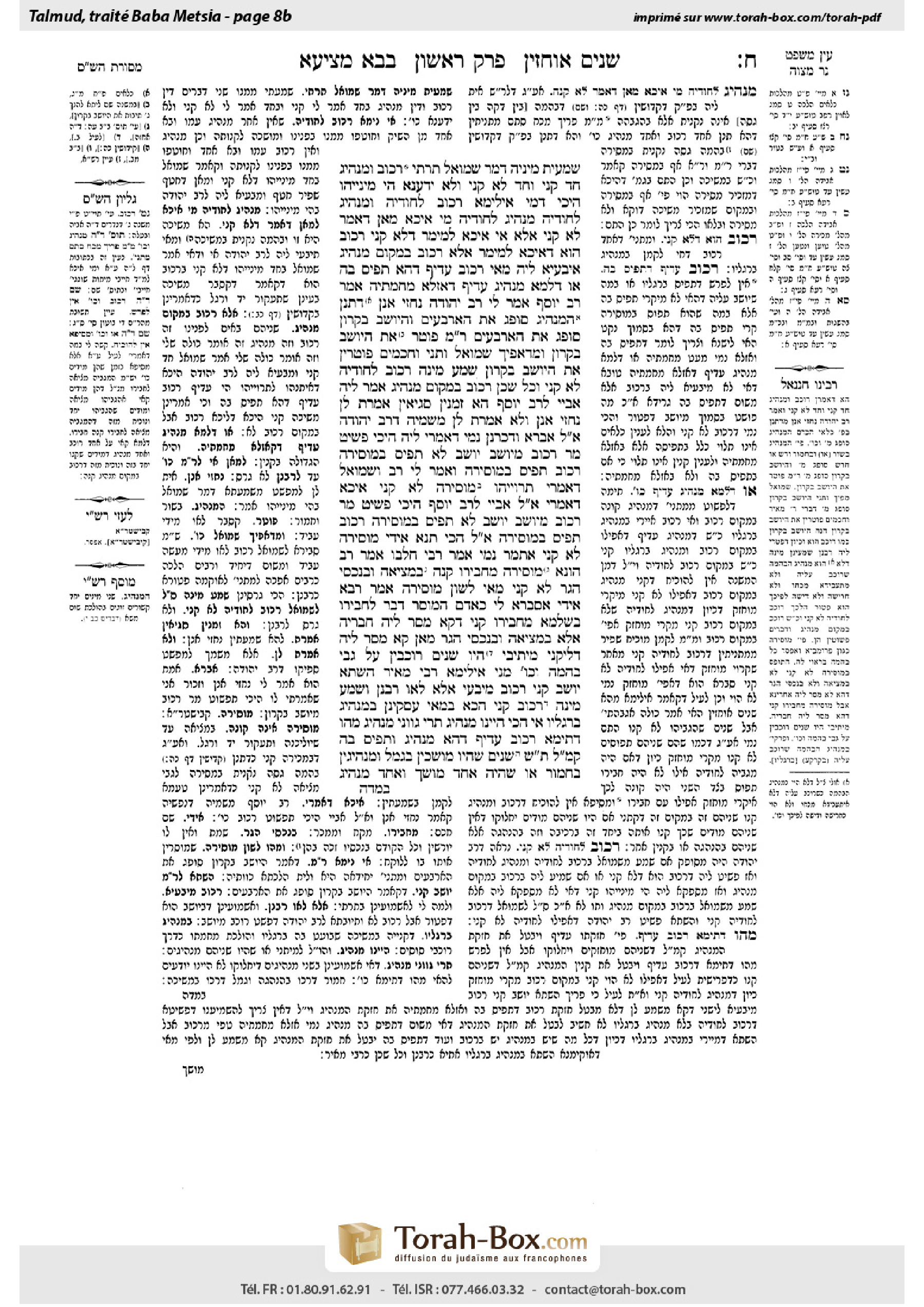
Bava Metzia 8b: Talmud study for Daf Yomi
Study the Talmud for Daf Yomi with scanned pages, Hebrew text, English translations from Sefaria and AI-generated French translations.
Passage selection and English or AI-generated French translation are available where the scan has annotations. Daf Study is independent of Torah-Box and Sefaria.
Browse Bava Metzia · בבא מציעא · All tractatesBava Metzia 8b text and translations
This page of Bava Metzia includes the Aramaic text, an English translation and an AI-generated French translation, alongside the scan above.
בבא מציעא ח׳ ב · Aramaic and Hebrew text
שְׁמַעִית מִינֵּיהּ דְּמָר שְׁמוּאֵל תַּרְתֵּי: רָכוּב וּמַנְהִיג, חַד קָנֵי וְחַד לָא קָנֵי. וְלָא יָדַעְנָא הֵי מִינַּיְיהוּ.
הֵיכִי דָמֵי? אִילֵּימָא רָכוּב לְחוֹדֵיהּ וּמַנְהִיג לְחוֹדֵיהּ – מַנְהִיג לְחוֹדֵיהּ מִי אִיכָּא מַאן דְּאָמַר לָא קָנֵי? אֶלָּא אִי אִיכָּא לְמֵימַר דְּלָא קָנֵי – רָכוּב הוּא דְּאִיכָּא לְמֵימַר.
אֶלָּא רָכוּב בִּמְקוֹם מַנְהִיג אִיבַּעְיָא לֵיהּ. מַאי: רָכוּב עָדִיף – דְּהָא תָּפֵיס בַּהּ, אוֹ דִלְמָא מַנְהִיג עָדִיף – דְּאָזְלָא מֵחֲמָתֵיהּ?
אָמַר רַב יוֹסֵף, אָמַר לִי רַב יְהוּדָה: נֶחְזֵי אֲנַן, דִּתְנַן: הַמַּנְהִיג סוֹפֵג אֶת הָאַרְבָּעִים, וְהַיּוֹשֵׁב בַּקָּרוֹן סוֹפֵג אֶת הָאַרְבָּעִים. רַבִּי מֵאִיר פּוֹטֵר אֶת הַיּוֹשֵׁב בַּקָּרוֹן.
וּמִדְּאָפֵיךְ שְׁמוּאֵל וְתָנֵי: וַחֲכָמִים פּוֹטְרִין אֶת הַיּוֹשֵׁב בַּקָּרוֹן, שְׁמַע מִינַּהּ רָכוּב לְחוֹדֵיהּ לָא קָנֵי, וְכׇל שֶׁכֵּן רָכוּב בִּמְקוֹם מַנְהִיג.
אֲמַר לֵיהּ אַבָּיֵי לְרַב יוֹסֵף: הָא זִמְנִין סַגִּיאִין אֲמַרְתְּ לַן: נֶחְזֵי אֲנַן, וְלָא אֲמַרְתְּ לַן מִשְּׁמֵיהּ דְּרַב יְהוּדָה.
אֲמַר לֵיהּ: אִבְרָא! וּדְכִירְנָא נָמֵי דַּאֲמַרִי לֵיהּ: הֵיכִי פָּשֵׁיט מָר רָכוּב מִיּוֹשֵׁב? יוֹשֵׁב לָא תָּפֵיס בְּמוֹסֵירָה, רָכוּב תָּפֵיס בְּמוֹסֵירָה! וַאֲמַר לִי רַב וּשְׁמוּאֵל דְּאָמְרִי תַּרְוַיְיהוּ: מוֹסֵירָה לָא קָנֵי.
אִיכָּא דְאָמְרִי, אֲמַר לֵיהּ אַבָּיֵי לְרַב יוֹסֵף: הֵיכִי פָּשֵׁיט מָר רָכוּב מִיּוֹשֵׁב? יוֹשֵׁב לָא תָּפֵיס בְּמוֹסֵירָה, רָכוּב תָּפֵיס בְּמוֹסֵירָה! אֲמַר לֵיהּ, הָכִי תְּנָא אִידֵּי: מוֹסֵירָה לָא קָנֵי.
אִתְּמַר נָמֵי, אָמַר רַבִּי חֶלְבּוֹ אָמַר רַב הוּנָא: מוֹסֵירָה מֵחֲבֵירוֹ – קָנָה. בִּמְצִיאָה וּבְנִכְסֵי הַגֵּר – לָא קָנֵי.
מַאי לְשׁוֹן מוֹסֵירָה? אָמַר רָבָא: אִידִי אַסְבְּרָא לִי כְּאָדָם הַמּוֹסֵר דָּבָר לַחֲבֵירוֹ. בִּשְׁלָמָא מֵחֲבֵירוֹ קָנֵי, דְּקָא מָסַר לֵיהּ חַבְרֵיהּ. אֶלָּא בִּמְצִיאָה וּבְנִכְסֵי הַגֵּר מַאן קָא מָסַר לֵיהּ דְּלִיקְנֵי?
מֵיתִיבִי: הָיוּ שְׁנַיִם רוֹכְבִין עַל גַּבֵּי בְּהֵמָה וְכוּ׳. מַנִּי? אִילֵימָא רַבִּי מֵאִיר – הַשְׁתָּא יוֹשֵׁב קָנֵי, רָכוּב מִיבְּעֵי?! אֶלָּא לָאו רַבָּנַן, וּשְׁמַע מִינַּהּ רָכוּב קָנֵי.
הָכָא בְּמַאי עָסְקִינַן – בְּמַנְהִיג בְּרַגְלָיו. אִי הָכִי, הַיְינוּ מַנְהִיג! תְּרֵי גַּוְונֵי מַנְהִיג, מַהוּ דְּתֵימָא: רָכוּב עָדִיף, דְּהָא מַנְהִיג וְתָפֵיס בַּהּ, קָא מַשְׁמַע לַן.
תָּא שְׁמַע: שְׁנַיִם שֶׁהָיוּ מוֹשְׁכִין בְּגָמָל, וּמַנְהִיגִין בַּחֲמוֹר, אוֹ שֶׁהָיָה אֶחָד מוֹשֵׁךְ וְאֶחָד מַנְהִיג,
Bava Metzia 8b · English translation
I heard two halakhot from Master Shmuel, one halakha with regard to one who sits in a riding position on an animal, and the other halakha with regard to one who leads an animal. With regard to one case I heard that he thereby acquires the animal, and with regard to the other one I heard that he does not acquire the animal. But I do not know which halakha applies to which of them.
The Gemara asks: What are the circumstances? If we say that this is referring to one who sits in a riding position alone and to one who leads alone, is there anyone who says that one who leads an animal alone does not acquire it? Pulling an item, or leading an animal, is a classic mode of acquisition (see Kiddushin 25b). Rather, if there is a case where it could be said that one does not acquire the animal, it is obviously in the case of one who sits in a riding position that it could be said. Therefore, why was Rav Yehuda uncertain?
The Gemara answers: Rather, his dilemma was with regard to a case where one sits in a riding position on the animal while another leads it. What is the halakha? Which of them acquires the animal? Does the one sitting in a riding position on the animal take precedence, as the animal is in his grasp, since his legs are grasping the sides of the animal, or perhaps the one leading the animal takes precedence, as it walks because of him?
Rav Yosef said: Rav Yehuda said to me: Although I do not remember what Shmuel said, let us see if we can analyze this ourselves, as we learned in a mishna concerning the prohibition against leading animals of diverse kinds (Kilayim 8:3): If two animals of diverse kinds, e.g., a horse and a donkey, are harnessed to the same wagon, the one leading the animals incurs the forty lashes for transgressing the Torah prohibition: “You shall not plow with an ox and a donkey together” (Deuteronomy 22:10), and the one sitting in the wagon [bakaron] also incurs the forty lashes. Rabbi Meir deems the one sitting in the wagon exempt, as he did not perform any action.
And from the fact that in his version of the mishna Shmuel reversed the opinions and taught: And the Rabbis deem the one sitting in the wagon exempt, it can be inferred that he agrees with this opinion that the one sitting in the wagon is considered to have not performed any action, as the halakha is in accordance with the opinion of the Rabbis in their disputes with Rabbi Meir. Conclude from it that one who sits on an animal alone does not acquire it, as sitting on an animal is not considered a significant action, and all the more so one who sits on an animal while another leads the animal does not acquire the animal.
Abaye said to Rav Yosef: Didn’t you say to us many times with regard to this halakha: Let us see if we can analyze this ourselves, followed by the proof from the aforementioned mishna? And you did not say to us that this statement was in the name of Rav Yehuda. Rav Yosef had an illness that caused him memory loss. Consequently, some of his later statements of halakha were inaccurate, and Abaye suspected that he attributed this statement to Rav Yehuda erroneously.
Rav Yosef said to him: Indeed [ivra], I remember that Rav Yehuda stated this proof, and I also remember that I said to him in response: How can the Master resolve the case of one who sits on an animal via proof from the case of one who sits in the wagon? One who sits in the wagon does not hold the reins, whereas one who sits on the animal holds the reins. And Rav Yehuda said to me in response: Rav and Shmuel both say that holding the reins of an ownerless animal does not effect acquisition of it. Consequently, there is no difference between sitting on an animal and sitting in a wagon drawn by an animal.
There are those who say that the exchange between Abaye and Rav Yosef was as follows: Abaye said to Rav Yosef: How can the Master resolve the case of one who sits on an animal via proof from the case of one who sits in the wagon? One who sits in the wagon does not hold the reins, whereas one who sits on the animal holds the reins. Rav Yosef said to him: Idi taught in a baraita like this: Holding the reins of an ownerless animal does not effect acquisition of it.
It was also stated that Rabbi Ḥelbo says that Rav Huna says: With regard to holding the reins of an animal in order to acquire it, if he is attempting to acquire it from another person, he acquires the animal. But with regard to acquisition of a found animal, or with regard to acquisition of an animal that was the property of a convert who died without heirs, leaving his property ownerless, it does not effect acquisition.
The Gemara explains: What is the meaning of the term reins [moseira]? Rava said: Idi explained to me that they are used like a person who transmits [moser] an item to another, i.e., they are used to transfer the ownership of the animal. Granted, in a case where one takes the reins from another, this effects acquisition of the animal, as the other person hands them to him. But in a case of a found animal or of one that was the property of a convert, who is handing him the reins, enabling him to acquire the ownerless animal? Since there was no transaction, one cannot acquire the animal by merely holding the reins.
The Gemara raises an objection from the mishna: If two people were sitting in a riding position on an animal, or if one was sitting on it in a riding position and the other was leading it, they divide it after taking an oath. In accordance with whose opinion is this mishna? If we say that it is in accordance with the opinion of Rabbi Meir, now, in his opinion, even one who sits in a wagon acquires the animal that is pulling the wagon. Is it necessary to state that one who sits in a riding position on an animal acquires it? Rather, is it not the opinion of the Rabbis? And learn from it that one who sits in a riding position on an animal acquires it.
The Gemara answers: With what are we dealing here? We are dealing with a case where the one sitting on the animal also leads, i.e., drives it by squeezing or kicking it with his legs. The Gemara asks: If so, this is the same as leading the animal by pulling the reins, as the essential factor in both is that one causes the animal to move, so why does the mishna need to mention it? The Gemara answers: The tanna teaches two types of leading, both pulling the animal by the reins and driving it while sitting on it. Lest you say that one who is sitting in a riding position on the animal takes precedence, as he is both leading the animal and also holding it by the reins, the tanna teaches us that the claim of the one sitting in a riding position on the animal is not stronger than the claim of the one leading it by the reins.
Come and hear a different proof from a baraita: With regard to two people who were pulling a camel or driving a donkey together, or one who was pulling it and one who was driving it,
Bava Metzia 8b · Traduction française (IA)
J'ai entendu deux halakhot du Maître Shmuel, l'une concernant celui qui monte à cheval sur un animal, et l'autre concernant celui qui conduit un animal. Dans l'un des cas, j'ai entendu qu'il acquiert l'animal, et dans l'autre, qu'il ne l'acquiert pas. Mais je ne sais pas quelle halakha s'applique à quel cas.
Le Guemara pose la question : Quelles sont les circonstances ? Si nous disons que cela concerne celui qui monte seul et celui qui conduit seul, y a-t-il quelqu'un qui affirme que celui qui conduit un animal seul ne l'acquiert pas ? Tirer un objet ou conduire un animal est un mode classique d'acquisition (voir Kiddushin 25b). En revanche, si un cas pourrait être dit où l'on ne peut pas acquérir l'animal, c'est évidemment dans le cas de celui qui monte seul que cela pourrait être dit. Pourquoi donc Rav Yehuda était-il incertain ?
Le Guemara répond : En réalité, son dilemme concernait un cas où l'on monte sur l'animal tandis que l'autre le conduit. Quelle est la halakha ? Qui acquiert l'animal ? Le monteur, car l'animal est en son pouvoir, car ses jambes tiennent les côtés de l'animal, ou peut-être le conducteur, car l'animal marche à cause de lui ?
Rav Yosef dit : Rav Yehuda me dit : Bien que je ne me souvienne pas de ce que Shmuel a dit, voyons si nous pouvons analyser cela nous-mêmes, comme nous avons appris dans une mitsna concernant l'interdiction de conduire des animaux de différentes espèces (Kilayim 8:3) : Si deux animaux de différentes espèces, par exemple un cheval et un âne, sont attelés à la même charrette, celui qui conduit les animaux est puni de quarante coups pour avoir transgressé l'interdiction divine : « Tu ne bêneras pas un bœuf et un âne ensemble » (Deutéronome 22:10), et celui qui est assis sur la charrette [bakaron] est également puni de quarante coups. Rabbi Meir considère celui qui est assis sur la charrette comme exempt, car il n'a pas accompli d'action.
Et du fait que dans sa version de la mitsna, Shmuel a inversé les opinions et a enseigné : Et les Rabbins considèrent celui qui est assis sur la charrette comme exempt, on peut en déduire qu'il s'accorde avec cette opinion selon laquelle celui qui est assis sur la charrette n'a pas accompli d'action, car la halakha suit l'opinion des Rabbins dans leurs débats avec Rabbi Meir. En conclure que celui qui monte seul sur un animal ne l'acquiert pas, car monter sur un animal n'est pas considéré comme une action significative, et encore plus celui qui monte sur un animal tandis que l'autre le conduit ne l'acquiert pas.
Abaye dit à Rav Yosef : N'as-tu pas dit à plusieurs reprises à ce sujet : Voyons si nous pouvons analyser cela nous-mêmes, suivi de la preuve tirée de la mitsna mentionnée plus haut ? Et tu n'as pas dit à nous que cette déclaration était en nom de Rav Yehuda. Rav Yosef souffrait d'une maladie qui causait une perte de mémoire. En conséquence, certains de ses propos ultérieurs concernant la halakha étaient inexactes, et Abaye soupçonnait qu'il attribuait cette déclaration à Rav Yehuda à tort.
Rav Yosef dit à lui : En effet [ivra], je me souviens que Rav Yehuda a énoncé cette preuve, et je me souviens également que j'ai répondu à lui en disant : Comment le Maître peut-il résoudre le cas de celui qui monte sur un animal à l'aide de la preuve tirée du cas de celui qui est assis sur la charrette ? Celui qui est assis sur la charrette ne tient pas les rênes, tandis que celui qui monte sur l'animal tient les rênes. Et Rav Yehuda a répondu à moi en disant : Rav et Shmuel disent tous les deux que tenir les rênes d'un animal sans propriétaire ne produit pas l'acquisition de celui-ci. Par conséquent, il n'y a pas de différence entre monter sur un animal et être assis sur une charrette attelée.
Certains disent que l'échange entre Abaye et Rav Yosef était comme suit : Abaye dit à Rav Yosef : Comment le Maître peut-il résoudre le cas de celui qui monte sur un animal à l'aide de la preuve tirée du cas de celui qui est assis sur la charrette ? Celui qui est assis sur la charrette ne tient pas les rênes, tandis que celui qui monte sur l'animal tient les rênes. Rav Yosef dit à lui : Idi a enseigné dans une baraïta comme suit : Tenir les rênes d'un animal sans propriétaire ne produit pas l'acquisition de celui-ci.
Il a également été dit que Rabbi Ḥelbo dit que Rav Huna dit : Concernant le fait de tenir les rênes d'un animal afin d'acquérir celui-ci, s'il tente d'acquérir celui-ci à partir d'une autre personne, il acquiert l'animal. Mais concernant l'acquisition d'un animal trouvé ou d'un animal qui était la propriété d'un converti décédé sans héritiers, laissant son propriété sans propriétaire, cela ne produit pas l'acquisition.
Le Guemara explique : Quelle est la signification du terme rênes [moseira] ? Rava dit : Idi m'a expliqué que ce sont des rênes utilisées comme un homme qui transmet [moser] un objet à un autre, c'est-à-dire qu'elles sont utilisées pour transférer la propriété de l'animal. En effet, dans le cas où l'on prend les rênes d'une autre personne, cela produit l'acquisition de l'animal, car la personne lui transmet les rênes. Mais dans le cas d'un animal trouvé ou d'un animal qui était la propriété d'un converti, qui lui transmet les rênes, permettant ainsi d'acquérir l'animal sans propriétaire, puisque il n'y a pas de transaction, on ne peut pas acquérir l'animal simplement en tenant les rênes.
Le Guemara soulève un objet d'après la mitsva : Si deux personnes étaient assises en montant sur un animal, ou si l'une était assise en montant et l'autre le conduisait, ils divisent l'animal après avoir pris serment. Selon l'opinion de qui est-ce que cette mitsva ? Si nous disons qu'elle suit l'opinion de Rabbi Meir, maintenant, selon son opinion, même celui qui est assis sur la charrette acquiert l'animal qui tire la charrette. Il est donc inutile de dire que celui qui monte sur l'animal acquiert celui-ci. En revanche, n'est-ce pas l'opinion des Rabbins ? Et apprendre-en que celui qui monte sur l'animal acquiert celui-ci.
La Guemara répond : De quoi sommes-nous en train de parler ? Nous parlons d’un cas où la personne assise sur l’animal le guide également, c’est-à-dire qu’il le fait avancer en le poussant ou en le frappant avec ses jambes. La Guemara demande : Si c’est ainsi, cela est identique à la conduite de l’animal par la bride, puisque le facteur essentiel dans les deux cas est que l’on fait avancer l’animal, donc pourquoi la mitsna doit-elle mentionner cela ? La Guemara répond : La tanna enseigne deux types de conduite, l’un consistant à tirer l’animal par la bride et l’autre à le faire avancer en étant assis dessus. De peur que l’on dise que celui qui est assis en position de monture a la priorité, car il guide l’animal et le tient également par la bride, la tanna nous apprend que la revendication de celui qui est assis en position de monture n’est pas plus forte que celle de celui qui le guide par la bride.
Venez écouter une autre preuve tirée d’une baraïta : En ce qui concerne deux personnes qui tiraient un chameau ou faisaient avancer un âne ensemble, ou l’une qui tirait et l’autre qui le faisait avancer,
Traduction française générée par IA à partir de l’édition anglaise de Sefaria. Vérifie toujours un passage avec le texte source.
Text from Sefaria: William Davidson Edition - Vocalized Aramaic (CC BY NC); William Davidson Edition - English (CC BY NC).