Bava Metzia 9a: Talmud study for Daf Yomi
Study the Talmud for Daf Yomi with scanned pages, Hebrew text, English translations from Sefaria and AI-generated French translations.
Passage selection and English or AI-generated French translation are available where the scan has annotations. Daf Study is independent of Torah-Box and Sefaria.
Browse Bava Metzia · בבא מציעא · All tractatesBava Metzia 9a text and translations
This page of Bava Metzia includes the Aramaic text, an English translation and an AI-generated French translation, alongside the scan above.
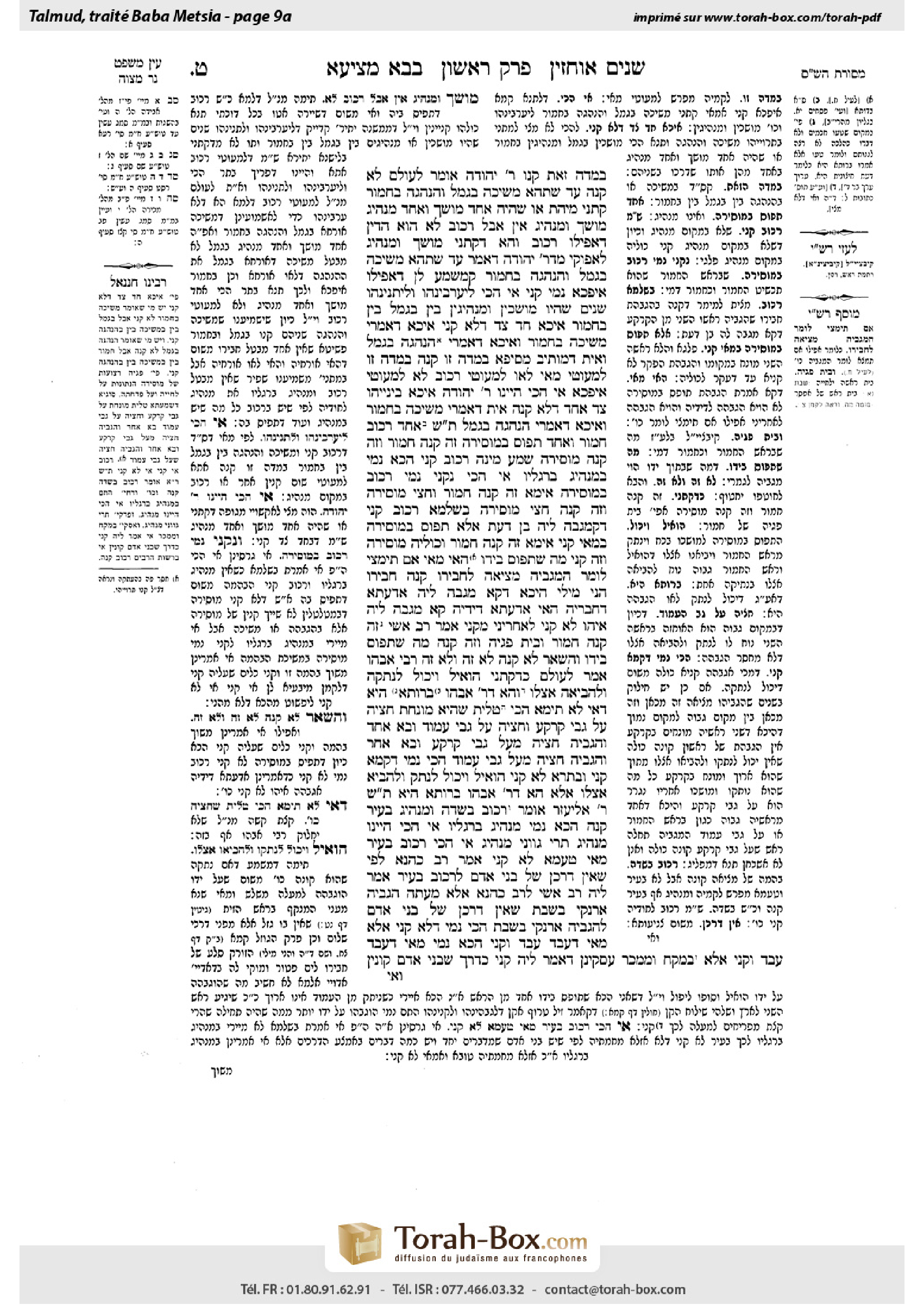
בבא מציעא ט׳ א · Aramaic and Hebrew text
בְּמִדָּה זֹאת קָנוּ. רַבִּי יְהוּדָה אוֹמֵר: לְעוֹלָם לֹא קָנָה עַד שֶׁתְּהֵא מְשִׁיכָה בְּגָמָל וְהַנְהָגָה בַּחֲמוֹר.
קָתָנֵי מִיהַת: אוֹ שֶׁהָיָה אֶחָד מוֹשֵׁךְ וְאֶחָד מַנְהִיג, מוֹשֵׁךְ וּמַנְהִיג – אִין. אֲבָל רָכוּב לָא!
הוּא הַדִּין דַּאֲפִילּוּ רָכוּב, וְהָא דְּקָתָנֵי מוֹשֵׁךְ וּמַנְהִיג – לְאַפּוֹקֵי מִדְּרַבִּי יְהוּדָה דְּאָמַר: עַד שֶׁתְּהֵא מְשִׁיכָה בְּגָמָל וְהַנְהָגָה בַּחֲמוֹר, קָמַשְׁמַע לַן דַּאֲפִילּוּ אִיפְּכָא נָמֵי קָנֵי.
אִי הָכִי, לִיעָרְבִינְהוּ וְלִתְנִינְהוּ: שְׁנַיִם שֶׁהָיוּ מוֹשְׁכִין וּמַנְהִיגִין בֵּין בְּגָמָל בֵּין בַּחֲמוֹר!
אִיכָּא חַד צַד דְּלָא קָנֵי: אִיכָּא דְּאָמְרִי מְשִׁיכָה בַּחֲמוֹר, וְאִיכָּא דְּאָמְרִי הַנְהָגָה בְּגָמָל.
וְאִית דְּמוֹתֵיב מִסֵּיפָא: בְּמִדָּה זוֹ קָנָה. ״בְּמִדָּה זוֹ״ לְמַעוֹטֵי מַאי? לָאו לְמַעוֹטֵי רָכוּב?! לָא, לְמַעוֹטֵי אִיפְּכָא.
אִי הָכִי, הַיְינוּ רַבִּי יְהוּדָה! אִיכָּא בֵּינַיְיהוּ צַד אֶחָד דְּלֹא קָנָה: אִית דְּאָמְרִי מְשִׁיכָה בַּחֲמוֹר, וְאִיכָּא דְּאָמְרִי הַנְהָגָה בְּגָמָל.
תָּא שְׁמַע: אֶחָד רָכוּב חֲמוֹר וְאֶחָד תָּפוּס בְּמוֹסֵירָה – זֶה קָנָה חֲמוֹר, וְזֶה קָנָה מוֹסֵירָה. שְׁמַע מִינַּהּ: רָכוּב קָנֵי!
הָכָא נָמֵי בְּמַנְהִיג בְּרַגְלָיו. אִי הָכִי, נִקְנֵי נָמֵי רָכוּב בְּמוֹסֵירָה! אֵימָא: זֶה קָנָה חֲמוֹר וַחֲצִי מוֹסֵירָה, וְזֶה קָנָה חֲצִי מוֹסֵירָה.
בִּשְׁלָמָא רָכוּב קָנֵי, דְּקָמַגְבַּהּ לֵיהּ בֶּן דַּעַת. אֶלָּא תָּפוּס בְּמוֹסֵירָה בְּמַאי קָנֵי?
אֵימָא: זֶה קָנָה חֲמוֹר וְכוּלֵּיהּ מוֹסֵירָה, וְזֶה קָנָה מַה שֶּׁתָּפוּס בְּיָדוֹ.
הַאי מַאי?! אִם תִּימְצֵי לוֹמַר הַמַּגְבִּיהַּ מְצִיאָה לַחֲבֵירוֹ קָנָה חֲבֵירוֹ – הָנֵי מִילֵּי הֵיכָא דְּקָא מַגְבַּהּ לֵיהּ אַדַּעְתָּא דְּחַבְרֵיהּ. הַאי אַדַּעְתָּא דִּידֵיהּ קָא מַגְבַּהּ לֵיהּ: אִיהוּ לָא קָנֵי, לְאַחֲרִינֵי מַקְנֵי?!
אָמַר רַב אָשֵׁי: זֶה קָנָה חֲמוֹר וּבֵית פַּגֶּיהָ, וְזֶה קָנָה מַה שֶׁתָּפוּס בְּיָדוֹ – וְהַשְּׁאָר לֹא קָנָה, לֹא זֶה וְלֹא זֶה.
רַבִּי אֲבָהוּ אָמַר: לְעוֹלָם כִּדְקָתָנֵי – הוֹאִיל וְיָכוֹל לְנַתְּקָהּ וְלַהֲבִיאָהּ אֶצְלוֹ.
וְהָא דְּרַבִּי אֲבָהוּ בְּרוּתָא הִיא, דְּאִי לָא תֵּימָא הָכִי: טַלִּית שֶׁהִיא מוּנַּחַת חֶצְיָהּ עַל גַּבֵּי קַרְקַע וְחֶצְיָהּ עַל גַּבֵּי עַמּוּד, וּבָא אֶחָד וְהִגְבִּיהַּ חֶצְיָהּ מֵעַל גַּבֵּי קַרְקַע וּבָא אַחֵר וְהִגְבִּיהַּ חֶצְיָהּ מֵעַל גַּבֵּי עַמּוּד, הָכִי נָמֵי דְּקַמָּא קָנֵי וּבָתְרָא לָא קָנֵי, הוֹאִיל וְיָכוֹל לְנַתְּקָ[הּ] וְלַהֲבִיאָ[הּ] אֶצְלוֹ?! אֶלָּא הָא דְּרַבִּי אֲבָהוּ בְּרוּתָא הִיא.
תָּא שְׁמַע, רַבִּי אֱלִיעֶזֶר אוֹמֵר: רָכוּב בַּשָּׂדֶה וּמַנְהִיג בָּעִיר – קָנָה! הָכָא נָמֵי מַנְהִיג בְּרַגְלָיו. אִי הָכִי, הַיְינוּ מַנְהִיג! תְּרֵי גַּוְונֵי מַנְהִיג.
אִי הָכִי, רָכוּב בָּעִיר מַאי טַעְמָא לָא קָנֵי? אָמַר רַב כָּהֲנָא: לְפִי שֶׁאֵין דַּרְכָּן שֶׁל בְּנֵי אָדָם לִרְכּוֹב בָּעִיר.
אֲמַר לֵיהּ רַב אָשֵׁי לְרַב כָּהֲנָא: אֶלָּא מֵעַתָּה, הִגְבִּיהַּ אַרְנָקִי בְּשַׁבָּת, שֶׁאֵין דַּרְכָּן שֶׁל בְּנֵי אָדָם לְהַגְבִּיהַּ אַרְנָקִי בְּשַׁבָּת, הָכִי נָמֵי דְּלָא קָנֵי? אֶלָּא מַאי דַּעֲבַד – עֲבַד, וְקָנֵי, הָכָא נָמֵי מַאי דַּעֲבַד – עֲבַד, וּקְנִי.
אֶלָּא בְּמִקָּח וּמִמְכָּר עָסְקִינַן, דַּאֲמַר לֵיהּ: קְנֵי כְּדֶרֶךְ שֶׁבְּנֵי אָדָם קוֹנִין.
Bava Metzia 9a · English translation
they have both acquired the animal in that manner. Rabbi Yehuda says: Actually, one acquires an animal only through pulling in the case of a camel or driving in the case of a donkey, as that is the manner in which they are normally directed.
In any event, it is taught in the baraita: Or one who was pulling and one who was driving, which indicates that pulling and driving are indeed effective modes of acquisition, but sitting in a riding position on an animal is not.
The Gemara rejects this inference: The same is true with regard to even sitting in a riding position on an animal; it is an effective mode of acquisition. And the reason that the baraita teaches specifically the modes of pulling and driving is only to exclude the opinion of Rabbi Yehuda, who says that one acquires an animal only through pulling in the case of a camel or driving in the case of a donkey. Therefore, the first tanna teaches us that even in the opposite manner, i.e., pulling a donkey or driving a camel, one acquires the animal.
The Gemara asks: If that is so, then let the first tanna combine the cases and teach them as follows: With regard to two people who were pulling or driving either a camel or a donkey, they each acquire the respective animal. The fact that this wording is not used indicates that the first tanna does not entirely disagree with Rabbi Yehuda.
The Gemara modifies its response: There is one manner of acquisition by which the first tanna concedes to Rabbi Yehuda that one does not acquire the animal if one employs it, and it is unclear what manner that is. Some say that by pulling a donkey one does not acquire it, as donkeys tend to not move at all when being pulled, and some say that by driving a camel one does not acquire it, as that is not the common way to move it.
And according to an alternative version of this discussion, there are those who raise an objection to the opinion that one can acquire an animal by sitting on it in a riding position from the latter clause of the statement of the first tanna in the baraita: They acquire the animal in that manner. The phrase in that manner is stated to exclude what? Is it not to exclude one who sits in a riding position on the animal? The Gemara answers: No, it is stated to exclude the opposite cases: One who drives a camel or pulls a donkey does not acquire the animal.
The Gemara asks: If so, that is identical to the opinion of Rabbi Yehuda. The Gemara answers: There is a practical difference between them with regard to one manner of acquisition in which one does not acquire the animal. Some say that according to the first tanna, by pulling a donkey one does not acquire it, and some say that by driving a camel one does not acquire it.
Come and hear proof from a baraita that one can acquire an animal by sitting on it in a riding position: If one person is sitting in a riding position on a donkey and one other person is holding the reins, this one, the one sitting on the donkey, acquires the donkey, and that one, who is holding the reins, acquires the reins. Learn from it that one who sits in a riding position on an animal acquires it.
The Gemara rejects this: Here too, the reference is to one who is not only sitting on the donkey but who is also driving it with his feet by squeezing or kicking it. The Gemara asks: If so, the one who is sitting should acquire part of the reins too. The fact that he does not acquire the reins indicates that his acquisition of the donkey is imperfect, which would not be the case if he were driving it. The Gemara answers: Emend the text and say: This one acquires the donkey and half of the reins, and that one acquires half of the reins.
The Gemara asks: Granted, the one sitting on the donkey acquires half of the reins because a mentally competent person, the one holding the reins, has lifted it for him, but in what manner does the one holding the reins acquire half the reins? The other end of the reins is attached to the donkey, and because he does not acquire the donkey he cannot acquire the reins.
The Gemara answers: Emend the text and say: This one, the one sitting on the donkey, acquires the donkey and almost the entire reins, and that one, who is holding the reins, acquires only the part of the reins that is actually held in his hand.
The Gemara asks: What is the basis for this understanding? Even if you say that in a case of one who performs an act of acquisition by lifting a found item on behalf of another, the other person, i.e., the latter, acquires ownership of the item, that statement applies only in a case where one lifts an item with the intention that another person will acquire it. In the case here, this person who is holding the reins is lifting them with the intention of acquiring them for himself. Since he himself does not acquire them, how can he acquire them for others?
Rav Ashi said: Emend the baraita and say: This one, who is sitting on the donkey and driving it, acquires the donkey and its halter, which is attached to its head; and that one, who is holding the reins, acquires only the part that is held in his hand. And with regard to the rest, the part of the reins that is neither attached to the donkey’s head nor held in the person’s hand, neither this one nor that one has acquired it.
Rabbi Abbahu said: Actually, do not emend the baraita; leave it as it is taught. The one holding the reins acquires them because he can detach them from the donkey and bring them toward himself. Since he is able to pull the reins into his possession, they are considered his even though he does not lift them.
The Gemara comments: And this statement of Rabbi Abbahu is an error. As, if you do not say so, but instead accept Rabbi Abbahu’s opinion, that would result in an incorrect halakhic ruling in the case of a garment, half of which was lying on the ground and half of which was lying on a pillar, and one came and lifted the half of it that was on the ground off the ground, and another person came and lifted the other half of it off the pillar. In that case, should one also rule that the first one acquires the garment and the latter one does not acquire it, since the first one was able to detach it from the pillar and bring the entire garment toward him? That is certainly not the halakha. Rather, clearly this statement of Rabbi Abbahu is an error. In any event, the question of whether one can acquire an animal by sitting on it in a riding position remains unresolved.
The Gemara suggests: Come and hear an additional proof from a baraita: Rabbi Eliezer says: If one sits on an animal in the field or leads an animal in the city, he acquires it. This proves that one can acquire an animal by sitting on it. The Gemara rejects this proof: Here too, the reference is to one who leads, i.e., drives, the animal with his feet. The Gemara asks: If so, that is the same as leading the animal. Why would the baraita mention the same case twice? The Gemara answers: The baraita is discussing two types of leading.
The Gemara asks: If that is so, what is the reason that one who sits on an animal in the city does not acquire it? Rav Kahana said: It is because people do not normally ride in the city, as it is crowded.
Rav Ashi said to Rav Kahana: If that is so, that by means of an unusual action one cannot effect an acquisition, then if one lifted a purse that he found on Shabbat, has he also not acquired it, since people do not normally lift a purse on Shabbat due to the prohibition of set-aside [muktze]? That is clearly not the halakha. Rather, how should one rule in that case? What he did, he did, and he acquires the purse. Here too, if one sat on an animal in the city, what he did, he did, and he acquires the animal.
Rather, the baraita is not referring to the case of a found animal, which one can acquire even by sitting on it in the city. In fact, we are dealing with a case of buying and selling an animal, where the seller said to the buyer: Acquire the animal the way that people normally acquire an animal. Therefore, the buyer cannot acquire it in the city by sitting on it.
Bava Metzia 9a · Traduction française (IA)
ils ont tous deux acquis l'animal de cette manière. Rabbi Yéhuda dit : En réalité, on acquiert un animal uniquement en le tirant dans le cas d'un chameau ou en le guidant dans le cas d'un âne, car c'est ainsi qu'ils sont normalement dirigés.
En tout cas, il est enseigné dans la baraïta : Ou celui qui tirait et celui qui guidait, ce qui indique que tirer et guider sont effectivement des modes d'acquisition efficaces, mais s'asseoir en position de monture sur un animal ne l'est pas.
La Guemara rejette cette déduction : C'est également le cas pour s'asseoir en position de monture sur un animal ; c'est un mode d'acquisition efficace. Et la raison pour laquelle la baraïta enseigne spécifiquement les modes de tirage et de guidage est uniquement pour exclure l'opinion de Rabbi Yéhuda, qui dit qu'on acquiert un animal uniquement en le tirant dans le cas d'un chameau ou en le guidant dans le cas d'un âne. Ainsi, le premier tanna nous apprend que même dans le cas contraire, c'est-à-dire en tirant un âne ou en guidant un chameau, on acquiert l'animal.
La Guemara pose la question : Si c'est ainsi, alors que le premier tanna combine les cas et enseigne ainsi : Concernant deux personnes qui tiraient ou guidaient soit un chameau soit un âne, chacun acquiert l'animal correspondant. Le fait que ce mode de formulation ne soit pas utilisé indique que le premier tanna ne s'oppose pas entièrement à l'opinion de Rabbi Yéhuda.
La Guemara modifie sa réponse : Il existe un mode d'acquisition par lequel le premier tanna reconnaît à Rabbi Yéhuda que l'on ne peut pas acquérir l'animal si l'on l'utilise, et il est unclear quel est ce mode. Certains disent que tirer un âne ne permet pas d'acquérir l'animal, car les ânes ne bougent pas du tout lorsqu'ils sont tirés, et d'autres disent que guider un chameau ne permet pas d'acquérir l'animal, car ce n'est pas la manière habituelle de le faire.
Et selon une version alternative de cette discussion, il y a ceux qui soulèvent une objection contre l'opinion selon laquelle on peut acquérir un animal en s'asseyant en position de monture sur lui à partir de la dernière partie de l'affirmation du premier tanna dans la baraïta : Ils acquièrent l'animal de cette manière. La phrase « de cette manière » est utilisée pour exclure quoi ? N'est-ce pas pour exclure celui qui s'assoit en position de monture sur l'animal ? La Guemara répond : Non, elle est utilisée pour exclure les cas opposés : celui qui guide un chameau ou qui tire un âne ne peut pas acquérir l'animal.
La Guemara pose la question : Si c'est ainsi, cela correspond à l'opinion de Rabbi Yéhuda. La Guemara répond : Il existe une différence pratique entre eux concernant un mode d'acquisition dans lequel on ne peut pas acquérir l'animal. Certains disent que selon le premier tanna, tirer un âne ne permet pas d'acquérir l'animal, et d'autres disent que guider un chameau ne permet pas d'acquérir l'animal.
Venez écouter une preuve tirée d'une baraïta : On peut acquérir un animal en s'asseyant sur lui en position de monture. Si une personne est assise en position de monture sur un âne et une autre personne tient les rênes, celle qui est assise sur l'âne acquiert l'âne, et celle qui tient les rênes acquiert les rênes. Apprenez-en que celui qui s'assoit en position de monture sur un animal acquiert l'animal.
La Guemara rejette cela : Ici aussi, la référence est à celui qui n'est pas seulement assis sur l'âne mais qui le guide avec ses pieds en le poussant ou en le frappant. La Guemara pose la question : Si c'est ainsi, celui qui est assis devrait acquérir aussi une partie des rênes. Le fait qu'il n'acquière pas les rênes indique que son acquisition de l'âne est imparfaite, ce qui ne serait pas le cas s'il le guidait. La Guemara répond : Corrigez le texte et dites : Celui-ci acquiert l'âne et la moitié des rênes, et celui-là acquiert la moitié des rênes.
La Guemara pose la question : D'accord, celui qui est assis sur l'âne acquiert la moitié des rênes parce qu'une personne mentalement compétente, celle qui tient les rênes, l'a soulevé pour lui, mais dans quel sens celui qui tient les rênes acquiert-il la moitié des rênes ? L'autre extrémité des rênes est attachée à l'âne, et puisque celui-ci ne l'acquiert pas, il ne peut pas acquérir les rênes.
La Guemara répond : Corrigez le texte et dites : Celui-ci, celui qui est assis sur l'âne, acquiert l'âne et presque toute la longueur des rênes, et celui-là, qui tient les rênes, acquiert seulement la partie des rênes qui est effectivement tenue dans sa main.
La Guemara pose la question : Quelle est la base de cette compréhension ? Même si vous dites que dans le cas d'une action d'acquisition effectuée par le levé d'un objet trouvé au nom d'autrui, la personne, c'est-à-dire celle qui est après, acquiert la propriété de l'objet, cette affirmation s'applique uniquement dans le cas où l'on lève un objet avec l'intention que l'autre personne l'acquière. Dans le cas présent, cette personne qui tient les rênes les lève avec l'intention d'acquérir lui-même. Puisque lui-même ne les acquiert pas, comment peut-il les acquérir pour autrui ?
Rav Ashi dit : Corrigez la baraïta et dites : Celui qui est assis sur l'âne et le guide acquiert l'âne et son harnais, qui est attaché à sa tête ; et celui qui tient les rênes acquiert seulement la partie qui est tenue dans sa main. Et concernant le reste, la partie des rênes qui n'est ni attachée à la tête de l'âne ni tenue dans la main de la personne, ni celui-ci ni celui-là n'ont acquis cela.
Rabbi Abbahu dit : En réalité, ne corrigez pas la baraïta ; laissez-la telle qu'elle est enseignée. Celui qui tient les rênes les acquiert car il peut les détacher de l'âne et les ramener vers lui. Puisqu'il peut tirer les rênes vers sa possession, elles sont considérées comme étant à lui même s'il ne les lève pas.
La Guemara commente : Et cette déclaration de Rabbi Abbahu est une erreur. Car, si l'on ne dit pas cela, mais plutôt qu'on accepte l'opinion de Rabbi Abbahu, cela entraînerait une décision halakhique erronée dans le cas d'un vêtement, la moitié duquel était posée sur le sol et la moitié sur un pilier, et l'un vint et souleva la moitié qui était sur le sol du sol, et un autre vint et souleva l'autre moitié du pilier. Dans ce cas, devrait-on aussi décider que le premier acquiert le vêtement et que le second ne l'acquiert pas, puisque le premier a pu détacher le vêtement du pilier et l'amener entièrement vers lui ? Cela n'est certainement pas la halakha. Plutôt, clairement cette déclaration de Rabbi Abbahu est une erreur. En tout cas, la question de savoir si l'on peut acquérir un animal en s'y asseyant en position de monture reste indéterminée.
La Guemara suggère : Viens écouter une preuve supplémentaire tirée d'une baraïta : Rabbi Élazar dit : Si l'on s'assoit sur un animal dans le champ ou qu'on conduit un animal dans la ville, on l'acquiert. Cela prouve que l'on peut acquérir un animal en s'y asseyant. La Guemara rejette cette preuve : Ici aussi, la référence est à celui qui conduit, c'est-à-dire qui guide l'animal avec ses pieds. La Guemara demande : Si c'est ainsi, cela est identique à conduire l'animal. Pourquoi la baraïta mentionne-t-elle le même cas deux fois ? La Guemara répond : La baraïta discute de deux types de conduite.
La Guemara demande : Si c'est ainsi, quelle est la raison pour laquelle celui qui s'assoit sur un animal dans la ville ne l'acquiert pas ? Rabbi Kahana dit : C'est parce que les gens ne montent généralement pas en ville, car c'est bondé.
Rabbi Ashi dit à Rabbi Kahana : Si c'est ainsi, c'est-à-dire que par une action inhabituelle on ne peut pas accomplir une acquisition, alors si l'on soulève un sac trouvé le sabbat, a-t-on aussi l'acquisition, puisque les gens ne soulèvent généralement pas un sac le sabbat en raison de l'interdiction de muktze ? Cela n'est certainement pas la halakha. Plutôt, comment devrait-on décider dans ce cas ? Ce qu'il a fait, il l'a fait, et il acquiert le sac. Ici aussi, si l'on s'assoit sur un animal en ville, ce qu'il a fait, il l'a fait, et il acquiert l'animal.
Plutôt, la baraïta ne fait pas référence au cas d'un animal trouvé, que l'on peut acquérir même en s'y asseyant en ville. En réalité, nous sommes en présence d'un cas d'achat et de vente d'un animal, où le vendeur dit au acheteur : Acquiers l'animal de la manière dont les gens acquièrent habituellement un animal. Ainsi, l'acheteur ne peut pas l'acquérir en ville en s'y asseyant.
Traduction française générée par IA à partir de l’édition anglaise de Sefaria. Vérifie toujours un passage avec le texte source.
Text from Sefaria: William Davidson Edition - Vocalized Aramaic (CC BY NC); William Davidson Edition - English (CC BY NC).