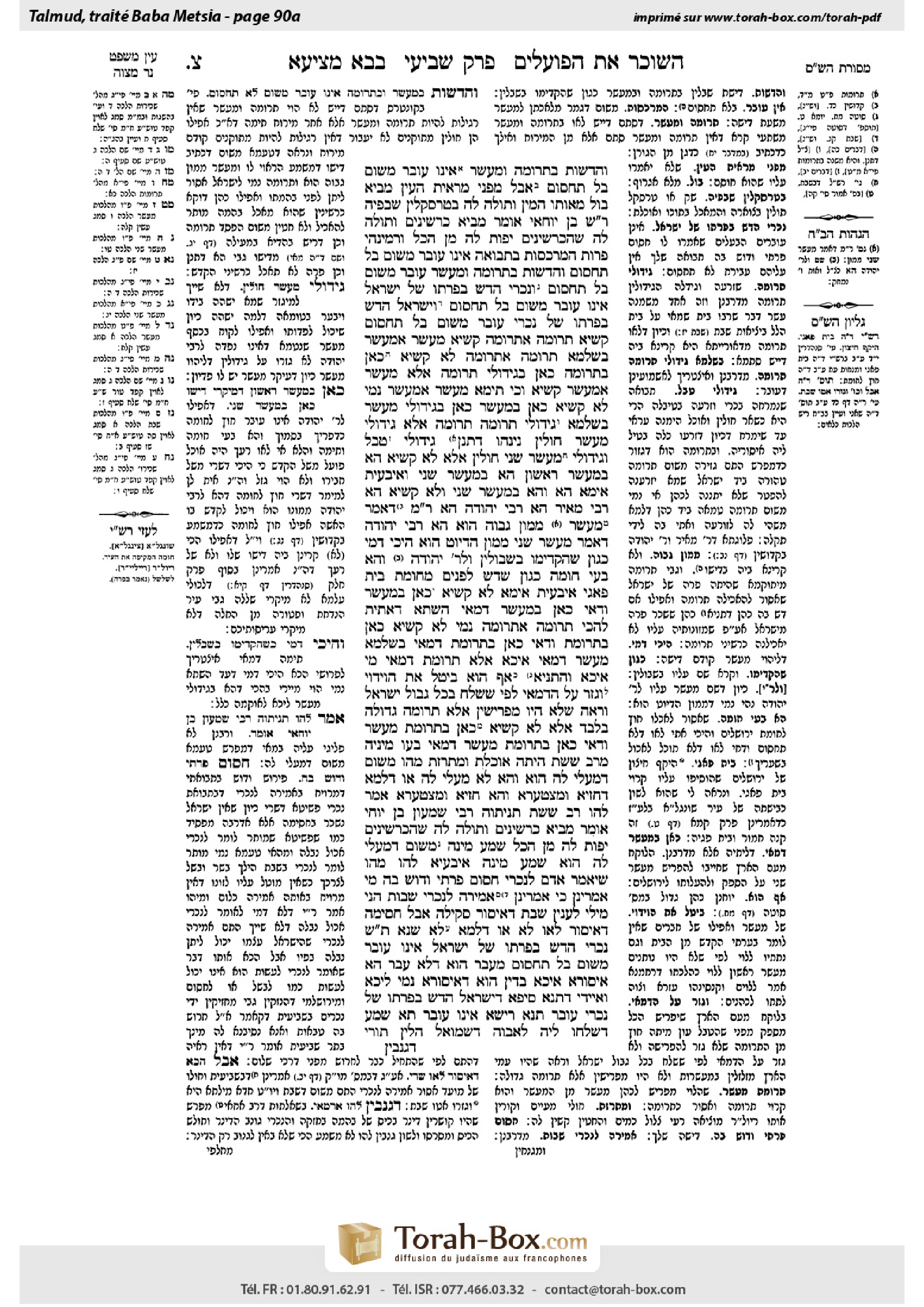
Bava Metzia 90a: Talmud study for Daf Yomi
Study the Talmud for Daf Yomi with scanned pages, Hebrew text, English translations from Sefaria and AI-generated French translations.
Passage selection and English or AI-generated French translation are available where the scan has annotations. Daf Study is independent of Torah-Box and Sefaria.
Browse Bava Metzia · בבא מציעא · All tractatesBava Metzia 90a text and translations
This page of Bava Metzia includes the Aramaic text, an English translation and an AI-generated French translation, alongside the scan above.
בבא מציעא צ׳ א · Aramaic and Hebrew text
וְהַדָּשׁוֹת בִּתְרוּמָה וּמַעֲשֵׂר, אֵינוֹ עוֹבֵר מִשּׁוּם ״בַּל תַּחְסוֹם״, אֲבָל מִפְּנֵי מַרְאִית הָעַיִן – מֵבִיא בּוּל מֵאוֹתוֹ הַמִּין וְתוֹלֶה לָהּ בַּטְּרַסְקָלִין שֶׁבְּפִיהָ. רַבִּי שִׁמְעוֹן בֶּן יוֹחַאי אוֹמֵר: מֵבִיא כַּרְשִׁינִים וְתוֹלֶה לָהּ, שֶׁהַכַּרְשִׁינִים יָפוֹת לָהּ מִן הַכֹּל.
וּרְמִינְהִי: פָּרוֹת הַמְרַכְּסוֹת בִּתְבוּאָה – אֵינוֹ עוֹבֵר מִשּׁוּם ״בַּל תַּחְסוֹם״. וְהַדָּשׁוֹת בִּתְרוּמָה וּמַעֲשֵׂר – עוֹבֵר מִשּׁוּם ״בַּל תַּחְסוֹם״. וְנׇכְרִי הַדָּשׁ בְּפָרָתוֹ שֶׁל יִשְׂרָאֵל – אֵינוֹ עוֹבֵר מִשּׁוּם ״בַּל תַּחְסוֹם״. וְיִשְׂרָאֵל הַדָּשׁ בְּפָרָתוֹ שֶׁל נׇכְרִי – עוֹבֵר מִשּׁוּם ״בַּל תַּחְסוֹם״. קַשְׁיָא תְּרוּמָה אַתְּרוּמָה, קַשְׁיָא מַעֲשֵׂר אַמַּעֲשֵׂר!
בִּשְׁלָמָא תְּרוּמָה אַתְּרוּמָה לָא קַשְׁיָא – כָּאן בִּתְרוּמָה, כָּאן בְּגִידּוּלֵי תְרוּמָה. אֶלָּא מַעֲשֵׂר אַמַּעֲשֵׂר קַשְׁיָא!
וְכִי תֵּימָא מַעֲשֵׂר אַמַּעֲשֵׂר נָמֵי לָא קַשְׁיָא: כָּאן – בְּמַעֲשֵׂר, כָּאן – בְּגִידּוּלֵי מַעֲשֵׂר. בִּשְׁלָמָא גִּידּוּלֵי תְרוּמָה – תְּרוּמָה! אֶלָּא גִּידּוּלֵי מַעֲשֵׂר – חוּלִּין נִינְהוּ. דִּתְנַן: גִּידּוּלֵי טֶבֶל וְגִידּוּלֵי מַעֲשֵׂר שֵׁנִי – חוּלִּין!
אֶלָּא לָא קַשְׁיָא: הָא בְּמַעֲשֵׂר רִאשׁוֹן, הָא בְּמַעֲשֵׂר שֵׁנִי. וְאִיבָּעֵית אֵימָא: הָא וְהָא בְּמַעֲשֵׂר שֵׁנִי, וְלָא קַשְׁיָא: הָא רַבִּי מֵאִיר, הָא רַבִּי יְהוּדָה.
הָא רַבִּי מֵאִיר, דְּאָמַר: מַעֲשֵׂר מָמוֹן גָּבוֹהַּ הוּא, הָא רַבִּי יְהוּדָה דְּאָמַר: מַעֲשֵׂר שֵׁנִי מָמוֹן הֶדְיוֹט הוּא.
הֵיכִי דָּמֵי? כְּגוֹן שֶׁהִקְדִּימוֹ בְּשִׁבֳּלִין.
וּלְרַבִּי יְהוּדָה? וְהָא בָּעֵי חוֹמָה! כְּגוֹן שֶׁדָּשׁ לִפְנִים מֵחוֹמַת בֵּית פָּאגֵי.
אִיבָּעֵית אֵימָא: לָא קַשְׁיָא. כָּאן – בְּמַעֲשֵׂר וַדַּאי, כָּאן – בְּמַעֲשֵׂר דְּמַאי. הַשְׁתָּא דְּאָתֵית לְהָכִי, תְּרוּמָה אַתְּרוּמָה נָמֵי לָא קַשְׁיָא: כָּאן – בִּתְרוּמַת וַדַּאי, כָּאן – בִּתְרוּמַת דְּמַאי.
בִּשְׁלָמָא מַעֲשֵׂר דְּמַאי אִיכָּא, אֶלָּא תְּרוּמַת דְּמַאי מִי אִיכָּא? וְהָתַנְיָא: אַף הוּא בִּיטֵּל אֶת הַוִּידּוּי וְגָזַר עַל הַדְּמַאי – לְפִי שֶׁשָּׁלַח בְּכֹל גְּבוּל יִשְׂרָאֵל וְרָאָה שֶׁלֹּא הָיוּ מַפְרִישִׁין אֶלָּא תְּרוּמָה גְּדוֹלָה בִּלְבָד!
אֶלָּא לָא קַשְׁיָא: כָּאן – בִּתְרוּמַת מַעֲשֵׂר וַדַּאי, כָּאן – בִּתְרוּמַת מַעֲשֵׂר דְּמַאי.
בְּעוֹ מִינֵּיהּ מֵרַב שֵׁשֶׁת: הָיְתָה אוֹכֶלֶת וּמַתְרֶזֶת, מַהוּ? מִשּׁוּם דִּמְעַלֵּי לַהּ הוּא, וְהָא לָא מְעַלֵּי לַהּ? אוֹ דִלְמָא דְּחָזְיָא וּמִצְטַעֲרָא, וְהָא חָזְיָא וּמִצְטַעֲרָא?
אֲמַר לְהוּ רַב שֵׁשֶׁת: תְּנֵיתוּהָ, רַבִּי שִׁמְעוֹן בֶּן יוֹחַי אוֹמֵר: מֵבִיא כַּרְשִׁינִים וְתוֹלֶה לָהּ, שֶׁהַכַּרְשִׁינִים יָפוֹת לָהּ מִן הַכֹּל. שְׁמַע מִינַּהּ מִשּׁוּם דִּמְעַלֵּי לַהּ הוּא. שְׁמַע מִינַּהּ.
אִיבַּעְיָא לְהוּ: מַהוּ שֶׁיֹּאמַר אָדָם לְנׇכְרִי ״חֲסוֹם פָּרָתִי וְדוּשׁ בָּהּ״? מִי אָמְרִינַן: כִּי אָמְרִינַן אֲמִירָה לְנׇכְרִי שְׁבוּת, הָנֵי מִילֵּי לְעִנְיַן שַׁבָּת – דְּאִיסּוּר סְקִילָה, אֲבָל חֲסִימָה, דְּאִיסּוּר לָאו – לָא, אוֹ דִלְמָא לָא שְׁנָא?
תָּא שְׁמַע: נׇכְרִי הַדָּשׁ בְּפָרָתוֹ שֶׁל יִשְׂרָאֵל – אֵינוֹ עוֹבֵר מִשּׁוּם ״בַּל תַּחְסוֹם״. מִעְבָּר הוּא דְּלָא עָבַר, הָא אִיסּוּרָא אִיכָּא. בְּדִין הוּא דְּאִיסּוּרָא נָמֵי לֵיכָּא, וְאַיְּידֵי דִּתְנָא סֵיפָא דְּיִשְׂרָאֵל הַדָּשׁ בְּפָרָתוֹ שֶׁל נׇכְרִי עוֹבֵר, תְּנָא רֵישָׁא: אֵינוֹ עוֹבֵר.
תָּא שְׁמַע דִּשְׁלַחוּ לֵיהּ לַאֲבוּהּ דִּשְׁמוּאֵל: הָלֵין תּוֹרֵי
Bava Metzia 90a · English translation
or that thresh teruma and tithe, which one may not allow his cows to eat, if he muzzles them he does not violate the prohibition of: Do not muzzle, but due to the appearance of prohibition, as observers are unaware that he is acting in a permitted manner, he should bring a piece of that species of produce and hang it in the basket [bateraskalin] that is by the animal’s mouth. Rabbi Shimon ben Yoḥai says: He does not have to use the same food that the animal is threshing, as he may bring vetches and hang them for it, as vetches are better for it than anything.
And the Gemara raises a contradiction against this from a baraita: In the case of cows that tread on produce, one does not violate the prohibition of: Do not muzzle, but with regard to those which thresh teruma and tithes, he does violate the prohibition of: Do not muzzle. And in the case of a gentile who threshes with the cow of a Jew, he does not violate the prohibition of: Do not muzzle, but a Jew who threshes with the cow of a gentile does violate the prohibition of: Do not muzzle, as it depends on the person who performs the action, not the identity of the animal’s owner. This presents a difficulty with regard to the ruling concerning teruma in one baraita and the ruling concerning teruma in the other baraita, and there is similarly a difficulty with regard to the ruling concerning tithe in one baraita and the ruling concerning tithe in the other baraita.
The Gemara comments: Granted, the contradiction between the ruling concerning teruma in one baraita and the ruling concerning teruma in the other baraita is not difficult, as here, the ruling in this baraita is stated with regard to actual teruma, which may not be fed to a cow, and there, the ruling in that baraita is stated with regard to growths of teruma, which have the status of teruma by rabbinic law, and therefore it is permitted to feed them to one’s animal so as not to violate the prohibition against muzzling. But as for the contradiction between the ruling concerning tithe in one baraita and the ruling concerning tithe in the other baraita, this is difficult.
And if you would say that the contradiction between the ruling concerning tithe in one baraita and the ruling concerning tithe in the other baraita is also not difficult, as here, the ruling in this baraita is stated with regard to actual tithe, which may not be fed to a cow, and there, the ruling in that baraita is stated with regard to growths of tithe, which have the status of tithe by rabbinic law, and therefore it is permitted to feed them to one’s animal in order not to violate the prohibition against muzzling, this answer cannot be accepted. The reason is that granted, the growths of teruma are considered like teruma by rabbinic law, but the growths of tithe are non-sacred foods. As we learned in a mishna (Terumot 9:4): The growths of untithed produce and the growths of second tithe are non-sacred.
The Gemara suggests a different answer: Rather, this is not difficult. The ruling of this baraita is stated with regard to first tithe, which is considered the owner’s property, whereas the ruling of that baraita is stated with regard to second tithe, which is property of the Temple treasury. And if you wish, say that both this ruling and that ruling are stated with regard to second tithe, and it is not difficult, as the ruling of this baraita, according to which it is prohibited to feed it to the animal, is in accordance with the opinion of Rabbi Meir, while the ruling of that baraita, which says that one may feed it to the animal, is in accordance with the opinion of Rabbi Yehuda.
The Gemara elaborates: This baraita is in accordance with the opinion of Rabbi Meir, who says that second tithe is property belonging to the Most High, i.e., the owner has only the right to eat the food, and therefore he may not let his cow consume it, whereas that baraita is in accordance with the opinion of Rabbi Yehuda, who says that second tithe is non-sacred property.
The Gemara asks: What are the circumstances of a cow that threshes tithes? Tithes are usually separated only after the produce has been threshed and collected into a pile. The Gemara answers: This is referring to a case where the separation of tithes performed by the owner preceded the separation of teruma at the stage when the produce was still on the stalks.
The Gemara further asks: And according to the explanation that the baraita that permits feeding this produce to one’s animal is in accordance with the opinion of Rabbi Yehuda, i.e., that this is referring to second tithe, how is the consumption of this tithe permitted before it enters Jerusalem? But one is required to bring second tithe within the city wall. The Gemara answers: This is referring to a case where he threshed inside the wall of Beit Pagei, the outer wall of Jerusalem, which enclosed a semi-rural suburb.
If you wish, say a different answer to the original contradiction between the baraitot: This is not difficult; here, the ruling in this baraita is stated with regard to definite tithe, which may not be fed to a cow, whereas there, the ruling in that baraita is stated with regard to doubtfully tithed produce [demai], from which one is required to separate tithes by rabbinic law. The Gemara comments: Now that you have arrived at this answer, i.e., that this baraita is referring to demai, the contradiction between the ruling of this baraita concerning teruma and the ruling of that baraita concerning teruma is also not difficult, as one can likewise say that here, the ruling in this baraita is stated with regard to definite teruma, and there, the ruling in that baraita is stated with regard to teruma of demai.
The Gemara asks: Granted, with regard to demai of tithe, there is such a concept, as the Sages decreed that one must separate tithe from doubtfully tithed produce. But with regard to demai of teruma, is there teruma of this kind? But isn’t it taught in a baraita: He, Yoḥanan the High Priest, also annulled the declaration of tithes (Deuteronomy 26:12–19), due to fear that the agricultural halakhot were not being properly observed and the declaration that one has separated his tithe in accordance with Torah law would therefore be false, and he decreed that one must separate demai of tithe from the produce of one who is unreliable with regard to tithes. He issued this decree because he sent messengers throughout all the borders of Eretz Yisrael and saw that they would separate only the great teruma alone, not tithes. It is clear from here that Jews were not suspected of neglecting the mitzva of teruma, and therefore was no need to separate teruma from demai.
Rather, the Gemara offers a slightly different answer: It is not difficult; here, the ruling in this baraita is stated with regard to definite teruma of the tithe, separated by a Levite from his tithe and given to a priest; there, the ruling in that baraita is stated with regard to teruma of the tithe from demai.
§ The Sages raised a dilemma before Rav Sheshet: If the animal was eating from the produce it was threshing, and it was excreting diarrhea [matrezet], what is the halakha? The Gemara explains the sides of the dilemma: Is the reason that one must let the animal eat because the food is good for it, and this produce is evidently not good for it, and therefore the animal should be muzzled to prevent it from harm? Or perhaps the reason for the prohibition against muzzling is that it sees food and suffers when it cannot eat, and this one also sees food and suffers when it cannot eat.
Rav Sheshet said to them: You learned a baraita that provides the answer to your question. Rabbi Shimon ben Yoḥai says: One can bring vetches and hang them for it, as vetches are better for it than anything. One can learn from the baraita that the reason is because the food is good for it. The Gemara affirms: Learn from the baraita that it is so.
§ A dilemma was raised before the Sages: What is the halakha with regard to the possibility that a person can say to a gentile: Muzzle my cow and thresh with it? Do we say that when we state the principle that speaking to a gentile and requesting of him to perform for oneself a task forbidden to a Jew is prohibited by a rabbinic decree, this matter applies only to Shabbat, when the performance of labor is a prohibition that entails stoning, but with regard to muzzling, which is merely a regular prohibition, giving an instruction of this kind to a gentile is not prohibited; or perhaps there is no difference between the prohibitions of Shabbat and other prohibitions in this regard?
The Gemara suggests: Come and hear a proof from the aforementioned baraita. A gentile who threshes with the cow of a Jew does not violate the prohibition of: Do not muzzle. One can infer as follows: It is a transgression by Torah law that he does not transgress, but there is a prohibition here by rabbinic law. The Gemara refutes this argument: This is no proof, as by right the baraita should have stated that there is no prohibition here either, but since the tanna of the baraita taught in the latter clause that a Jew who threshes with the cow of a gentile does violate the prohibition, he taught the first clause in a similar style, with the phrase: He does not violate the prohibition. If so, one cannot reach any conclusions from the wording of the baraita.
The Gemara suggests: Come and hear, as they sent to Shmuel’s father a halakhic inquiry with regard to these oxen
Bava Metzia 90a · Traduction française (IA)
ou celui qui trie la terouma et la dîme, qui ne doit pas permettre à ses vaches de les manger, si l'on munit les bêtes d'un bâillon, on ne viole pas la prohibition de : Ne mets pas un bâillon, mais en raison de l'apparence de prohibition, comme les observateurs ne savent pas qu'il agit dans un mode permis, il devrait apporter un morceau de cette espèce de produit et le suspendre dans le panier [bateraskalin] qui est à la bouche de l'animal. Rabbi Shimon ben Yoḥai dit : Il n'est pas nécessaire d'utiliser la même nourriture que l'animal trie, car il peut apporter des vetches et les suspendre pour lui, car les vetches sont meilleures pour lui que tout autre chose.
Et la Guemara soulève une contradiction contre cela à partir d'une baraïta : Dans le cas de vaches qui foulent les produits, on ne viole pas la prohibition de : Ne mets pas un bâillon, mais concernant celles qui trient la terouma et la dîme, il viole la prohibition de : Ne mets pas un bâillon. Et dans le cas d'un non-Juif qui trie avec la vache d'un Juif, il ne viole pas la prohibition de : Ne mets pas un bâillon, mais un Juif qui trie avec la vache d'un non-Juif viole la prohibition de : Ne mets pas un bâillon, car cela dépend de la personne qui effectue l'action, pas de l'identité du propriétaire de l'animal. Cela présente une difficulté concernant la décision concernant la terouma dans une baraïta et la décision concernant la terouma dans l'autre baraïta, et de même il y a une difficulté concernant la décision concernant la dîme dans une baraïta et la décision concernant la dîme dans l'autre baraïta.
La Guemara commente : Cela est admis, la contradiction entre la décision concernant la terouma dans une baraïta et la décision concernant la terouma dans l'autre baraïta n'est pas difficile, car ici, la décision dans cette baraïta est formulée concernant la terouma réelle, qui ne peut pas être donnée à une vache, et là, la décision dans cette autre baraïta est formulée concernant les pousses de terouma, qui ont le statut de terouma selon la loi rabbinique, et donc il est permis de les nourrir à son animal afin de ne pas violer la prohibition contre le bâillon. Mais concernant la contradiction entre la décision concernant la dîme dans une baraïta et la décision concernant la dîme dans l'autre baraïta, cela est difficile.
Et si vous dites que la contradiction entre la décision concernant la dîme dans une baraïta et la décision concernant la dîme dans l'autre baraïta n'est pas difficile non plus, car ici, la décision dans cette baraïta est formulée concernant la dîme réelle, qui ne peut pas être donnée à une vache, et là, la décision dans cette autre baraïta est formulée concernant les pousses de dîme, qui ont le statut de dîme selon la loi rabbinique, et donc il est permis de les nourrir à son animal afin de ne pas violer la prohibition contre le bâillon, cette réponse ne peut pas être acceptée. La raison est que, bien que les pousses de terouma soient considérées comme de la terouma selon la loi rabbinique, les pousses de dîme sont des aliments non sacrés. Comme nous l'avons appris dans une mitsva (Teroumot 9:4) : Les pousses des produits non titrés et les pousses de la dîme secondaire sont des aliments non sacrés.
La Guemara suggère une autre réponse : Plutôt, cela n'est pas difficile. La décision de cette baraïta est formulée concernant la première dîme, qui est considérée comme la propriété du propriétaire, tandis que la décision de celle-ci est formulée concernant la deuxième dîme, qui est la propriété du trésor du Temple. Et si vous le souhaitez, dites que les deux décisions sont formulées concernant la deuxième dîme, et cela n'est pas difficile, car la décision de cette baraïta, selon laquelle il est interdit de nourrir l'animal, est selon l'opinion de Rabbi Meir, tandis que la décision de celle-ci, qui dit qu'on peut nourrir l'animal, est selon l'opinion de Rabbi Yéhuda.
La Guemara développe : Cette baraïta est selon l'opinion de Rabbi Meir, qui dit que la deuxième dîme est la propriété du Très Haut, c'est-à-dire que le propriétaire a seulement le droit de manger la nourriture, et donc il ne peut pas permettre à sa vache de la consommer, tandis que cette baraïta est selon l'opinion de Rabbi Yéhuda, qui dit que la deuxième dîme est une propriété non sacrée.
La Guemara pose une question : Quelles sont les circonstances d'une vache qui trie les dîmes ? Les dîmes sont généralement séparées seulement après que les produits ont été triés et regroupés en tas. La Guemara répond : Cela fait référence à un cas où la séparation des dîmes effectuée par le propriétaire a précédé la séparation de la terouma à la phase où les produits étaient encore sur les tiges.
La Guemara pose davantage de questions : Et selon l'explication que la baraïta qui permet de nourrir ce produit à son animal est selon l'opinion de Rabbi Yéhuda, c'est-à-dire que cela fait référence à la dîme secondaire, comment la consommation de cette dîme est-elle permise avant qu'elle n'entre à Jérusalem ? Mais on est tenu de ramener la dîme secondaire dans les murs de la ville. La Guemara répond : Cela fait référence à un cas où il a foulé à l'intérieur des murs de Beit Pagei, le mur extérieur de Jérusalem, qui entourait un quartier semi-rural.
Si vous le souhaitez, dites une autre réponse à la contradiction originale entre les baraïtotes : Cela n'est pas difficile ; ici, la décision dans cette baraïta est formulée concernant la dîme définie, qui ne peut pas être nourrie à une vache, tandis que là, la décision dans cette autre baraïta est formulée concernant les produits dîmés [demai], à partir desquels on est tenu de séparer des dîmes selon la loi rabbinique. La Guemara commente : Maintenant que vous avez atteint cette réponse, c'est-à-dire que cette baraïta fait référence à demai, la contradiction entre la décision de cette baraïta concernant la terouma et la décision de cette autre baraïta concernant la terouma n'est pas difficile non plus, car on peut également dire que ici, la décision dans cette baraïta est formulée concernant la terouma définie, et là, la décision dans cette autre baraïta est formulée concernant la terouma de demai.
La Guemara pose la question : Cela est vrai, concernant le demai des dîmes, il existe une telle notion, car les Sages ont décrété qu'il fallait séparer les dîmes des produits dont l'origine était douteuse. Mais concernant le demai de la terouma, y a-t-il une telle terouma ? N'est-ce pas enseigné dans une baraïta : Il, Yochanan le grand prêtre, a annulé la déclaration des dîmes (Deutéronome 26 : 12-19), en raison de la crainte que les lois halakhiques agricoles ne fussent pas observées correctement et que la déclaration selon laquelle l'on avait séparé ses dîmes conformément à la loi divine serait donc fausse, et il a décrété qu'il fallait séparer le demai des dîmes des produits d'une personne peu fiable en matière de dîmes. Il a émis ce décret car il avait envoyé des messagers dans toutes les frontières d'Israël et avait vu qu'ils séparaient uniquement la grande terouma, pas les dîmes. Il est clair d'ici que les Juifs n'étaient pas soupçonnés de négliger la Mitsva de la terouma, et donc il n'était pas nécessaire de séparer la terouma du demai.
Plutôt, la Guemara propose une réponse légèrement différente : Ce n'est pas difficile ; ici, la décision de cette baraïta est énoncée concernant la terouma définie des dîmes, séparée par un Lévi de ses dîmes et donnée à un prêtre ; là, la décision de cette baraïta est énoncée concernant la terouma des dîmes du demai.
§ Les Sages ont soulevé un dilemme devant Rav Sheshet : Si l'animal mangeait des produits qu'il était en train de battre, et qu'il excretait de la diarrhée [matrezet], quelle est la halakha ? La Guemara explique les deux côtés du dilemme : Est-ce que la raison pour laquelle il faut laisser l'animal manger est que la nourriture est bonne pour lui, et que ce produit n'est pas bon pour lui, et donc l'animal devrait être moucheté pour le préserver ? Ou bien est-ce que la raison de l'interdiction de moucheter est qu'il voit de la nourriture et souffre de ne pas pouvoir manger, et cet animal aussi voit de la nourriture et souffre de ne pas pouvoir manger.
Rav Sheshet dit à eux : Vous avez appris une baraïta qui fournit la réponse à votre question. Rabbi Shimon ben Yochai dit : On peut amener des fèves et les suspendre pour cela, car les fèves sont meilleures pour cela que tout autre chose. On peut apprendre de la baraïta que la raison est que la nourriture est bonne pour cela. La Guemara affirme : Apprenez de la baraïta qu'il en est ainsi.
§ Un dilemme a été soulevé devant les Sages : Quelle est la halakha concernant la possibilité qu'une personne dise à un non-Juif : Mouchete ma vache et batte-la ? Disons-nous que lorsque nous énonçons le principe selon lequel parler à un non-Juif et lui demander de faire une tâche interdite aux Juifs est interdit par un décret rabbinique, cette matière s'applique uniquement à la Shabbat, lorsque l'accomplissement du travail est une interdiction entraînant la lapidation, mais concernant le mouchetage, qui est simplement une interdiction ordinaire, donner une instruction de ce genre à un non-Juif n'est pas interdit ; ou bien n'y a-t-il pas de différence entre les interdictions de la Shabbat et d'autres interdictions en ce qui concerne cela ?
La Guemara suggère : Venez et entendez une preuve à partir de la baraïta mentionnée précédemment. Un non-Juif qui batte avec la vache d'un Juif ne viole pas l'interdiction de : Ne mouchete pas. On peut en déduire comme suit : C'est une transgression selon la Torah qu'il ne viole pas, mais il y a une interdiction ici selon la loi rabbinique. La Guemara réfute cet argument : Cela n'est pas une preuve, car selon la raison, la baraïta aurait dû énoncer qu'il n'y a pas d'interdiction ici non plus, mais puisque le tanna de la baraïta a enseigné dans la clause suivante que le Juif qui batte avec la vache d'un non-Juif viole l'interdiction, il a énoncé la première clause dans un style similaire, avec la phrase : Il ne viole pas l'interdiction. Si tel est le cas, on ne peut tirer aucune conclusion à partir du wording de la baraïta.
La Guemara suggère : Venez et entendez, car ils ont envoyé à la père de Shmuel une question halakhique concernant ces bœufs
Traduction française générée par IA à partir de l’édition anglaise de Sefaria. Vérifie toujours un passage avec le texte source.
Text from Sefaria: William Davidson Edition - Vocalized Aramaic (CC BY NC); William Davidson Edition - English (CC BY NC).