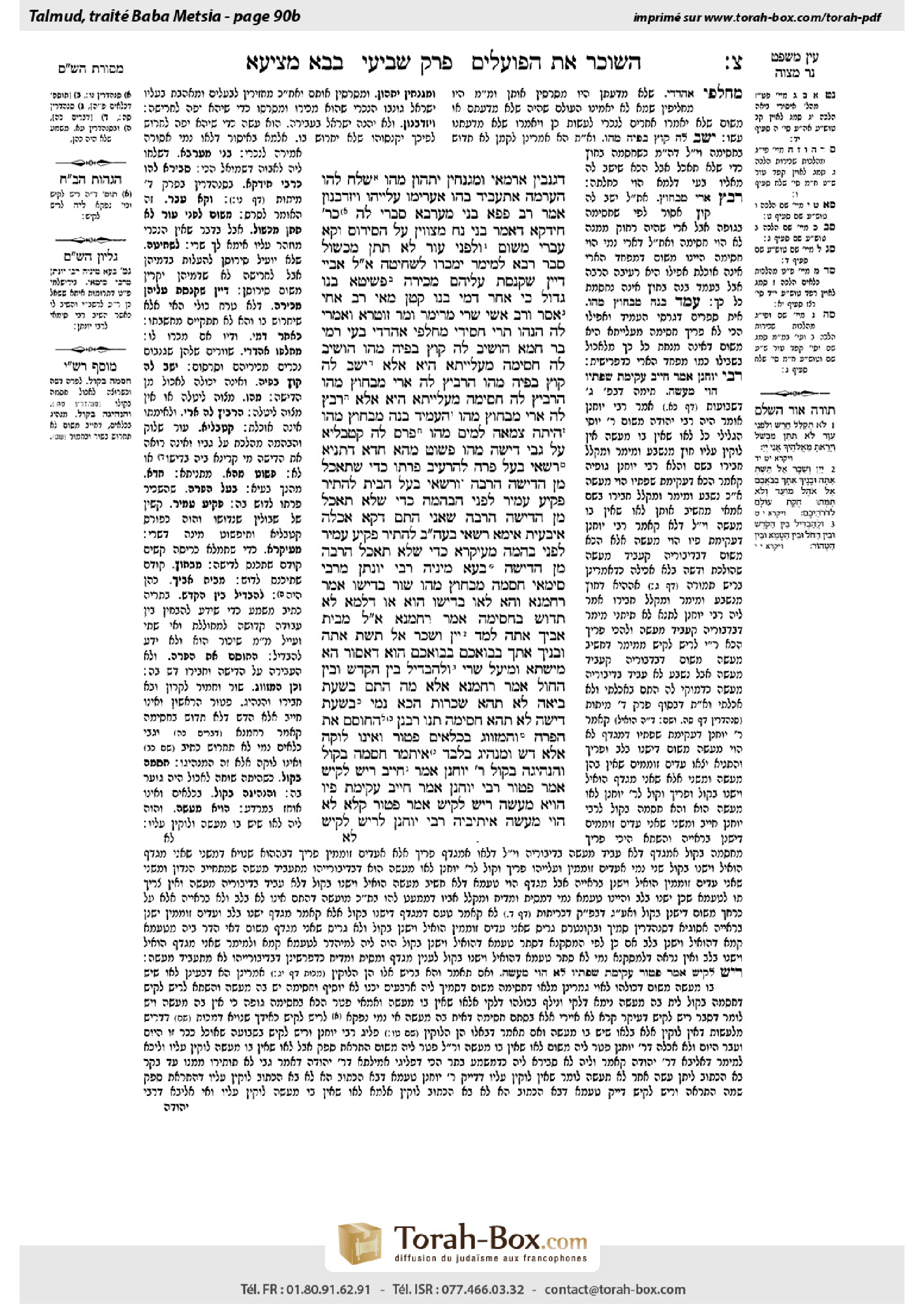
Bava Metzia 90b: Talmud study for Daf Yomi
Study the Talmud for Daf Yomi with scanned pages, Hebrew text, English translations from Sefaria and AI-generated French translations.
Passage selection and English or AI-generated French translation are available where the scan has annotations. Daf Study is independent of Torah-Box and Sefaria.
Browse Bava Metzia · בבא מציעא · All tractatesBava Metzia 90b text and translations
This page of Bava Metzia includes the Aramaic text, an English translation and an AI-generated French translation, alongside the scan above.
בבא מציעא צ׳ ב · Aramaic and Hebrew text
דְּגָנְבִין אַרְמָאֵי וּמְגַנְּחִין יָתְהוֹן, מַהוּ? שְׁלַח לְהוּ: הַעֲרָמָה אִתְעֲבִיד בְּהוּ, אַעֲרִימוּ עֲלַיְיהוּ וְיִזְדַּבְּנוּן.
אָמַר רַב פָּפָּא: בְּנֵי מַעְרְבָא סָבְרִי לַהּ כְּרַבִּי חִידְקָא, דְּאָמַר: בְּנֵי נֹחַ מְצֻוִּוין עַל הַסֵּירוּס, וְקָא עָבְרִי מִשּׁוּם ״וְלִפְנֵי עִוֵּר לֹא תִתֵּן מִכְשֹׁל״.
סְבַר רָבָא לְמֵימַר יִמָּכְרוּ לִשְׁחִיטָה. אָמַר לוֹ אַבָּיֵי דַּיָּין שֶׁקָּנַסְתָּ עֲלֵיהֶם מְכִירָה.
פְּשִׁיטָא: בְּנוֹ גָּדוֹל – כִּי אַחֵר דָּמֵי. בְּנוֹ קָטָן מַאי? רַב אַחַי אָסַר, וְרַב אָשֵׁי שָׁרֵי. מָרִימָר וּמָר זוּטְרָא, וְאָמְרִי לַהּ הָנְהוּ תְּרֵי חֲסִידֵי, מְחַלְּפִי אַהֲדָדֵי.
בָּעֵי רָמֵי בַּר חָמָא: הוֹשִׁיב לָהּ קוֹץ בְּפִיהָ, מַהוּ? הוֹשִׁיב לָהּ?! חֲסִימָה מְעַלַּיְיתָא הִיא! אֶלָּא יָשַׁב לָהּ קוֹץ בְּפִיהָ, מַהוּ?
הִרְבִּיץ לָהּ אֲרִי מִבַּחוּץ, מַהוּ? הִרְבִּיץ לָהּ?! חֲסִימָה מְעַלַּיְיתָא הִיא! אֶלָּא רָבַץ לָהּ אֲרִי מִבַּחוּץ, מַהוּ? הֶעֱמִיד בְּנָהּ מִבַּחוּץ, מַהוּ? הָיְתָה צְמֵאָה לְמַיִם, מַהוּ? פָּרַס לָהּ קַטְבֻלְיָא עַל גַּבֵּי דִּישָׁה, מַהוּ?
פְּשׁוֹט מִיהָא חֲדָא, דְּתַנְיָא: רַשַּׁאי בַּעַל פָּרָה לְהַרְעִיב פָּרָתוֹ כְּדֵי שֶׁתֹּאכַל מִן הַדִּישָׁה הַרְבֵּה, וְרַשַּׁאי בַּעַל הַבַּיִת לְהַתִּיר פְּקִיעַ עָמִיר לִפְנֵי הַבְּהֵמָה כְּדֵי שֶׁלֹּא תֹּאכַל מִן הַדִּישָׁה הַרְבֵּה!
שָׁאנֵי הָתָם דְּקָא אָכְלָה. אִיבָּעֵית אֵימָא: רַשַּׁאי בַּעַל הַבַּיִת לְהַתִּיר פְּקִיעַ עָמִיר לִפְנֵי בְּהֵמָה מֵעִיקָּרָא כְּדֵי שֶׁלֹּא תֹּאכַל הַרְבֵּה מִן הַדִּישָׁה.
בְּעָא מִינֵּיהּ רַבִּי יוֹנָתָן מֵרַבִּי סִימַאי: חֲסָמָהּ מִבַּחוּץ, מַהוּ? ״שׁוֹר בְּדִישׁוֹ״ אָמַר רַחֲמָנָא, וְהָא לָאו בְּדִישׁוֹ הוּא, אוֹ דִלְמָא לֹא תָּדוּשׁ בַּחֲסִימָה אָמַר רַחֲמָנָא?
אָמַר לוֹ: מִבֵּית אָבִיךָ אַתָּה לָמֵד: ״יַיִן וְשֵׁכָר אַל תֵּשְׁתְּ אַתָּה וּבָנֶיךָ אִתָּךְ בְּבֹאֲכֶם״. בְּבוֹאֲכֶם הוּא דְּאָסוּר, הָא מִישְׁתָּא וּמֵיעַל שְׁרֵי.
״וּלְהַבְדִּיל בֵּין הַקֹּדֶשׁ וּבֵין הַחֹל״ אָמַר רַחֲמָנָא. אֶלָּא, מָה הָתָם: בִּשְׁעַת בִּיאָה לֹא תְּהֵא שִׁכְרוּת, הָכָא נָמֵי: בִּשְׁעַת דִּישָׁה לֹא תְּהֵא חֲסִימָה.
תָּנוּ רַבָּנַן: הַחוֹסֵם אֶת הַפָּרָה וְהַמְזַוֵּוג בְּכִלְאַיִם – פָּטוּר, וְאֵינוֹ לוֹקֶה אֶלָּא דָּשׁ וּמַנְהִיג בִּלְבָד.
אִיתְּמַר: חֲסָמָהּ בְּקוֹל וְהִנְהִיגָהּ בְּקוֹל? רַבִּי יוֹחָנָן אָמַר: חַיָּיב, רֵישׁ לָקִישׁ אָמַר: פָּטוּר. רַבִּי יוֹחָנָן אָמַר: חַיָּיב, עֲקִימַת פִּיו הָוְיָא מַעֲשֶׂה. רֵישׁ לָקִישׁ אָמַר: פָּטוּר, קָלָא לָא הָוֵי מַעֲשֶׂה.
אֵיתִיבֵיהּ רַבִּי יוֹחָנָן לְרֵישׁ לָקִישׁ:
Bava Metzia 90b · English translation
which gentiles steal and castrate. Since it is prohibited for Jews to castrate animals, they would sometimes arrange for a gentile to pretend to steal the animal and subsequently return it after castrating it, as it is easier to handle a castrated animal. What is the halakha with regard to a case of this kind? Shmuel’s father sent to him: They used artifice; therefore, you should use artifice with them and make them sell it as a punishment. This shows that it is prohibited to instruct a gentile to perform a prohibition on one’s behalf.
Rav Pappa said: This provides no conclusive proof, as the inhabitants of the West, i.e., Eretz Yisrael, who are the ones who raised this question, hold in accordance with the opinion of Rabbi Ḥideka, who says: The descendants of Noah are commanded with regard to castration. They too are prohibited from performing this practice. And consequently, those Jews who cause them to do it transgress the prohibition of: “Nor put a stumbling block before the blind” (Leviticus 19:14).
Rava thought to say that it is not enough that the owners may not use these animals castrated for them by gentiles, but they must even sell the animals for slaughter, but not for plowing, so that they would derive no benefit at all from the increase in the value of their property that resulted from a transgression. A castrated animal is worth more if it is sold for plowing, but not if it is sold for slaughter. Abaye said to him: It is enough for them that you penalized them by requiring them to sell the animals.
With regard to the same issue, the Gemara comments: It is obvious that if one sold the castrated animal to his adult son, the son is considered like another person, i.e., there is no need to sell to a complete stranger. If the buyer was his minor son, what is the halakha? Rav Aḥai prohibited this, and Rav Ashi permitted it. Mareimar and Mar Zutra, and some say it was a certain pair of unknown pious men, would exchange such oxen with each other.
§ Rami bar Ḥama raises a dilemma: If one placed a thorn in the mouth of a threshing animal, what is the halakha? The Gemara is puzzled by this question: If he placed the thorn in its mouth, this is certainly considered proper muzzling. Rather, the dilemma should be formulated as follows: If a thorn settled in its mouth and one did not remove it, what is the halakha?
The Gemara poses a similar question: If one made a lion crouch over it from outside, to frighten the animal and stop it from eating, what is the halakha? The Gemara responds as it did before: If he made the lion crouch over it, this is considered proper muzzling. Rather, if a lion was crouching over it and he did not get rid of it, what is the halakha? Similarly, if he placed its young on the outside, so that the animal looks toward its young and does not eat, what is the halakha? Or, if it was thirsty for water, what is the halakha? If he spread a leather blanket [katavliya] for it over the produce it was threshing, so that the animal cannot see the food, what is the halakha?
The Gemara comments: Resolve at least one of the abovementioned dilemmas, as it is taught in a baraita: The owner of a cow who lent his animal to thresh the field of another is permitted to starve his cow so that it will eat plenty of the crop it is threshing, and a homeowner is permitted to untie a bundle of straw before an animal so that it will not eat plenty of the produce it is threshing. This is similar to spreading a blanket over the produce.
The Gemara refutes this comparison: No proof can be brought from here, because there it is different, as it at least gets to eat the produce. If you wish, say instead that the baraita should be explained as follows: A homeowner is permitted to untie a bundle of straw before an animal at the outset, before the threshing begins, so that it will fill itself with straw beforehand and will not eat plenty of the crop it is threshing.
§ Rabbi Yonatan raised a dilemma before Rabbi Simai: If one muzzled the animal from the outside, i.e., before it began to thresh, what is the halakha? The Gemara clarifies the sides of the dilemma: One can argue that the Merciful One states: “An ox in its threshing” (Deuteronomy 25:4), and this animal is not in its threshing, as it was muzzled before it was taken to thresh. Or perhaps the Merciful One states that one may not have the animal thresh while it is muzzled.
Rabbi Simai said to him: You can learn from your father’s house, i.e., you can derive this halakha from the case of priests, being a priest yourself. As the Torah states: “Drink no wine nor strong drink, you nor your sons with you, when you come into the Tent of Meeting” (Leviticus 10:9). Doesn’t a straightforward reading of this verse lead to the conclusion that it is only when you come into the Sanctuary that it is prohibited, whereas to drink wine and then enter is permitted?
This interpretation is not tenable, as with regard to the same matter the Merciful One states: “That you may make a difference between the sacred and the non-sacred” (Leviticus 10:10), which indicates that the priest must be capable of making these distinctions when he enters the Temple. Rather, just as there, with regard to the prohibition against drinking wine in the Sanctuary, the Torah means that at the time of entry there must be no drunkenness, whether the wine was drunk inside or outside the Sanctuary, here too it means that at the time of threshing there must be no muzzling.
§ The Sages taught: With regard to one who muzzles a cow that someone else is using for threshing, and similarly, one who plows with animals of diverse kinds together, e.g., with an ox and a donkey on the same plow, he is exempt, as only one who threshes a muzzled animal and one who leads diverse kinds of animals together are flogged.
§ It was stated that the amora’im disagreed about the following case: If one muzzled an animal with his voice, by berating it whenever it tried to eat, and similarly, if he led diverse kinds of animals together by means of his voice, without performing any action, what is the halakha? Rabbi Yoḥanan says he is liable; Reish Lakish says he is exempt. The Gemara explains the reasoning behind their opinions: Rabbi Yoḥanan says he is liable, as he maintains that the twisting of one’s mouth to speak is considered an action, albeit a slight one, whereas Reish Lakish says he is exempt, because a mere voice is not considered an action.
Rabbi Yoḥanan raised an objection to the opinion of Reish Lakish:
Bava Metzia 90b · Traduction française (IA)
qui volent et castreront des animaux. Puisque c'est interdit aux Juifs de castrer des animaux, ils faisaient parfois appel à un non-Juif pour qu'il prétende voler l'animal et le rende ensuite après l'avoir castré, car c'est plus facile de manipuler un animal castré. Quel est le halakha dans un cas tel que celui-ci ? Le père de Shmuel envoya à lui : Ils ont utilisé un artifice ; donc, vous devriez utiliser un artifice avec eux et les faire vendre l'animal comme punition. Cela montre qu'il est interdit d'instruire un non-Juif à accomplir une interdiction à sa place.
Rav Pappa dit : cela ne constitue pas une preuve concluante, car les habitants de l'Ouest, c'est-à-dire l'Éretz Yisrael, qui ont posé cette question, suivent l'opinion de Rabbi Ḥideka, qui dit : les descendants de Noé sont commandés concernant la castration. Ils aussi sont interdits de pratiquer cette pratique. Et par conséquent, ceux qui font cela transgressent l'interdiction de : « Et tu ne mettras pas un obstacle devant le boiteux » (Lévitique 19:14).
Rava pensait dire que ce n'est pas suffisant que les propriétaires ne puissent pas utiliser ces animaux castrés par les non-Juifs, mais ils doivent même vendre les animaux pour la boucherie, pas pour la culture, afin qu'ils ne tirent aucun avantage du gain de valeur de leur propriété résultant d'une transgression. Un animal castré est plus valorisé s'il est vendu pour la boucherie, mais pas s'il est vendu pour la culture. Abaye dit à lui : il suffit qu'ils soient pénalisés en exigeant qu'ils vendent les animaux.
Concernant la même question, le Guemara commente : il est évident que si l'on vend l'animal castré à son fils adulte, le fils est considéré comme une autre personne, c'est-à-dire qu'il n'y a pas besoin de vendre à un étranger complet. Si l'acheteur était son fils mineur, quelle est la halakha ? Rav Aḥai interdit cela, et Rav Ashi le permet. Mareimar et Mar Zutra, et certains disent qu'il s'agissait d'un certain couple d'hommes pieux inconnus, échangeaient de tels bœufs entre eux.
§ Rami bar Ḥama soulève un dilemme : Si l'on a mis un épine dans la bouche d'un bœuf de meunier, quelle est la halakha ? Le Guemara est perplexe face à cette question : si l'on a mis l'épine dans sa bouche, cela est certainement considéré comme une bonne étranglement. Plutôt, le dilemme devrait être formulé comme suit : si une épine s'est installée dans sa bouche et qu'on n'a pas retiré, quelle est la halakha ?
Le Guemara pose une question similaire : si l'on a fait coucher un lion sur lui depuis l'extérieur, pour effrayer l'animal et l'empêcher de manger, quelle est la halakha ? Le Guemara répond comme avant : si l'on a fait coucher le lion sur lui, cela est considéré comme une bonne étranglement. Plutôt, si un lion était couché sur lui et qu'on n'a pas éliminé, quelle est la halakha ? De même, si l'on a mis ses petits à l'extérieur, de sorte que l'animal regarde vers ses petits et ne mange pas, quelle est la halakha ? Ou, si l'animal avait soif d'eau, quelle est la halakha ? Si l'on a étendu un tapis de cuir [katavliya] pour lui sur les produits qu'il meunait, de sorte que l'animal ne puisse pas voir la nourriture, quelle est la halakha ?
Le Guemara commente : résolvez au moins l'un des dilemmes mentionnés ci-dessus, car il est enseigné dans une baraïta : l'owner d'une vache qui a prêté son animal pour meuler le champ d'un autre est autorisé à affamer sa vache afin qu'elle mange beaucoup des produits qu'elle meule, et un propriétaire est autorisé à délier un faisceau de paille devant un animal afin qu'il ne mange pas beaucoup des produits qu'il meule. Cela est similaire à étendre un tapis sur les produits.
Le Guemara réfute cette comparaison : on ne peut pas apporter de preuve à partir de là, car là, au moins, il peut manger les produits. Si vous le souhaitez, dites plutôt que la baraïta devrait être expliquée comme suit : un propriétaire est autorisé à délier un faisceau de paille devant un animal au début, avant que le meulage ne commence, afin qu'il s'emplisse de paille d'abord et ne mange pas beaucoup des produits qu'il meule.
§ Rabbi Yonatan a soulevé un dilemme devant Rabbi Simai : si l'on a mouché l'animal depuis l'extérieur, c'est-à-dire avant qu'il ne commence à meuler, quelle est la halakha ? Le Guemara clarifie les côtés du dilemme : on peut arguer que l'Éternel dit : « Un bœuf en meulage » (Deutéronome 25:4), et cet animal n'est pas en meulage, car il a été mouché avant d'être emmené meuler. Ou peut-être l'Éternel dit que l'on ne peut pas avoir l'animal meuler alors qu'il est mouché.
Rabbi Simai dit à lui : vous pouvez apprendre de votre maison, c'est-à-dire vous pouvez dériver cette halakha du cas des prêtres, étant lui-même un prêtre. Comme la Torah dit : « Ne boirez pas de vin ni de liqueur forte, vous ni vos fils avec vous, quand vous entrerez dans le Tabernacle » (Lévitique 10:9). N'est-ce pas une lecture directe de cette verset qui mène à la conclusion que c'est seulement quand vous entrez dans le Saint des Saints que cela est interdit, alors que boire du vin et entrer ensuite est permis ?
Cette interprétation n'est pas tenable, car concernant la même affaire, l'Éternel dit : « afin de faire la différence entre le saint et le non-saint » (Lévitique 10:10), ce qui indique que le prêtre doit être capable de faire ces distinctions lorsqu'il entre dans le Temple. Plutôt, tout comme là, concernant l'interdiction de boire du vin dans le Sanctuaire, la Torah signifie que lors de l'entrée, il ne doit pas y avoir d'ivresse, que le vin ait été bu à l'intérieur ou à l'extérieur du Sanctuaire, ici aussi cela signifie que lors du battage, il ne doit pas y avoir de muzzling.
§ Les Sages enseignèrent : concernant celui qui mousse un bovin que quelqu'un d'autre utilise pour battre, et de même, celui qui laboure avec des animaux de différentes espèces ensemble, par exemple, avec un bœuf et un âne sur la même charrue, il est exempt, car seul celui qui bat un animal moussoir et celui qui conduit des animaux de différentes espèces ensemble sont flagellés.
§ Il a été dit que les amora’im étaient en désaccord sur le cas suivant : Si une personne étrangle un animal avec sa voix, en le réprimandant chaque fois qu’il tentait de manger, et de même, si elle rassemble divers types d’animaux ensemble par sa voix, sans accomplir aucune action, quelle est la halakha ? Rabbi Yoḥanan dit qu’il est responsable ; Reish Lakish dit qu’il est exempt. La Guemara explique la raison de leurs opinions : Rabbi Yoḥanan dit qu’il est responsable, car il considère que le tordage de la bouche pour parler est considéré comme une action, même si elle est légère, tandis que Reish Lakish dit qu’il est exempt, car une simple voix n’est pas considérée comme une action.
Rabbi Yoḥanan a soulevé une objection contre l'opinion de Reish Lakish :
Traduction française générée par IA à partir de l’édition anglaise de Sefaria. Vérifie toujours un passage avec le texte source.
Text from Sefaria: William Davidson Edition - Vocalized Aramaic (CC BY NC); William Davidson Edition - English (CC BY NC).