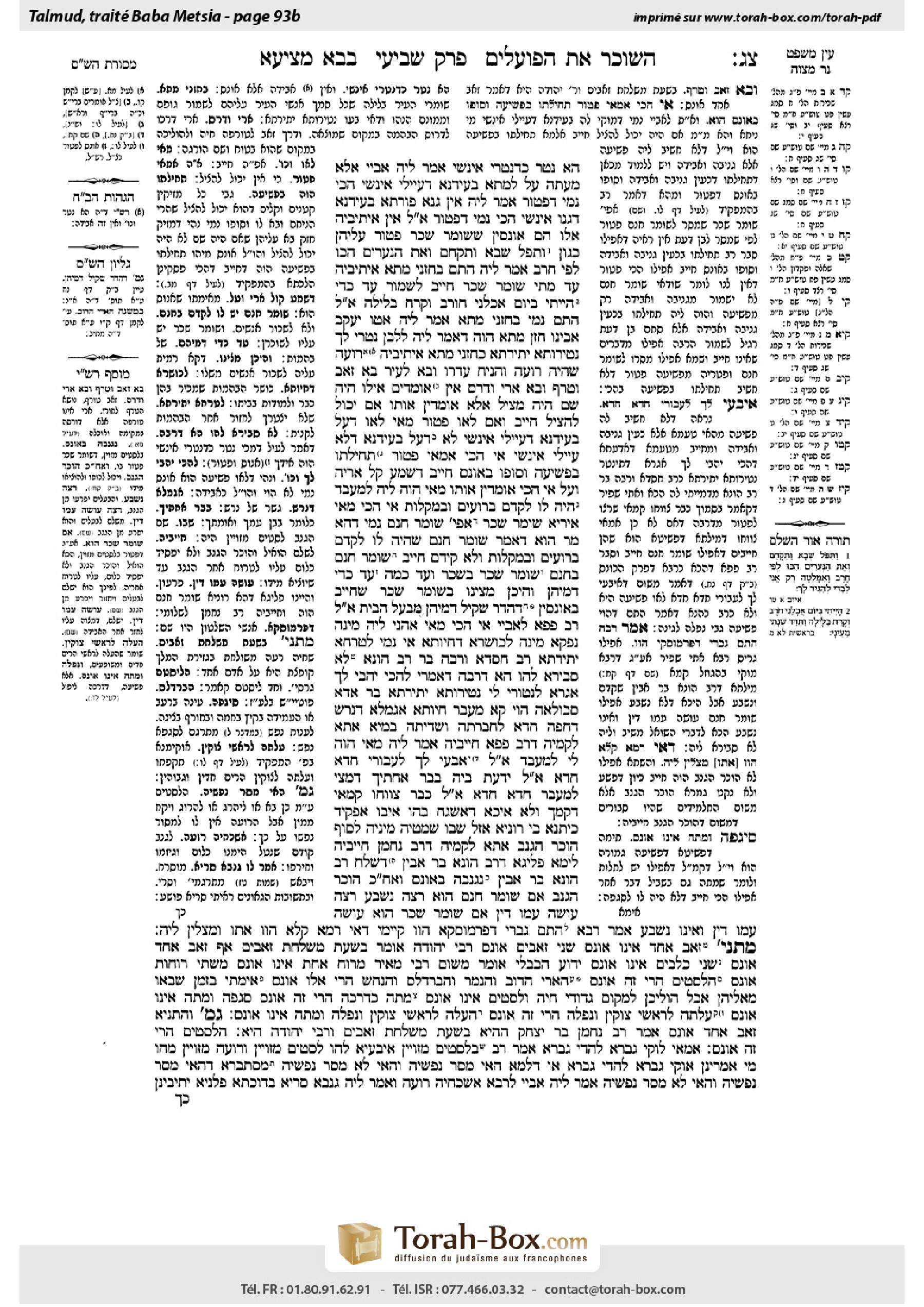
Bava Metzia 93b: Talmud study for Daf Yomi
Study the Talmud for Daf Yomi with scanned pages, Hebrew text, English translations from Sefaria and AI-generated French translations.
Passage selection and English or AI-generated French translation are available where the scan has annotations. Daf Study is independent of Torah-Box and Sefaria.
Browse Bava Metzia · בבא מציעא · All tractatesBava Metzia 93b text and translations
This page of Bava Metzia includes the Aramaic text, an English translation and an AI-generated French translation, alongside the scan above.
בבא מציעא צ״ג ב · Aramaic and Hebrew text
הָא נְטַר כִּדְנָטְרִי אִינָשֵׁי. אֲמַר לֵיהּ אַבָּיֵי: אֶלָּא מֵעַתָּה, עָל לְמָתָא בְּעִידָּנָא דְּעָיְילִי אִינָשֵׁי – הָכִי נָמֵי דְּפָטוּר?! אֲמַר לֵיהּ: אִין. גְּנָא פּוּרְתָּא בְּעִידָּנָא דְּגָנוּ אִינָשֵׁי – הָכִי נָמֵי דְּפָטוּר?! אֲמַר לֵיהּ: אִין.
אֵיתִיבֵיהּ: אֵלּוּ הֵם אוֹנָסִין שֶׁשּׁוֹמֵר שָׂכָר פָּטוּר עֲלֵיהֶן – כְּגוֹן: ״וַתִּפֹּל שְׁבָא וַתִּקָּחֵם וְאֶת הַנְּעָרִים הִכּוּ לְפִי חָרֶב״. אֲמַר לֵיהּ: הָתָם בְּחַזָּנֵי מָתָא.
אֵיתִיבֵיהּ: עַד מָתַי שׁוֹמֵר שָׂכָר חַיָּיב לִשְׁמוֹר – עַד כְּדֵי ״הָיִיתִי בַיּוֹם אֲכָלַנִי חֹרֶב וְקֶרַח בַּלַּיְלָה״. אֲמַר לֵיהּ: הָתָם נָמֵי בְּחַזָּנֵי מָתָא. אֲמַר לֵיהּ: אַטּוּ יַעֲקֹב אָבִינוּ חַזַּן מָתָא הֲוָה! דַּאֲמַר לֵיהּ לְלָבָן: נְטַרִי לָךְ נְטִירוּתָא יַתִּירְתָּא כְּחַזָּנֵי מָתָא.
אֵיתִיבֵיהּ: רוֹעֶה שֶׁהָיָה רוֹעֶה וְהִנִּיחַ עֶדְרוֹ וּבָא לָעִיר, בָּא זְאֵב וְטָרַף, וּבָא אֲרִי וְדָרַס – אֵין אוֹמְרִים: אִילּוּ הָיָה שָׁם הָיָה מַצִּיל. אֶלָּא אוֹמְדִין אוֹתוֹ: אִם יָכוֹל לְהַצִּיל – חַיָּיב, אִם לָאו – פָּטוּר.
מַאי לָאו דְּעָל בְּעִידָּנָא דְּעָיְילִי אִינָשֵׁי? לָא, דְּעָל בְּעִידָּנָא דְּלָא עָיְילִי אִינָשֵׁי. אִי הָכִי, אַמַּאי פָּטוּר? תְּחִילָּתוֹ בִּפְשִׁיעָה וְסוֹפוֹ בְּאוֹנֶס, חַיָּיב!
דִּשְׁמַע קָל אַרְיָה וְעָל. אִי הָכִי, אוֹמְדִין אוֹתוֹ? מַאי הֲוָה לֵיהּ לְמֶעְבַּד?! הָיָה לוֹ לְקַדֵּם בְּרוֹעִים וּבְמַקְלוֹת.
אִי הָכִי, מַאי אִירְיָא שׁוֹמֵר שָׂכָר? אֲפִילּוּ שׁוֹמֵר חִנָּם נָמֵי, דְּהָא מָר הוּא דְּאָמַר: שׁוֹמֵר חִנָּם שֶׁהָיָה לוֹ לְקַדֵּם בְּרוֹעִים וּבְמַקְלוֹת וְלֹא קִידֵּם – חַיָּיב. שׁוֹמֵר חִנָּם בְּחִנָּם, שׁוֹמֵר שָׂכָר בְּשָׂכָר.
וְעַד כַּמָּה? עַד כְּדֵי דְמֵיהֶן. וְהֵיכָן מָצִינוּ בְּשׁוֹמֵר שָׂכָר שֶׁחַיָּיב בָּאוֹנָסִין? דַּהֲדַר שָׁקֵיל דְּמֵיהֶן מִבַּעַל הַבַּיִת.
אֲמַר לֵיהּ רַב פָּפָּא לְאַבָּיֵי: אִי הָכִי, מַאי אַהֲנִי לֵיהּ מִינַּהּ? נָפְקָא מִינַּהּ לְכוּשְׁרָא דְחֵיוָתָא. אִי נָמֵי לְטִרְחָא יַתִּירְתָּא.
רַב חִסְדָּא וְרַבָּה בַּר רַב הוּנָא לָא סְבִירָא לְהוּ הָא דְּרַבָּה, דְּאָמְרִי: לְהָכִי יְהַבִי לָךְ אַגְרָא, לְנַטּוֹרֵי לִי נְטִירוּתָא יַתִּירְתָּא.
בַּר אַדָּא סָבוֹלָאָה (הָוֵי) [הֲוָה] קָא מְעַבַּר חֵיוָתָא אַגַּמְלָא דְנַרֶשׁ. דְּחַפָה חֲדָא לַחֲבֶרְתַּהּ וּשְׁדָיתַהּ בְּמַיָּא. אֲתָא לְקַמֵּיהּ דְּרַב פָּפָּא, חַיְּיבֵיהּ. אֲמַר לֵיהּ: מַאי הֲוָה לִי לְמֶעְבַּד? אֲמַר לֵיהּ: אִבְּעִי לָךְ לְעַבּוֹרֵי חֲדָא חֲדָא. אֲמַר לֵיהּ: יָדְעַתְּ בֵּיהּ בְּבַר אֲחָתָיךְ דְּמָצֵי (ל)מְעַבַּר חֲדָא חֲדָא? אֲמַר לֵיהּ: כְּבָר צְוַוחוּ קַמָּאֵי דְקַמָּךְ וְלָא אִיכָּא דְּאַשְׁגַּח בְּהוּ.
אַיְבוּ אַפְקֵיד כִּיתָּנָא בֵּי רוּנְיָא. אֲזַל שַׁבּוּ שַׁמְטֵיהּ מִינֵּיהּ. לְסוֹף הוּכַּר הַגַּנָּב. אֲתָא לְקַמֵּיהּ דְּרַב נַחְמָן, חַיְּיבֵיהּ. לֵימָא פְּלִיגָא דְּרַב הוּנָא בַּר אָבִין?
דִּשְׁלַח רַב הוּנָא בַּר אָבִין: נִגְנְבָה בְּאוֹנֶס וְאַחַר כָּךְ הוּכַּר הַגַּנָּב, אִם שׁוֹמֵר חִנָּם הוּא – רָצָה נִשְׁבָּע, רָצָה עוֹשֶׂה עִמּוֹ דִּין. אִם שׁוֹמֵר שָׂכָר הוּא – עוֹשֶׂה עִמּוֹ דִּין וְאֵינוֹ נִשְׁבָּע.
אָמַר רָבָא: הָתָם גַּבְרֵי דְּפַרְמוּסְקָא הֲווֹ קָיְימִי, דְּאִי רְמָא קָלָא הֲווֹ אָתוּ וּמַצְּלִין לֵיהּ.
מַתְנִי׳ זְאֵב אֶחָד – אֵינוֹ אוֹנֶס. שְׁנֵי זְאֵבִים – אוֹנֶס. רַבִּי יְהוּדָה אוֹמֵר: בִּשְׁעַת מִשְׁלַחַת זְאֵבִים, אַף זְאֵב אֶחָד אוֹנֶס.
שְׁנֵי כְלָבִים – אֵינוֹ אוֹנֶס. יָדוּעַ הַבַּבְלִי אוֹמֵר מִשּׁוּם רַבִּי מֵאִיר: מֵרוּחַ אַחַת – אֵינוֹ אוֹנֶס, מִשְׁתֵּי רוּחוֹת – אוֹנֶס. הַלִּסְטִים – הֲרֵי זֶה אוֹנֶס. הָאֲרִי הַדּוֹב וְהַנָּמֵר וְהַבַּרְדְּלָס וְהַנָּחָשׁ – הֲרֵי אֵלּוּ אוֹנֶס.
אֵימָתַי – בִּזְמַן שֶׁבָּאוּ מֵאֲלֵיהֶן. אֲבָל הוֹלִיכָן לִמְקוֹם גְּדוּדֵי חַיָּה וְלִסְטִים – אֵינוֹ אוֹנֶס.
מֵתָה כְּדַרְכָּהּ – הֲרֵי זֶה אוֹנֶס. סִגְּפָהּ וָמֵתָה – אֵינוֹ אוֹנֶס. עָלְתָה לְרָאשֵׁי צוּקִין וְנָפְלָה – הֲרֵי זֶה אוֹנֶס. הֶעֱלָהּ לְרָאשֵׁי צוּקִין וְנָפְלָה וָמֵתָה – אֵינוֹ אוֹנֶס.
גְּמָ׳ וְהָתַנְיָא: זְאֵב אֶחָד – אוֹנֶס! אָמַר רַב נַחְמָן בַּר יִצְחָק: הָהִיא בִּשְׁעַת מִשְׁלַחַת זְאֵבִים, וְרַבִּי יְהוּדָה הִיא.
הַלִּסְטִים – הֲרֵי זֶה אוֹנֶס. אַמַּאי? לוֹקֵי גַּבְרָא לַהֲדֵי גַּבְרָא! אָמַר רַב: בְּלִסְטִים מְזוּיָּין.
אִיבַּעְיָא לְהוּ: לִסְטִים מְזוּיָּין וְרוֹעֶה מְזוּיָּין, מַהוּ? מִי אָמְרִינַן אוֹקֵי גַּבְרָא לַהֲדֵי גַּבְרָא, אוֹ דִלְמָא: הַאי מָסַר נַפְשֵׁיהּ, וְהַאי לָא מָסַר נַפְשֵׁיהּ? מִסְתַּבְּרָא דְּהַאי מָסַר נַפְשֵׁיהּ, וְהַאי לָא מָסַר נַפְשֵׁיהּ. אֲמַר לֵיהּ אַבָּיֵי לְרָבָא: אַשְׁכְּחֵיהּ רוֹעֶה, וַאֲמַר לֵיהּ: גַּנָּבָא סַרְיָא! בְּדוּכְתָּא פְּלָנְיָא יְתִיבִינַן,
Bava Metzia 93b · English translation
He safeguarded them in the manner that people safeguard, and he is not required to do anything more. Abaye said to him: If that is so, in a case where he entered the city at a time when other people enter, as shepherds normally do, when their animals are grazing in a quiet and safe place, and a theft occurred at that hour, so too will you say that he is exempt? Rabba said to him: Yes. Abaye raised a further difficulty: If he slept a little at a time when people generally sleep, so too is he exempt? Rabba said to him: Yes.
Abaye raised an objection to him from a baraita: These are the circumstances beyond one’s control for which a paid bailee is exempt: For example, as it is stated in the verse: “The oxen were plowing, and the donkeys feeding beside them. And the Sabeans made a raid and took them away, and they have slain the servants with the edge of the sword” (Job 1:15). This teaches that only a robbery by an army is considered a circumstance beyond his control, but nothing less. Rabba said to him: There it is referring to city watchmen, i.e., professionals hired to watch over city property, who are exempt due to an occurrence on that scale, i.e., a military incursion.
Abaye raised an objection to Rabba from another baraita: To what extent is a paid bailee obligated to safeguard? He is obligated to the extent that Jacob said to Laban: “Thus I was: In the day the drought consumed me, and the frost by night” (Genesis 31:40). Rava said to him: There too, the baraita is speaking of city watchmen, whose responsibility extends further. Abaye said to him: Is that to say that Jacob, our forefather, whose statement is the source of this halakha, was a city watchman? Rava replied: It means that Jacob said to Laban: I safeguarded for you an extra level of safeguarding, like that of city watchmen.
Abaye raised an objection to Rabba from another baraita: With regard to a shepherd who was herding the animals of others, and he left his flock and came to the town, if in the meantime a wolf came and tore an animal to pieces, or a lion came and trampled one of his flock, we do not say definitively that had he been there he would have rescued them and therefore he is liable due to his absence. Rather, the court estimates with regard to him: If he could have rescued his animal by chasing a beast of this kind away, he is liable, as his departure from the scene was certainly a contributing factor to the damage. If not, he is exempt from liability.
Abaye continues: What, is this baraita not referring to a case when the shepherd enters the town at a time when other people usually enter? If so, it presents a difficulty to the opinion of Rabba. Rabba responds: No, it is speaking of one who enters at a time when other people do not usually enter. Abaye retorts: If so, why is he exempt even if he could not have rescued the animal? This is a mishap that came about initially through negligence and ultimately by accident, and in a case of this kind he is liable due to his negligence.
Rabba explains: It is referring to one who heard the sound of a lion roaring and entered the city to save himself. In such a case, his actions were not initially negligent, but rather, it was a circumstance beyond his control. Abaye questions this response: If so, what is the relevance of the statement: The court estimates with regard to him? What could he have done to prevent an attack by a lion? Rabba replies: He should have faced the lion with other shepherds and with sticks to chase it away.
Abaye asks: If so, why specifically state this halakha with regard to a paid bailee? The same would hold true even for an unpaid bailee, as wasn’t it you, Master, who said that an unpaid bailee who had the option of facing an animal with other shepherds and with sticks and did not face it in this manner is liable, as he is considered negligent in his duty? Rabba answers: An unpaid bailee is liable only if he could have gathered together other shepherds to help him defend his animals free of charge, whereas a paid bailee is obligated to do so even for payment.
The Gemara asks: And up to how much must a paid bailee pay for this extra protection? The Gemara answers: Up to the sum of the value of the animals he is responsible to safeguard. The Gemara further asks: But in that case, it seems that a paid bailee must pay from his own pocket to protect the animals from marauding beasts; where have we found with regard to a paid bailee that he is liable for circumstances beyond his control? Everyone agrees that this loss was caused by circumstances beyond the bailee’s control, and yet he must bear the expenses indirectly. The Gemara responds: The halakha is that he may return and take the money that he paid for these additional guards from the owner.
Rav Pappa said to Abaye: If so, what benefit does the owner of the animals receive from this? Any potential loss he avoided from the lion must be paid to the extra guards. Abaye replied: The practical difference concerns the fitness of and his familiarity with the animals. Although it makes no difference to him financially, if he had to purchase other animals he would lose those animals that he knows, and he would rather keep his own livestock. Alternatively, it matters with respect to the additional effort involved in the acquisition of new animals.
As demonstrated in the above discussion, Rabba maintains that even a paid bailee is required to safeguard and take care of the animals only in the normal fashion. By contrast, Rav Ḥisda and Rabba bar Rav Huna do not hold in accordance with this opinion of Rabba, as they say that the owner can tell the bailee: It was for this reason that I gave you a wage, so that you should safeguard for me with an additional level of safeguarding, not for you to go and eat and sleep like other people.
The Gemara relates: Bar Adda the porter was transporting animals across the narrow bridge of Neresh when one animal pushed another and cast it into the water, and it drowned. The case came before Rav Pappa, who deemed him liable. Bar Adda said to him: What should I have done? Rav Pappa said to him: You should have transported them one by one. The porter said to him: Do you know of the son of your sister who can transport them one by one? In other words, are you aware of anyone who can do such a thing? It is virtually impossible. Rav Pappa said to him: The very earliest scholars before you already shouted and complained about this, but none paid attention to them. Since you are an expert and were hired for this purpose, the responsibility is yours.
The Gemara relates another incident: Aivu deposited flax with a bailee in the house of Ronya. A robber called Shabbu went and forcibly snatched the flax from him. Eventually the thief was identified and caught. The matter came before Rav Naḥman, who rendered the bailee liable. The Gemara asks: Shall we say that Rav Naḥman disagrees with the opinion of Rav Huna bar Avin?
The Gemara explains: As Rav Huna bar Avin sent this ruling: In a case where an animal was stolen in a circumstance beyond his control, and the thief was subsequently identified and captured, if the bailee is an unpaid bailee, the following distinction applies: If he wishes, he takes an oath that he did not misappropriate the animal before it was stolen, and the owners must claim its value from the thief; if he wishes, he enters into judgment with the thief, by claiming the money directly from him. If he is a paid bailee, he enters into judgment with the thief and does not take an oath. Since the ruling of Rav Naḥman was in the case of an unpaid bailee, why did he have to deal with the thief?
Rava said: The cases are not the same, as there, in the ruling of Rav Naḥman, men from the government were standing there, which means that if he had raised his voice they would have come and rescued him. Since it was his own negligence that caused the robbery, he must find a way to collect the money from the robber.
MISHNA: One wolf that approaches a flock and attacks is not considered a circumstance beyond one’s control, as the shepherd can drive it away, but an attack by two wolves is considered a circumstance beyond one’s control. Rabbi Yehuda says: At a time of wolf attacks, when many wolves come out of hiding and pounce on animals at every corner, even an attack by one wolf is considered a circumstance beyond one’s control.
An attack by two dogs is not considered a circumstance beyond one’s control. Yadua the Babylonian says in the name of Rabbi Meir: If the two dogs came and attacked from one direction it is not considered a circumstance beyond one’s control, but if they attacked from two directions, this is considered a circumstance beyond one’s control, as the shepherd cannot protect his flock from both of them at once. If bandits came, this is considered a circumstance beyond one’s control. Likewise, with regard to an attack by a lion, a bear, a leopard, a cheetah, and a snake, these are each considered a circumstance beyond one’s control.
When is an attack by one of the above considered beyond his control, which means that a paid bailee is exempt? It is when the dangerous beasts or bandits came of their own accord to the usual grazing spot. But if the shepherd led his flock to a place of groups of beasts or bandits, this is not considered a circumstance beyond one’s control, as he is at fault.
If the animal died in its normal manner, this is considered a circumstance beyond one’s control; if he afflicted it by overworking it or by negligent treatment and it died, this is not considered a circumstance beyond one’s control. If the animal ascended to the top of a cliff and fell down and died, this is considered a circumstance beyond one’s control. If the shepherd himself brought it up to the top of a cliff and it fell down and died, this is not considered a circumstance beyond one’s control.
GEMARA: The Gemara asks: But isn’t it taught in a baraita that an attack by one wolf is considered a circumstance beyond one’s control? Rav Naḥman bar Yitzḥak said: That baraita is speaking of a time of wolf attacks, and it is the opinion of Rabbi Yehuda in the mishna.
The mishna teaches that if bandits came, this is considered a circumstance beyond one’s control. The Gemara asks: Why? Let one man stand against another man. The shepherd should defend his flock and fight the bandit, as that is what he was hired to do. Rav said: The mishna is referring to armed bandits, against whom the shepherd cannot reasonably defend the flock.
A dilemma was raised before the Sages: If the case involved an armed bandit and an armed shepherd, what is the halakha? Do we say, let one man stand and fight against another man, or perhaps this bandit is willing to risk his life and that shepherd is not prepared to risk his life? The Gemara answers: It stands to reason that this one will risk his life and that one would not risk his life. Consequently, the shepherd is not held responsible if he refuses to fight the bandit. Abaye said to Rava: What is the halakha if the shepherd found a known thief and said to him: You dirty thief! In such and such a place we shepherds sit;
Bava Metzia 93b · Traduction française (IA)
Il les a gardés dans la manière dont les gens les gardent, et il n'est pas tenu de faire davantage. Abaye dit à lui : Si c'est ainsi, dans un cas où il entre dans la ville à l'heure où d'autres personnes entrent, comme les bergers le font normalement, lorsque leurs bêtes paissent dans un lieu calme et sûr, et qu'un vol a eu lieu à cette heure, diras-tu aussi qu'il est exempt ? Rabba répondit à lui : Oui. Abaye souleva une difficulté supplémentaire : Si il a dormi un peu à l'heure où les gens dorment généralement, diras-tu aussi qu'il est exempt ? Rabba répondit : Oui.
Abaye souleva un objet contre lui à partir d'une baraïta : Ces sont les circonstances au-delà de son contrôle pour lesquelles un baal kessef est exempt : Par exemple, comme il est dit dans la parabole : « Les bœufs étaient en train de labourer, et les ânes paissaient à côté d'eux. Et les Sabeens firent une attaque et les emportèrent, et ils ont tué les serviteurs avec l'edge du glaive » (Job 1:15). Cela enseigne que seul un vol par une armée est considéré comme une circonstance au-delà de son contrôle, mais rien de moins. Rabba répondit à lui : Il s'agit là de gardes de ville, c'est-à-dire des professionnels engagés pour surveiller les biens de la ville, qui sont exemptés en raison d'un événement de cette envergure, c'est-à-dire une incursion militaire.
Abaye souleva une objection contre Rabba à partir d'une autre baraïta : Dans quelle mesure un baal kessef est-il tenu de garder ? Il est tenu à la mesure où Jacob dit à Laban : « Ainsi j'étais : La sécheresse m'a dévasté le jour, et la gelée la nuit » (Genèse 31:40). Rava répondit à lui : Là aussi, la baraïta parle des gardes de ville, dont la responsabilité s'étend davantage. Abaye dit à lui : Est-ce que cela signifie que Jacob, notre patriarche, dont la déclaration est la source de cette halakha, était un gardien de ville ? Rava répondit : Cela signifie que Jacob dit à Laban : J'ai gardé pour toi un niveau supplémentaire de garde, comme celui des gardes de ville.
Abaye souleva une objection contre Rabba à partir d'une autre baraïta : Concernant un berger qui gardait les bêtes d'autrui, et qui quitta son troupeau pour aller en ville, si en attendant un loup vint et déchira une bête en morceaux, ou un lion vint et écrasa l'une de ses bêtes, nous ne disons pas définitivement qu'il aurait pu les sauver s'il était resté, et donc il est responsable en raison de son absence. Plutôt, la cour estime à son égard : Si il aurait pu sauver son bétail en chassant un tel animal, il est responsable, car son départ du lieu a certainement été un facteur contributif à la détérioration. Si non, il est exempt de responsabilité.
Abaye continue : Qu'est-ce que cette baraïta ne parle pas d'un cas où le berger entre en ville à l'heure où d'autres personnes entrent normalement ? Si c'est ainsi, cela présente une difficulté pour l'opinion de Rabba. Rabba répond : Non, il s'agit d'une personne qui entre à l'heure où d'autres personnes ne sont pas habituellement présentes. Abaye rétorque : Si c'est ainsi, pourquoi est-il exempt même s'il ne pouvait pas sauver l'animal ? C'est un accident qui s'est produit initialement par négligence et finalement par hasard, et dans un cas de ce genre, il est responsable en raison de sa négligence.
Rabba explique : Il s'agit d'une personne qui a entendu le rugissement d'un lion et est entré en ville pour se sauver. Dans ce cas, ses actions n'étaient pas initialement négligentes, mais plutôt, il s'agissait d'une circonstance au-delà de son contrôle. Abaye questionne cette réponse : Si c'est ainsi, quelle est l'importance de l'affirmation : La cour estime à son égard ? Qu'est-ce qu'il aurait pu faire pour éviter une attaque de lion ? Rabba répond : Il aurait dû affronter le lion avec d'autres bergers et avec des bâtons pour le chasser.
Abaye demande : Si c'est ainsi, pourquoi spécifiquement énoncer cette halakha concernant un baal kessef ? La même chose serait vraie même pour un baal kessef non rémunéré, comme n'étais-tu pas toi, Maître, qui as dit qu'un baal kessef non rémunéré qui avait l'option de faire face à un animal avec d'autres bergers et avec des bâtons et n'a pas fait cela ainsi est responsable, car il est considéré comme négligent dans son devoir ? Rabba répond : Un baal kessef non rémunéré est responsable uniquement s'il pouvait avoir rassemblé d'autres bergers pour l'aider à défendre ses bêtes gratuitement, tandis qu'un baal kessef rémunéré est tenu de le faire même pour la rémunération.
La Guemara demande : Et jusqu'à quel point un baal kessef doit-il payer pour cette protection supplémentaire ? La Guemara répond : Jusqu'au montant de la valeur des bêtes qu'il est tenu de garder. La Guemara demande davantage : Mais dans ce cas, il semble que un baal kessef doive payer de sa poche pour protéger les bêtes contre les prédateurs ; où avons-nous trouvé concernant un baal kessef qu'il est responsable des circonstances au-delà de son contrôle ? Tout le monde convient que cette perte a été causée par des circonstances au-delà du contrôle du baal kessef, et pourtant il doit supporter les coûts indirectement. La Guemara répond : La halakha est qu'il peut revenir et récupérer l'argent qu'il a payé pour ces gardes supplémentaires auprès du propriétaire.
Rav Pappa dit à Abaye : Si c'est ainsi, quel est le bénéfice que le propriétaire des bêtes en tire ? Tout dommage évité du lion doit être payé aux gardes supplémentaires. Abaye répondit : La différence pratique concerne la familiarité et la connaissance des bêtes. Bien qu'il n'y ait pas de différence financière, s'il devait acheter d'autres bêtes, il perdrait celles qu'il connaît, et il préférerait garder ses propres bêtes. Alternativement, cela importe en ce qui concerne l'effort supplémentaire impliqué dans l'acquisition de nouvelles bêtes.
Comme démontré dans la discussion ci-dessus, Rabba affirme que même un baal kessef est tenu de garder et de prendre soin des bêtes uniquement selon la manière normale. À l'inverse, Rav Ḥisda et Rabba bar Rav Huna ne partagent pas cet avis de Rabba, car ils disent que le propriétaire peut dire au baal kessef : C'est pour cela que j'ai donné un salaire, afin qu'il garde pour moi un niveau supplémentaire de garde, et non pour qu'il aille manger et dormir comme les autres personnes.
La Guemara rapporte : Bar Adda, le porteur, transportait des bêtes sur le petit pont de Neresh lorsqu’une bête poussa une autre et la jeta dans l’eau, et celle-ci mourut. Le cas fut porté devant Rav Pappa, qui déclara qu’il était responsable. Bar Adda dit à Rav Pappa : Que devais-je faire ? Rav Pappa répondit : Tu aurais dû transporter les bêtes une par une. Le porteur dit à Rav Pappa : Savez-vous si le fils de votre sœur peut transporter les bêtes une par une ? Autrement dit, savez-vous s’il y a quelqu’un qui puisse faire cela ? C’est presque impossible. Rav Pappa dit : Les plus anciens savants avant vous ont déjà crié et se sont plaints de cela, mais personne n’a prêté attention à eux. Puisque vous êtes un expert et que vous avez été engagé à cette fin, la responsabilité est la vôtre.
La Guemara rapporte un autre incident : Aivu avait déposé du lin chez un dépositaire, dans la maison de Ronya. Un voleur nommé Shabbu vint et s’empara fortement du lin. Finalement, le voleur fut identifié et arrêté. Le cas fut porté devant Rav Naḥman, qui rendit le dépositaire responsable. La Guemara demande : Devons-nous dire que Rav Naḥman est en désaccord avec l’opinion de Rav Huna bar Avin ?
La Guemara explique : Comme Rav Huna bar Avin avait rendu ce jugement : Dans un cas où une bête est volée dans des circonstances au-delà de son contrôle, et que le voleur est ensuite identifié et arrêté, si le dépositaire est un dépositaire non rémunéré, la distinction suivante s’applique : S’il le souhaite, il prend un serment qu’il n’a pas mal utilisé la bête avant qu’elle ne soit volée, et les propriétaires doivent réclamer sa valeur au voleur ; s’il le souhaite, il entre en jugement avec le voleur en réclamant directement l’argent. Si le dépositaire est un dépositaire rémunéré, il entre en jugement avec le voleur et ne prend pas de serment. Puisque le jugement de Rav Naḥman était dans le cas d’un dépositaire non rémunéré, pourquoi a-t-il dû s’occuper du voleur ?
Rava dit : Les cas ne sont pas les mêmes, car là, dans le jugement de Rav Naḥman, des hommes de la gouvernance étaient présents, ce qui signifie que s’il avait crié, ils seraient venus le sauver. Puisque c’était sa propre négligence qui avait causé le vol, il doit trouver un moyen de récupérer l’argent auprès du voleur.
MICHNA : Un loup qui approche d’un troupeau et attaque n’est pas considéré comme une circonstance au-delà du contrôle, car le berger peut le repousser, mais une attaque par deux loups est considérée comme une circonstance au-delà du contrôle. Rabbi Yehuda dit : Lors d’une épidémie de loups, lorsque de nombreux loups sortent de leur cachette et attaquent les bêtes de tous côtés, même une attaque par un seul loup est considérée comme une circonstance au-delà du contrôle.
Une attaque par deux chiens n’est pas considérée comme une circonstance au-delà du contrôle. Yadua, le Babylonien, cite en nom de Rabbi Meir : Si les deux chiens sont venus et ont attaqué d’un seul côté, cela n’est pas considéré comme une circonstance au-delà du contrôle, mais si ils ont attaqué de deux côtés, cela est considéré comme une circonstance au-delà du contrôle, car le berger ne peut pas protéger son troupeau des deux à la fois. Si des bandits sont venus, cela est considéré comme une circonstance au-delà du contrôle. De même, concernant une attaque par un lion, un ours, un léopard, un léopard, un serpent, ces cas sont chacun considérés comme une circonstance au-delà du contrôle.
Quand une attaque par l’un desdits est considérée comme au-delà de son contrôle, ce qui signifie que le dépositaire rémunéré est exempt ? C’est lorsque les bêtes dangereuses ou les bandits sont venus d’eux-mêmes vers le lieu habituel de paillage. Mais si le berger a conduit son troupeau vers un lieu où se trouvent des groupes de bêtes ou de bandits, cela n’est pas considéré comme une circonstance au-delà du contrôle, car c’est sa faute.
Si l’animal est mort dans les conditions normales, cela est considéré comme une circonstance au-delà du contrôle ; si l’animal est mort à cause d’un surmenage ou d’un traitement négligent, cela n’est pas considéré comme une circonstance au-delà du contrôle. Si l’animal est monté en haut d’un rocher et est tombé et est mort, cela est considéré comme une circonstance au-delà du contrôle. Si le berger lui-même l’a conduit en haut du rocher et il est tombé et est mort, cela n’est pas considéré comme une circonstance au-delà du contrôle.
GUEMARA : La Guemara demande : N’est-ce pas enseigné dans une baraïta que l’attaque d’un loup est considérée comme une circonstance au-delà du contrôle ? Rav Naḥman bar Yitzḥak dit : Cette baraïta parle d’une époque d’attaques de loups, et c’est l’opinion de Rabbi Yehuda dans la mishna.
La Michna enseigne que si des bandits sont venus, cela est considéré comme une circonstance au-delà du contrôle de l'individu. La Guemara demande : Pourquoi ? Laisser un homme se battre contre un autre homme. Le berger devrait défendre son troupeau et combattre le bandit, car c’est ce qu’il a été engagé à faire. Rav dit : La Michna fait référence à des bandits armés, contre lesquels le berger ne peut raisonnablement pas défendre le troupeau.
Un dilemme a été soulevé devant les Sages : Si le cas impliquait un bandit armé et un berger armé, quelle est la halakha ? Devons-nous dire : Laisser un homme se battre contre un autre homme, ou peut-être que ce bandit est prêt à risquer sa vie et que ce berger n’est pas prêt à risquer sa vie ? La Guemara répond : Il est raisonnable de penser que celui-ci risquera sa vie et que celui-là ne le fera pas. Par conséquent, le berger n’est pas tenu responsable s’il refuse de combattre le bandit. Abaye dit à Rava : Quelle est la halakha si le berger a trouvé un voleur connu et lui a dit : Tu sale voleur ! Dans telle et telle place nous les bergers nous tenons nos postes ;
Traduction française générée par IA à partir de l’édition anglaise de Sefaria. Vérifie toujours un passage avec le texte source.
Text from Sefaria: William Davidson Edition - Vocalized Aramaic (CC BY NC); William Davidson Edition - English (CC BY NC).