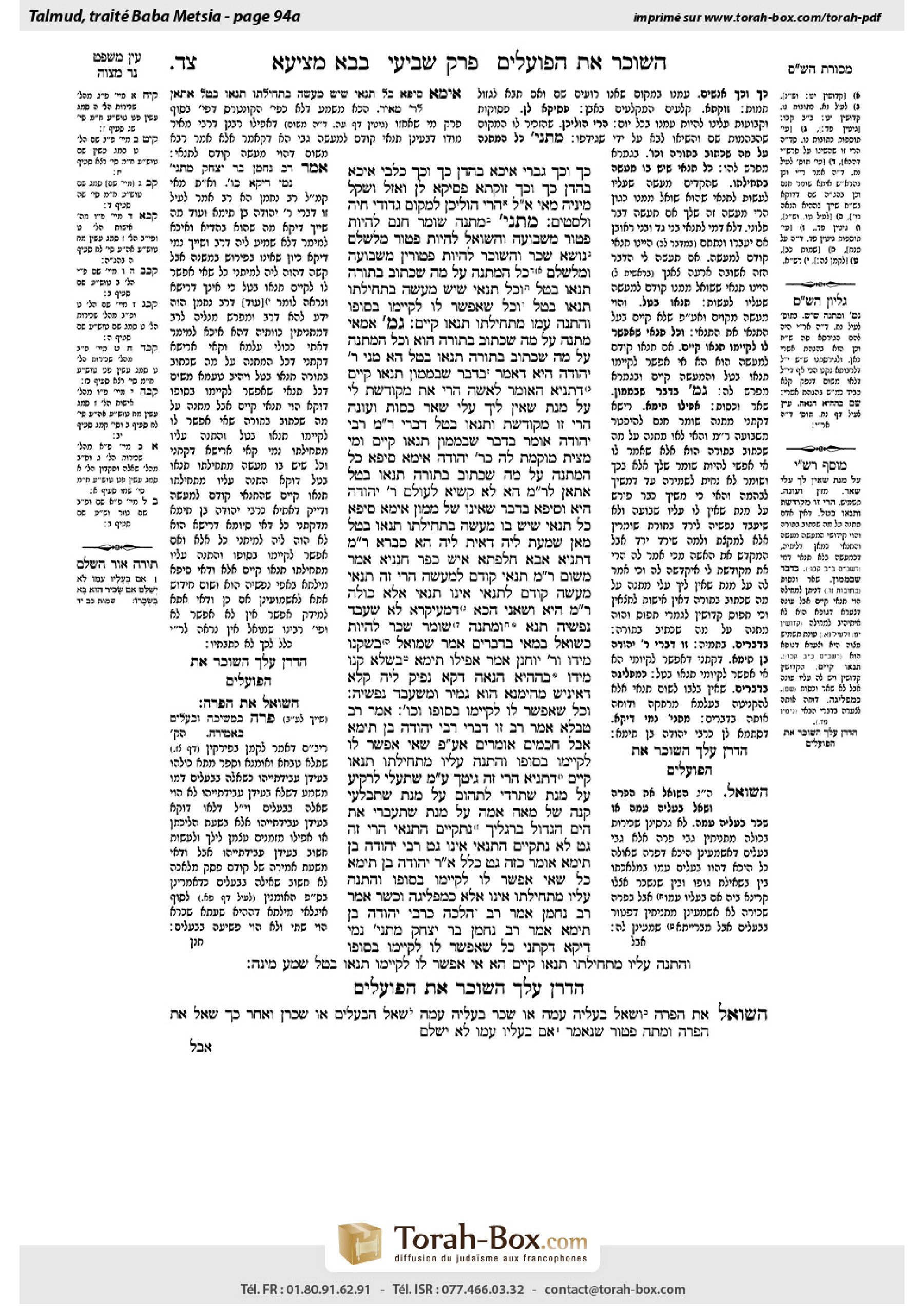
Bava Metzia 94a: Talmud study for Daf Yomi
Study the Talmud for Daf Yomi with scanned pages, Hebrew text, English translations from Sefaria and AI-generated French translations.
Passage selection and English or AI-generated French translation are available where the scan has annotations. Daf Study is independent of Torah-Box and Sefaria.
Browse Bava Metzia · בבא מציעא · All tractatesBava Metzia 94a text and translations
This page of Bava Metzia includes the Aramaic text, an English translation and an AI-generated French translation, alongside the scan above.
בבא מציעא צ״ד א · Aramaic and Hebrew text
כָּךְ וְכָךְ גַּבְרֵי אִיכָּא בַּהֲדַן, כָּךְ וְכָךְ כַּלְבֵי אִיכָּא בַּהֲדַן, כָּךְ וְכָךְ זוּקָתָא פְּסִיקָא לַן. וַאֲזַל וּשְׁקַל מִינֵּיהּ, מַאי? אֲמַר לֵיהּ: הֲרֵי הוֹלִיכָן לִמְקוֹם גְּדוּדֵי חַיָּה וְלִסְטִים.
מַתְנִי׳ מַתְנֶה שׁוֹמֵר חִנָּם לִהְיוֹת פָּטוּר מִשְּׁבוּעָה, וְהַשּׁוֹאֵל לִהְיוֹת פָּטוּר מִלְּשַׁלֵּם, נוֹשֵׂא שָׂכָר וְהַשּׂוֹכֵר לִהְיוֹת פְּטוּרִין מִשְּׁבוּעָה וּמִלְּשַׁלֵּם. כׇּל הַמַּתְנֶה עַל מַה שֶּׁכָּתוּב בַּתּוֹרָה – תְּנָאוֹ בָּטֵל,
וְכׇל תְּנַאי שֶׁיֵּשׁ מַעֲשֶׂה בִּתְחִילָּתוֹ – תְּנָאוֹ בָּטֵל. וְכׇל שֶׁאֶפְשָׁר לוֹ לְקַיְּימוֹ בְּסוֹפוֹ, וְהִתְנָה עִמּוֹ מִתְּחִילָּתוֹ – תְּנָאוֹ קַיָּים.
גְּמָ׳ אַמַּאי? מַתְנֶה עַל מַה שֶּׁכָּתוּב בַּתּוֹרָה הוּא, וְכׇל הַמַּתְנֶה עַל מַה שֶּׁכָּתוּב בַּתּוֹרָה תְּנָאוֹ בָּטֵל!
הָא מַנִּי – רַבִּי יְהוּדָה הִיא, דְּאָמַר: בְּדָבָר שֶׁבְּמָמוֹן – תְּנָאוֹ קַיָּים. דְּתַנְיָא: הָאוֹמֵר לְאִשָּׁה ״הֲרֵי אַתְּ מְקוּדֶּשֶׁת לִי עַל מְנָת שֶׁאֵין לִיךְ עָלַי שְׁאֵר כְּסוּת וְעוֹנָה״ – הֲרֵי זוֹ מְקוּדֶּשֶׁת, וּתְנָאוֹ בָּטֵל, דִּבְרֵי רַבִּי מֵאִיר. רַבִּי יְהוּדָה אוֹמֵר: בְּדָבָר שֶׁבְּמָמוֹן – תְּנָאוֹ קַיָּים.
וּמִי מָצֵית מוֹקְמַתְּ לַהּ כְּרַבִּי יְהוּדָה? אֵימָא סֵיפָא: כׇּל הַמַּתְנֶה עַל מַה שֶּׁכָּתוּב בַּתּוֹרָה – תְּנָאוֹ בָּטֵל, אֲתָאן לְרַבִּי מֵאִיר! הָא לָא קַשְׁיָא: לְעוֹלָם רַבִּי יְהוּדָה הִיא, וְסֵיפָא – בְּדָבָר שֶׁאֵינוֹ שֶׁל מָמוֹן.
אֵימָא סֵיפָא: כׇּל תְּנַאי שֶׁיֵּשׁ בּוֹ מַעֲשֶׂה בִּתְחִילָּתוֹ – תְּנָאוֹ בָּטֵל, מַאן שָׁמְעַתְּ לֵיהּ דְּאִית לֵיהּ הָא סְבָרָא – רַבִּי מֵאִיר, דְּתַנְיָא: אַבָּא חֲלַפְתָּא אִישׁ כְּפַר חֲנַנְיָא אָמַר מִשּׁוּם רַבִּי מֵאִיר: תְּנַאי קוֹדֵם לַמַּעֲשֶׂה – הֲרֵי זֶה תְּנַאי, מַעֲשֶׂה קוֹדֵם לַתְּנַאי – אֵינוֹ תְּנַאי.
אֶלָּא כּוּלַּהּ רַבִּי מֵאִיר הִיא, וְשָׁאנֵי הָכָא, דְּמֵעִיקָּרָא לָא שַׁעְבֵּד נַפְשֵׁיהּ.
תָּנָא: וּמַתְנֶה שׁוֹמֵר שָׂכָר לִהְיוֹת כְּשׁוֹאֵל. בְּמַאי? בִּדְבָרִים?! אָמַר שְׁמוּאֵל: בְּשֶׁקָּנוּ מִיָּדוֹ.
וְרַבִּי יוֹחָנָן אָמַר: אֲפִילּוּ תֵּימָא בְּשֶׁלֹּא קָנוּ מִיָּדוֹ, בְּהָהִיא הֲנָאָה דְּקָא נָפֵיק לֵיהּ קָלָא דְּאִינִישׁ מְהֵימְנָא הוּא – גָּמַיר וּמְשַׁעְבֵּד נַפְשֵׁיהּ.
וְכׇל שֶׁאֶפְשָׁר לוֹ לְקַיְּימוֹ בְּסוֹפוֹ וְכוּ׳. אָמַר רַב טַבְלָא אָמַר רַב: זוֹ דִּבְרֵי רַבִּי יְהוּדָה בֶּן תֵּימָא. אֲבָל חֲכָמִים אוֹמְרִים: אַף עַל פִּי שֶׁאִי אֶפְשָׁר לוֹ לְקַיְּימוֹ בְּסוֹפוֹ וְהִתְנָה עָלָיו מִתְּחִילָּתוֹ – תְּנָאוֹ קַיָּים.
דְּתַנְיָא: ״הֲרֵי זֶה גִּיטִּךְ עַל מְנָת שֶׁתַּעֲלִי לָרָקִיעַ, עַל מְנָת שֶׁתֵּרְדִי לַתְּהוֹם, עַל מְנָת שֶׁתִּבְלְעִי קָנֶה שֶׁל מֵאָה אַמָּה, עַל מְנָת שֶׁתַּעַבְרִי אֶת הַיָּם הַגָּדוֹל בְּרַגְלַיִךְ״, נִתְקַיֵּים הַתְּנַאי – הֲרֵי זֶה גֵּט, לֹא נִתְקַיֵּים הַתְּנַאי – אֵינוֹ גֵּט.
רַבִּי יְהוּדָה בֶּן תֵּימָא אוֹמֵר: כָּזֶה – גֵּט. כְּלָל אָמַר רַבִּי יְהוּדָה בֶּן תֵּימָא: כֹּל שֶׁאִי אֶפְשָׁר לוֹ לְקַיְּימוֹ בְּסוֹפוֹ, וְהִתְנָה עָלָיו מִתְּחִילָּתוֹ – אֵינוֹ אֶלָּא כְּמַפְלִיגָהּ וְכָשֵׁר.
אָמַר רַב נַחְמָן אָמַר רַב: הֲלָכָה כְּרַבִּי יְהוּדָה בֶּן תֵּימָא. אָמַר רַב נַחְמָן בַּר יִצְחָק: מַתְנִיתִין נָמֵי דַּיְקָא, דְּקָתָנֵי: כׇּל שֶׁאֶפְשָׁר לוֹ לְקַיְּימוֹ בְּסוֹפוֹ וְהִתְנָה עָלָיו מִתְּחִילָּתוֹ – תְּנָאוֹ קַיָּים, הָא אִי אֶפְשָׁר לוֹ לְקַיְּימוֹ – תְּנָאוֹ בָּטֵל. שְׁמַע מִינַּהּ.
הֲדַרַן עֲלָךְ הַשּׂוֹכֵר אֶת הַפּוֹעֲלִים.
מַתְנִי׳ הַשּׁוֹאֵל אֶת הַפָּרָה וְשָׁאַל בְּעָלֶיהָ עִמָּהּ, אוֹ שָׂכַר בְּעָלֶיהָ עִמָּהּ, שָׁאַל הַבְּעָלִים אוֹ שְׂכָרָן וְאַחַר כָּךְ שָׁאַל אֶת הַפָּרָה וָמֵתָה – פָּטוּר, שֶׁנֶּאֱמַר: ״אִם בְּעָלָיו עִמּוֹ לֹא יְשַׁלֵּם״.
Bava Metzia 94a · English translation
we have such and such men with us; such and such dogs with us, and such and such slings [zukata] with us. In other words, we are fully protected and you should not dare to take anything from us. If the thief subsequently went and took an animal from him, what is the halakha? Rava said to Abaye: It is as though he has taken them to a place of groups of beasts and bandits, as his taunting of the thief motivated the theft.
MISHNA: The halakhot of bailees stated in the previous mishna apply to standard cases. The halakha is that in any case involving monetary matters the parties may agree to special terms. Therefore, an unpaid bailee may stipulate with the owner that he will be exempt from taking an oath if the item is lost, and similarly, a borrower may stipulate that he will be exempt from having to pay, and a paid bailee or a renter can stipulate that he will be exempt from taking an oath and from having to pay, as one can relinquish his monetary rights. With regard to matters that do not involve monetary claims, anyone who stipulates counter to that which is written in the Torah, his stipulation is void.
And any condition that is preceded by an action, i.e., the agreement is formulated with the promise of an action followed by a statement that this action will be carried out only under certain terms, the condition is void and the promise remains intact. The condition must be stated before the action. And with regard to any condition that one can ultimately fulfill, but he stipulated with him initially, i.e., in practice the action is performed first, followed by the fulfillment of the condition, nevertheless, because it was formulated in the proper manner, with the condition first, his condition is valid. If the condition cannot be fulfilled at all, once the action has been carried out the condition is void.
GEMARA: The Gemara asks a question with regard to the mishna’s statement that bailees can issue conditions and change the liabilities imposed on them by Torah law: Why are they able to do so? This is a case of one who stipulates counter to that which is written in the Torah, as the Torah determines who takes an oath and who must pay, and with regard to anyone who stipulates counter to that which is written in the Torah, his condition is void.
The Gemara explains: In accordance with whose opinion is this mishna? It is that of Rabbi Yehuda, who says that if the condition that runs counter to that which is written in the Torah is referring to monetary matters, his condition is valid. As it is taught in a baraita: With regard to one who says to a woman: You are hereby betrothed to me on the condition that you have no claim against me to give you food, clothing, and conjugal rights, she is betrothed but his condition is void; this is the statement of Rabbi Meir. And Rabbi Yehuda said: With regard to monetary matters, i.e., her food and clothing, his condition is valid.
The Gemara raises a difficulty: But can you establish the mishna in accordance with the opinion of Rabbi Yehuda? Say the latter clause of the mishna: Anyone who stipulates counter to that which is written in the Torah, his condition is void. In this clause we arrive at the opinion of Rabbi Meir. The Gemara answers: This is not difficult, as actually you can explain that the mishna is in accordance with the opinion of Rabbi Yehuda, and the latter clause is referring to non-monetary matters.
The Gemara continues to question this explanation: But say the latter clause from near the end of the mishna: And any condition that is preceded by an action, the condition is void. Who have you heard who accepts this reasoning? It is Rabbi Meir, as it is taught in a baraita: Abba Ḥalafta, from the village of Ḥananya, said in the name of Rabbi Meir: If a condition was stated before the action, this is a valid condition, but if the action came before the condition, it is not a valid condition.
Rather, the Gemara retracts the previous explanation and states that the entire mishna is in accordance with the opinion of Rabbi Meir. Why, then, is the bailee exempt from payment or an oath? Because here it is different, as at the outset he did not obligate himself in the halakhot of a bailee as stated in the Torah. Before he entered into the agreement, he clearly stated that he is unwilling to accept upon himself the liabilities of a paid or an unpaid bailee by Torah law.
A Sage taught in a baraita: Just as a bailee can issue a condition that he should be exempt, the converse is also possible: A paid bailee can stipulate to be like a borrower, i.e., he can accept upon himself all the responsibilities of a borrower. The Gemara asks: By what means is this commitment binding? Is it merely by speech alone? Mere speech is not sufficient to demonstrate a commitment of this kind. Shmuel said: No; it is referring to a case where the owner performed an act of acquisition with the bailee affirming this arrangement. The obligation goes into effect only if there was an act of acquisition.
And Rabbi Yoḥanan said: You may even say that it is referring to a situation where the owner did not perform an act of acquisition with the bailee, and even so he is liable as a borrower. The reason is that by means of that benefit he receives from the fact that a rumor goes out about him that he is a trustworthy person, he commits wholeheartedly to obligate himself, even by means of a verbal promise alone. Therefore, there is no need for a formal act of acquisition.
§ The mishna teaches: With regard to any condition that ultimately can be fulfilled, if he stipulated it initially, his condition is valid. Rav Tavla says that Rav says: This is the statement of Rabbi Yehuda ben Teima, but the Rabbis say: Even though one cannot ultimately fulfill the condition, and he stipulated with regard to it initially, his condition is valid.
As it is taught in a baraita: If a man said to his wife: This is your bill of divorce on the condition that you ascend to the skies, or on the condition that you descend to the depths; or on the condition that you swallow a reed of one hundred cubits in size; or on the condition that you cross the Great Sea by foot, only if the condition was fulfilled and she did as he demanded is this a valid bill of divorce, but if the condition was not fulfilled it is not a valid bill of divorce. According to this tanna, the condition is binding despite the fact that it cannot be fulfilled in practice.
Rabbi Yehuda ben Teima says: A document such as this is a valid bill of divorce. The condition is negated, and therefore the bill of divorce is valid even though the condition was not fulfilled. As Rabbi Yehuda ben Teima stated a principle: With regard to any condition that one cannot ultimately fulfill, i.e., a condition that cannot be fulfilled at all, and yet he stipulated to this effect, even if he did so initially, he is considered as only exaggerating, and the document is valid. The supposed condition is not taken seriously and is not binding.
Rav Naḥman says that Rav says: The halakha is in accordance with the opinion of Rabbi Yehuda ben Teima. Rav Naḥman bar Yitzḥak said: The mishna is also precisely formulated in accordance with this opinion, as it teaches: With regard to any condition that ultimately he can fulfill, and he stipulated with regard to it initially, his condition is valid. This indicates that if he cannot fulfill it, his condition is void. The Gemara affirms: One can learn from this formulation that the unattributed mishna does in fact represent the opinion of Rabbi Yehuda ben Teima.
MISHNA: In the case of one who borrowed a cow and borrowed the services of its owner with it, or he borrowed a cow and hired its owner with it, or he borrowed the services of the owner or hired him and afterward borrowed the cow; in all such cases, if the cow died, the borrower is exempt from liability. Although a borrower is generally liable to pay if a cow he borrowed dies, here he is exempt, as it is stated: “If its owner is with him, he does not pay” (Exodus 22:14).
Bava Metzia 94a · Traduction française (IA)
Nous avons tels et tels hommes avec nous ; tels et tels chiens avec nous, et tels et tels arcs [zukata] avec nous. En d'autres termes, nous sommes pleinement protégés et vous ne devriez pas oser prendre quelque chose de nous. Si le voleur est ensuite allé prendre un animal de lui, quelle est la halakha ? Rava a dit à Abaye : C'est comme s'il avait amené les animaux à un lieu de troupeaux et de bandits, car son provocation envers le voleur a motivé le vol.
MICHNA : Les halakhot des dépositaires énoncées dans la précédente mishna s'appliquent aux cas normaux. La halakha est que dans tout cas concernant des affaires monétaires, les parties peuvent convenir de termes spéciaux. Ainsi, un dépositaire non rémunéré peut stipuler avec l'owner qu'il sera exempt de prendre un serment si l'objet est perdu, et de même, un emprunteur peut stipuler qu'il sera exempt de devoir payer, et un dépositaire rémunéré ou un locataire peut stipuler qu'il sera exempt de prendre un serment et de devoir payer, car l'on peut renoncer à ses droits monétaires. En ce qui concerne les affaires qui ne comportent pas de revendications monétaires, toute stipulation contraire à ce qui est écrit dans la Torah est nulle.
Et toute condition qui précède une action, c'est-à-dire que l'accord est formulé avec la promesse d'une action suivie d'une déclaration selon laquelle cette action sera exécutée uniquement sous certaines conditions, la condition est nulle et la promesse reste valide. La condition doit être énoncée avant l'action. Et concernant toute condition dont l'on peut finalement s'acquitter, mais qu'on a stipulé d'abord, c'est-à-dire que dans la pratique l'action est d'abord exécutée, suivie de l'accomplissement de la condition, néanmoins, parce qu'elle a été formulée correctement, avec la condition d'abord, sa condition est valide. Si la condition ne peut être accomplie du tout, une fois l'action exécutée, la condition est nulle.
GUEMARA : La Guemara pose une question concernant l'énoncé de la mishna selon lequel les dépositaires peuvent émettre des conditions et modifier les obligations imposées par la loi divine : Pourquoi peuvent-ils le faire ? C'est un cas d'une personne qui stipule contrairement à ce qui est écrit dans la Torah, car la Torah détermine qui doit prendre un serment et qui doit payer, et concernant toute personne qui stipule contrairement à ce qui est écrit dans la Torah, sa stipulation est nulle.
La Guemara explique : Selon l'opinion de qui est cette mishna ? Celle de Rabbi Yehuda, qui dit que si la condition qui contredit ce qui est écrit dans la Torah concerne des affaires monétaires, sa condition est valide. Comme il est enseigné dans une baraïta : Concernant celui qui dit à une femme : Tu es désormais mariée à moi sous la condition que tu n'as pas de revendication contre moi pour me donner à manger, vêtements et droits conjugaux, elle est mariée mais sa condition est nulle ; c'est l'opinion de Rabbi Meir. Et Rabbi Yehuda a dit : Concernant les affaires monétaires, c'est-à-dire son alimentation et ses vêtements, sa condition est valide.
La Guemara soulève une difficulté : Mais pouvez-vous établir la mishna selon l'opinion de Rabbi Yehuda ? Dites la dernière partie de la mishna : Tout celui qui stipule contrairement à ce qui est écrit dans la Torah, sa stipulation est nulle. Dans cette partie nous arrivons à l'opinion de Rabbi Meir. La Guemara répond : Ce n'est pas difficile, car en réalité vous pouvez expliquer que la mishna est selon l'opinion de Rabbi Yehuda, et la dernière partie fait référence aux affaires non monétaires.
La Guemara continue à poser des questions sur cette explication : Mais dites la dernière partie de la mishna : Et toute condition qui est précédée d'une action, la condition est nulle. Qui avez-vous entendu accepter ce raisonnement ? C'est Rabbi Meir, comme il est enseigné dans une baraïta : Abba Ḥalafta, du village de Ḥananya, a dit en nom de Rabbi Meir : Si une condition a été énoncée avant l'action, c'est une condition valide, mais si l'action est venue avant la condition, ce n'est pas une condition valide.
Plutôt, la Guemara retire l'explication précédente et affirme que toute la mishna est selon l'opinion de Rabbi Meir. Pourquoi, alors, le dépositaire est-il exempt de paiement ou de serment ? Parce que c'est différent ici, car au départ il n'a pas s'engagé dans les halakhot d'un dépositaire comme le stipule la Torah. Avant d'entrer dans l'accord, il a clairement déclaré qu'il ne souhaitait pas s'engager dans les obligations d'un dépositaire rémunéré ou non rémunéré selon la loi divine.
Un Sage a enseigné dans une baraïta : Tout comme un dépositaire peut émettre une condition selon laquelle il sera exempt, l'inverse est également possible : un dépositaire rémunéré peut stipuler d'être comme un emprunteur, c'est-à-dire qu'il peut s'engager à assumer toutes les responsabilités d'un emprunteur. La Guemara pose une question : Par quel moyen cette promesse est-elle engageante ? Est-ce uniquement par la parole ? La parole seule n'est pas suffisante pour démontrer un tel engagement. Shmuel a dit : Non ; il s'agit d'un cas où l'owner a accompli un acte d'acquisition avec le dépositaire en affirmant cette disposition. L'obligation prend effet uniquement s'il y a eu un acte d'acquisition.
Et Rabbi Yoḥanan a dit : On peut même dire qu'il s'agit d'un cas où l'owner n'a pas accompli un acte d'acquisition avec le dépositaire, et même ainsi il est tenu responsable comme emprunteur. La raison est que par le biais du bénéfice qu'il reçoit, à savoir que la rumeur circule à son sujet qu'il est une personne de confiance, il s'engage pleinement, même par une promesse verbale seule. Ainsi, il n'est pas nécessaire d'avoir un acte d'acquisition formel.
§ La mishna enseigne : Concernant toute condition dont on peut finalement s'acquitter, si l'on a stipulé cela d'abord, sa condition est valide. Rav Tavla dit que Rav dit : C'est l'opinion de Rabbi Yehuda ben Teima, mais les Rabbins disent : Même si l'on ne peut pas finalement accomplir la condition, et qu'on a stipulé cela d'abord, sa condition est valide.
Comme il est enseigné dans une baraïta : Si un homme dit à sa femme : C'est ton divorce à condition que tu montes au ciel, ou à condition que tu descends aux profondeurs ; ou à condition que tu avales un roseau de cent coudées de longueur ; ou à condition que tu traverses la grande mer à pied, ce divorce est valide uniquement si la condition a été accomplie et qu'elle a été exécutée par elle, mais si la condition n'a pas été accomplie, ce n'est pas un divorce valide. Selon ce tanna, la condition est contraignante malgré le fait qu'elle ne peut pas être accomplie en pratique.
Rabbi Yehuda ben Teima dit : Un document tel que celui-ci est un divorce valide. La condition est nulle, et par conséquent le divorce est valide même si la condition n'a pas été accomplie. Comme Rabbi Yehuda ben Teima a déclaré un principe : En ce qui concerne toute condition que l'on ne peut pas finalement accomplir, c'est-à-dire une condition qui ne peut pas être accomplie du tout, et pourtant il a stipulé à cet égard, même s'il l'a fait initialement, il est considéré comme seulement exagérer, et le document est valide. La condition supposée n'est pas prise au sérieux et n'est pas contraignante.
Rav Naḥman dit que Rav dit : La halakha suit l'opinion de Rabbi Yehuda ben Teima. Rav Naḥman bar Yitzḥak dit : La mésna est également formulée exactement selon cette opinion, car elle enseigne : En ce qui concerne toute condition qu'il peut finalement accomplir, et qu'il a stipulé initialement, sa condition est valide. Cela indique que si il ne peut pas l'accomplir, sa condition est nulle. La Guemara affirme : On peut apprendre de cette formulation que la mésna non attribuée représente effectivement l'opinion de Rabbi Yehuda ben Teima.
MICHNA : Dans le cas d'une personne qui a emprunté une vache et a emprunté les services de son propriétaire avec elle, ou s'il a emprunté une vache et a engagé son propriétaire avec elle, ou s'il a emprunté les services du propriétaire ou l'a engagé et après cela a emprunté la vache ; dans tous ces cas, si la vache meurt, le prêteur est exempt de responsabilité. Bien qu'un prêteur soit généralement tenu de payer si une vache qu'il a empruntée meurt, ici il est exempt, car il est dit : « Si son propriétaire est avec lui, il ne paie pas » (Exode 22:14).
Traduction française générée par IA à partir de l’édition anglaise de Sefaria. Vérifie toujours un passage avec le texte source.
Text from Sefaria: William Davidson Edition - Vocalized Aramaic (CC BY NC); William Davidson Edition - English (CC BY NC).