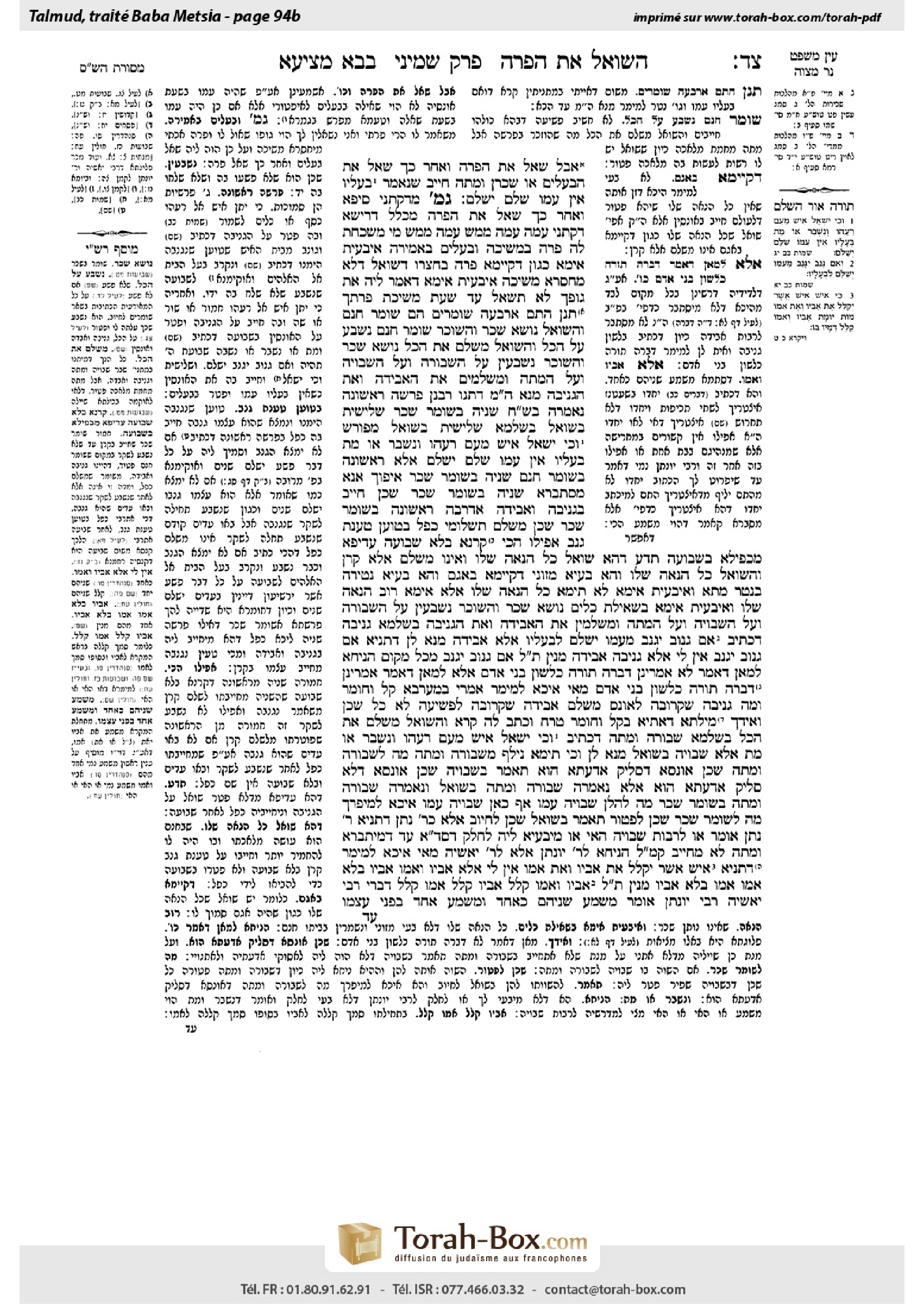
Bava Metzia 94b: Talmud study for Daf Yomi
Study the Talmud for Daf Yomi with scanned pages, Hebrew text, English translations from Sefaria and AI-generated French translations.
Passage selection and English or AI-generated French translation are available where the scan has annotations. Daf Study is independent of Torah-Box and Sefaria.
Browse Bava Metzia · בבא מציעא · All tractatesBava Metzia 94b text and translations
This page of Bava Metzia includes the Aramaic text, an English translation and an AI-generated French translation, alongside the scan above.
בבא מציעא צ״ד ב · Aramaic and Hebrew text
אֲבָל שָׁאַל אֶת הַפָּרָה וְאַחַר כָּךְ שָׁאַל אֶת הַבְּעָלִים, אוֹ שְׂכָרָן, וָמֵתָה – חַיָּיב, שֶׁנֶּאֱמַר: ״בְּעָלָיו אֵין עִמּוֹ שַׁלֵּם יְשַׁלֵּם״.
גְּמָ׳ מִדְּקָתָנֵי סֵיפָא: וְאַחַר כָּךְ שָׁאַל אֶת הַפָּרָה, מִכְּלָל דְּרֵישָׁא דְּקָתָנֵי ״עִמָּהּ״ – עִמָּהּ מַמָּשׁ. עִמָּהּ מַמָּשׁ, מִי מַשְׁכַּחַתְּ לַהּ פָּרָה בִּמְשִׁיכָה, וּבְעָלִים בַּאֲמִירָה?
אִיבָּעֵית אֵימָא: כְּגוֹן דְּקַיְימָא פָּרָה בַּחֲצֵרוֹ דְּשׁוֹאֵל, דְּלָא מְחַסְּרָא מְשִׁיכָה. אִיבָּעֵית אֵימָא: דַּאֲמַר לֵיהּ ״אַתְּ גּוּפָךְ לֹא תִּשָּׁאֵל עַד שְׁעַת מְשִׁיכַת פָּרָתְךָ״.
תְּנַן הָתָם, אַרְבָּעָה שׁוֹמְרִים הֵם: שׁוֹמֵר חִנָּם וְהַשּׁוֹאֵל, נוֹשֵׂא שָׂכָר וְהַשּׂוֹכֵר.
שׁוֹמֵר חִנָּם נִשְׁבָּע עַל הַכֹּל, וְהַשּׁוֹאֵל מְשַׁלֵּם אֶת הַכֹּל, נוֹשֵׂא שָׂכָר וְהַשּׂוֹכֵר – נִשְׁבָּעִין עַל הַשְּׁבוּרָה וְעַל הַשְּׁבוּיָה וְעַל הַמֵּתָה, וּמְשַׁלְּמִים אֶת הָאֲבֵידָה וְאֶת הַגְּנֵיבָה.
מְנָא הָנֵי מִילֵּי? דְּתָנוּ רַבָּנַן: פָּרָשָׁה רִאשׁוֹנָה נֶאֶמְרָה בְּשׁוֹמֵר חִנָּם, שְׁנִיָּה – בְּשׁוֹמֵר שָׂכָר, שְׁלִישִׁית – בְּשׁוֹאֵל.
בִּשְׁלָמָא שְׁלִישִׁית בְּשׁוֹאֵל – מְפוֹרָשׁ: ״וְכִי יִשְׁאַל אִישׁ מֵעִם רֵעֵהוּ וְנִשְׁבַּר אוֹ מֵת בְּעָלָיו אֵין עִמּוֹ שַׁלֵּם יְשַׁלֵּם״. אֶלָּא רִאשׁוֹנָה בְּשׁוֹמֵר חִנָּם, שְׁנִיָּה בְּשׁוֹמֵר שָׂכָר – אֵיפוֹךְ אֲנָא!
מִסְתַּבְּרָא שְׁנִיָּה בְּשׁוֹמֵר שָׂכָר, שֶׁכֵּן חַיָּיב בִּגְנֵיבָה וַאֲבֵידָה. אַדְּרַבָּה: רִאשׁוֹנָה בְּשׁוֹמֵר שָׂכָר, שֶׁכֵּן מְשַׁלֵּם תַּשְׁלוּמֵי כֶפֶל בְּטוֹעֵן טַעֲנַת גַּנָּב!
אֲפִילּוּ הָכִי, קַרְנָא בְּלָא שְׁבוּעָה עֲדִיפָא מִכְּפֵילָא בִּשְׁבוּעָה.
תִּדַּע, דְּהָא שׁוֹאֵל כׇּל הֲנָאָה שֶׁלּוֹ וְאֵינוֹ מְשַׁלֵּם אֶלָּא קֶרֶן.
וְהַשּׁוֹאֵל כׇּל הֲנָאָה שֶׁלּוֹ? וְהָא בָּעֲיָא מְזוֹנֵי! דְּקַיְימָא בַּאֲגַם. וְהָא בָּעֲיָא נְטִירָה! בְּנָטַר מָתָא. וְאִיבָּעֵית אֵימָא: לָא תֵּימָא ״כׇּל הֲנָאָה שֶׁלּוֹ״, אֶלָּא אֵימָא ״רוֹב הֲנָאָה שֶׁלּוֹ״. וְאִיבָּעֵית אֵימָא: בִּשְׁאֵילַת כֵּלִים.
נוֹשֵׂא שָׂכָר וְהַשּׂוֹכֵר נִשְׁבָּעִין עַל הַשְּׁבוּרָה וְעַל הַשְּׁבוּיָה וְעַל הַמֵּתָה, וּמְשַׁלְּמִין אֶת הָאֲבֵידָה וְאֶת הַגְּנֵיבָה.
בִּשְׁלָמָא גְּנֵיבָה, דִּכְתִיב: ״אִם גָּנוֹב יִגָּנֵב מֵעִמּוֹ יְשַׁלֵּם לִבְעָלָיו״, אֶלָּא אֲבֵידָה מְנָא לַן? דְּתַנְיָא: ״אִם גָּנֵב יִגָּנֵב״ – אֵין לִי אֶלָּא גְּנֵיבָה, אֲבֵידָה מִנַּיִן? תַּלְמוּד לוֹמַר: ״אִם גָּנוֹב יִגָּנֵב״, מִכׇּל מָקוֹם.
הָנִיחָא לְמַאן דְּאָמַר: לָא אָמְרִינַן דִּבְּרָה תוֹרָה כִּלְשׁוֹן בְּנֵי אָדָם. אֶלָּא לְמַאן דְּאָמַר: אָמְרִינַן דִּבְּרָה תוֹרָה כִלְשׁוֹן בְּנֵי אָדָם, מַאי אִיכָּא לְמֵימַר?
אָמְרִי בְּמַעְרְבָא: קַל וָחוֹמֶר; וּמָה גְּנֵיבָה שֶׁקְּרוֹבָה לְאוֹנֶס – מְשַׁלֵּם, אֲבֵידָה שֶׁקְּרוֹבָה לִפְשִׁיעָה – לֹא כׇּל שֶׁכֵּן!
וְאִידַּךְ, מִילְּתָא דְּאָתְיָא בְּקַל וְחוֹמֶר טָרַח וְכָתַב לַהּ קְרָא.
וְהַשּׁוֹאֵל מְשַׁלֵּם אֶת הַכֹּל. בִּשְׁלָמָא שְׁבוּרָה וּמֵתָה, דִּכְתִיב: ״וְכִי יִשְׁאַל אִישׁ מֵעִם רֵעֵהוּ וְנִשְׁבַּר אוֹ מֵת״. אֶלָּא שְׁבוּיָה בְּשׁוֹאֵל מְנָא לַן?
וְכִי תֵּימָא נֵילַף מִשְּׁבוּרָה וּמֵתָה, מָה לִשְׁבוּרָה וּמֵתָה – שֶׁכֵּן אוּנְסָא דְּסָלֵיק אַדַּעְתָּא הוּא. תֹּאמַר בִּשְׁבוּיָה – שֶׁכֵּן אוּנְסָא דְּלָא סָלֵיק אַדַּעְתָּא הוּא!
אֶלָּא: נֶאֶמְרָה שְׁבוּרָה וּמֵתָה בְּשׁוֹאֵל, וְנֶאֶמְרָה שְׁבוּרָה וּמֵתָה בְּשׁוֹמֵר שָׂכָר. מָה לְהַלָּן שְׁבוּיָה עִמּוֹ, אַף כָּאן שְׁבוּיָה עִמּוֹ.
אִיכָּא לְמִיפְרַךְ: מָה לְשׁוֹמֵר שָׂכָר שֶׁכֵּן לִפְטוּר, תֹּאמַר בַּשּׁוֹאֵל שֶׁכֵּן לְחִיּוּב!
אֶלָּא כְּרַבִּי נָתָן, דְּתַנְיָא, רַבִּי נָתָן אוֹמֵר: ״אוֹ״ לְרַבּוֹת שְׁבוּיָה.
הַאי ״אוֹ״ מִיבַּעְיָא לֵיהּ לְחַלֵּק. דְּסָלְקָא דַּעְתָּךְ אָמֵינָא: עֵד דְּמִיתַּבְרָא וּמֵתָה לָא מְחַיֵּיב, קָא מַשְׁמַע לַן.
הָנִיחָא לְרַבִּי יוֹנָתָן. אֶלָּא לְרַבִּי יֹאשִׁיָּה, מַאי אִיכָּא לְמֵימַר?
דְּתַנְיָא: ״אִישׁ אֲשֶׁר יְקַלֵּל אֶת אָבִיו וְאֶת אִמּוֹ״, אֵין לִי אֶלָּא אָבִיו וְאִמּוֹ. אָבִיו בְּלֹא אִמּוֹ, אִמּוֹ בְּלֹא אָבִיו, מִנַּיִן? תַּלְמוּד לוֹמַר: ״אָבִיו וְאִמּוֹ קִלֵּל״. אָבִיו קִלֵּל, אִמּוֹ קִלֵּל. דִּבְרֵי רַבִּי יֹאשִׁיָּה.
רַבִּי יוֹנָתָן אוֹמֵר: מַשְׁמַע שְׁנֵיהֶם כְּאֶחָד, וּמַשְׁמַע אֶחָד בִּפְנֵי עַצְמוֹ –
Bava Metzia 94b · English translation
But if one first borrowed the cow and only afterward borrowed the services of the owner or hired him, and the cow died, he is liable to pay the owner for the cow. This is the halakha even if the owner was working for the borrower at the time, as it is stated: “If its owner is not with him, he shall pay” (Exodus 22:13).
GEMARA: From the fact that the latter clause teaches: And afterward borrowed the cow, it may be inferred that when the first clause teaches: Borrowed its owner with it, the intention is: Literally with it, i.e., at the same moment. The Gemara asks: Can you find such a case where the owner obligates himself to serve the borrower literally with it? Given that one borrows the cow through pulling the cow and contracts the services of the owner through their verbal agreement, it emerges that if they agree to both matters at the same time, one borrows the services of the owner before he borrows the cow, which is the case mentioned in the latter clause of the mishna. What, then, is the case mentioned in the first clause?
The Gemara answers: If you wish, say that the mishna is referring to a case such as where the cow is standing in the borrower’s courtyard, which can effect acquisition of the rights to use the cow for him, so that it does not lack, i.e., there is no need for, pulling. Accordingly, both the borrowing of the owner’s services and the borrowing of his cow will take effect simultaneously upon their agreement. Alternatively, if you wish, say that the case is where the borrower says to him: You, yourself, will not be lent to me until the moment of the pulling of your cow.
§ The Gemara analyses the halakhot of the four types of bailees that were delineated in the previous chapter: We learned in a mishna there (93a): There are four types of bailees: An unpaid bailee, and the borrower, a paid bailee, and the renter.
The mishna there continues: If the item was stolen, lost, or broken, or if the animal died in any manner, the halakhot with regard to them are as follows: An unpaid bailee takes an oath over every outcome; whether the item was lost, stolen, or broken, or if the animal died, the unpaid bailee must take an oath that it happened as he described, and he is then exempt from payment. And the borrower does not take an oath, but pays for every outcome, whether it was stolen or lost, even in a circumstance beyond his control. The halakhot of a paid bailee and a renter are the same: They take an oath over an injured animal, over a captured animal, and over a dead animal, attesting that the mishaps were caused by circumstances beyond their control, and they are exempt; but they must pay for loss or theft.
The Gemara asks: From where are these matters derived? As the Sages taught in a baraita: The verses in the Torah about bailees can be divided into three passages. The first passage (Exodus 22:6–8) is stated about an unpaid bailee; the second (Exodus 22:9–12) is about a paid bailee; and the third (Exodus 22:13–14) is about a borrower.
The Gemara asks: Granted, it is clear that the third passage is about a borrower, as the verse explicitly states: “And when a man borrows from another, and it is injured or dies, if its owner is not with him, he shall pay” (Exodus 22:13). But with regard to the claim of the baraita that the first passage is about an unpaid bailee and the second is about a paid bailee, I could also say the reverse, as the verses do not state which type of bailee they are referring to.
The Gemara justifies the claim of the baraita: Clearly a paid bailee carries a more severe level of liability than an unpaid bailee. Accordingly, it stands to reason that the second passage is about a paid bailee, as it states a stringency, that the bailee is liable even in cases of theft or loss (see Exodus 22:11). The Gemara challenges this claim: On the contrary, it stands to reason that the first passage is about a paid bailee, as it states a stringency, that the bailee pays the double payment in a case where he takes a false oath stating the claim that a thief stole the item he was safeguarding (see Exodus 22:6).
The Gemara explains: Even so, being liable to pay the principal whenever one claims the deposit was stolen, without the ability to exempt oneself by taking an oath, is a greater stringency than being liable for the double payment, as that liability is only when one takes a false oath to that effect. Otherwise, he is exempt.
The Gemara adds: Know that this is so, as a borrower bears the most severe level of liability, because he is privileged. All benefit from the transaction is his, without incurring any cost to himself. And in cases of theft he pays only the principal but is never required to pay the double payment.
The Gemara questions the proof just cited: But is it true that with regard to the borrower all benefit from the transaction is his? But doesn’t the animal require food, which the borrower must provide? The Gemara answers: The halakhot of a borrower also apply when the animal is standing in a marsh, where food is freely available. The Gemara persists: But doesn’t the animal require safeguarding? The Gemara answers: The halakhot of a borrower also apply when the borrower is a city guard and does not need to do anything additional to safeguard the animal. And if you wish, say: Do not say that all benefit is his, rather say: Most of the benefit is his, and that is sufficient reason to render him liable in all circumstances. And if you wish, say that the halakhot of a borrower apply also with regard to borrowing vessels, which do not require constant care. In any event, it is clear that a borrower is uniquely privileged and accordingly bears the most severe level of liability.
§ The mishna cited previously states: The halakhot of a paid bailee and a renter are the same: They take an oath over an injured animal, over a captured animal, and over a dead animal, attesting that the mishaps were caused by circumstances beyond their control, and they are exempt; but they must pay for loss or theft.
The Gemara asks: Granted, a paid bailee is liable in the case of theft, as it is written: “If it is stolen from him, he must pay its owner” (Exodus 22:11). But in a case of loss, from where do we derive that a paid bailee is liable? The Gemara answers: As it is taught in a baraita: From the verse: “If it is stolen [ganov yigganev],” I have derived only that a paid bailee is liable if the item he is safeguarding is stolen; from where do I derive he is liable also if it is lost? The verse states: “ganov yigganev,” repeating the verb for emphasis. This teaches that he is liable in any case, i.e., for loss as well as theft.
The Gemara asks: This works out well according to the one who says: We do not say that the Torah spoke in the language of people, and so any repeated verb must serve to teach additional halakhot. But according to the one who says: We do say that the Torah spoke in the language of people, and so the use of a repeated verb is only for stylistic reasons, what can be said? From where is it derived that the bailee is liable for losing the item?
They say in the West, Eretz Yisrael: It is derived through an a fortiori inference: If in a case of theft, which is near to being a case of circumstances beyond his control, the halakha is that the bailee pays the owner the item’s value, then in a case of loss, which is near to being a case of negligence, is it not all the more so logical that he should pay?
The Gemara asks: And according to the other opinion, why is there a need for a verse to teach this halakha if it can be derived from an a fortiori inference? The Gemara answers: At times, there is a matter that can be derived through an a fortiori inference, and the verse nevertheless takes the trouble and writes it explicitly.
§ The mishna cited above states: And the borrower does not take an oath, but pays for every outcome, whether it was stolen or lost, even in a circumstance beyond his control. The Gemara asks: Granted, the bailee is liable if the animal is injured or dies, as it is written: “And if a man borrows from another and it is injured or dies…he shall pay” (Exodus 22:13). But from where do we derive the liability of a borrower when the animal is captured?
And if you would say: Let us derive it from the fact the borrower is liable if the animal was injured or dies because they are all similarly cases of circumstances beyond his control, then one could counter as follows: What is notable about a case where the animal is injured or died? It is notable in that it is the type of unavoidable accident whose possibility of occurring entered one’s mind, so it is reasonable that the borrower accepted responsibility for such mishaps. Can you say the same about being captured, which is an unavoidable accident whose possibility of occurring does not enter one’s mind?
Rather, the liability of a borrower in a case where the animal is captured is derived as follows: The cases where the animal is injured or dies are stated in the passage about a borrower, and similarly the cases where it is injured or dies are stated in the passage about a paid bailee. Just as below, i.e., in the passage in the Torah concerning a paid bailee, the case in which it is captured is included with it, as the verse there states: “If a man deliver to his neighbor a donkey, or an ox, or a sheep, or any beast, to safeguard, and it die, or be hurt, or is captured” (Exodus 22:9); so too here, with regard to a borrower, the case where it is captured is included with it.
The Gemara explains that this derivation can be refuted as follows: What is notable about a paid bailee? He is notable in that the cases in which the animal is injured or dies are mentioned in order to exempt him from liability. Can you say this is also true with regard to a borrower, where the cases are mentioned in order to teach that he is liable?
Rather, the liability of a borrower in a case where the animal is captured is derived in accordance with the statement of Rabbi Natan, as it is taught in a baraita: Rabbi Natan says: The word “or” in the phrase “injured or dies” (Exodus 22:13) serves to include the case in which the animal was captured.
The Gemara asks: But this word “or” is required in order to divide the cases, as otherwise it could enter your mind to say that the bailee is not liable unless the animal is first injured and then also dies. Therefore, the term “or” is necessary to teach us that these are two separate cases.
The Gemara comments: This works out well according to the opinion of Rabbi Yonatan, that it is obvious that the borrower is liable even if the animal died without being injured first. Consequently, “or” is unnecessary, and so it can be used for Rabbi Natan’s derivation. But according to the opinion of Rabbi Yoshiya, what is there to say? According to his opinion, it is necessary for the Torah to state “or” in this case, to teach that the borrower is liable even if the animal dies without being injured first, and so it cannot be used for a derivation.
The Gemara explains: As it is taught in a baraita: From the verse: “A man who curses his father and his mother shall die” (Leviticus 20:9), I have derived only that one is liable if he curses both his father and his mother. From where do I derive that if one curses his father but not his mother, or his mother but not his father, that he is liable? The continuation of the verse states: “His father and his mother he has cursed, his blood is upon him.” In the first part of the verse, the word “curses” is in proximity to “his father,” and in the last part of the verse, it is in proximity to “his mother.” This teaches that the verse is referring to both a case where he cursed only his father and a case where he cursed only his mother; this is the statement of Rabbi Yoshiya.
Rabbi Yonatan says: There is no need for this derivation, because the phrase “his father and his mother” indicates that one is liable if he curses both of them together, and it also indicates that he is liable if he curses either one of them on their own,
Bava Metzia 94b · Traduction française (IA)
Mais si l'on emprunte d'abord la vache et ensuite seulement les services de l'propriétaire ou qu'on le rémunère, et que la vache meurt, il est tenu responsable de payer l'propriétaire pour la vache. C'est la halakha même si l'propriétaire travaillait pour l'emprunteur à ce moment-là, car il est dit : « Si son propriétaire n'est pas avec lui, il devra payer » (Exode 22:13).
GUEMARA : D'après le fait que la clause ultérieure enseigne : « Et ensuite emprunta la vache », on peut en déduire que lorsque la première clause enseigne : « Emprunta son propriétaire avec elle », l'intention est : littéralement avec elle, c'est-à-dire en même temps. La Guemara pose la question : peut-on trouver un cas où l'propriétaire s'engage à servir l'emprunteur littéralement avec lui ? Sachant que l'on emprunte la vache en la tirant et qu'on contracte les services de l'propriétaire par un accord verbal, il ressort que si l'on s'accorde sur les deux choses en même temps, l'emprunt des services de l'propriétaire a lieu avant l'emprunt de la vache, ce qui est le cas mentionné dans la clause ultérieure de la mishna. Quel est alors le cas mentionné dans la première clause ?
La Guemara répond : Si tu le souhaites, dis que la mishna fait référence à un cas où la vache est dans le courtil de l'emprunteur, ce qui permet l'acquisition des droits d'utilisation de la vache pour lui, de sorte qu'il n'y a pas besoin de tirer. Ainsi, à l'occasion de leur accord, l'emprunt des services de l'propriétaire et l'emprunt de sa vache prendront effet simultanément. Alternativement, si tu le souhaites, dis que le cas est celui où l'emprunteur dit à l'propriétaire : « Tu ne me seras pas prêté jusqu'au moment de la traction de ta vache. »
§ La Guemara examine les halakhot des quatre types de baileurs évoqués dans le chapitre précédent : Nous avons appris dans une mishna là (93a) : Il y a quatre types de baileurs : un baileur non rémunéré, et l'emprunteur, un baileur rémunéré, et le locataire.
La mishna continue : Si l'objet a été volé, perdu ou abîmé, ou si l'animal est mort de toute manière, les halakhot concernant ces cas sont les suivantes : Le baileur non rémunéré prend un serment sur chaque issue ; que l'objet ait été perdu, volé ou abîmé, ou que l'animal soit mort, le baileur non rémunéré doit prendre un serment qu'il s'est passé comme il l'a décrit, et il est alors exempt de paiement. L'emprunteur ne prend pas de serment, mais paie pour chaque issue, que ce soit volé ou perdu, même dans un cas au-delà de son contrôle. Les halakhot du baileur rémunéré et du locataire sont les mêmes : Ils prennent un serment sur un animal blessé, sur un animal capturé et sur un animal mort, attestant que les accidents sont causés par des circonstances au-delà de leur contrôle, et ils sont exemptés ; mais ils doivent payer pour la perte ou le vol.
La Guemara pose la question : D'où sont dérivés ces points ? Comme les Sages ont enseigné dans une baraïta : Les versets de la Torah concernant les baileurs peuvent être divisés en trois passages. Le premier passage (Exode 22:6–8) est concernant un baileur non rémunéré ; le second (Exode 22:9–12) est concernant un baileur rémunéré ; et le troisième (Exode 22:13–14) est concernant l'emprunteur.
La Guemara pose la question : C'est évident, en effet, que le troisième passage concerne un emprunteur, car le verset mentionne explicitement : « Et quand un homme emprunte à un autre, et qu'il est blessé ou mort, si son propriétaire n'est pas avec lui, il devra payer » (Exode 22:13). Mais concernant la revendication de la baraïta que le premier passage concerne un gardien non rémunéré et le second un gardien rémunéré, je pourrais aussi dire l'inverse, car les versets ne mentionnent pas quel type de gardien ils désignent.
La Guemara justifie la revendication de la baraïta : Il est clair qu'un gardien rémunéré supporte un niveau de responsabilité plus sévère qu'un gardien non rémunéré. Ainsi, il est logique que le second passage concerne un gardien rémunéré, car il mentionne une stricte exigence, que le gardien est tenu responsable même en cas de vol ou de perte (voir Exode 22:11). La Guemara conteste cette revendication : Au contraire, il est logique que le premier passage concerne un gardien rémunéré, car il mentionne une stricte exigence, que le gardien paie le double en cas où il affirme faussement que un voleur a volé l'objet qu'il gardait (voir Exode 22:6).
La Guemara explique : Même ainsi, être tenu de payer le principal chaque fois qu'on réclame que le dépôt a été volé, sans la possibilité d'exonérer par un serment, est une stricte exigence plus grande que d'être tenu de payer le double, car cette responsabilité n'est valable que lorsqu'on affirme faussement cela. Sinon, on est exempt.
La Guemara ajoute : Sache que c'est ainsi, car l'emprunteur supporte le niveau de responsabilité le plus sévère, car il est privilégié. Tout le bénéfice de la transaction est à lui, sans qu'il n'ait à supporter aucun coût. Et dans les cas de vol, il paie seulement le principal, mais n'est jamais tenu de payer le double.
La Guemara questionne la preuve citée précédemment : Mais est-ce vrai que concernant l'emprunteur tout le bénéfice de la transaction est à lui ? Mais ne faut-il pas que l'animal ait de la nourriture, que l'emprunteur doive fournir ? La Guemara répond : Les halakhot de l'emprunteur s'appliquent aussi lorsque l'animal est dans un marais, où la nourriture est librement disponible. La Guemara persiste : Mais ne faut-il pas que l'animal ait besoin de protection ? La Guemara répond : Les halakhot de l'emprunteur s'appliquent aussi lorsque l'emprunteur est un gardien de ville et n'a pas besoin de faire quoi que ce soit de plus pour protéger l'animal. Et si tu le souhaites, dis : N'assure pas que tout le bénéfice est à lui, plutôt dis : La plupart du bénéfice est à lui, et cela suffit à justifier qu'il soit tenu responsable dans tous les cas. Et si tu le souhaites, dis que les halakhot de l'emprunteur s'appliquent aussi concernant l'emprunt de récipients, qui n'ont pas besoin de soins constants. En tout cas, il est clair que l'emprunteur est unement privilégié et donc supporte le niveau de responsabilité le plus sévère.
§ La mishna citée précédemment affirme : Les halakhot du gardien rémunéré et du locataire sont les mêmes : Ils prennent un serment sur un animal blessé, sur un animal capturé et sur un animal mort, attestant que les accidents sont causés par des circonstances au-delà de leur contrôle, et ils sont exemptés ; mais ils doivent payer pour la perte ou le vol.
Le Guemara demande : Cela est admis, un baal késoubh qui est payé est responsable en cas de vol, car il est écrit : « Si quelque chose lui est volé, il doit payer son propriétaire » (Exode 22:11). Mais en cas de perte, d'où dérivons-nous que le baal késoubh payé est responsable ? Le Guemara répond : Comme il est enseigné dans une baraïta : De la parole « si quelque chose lui est volé [ganov yigganev] », j'ai dérivé seulement que le baal késoubh payé est responsable si l'objet qu'il garde est volé ; d'où dérive-t-on qu'il est responsable aussi en cas de perte ? La parole dit : « ganov yigganev », répétant le verbe pour l'accentuer. Cela enseigne qu'il est responsable dans tous les cas, c'est-à-dire pour la perte comme pour le vol.
Le Guemara demande : Cela s'explique bien selon celui qui dit : Nous ne disons pas que la Torah a parlé dans la langue des gens, et donc toute répétition de verbe doit servir à enseigner des halakhot supplémentaires. Mais selon celui qui dit : Nous disons que la Torah a parlé dans la langue des gens, et donc l'usage d'une répétition de verbe est seulement pour des raisons stylistiques, que peut-on dire ? D'où dérive-t-on que le baal késoubh est responsable de la perte de l'objet ?
Ils disent à l'Ouest, en Terre d'Israël : Cela se dérive par une inférence a fortiori : Si, dans le cas de vol, qui est proche d'être un cas de circonstances hors de son contrôle, la halakha est que le baal késoubh paie au propriétaire la valeur de l'objet, alors dans le cas de perte, qui est proche d'être un cas de négligence, n'est-il pas encore plus logique qu'il paie ?
Le Guemara demande : Et selon l'autre opinion, pourquoi a-t-on besoin d'un verset pour enseigner cette halakha si elle peut être dérivée par une inférence a fortiori ? Le Guemara répond : Parfois, il y a une matière qui peut être dérivée par une inférence a fortiori, et le verset n'en prend pas moins la peine de l'écrire explicitement.
§ La mitsna citée ci-dessus dit : Et le prêteur ne prend pas d'œuf, mais paie pour chaque issue, qu'il soit volé ou perdu, même dans un cas hors de son contrôle. Le Guemara demande : Cela est admis, le baal késoubh est responsable si l'animal est blessé ou meurt, car il est écrit : « Et si un homme prête à un autre et qu'il est blessé ou meurt… il doit payer » (Exode 22:13). Mais d'où dérivons-nous la responsabilité du prêteur quand l'animal est capturé ?
Et si vous dites : Faisons-en la dérivation du fait que le prêteur est responsable si l'animal est blessé ou meurt, car ils sont tous des cas de circonstances hors de son contrôle, alors l'on pourrait contre-argumenter ainsi : Qu'est-ce qui est notable dans le cas où l'animal est blessé ou meurt ? C'est notable dans le fait qu'il s'agit d'un accident inévitable dont la possibilité d'occurrence entre dans l'esprit, et donc il est raisonnable que le prêteur accepte la responsabilité pour de tels imprévus. Puis-je dire la même chose concernant la capture, qui est un accident inévitable dont la possibilité d'occurrence n'entre pas dans l'esprit ?
Plutôt, la responsabilité du prêteur dans le cas où l'animal est capturé se dérive ainsi : Les cas où l'animal est blessé ou meurt sont mentionnés dans le passage concernant le prêteur, et de même les cas où il est blessé ou meurt sont mentionnés dans le passage concernant le baal késoubh. Tout comme en bas, c'est-à-dire dans le passage de la Torah concernant le baal késoubh, le cas où il est capturé est inclus avec lui, car le verset dit : « Si un homme livre à son voisin un âne, ou un bœuf, ou une brebis, ou tout animal, pour le garder, et qu'il meurt, ou qu'il soit blessé, ou qu'il soit capturé » (Exode 22:9) ; de même ici, concernant le prêteur, le cas où il est capturé est inclus avec lui.
Le Guemara explique que cette dérivation peut être réfutée ainsi : Qu'est-ce qui est notable concernant le baal késoubh ? Il est notable dans le fait que les cas où l'animal est blessé ou meurt sont mentionnés afin de l'exonérer de responsabilité. Puis-je dire que c'est aussi vrai concernant le prêteur, où les cas sont mentionnés afin d'enseigner qu'il est responsable ?
Plutôt, la responsabilité du prêteur dans le cas où l'animal est capturé se dérive selon la déclaration de Rabbi Natan, comme il est enseigné dans une baraïta : Rabbi Natan dit : Le mot « ou » dans la phrase « blessé ou meurt » (Exode 22:13) sert à inclure le cas où l'animal a été capturé.
Le Guemara demande : Mais ce mot « ou » est nécessaire afin de diviser les cas, car autrement on pourrait penser que le baal késoubh n'est responsable que si l'animal est d'abord blessé et ensuite meurt. Ainsi, le terme « ou » est nécessaire pour enseigner que ces sont deux cas distincts.
Le Guemara commente : Cela s'explique bien selon l'opinion de Rabbi Yonatan, qui dit qu'il est évident que le prêteur est responsable même si l'animal est mort sans avoir été d'abord blessé. Ainsi, « ou » n'est pas nécessaire, et donc il peut être utilisé pour la dérivation de Rabbi Natan. Mais selon l'opinion de Rabbi Yoshiya, que dire ? Selon son opinion, il est nécessaire que la Torah énonce « ou » dans ce cas-là, afin d'enseigner que le prêteur est responsable même si l'animal meurt sans avoir été d'abord blessé, et donc il ne peut pas être utilisé pour une dérivation.
Le Guemara explique : Comme il est enseigné dans une baraïta : De la parole « Un homme qui maudit son père et sa mère mourra » (Lévitique 20:9), j'ai dérivé seulement que l'on est responsable si l'on maudit à la fois son père et sa mère. D'où dérive-t-on que si l'on maudit son père mais pas sa mère, ou sa mère mais pas son père, l'on est responsable ? La continuation du verset dit : « Son père et sa mère qu'il a maudits, sa sang est sur lui. » Dans la première partie du verset, le mot « maudit » est proche de « son père », et dans la dernière partie, il est proche de « sa mère ». Cela enseigne que le verset parle à la fois d'un cas où il a maudit seulement son père et d'un cas où il a maudit seulement sa mère ; c'est la déclaration de Rabbi Yoshiya.
Rabbi Yonatan dit : Il n'y a pas besoin de cette dérivation, car la phrase « son père et sa mère » indique que l'on est responsable s'il maudit les deux ensemble, et elle indique aussi qu'on est responsable s'il maudit l'un d'eux seul.
Traduction française générée par IA à partir de l’édition anglaise de Sefaria. Vérifie toujours un passage avec le texte source.
Text from Sefaria: William Davidson Edition - Vocalized Aramaic (CC BY NC); William Davidson Edition - English (CC BY NC).