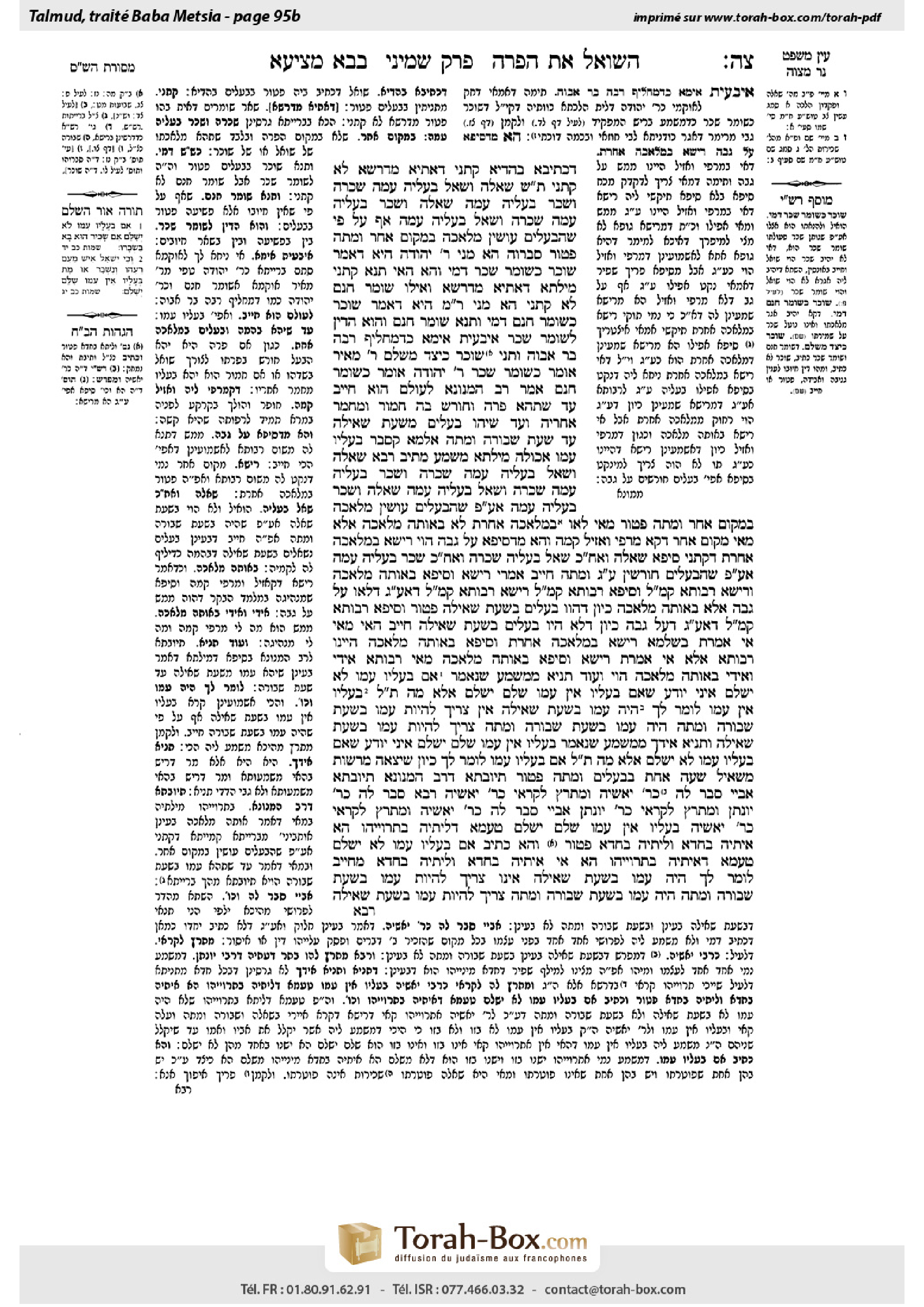
Bava Metzia 95b: Talmud study for Daf Yomi
Study the Talmud for Daf Yomi with scanned pages, Hebrew text, English translations from Sefaria and AI-generated French translations.
Passage selection and English or AI-generated French translation are available where the scan has annotations. Daf Study is independent of Torah-Box and Sefaria.
Browse Bava Metzia · בבא מציעא · All tractatesBava Metzia 95b text and translations
This page of Bava Metzia includes the Aramaic text, an English translation and an AI-generated French translation, alongside the scan above.
בבא מציעא צ״ה ב · Aramaic and Hebrew text
דִּכְתִיבָא בְּהֶדְיָא – קָתָנֵי, דְּאָתְיָא מִדְּרָשָׁא – לָא קָתָנֵי.
תָּא שְׁמַע: שְׁאָלָהּ וְשָׁאַל בְּעָלֶיהָ עִמָּהּ, שְׂכָרָהּ וְשָׂכַר בְּעָלֶיהָ עִמָּהּ, שְׁאָלָהּ וְשָׂכַר בְּעָלֶיהָ עִמָּהּ, שְׂכָרָהּ וְשָׁאַל בְּעָלֶיהָ עִמָּהּ, אַף עַל פִּי שֶׁהַבְּעָלִים עוֹשִׂין מְלָאכָה בְּמָקוֹם אַחֵר, וָמֵתָה – פָּטוּר.
סַבְרוּהָ הָא מַנִּי – רַבִּי יְהוּדָה הִיא, דְּאָמַר: שׂוֹכֵר כְּשׁוֹמֵר שָׂכָר דָּמֵי! וְהָא הַאי תַּנָּא קָתָנֵי מִילְּתָא דְּאָתְיָא מִדְּרָשָׁא, וְאִילּוּ שׁוֹמֵר חִנָּם לָא קָתָנֵי!
הָא מַנִּי – רַבִּי מֵאִיר הִיא, דְּאָמַר: שׂוֹכֵר כְּשׁוֹמֵר חִנָּם דָּמֵי, וְתַנָּא שׁוֹמֵר חִנָּם, וְהוּא הַדִּין לְשׁוֹמֵר שָׂכָר.
אִיבָּעֵית אֵימָא כִּדְמַחְלֵיף רַבָּה בַּר אֲבוּהּ וְתָנֵי: שׂוֹכֵר כֵּיצַד מְשַׁלֵּם? רַבִּי מֵאִיר אוֹמֵר: כְּשׁוֹמֵר שָׂכָר, רַבִּי יְהוּדָה אוֹמֵר: כְּשׁוֹמֵר חִנָּם.
אָמַר רַב הַמְנוּנָא: לְעוֹלָם הוּא חַיָּיב עַד שֶׁתְּהֵא פָּרָה וְחוֹרֵשׁ בָּהּ, חֲמוֹר וּמְחַמֵּר אַחֲרֶיהָ, וְעַד שֶׁיְּהוּ בְּעָלִים מִשְּׁעַת שְׁאֵילָה עַד שְׁעַת שְׁבוּרָה וּמֵתָה. אַלְמָא קָסָבַר ״בְּעָלָיו עִמּוֹ״ – אַכּוּלַּהּ מִילְּתָא מַשְׁמַע.
מֵתִיב רָבָא: שְׁאָלָהּ וְשָׁאַל בְּעָלֶיהָ עִמָּהּ, שְׂכָרָהּ וְשָׂכַר בְּעָלֶיהָ עִמָּהּ, שְׂכָרָהּ וְשָׁאַל בְּעָלֶיהָ עִמָּהּ, שְׁאָלָהּ וְשָׂכַר בְּעָלֶיהָ עִמָּהּ, אַף עַל פִּי שֶׁהַבְּעָלִים עוֹשִׂין מְלָאכָה בְּמָקוֹם אַחֵר וָמֵתָה – פָּטוּר. מַאי לָאו ״בִּמְלָאכָה אַחֶרֶת״?
לָא, בְּאוֹתָהּ מְלָאכָה. אֶלָּא, מַאי ״מָקוֹם אַחֵר״? דְּקָא מְרַפֵּי וְאָזֵיל קַמַּהּ.
וְהָא מִדְּסֵיפָא ״עַל גַּבָּהּ״ הָוֵי, רֵישָׁא בִּמְלָאכָה אַחֶרֶת, דְּקָתָנֵי סֵיפָא: שְׁאָלָהּ וְאַחַר כָּךְ שָׁאַל בְּעָלֶיהָ, שְׂכָרָהּ וְאַחַר כָּךְ שָׂכַר בְּעָלֶיהָ עִמָּהּ, אַף עַל פִּי שֶׁהַבְּעָלִים חוֹרְשִׁין עַל גַּבָּהּ וָמֵתָה – חַיָּיב!
אָמְרִי: רֵישָׁא וְסֵיפָא בְּאוֹתָהּ מְלָאכָה, וְרֵישָׁא רְבוּתָא קָא מַשְׁמַע לַן, וְסֵיפָא רְבוּתָא קָא מַשְׁמַע לַן. רֵישָׁא רְבוּתָא קָא מַשְׁמַע לַן, דְּאַף עַל גַּב דְּלָאו עַל גַּבָּהּ אֶלָּא בְּאוֹתָהּ מְלָאכָה, כֵּיוָן דַּהֲווֹ בְּעָלִים בִּשְׁעַת שְׁאֵילָה – פָּטוּר. וְסֵיפָא רְבוּתָא קָא מַשְׁמַע לַן, דְּאַף עַל גַּב דְּעַל גַּבָּהּ, כֵּיוָן דְּלָא הֲווֹ בְּעָלִים בִּשְׁעַת שְׁאֵילָה – חַיָּיב.
הַאי מַאי?! אִי אָמְרַתְּ בִּשְׁלָמָא רֵישָׁא בִּמְלָאכָה אַחֶרֶת, וְסֵיפָא בְּאוֹתָהּ מְלָאכָה – הַיְינוּ רְבוּתָא.
אֶלָּא אִי אָמְרַתְּ רֵישָׁא וְסֵיפָא בְּאוֹתָהּ מְלָאכָה, מַאי רְבוּתָא? אִידֵּי וְאִידֵּי בְּאוֹתָהּ מְלָאכָה הָוֵי!
וְעוֹד, תַּנְיָא: מִמַּשְׁמַע שֶׁנֶּאֱמַר ״אִם בְּעָלָיו עִמּוֹ לֹא יְשַׁלֵּם״ אֵינִי יוֹדֵעַ שֶׁאִם בְּעָלָיו אֵין עִמּוֹ שַׁלֵּם יְשַׁלֵּם? אֶלָּא מָה תַּלְמוּד לוֹמַר ״בְּעָלָיו אֵין עִמּוֹ״ – לוֹמַר לָךְ: הָיָה עִמּוֹ בִּשְׁעַת שְׁאֵילָה – אֵין צָרִיךְ לִהְיוֹת עִמּוֹ בִּשְׁעַת שְׁבוּרָה וּמֵתָה, הָיָה עִמּוֹ בִּשְׁעַת שְׁבוּרָה וּמֵתָה – צָרִיךְ לִהְיוֹת עִמּוֹ בִּשְׁעַת שְׁאֵילָה.
וְתַנְיָא אִידַּךְ: מִמַּשְׁמַע שֶׁנֶּאֱמַר ״בְּעָלָיו אֵין עִמּוֹ שַׁלֵּם יְשַׁלֵּם״ אֵינִי יוֹדֵעַ שֶׁאִם בְּעָלָיו עִמּוֹ לֹא יְשַׁלֵּם? אֶלָּא מָה תַּלְמוּד לוֹמַר ״אִם בְּעָלָיו עִמּוֹ״? לוֹמַר לְךָ: כֵּיוָן שֶׁיָּצְאָה מֵרְשׁוּת מַשְׁאִיל שָׁעָה אַחַת בִּבְעָלִים וָמֵתָה – פָּטוּר. תְּיוּבְתָּא דְּרַב הַמְנוּנָא. תְּיוּבְתָּא.
אַבָּיֵי סָבַר לַהּ כְּרַבִּי יֹאשִׁיָּה, וּמְתָרֵץ לִקְרָאֵי כְּרַבִּי יֹאשִׁיָּה. רָבָא סָבַר לַהּ כְּרַבִּי יוֹנָתָן, וּמְתָרֵץ לִקְרָאֵי כְּרַבִּי יוֹנָתָן.
אַבָּיֵי סָבַר לַהּ כְּרַבִּי יֹאשִׁיָּה וּמְתָרֵץ לִקְרָאֵי כְּרַבִּי יֹאשִׁיָּה: ״בְּעָלָיו אֵין עִמּוֹ שַׁלֵּם יְשַׁלֵּם״, טַעְמָא דְּלֵיתֵיהּ בְּתַרְוַיְיהוּ, הָא אִיתֵיהּ בַּחֲדָא וְלֵיתֵיהּ בַּחֲדָא – פָּטוּר.
וְהָא כְּתִיב: ״אִם בְּעָלָיו עִמּוֹ לֹא יְשַׁלֵּם״, טַעְמָא דְּאִיתֵיהּ בְּתַרְוַיְיהוּ, הָא אִי אִיתֵיהּ בַּחֲדָא וְלֵיתֵיהּ בַּחֲדָא – מִחַיַּיב.
לוֹמַר לָךְ: הָיָה עִמּוֹ בִּשְׁעַת שְׁאֵילָה – אֵינוֹ צָרִיךְ לִהְיוֹת עִמּוֹ בִּשְׁעַת שְׁבוּרָה וּמֵתָה, הָיָה עִמּוֹ בִּשְׁעַת שְׁבוּרָה וּמֵתָה – צָרִיךְ לִהְיוֹת עִמּוֹ בִּשְׁעַת שְׁאֵילָה.
Bava Metzia 95b · English translation
that is explicitly written in the Torah he teaches, and those matters that are derived through interpretation he does not teach. Consequently, no proof can be brought from the mishna.
The Gemara suggests: Come and hear a proof from a baraita: If one borrowed an animal and borrowed the services of its owner with it, or rented it and hired its owner with it, or borrowed it and hired its owner with it, or rented it and borrowed the services of its owner with it; in all of these cases, although the owner performed the work for him in another place, i.e., not near the animal, and it dies, the borrower or renter is exempt.
The Gemara notes: The scholars in the study hall assumed that this baraita is in accordance with whose opinion? It is in accordance with the opinion of Rabbi Yehuda, who says that one who rents an item is responsible for it like a paid bailee. According to his understanding, the baraita teaches that the exemption from liability applies to both a borrower and a paid bailee. Consequently, the baraita can serve as a proof: Doesn’t this tanna teach even a matter that is derived through interpretation, i.e., the fact that exemption from liability applies to a paid bailee, while he still does not teach that it applies to an unpaid bailee? It would appear that this is a proof that exemption from liability does not apply to an unpaid bailee, since it does not apply to a mishap that is the result of the bailee’s negligence.
The Gemara refutes this proof, as one could counter: In accordance with whose opinion is this baraita? It is in accordance with the opinion of Rabbi Meir, who says that the liability of one who rents an item is like that of an unpaid bailee. And, according to his understanding, the baraita teaches that the exemption from liability applies to an unpaid bailee, and it is understood that the same is true for a paid bailee. Understood like this, the baraita explicitly applies the exemption from liability to a case of negligence. Since, ultimately, it is unclear according to whose opinion the baraita is taught, no proof can be drawn from it.
If you wish, say that the baraita can be understood as referring to an unpaid bailee, even if it is assumed to be in accordance with the opinion of Rabbi Yehuda. As Rabba bar Avuh reversed their opinions and taught: How does one who rents an item pay in the case of a mishap? Rabbi Meir says: Like a paid bailee. Rabbi Yehuda says: Like an unpaid bailee.
§ Rav Hamnuna says that the exemption from liability when one borrows an item together with the services of its owner exists only in very specific circumstances: A borrower is always liable, unless the item entrusted to him is a cow and its owner plows with it in the service of the borrower, or it is a donkey and its owner drives it by walking behind it in the service of the borrower, i.e., the owner and his animal are engaged in the same work. And even so, the borrower will not be exempt unless the owner is working for him from the time of the borrowing of the animal until the time when it is injured or dies. The Gemara notes: Evidently, Rav Hamnuna holds that the phrase: “Its owner is with him” (Exodus 22:14), teaches that the exemption from liability applies only when the owner is working for the borrower for the entire matter.
Rava raises an objection from the baraita cited previously: If one borrowed an animal and borrowed the services of its owner with it, or rented it and hired its owner with it, or rented it and borrowed the services of its owner with it, or borrowed it and hired its owner with it; in all these cases, although the owner performed the work for him in another place, i.e., not near the animal, and it died, the borrower or renter is exempt. Rava explains how the baraita poses a challenge: What, is it not referring to a case where the owner was engaged with different work than his animal? The baraita proves that the exemption from liability applies even in such a case.
The Gemara rejects this: No, the baraita is referring to a case where the owner was engaged with the same work as the animal. The Gemara asks: But, if so, what does the baraita mean by saying: He performed the work in another place? The Gemara explains: For example, it is a case where the owner loosens the hard soil with a hoe while walking ahead of the animal. He is engaged in the same work, but not in the same place.
The Gemara raises a difficulty: But from the fact that the latter clause of the baraita is referring to a case where the owner was working alongside it, it may be inferred that the first clause, i.e., the passage of the baraita cited above, is referring to a case where the owner was engaged with different work. As the latter clause teaches: If he borrowed it and afterward borrowed the services of its owner, or rented it and afterward hired its owner with it, in both these cases, although the owner was plowing alongside it and at that time it died, the borrower or renter is liable.
In resolution of this difficulty, the Sages say: Both the first clause and the latter clause pertain to a case where the owner was engaged with the same work as the animal. And the difference in formulation of the two clauses is because the first clause teaches us a novelty and the latter clause teaches us a novelty. The first clause teaches us the novelty that although the owner was not actually working alongside his animal but was merely engaged with the same work, since the owner was working for the borrower at the time of the borrowing, the borrower is exempt. The latter clause teaches us the novelty that although the owner was actually working alongside his animal, since the owner was not working for the borrower at the time of the borrowing, the borrower is liable.
The Gemara is puzzled: What is this? Granted, if you say that the first clause is referring to a case where the owner is engaged in different work than his animal, and the latter clause is referring to a case where he is engaged in the same work as his animal, then this is the novelty of mentioning what type of work he did: It teaches that it is irrelevant whether the owner did or did not work together with his animal. Rather, the liability of the borrower depends on whether or not the owner was working for the borrower when he entrusted the borrower with his animal.
But if you say that the first clause and the latter clause both pertain to a case where the owner is engaged in the same work as his animal, what is the novelty of mentioning what type of work he did? Both this clause and that clause concern similar cases, in which the owner is engaged in the same work as his animal. It is therefore apparent that the clauses concern different cases. The first clause teaches that the borrower is exempt even in a case where the owner was engaged in different work than his animal. The first part of Rav Hamnuna’s ruling, that the owner needs to be engaged in the same work as his animal, is thereby refuted.
And furthermore, even the second part of Rav Hamnuna’s ruling, that the exemption applies only when the owner was working for the borrower from the time of the borrowing of the animal until the time of the mishap, can be refuted, as it is taught in a baraita: From the implication of that which is stated: “If its owner is with him, he does not pay” (Exodus 22:14), do I not already know what is stated in the next verse, that “if its owner is not with him, he shall pay” (Exodus 22:13)? Rather, what is the meaning when the verse states: “Its owner is not with him”? It serves to tell you: If he was with him, i.e., working for him, at the time of borrowing, he does not need to be with him at the time when the animal is injured or dies for the exemption from liability to apply; but if he was with him at the time when the animal is injured or dies, he does need to have been with him at the time of borrowing for the exemption from liability to apply.
And it is taught in another baraita: From the implication of that which is stated: “If its owner is not with him, he shall pay,” do I not already know what is stated in the preceding verse, that “if its owner is with him, he does not pay”? Rather, what is the meaning when the verse states: “If its owner is with him”? It serves to tell you: Once the animal has left the domain of the lender, i.e., its owner, and has been entrusted to the borrower, with its owner working for the borrower at that time, even for only one moment, and then it dies, the borrower is exempt. The Gemara concludes: The refutation of the opinion of Rav Hamnuna provided by these baraitot is indeed a conclusive refutation.
§ The Gemara explains how the first of these baraitot arrives at its conclusion: Abaye holds in accordance with the opinion of Rabbi Yoshiya, that when the Torah mentions two details together in reference to a halakha, it is presumed that the halakha applies only when both details are in effect (see 94b), and he likewise explains the two verses in accordance with Rabbi Yoshiya. Rava holds in accordance with the opinion of Rabbi Yonatan, that it is presumed that the halakha applies even when only one of the details is in effect, and he explains the verses in accordance with the opinion of Rabbi Yonatan.
The Gemara clarifies: When the Torah refers to an owner working for the borrower, it should be understood as referring to the time of the borrowing and the time of the mishap. According to Rabbi Yoshiya’s opinion, this indicates that the owner worked for him at both times, whereas according to Rabbi Yonatan’s opinion, this implies that he worked for him at either time. Based on this, Abaye and Rava explain the verses: Abaye holds in accordance with the opinion of Rabbi Yoshiya, and he likewise explains the two verses in accordance with the opinion of Rabbi Yoshiya, thereby arriving at the conclusion of the baraita, as follows: From the verse: “If its owner is not with him, he shall pay,” it appears that the reason the borrower is liable is that the owner was not working for him at either point in time. By inference, if he worked for him at one of those times but not at the other one, the borrower is exempt.
The Gemara raises an objection: But isn’t it written: “If its owner is with him, he does not pay”? From this verse it appears that the reason the borrower is exempt is that the owner was working for him at both points in time. By inference, if he was working for him at one of those times but not at the other one, the borrower is liable. The two verses appear to contradict each another.
To reconcile the verses, one must say that the phrase “if its owner is with him” serves to tell you: If he was with him, i.e., working for him, at the time of borrowing, he does not need to be with him at the time when the animal is injured or dies for the exemption from liability to apply; but if he was with him at the time when the animal is injured or dies, he does need to have been with him at the time of borrowing for the exemption to apply.
Bava Metzia 95b · Traduction française (IA)
Ce qui est explicitement écrit dans la Torah, il l'enseigne, et ceux qui sont dérivés par l'interprétation, il ne les enseigne pas. Ainsi, aucun argument ne peut être tiré de la Michna.
La Guemara suggère : Viens écouter un argument à partir d'une baraïta : Si l'on emprunte un animal et l'on emprunte les services de son propriétaire avec lui, ou l'on loue et l'on engage son propriétaire avec lui, ou l'on emprunte et l'on engage son propriétaire avec lui, ou l'on loue et l'on emprunte les services de son propriétaire avec lui ; dans tous ces cas, même si le propriétaire a travaillé pour lui ailleurs, c'est-à-dire pas près de l'animal, et qu'il meurt, l'emprunteur ou le locataire est exempt.
La Guemara note : Les savants dans la salle de étude supposaient que cette baraïta est selon l'opinion de qui ? Elle est selon l'opinion de Rabbi Yéhuda, qui dit que celui qui loue un objet est responsable de lui comme un baïlé payé. Selon sa compréhension, la baraïta enseigne que l'exemption de responsabilité s'applique à la fois à l'emprunteur et au baïlé payé. Ainsi, la baraïta peut servir d'argument : N'est-ce pas que ce tanna enseigne même une question dérivée par l'interprétation, c'est-à-dire le fait que l'exemption de responsabilité s'applique au baïlé payé, alors qu'il ne l'enseigne pas pour un baïlé non payé ? Il semble que cela soit un argument qui montre que l'exemption de responsabilité ne s'applique pas au baïlé non payé, puisqu'elle ne s'applique pas à un accident résultant de négligence du baïlé.
La Guemara réfute cet argument, car l'on pourrait répondre : Selon l'opinion de qui est cette baraïta ? Elle est selon l'opinion de Rabbi Méir, qui dit que la responsabilité de celui qui loue un objet est comme celle d'un baïlé non payé. Selon sa compréhension, la baraïta enseigne que l'exemption de responsabilité s'applique au baïlé non payé, et on comprend que c'est aussi le cas pour le baïlé payé. Ainsi interprétée, la baraïta applique explicitement l'exemption de responsabilité à un cas de négligence. Puisque, finalement, il est incertain selon l'opinion de qui la baraïta est enseignée, aucun argument ne peut être tiré d'elle.
Si tu le souhaites, dis que la baraïta peut être interprétée comme faisant référence à un baïlé non payé, même s'il est supposé être selon l'opinion de Rabbi Yéhuda. Comme Rabba bar Avoua a inversé leurs opinions et a enseigné : Comment paie-t-on en cas d'accident lorsqu'on loue un objet ? Rabbi Méir dit : Comme un baïlé payé. Rabbi Yéhuda dit : Comme un baïlé non payé.
§ Rav Hamnuna dit que l'exemption de responsabilité lorsqu'on emprunte un objet avec les services de son propriétaire existe uniquement dans des circonstances très spécifiques : l'emprunteur est toujours responsable, sauf si l'objet confié est un bovin et son propriétaire le laboure avec lui dans le service de l'emprunteur, ou si c'est un âne et son propriétaire le conduit en marchant derrière lui dans le service de l'emprunteur, c'est-à-dire que le propriétaire et son animal sont engagés dans le même travail. Et même alors, l'emprunteur ne sera exempt que si le propriétaire travaille pour lui du moment de l'emprunt de l'animal jusqu'au moment où il est blessé ou meurt. La Guemara note : Il semble que Rav Hamnuna considère que la phrase : « Son propriétaire est avec lui » (Exode 22:14) enseigne que l'exemption de responsabilité s'applique uniquement lorsque le propriétaire travaille pour l'emprunteur tout au long de l'affaire.
Rava soulève un objet à partir de la baraïta citée précédemment : Si l'on emprunte un animal et l'on emprunte les services de son propriétaire avec lui, ou l'on loue et l'on engage son propriétaire avec lui, ou l'on loue et l'on emprunte les services de son propriétaire avec lui, ou l'on emprunte et l'on engage son propriétaire avec lui ; dans tous ces cas, même si le propriétaire a travaillé pour lui ailleurs, c'est-à-dire pas près de l'animal, et qu'il meurt, l'emprunteur ou le locataire est exempt. Rava explique comment la baraïta pose un défi : Qu'est-ce que cela signifie, n'est-ce pas qu'il ne s'agit pas d'un cas où le propriétaire était engagé dans un travail différent de son animal ? La baraïta prouve que l'exemption de responsabilité s'applique même dans un tel cas.
La Guemara rejette cela : Non, la baraïta fait référence à un cas où le propriétaire était engagé dans le même travail que l'animal. La Guemara pose une question : Mais, si c'est ainsi, que signifie la baraïta en disant : Il a travaillé ailleurs ? La Guemara explique : Par exemple, c'est un cas où le propriétaire détend la terre dure avec une houe tout en marchant devant l'animal. Il est engagé dans le même travail, mais pas au même endroit.
La Guemara soulève une difficulté : Mais à partir du fait que la clause ultérieure de la baraïta fait référence à un cas où le propriétaire était engagé avec l'animal, on pourrait en déduire que la première clause, c'est-à-dire la partie de la baraïta citée ci-dessus, fait référence à un cas où le propriétaire était engagé dans un travail différent. Comme la clause ultérieure enseigne : Si l'on emprunte et ensuite l'on emprunte les services de son propriétaire, ou l'on loue et ensuite l'on engage son propriétaire avec lui, dans ces deux cas, même si le propriétaire labourait avec l'animal et à ce moment-là l'animal meurt, l'emprunteur ou le locataire est responsable.
Pour résoudre cette difficulté, les Sages disent : Les deux clauses, la première et la dernière, concernent un cas où le propriétaire était engagé dans le même travail que l'animal. Et la différence dans la formulation des deux clauses est parce que la première clause nous enseigne une nouveauté et la dernière clause nous enseigne une autre nouveauté. La première clause nous enseigne la nouveauté que, bien que le propriétaire ne soit pas réellement travaillant avec son animal mais seulement engagé dans le même travail, puisque le propriétaire travaillait pour l'emprunteur au moment de l'emprunt, l'emprunteur est exempt. La dernière clause nous enseigne la nouveauté que, bien que le propriétaire était réellement travaillant avec son animal, puisque le propriétaire ne travaillait pas pour l'emprunteur au moment de l'emprunt, l'emprunteur est responsable.
La Guemara est perplexe : Qu'est-ce que cela signifie ? Si l'on dit que la première clause fait référence à un cas où l'propriétaire est engagé dans un travail différent de celui de son animal, et que la seconde clause fait référence à un cas où il est engagé dans le même travail que son animal, alors c'est la nouveauté de l'indication du type de travail qu'il effectue : cela enseigne que cela n'a pas d'importance si l'propriétaire a travaillé ou non avec son animal. En revanche, la responsabilité du prêteur dépend de savoir si l'propriétaire travaillait pour le prêteur lorsqu'il a confié son animal à ce dernier.
Mais si l'on dit que la première clause et la seconde clause font référence à un cas où l'propriétaire est engagé dans le même travail que son animal, quelle est la nouveauté de l'indication du type de travail qu'il effectue ? Les deux clauses concernent des cas similaires, où l'propriétaire est engagé dans le même travail que son animal. Il est donc évident que les clauses concernent des cas différents. La première clause enseigne que le prêteur est exempt même dans un cas où l'propriétaire était engagé dans un travail différent de celui de son animal. La première partie de la décision de Rav Hamnuna, selon laquelle l'propriétaire doit être engagé dans le même travail que son animal, est ainsi réfutée.
Et de plus, même la seconde partie de la décision de Rav Hamnuna, selon laquelle l'exemption s'applique uniquement lorsque l'owner travaillait pour le prêteur du moment de la prêture de l'animal jusqu'au moment de l'accident, peut être réfutée, comme il est enseigné dans une baraïta : À partir de l'implication de ce qui est dit : « Si son propriétaire est avec lui, il ne paie pas » (Exode 22:14), ne sais-je pas déjà ce qui est dit dans la verset suivant, qui dit : « Si son propriétaire n'est pas avec lui, il paiera » (Exode 22:13) ? Plutôt, quelle est la signification lorsque le verset dit : « Son propriétaire n'est pas avec lui » ? Cela sert à vous dire : Si il était avec lui, c'est-à-dire travaillait pour lui, au moment de la prêture, il n'a pas besoin d'être avec lui au moment où l'animal est blessé ou meurt pour que l'exemption de responsabilité s'applique ; mais si il était avec lui au moment où l'animal est blessé ou meurt, il faut qu'il ait été avec lui au moment de la prêture pour que l'exemption de responsabilité s'applique.
Et il est enseigné dans une autre baraïta : À partir de l'implication de ce qui est dit : « Si son propriétaire n'est pas avec lui, il paiera », ne sais-je pas déjà ce qui est dit dans le verset précédent, qui dit : « Si son propriétaire est avec lui, il ne paie pas » ? Plutôt, quelle est la signification lorsque le verset dit : « Si son propriétaire est avec lui » ? Cela sert à vous dire : Une fois que l'animal a quitté le domaine du prêteur, c'est-à-dire son propriétaire, et a été confié au prêteur, avec son propriétaire travaillant pour le prêteur à ce moment-là, même pendant une seule seconde, et puis il meurt, le prêteur est exempt. La Guemara conclut : La réfutation de l'opinion de Rav Hamnuna fournie par ces baraitot est effectivement une réfutation concluante.
§ La Guemara explique comment la première de ces baraitot arrive à sa conclusion : Abaye suit l'opinion de Rabbi Yoshiya, qui considère que lorsque la Torah mentionne deux détails ensemble en référence à une halakha, on suppose que la halakha s'applique uniquement lorsque les deux détails sont en jeu (voir 94b), et il explique également les deux versets selon l'opinion de Rabbi Yoshiya. Rava suit l'opinion de Rabbi Yonatan, qui considère que la halakha s'applique même lorsque seul un des détails est en jeu, et il explique les versets selon l'opinion de Rabbi Yonatan.
La Guemara précise : Lorsque la Torah mentionne un propriétaire travaillant pour le prêteur, cela doit être compris comme se référant au moment de la prêture et au moment de l'accident. Selon l'opinion de Rabbi Yoshiya, cela indique que le propriétaire travaillait pour lui à ces deux moments, tandis que selon l'opinion de Rabbi Yonatan, cela implique qu'il travaillait pour lui à l'un ou l'autre moment. Sur cette base, Abaye et Rava expliquent les versets : Abaye suit l'opinion de Rabbi Yoshiya, et il explique également les deux versets selon l'opinion de Rabbi Yoshiya, ce qui lui permet d'arriver à la conclusion de la baraïta, comme suit : À partir du verset : « Si son propriétaire n'est pas avec lui, il paiera », il semble que la raison pour laquelle le prêteur est responsable est que le propriétaire n'était pas travaillant pour lui à aucun des deux moments. Par conséquent, si il travaillait pour lui à l'un de ces moments mais pas à l'autre, le prêteur est exempt.
La Guemara soulève une objection : Mais n'est-il pas écrit : « Si son propriétaire est avec lui, il ne paie pas » ? À partir de ce verset, il semble que la raison pour laquelle le prêteur est exempt est que le propriétaire travaillait pour lui à tous les deux moments. Par conséquent, si il travaillait pour lui à l'un de ces moments mais pas à l'autre, le prêteur est responsable. Les deux versets semblent s'opposer l'un à l'autre.
Pour concilier les versets, il faut dire que la phrase « si son propriétaire est avec lui » sert à vous indiquer : si l'homme était avec lui, c'est-à-dire travaillait pour lui, au moment de la prêture, il n'a pas besoin d'être avec lui au moment où l'animal est blessé ou meurt pour que l'exemption de responsabilité s'applique ; mais si l'homme était avec lui au moment où l'animal est blessé ou meurt, il faut qu'il ait été avec lui au moment de la prêture pour que l'exemption de responsabilité s'applique.
Traduction française générée par IA à partir de l’édition anglaise de Sefaria. Vérifie toujours un passage avec le texte source.
Text from Sefaria: William Davidson Edition - Vocalized Aramaic (CC BY NC); William Davidson Edition - English (CC BY NC).