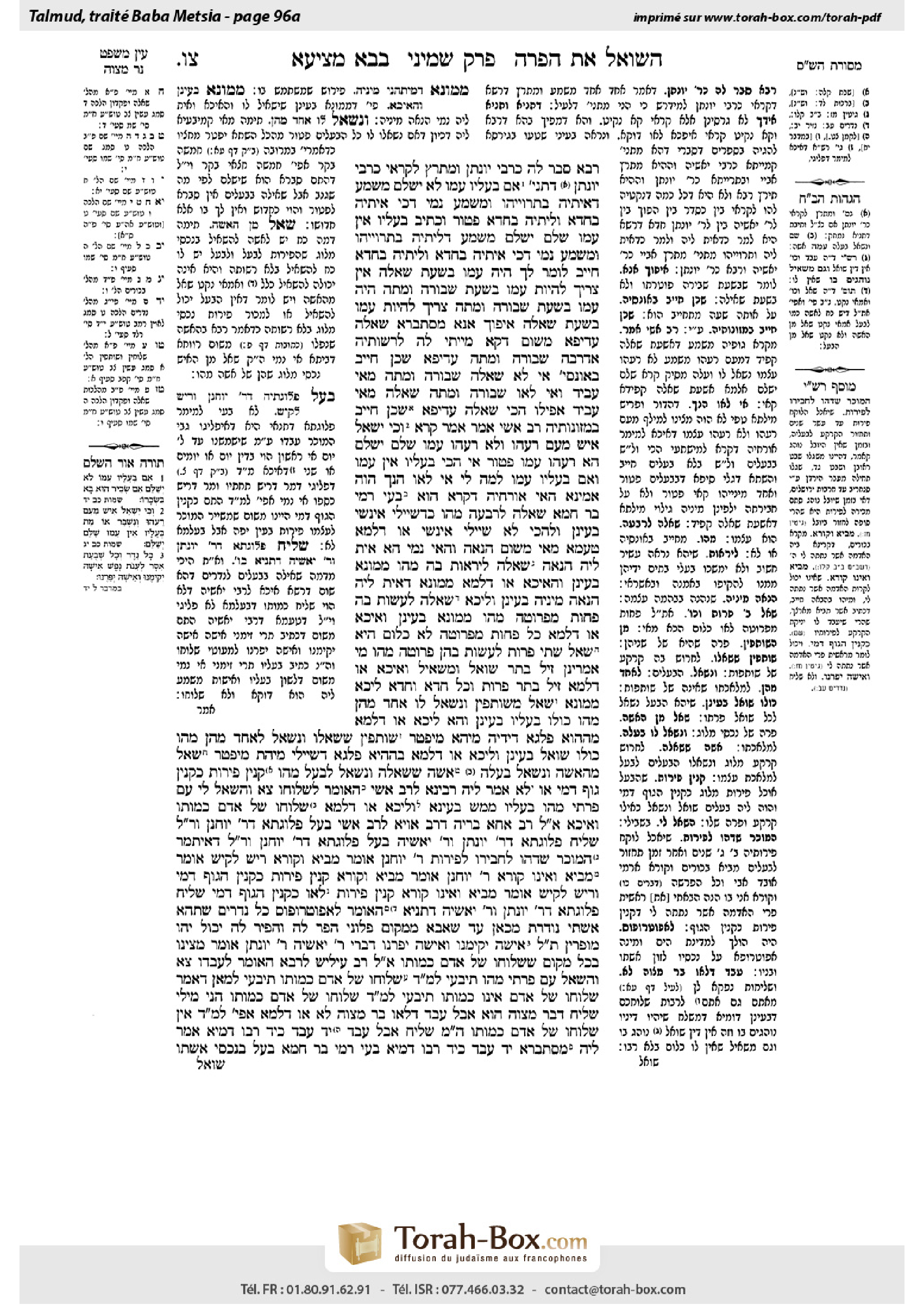
Bava Metzia 96a: Talmud study for Daf Yomi
Study the Talmud for Daf Yomi with scanned pages, Hebrew text, English translations from Sefaria and AI-generated French translations.
Passage selection and English or AI-generated French translation are available where the scan has annotations. Daf Study is independent of Torah-Box and Sefaria.
Browse Bava Metzia · בבא מציעא · All tractatesBava Metzia 96a text and translations
This page of Bava Metzia includes the Aramaic text, an English translation and an AI-generated French translation, alongside the scan above.
בבא מציעא צ״ו א · Aramaic and Hebrew text
רָבָא סָבַר לַהּ כְּרַבִּי יוֹנָתָן וּמְתָרֵץ לִקְרָאֵי כְּרַבִּי יוֹנָתָן, דְּתַנְיָא: ״אִם בְּעָלָיו עִמּוֹ לֹא יְשַׁלֵּם״. מַשְׁמַע דְּאִיתֵיהּ בְּתַרְוַיְיהוּ, וּמַשְׁמַע נָמֵי דְּכִי אִיתֵיהּ בַּחֲדָא וְלֵיתֵיהּ בַּחֲדָא – פָּטוּר.
וּכְתִיב: ״בְּעָלָיו אֵין עִמּוֹ שַׁלֵּם יְשַׁלֵּם״ – מַשְׁמַע דְּלֵיתֵיהּ בְּתַרְוַיְיהוּ, מַשְׁמַע נָמֵי דְּכִי אִיתֵיהּ בַּחֲדָא וְלֵיתֵיהּ בַּחֲדָא – חַיָּיב.
לוֹמַר לָךְ: הָיָה עִמּוֹ בִּשְׁעַת שְׁאֵלָה – אֵין צָרִיךְ לִהְיוֹת עִמּוֹ בִּשְׁעַת שְׁבוּרָה וּמֵתָה, הָיָה עִמּוֹ בִּשְׁעַת שְׁבוּרָה וּמֵתָה – צָרִיךְ לִהְיוֹת עִמּוֹ בִּשְׁעַת שְׁאֵלָה.
אֵיפוֹךְ אֲנָא! מִסְתַּבְּרָא שְׁאֵלָה עֲדִיפָא, מִשּׁוּם דְּקָא מַיְיתֵי לַהּ לִרְשׁוּתֵיהּ.
אַדְּרַבָּה, שְׁבוּרָה וּמֵתָה עֲדִיפָא, שֶׁכֵּן חַיָּיב בָּאוֹנָסִין!
אִי לָא שְׁאֵלָה, שְׁבוּרָה וּמֵתָה מַאי עָבֵיד? וְאִי לָאו שְׁבוּרָה וּמֵתָה, שְׁאֵלָה מַאי עָבֵיד? אֲפִילּוּ הָכִי שְׁאֵלָה עֲדִיפָא, שֶׁכֵּן חַיָּיב בִּמְזוֹנוֹתֶיהָ.
רַב אָשֵׁי אָמַר, אָמַר קְרָא: ״וְכִי יִשְׁאַל אִישׁ מֵעִם רֵעֵהוּ״, וְלֹא רֵעֵהוּ עִמּוֹ – ״שַׁלֵּם יְשַׁלֵּם״, הָא רֵעֵהוּ עִמּוֹ – פָּטוּר.
אִי הָכִי: ״בְּעָלָיו אֵין עִמּוֹ״, וְ״אִם בְּעָלָיו עִמּוֹ״ לְמָה לִי? אִי לָאו הָנָךְ, הֲוָה אָמֵינָא: הַאי אוֹרְחֵיהּ דִּקְרָא הוּא.
בָּעֵי רָמֵי בַּר חָמָא שְׁאָלָהּ לְרִבְעָהּ, מַהוּ? כִּדְשָׁיְילִי אִינָשֵׁי בָּעֵינַן וּלְהָכִי לָא שָׁיְילִי אִינָשֵׁי, אוֹ דִלְמָא טַעְמָא מַאי – מִשּׁוּם הֲנָאָה, וְהַאי נָמֵי הָא אִית לֵיהּ הֲנָאָה.
שְׁאָלָהּ לֵירָאוֹת בָּהּ, מַהוּ? מָמוֹנָא בָּעֵינַן וְהָאִיכָּא, אוֹ דִלְמָא מָמוֹנָא דְּאִית לֵיהּ הֲנָאָה מִינֵּיהּ בָּעֵינַן וְלֵיכָּא?
שְׁאָלָהּ לַעֲשׂוֹת בָּהּ פָּחוֹת מִפְּרוּטָה, מַהוּ? מָמוֹנָא בָּעֵינַן וְאִיכָּא, אוֹ דִלְמָא כׇּל פָּחוֹת מִפְּרוּטָה – לֹא כְּלוּם הִיא.
שָׁאַל שְׁתֵּי פָּרוֹת לַעֲשׂוֹת בָּהֶן פְּרוּטָה, מַהוּ? מִי אָמְרִינַן: זִיל בָּתַר שׁוֹאֵל וּמַשְׁאִיל, וְאִיכָּא? אוֹ דִּלְמָא: זִיל בָּתַר פָּרוֹת וְכֹל חֲדָא וַחֲדָא לֵיכָּא מָמוֹנָא?
שָׁאַל מִשּׁוּתָּפִין וְנִשְׁאַל לוֹ אֶחָד מֵהֶן, מַהוּ? כּוּלּוֹ בְּעָלָיו בָּעֵינַן – וְהָא לֵיכָּא, אוֹ דִלְמָא מֵהָהוּא פַּלְגָא דִּידֵיהּ מִיהָא מִיפְּטַר?
שׁוּתָּפִין שֶׁשָּׁאֲלוּ וְנִשְׁאַל לְאֶחָד מֵהֶן, מַהוּ? כּוּלּוֹ שׁוֹאֵל בָּעֵינַן, וְלֵיכָּא? אוֹ דִלְמָא בְּהָהִיא פַּלְגָא דְּשַׁיְילֵיהּ מִיהַת מִיפְּטַר?
שָׁאַל מֵהָאִשָּׁה וְנִשְׁאַל בַּעְלָהּ, אִשָּׁה שֶׁשָּׁאֲלָה וְנִשְׁאַל לַבַּעַל, מַהוּ? קִנְיַן פֵּירוֹת כְּקִנְיַן גּוּף דָּמֵי, אוֹ לָא?
אֲמַר לֵיהּ רָבִינָא לְרַב אָשֵׁי: הָאוֹמֵר לִשְׁלוּחוֹ צֵא וְהִשָּׁאֵל לִי עִם פָּרָתִי, מַהוּ? ״בְּעָלָיו״ מַמָּשׁ בָּעֵינַן וְלֵיכָּא, אוֹ דִלְמָא שְׁלוּחוֹ שֶׁל אָדָם כְּמוֹתוֹ, וְאִיכָּא?
אֲמַר לֵיהּ רַב אַחָא בְּרֵיהּ דְּרַב אַוְיָא לְרַב אָשֵׁי: בַּעַל – פְּלוּגְתָּא דְּרַבִּי יוֹחָנָן וְרֵישׁ לָקִישׁ, שָׁלִיחַ – פְּלוּגְתָּא דְּרַבִּי יוֹנָתָן וְרַבִּי יֹאשִׁיָּה.
בַּעַל – פְּלוּגְתָּא דְּרַבִּי יוֹחָנָן וְרֵישׁ לָקִישׁ. דְּאִיתְּמַר: הַמּוֹכֵר שָׂדֵהוּ לַחֲבֵירוֹ לְפֵירוֹת, רַבִּי יוֹחָנָן אוֹמֵר: מֵבִיא וְקוֹרֵא, רֵישׁ לָקִישׁ אוֹמֵר: מֵבִיא וְאֵינוֹ קוֹרֵא,
רַבִּי יוֹחָנָן אוֹמֵר מֵבִיא וְקוֹרֵא: קִנְיַן פֵּירוֹת כְּקִנְיַן הַגּוּף דָּמֵי. וְרֵישׁ לָקִישׁ אוֹמֵר מֵבִיא וְאֵינוֹ קוֹרֵא: קִנְיַן פֵּירוֹת לָאו כְּקִנְיַן הַגּוּף דָּמֵי.
שָׁלִיחַ – פְּלוּגְתָּא דְּרַבִּי יוֹנָתָן וְרַבִּי יֹאשִׁיָּה. דְּתַנְיָא: הָאוֹמֵר לְאַפּוֹטְרוֹפּוֹס: כׇּל נְדָרִים שֶׁתְּהֵא אִשְׁתִּי נוֹדֶרֶת מִכָּאן עַד שֶׁאָבֹא מִמָּקוֹם פְּלוֹנִי – הָפֵר לָהּ, וְהֵפֵיר לָהּ, יָכוֹל יְהוּ מוּפָרִין, תַּלְמוּד לוֹמַר: ״אִישָׁהּ יְקִימֶנּוּ וְאִישָׁהּ יְפֵרֶנּוּ״, דִּבְרֵי רַבִּי יֹאשִׁיָּה. רַבִּי יוֹנָתָן אוֹמֵר: מָצִינוּ בְּכׇל מָקוֹם שֶׁשְּׁלוּחוֹ שֶׁל אָדָם כְּמוֹתוֹ.
אֲמַר לֵיהּ רַב עִילִישׁ לְרָבָא: הָאוֹמֵר לְעַבְדּוֹ צֵא וְהִשָּׁאֵל עִם פָּרָתִי, מַהוּ? תִּיבְּעֵי לְמַאן דְּאָמַר שְׁלוּחוֹ שֶׁל אָדָם כְּמוֹתוֹ, תִּיבְּעֵי לְמַאן דְּאָמַר שְׁלוּחוֹ שֶׁל אָדָם אֵינוֹ כְּמוֹתוֹ.
תִּיבְּעֵי לְמַאן דְּאָמַר שְׁלוּחוֹ שֶׁל אָדָם כְּמוֹתוֹ, הָנֵי מִילֵּי שָׁלִיחַ – דְּבַר מִצְוָה הוּא. אֲבָל עֶבֶד, דְּלָאו בַּר מִצְוָה – לָא. אוֹ דִלְמָא אֲפִילּוּ לְמַאן דְּאָמַר אֵין שְׁלוּחוֹ שֶׁל אָדָם כְּמוֹתוֹ, הָנֵי מִילֵּי שָׁלִיחַ. אֲבָל עֶבֶד, יַד עֶבֶד כְּיַד רַבּוֹ דָּמְיָא.
אֲמַר לֵיהּ: מִסְתַּבְּרָא יַד עֶבֶד כְּיַד רַבּוֹ דָּמְיָא.
בָּעֵי רָמֵי בַּר חָמָא: בַּעַל בְּנִכְסֵי אִשְׁתּוֹ
Bava Metzia 96a · English translation
By contrast, Rava holds in accordance with the opinion of Rabbi Yonatan, and he explains the verses in accordance with the opinion of Rabbi Yonatan, thereby arriving at the conclusion of the baraita, as it is taught in a baraita: “If its owner is with him, he does not pay” teaches about the case in which the owner was working for the borrower at both points in time, and it also teaches about the case in which he was working for him at one of those times but not at the other one; in both cases the borrower is exempt.
The Gemara raises an objection: But it is also written: “If its owner is not with him, he shall pay.” The verse teaches about the case in which the owner was not working for the borrower at either point in time, and it also teaches about the case in which he was working for him at one of those times but not at the other one; in both cases the borrower is liable.
To reconcile the verses, one must say that the phrase “if its owner is with him” serves to tell you that if the owner was with the borrower, i.e., working for him, at the time of borrowing, then he does not need to be with him at the time when the animal is injured or dies for the exemption from liability to apply; but if he was with him at the time when the animal is injured or dies, he does need to have been with him at the time of borrowing for the exemption to apply.
The Gemara raises a difficulty: I could reverse the conclusion and say that the borrower’s exemption from liability is dependent upon the time when the animal was injured or died. The Gemara explains: It is reasonable that the exemption from liability should be dependent on the time of the borrowing because the borrowing is of greater significance, as with it the borrower brings the animal into his domain.
The Gemara retorts: On the contrary, the time when the animal is injured or dies is of greater significance, because that point marks when the borrower is actually liable to pay for any accidents that occurred.
The Gemara responds: No, the borrowing is more significant. Were it not for the initial borrowing, what liability could be caused by the fact that the animal is injured or dies? The Gemara argues: But by the same logic, were it not for the fact that the animal is injured or dies, what liability could be caused by the act of borrowing? The Gemara concludes: Even so, the borrowing is of greater significance, as with it the borrower is obligated to provide the animal’s sustenance as long as it is entrusted with him.
Rav Ashi said that the halakha that the borrower’s exemption from liability is dependent upon the time of the borrowing can be derived from the verse itself: The verse states: “And when a man borrows from another…he shall pay” (Exodus 22:13). The precise formulation of the verse indicates that he borrowed an item from another, but that other person was not with him, i.e., working for him, at the time. It is only in such a case that that verse concludes: “He shall pay.” By inference, when the other person is working with him, the borrower is exempt. Accordingly, it is clear that the critical moment is the time of the borrowing.
The Gemara asks: If so, why do I need the continuation of that verse: “Its owner is not with him,” and the next verse: “If its owner is with him”? According to Rav Ashi, the circumstances of the borrower’s liability and exemption can be derived from the beginning of the first verse. The Gemara explains: If it were not for these additional clauses, I would say that this phrase “from another” is simply the usual manner of the verse, and is not to be expounded to teach an exemption. Since the continuation of the verse and the next verse teach the actual exemption from liability, and the apparent contradiction between them raises the question of when the critical moment is, it is apparent that the beginning of the verse was written in order to be expounded, as Rav Ashi did.
§ Rami bar Ḥama raises a dilemma: If one borrowed an animal in order to engage in bestiality with it, a severe transgression (see Leviticus 18:23), what is the halakha; is the borrower liable for mishaps? The crux of the dilemma is: In order for him to be liable, do we require that the borrowing be for a purpose similar to that for which people typically borrow animals, and since people do not typically borrow animals for this purpose, the borrower is exempt? Or perhaps, what is the reason that a borrower is liable? It is due to the benefit he derives from the animal, and as this borrower, too, has benefit from the animal, he is liable for mishaps.
A similar question: If one borrowed an item, not to use it but to be seen with it, so that people will assume that he is wealthy, what is the halakha? In order for him to be liable, do we require that he borrow an item of monetary worth, and that exists in this case? Or, perhaps we require that he borrow an item of monetary worth from which he also derives tangible benefit, and that does not exist in this case.
Another question: If one borrowed an item to perform work with it that is worth less than the value of one peruta, what is the halakha? Do we require only that he borrow an item of monetary worth, and that exists in this case? Or, perhaps any benefit derived that is worth less than one peruta is nothing, i.e., it is legally considered to be of no monetary worth, and he is therefore exempt.
Another question: If one borrowed two cows to perform work with them that will be worth the value of one peruta in total, what is the halakha? When appraising the value of the benefit derived, to see if it has monetary worth of one peruta, do we say: Follow the borrower and lender, i.e., appraise how much benefit the borrower received from the lender, and in this case there is benefit of the value of one peruta. Or, perhaps we follow the cows, and in this case, each one of the cows does not provide the borrower with monetary worth of one peruta.
Another question: If one borrowed an item from two partners, and the services of one of those partners were also borrowed by him, what is the halakha? Does the exemption of borrowing an item together with its owner apply in this case? For the exemption to apply, do we require all of the item’s owners to be working for the borrower, and that does not exist in this case? Or, perhaps there is no such condition, but in any event, the borrower should at least be exempt from liability for that half of the item owned by the partner who is working for him.
Another question: In the case of partners who borrowed an item and its owner’s services were also borrowed by one of them, what is the halakha? For the exemption to apply, do we require that the owner be working for all the borrowers, and that does not exist in this case? Or, perhaps there is no such condition, but in any event, the partner who borrowed only the item should at least be exempt from liability for the half of the animal that the partner, whom the owner worked for, had borrowed.
Another question: If one borrowed an item from a woman, and the services of her husband were also borrowed by him, or where a woman borrowed an item and its owner’s services were also borrowed by her husband, what is the halakha? A husband has the right to use his wife’s property. These questions are dependent on whether ownership of the right to use an item and the profits it engenders is tantamount to ownership of the item itself or not.
Ravina said to Rav Ashi: In the case of one who says to his agent: Go and lend your services to somebody on my behalf together with lending my cow to that person, what is the halakha? For the exemption to apply, do I require that the cow’s actual owner work for the borrower, and in this case that does not exist? Or perhaps, since the legal status of a person’s agent is like that of himself, it is sufficient if his agent works for the borrower, and accordingly, the necessary conditions exist.
Rav Aḥa, son of Rav Avya, said to Rav Ashi: This question concerning a husband is subject to a dispute between Rabbi Yoḥanan and Reish Lakish. And the question concerning an agent is subject to a dispute between Rabbi Yonatan and Rabbi Yoshiya.
The Gemara clarifies: The question concerning a husband is subject to a dispute between Rabbi Yoḥanan and Reish Lakish pertaining to the requirement to bring the first fruits of one’s field to the Temple and recite the accompanying declaration (see Deuteronomy, chapter 26): As it was stated: With regard to one who sells his field to another, not outright but for its produce, Rabbi Yoḥanan says: The buyer brings the first fruits and recites the declaration, whereas Reish Lakish says: The buyer brings the first fruits but does not recite the declaration.
The Gemara explains: They disagree about whether it is justifiable for the buyer to recite the declaration, since in that declaration he refers to the land as: “The land which You, the Lord, have given me” (Deuteronomy 26:10), i.e., he states that the land belongs to him. Rabbi Yoḥanan says that the buyer brings the first fruits and recites the declaration, because he holds that ownership of the right to use land and its produce is tantamount to ownership of the land itself. Accordingly, the buyer is considered to be the owner of the land and he may consequently recite the declaration. And Reish Lakish says that the buyer brings the first fruits but does not recite the declaration, because he holds that ownership of the right to use land and its produce is not tantamount to ownership of the land itself. Accordingly, the buyer is not considered to be the owner of the land and is consequently unable to recite the declaration.
The Gemara clarifies the second disagreement: The question concerning an agent is subject to a dispute between Rabbi Yonatan and Rabbi Yoshiya, as it is taught in a baraita: If there is one who says to a steward appointed to take care of his household: All vows that my wife will vow from now until I come back from such and such a place, you should nullify them for her in my stead, and the steward annulled them for her, one might have thought that they would be nullified. To dispel this notion, the verse states with regard to a vow taken by a wife: “Her husband sustains it and her husband nullifies it” (Numbers 30:14), which indicates that only her husband is able to do so, and no one else; this is the statement of Rabbi Yoshiya. Rabbi Yonatan says: We have found everywhere in halakha that the legal status of a person’s agent is like that of himself. Since the steward was the agent of the husband, his nullification of the vows is effective.
Another question: Rav Ilish said to Rava: In the case of one who says to his Canaanite slave: Go and lend your services to another together with lending my cow to that person, what is the halakha? Let the dilemma be raised according to the one who says that the legal status of a person’s agent is like that of himself, and let the dilemma be raised according to the one who says that the legal status of a person’s agent is not like that of himself.
The Gemara elaborates: Let the dilemma be raised according to the one who says that the legal status of a person’s agent is like that of himself, as follows: Does this matter apply only to an agent, who is obligated in mitzvot, just like the one who appointed him; but for a slave, who is not fully obligated in mitzvot, the principle does not apply? Or perhaps, even according to the one who says that the legal status of a person’s agent is not like that of himself, maybe that matter applies to an agent, who is a free, independent person. But in the case of a slave, since he has no independence from his master, as the possession of a slave is like the possession of his master, i.e., anything that the slave acquires is automatically acquired by his master, perhaps if the slave’s services are borrowed it is the same as if the master himself had been borrowed.
Rava said to Rav Ilish: It stands to reason that since the possession of a slave is like the possession of his master, then one who borrows both another’s item and the services of his slave is exempt from liability.
§ Rami bar Ḥama raises a dilemma: What level of liability does a husband bear with regard to his wife’s usufruct property? This is property belonging to the wife that the husband has the right to use and to enjoy its profits while they are married, but that is returned to her upon termination of the marriage.
Bava Metzia 96a · Traduction française (IA)
Par contre, Rava suit l'opinion de Rabbi Yonatan, et il explique les versets selon l'opinion de Rabbi Yonatan, ce qui lui permet d'aboutir à la conclusion de la baraïta, comme il est enseigné dans une baraïta : « Si son propriétaire est avec lui, il ne paie pas » enseigne le cas où le propriétaire travaillait pour le prêteur à la fois au moment de l'emprunt et au moment de la perte ou de la mort de l'animal, et il enseigne aussi le cas où il travaillait pour lui à l'un de ces moments mais pas à l'autre ; dans les deux cas, le prêteur est exempt.
La Guemara soulève une objection : Mais il est aussi écrit : « Si son propriétaire n'est pas avec lui, il paie. » Le verset enseigne le cas où le propriétaire ne travaillait pas pour le prêteur à aucun des deux moments, et il enseigne aussi le cas où il travaillait pour lui à l'un de ces moments mais pas à l'autre ; dans les deux cas, le prêteur est responsable.
Pour concilier les versets, il faut dire que la phrase « si son propriétaire est avec lui » sert à indiquer que si le propriétaire était avec le prêteur, c'est-à-dire travaillait pour lui, au moment de l'emprunt, alors il n'a pas besoin d'être avec lui au moment où l'animal est blessé ou meurt pour que l'exemption s'applique ; mais si le propriétaire était avec lui au moment où l'animal est blessé ou meurt, il faut qu'il ait été avec lui au moment de l'emprunt pour que l'exemption s'applique.
La Guemara soulève une difficulté : Je pourrais inverser la conclusion et dire que l'exemption du prêteur dépend du moment où l'animal a été blessé ou est mort. La Guemara explique : Il est raisonnable que l'exemption dépende du moment de l'emprunt, car l'emprunt est plus important, car c'est à ce moment-là que le prêteur introduit l'animal dans son domaine.
La Guemara rétorque : Au contraire, le moment où l'animal est blessé ou meurt est plus important, car c'est à ce moment-là que le prêteur est réellement responsable des accidents survenus.
La Guemara répond : Non, l'emprunt est plus important. Sans l'emprunt initial, quelle responsabilité pourrait résulter du fait que l'animal est blessé ou meurt ? La Guemara argumente : Mais par la même logique, sans le fait que l'animal soit blessé ou meurt, quelle responsabilité pourrait résulter de l'emprunt ? La Guemara conclut : Même ainsi, l'emprunt est plus important, car c'est à ce moment-là que le prêteur est tenu de fournir la nourriture à l'animal tant qu'il est en son pouvoir.
Rav Ashi a dit que la halakha selon laquelle l'exemption du prêteur dépend du moment de l'emprunt peut être déduite directement du verset lui-même : Le verset dit : « Et quand un homme emprunte à un autre… il paiera » (Exode 22:13). La formulation précise du verset indique qu'il a emprunté un objet à un autre, mais que ce dernier ne travaillait pas avec lui, c'est-à-dire ne travaillait pas pour lui, à ce moment-là. C'est seulement dans un tel cas que ce verset conclut : « Il paiera. » Par conséquent, on peut déduire que lorsque l'autre personne travaillait avec lui, le prêteur est exempt. Ainsi, il est clair que le moment crucial est celui de l'emprunt.
La Guemara pose une question : Si c'est ainsi, pourquoi avons-nous besoin de la continuation de ce verset : « Son propriétaire n'est pas avec lui », et du verset suivant : « Si son propriétaire est avec lui » ? Selon Rav Ashi, les circonstances de la responsabilité et de l'exemption du prêteur peuvent être déduites du début du premier verset. La Guemara explique : Si ce n'était pas pour ces clauses supplémentaires, je dirais que cette phrase « d'un autre » est simplement la manière habituelle du verset, et n'est pas à interpréter pour enseigner une exemption. Puisque la continuation du verset et le verset suivant enseignent l'exemption réelle, et que le paradoxe entre eux soulève la question de savoir quel est le moment crucial, il est évident que le début du verset a été rédigé à l'intention d'être interprété, comme Rav Ashi l'a fait.
§ Rami bar Ḥama soulève un dilemme : Si l'on emprunte un animal afin de l'utiliser à des fins de bestialité, une grave transgression (voir Lévitique 18:23), quelle est la halakha ; est-ce que le prêteur est responsable des accidents ? Le point crucial du dilemme est : Pour qu'il soit responsable, exige-t-on que l'emprunt ait lieu pour une raison similaire à celle pour laquelle les gens empruntent habituellement des animaux, et comme les gens n'empruntent pas d'habituellement des animaux à cette fin, le prêteur est exempt ? Ou bien, peut-être que la raison pour laquelle le prêteur est responsable est due au bénéfice qu'il tire de l'animal, et comme ce prêteur aussi tire un bénéfice de l'animal, il est responsable des accidents.
Une question similaire : Si l'on emprunte un objet non pas pour l'utiliser, mais pour être vu avec lui, afin que les gens pensent qu'il est riche, quelle est la halakha ? Pour qu'il soit responsable, exige-t-on qu'il emprunte un objet de valeur monétaire, et que cela existe dans ce cas ? Ou, peut-être exige-t-on qu'il emprunte un objet de valeur monétaire d'où il tire un bénéfice tangible, et que cela n'existe pas dans ce cas.
Une autre question : Si l'on emprunte un objet pour le travailler, et que ce travail vaut moins que la valeur d'un peruta, quelle est la halakha ? Exige-t-on seulement qu'il emprunte un objet de valeur monétaire, et que cela existe dans ce cas ? Ou, peut-être que tout bénéfice tiré qui vaut moins qu'un peruta est considéré comme n'ayant aucune valeur monétaire, et qu'il est donc exempt.
Une autre question : Si l'on emprunte deux vaches pour les travailler, et que ce travail vaut la valeur d'un peruta en total, quelle est la halakha ? Lors de l'évaluation de la valeur du bénéfice tiré, pour voir s'il a une valeur monétaire d'un peruta, disons-nous : Suivez le prêteur et le prêteur, c'est-à-dire évaluez combien de bénéfice le prêteur a reçu du prêteur, et dans ce cas, il y a un bénéfice de la valeur d'un peruta. Ou, peut-être suivons-nous les vaches, et dans ce cas, chaque vache ne fournit pas au prêteur une valeur monétaire d'un peruta.
Une autre question : Si une personne emprunte un objet à deux associés, et que les services d’un de ces associés sont également empruntés par lui, quelle est la halakha ? L’exemption d’emprunt d’un objet avec son propriétaire s’applique-t-elle dans ce cas ? Pour que l’exemption s’applique, exige-t-on que tous les propriétaires de l’objet travaillent pour l’emprunteur, et cela n’existe pas dans ce cas ? Ou, peut-être n’existe-t-il pas de telle condition, mais en tout cas, l’empruteur devrait au moins être exempt de responsabilité pour cette moitié de l’objet appartenant à l’associé qui travaille pour lui.
Une autre question : Dans le cas d’associés qui empruntent un objet et dont les services de l’un d’eux sont également empruntés par l’un d’entre eux, quelle est la halakha ? L’exemption s’applique-t-elle si l’propriétaire travaille pour tous les emprunteurs, et cela n’existe pas dans ce cas ? Ou, peut-être n’existe-t-il pas de telle condition, mais en tout cas, l’associé qui a emprunté uniquement l’objet devrait au moins être exempt de responsabilité pour la moitié de l’animal que l’associé, pour lequel l’propriétaire travaillait, avait emprunté.
Une autre question : Si une personne emprunte un objet à une femme, et que les services de son mari sont également empruntés par lui, ou si une femme emprunte un objet et que les services de son mari sont également empruntés par elle, quelle est la halakha ? Un mari a le droit d’utiliser la propriété de sa femme. Ces questions dépendent de savoir si le droit d’utiliser un objet et les profits qu’il génère est équivalent à la propriété de l’objet lui-même.
Ravina dit à Rav Ashi : Dans le cas d'une personne qui dit à son agent : Va et prête tes services à quelqu'un à ma place, en même temps que tu prêtes ma vache à cette personne, quelle est la halakha ? L'exemption s'applique-t-elle si l'propriétaire de la vache travaille pour l'emprunteur, et cela n'existe pas dans ce cas ? Ou, peut-être le statut juridique d'un agent est comme celui de lui-même, et il suffit que son agent travaille pour l'emprunteur, et ainsi les conditions nécessaires sont remplies.
Rav Aḥa, fils de Rav Avya, dit à Rav Ashi : Cette question concernant un mari est soumise à un débat entre Rabbi Yoḥanan et Reish Lakish. Et la question concernant un agent est soumise à un débat entre Rabbi Yonatan et Rabbi Yoshiya.
La Guemara clarifie : La question concernant un mari est soumise à un débat entre Rabbi Yoḥanan et Reish Lakish concernant la nécessité de présenter les premiers fruits du champ à l'Éternel et de réciter la déclaration accompagnante (voir Lévitique, chapitre 26) : Comme il a été dit : En ce qui concerne celui qui vend son champ à un autre, non directement mais pour ses récoltes, Rabbi Yoḥanan dit : L'acheteur présente les premiers fruits et récite la déclaration, tandis que Reish Lakish dit : L'acheteur présente les premiers fruits mais ne récite pas la déclaration.
La Guemara explique : Ils divergent sur le fait que la déclaration soit justifiée pour l’acheteur, car dans cette déclaration il mentionne le sol comme : « Le sol que Tu, L’Éternel, as donné à moi » (Deutéronome 26:10), c’est-à-dire qu’il affirme que le sol lui appartient. Rabbi Yoḥanan dit que l’acheteur présente les premiers fruits et récite la déclaration, car il considère que le droit d’utiliser le sol et ses récoltes est équivalent à la propriété du sol lui-même. Ainsi, l’acheteur est considéré comme propriétaire du sol et peut donc réciter la déclaration. Et Reish Lakish dit que l’acheteur présente les premiers fruits mais ne récite pas la déclaration, car il considère que le droit d’utiliser le sol et ses récoltes n’est pas équivalent à la propriété du sol lui-même. Ainsi, l’acheteur n’est pas considéré comme propriétaire du sol et ne peut donc pas réciter la déclaration.
La Guemara clarifie le second débat : La question concernant un agent est soumise à un débat entre Rabbi Yonatan et Rabbi Yoshiya, comme il est enseigné dans une baraïta : Si quelqu’un dit à un steward chargé de gérer sa maison : « Annule toutes les vœux que sa femme voudra formuler du moment où je partirai jusqu’à mon retour d’un tel endroit, tu dois les annuler à sa place », et le steward annule les vœux, on pourrait penser qu’ils seront annulés. Pour éliminer cette idée, la Bible dit concernant un vœu d’une femme : « Son mari le sustente et son mari l’annule » (Nombres 30:14), ce qui indique que seul son mari peut le faire, et personne d’autre ; c’est la déclaration de Rabbi Yoshiya. Rabbi Yonatan dit : Nous avons trouvé partout dans la halakha que le statut juridique d’un agent d’une personne est comme celui de lui-même. Puisque le steward était l’agent du mari, son annulation des vœux est efficace.
Une autre question : Rav Ilish dit à Rava : Dans le cas d'une personne qui dit à son esclave cananéen : Va et prête tes services à un autre, en même temps que tu prêtes ma vache à cette personne, quelle est la halakha ? Fais lever le dilemme selon celui qui dit que le statut juridique d'un agent est comme celui de lui-même, et fais lever le dilemme selon celui qui dit que le statut juridique d'un agent n'est pas comme celui de lui-même.
La Guemara développe : Fais lever le dilemme selon celui qui dit que le statut juridique d'un agent est comme celui de lui-même, comme suit : Ce cas s'applique-t-il uniquement à un agent, qui est tenu des commandements, comme celui qui l'a désigné ; mais pour un esclave, qui n'est pas pleinement tenu des commandements, ce principe ne s'applique pas ? Ou peut-être, même selon celui qui dit que le statut juridique d'un agent n'est pas comme celui de lui-même, ce cas s'applique à un agent, qui est un homme libre et indépendant. Mais dans le cas d'un esclave, puisque celui-ci n'a pas d'indépendance par rapport à son maître, comme la possession d'un esclave est comme la possession de son maître, c'est-à-dire que tout ce que l'esclave acquiert est automatiquement acquis par son maître, peut-être que si les services de l'esclave sont empruntés, cela est comme si le maître lui-même avait été emprunté.
Rava a dit à Rav Ilish : Il est logique que puisque la possession d’un esclave est comme la possession de son maître, celui qui emprunte un objet à quelqu’un et les services de son esclave est exempt de responsabilité.
§ Rami bar Ḥama énonce un problème : Quel niveau de responsabilité un mari supporte-t-il concernant la propriété de jouissance de sa femme ? C’est une propriété appartenant à la femme dont le mari a le droit d’en user et de profiter de ses revenus pendant leur mariage, mais qui est rendue à elle à la fin du mariage.
Traduction française générée par IA à partir de l’édition anglaise de Sefaria. Vérifie toujours un passage avec le texte source.
Text from Sefaria: William Davidson Edition - Vocalized Aramaic (CC BY NC); William Davidson Edition - English (CC BY NC).