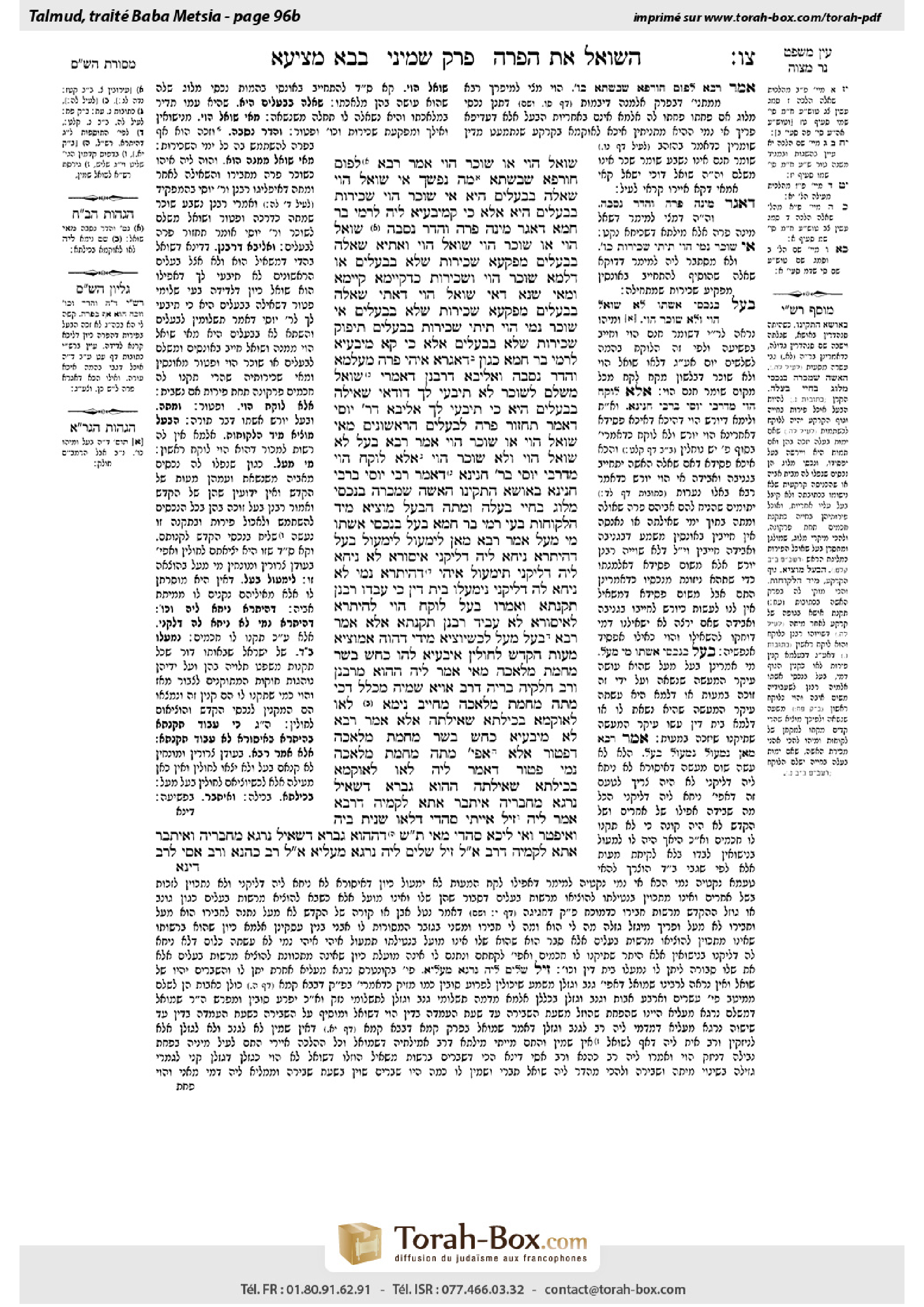
Bava Metzia 96b: Talmud study for Daf Yomi
Study the Talmud for Daf Yomi with scanned pages, Hebrew text, English translations from Sefaria and AI-generated French translations.
Passage selection and English or AI-generated French translation are available where the scan has annotations. Daf Study is independent of Torah-Box and Sefaria.
Browse Bava Metzia · בבא מציעא · All tractatesBava Metzia 96b text and translations
This page of Bava Metzia includes the Aramaic text, an English translation and an AI-generated French translation, alongside the scan above.
בבא מציעא צ״ו ב · Aramaic and Hebrew text
שׁוֹאֵל הָוֵי, אוֹ שׂוֹכֵר הָוֵי?
אָמַר רָבָא, לְפוּם חוּרְפָּא שַׁבֶּשְׁתָּא – מָה נַפְשָׁךְ, אִי שׁוֹאֵל הָוֵי – שְׁאָלָהּ בִּבְעָלִים הִיא, אִי שׂוֹכֵר הָוֵי – שְׂכִירוּת בִּבְעָלִים הִיא.
אֶלָּא כִּי קָמִיבַּעְיָא לֵיהּ לְרָמִי בַּר חָמָא: דַּאֲגַר מִינַּהּ פָּרָה וַהֲדַר נַסְבַהּ, שׁוֹאֵל הָוֵי אוֹ שׂוֹכֵר הָוֵי?
שׁוֹאֵל הָוֵי וְאָתְיָא שְׁאֵלָה בִּבְעָלִים מַפְקְעָא שְׂכִירוּת שֶׁלֹּא בִּבְעָלִים, אוֹ דִלְמָא שׂוֹכֵר הָוֵי וּשְׂכִירוּת כִּדְקָיְימָא קָיְימָא?
וּמַאי שְׁנָא: דְּאִי שׁוֹאֵל הָוֵי, דְּאָתֵי שְׁאֵלָה בִּבְעָלִים מַפְקְעָא שְׂכִירוּת שֶׁלֹּא בִּבְעָלִים. אִי שׂוֹכֵר נָמֵי הָוֵי, תֵּיתֵי שְׂכִירוּת בִּבְעָלִים (תַּיפֵּוק) [תַּפְקַע] שְׂכִירוּת שֶׁלֹּא בִּבְעָלִים!
אֶלָּא כִּי קָא מִיבַּעְיָא לְרָמֵי בַּר חָמָא: כְּגוֹן דַּאֲגַרָא אִיהִי פָּרָה מֵעָלְמָא, וַהֲדַר נַסְבַהּ,
וְאַלִּיבָּא דְּרַבָּנַן, דְּאָמְרִי: שׁוֹאֵל מְשַׁלֵּם לַשּׂוֹכֵר, לָא תִּיבְּעֵי לָךְ – דְּוַדַּאי שְׁאֵילָה בִּבְעָלִים הִיא.
כִּי תִּיבְּעֵי לָךְ, אַלִּיבָּא דְּרַבִּי יוֹסֵי, דְּאָמַר: תַּחְזוֹר פָּרָה לַבְּעָלִים הָרִאשׁוֹנִים, מַאי – שׁוֹאֵל הָוֵי, אוֹ שׂוֹכֵר הָוֵי?
אָמַר רָבָא: בַּעַל לָא שׁוֹאֵל הָוֵי וְלָא שׂוֹכֵר הָוֵי, אֶלָּא לוֹקֵחַ הָוֵי – מִדְּרַבִּי יוֹסֵי בְּרַבִּי חֲנִינָא. דְּאָמַר רַבִּי יוֹסֵי בְּרַבִּי חֲנִינָא: בְּאוּשָׁא הִתְקִינוּ: הָאִשָּׁה שֶׁמָּכְרָה בְּנִכְסֵי מְלוֹג בְּחַיֵּי בַּעְלָהּ, וָמֵתָה – הַבַּעַל מוֹצִיא מִיַּד הַלָּקוֹחוֹת.
בָּעֵי רָמֵי בַּר חָמָא: בַּעַל בְּנִכְסֵי אִשְׁתּוֹ, מִי מָעַל?
אָמַר רָבָא: מַאן לִימְעוֹל? לִימְעוֹל בַּעַל, דְּהֶיתֵּרָא נִיחָא לֵיהּ דְּלִיקְנֵי, אִיסּוּרָא לָא נִיחָא לֵיהּ דְּלִיקְנֵי.
תִּימְעוֹל אִיהִי, דְּהֶיתֵּרָא נָמֵי לָא נִיחָא לַהּ דְּלִיקְנֵי.
נִימְעֲלוּ בֵּית דִּין, כִּי עֲבַדוּ רַבָּנַן תַּקַּנְתָּא וַאֲמַרוּ: בַּעַל לוֹקֵחַ הָוֵי – לְהֶיתֵּרָא, לְאִיסּוּרָא לָא עֲבֻיד רַבָּנַן תַּקַּנְתָּא.
אֶלָּא אָמַר רָבָא: בַּעַל מָעַל לִכְשֶׁיּוֹצִיא, מִידֵּי דְּהָוֵה אַמּוֹצִיא מְעוֹת הֶקְדֵּשׁ לְחוּלִּין.
אִיבַּעְיָא לְהוּ: כָּחַשׁ בָּשָׂר מֵחֲמַת מְלָאכָה, מַאי?
אֲמַר לֵיהּ הָהוּא מֵרַבָּנַן וְרַב חִלְקִיָּה בְּרֵיהּ דְּרַב אַוְיָא שְׁמֵיהּ: מִכְּלָל דְּכִי מֵתָה מֵחֲמַת מְלָאכָה מְחַיֵּיב? נֵימָא: לָאו לְאוֹקֹמַהּ בְּכִילְּתָא שְׁאֵילְתַהּ!
אֶלָּא אָמַר רָבָא: לָא מִיבַּעְיָא כָּחַשׁ בָּשָׂר מֵחֲמַת מְלָאכָה דְּפָטוּר, אֶלָּא אֲפִילּוּ מֵתָה מֵחֲמַת מְלָאכָה נָמֵי פָּטוּר. דַּאֲמַר לֵיהּ: לָאו לְאוֹקֹמַהּ בְּכִילְּתָא שְׁאֵילְתַהּ.
הָהוּא גַּבְרָא דִּשְׁאֵיל נַרְגָּא מֵחַבְרֵיהּ, אִיתְּבַר. אֲתָא לְקַמֵּיהּ דְּרָבָא, אֲמַר לֵיהּ: זִיל אַיְיתִי סָהֲדִי דְּלָאו שַׁנֵּית בֵּיהּ, וְאִיפְּטַר.
וְאִי לֵיכָּא סָהֲדִי מַאי? תָּא שְׁמַע: דְּהָהוּא גַּבְרָא דִּשְׁאֵיל נַרְגָּא מֵחַבְרֵיהּ וְאִיתְּבַר, אֲתָא לְקַמֵּיהּ דְּרַב, אֲמַר לֵיהּ: זִיל שַׁלֵּים לֵיהּ נַרְגָּא מְעַלְּיָא.
אֲמַרוּ לֵיהּ רַב כָּהֲנָא וְרַב אַסִּי לְרַב:
Bava Metzia 96b · English translation
Is he like a borrower or is he like a renter?
Rava said of Rami bar Ḥama: Commensurate to the sharpness of his mind is the extent of his error, as whichever way you look at it, he should be exempt: If he is like a borrower, this is a case of borrowing an item together with the services of the owner, as his wife is obligated to perform household services for him. Alternatively, if he is like a renter, this is a case of renting an item together with the services of the owner, for the same reason. Either way, he should be exempt.
The Gemara reinterprets Rami bar Ḥama’s question: Rather, when Rami bar Ḥama raised the dilemma, it was with regard to a case in which one first rented a cow from a woman and subsequently married her. In that case, she was not working for him at the time he began renting the cow, and so the exemption of borrowing an item together with its owner does not apply. Rami bar Ḥama’s question was: What is the halakha once they get married? This is dependent on whether, from that point, he is like a borrower or he is like a renter.
The Gemara elaborates: Since the husband initially rented the cow, if he is now like a borrower, then his status has changed, and so the new borrowing of the cow done together with borrowing the services of its owner comes and displaces the initial renting that was done without borrowing the services of the owner. Accordingly, the exemption will apply. Or perhaps even once he is married he is still like a renter, and since his status has not changed, the renting stands as it was, i.e., his current renting of the cow is considered a continuation of the initial renting that began before his wife was obligated to work for him. Consequently, the exemption would not apply.
The Gemara questions this logic: But what is different about these possibilities, that you say that only if he is a borrower is it so that the new borrowing of the cow done together with borrowing the services of the owner comes and displaces the initial renting that was done without borrowing the services of the owner? Say the same also if he is now like a renter, and let the new renting of the cow done together with borrowing the services of the owner come and displace the initial renting that was done without borrowing the services of the owner.
The Gemara reinterprets his question: Rather, when Rami bar Ḥama raised the dilemma, it was with regard to a case where a woman rented a cow from someone in the world at large, and subsequently another man married her.
The Gemara explains that the relevance of this dilemma is dependent upon a dispute between the Rabbis and Rabbi Yosei concerning a case in which one rents a cow, and then another person borrows it from the renter, and then a mishap occurs to it (see 35a). And according to the opinion of the Rabbis, who say that the borrower pays the renter, do not raise the dilemma, as it is certainly a case of borrowing an item and borrowing or hiring its owner with it. Evidently, the Rabbis hold that for the duration of the rental period the renter is considered to be the owner of the cow. Accordingly, in this case, the woman is considered to be the owner of the cow. Therefore, when the man marries her, he is considered to be borrowing the cow from her at the same time at which she becomes obligated to work for him.
When should you raise the dilemma? Raise it according to the opinion of Rabbi Yosei, who says that the value of the cow must be returned to its original owner. Rabbi Yosei holds that the renter is not considered to be the owner of the cow, and therefore this is not a case of borrowing an item together with borrowing or renting the services of its owner. Therefore, Rami bar Ḥama asks what level of liability the husband bears; is he like a borrower or is he like a renter?
Rava said: A husband is not like a borrower nor is he like a renter. Rather, he is considered to be like a buyer of his wife’s property, as can be inferred from the statement of Rabbi Yosei, son of Rabbi Ḥanina, as Rabbi Yosei, son of Rabbi Ḥanina, said: In Usha the Sages instituted: In the case of a woman who sold her usufruct property during her husband’s lifetime and then died, the husband can appropriate the property from the buyers, provided he compensates them for their loss of the purchase. Evidently, the wife’s property is considered to be owned by the husband.
§ Rami bar Ḥama raises a dilemma: When a husband acquires the rights to his wife’s usufruct property that includes consecrated property, acquiring property from the Temple in this way is considered misuse of consecrated property. In such a case, who is liable for having misused consecrated property?
Rava said: Who could be considered to have misused consecrated property? Should the husband be considered to have misused consecrated property? Certainly not, as while it is satisfactory for him to acquire non-sacred items of his wife’s property, which are permitted for him to use, it is not satisfactory for him to acquire consecrated property, which it is prohibited for him to use. Since he does not wish to acquire these items, he cannot be held liable for removing them from the possession of the Temple.
Should she be considered to have misused consecrated property? Certainly not, as also with regard to non-sacred items, which are permitted for use, it is not satisfactory to her that her husband acquire them. Nevertheless, by virtue of the rabbinic ordinance, he does. Evidently, her husband’s acquisition is not affected by her wishes, and therefore she cannot be held liable for it.
Should the court be considered to have misused consecrated property, as it is their ordinance that granted the husband ownership? Certainly not, because when the Sages instituted the ordinance, and they said that a husband is considered to be like a buyer of his wife’s property, that was only with regard to non-sacred items, which are permitted for him to use. But with regard to consecrated property, which it is prohibited for him to use, the Sages did not institute the ordinance.
Rather, Rava said: The husband is liable for having misused consecrated property only when he actually takes and spends the money for himself, just as it is in the case of one who mistakenly spends consecrated coins for a non-sacred purpose.
§ A dilemma was raised before the Sages: If the flesh of a borrowed animal was weakened due to the labor it performed for the borrower, what is the halakha? Is the borrower liable to compensate the owner of the animal?
One of the Sages, and Rav Ḥilkiya, son of Rav Avya, is his name, said to the Sage who raised the dilemma: By inference from your question, it seems that when a borrowed animal died due to ordinary labor that it performed, the borrower is liable. Why should that be? Let the borrower say: It was understood by you that I did not borrow it just to stow it in a canopy but to use it; therefore, if it died while I was using it, I should not be liable.
Rather, Rava said: It is not necessary to say that if its flesh was weakened due to ordinary labor that the borrower is exempt from liability. Rather, even if the animal died due to ordinary labor, he is also exempt, as the borrower can say to the owner: It is self-understood that I did not borrow it just to stow it in a canopy, but rather in order to use it.
The Gemara relates: A certain man borrowed an ax from another and it broke. The borrower came before Rava for judgment, who said to him: Go, bring witnesses that you did not deviate from its regular use, and you will be exempt from liability, as this is comparable to a case of a borrowed animal that died due to ordinary labor.
The Gemara asks: And if there are no witnesses, what is the halakha? The Gemara provides a precedent: Come and hear a similar case: There was an incident in which a certain man borrowed an ax from another and it broke. The borrower came before Rav for judgment, who said to him: Go and pay him the entire value of a proper ax.
Rav Kahana and Rav Asi said to Rav:
Bava Metzia 96b · Traduction française (IA)
Est-il comme un emprunteur ou comme un locataire ?
Rava a dit de Rami bar Ḥama : La mesure de son erreur correspond à la finesse de son esprit, car quel que soit le point de vue, il devrait être exempt : s'il est comme un emprunteur, c'est un cas d'emprunt d'un objet avec les services de l'propriétaire, car sa femme est tenue de lui rendre des services domestiques. Alternativement, s'il est comme un locataire, c'est un cas de location d'un objet avec les services de l'propriétaire, pour la même raison. Quel que soit le cas, il devrait être exempt.
La Guemara réinterprète la question de Rami bar Ḥama : En réalité, lorsque Rami bar Ḥama a soulevé ce dilemme, il s'agissait d'un cas où l'on avait d'abord loué une vache à une femme, puis épousé celle-ci. Dans ce cas, elle ne travaillait pas pour lui lorsqu'il avait commencé à louer la vache, et donc l'exemption d'emprunt d'un objet avec son propriétaire ne s'applique pas. La question de Rami bar Ḥama était : Quel est le halakha une fois qu'ils se marient ? Cela dépend du fait qu'il soit comme un emprunteur ou comme un locataire.
La Guemara développe : Puisque le mari avait d'abord loué la vache, si maintenant il est comme un emprunteur, son statut a changé, et donc l'emprunt nouveau de la vache, réalisé conjointement avec l'emprunt des services de l'propriétaire, vient remplacer le louage initial qui n'avait pas inclus les services de l'propriétaire. Ainsi, l'exemption s'appliquerait. Ou peut-être que même après son mariage il reste comme un locataire, et puisque son statut n'a pas changé, le louage reste tel qu'il était, c'est-à-dire que son louage actuel de la vache est considéré comme une continuation du louage initial qui avait commencé avant que sa femme ne soit tenue de travailler pour lui. Par conséquent, l'exemption ne s'appliquerait pas.
La Guemara questionne cette logique : Mais qu'y a-t-il de différent entre ces possibilités, que tu dis que seulement si c'est un emprunteur, c'est ainsi que l'emprunt nouveau de la vache, réalisé conjointement avec l'emprunt des services de l'propriétaire, vient remplacer le louage initial qui n'avait pas inclus les services de l'propriétaire ? Dis la même chose aussi si c'est maintenant un locataire, et laisse l'emprunt nouveau de la vache, réalisé conjointement avec l'emprunt des services de l'propriétaire, venir remplacer le louage initial qui n'avait pas inclus les services de l'propriétaire.
La Guemara réinterprète sa question : En réalité, lorsque Rami bar Ḥama a soulevé ce dilemme, il s'agissait d'un cas où une femme avait loué une vache à quelqu'un dans le monde, puis un autre homme s'était marié avec elle.
La Guemara explique que la pertinence de ce dilemme dépend d'un débat entre les Rabbins et Rabbi Yosei concernant un cas où l'on loue une vache, puis une autre personne l'emprunte à l'locataire, et ensuite un malheur arrive à l'objet (voir 35a). Et selon l'opinion des Rabbins, qui disent que l'emprunteur paie le locataire, ils ne soulevent pas ce dilemme, car c'est certainement un cas d'emprunt d'un objet avec l'emprunt ou l'emploi de son propriétaire. Évidemment, les Rabbins considèrent que durant la période de location, le locataire est considéré comme l'propriétaire de la vache. Ainsi, dans ce cas, la femme est considérée comme l'propriétaire de la vache. Par conséquent, lorsqu'il se marie avec elle, il est considéré comme empruntant la vache d'elle en même temps qu'elle devient tenue de travailler pour lui.
Quand devrait-on soulever ce dilemme ? Souleve-le selon l'opinion de Rabbi Yosei, qui dit que la valeur de la vache doit être rendue à son propriétaire originel. Rabbi Yosei considère que le locataire n'est pas considéré comme l'propriétaire de la vache, et donc ce n'est pas un cas d'emprunt d'un objet avec l'emprunt ou l'emploi de son propriétaire. Ainsi, Rami bar Ḥama demande quel niveau de responsabilité le mari supporte ; est-il comme un emprunteur ou comme un locataire ?
Rava a dit : Le mari n'est ni comme un emprunteur ni comme un locataire. Il est plutôt considéré comme un acheteur des biens de sa femme, comme on peut l'inférer de la déclaration de Rabbi Yosei, fils de Rabbi Ḥanina, car Rabbi Yosei, fils de Rabbi Ḥanina, a dit : À Usha, les Sages ont institué : Dans le cas d'une femme qui a vendu ses biens usufruit pendant la vie de son mari et est ensuite décédée, le mari peut s'approprier les biens des acheteurs, à condition qu'il compense ceux-ci de leur perte de l'achat. Évidemment, les biens de la femme sont considérés comme appartenant au mari.
§ Rami bar Ḥama pose un dilemme : Lorsqu'un mari acquiert les droits sur les biens usufruit de sa femme qui incluent des biens consacrés, l'acquisition de biens du Temple de cette manière est considérée comme une mauvaise utilisation des biens consacrés. Dans ce cas, qui est tenu responsable de cette mauvaise utilisation des biens consacrés ?
Rava a dit : Qui pourrait être considéré comme ayant mauvaise utilisation des biens consacrés ? Devrait-on considérer le mari comme ayant mauvaise utilisation des biens consacrés ? Certainement pas, car il est permis pour lui d'acquérir des biens non sacrés de la propriété de sa femme, qui sont autorisés à son usage, mais il est interdit pour lui d'acquérir des biens sacrés, qui sont interdits à son usage. Puisque il ne souhaite pas acquérir ces biens, il ne peut pas être tenu responsable de leur retrait de la possession du Temple.
Devrait-on considérer elle comme ayant mauvaise utilisation des biens consacrés ? Certainement pas, car même concernant des biens non sacrés, qui sont autorisés à l'usage, il n'est pas souhaitable pour elle que son mari les acquière. Cependant, par l'ordre rabbinique, il le fait. Évidemment, l'acquisition de son mari n'est pas affectée par ses souhaits, et donc elle ne peut pas être tenue responsable de cela.
Le tribunal ne peut pas être considéré comme ayant abusé de la propriété consacrée, car c'est leur ordonnance qui a donné au mari la propriété. Cela n'est pas du tout le cas, car lorsque les Sages ont institué cette ordonnance et qu'ils ont dit que le mari est considéré comme un acheteur de la propriété de sa femme, cela était uniquement concernant les objets non sacrés, qui sont permis d'être utilisés. En ce qui concerne la propriété consacrée, qui est interdite d'être utilisée, les Sages n'ont pas institué cette ordonnance.
Rava a dit plutôt : Le mari est responsable d'avoir abusé de la propriété consacrée uniquement lorsqu'il prend effectivement l'argent et le dépense pour lui-même, tout comme c'est le cas d'une personne qui dépense des monnaies consacrées à un usage non sacré.
§ Un dilemme a été soulevé devant les Sages : Si la viande d'un animal emprunté s'est affaiblie en raison du travail qu'il a effectué pour l'emprunteur, quelle est la halakha ? L'emprunteur est-il responsable de compenser l'propriétaire de l'animal ?
Un des Sages, et Rav Ḥilkiya, fils de Rav Avya, est son nom, a dit au Sage qui avait soulevé le dilemme : Par l'inférence de votre question, il semble que lorsque l'animal emprunté meurt en raison du travail ordinaire qu'il a effectué, l'emprunteur est responsable. Pourquoi cela ? L'emprunteur pourrait dire : Vous avez compris que je n'ai pas emprunté l'animal juste pour le placer sous un dais, mais pour l'utiliser ; donc, si l'animal meurt pendant que j'en faisais usage, je ne devrais pas être responsable.
Rava a dit plutôt : Il n'est pas nécessaire de dire que si la viande s'est affaiblie en raison du travail ordinaire, l'emprunteur est exempt de responsabilité. En réalité, même si l'animal est mort en raison du travail ordinaire, il est également exempt, car l'emprunteur peut dire à l'propriétaire : C'est évident que je n'ai pas emprunté l'animal juste pour le placer sous un dais, mais plutôt pour l'utiliser.
La Guemara rapporte : Un certain homme a emprunté une hache à un autre et elle s'est cassée. L'emprunteur est venu devant Rava pour être jugé, et Rava a dit à lui : Allez, apportez des témoins qui attestent que vous n'avez pas dévié de son usage normal, et vous serez exempt de responsabilité, car cela est comparable à un cas d'animal emprunté qui meurt en raison du travail ordinaire.
La Guemara pose la question : Et s'il n'y a pas de témoins, quelle est la halakha ? La Guemara fournit un précédent : Venez écouter un cas similaire : Il y avait un incident où un certain homme avait emprunté une hache à un autre et elle s'était cassée. L'emprunteur est venu devant Rav pour être jugé, et Rav a dit à lui : Allez et payez-lui la valeur d'une hache convenable.
Rav Kahana et Rav Asi ont dit à Rav :
Traduction française générée par IA à partir de l’édition anglaise de Sefaria. Vérifie toujours un passage avec le texte source.
Text from Sefaria: William Davidson Edition - Vocalized Aramaic (CC BY NC); William Davidson Edition - English (CC BY NC).