Bava Metzia 97b: Talmud study for Daf Yomi
Study the Talmud for Daf Yomi with scanned pages, Hebrew text, English translations from Sefaria and AI-generated French translations.
Passage selection and English or AI-generated French translation are available where the scan has annotations. Daf Study is independent of Torah-Box and Sefaria.
Browse Bava Metzia · בבא מציעא · All tractatesBava Metzia 97b text and translations
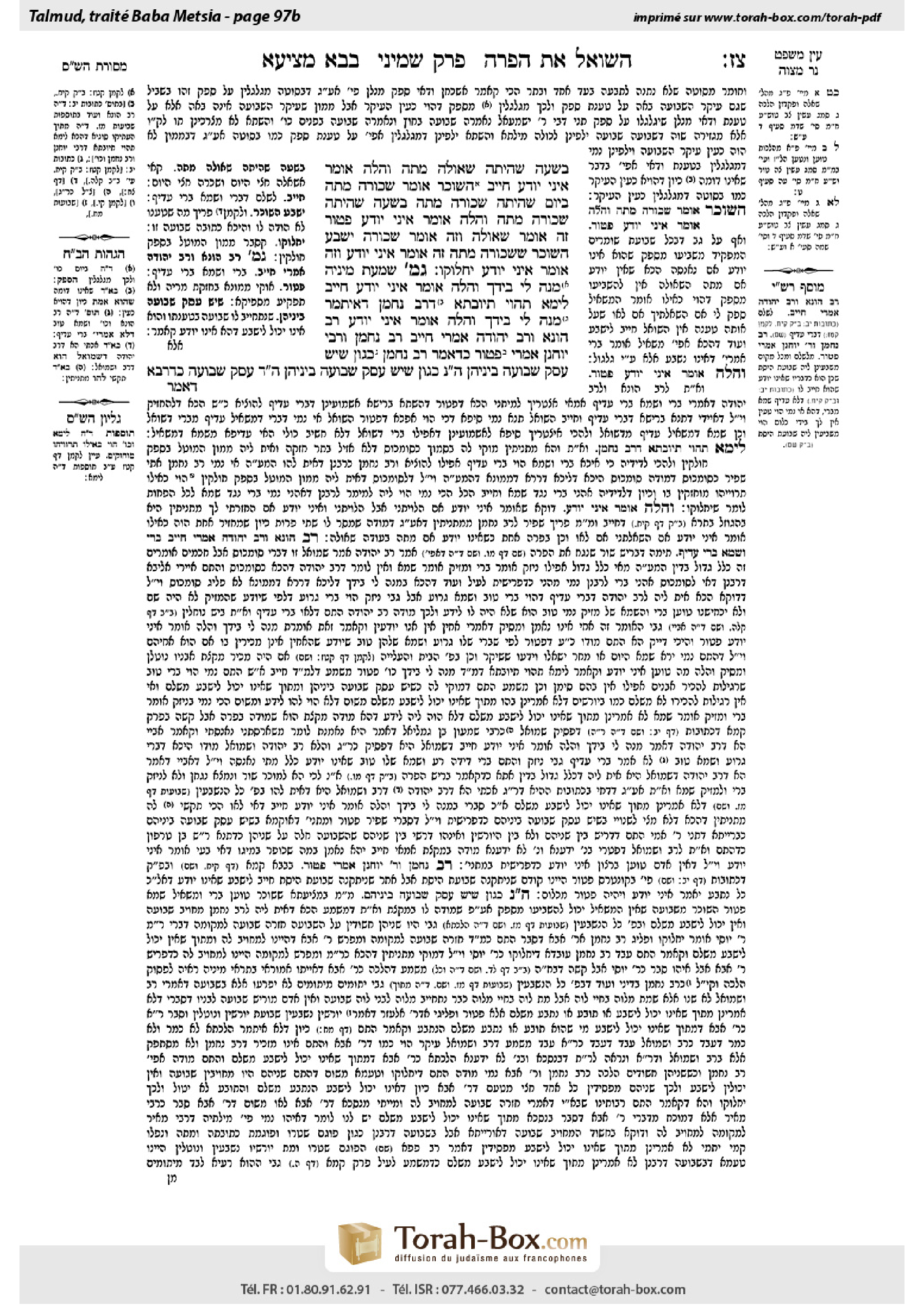
This page of Bava Metzia includes the Aramaic text, an English translation and an AI-generated French translation, alongside the scan above.
בבא מציעא צ״ז ב · Aramaic and Hebrew text
בְּשָׁעָה שֶׁהָיְתָה שְׁאוּלָה מֵתָה. וְהַלָּה אוֹמֵר: אֵינִי יוֹדֵעַ – חַיָּיב.
הַשּׂוֹכֵר אוֹמֵר: שְׂכוּרָה מֵתָה, בְּיוֹם שֶׁהָיְתָה שְׂכוּרָה מֵתָה, בְּשָׁעָה שֶׁהָיְתָה שְׂכוּרָה מֵתָה. וְהַלָּה אוֹמֵר: אֵינִי יוֹדֵעַ – פָּטוּר.
זֶה אוֹמֵר: שְׁאוּלָה, וְזֶה אוֹמֵר: שְׂכוּרָה – יִשָּׁבַע הַשּׂוֹכֵר שֶׁשְּׂכוּרָה מֵתָה.
זֶה אוֹמֵר: אֵינִי יוֹדֵעַ, וְזֶה אוֹמֵר: אֵינִי יוֹדֵעַ – יַחְלוֹקוּ.
גְּמָ׳ שָׁמְעַתְּ מִינַּהּ: מָנֶה לִי בְּיָדְךָ, וְהַלָּה אוֹמֵר: אֵינִי יוֹדֵעַ – חַיָּיב.
לֵימָא תִּהְוֵי תְּיוּבְתָּא דְּרַב נַחְמָן, דְּאִיתְּמַר: ״מָנֶה לִי בְּיָדְךָ״, וְהַלָּה אוֹמֵר: אֵינִי יוֹדֵעַ. רַב הוּנָא וְרַב יְהוּדָה אָמְרִי: חַיָּיב. רַב נַחְמָן וְרַבִּי יוֹחָנָן אָמְרִי: פָּטוּר!
כִּדְאָמַר רַב נַחְמָן: כְּגוֹן שֶׁיֵּשׁ עֵסֶק שְׁבוּעָה בֵּינֵיהֶן. הָכָא נָמֵי – כְּגוֹן שֶׁיֵּשׁ עֵסֶק שְׁבוּעָה בֵּינֵיהֶן.
הֵיכִי דָּמֵי עֵסֶק שְׁבוּעָה? כִּדְרָבָא,
Bava Metzia 97b · English translation
or: It died during the period in which it was being borrowed, so that, according to his claim, the borrower is liable to pay for the cow, and the other one, the borrower, says: I do not know what happened, the borrower is liable to pay.
If the renter says: The rented cow is the one that died; or: It died on the day that it was being rented; or: It died during the period in which it was being rented, and the other one, the owner of the cow, says: I do not know what happened, the renter is exempt.
If this owner says with certitude: The borrowed cow is the one that died, and that renter says with certitude: The rented cow is the one that died, then the renter takes an oath that the rented cow is the one that died, and he is then exempt from liability.
If this one says: I do not know what happened, and that one says: I do not know what happened, then they divide the disputed amount. The bailee is liable to pay for only half the value of the cow.
GEMARA: Conclude from the mishna that in a comparable situation, where one says to another: I have one hundred dinars in your possession, and the other one says: I do not know whether or not I have your money, that the defendant is liable to pay.
The Gemara suggests: Let us say that it is a conclusive refutation of the opinion of Rav Naḥman. As it was stated that the amora’im disagreed about the following case: With regard to one who approaches another and says: I have one hundred dinars in your possession, and the other says: I do not know, Rav Huna and Rav Yehuda say: The respondent is liable to pay, because he did not deny the claim. Rav Naḥman and Rabbi Yoḥanan say: He is exempt from payment.
The Gemara refutes this contention: Just as Rav Naḥman says in that context: He is liable to pay only in a case where there is a matter of an oath between them, here too, it is a case where there is a matter of an oath between them. In that case, Rav Naḥman rules that he is liable to pay only if he is already liable to take an oath concerning his denial of part of the claim. Since he does not know if he owes this sum, and he is therefore unable to take the oath he is liable to take, he must pay. In this case as well, since the bailee does not know what occurred, he cannot take an oath, and must pay.
The Gemara asks: What are the circumstances of a matter of an oath? The Gemara explains: This in accordance with the statement of Rava,
Bava Metzia 97b · Traduction française (IA)
ou : La vache est morte pendant la période où elle était empruntée, de sorte que, selon son déclaration, le prêteur est tenu de payer pour la vache, et l'autre, le prêteur, dit : Je ne sais pas ce qui s'est passé, le prêteur est tenu de payer.
Si le locataire dit : La vache louée est celle qui est morte ; ou : Elle est morte le jour où elle était louée ; ou : Elle est morte pendant la période où elle était louée, et l'autre, le propriétaire de la vache, dit : Je ne sais pas ce qui s'est passé, le locataire est exempt.
Si cet propriétaire dit avec certitude : La vache empruntée est celle qui est morte, et que ce locataire dit avec certitude : La vache louée est celle qui est morte, alors le locataire jure que la vache louée est celle qui est morte, et il est alors exempt de responsabilité.
Si l'un dit : Je ne sais pas ce qui s'est passé, et l'autre dit : Je ne sais pas ce qui s'est passé, alors ils partagent la somme en dispute. Le dépositaire est tenu de payer seulement la moitié de la valeur de la vache.
GUEMARA : Concluez de la mitsna que dans une situation comparable, où l'un dit à l'autre : J'ai cent dinars à votre disposition, et l'autre dit : Je ne sais pas si j'ai vos dinars, que le défendeur est tenu de payer.
La Guemara suggère : Faisons-le savoir que c'est une refutation concluante de l'opinion de Rav Naḥman. Comme il a été dit que les amora’im s'entendaient sur le cas suivant : Concernant celui qui s'adresse à un autre et dit : J'ai cent dinars à votre disposition, et l'autre dit : Je ne sais pas, Rav Huna et Rav Yehuda disent : Le répondant est tenu de payer, car il n'a pas nié la revendication. Rav Naḥman et Rabbi Yoḥanan disent : Il est exempt de paiement.
La Guemara réfute cette contestation : Tout comme Rav Naḥman dit dans ce contexte : Il est tenu de payer seulement dans le cas où il y a une affaire d'œuf entre eux, ici aussi, il s'agit d'une affaire d'œuf entre eux. Dans ce cas, Rav Naḥman déclare qu'il est tenu de payer seulement s'il est déjà tenu de jurer concernant son déni d'une partie de la revendication. Puisque il ne sait pas s'il doit cette somme, et qu'il est donc incapable de jurer, il doit payer. Dans ce cas également, puisque le dépositaire ne sait pas ce qui s'est passé, il ne peut pas jurer et doit payer.
La Guemara pose la question : Quelles sont les circonstances d'une affaire d'œuf ? La Guemara explique : Cela selon la déclaration de Rava,
Traduction française générée par IA à partir de l’édition anglaise de Sefaria. Vérifie toujours un passage avec le texte source.
Text from Sefaria: William Davidson Edition - Vocalized Aramaic (CC BY NC); William Davidson Edition - English (CC BY NC).