Bava Metzia 98a: Talmud study for Daf Yomi
Study the Talmud for Daf Yomi with scanned pages, Hebrew text, English translations from Sefaria and AI-generated French translations.
Passage selection and English or AI-generated French translation are available where the scan has annotations. Daf Study is independent of Torah-Box and Sefaria.
Browse Bava Metzia · בבא מציעא · All tractatesBava Metzia 98a text and translations
This page of Bava Metzia includes the Aramaic text, an English translation and an AI-generated French translation, alongside the scan above.
בבא מציעא צ״ח א · Aramaic and Hebrew text
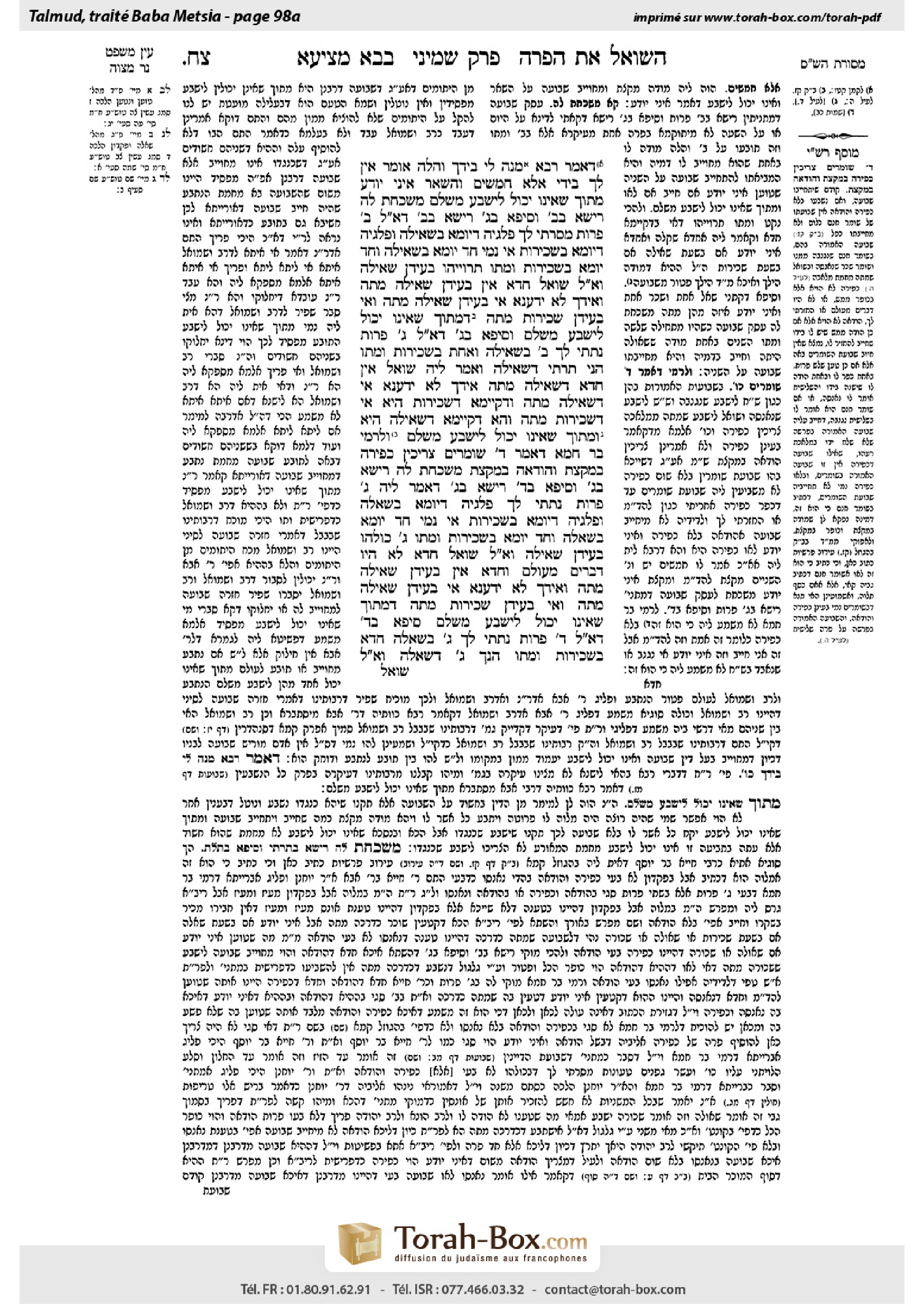
דְּאָמַר רָבָא: ״מָנֶה לִי בְּיָדְךָ״, וְהַלָּה אוֹמֵר: אֵין לְךָ בְּיָדִי אֶלָּא חֲמִשִּׁים, וְהַשְּׁאָר אֵינִי יוֹדֵעַ. מִתּוֹךְ שֶׁאֵינוֹ יָכוֹל לִישָּׁבַע – מְשַׁלֵּם.
מַשְׁכַּחַתְּ לַהּ רֵישָׁא בִּשְׁתַּיִם וְסֵיפָא בְּשָׁלֹשׁ.
רֵישָׁא בִּשְׁתַּיִם – דַּאֲמַר לֵיהּ: שְׁתֵּי פָרוֹת מָסַרְתִּי לָךְ, פַּלְגֵיהּ דְּיוֹמָא בִּשְׁאֵילָה, וּפַלְגֵיהּ דְּיוֹמָא בִּשְׂכִירוּת. אִי נָמֵי: חַד יוֹמָא בִּשְׁאֵילָה, וְחַד יוֹמָא בִּשְׂכִירוּת, וּמֵתוּ תַּרְוַיְיהוּ בְּעִידָּן שְׁאֵילָה.
וַאֲמַר לֵיהּ שׁוֹאֵל: חֲדָא – אִין, בְּעִידָּן שְׁאֵילָה מֵתָה, וְאִידַּךְ – לָא יָדַעְנָא אִי בְּעִידָּן שְׁאֵילָה מֵתָה וְאִי בְּעִידָּן שְׂכִירוּת מֵתָה, דְּמִתּוֹךְ שֶׁאֵינוֹ יָכוֹל לִישָּׁבַע – מְשַׁלֵּם.
וְסֵיפָא בְּשָׁלֹשׁ – דַּאֲמַר לֵיהּ: שָׁלֹשׁ פָּרוֹת נָתַתִּי לָךְ, שְׁתַּיִם בִּשְׁאֵילָה וְאַחַת בִּשְׂכִירוּת, וָמֵתוּ הָנֵי תַּרְתֵּי דִּשְׁאֵילָה, וַאֲמַר לֵיהּ שׁוֹאֵל: אִין, חֲדָא דִּשְׁאֵילָה מֵתָה, אִידַּךְ – לָא יָדַעְנָא אִי דִּשְׁאֵילָה מֵתָה וּדְקָיְימָא דִּשְׂכִירוּת הִיא, אִי דִּשְׂכִירוּת מֵתָה וְהָא דְּקָיְימָא דִּשְׁאֵילָה הִיא, וּמִתּוֹךְ שֶׁאֵינוֹ יָכוֹל לִישָּׁבַע – מְשַׁלֵּם.
וּלְרָמֵי בַּר חָמָא, דְּאָמַר: אַרְבָּעָה שׁוֹמְרִים צְרִיכִין כְּפִירָה בְּמִקְצָת וְהוֹדָאָה בְּמִקְצָת, מַשְׁכַּחַתְּ לַהּ רֵישָׁא בְּשָׁלֹשׁ וְסֵיפָא בְּאַרְבַּע.
רֵישָׁא בְּשָׁלֹשׁ – דַּאֲמַר לֵיהּ: שָׁלֹשׁ פָּרוֹת נָתַתִּי לְךָ, פַּלְגֵיהּ דְּיוֹמָא בִּשְׁאֵלָה וּפַלְגֵיהּ דְּיוֹמָא בִּשְׂכִירוּת, אִי נָמֵי חַד יוֹמָא בִּשְׁאֵלָה וְחַד יוֹמָא בִּשְׂכִירוּת, וּמֵתוּ תְּלָת כּוּלְּהוּ בְּעִידָּן שְׁאֵילָה,
וַאֲמַר לֵיהּ שׁוֹאֵל: חֲדָא – לֹא הָיוּ דְבָרִים מֵעוֹלָם. וַחֲדָא – אִין, בְּעִידָּן שְׁאֵילָה מֵתָה, וְאִידַּךְ – לָא יָדַעְנָא אִי בְּעִידָּן שְׁאֵילָה מֵתָה וְאִי בְּעִידָּן שְׂכִירוּת מֵתָה, דְּמִתּוֹךְ שֶׁאֵינוֹ יָכוֹל לִישָּׁבַע – מְשַׁלֵּם.
סֵיפָא בְּאַרְבַּע – דַּאֲמַר לֵיהּ: אַרְבַּע פָּרוֹת נָתַתִּי לְךָ, שָׁלֹשׁ בִּשְׁאֵלָה, חֲדָא בִּשְׂכִירוּת, וּמֵתוּ הָנָךְ שָׁלֹשׁ דִּשְׁאֵלָה. וַאֲמַר לֵיהּ
Bava Metzia 98a · English translation
as Rava says: One who approaches another and says: I have one hundred dinars in your possession, and the other says: You have in my possession only fifty dinars that I am sure about, and as for the rest, I do not know. As one who admitted to part of a claim, he is liable, by Torah law, to take an oath that he does not owe the other fifty dinars. Since he cannot take an oath to that effect, as he is unsure if he owes it, he must pay.
The Gemara explains how the mishna can be interpreted as referring to a case in which the defendant makes a partial admission, thereby requiring him to take an oath: You find it in the first clause, i.e., in the first two cases of the mishna, in a situation where he took hold of two cows, and in the latter clause, i.e., in the third case, in a situation where he took hold of three cows.
The Gemara explains: One can interpret the first clause to be referring to a case where one took hold of two cows, as follows: The case is that the owner said to the bailee: I delivered two cows to you under the agreement that one half of the day you would have them through borrowing and the other half of the day through renting, or, alternatively, one day through borrowing and one day through renting. And I claim that both died during a period of borrowing, so you are liable to pay for both of them.
And the borrower said to him: With regard to one of them, yes, I admit that it died during a period of borrowing. But with regard to the other one, I do not know whether it died during a period of borrowing or if it died during a period of renting. Because he admits to part of the claim, he is required to take an oath in order to be exempt from the rest of the claim. As he concedes that he does not know what happened, he is unable to take such an oath. The halakha is that since he is unable to take an oath, he must pay for both cows.
And one can interpret the latter clause to be referring to a case where he took hold of three cows, as follows: The case is that the owner said to the bailee: I gave three cows to you; two through borrowing and one through renting. And I claim that those two that were being borrowed were the ones that died. And the borrower said to him: Yes, I admit that one of the cows that was borrowed died. But with regard to the other one that died, I do not know if it was the other cow that was being borrowed that died, and so the cow that is still alive is the one that was being rented, or if the one that was being rented died, and this one that is still alive is the one that was being borrowed. Because he admits to part of the claim, in order to be exempt from the rest of the claim he is required to take an oath. As he concedes that he does not know what happened, he is unable to take such an oath. And the halakha is that since he is unable to take an oath, he must pay for both cows.
The Gemara explains how the mishna can be interpreted even according to the unique opinion of Rami bar Ḥama: And the mishna can be interpreted in accordance with the opinion of Rami bar Ḥama, who says: In order for any of the four types of bailees to be required to take an oath, they need to make both a denial of part of the owner’s claim and an admission of another part of his claim. According to his opinion, you find the bailee is liable to take an oath in the first clause, i.e., in the first two cases of the mishna, in a situation where he took hold of three cows, and in the latter clause, i.e., in the third case, in a situation where he took hold of four cows.
The Gemara elaborates: One can interpret the first clause to be referring to a case where he took hold of three cows, as follows: The case is that the owner said to the bailee: I gave three cows to you under the agreement that one half of the day you would have them through borrowing and the other half of the day through renting, or, alternatively, one day through borrowing and one day through renting. And I claim that all three of them died during a period of borrowing, and so you are liable to pay for all of them.
And the borrower said to him: With regard to one of them, this matter never occurred, as I took only two cows from you. And, as for the two cows I did take, with regard to one of them, yes, I admit that it died during a period of borrowing. But with regard to the other one, I do not know whether it died during a period of borrowing or if it died during a period of renting. Because the bailee admits to part of the claim and denies another part of the claim, he is required to take an oath in order to be exempt from the rest of the claim. As he concedes that he does not know what happened, he is unable to take such an oath. The halakha is that since he is unable to take an oath, he must pay for all three cows.
One can interpret the latter clause to be referring to a case where he took hold of four cows, as follows: The case is that the owner said to the bailee: I gave four cows to you, three through borrowing and one through renting. And I claim that those three that were being borrowed were the ones that died. And he said to him,
Bava Metzia 98a · Traduction française (IA)
comme Rava le dit : celui qui s'adresse à un autre et dit : j'ai cent dinars à votre possession, et l'autre dit : vous avez en ma possession cinquante dinars dont je suis sûr, et quant aux autres, je ne sais pas. Comme celui qui a admis une partie d'une réclamation, il est tenu, selon la loi divine, de prendre un serment qu'il ne doit pas aux autres cinquante dinars. Puisqu'il ne peut pas prendre ce serment, car il est incertain s'il doit cela, il doit payer.
La Guemara explique comment la Michna peut être interprétée comme faisant référence à un cas où le défendeur fait une admission partielle, ce qui exige qu'il prenne un serment : vous le trouvez dans la première clause, c'est-à-dire dans les deux premiers cas de la Michna, dans un cas où il a pris possession de deux vaches, et dans la dernière clause, c'est-à-dire dans le troisième cas, dans un cas où il a pris possession de trois vaches.
La Guemara explique : on peut interpréter la première clause comme faisant référence à un cas où l'on a pris possession de deux vaches, comme suit : le cas est que l'owner a dit au baal kessef : j'ai livré deux vaches à vous sous l'accord que la moitié de la journée vous les auriez par emprunt et l'autre moitié par location, ou, alternativement, une journée par emprunt et une journée par location. Et je réclame que les deux sont mortes durant une période d'emprunt, donc vous êtes tenu de payer pour les deux.
Et le prêteur a dit à lui : concernant l'une d'entre elles, oui, j'admet que celle-ci est morte durant une période d'emprunt. Mais concernant l'autre, je ne sais pas si elle est morte durant une période d'emprunt ou si elle est morte durant une période de location. Puisqu'il admet une partie de la réclamation, il est tenu de prendre un serment afin d'être exempt de la reste de la réclamation. Puisqu'il admet qu'il ne sait pas ce qui s'est passé, il ne peut pas prendre ce serment. La halakha est que puisqu'il ne peut pas prendre un serment, il doit payer pour les deux vaches.
Et on peut interpréter la dernière clause comme faisant référence à un cas où il a pris possession de trois vaches, comme suit : le cas est que l'owner a dit au baal kessef : j'ai donné trois vaches à vous ; deux par emprunt et une par location. Et je réclame que ce sont les deux qui étaient empruntées qui sont mortes. Et le prêteur a dit à lui : oui, j'admet que l'une des vaches empruntées est morte. Mais concernant l'autre qui est morte, je ne sais pas si c'est la autre vache empruntée qui est morte, et donc la vache qui est encore vivante est celle qui était louée, ou si c'est la vache louée qui est morte, et celle qui est encore vivante est celle qui était empruntée. Puisqu'il admet une partie de la réclamation, afin d'être exempt de la reste de la réclamation, il est tenu de prendre un serment. Puisqu'il admet qu'il ne sait pas ce qui s'est passé, il ne peut pas prendre ce serment. La halakha est que puisqu'il ne peut pas prendre un serment, il doit payer pour les deux vaches.
La Guemara explique comment la Michna peut être interprétée même selon l'opinion unique de Rami bar Ḥama : la Michna peut être interprétée selon l'opinion de Rami bar Ḥama, qui dit : afin que l'un des quatre types de baal kessef soit tenu de prendre un serment, il faut qu'il fasse à la fois une dénégation d'une partie de la réclamation de l'owner et une admission d'une autre partie de sa réclamation. Selon son opinion, on trouve que le baal kessef est tenu de prendre un serment dans la première clause, c'est-à-dire dans les deux premiers cas de la Michna, dans un cas où il a pris possession de trois vaches, et dans la dernière clause, c'est-à-dire dans le troisième cas, dans un cas où il a pris possession de quatre vaches.
La Guemara développe : on peut interpréter la première clause comme faisant référence à un cas où il a pris possession de trois vaches, comme suit : le cas est que l'owner a dit au baal kessef : j'ai donné trois vaches à vous sous l'accord que la moitié de la journée vous les auriez par emprunt et l'autre moitié par location, ou, alternativement, une journée par emprunt et une journée par location. Et je réclame que les trois sont mortes durant une période d'emprunt, donc vous êtes tenu de payer pour les trois.
Et le prêteur a dit à lui : concernant l'une d'entre elles, cela n'a jamais eu lieu, car j'ai pris seulement deux vaches à vous. Et, concernant les deux vaches que j'ai prises, concernant l'une d'entre elles, oui, j'admet que celle-ci est morte durant une période d'emprunt. Mais concernant l'autre, je ne sais pas si elle est morte durant une période d'emprunt ou si elle est morte durant une période de location. Puisqu'il admet une partie de la réclamation et dénie une autre partie de la réclamation, il est tenu de prendre un serment afin d'être exempt de la reste de la réclamation. Puisqu'il admet qu'il ne sait pas ce qui s'est passé, il ne peut pas prendre ce serment. La halakha est que puisqu'il ne peut pas prendre un serment, il doit payer pour les trois vaches.
On peut interpréter la dernière clause comme faisant référence à un cas où l'on a pris possession de quatre vaches, comme suit : le cas est que l'propriétaire a dit au baal kessef : j'ai donné quatre vaches à vous, trois par emprunt et une par location. Et je réclame que ce sont les trois qui étaient empruntées qui sont mortes. Et il a dit à lui,
Traduction française générée par IA à partir de l’édition anglaise de Sefaria. Vérifie toujours un passage avec le texte source.
Text from Sefaria: William Davidson Edition - Vocalized Aramaic (CC BY NC); William Davidson Edition - English (CC BY NC).