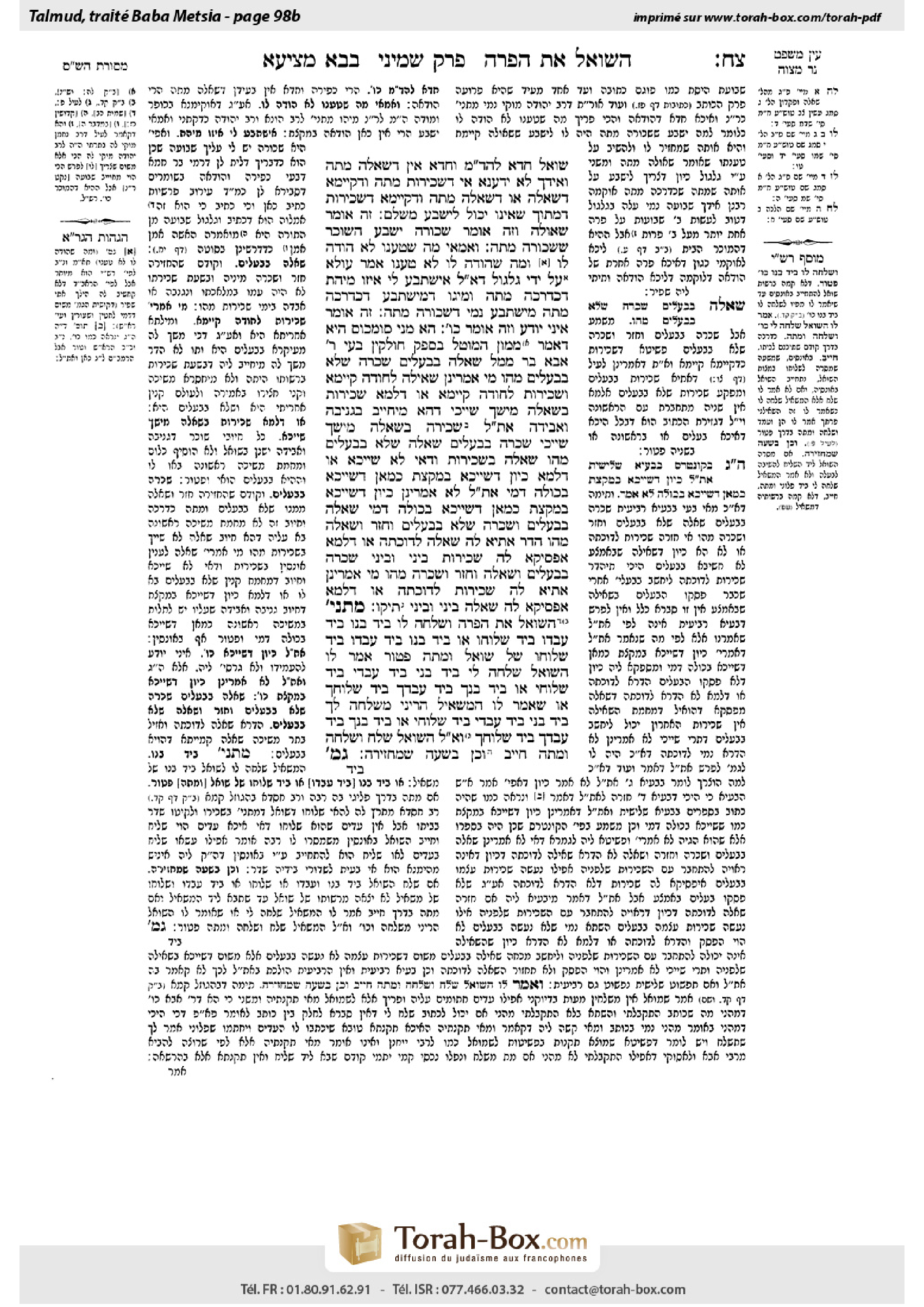
Bava Metzia 98b: Talmud study for Daf Yomi
Study the Talmud for Daf Yomi with scanned pages, Hebrew text, English translations from Sefaria and AI-generated French translations.
Passage selection and English or AI-generated French translation are available where the scan has annotations. Daf Study is independent of Torah-Box and Sefaria.
Browse Bava Metzia · בבא מציעא · All tractatesBava Metzia 98b text and translations
This page of Bava Metzia includes the Aramaic text, an English translation and an AI-generated French translation, alongside the scan above.
בבא מציעא צ״ח ב · Aramaic and Hebrew text
שׁוֹאֵל: חֲדָא – לֹא הָיוּ דְבָרִים מֵעוֹלָם. וַחֲדָא – אִין, דִּשְׁאֵלָה מֵתָה, וְאִידַּךְ – לָא יָדַעְנָא אִי דִּשְׂכִירוּת מֵתָה וּדְקָיְימָא דִּשְׁאֵלָה, אוֹ דִּשְׁאֵלָה מֵתָה וּדְקָיְימָא דִּשְׂכִירוּת, דְּמִתּוֹךְ שֶׁאֵינוֹ יָכוֹל לִישָּׁבַע – מְשַׁלֵּם.
זֶה אוֹמֵר שְׁאוּלָה, וְזֶה אוֹמֵר שְׂכוּרָה – יִשָּׁבַע הַשּׂוֹכֵר שֶׁשְּׂכוּרָה מֵתָה.
וְאַמַּאי? מַה שֶּׁטְּעָנוֹ – לֹא הוֹדָה לוֹ, וּמַה שֶּׁהוֹדָה לוֹ – לֹא טְעָנוֹ! אָמַר עוּלָּא: עַל יְדֵי גִּלְגּוּל.
דַּאֲמַר לֵיהּ: אִישְׁתְּבַע לִי אֵיזוֹ מִיהַת דִּכְדַרְכָּהּ מֵתָה, וּמִיגּוֹ דְּמִישְׁתְּבַע דִּכְדַרְכָּהּ מֵתָה, מִישְׁתְּבַע נָמֵי דִּשְׂכוּרָה מֵתָה.
זֶה אוֹמֵר אֵינִי יוֹדֵעַ וְזֶה אוֹמֵר כּוּ׳. הָא מַנִּי – סוֹמְכוֹס הִיא, דְּאָמַר: מָמוֹן הַמּוּטָּל בְּסָפֵק – חוֹלְקִין.
בָּעֵי רַבִּי אַבָּא בַּר מֶמֶל: שְׁאָלָהּ בִּבְעָלִים, שְׂכָרָהּ שֶׁלֹּא בִּבְעָלִים, מַהוּ?
מִי אָמְרִינַן שְׁאֵילָה לְחוֹדַהּ קָיְימָא וּשְׂכִירוּת לְחוֹדַהּ קָיְימָא, אוֹ דִלְמָא שְׂכִירוּת בִּשְׁאֵלָה מֵישָׁךְ שָׁיְיכִי, דְּהָא מִיחַיַּיב בִּגְנֵיבָה וַאֲבֵידָה?
אִם תִּמְצָא לוֹמַר שְׂכִירָה בִּשְׁאֵלָה מֵישָׁךְ שָׁיְיכִי, שְׂכָרָהּ בִּבְעָלִים שְׁאָלָהּ שֶׁלֹּא בִּבְעָלִים, מַהוּ?
שְׁאֵלָה בִּשְׂכִירוּת וַדַּאי לָא שָׁיְיכָא, אוֹ דִלְמָא כֵּיוָן דְּשָׁיְיכָא בְּמִקְצָת, כְּמַאן דְּשָׁיְיכָא בְּכוּלַּהּ דָּמֵי?
אִם תִּמְצָא לוֹמַר לָא אָמְרִינַן כֵּיוָן דְּשָׁיְיכָא בְּמִקְצָת כְּמַאן דְּשָׁיְיכָא בְּכוּלַּהּ דָּמֵי: שְׁאָלָהּ בִּבְעָלִים וּשְׂכָרָהּ שֶׁלֹּא בִּבְעָלִים, וְחָזַר וּשְׁאָלָהּ, מַהוּ?
הֲדַר אָתְיָא לַהּ שְׁאֵלָה לְדוּכְתַּהּ, אוֹ דִלְמָא אִפְּסִיקָא לַהּ שְׂכִירוּת בֵּינֵי וּבֵינֵי?
שְׂכָרָהּ בִּבְעָלִים וּשְׁאָלָהּ וְחָזַר וּשְׂכָרָהּ, מַהוּ? מִי אָמְרִינַן אָתְיָא לַהּ שְׂכִירוּת לְדוּכְתַּהּ, אוֹ דִלְמָא אִפְּסִיקָא לַהּ שְׁאֵלָה בֵּינֵי וּבֵינֵי?
תֵּיקוּ.
מַתְנִי׳ הַשּׁוֹאֵל אֶת הַפָּרָה וְשִׁלְּחָהּ לוֹ בְּיַד בְּנוֹ בְּיַד עַבְדּוֹ בְּיַד שְׁלוּחוֹ, אוֹ בְּיַד בְּנוֹ בְּיַד עַבְדּוֹ בְּיַד שְׁלוּחוֹ שֶׁל שׁוֹאֵל וּמֵתָה – פָּטוּר.
אָמַר לוֹ הַשּׁוֹאֵל: שַׁלְּחָהּ לִי בְּיַד בְּנִי, בְּיַד עַבְדִּי, בְּיַד שְׁלוּחִי, אוֹ בְּיַד בִּנְךָ, בְּיַד עַבְדְּךָ, בְּיַד שְׁלוּחֶךָ, אוֹ שֶׁאָמַר לוֹ הַמַּשְׁאִיל: הֲרֵינִי מְשַׁלְּחָהּ לְךָ בְּיַד בְּנִי, בְּיַד עַבְדִּי, בְּיַד שְׁלוּחִי, אוֹ בְּיַד בִּנְךָ, בְּיַד עַבְדְּךָ, בְּיַד שְׁלוּחֶךָ, וְאָמַר לוֹ הַשּׁוֹאֵל: שַׁלַּח, וְשִׁלְּחָהּ וּמֵתָה – חַיָּיב.
וְכֵן בְּשָׁעָה שֶׁמַּחְזִירָהּ.
Bava Metzia 98b · English translation
i.e., the borrower said to the owner: With regard to one of the cows that you claim, this matter never occurred, as I never took that cow from you. And as for the cows that I did take that died, with regard to one of them, yes, I admit that it was a cow that was being borrowed that died; but the other cow that died, I do not know whether it was the cow that was being rented that died, and so the cow that is still alive is the one that was being borrowed, or whether the cow that was being borrowed died, and so the cow that is still alive is the one that was being rented. Because the bailee admits to part of the claim and denies another part of the claim, he is required to take an oath in order to be exempt from the rest of the claim. As he concedes that he does not know what happened, he is unable to take such an oath. The halakha is that since he is unable to take an oath, he must pay for all three cows.
§ The mishna teaches: The bailee rented one cow and borrowed another one. This owner says with certitude: The borrowed cow is the one that died. And that renter says with certitude: The rented cow is the one that died. In this case, the renter takes an oath that the rented cow is the one that died and then he is exempt.
The Gemara asks: But why should he take an oath? That which the owner claimed from him, he did not admit to at all, and that which the bailee admitted to, the owner had not claimed from him. In order to be required to take an oath, the bailee must admit to part of the owner’s actual claim. Ulla said: The mishna is referring to a case where the owner required the bailee to take another oath by extending the oath that he had already required him to take.
The Gemara elaborates: For example, this is a case where the owner said to him: Take an oath to me, in any event, that the cow died naturally, and not as a result of your negligence. The owner has a right to demand such an oath. And since the bailee is made to take an oath that the cow died naturally, that oath can be extended such that he can also be made to take an oath that it was the cow that was rented that died.
The mishna concludes: If this one says: I do not know what happened, and that one says: I do not know what happened, then they divide the disputed amount. The bailee is liable to pay for only half the value of the cow. The Gemara asks: In accordance with whose opinion is this? It is in accordance with the opinion of Sumakhos, who says: When there is property of uncertain ownership, the parties divide it equally between them.
§ Rabbi Abba bar Memel raises a dilemma: If one borrowed a cow together with borrowing the services of its owner, and then, before returning the cow, he rented the cow from the owner without borrowing the services of its owner, what is the halakha?
Do we say: The borrowing stands by itself and the renting stands by itself, i.e., they are two independent transactions, and so the bailee is liable for any mishap that occurs during the renting period, as the owner’s services were not borrowed by him during that time? Or, perhaps the subsequent renting is related to the prior borrowing and is an extension of it. It could be said that the renting is related to the borrowing because a renter is liable for theft and loss, as is a borrower. Perhaps the liability resulting from renting that immediately follows a period of borrowing is a downgraded form of the liability undertaken at the start of the period of borrowing. If so, then in this case, since the bailee bore no liability during the borrowing period, as the cow was borrowed while the owner was providing his services to the borrower, the bailee will not bear liability during the rental period.
If you say that in such a case, the subsequent renting is related to the prior borrowing and is an extension of it, then in the reverse case, where one rented a cow together with borrowing the services of its owner, and then, before returning the cow, he borrowed it from the owner without borrowing the services of its owner, what is the halakha?
Do we say that the subsequent borrowing is certainly not related to or an extension of the prior renting, as a borrower undertakes a higher level of liability than a renter? Or perhaps, since the subsequent borrowing is partially related to the prior renting, as the borrower is liable for theft and loss just as a renter is, it is considered as though it were related entirely to it and is an extension of it. Consequently, the exemption of using an item together with its owner’s services also applies to the subsequent borrowing.
If you say: In such a case, we do not say that since the subsequent borrowing is partially related to the prior renting, it is considered as though it were entirely related to it and is an extension of it, then in a case where one borrowed a cow together with borrowing the services of its owner, and then, before returning the cow, he rented it from the owner without borrowing the services of its owner, and then at the end of the renting period, he again borrowed it without the owner’s services, what is the halakha?
Do we say that the second period of borrowing returns to its original place, i.e., is the third period, in which one borrowed the cow, essentially a continuation of the first period? Or, perhaps, the period of renting serves as an interruption in the middle of the two periods of borrowing, such that the third period cannot be seen as a continuation of the first period?
Similarly, in another case, one rented a cow together with borrowing the services of its owner. And then, before returning the cow, he borrowed it from the owner without borrowing the services of its owner. And then, at the end of the borrowing period, he again rented it, without borrowing the services of the owner. What is the halakha? Do we say that the second period of renting returns it to its original place, i.e., is the second period essentially a continuation of the first period? Or, perhaps the period of borrowing serves as an interruption in the middle of the two periods of renting, such that the third period cannot be seen as a continuation of the first period.
The Gemara concludes: These dilemmas shall stand unresolved.
MISHNA: In the case of one who borrowed a cow, and the lender sent it to the borrower by the hand of his son, or by the hand of his slave, or by the hand of his agent, or by the hand of the borrower’s son, or by the hand of his slave, or by the hand of the agent of the borrower; and it died on the way, the borrower is exempt, because the period of borrowing begins only once the cow reaches his domain.
The borrower said to the lender: Send it to me by the hand of my son, or by the hand of my slave, or by the hand of my agent, or by the hand of your son, or by the hand of your slave, or by the hand of your agent. Or, in a case where the lender said explicitly to the borrower: I am sending it to you by the hand of my son, or by the hand of my slave, or by the hand of my agent, or by the hand of your son, or by the hand of your slave, or by the hand of your agent; and the borrower said to him: Send it as you have said, and he then sent it, and it died on the way, then the borrower is liable to pay the lender the value of his cow. Since the borrower agreed to the cow’s being brought to him by the hand of another, he bears liability from the moment the cow was transferred into that person’s possession.
And, so too, this is the halakha at the time when the borrower returns it to the lender. The borrower is absolved of liability only once the cow is transferred to the lender himself or to someone who the lender agreed will bring it to him.
Bava Metzia 98b · Traduction française (IA)
c'est-à-dire, le prêteur dit au propriétaire : concernant l'une des vaches que vous affirmez, cette affaire n'a jamais eu lieu, car je n'ai jamais pris cette vache chez vous. Et concernant les vaches que j'ai effectivement prises qui sont mortes, concernant l'une d'entre elles, j'admet que c'était une vache empruntée qui est morte ; mais concernant l'autre vache morte, je ne sais pas si c'était la vache empruntée qui est morte ou la vache louée. Ainsi, la vache qui est encore vivante est soit celle qui était empruntée, soit celle qui était louée. Puisque le prêteur admet partiellement la revendication et nie une autre partie, il est tenu de prendre un serment afin d'être exempt de la reste de la revendication. Comme il admet qu'il ne sait pas ce qui s'est passé, il ne peut pas prendre un tel serment. La halakha est que, puisqu'il ne peut pas prendre un serment, il doit payer pour les trois vaches.
§ La mitsna enseigne : Le prêteur a loué une vache et a emprunté une autre. Ce propriétaire affirme avec certitude : La vache empruntée est celle qui est morte. Et ce loueur affirme avec certitude : La vache louée est celle qui est morte. Dans ce cas, le loueur prend un serment selon lequel la vache louée est celle qui est morte, et il est exempt.
Le Guemara pose la question : Pourquoi devrait-il prendre un serment ? Ce que le propriétaire a réclamé, il ne l'a pas admis du tout, et ce que le prêteur a admis, le propriétaire n'avait pas réclamé. Afin d'être tenu de prendre un serment, le prêteur doit admettre une partie de la revendication du propriétaire. Ulla dit : La mitsna fait référence à un cas où le propriétaire exige que le prêteur prenne un autre serment en étendant le serment qu'il avait déjà exigé de lui.
Le Guemara développe : Par exemple, c'est un cas où le propriétaire a dit à lui : Prends un serment à mon égard, en tout cas, que la vache est morte naturellement, et non en raison de ton négligence. Le propriétaire a le droit de demander un tel serment. Et puisque le prêteur est tenu de prendre un serment selon lequel la vache est morte naturellement, ce serment peut être étendu de sorte qu'il puisse également être tenu de prendre un serment selon lequel c'était la vache louée qui est morte.
La mitsva conclut : Si l'un dit : Je ne sais pas ce qui s'est passé, et que l'autre dit : Je ne sais pas ce qui s'est passé, alors ils partagent la somme en dispute. Le prêteur est tenu de payer seulement la moitié de la valeur de la vache. Le Guemara pose la question : Selon quel avis est-ce ? C'est selon l'avis de Sumakhos, qui dit : Lorsqu'il y a une propriété dont l'origine est incertaine, les parties partagent équitablement entre elles.
§ Rabbi Abba bar Memel soulève un dilemme : Si l'on a emprunté une vache avec l'emprunt des services de son propriétaire, et ensuite, avant de rendre la vache, il l'a louée à son propriétaire sans emprunter ses services, quelle est la halakha ?
Disons-nous : L'emprunt est indépendant et la location est indépendante, c'est-à-dire qu'il s'agit de deux transactions distinctes, et ainsi le prêteur est tenu responsable de tout dommage survenant pendant la période de location, car les services du propriétaire n'ont pas été empruntés par lui pendant cette période ? Ou, peut-être la location suivante est liée à l'emprunt précédent et constitue une prolongation de celui-ci. On pourrait dire que la location est liée à l'emprunt, car un locataire est tenu responsable de vol et de perte, tout comme un emprunteur. Peut-être que la responsabilité résultant de la location qui suit immédiatement une période d'emprunt est une forme dégradée de la responsabilité assumée au début de la période d'emprunt. Si tel est le cas, alors dans ce cas, puisque le prêteur n'avait pas de responsabilité pendant la période d'emprunt, car la vache avait été empruntée alors que le propriétaire fournissait ses services à l'emprunteur, le prêteur ne portera pas de responsabilité pendant la période de location.
Si vous dites que dans ce cas, la location suivante est liée à l'emprunt précédent et constitue une prolongation de celui-ci, alors dans le cas inverse, où l'on a loué une vache avec l'emprunt des services de son propriétaire, et ensuite, avant de rendre la vache, il l'a empruntée à son propriétaire sans emprunter ses services, quelle est la halakha ?
Disons-nous que l'emprunt suivant n'est certainement pas lié à la location précédente ni constitue une prolongation de celle-ci, car un emprunteur assume un niveau de responsabilité plus élevé qu'un locataire ? Ou peut-être, puisque l'emprunt suivant est partiellement lié à la location précédente, car l'emprunteur est tenu responsable de vol et de perte tout comme un locataire, on considère qu'il est comme s'il était entièrement lié à celle-ci et constitue une prolongation de celle-ci. Ainsi, l'exemption d'utiliser un objet avec les services de son propriétaire s'applique également à l'emprunt suivant.
Si vous dites : Dans ce cas, nous ne disons pas que puisque la location suivante est partiellement liée à la location précédente, on considère qu'elle est entièrement liée à celle-ci et constitue une prolongation de celle-ci, alors dans un cas où l'on a emprunté une vache ainsi que les services de son propriétaire, et ensuite, avant de rendre la vache, il l'a louée à son propriétaire sans emprunter ses services, et ensuite, à la fin de la période de location, il l'a à nouveau empruntée sans les services de son propriétaire, quelle est la halakha ?
Disons-nous que la deuxième période d'emprunt retourne à son point de départ, c'est-à-dire est-ce que la troisième période, dans laquelle l'on a emprunté la vache, est essentiellement une continuation de la première période ? Ou, peut-être, la période de location sert d'interruption entre les deux périodes d'emprunt, de sorte que la troisième période ne peut pas être considérée comme une continuation de la première période ?
De même, dans un autre cas, une personne loua un taureau en même temps qu'elle empruntait les services de son propriétaire. Puis, avant de rendre le taureau, elle emprunta à nouveau le taureau du propriétaire sans emprunter ses services. Puis, à la fin de la période d'emprunt, elle loua à nouveau le taureau sans emprunter les services du propriétaire. Quelle est la halakha ? Disons-nous que la deuxième période de location le ramène à son point de départ, c'est-à-dire que la deuxième période est essentiellement une continuation de la première période ? Ou, peut-être la période d'emprunt constitue une interruption entre les deux périodes de location, de sorte que la troisième période ne peut pas être considérée comme une continuation de la première période ?
La Guemara conclut : Ces dilemmes resteront sans solution.
MICHNA : Dans le cas où une personne emprunte un taureau, et le prêteur l'envoie à l'emprunteur par la main de son fils, ou par la main de son serviteur, ou par la main de son agent, ou par la main du fils de l'emprunteur, ou par la main de son serviteur, ou par la main de l'agent de l'emprunteur ; et le taureau meurt en chemin, l'emprunteur est exempt, car la période d'emprunt commence seulement une fois que le taureau arrive dans son domaine.
L'emprunteur dit au prêteur : Envoie-le-moi par la main de mon fils, ou par la main de mon serviteur, ou par la main de mon agent, ou par la main de ton fils, ou par la main de ton serviteur, ou par la main de ton agent. Ou, dans un cas où le prêteur dit explicitement à l'emprunteur : Je t'envoie le taureau par la main de mon fils, ou par la main de mon serviteur, ou par la main de mon agent, ou par la main de ton fils, ou par la main de ton serviteur, ou par la main de ton agent ; et l'emprunteur dit à lui : Envoie-le comme tu l'as dit, et il l'envoie, et le taureau meurt en chemin, alors l'emprunteur est tenu responsable de payer au prêteur la valeur du taureau. Puisque l'emprunteur a accepté que le taureau soit apporté à lui par un tiers, il est tenu responsable dès que le taureau est passé entre les mains de cette personne.
Et de même, c'est la halakha lorsqu'il rend le taureau au prêteur. L'emprunteur est exempt de responsabilité uniquement une fois que le taureau est transféré au prêteur lui-même ou à quelqu'un que le prêteur a autorisé à le lui apporter.
Traduction française générée par IA à partir de l’édition anglaise de Sefaria. Vérifie toujours un passage avec le texte source.
Text from Sefaria: William Davidson Edition - Vocalized Aramaic (CC BY NC); William Davidson Edition - English (CC BY NC).