Bava Metzia 99a: Talmud study for Daf Yomi
Study the Talmud for Daf Yomi with scanned pages, Hebrew text, English translations from Sefaria and AI-generated French translations.
Passage selection and English or AI-generated French translation are available where the scan has annotations. Daf Study is independent of Torah-Box and Sefaria.
Browse Bava Metzia · בבא מציעא · All tractatesBava Metzia 99a text and translations
This page of Bava Metzia includes the Aramaic text, an English translation and an AI-generated French translation, alongside the scan above.
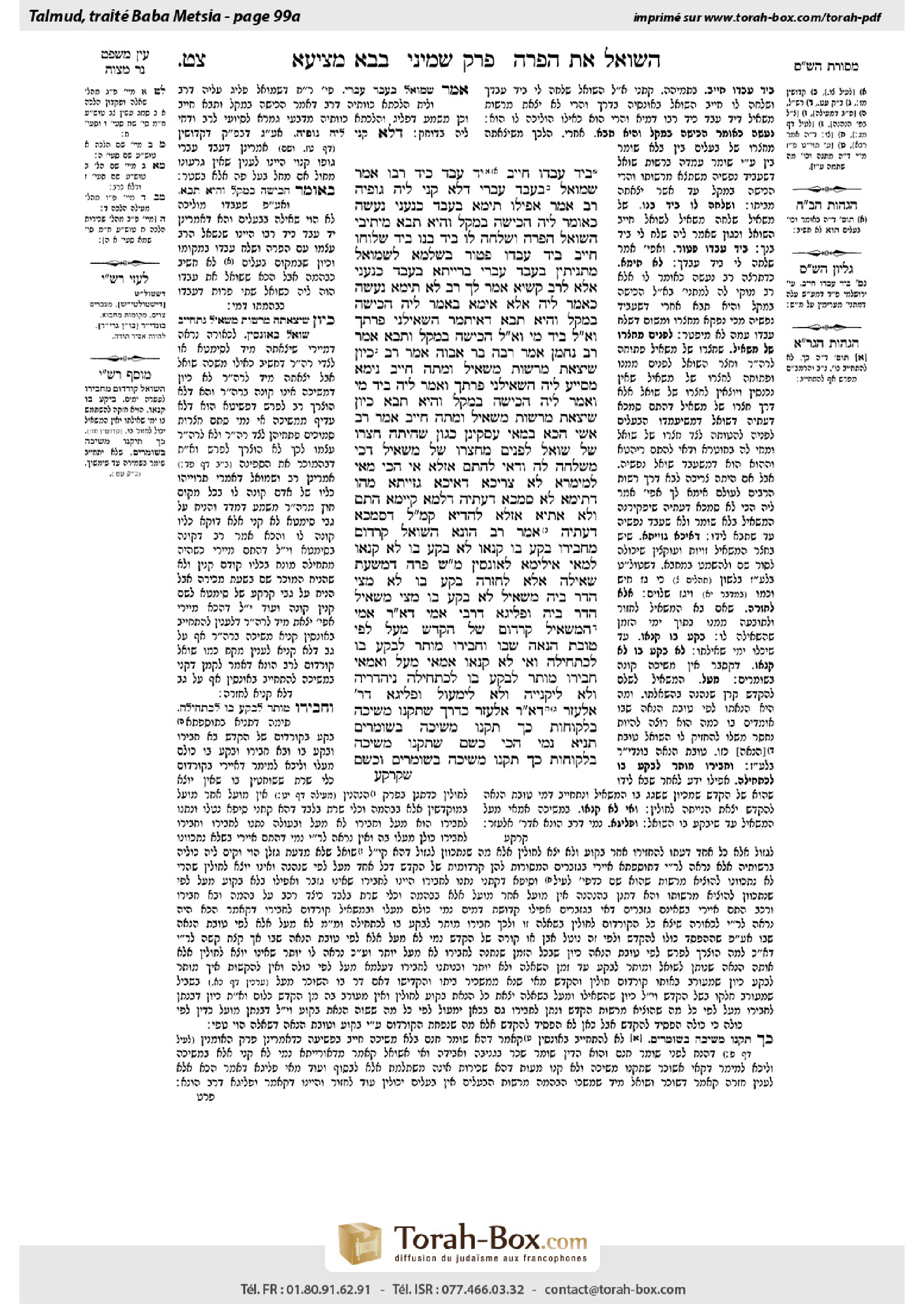
בבא מציעא צ״ט א · Aramaic and Hebrew text
גְּמָ׳ בְּיַד עַבְדּוֹ – חַיָּיב, יַד עֶבֶד כְּיַד רַבּוֹ!
אָמַר שְׁמוּאֵל: בְּעֶבֶד עִבְרִי, דְּלָא קְנֵי לֵיהּ גּוּפֵיהּ. רַב אָמַר: אֲפִילּוּ תֵּימָא בְּעֶבֶד כְּנַעֲנִי, נַעֲשֶׂה כְּאוֹמֵר לֵיהּ: הַכִּישָׁהּ בְּמַקֵּל וְהִיא תָּבֹא.
מֵיתִיבִי: הַשּׁוֹאֵל הַפָּרָה וְשִׁלְּחָהּ לוֹ בְּיַד בְּנוֹ, בְּיַד שְׁלוּחוֹ – חַיָּיב. בְּיַד עַבְדּוֹ – פָּטוּר.
בִּשְׁלָמָא לִשְׁמוּאֵל: מַתְנִיתִין בְּעֶבֶד עִבְרִי, בָּרַיְיתָא בְּעֶבֶד כְּנַעֲנִי. אֶלָּא לְרַב קַשְׁיָא!
אָמַר לְךָ רַב: לָא תֵּימָא נַעֲשָׂה כְּאָמַר לוֹ, אֶלָּא אֵימָא: בְּאָמַר לוֹ הַכִּישָׁהּ בְּמַקֵּל וְהִיא תָּבֹא.
דְּאִיתְּמַר: הַשְׁאִילֵנִי פָּרָתְךָ, וְאָמַר לוֹ: בְּיַד מִי? וְאָמַר לוֹ: הַכִּישָׁהּ בְּמַקֵּל וְתָבֹא. אָמַר רַב נַחְמָן אָמַר רַבָּה בַּר אֲבוּהּ אָמַר רַב: כֵּיוָן שֶׁיָּצָאת מֵרְשׁוּת מַשְׁאִיל וּמֵתָה – חַיָּיב.
נֵימָא מְסַיַּיע לֵיהּ: הַשְׁאִילֵנִי פָּרָתְךָ, וְאָמַר לוֹ: בְּיַד מִי? וְאָמַר לוֹ: הַכִּישָׁהּ בְּמַקֵּל וְהִיא תָּבֹא. כֵּיוָן שֶׁיָּצָאת מֵרְשׁוּת מַשְׁאִיל וּמֵתָה – חַיָּיב.
אָמַר רַב אָשֵׁי: הָכָא בְּמַאי עָסְקִינַן – כְּגוֹן שֶׁהָיְתָה חֲצֵרוֹ שֶׁל שׁוֹאֵל לִפְנִים מֵחֲצֵרוֹ שֶׁל מַשְׁאִיל, דְּכִי מְשַׁלְּחָהּ לַהּ – וַדַּאי לְהָתָם אָזְלָא.
אִי הָכִי, מַאי לְמֵימְרָא?! לָא צְרִיכָא דְּאִיכָּא גַּזְיָיתָא. מַהוּ דְּתֵימָא: לָא סָמְכָא דַּעְתֵּיהּ דִּלְמָא קָיְימָא הָתָם וְלָא אָתְיָא אָזְלָא לְהֶדְיָא, קָא מַשְׁמַע לַן דְּסָמְכָא דַּעְתֵּיהּ.
אָמַר רַב הוּנָא: הַשּׁוֹאֵל קַרְדּוֹם מֵחֲבֵירוֹ, בִּקַּע בּוֹ – קְנָאוֹ, לֹא בִּקַּע בּוֹ – לֹא קְנָאוֹ.
לְמַאי? אִילֵימָא לׇאוֹנָסִין – מַאי שְׁנָא פָּרָה דְּמִשְּׁעַת שְׁאֵילָה? אֶלָּא לַחֲזָרָה, בִּקַּע בּוֹ – לָא מָצֵי הָדַר בֵּיהּ מַשְׁאִיל, לֹא בִּקַּע בּוֹ – מָצֵי מַשְׁאִיל הָדַר בֵּיהּ.
וּפְלִיגָא דְּרַבִּי אַמֵּי, דְּאָמַר רַבִּי אַמֵּי: הַמַּשְׁאִיל קַרְדּוֹם שֶׁל הֶקְדֵּשׁ – מָעַל לְפִי טוֹבַת הֲנָאָה שֶׁבּוֹ, וַחֲבֵירוֹ מוּתָּר לְבַקֵּעַ בּוֹ לְכַתְּחִילָּה.
וְאִי לֹא קְנָאוֹ – אַמַּאי מָעַל? וְאַמַּאי חֲבֵירוֹ מוּתָּר לְבַקֵּעַ בּוֹ לְכַתְּחִילָּה? נַיהְדְּרֵיהּ וְלֹא לִיקְנְיֵיהּ וְלָא לִימְעוֹל.
וּפְלִיגָא דְּרַבִּי אֶלְעָזָר, דְּאָמַר רַבִּי אֶלְעָזָר: כְּדֶרֶךְ שֶׁתִּקְּנוּ מְשִׁיכָה בַּלָּקוֹחוֹת, כָּךְ תִּקְנוּ מְשִׁיכָה בַּשּׁוֹמְרִים.
תַּנְיָא נָמֵי הָכִי: כְּשֵׁם שֶׁתִּקְּנוּ מְשִׁיכָה בַּלָּקוֹחוֹת – כָּךְ תִּקְנוּ מְשִׁיכָה בַּשּׁוֹמְרִים, וּכְשֵׁם
Bava Metzia 99a · English translation
GEMARA: The mishna states that if the borrower agrees to have the lender send the cow by the hand of the lender’s slave, and it died on the way, then the borrower is liable. The Gemara asks: But isn’t the hand of a slave legally like the hand of his master; as long as the cow is in the possession of the lender’s slave, it is not considered to have left the lender’s possession. Why, then, is the borrower liable?
The Gemara presents two resolutions: Shmuel said: The mishna is referring to a Hebrew slave, whose master does not acquire his person. Therefore, property in the slave’s possession is not considered to be in his master’s possession. Rav said: You may even say that the mishna is referring to a Canaanite slave, as this case may be considered like one in which the borrower said to the lender: Hit the cow with a stick and then it will come on its own to me. Just as in that case the borrower is liable once the cow leaves the lender’s domain, so too in this case he is liable once the cow leaves the lender’s domain, irrespective of the fact it was brought by the lender’s slave.
The Gemara raises an objection from a baraita: If one borrows a cow; and, with the agreement of the borrower, the lender sends it to him by the hand of his son or by the hand of his agent; and it dies on the way, then the borrower is liable. If the lender sent it by the hand of his slave, then the borrower is exempt. The final clause appears to contradict the mishna’s ruling.
The Gemara elaborates: Granted, according to the resolution of Shmuel, one can explain that the mishna is referring to a Hebrew slave, whereas the baraita is referring to a Canaanite slave. But according to the resolution of Rav, who maintained that the mishna is referring to a Canaanite slave, the contradiction is difficult.
The Gemara presents a modified version of Rav’s resolution: Rav could say to you: Do not say in explanation of the mishna that the case may be considered like one in which the borrower said to the lender: Hit the cow with a stick and then it will come on its own. Rather, say that it is referring to a case where the borrower actually said to the lender: Hit the cow with a stick and then it will come to me on its own. Accordingly, one can explain that the baraita is referring to a case where he did not say this, and therefore, as long as the cow is still in the possession of the slave, the borrower is not liable.
As it was stated: One said to another: Lend me your cow. And the lender said to the borrower: By whose hand shall I send it? And the borrower said to him: Hit the cow with a stick and then it will come on its own to me. Rav Naḥman says that Rabba bar Avuh says that Rav says: In this case, the halakha is that once the cow left the domain of the lender and then it died, the borrower is liable.
The Gemara suggests: Let us say that the following baraita supports this opinion of Rav: One said to another: Lend me your cow. And the lender said to the borrower: By whose hand shall I send it? And the borrower said to him: Hit the cow with a stick and then it will come on its own to me. The halakha is that once the cow left the domain of the lender and then it died, the borrower is liable.
Rav Ashi said that the baraita is not a conclusive proof of Rav’s opinion. It is possible to say: With what are we dealing here; with a case where the courtyard of the borrower is situated further in from the public domain than the courtyard of the lender, such that when the lender sends the cow to him, it will certainly go to there. Consequently, the borrower is willing to accept liability from the moment the lender sends it.
The Gemara asks: If so, if that is the case addressed in the baraita, what is the purpose of stating this halakha? It is obvious. The Gemara explains: No, it is necessary for the case of a courtyard in which there are corners. Lest you say: The borrower does not rely on the possibility that the animal will come to him, as perhaps the animal will go and stand there in one of the corners and not come straight to the borrower’s courtyard, the baraita therefore teaches us that even in such a case he relies on the assumption that the cow will nevertheless come to him, and so he accepts liability.
§ Rav Huna says: In the case of one who borrows an ax from another, once he has chopped wood with it, he has acquired it, but as long as he has not chopped wood with it, he has not acquired it.
The Gemara clarifies: With regard to what matter does one acquire the ax? If we say he has acquired it for the purpose of being liable for unavoidable mishaps, i.e., his liability as a borrower begins once he uses the ax, then one could ask: What is different when one borrows a cow, that one is liable as a borrower from the moment of borrowing, even before one makes use of it? Rather, Rav Huna refers to one’s right of retraction, as follows: Once the borrower has chopped wood with it, the lender cannot renege on his commitment to lend the item, but as long as the borrower has not chopped wood with it, the lender can renege on his commitment to lend the item and prevent the borrower from borrowing the item.
And with this opinion, Rav Huna disagrees with the opinion of Rabbi Ami, as Rabbi Ami says: One who lends another an ax that is of property consecrated to the Temple treasury has there by misused consecrated property. He is liable to pay the Temple treasury according to the financial advantage he received from lending the ax. And despite this, that other person, i.e., the borrower, is permitted to chop wood with it ab initio.
The Gemara explains how it is apparent that Rabbi Ami disagrees with Rav Huna: And if one holds that the borrower does not acquire the ax from the moment of borrowing, why has the lender misused consecrated property? To be liable for misuse of consecrated property, one must acquire the item, thereby removing it from the Temple treasury. And furthermore, why is that other person permitted to chop wood with it ab initio? If the borrower does not acquire the ax from the moment of borrowing, let the borrower return the ax and not acquire it, and consequently the lender will not have misused consecrated property, as it will have turned out that nothing significant occurred. Rather, it is evident that Rabbi Ami holds that the act of lending is fully completed as soon as the borrower takes the ax, even before he has used it.
And furthermore, with this opinion, Rav Huna disagrees with the opinion of Rabbi Elazar, as Rabbi Elazar says: In the same way in which the Sages instituted for buyers that they can acquire an item by pulling it, and from that point the transaction is completed, so too they instituted for bailees that their rights and responsibilities are initiated by their pulling the item they agreed to safeguard, and from that point the transfer of the item to the bailee is completed.
This opinion of Rabbi Elazar is also taught in a baraita: Just as the Sages instituted for buyers that they can acquire an item by pulling it, so too they instituted for bailees that their rights and responsibilities are initiated by them pulling the item they agreed to safeguard. And just as
Bava Metzia 99a · Traduction française (IA)
GUEMARA : La Michna affirme que si le prêteur accepte que le prêteur envoie la vache par la main de son serviteur, et que la vache meurt en chemin, alors le prêteur est responsable. La Guemara pose la question : Mais n’est-ce pas que la main d’un serviteur est juridiquement comme la main de son maître ; tant que la vache est en possession du serviteur du prêteur, elle n’est pas considérée comme sortie de la possession du prêteur. Pourquoi, alors, le prêteur est-il responsable ?
La Guemara présente deux résolutions : Shmuel dit : La Michna fait référence à un serviteur hébreu, dont le maître ne possède pas sa personne. Ainsi, la propriété en possession du serviteur n’est pas considérée comme en possession de son maître. Rav dit : On pourrait même dire que la Michna fait référence à un serviteur cananéen, car cette situation peut être considérée comme celle où le prêteur dit au prêteur : Frappe la vache avec un bâton et elle viendra toute seule vers moi. Tout comme dans ce cas le prêteur est responsable dès que la vache sort du domaine du prêteur, de même dans ce cas il est responsable dès que la vache sort du domaine du prêteur, indépendamment du fait qu’elle ait été apportée par le serviteur du prêteur.
La Guemara soulève une objection à partir d’une baraïta : Si l’on prête une vache, et avec l’accord du prêteur, le prêteur l’envoie vers lui par la main de son fils ou par la main de son agent, et que la vache meurt en chemin, alors le prêteur est responsable. Si le prêteur l’envoie par la main de son serviteur, alors le prêteur est exempt. La dernière phrase semble contredire la décision de la Michna.
La Guemara développe : On admet, selon la résolution de Shmuel, qu'on puisse expliquer que la Michna fait référence à un serviteur hébreu, tandis que la baraïta fait référence à un serviteur cananéen. Mais selon la résolution de Rav, qui affirme que la Michna fait référence à un serviteur cananéen, la contradiction est difficile.
La Guemara présente une version modifiée de la résolution de Rav : Rav pourrait dire à vous : Ne dites pas en explication de la Michna que le cas peut être considéré comme celui où le prêteur dit au prêteur : Frappe la vache avec un bâton et elle viendra toute seule vers moi. Plutôt, dites que cela fait référence à un cas où le prêteur a réellement dit au prêteur : Frappe la vache avec un bâton et elle viendra toute seule vers moi. Ainsi, on peut expliquer que la baraïta fait référence à un cas où il n’a pas dit cela, et donc, tant que la vache est encore en possession du serviteur, le prêteur n’est pas responsable.
Comme il a été dit : On a dit à un autre : Prête-moi ta vache. Et le prêteur a dit au prêteur : Par la main de qui dois-je l’envoyer ? Et le prêteur a dit à lui : Frappe la vache avec un bâton et elle viendra toute seule vers moi. Rav Naḥman dit que Rabba bar Avuh dit que Rav dit : Dans ce cas, la halakha est que dès que la vache est sortie du domaine du prêteur et qu’elle meurt, le prêteur est responsable.
La Guemara suggère : Disons que la baraïta suivante soutient l'opinion de Rav : On dit à un autre : Prête-moi ta vache. Et le prêteur dit au prêteur : Par la main de qui dois-je l'envoyer ? Et le prêteur dit à lui : Frappe la vache avec un bâton et elle viendra toute seule vers moi. La halakha est que dès que la vache est sortie du domaine du prêteur et qu'elle meurt, le prêteur est responsable.
Rav Ashi a dit que la baraïta n'est pas une preuve conclusive de l'opinion de Rav. Il est possible de dire : De quel cas sommes-nous en train de parler ; d'un cas où le cour de l'emprunteur est situé plus loin dans le domaine public que le cour du prêteur, de sorte que lorsque le prêteur envoie la vache vers lui, elle ira certainement là. Ainsi, l'emprunteur est prêt à accepter la responsabilité dès que le prêteur l'envoie.
La Guemara pose la question : Si c'est le cas mentionné dans la baraïta, à quoi sert alors d'énoncer cette halakha ? C'est évident. La Guemara explique : Non, il est nécessaire pour le cas d'un cour où il y a des coins. De peur que vous disiez : L'emprunteur ne compte pas sur la possibilité que l'animal vienne vers lui, car peut-être l'animal ira se tenir dans l'un des coins et ne viendra pas directement vers le cour de l'emprunteur, la baraïta enseigne donc que même dans ce cas il compte sur l'hypothèse que la vache viendra tout de même vers lui, et donc il accepte la responsabilité.
§ Rav Huna dit : Dans le cas d’une personne qui emprunte un hache à un autre, dès qu’il a coupé du bois avec elle, il l’a acquis, mais tant qu’il n’a pas coupé du bois avec elle, il ne l’a pas acquis.
La Guemara clarifie : À propos de quelle matière l’acquisition de la hache a lieu ? Si nous disons qu’il l’a acquis pour être responsable des accidents inévitables, c’est-à-dire que sa responsabilité d’emprunteur commence dès qu’il utilise la hache, alors on pourrait demander : Qu’est-ce qui diffère dans le cas où l’on emprunte une vache, que l’on est responsable d’emprunteur dès l’emprunt, même avant d’en faire usage ? Plutôt, Rav Huna fait référence à son droit de rétractation, comme suit : Dès que l’emprunteur a coupé du bois avec elle, le prêteur ne peut pas revenir sur sa promesse de prêter l’objet, mais tant que l’emprunteur n’a pas coupé du bois avec elle, le prêteur peut revenir sur sa promesse de prêter l’objet et empêcher l’emprunteur d’emprunter l’objet.
Et avec cette opinion, Rav Huna s’oppose à l’opinion de Rabbi Ami, car Rabbi Ami dit : Celui qui prête à un autre une hache qui appartient à la propriété consacrée au trésor du Temple a abusé de la propriété consacrée. Il est responsable de payer le trésor du Temple selon l’avantage financier qu’il a reçu en prêtant la hache. Et malgré cela, cette autre personne, c’est-à-dire l’emprunteur, est autorisé à couper du bois avec elle dès le début.
La Guemara explique comment il est évident que le maître Ami est en désaccord avec Rava Huna : Et si l'on considère que le prêteur ne devient propriétaire de la hache dès le moment de la prêture, pourquoi le prêteur a-t-il abusé de la propriété consacrée ? Pour être tenu responsable d'abus de propriété consacrée, il faut acquérir l'objet, ce qui le retire du trésor du Temple. Et de plus, pourquoi cet autre homme est-il autorisé à couper du bois avec l'objet dès le début ? Si le prêteur ne devient propriétaire de la hache dès le moment de la prêture, que le prêteur rende la hache sans l'acquérir, et ainsi le prêteur n'aura pas abusé de la propriété consacrée, car il s'avérerait que rien de significatif n'a eu lieu. En revanche, il est évident que le maître Ami considère que l'acte de prêture est entièrement accompli dès que le prêteur prend la hache, même avant qu'il ne l'ait utilisée.
Et de plus, avec cet avis, Rava Huna est en désaccord avec l'avis du maître Elazar, car le maître Elazar dit : De la même manière que les Sages ont institué que les acheteurs peuvent acquérir un objet en le tirant, et à partir de ce moment la transaction est accomplie, de même ils ont institué que les dépositaires ont leurs droits et obligations initiés par leur tirage de l'objet qu'ils ont convenu de garder, et à partir de ce moment la transmission de l'objet au dépositaire est accomplie.
Cette opinion du maître Elazar est également enseignée dans une baraïta : De la même manière que les Sages ont institué que les acheteurs peuvent acquérir un objet en le tirant, de même ils ont institué que les dépositaires ont leurs droits et obligations initiés par leur tirage de l'objet qu'ils ont convenu de garder, et de la même manière
Traduction française générée par IA à partir de l’édition anglaise de Sefaria. Vérifie toujours un passage avec le texte source.
Text from Sefaria: William Davidson Edition - Vocalized Aramaic (CC BY NC); William Davidson Edition - English (CC BY NC).